Quick Overview
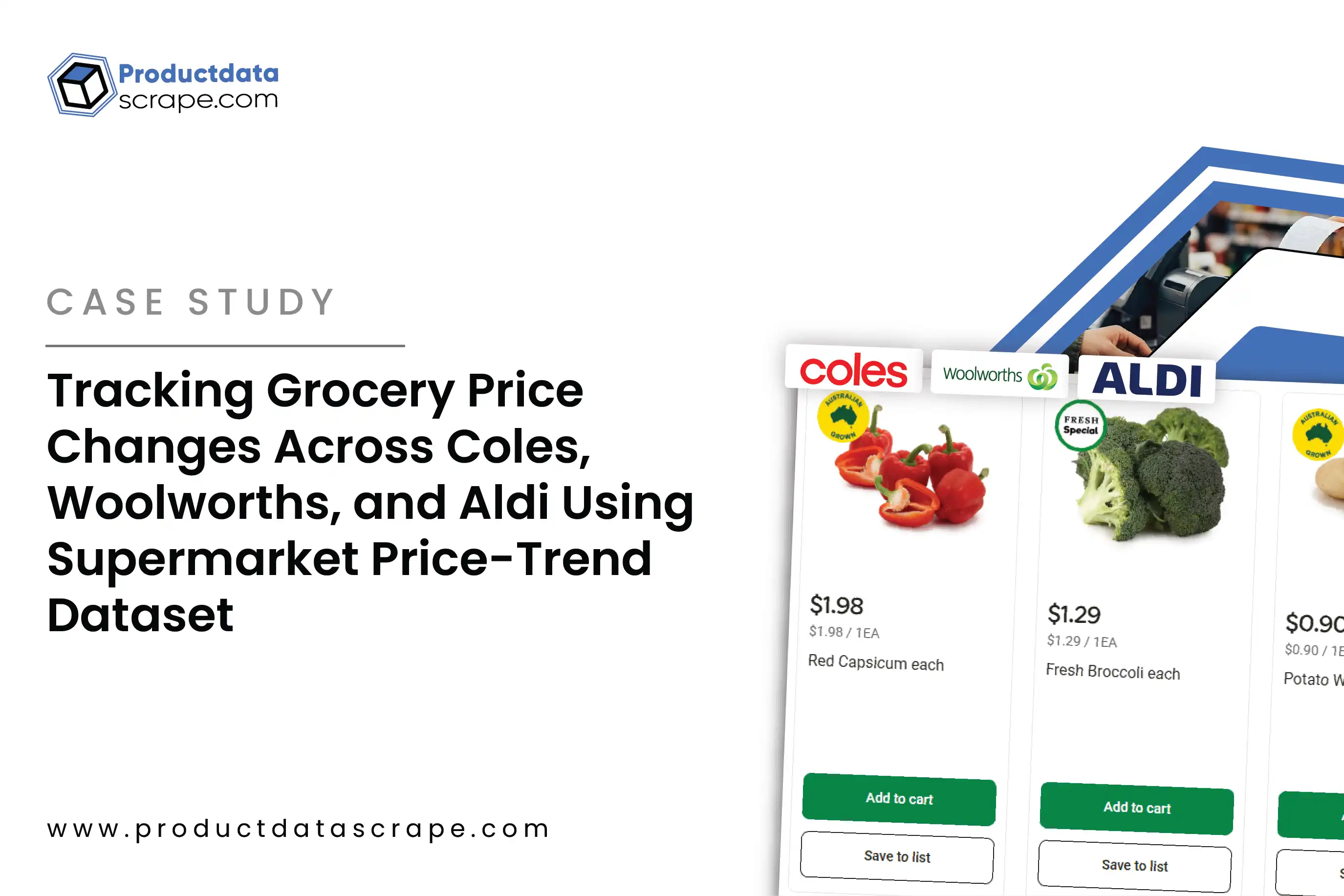
The project helped Product Data Scrape transform supermarket pricing information from Coles, Woolworths, and Aldi into structured, analysis-ready data. Using the Supermarket Price-Trend Dataset, the solution captured product prices, discounts, availability, and listing details at scale. The implementation focused on reliable Supermarket Price Scraping, automated collection, standardized datasets, and faster competitive analysis. The client gained a scalable data pipeline capable of supporting historical comparisons and ongoing retail intelligence. The project strengthened data accuracy, reduced manual monitoring requirements, and created a foundation for faster pricing decisions across Australia's highly competitive grocery market.
Client Name / Industry: Retail Intelligence / Grocery Analytics
Service / Duration: Supermarket Data Scraping & Analytics / 6 Months
Key Impact Metrics: 95%+ data accuracy | 80% reduction in manual processing | 3 major supermarket chains monitored
The Client
The client operated in the retail intelligence and grocery analytics space, where access to timely supermarket pricing information was essential for understanding competitive movements. Coles, Woolworths, and Aldi represent major forces in the Australian grocery market, making continuous monitoring valuable for brands, retailers, analysts, and pricing teams.
Increasing promotional activity, changing product prices, private-label competition, and shifting consumer expectations created pressure to maintain accurate market visibility. The client needed a transformation that could replace fragmented data collection with a dependable, automated process. Their previous approach involved manually gathering product information from multiple supermarket sources, which consumed considerable time and made frequent updates difficult.
To address these limitations, the project incorporated Supermarket Price Comparison Australia capabilities to standardize pricing information across competing retailers. The solution also supported an ALDI US Scraping API-ready architecture, allowing the client to extend the same data-processing framework into additional markets and use cases.
Before the partnership, pricing information was collected inconsistently, historical comparisons were difficult, and analysts spent substantial time cleaning and validating records. The transformation introduced automated collection, structured outputs, standardized product attributes, and scalable processing. This gave the client a stronger foundation for competitive intelligence and faster retail decision-making.
Goals & Objectives
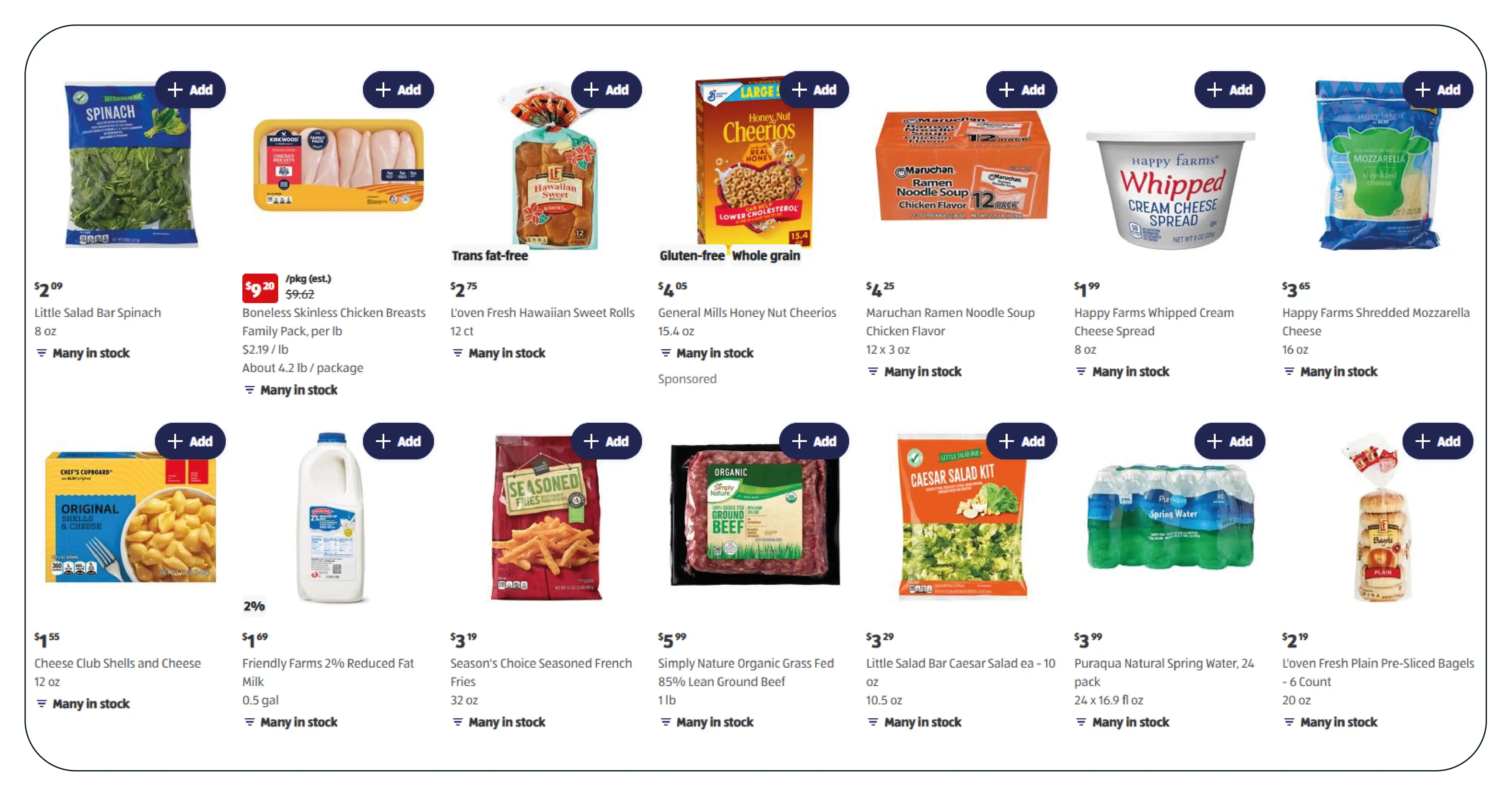
The project was designed around business requirements for scalable and dependable supermarket intelligence. The primary goals were to increase collection speed, improve product-level accuracy, reduce repetitive manual work, and establish a framework that could support continuous monitoring. The system was also expected to enable Supermarket Price Trend Analysis across multiple retailers and product categories.
Scale data collection across major supermarket websites.
Improve pricing and promotional data accuracy.
Reduce manual data-processing requirements.
Support frequent updates and historical comparisons.
Technical objectives focused on automation, integration, and analytics readiness. The implementation needed to collect structured product information, normalize records, detect changes, and prepare datasets for downstream analytics.
Automate product and pricing data collection.
Integrate data into standardized storage structures.
Identify price and promotional changes automatically.
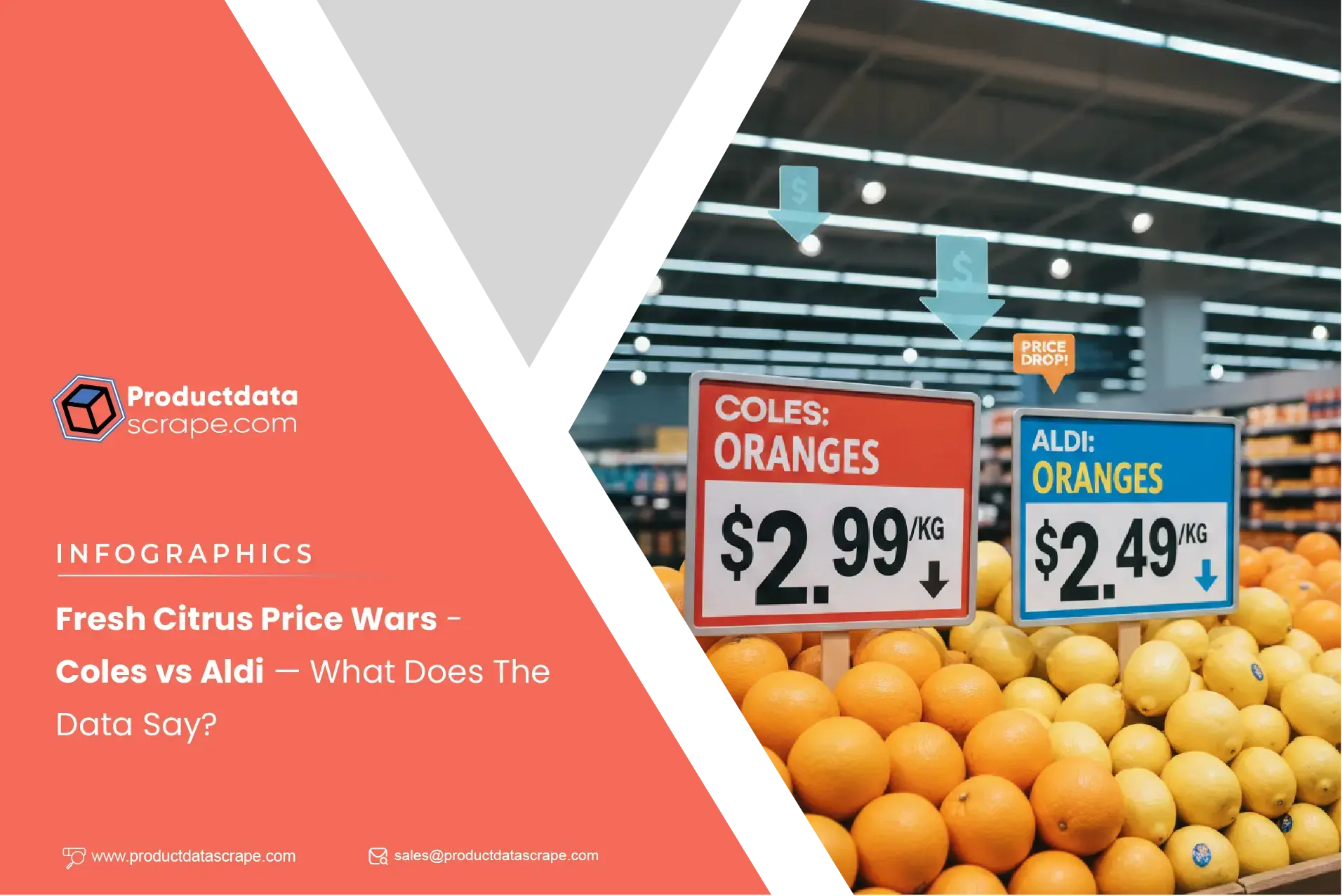
Support Scraping Coles & Aldi Citrus Listings Data for category-level analysis.
Enable scalable processing for future supermarket expansion.
Achieve 95%+ product-data accuracy.
Reduce manual processing by approximately 80%.
Monitor three major supermarket ecosystems.
Improve data refresh consistency.
Reduce duplicate and incomplete product records.
The Core Challenge
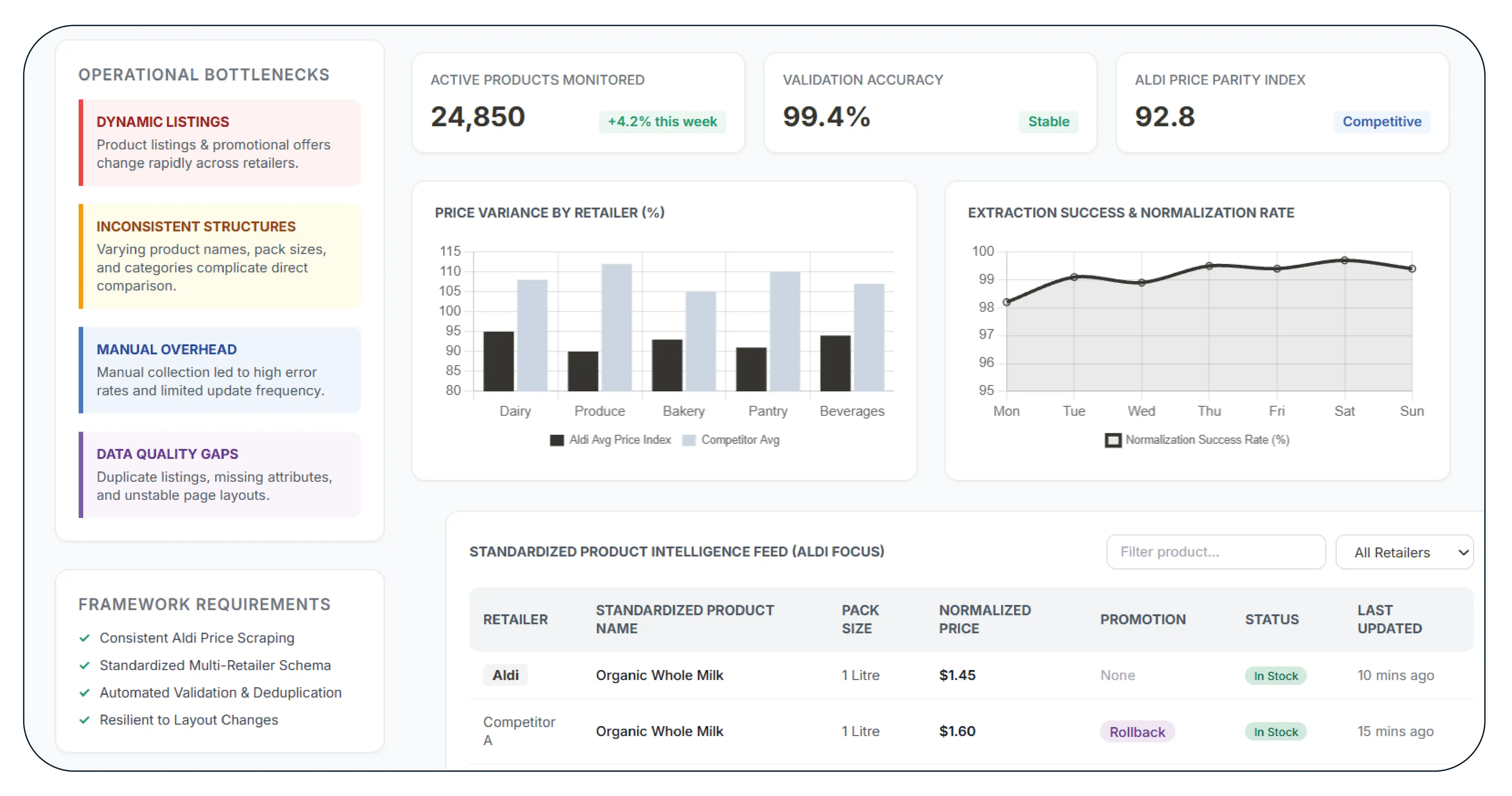
The client faced several operational bottlenecks while attempting to maintain supermarket pricing intelligence at scale. Product listings changed frequently, prices could vary between updates, promotional offers appeared and disappeared quickly, and product information was presented in different structures across retailers.
One of the most important requirements was the ability to Scrape Aldi Product Prices consistently while maintaining the same standardized output used for competing supermarket datasets. Differences in product names, pack sizes, categories, promotional labels, and availability indicators made direct comparisons difficult.
Manual collection created another challenge. Analysts had to spend significant time visiting pages, capturing information, checking records, and resolving inconsistencies. This approach limited update frequency and increased the possibility of human errors.
Data quality was also affected by duplicate listings, missing attributes, inconsistent formatting, and changing product-page structures. Without automated validation, these issues could affect price comparisons and trend calculations.
The client therefore needed more than a basic scraping process. They required a scalable framework that could continuously collect, normalize, validate, and organize supermarket data. The solution also needed to withstand changes in website structures while maintaining reliable output for analytics and competitive monitoring.
Our Solution
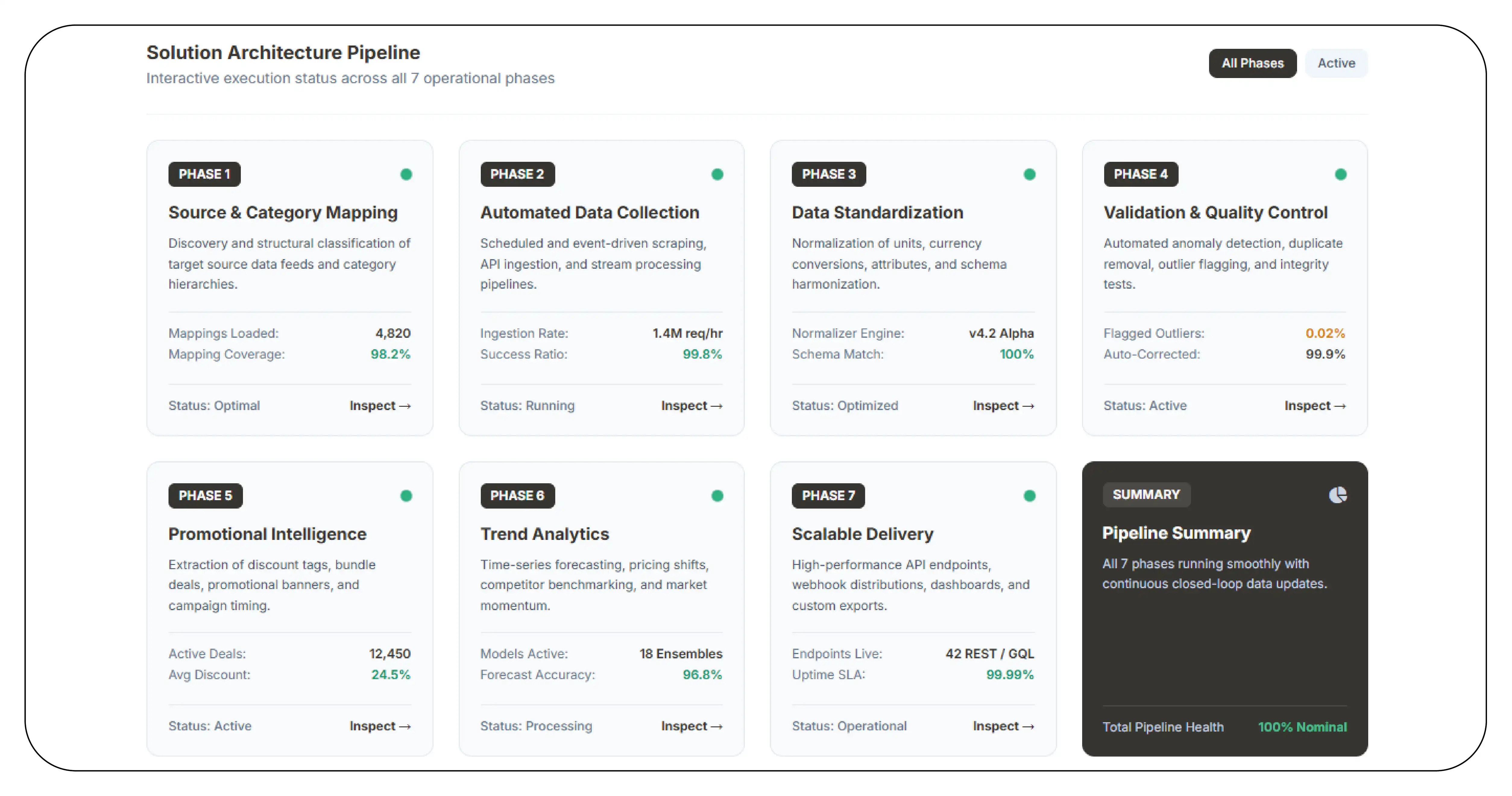
Product Data Scrape implemented a phased data-engineering approach designed to solve collection, standardization, validation, and analytics challenges progressively.
Phase 1: Source & Category Mapping
The first phase mapped supermarket sources, product categories, pricing attributes, promotional fields, product identifiers, pack sizes, and availability information. This created a consistent collection framework for Coles, Woolworths, and Aldi.
Phase 2: Automated Data Collection
Automated extraction workflows were introduced to collect product-level information at scale. The system captured product names, prices, discounts, categories, pack information, availability, and related listing attributes. Automated workflows reduced repetitive manual activities and improved collection consistency.
Phase 3: Data Standardization
Because supermarket websites organize information differently, raw records were transformed into standardized schemas. Product names, categories, pricing units, promotional indicators, and product identifiers were normalized so that records from different retailers could be compared more effectively.
Phase 4: Validation & Quality Control
Automated validation rules checked missing fields, duplicate records, abnormal price changes, and incomplete listings. Historical records were compared with new observations to identify unexpected changes and improve dataset reliability.
Phase 5: Promotional Intelligence
The framework incorporated Coles Discount Tracking to identify promotional movements and support retailer-level comparison. Discount information was structured alongside regular prices so analysts could distinguish standard pricing from promotional activity.
Phase 6: Trend Analytics
The processed information was organized into the Supermarket Price-Trend Dataset, creating a historical foundation for price monitoring, competitive benchmarking, and trend analysis. Analysts could examine changes by retailer, category, product, and time period.
Phase 7: Scalable Delivery
Finally, structured outputs were prepared for integration with analytics environments and business intelligence workflows. The architecture was designed to accommodate additional retailers, categories, markets, and monitoring frequencies without rebuilding the entire pipeline.
This phased approach transformed fragmented supermarket information into a repeatable and scalable retail intelligence workflow.
Results & Key Metrics
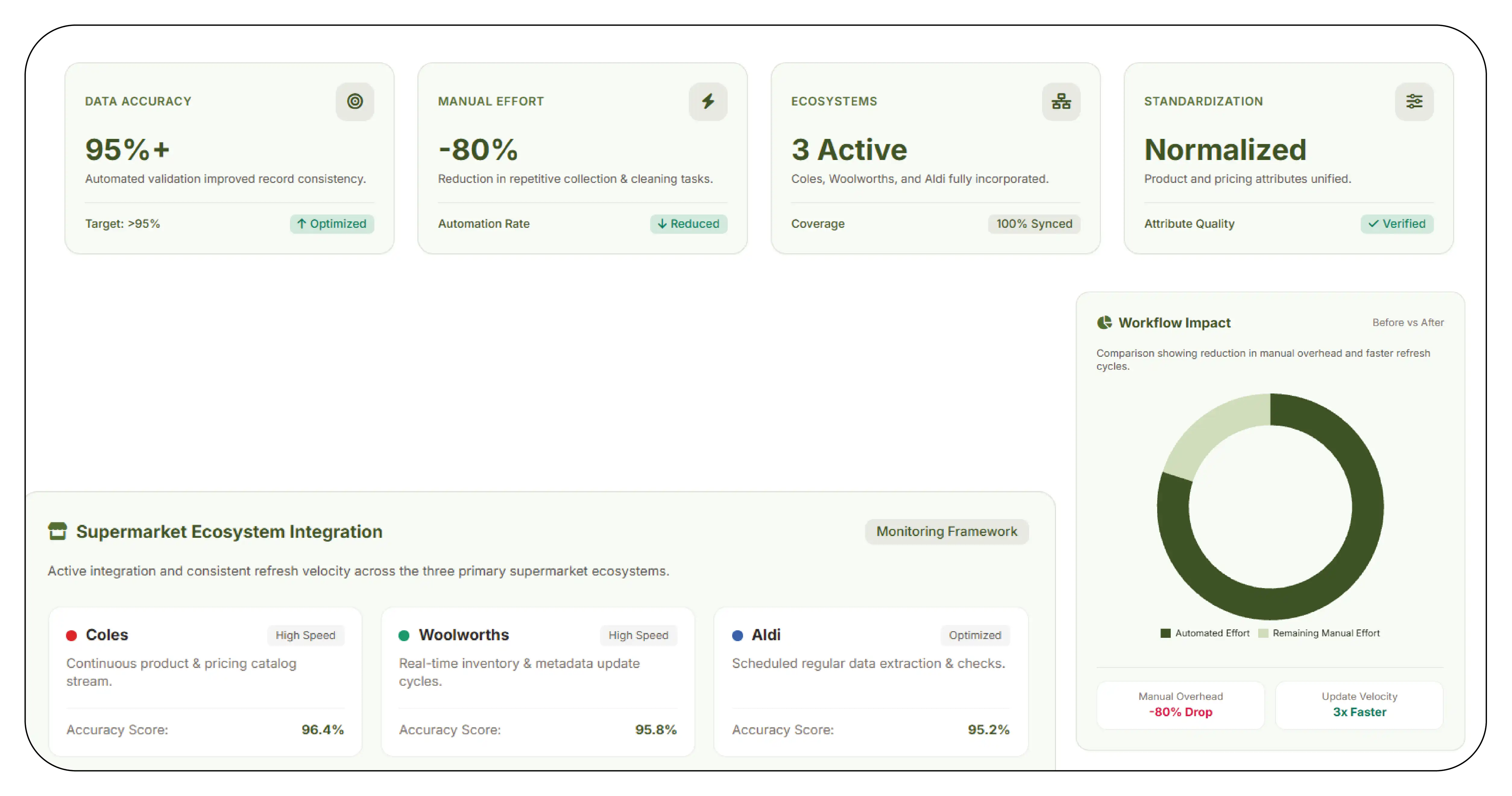
The implementation delivered measurable operational improvements across data collection and processing.
95%+ data accuracy: Automated validation improved consistency across product and pricing records.
80% lower manual effort: Automated workflows significantly reduced repetitive collection and cleaning activities.
3 supermarket ecosystems: Coles, Woolworths, and Aldi were incorporated into the monitoring framework.
Faster updates: Automated collection enabled more consistent refresh cycles.
Improved standardization: Product and pricing attributes were normalized across sources.
Results Narrative
The project created a more reliable foundation for competitive grocery intelligence. By continuously collecting and structuring Woolworths Price Data, the client could evaluate pricing movements alongside information from competing supermarket chains. The historical Supermarket Price-Trend Dataset enabled analysts to identify price changes, promotional activity, and category-level movements more efficiently. Automation reduced dependence on manual workflows while improving consistency and scalability. Standardized records also made downstream analytics easier to manage, allowing teams to focus more on interpreting market movements rather than preparing raw data. The resulting framework provided a repeatable model for expanding supermarket monitoring into new retailers and markets.
What Made Product Data Scrape Different
Product Data Scrape differentiated the project through a combination of automated extraction, structured data processing, validation workflows, and scalable architecture. Instead of simply collecting individual product pages, the solution created a repeatable framework for transforming large volumes of supermarket information into analytics-ready records.
The resulting Supermarket Product Database could organize product attributes, pricing, discounts, categories, and availability in a consistent structure. Smart validation routines helped identify incomplete records and inconsistencies before the data reached analytical workflows.
The architecture was also designed for expansion, allowing new retailers, categories, and geographic markets to be incorporated without major changes to the underlying framework. This combination of automation, standardization, and scalability helped Product Data Scrape deliver more than raw data—it provided a practical foundation for ongoing retail intelligence.
Client's Testimonial
"Product Data Scrape helped us move from time-consuming manual collection to a structured and scalable data workflow. The ability to consistently capture supermarket pricing and promotional information across multiple retailers has made competitive analysis significantly easier. The automated validation process also gave our team greater confidence in the consistency of the records. Most importantly, the solution provided a foundation that can grow as our monitoring requirements expand. We now have a more efficient approach to tracking market movements and supporting data-driven retail decisions. The project has made our supermarket monitoring process more reliable, scalable, and actionable."
— Head of Retail Analytics, Client Organization
Conclusion
The project demonstrated how structured supermarket intelligence can improve competitive pricing analysis across Australia's grocery market. By automating collection, normalization, validation, and delivery, Product Data Scrape created a scalable foundation for monitoring Coles, Woolworths, and Aldi. The framework can also support future integrations through a Woolworths Australia Grocery Data Scraping API, helping businesses expand their retail intelligence capabilities. Combined with the Supermarket Price-Trend Dataset, the solution enables organizations to identify pricing movements, evaluate promotions, benchmark competitors, and build stronger analytics workflows. As supermarket competition continues to evolve, automated data collection can provide the timely intelligence businesses need to make faster, evidence-based decisions.
FAQs
1. What information can a supermarket price dataset contain?
A supermarket price dataset can include product names, prices, discounts, categories, pack sizes, availability, product identifiers, and promotional information. These attributes can be used for competitive benchmarking, pricing analysis, and historical trend monitoring.
2. Why compare Coles, Woolworths, and Aldi?
Comparing these major supermarket chains helps businesses understand competitive price positioning, promotional patterns, product availability, and category-level movements. It can also highlight pricing differences for similar products.
3. How does automated supermarket scraping improve efficiency?
Automation reduces repetitive manual collection and enables structured information to be gathered consistently. It can also support scheduled updates, validation, normalization, and integration with analytical systems.
4. Can the solution support real-time or frequent monitoring?
Yes. A scalable scraping architecture can be configured for scheduled or frequent collection depending on business requirements, source accessibility, data volume, and technical constraints.
5. How can businesses use supermarket pricing data?
Businesses can use supermarket pricing information for competitor benchmarking, promotion monitoring, assortment analysis, pricing strategy, market research, and retail analytics. Historical records can additionally help identify longer-term pricing trends and category movements.


 Singapore
 EMAIL
EMAIL
 PHONE
PHONE










.webp)