Quick Overview
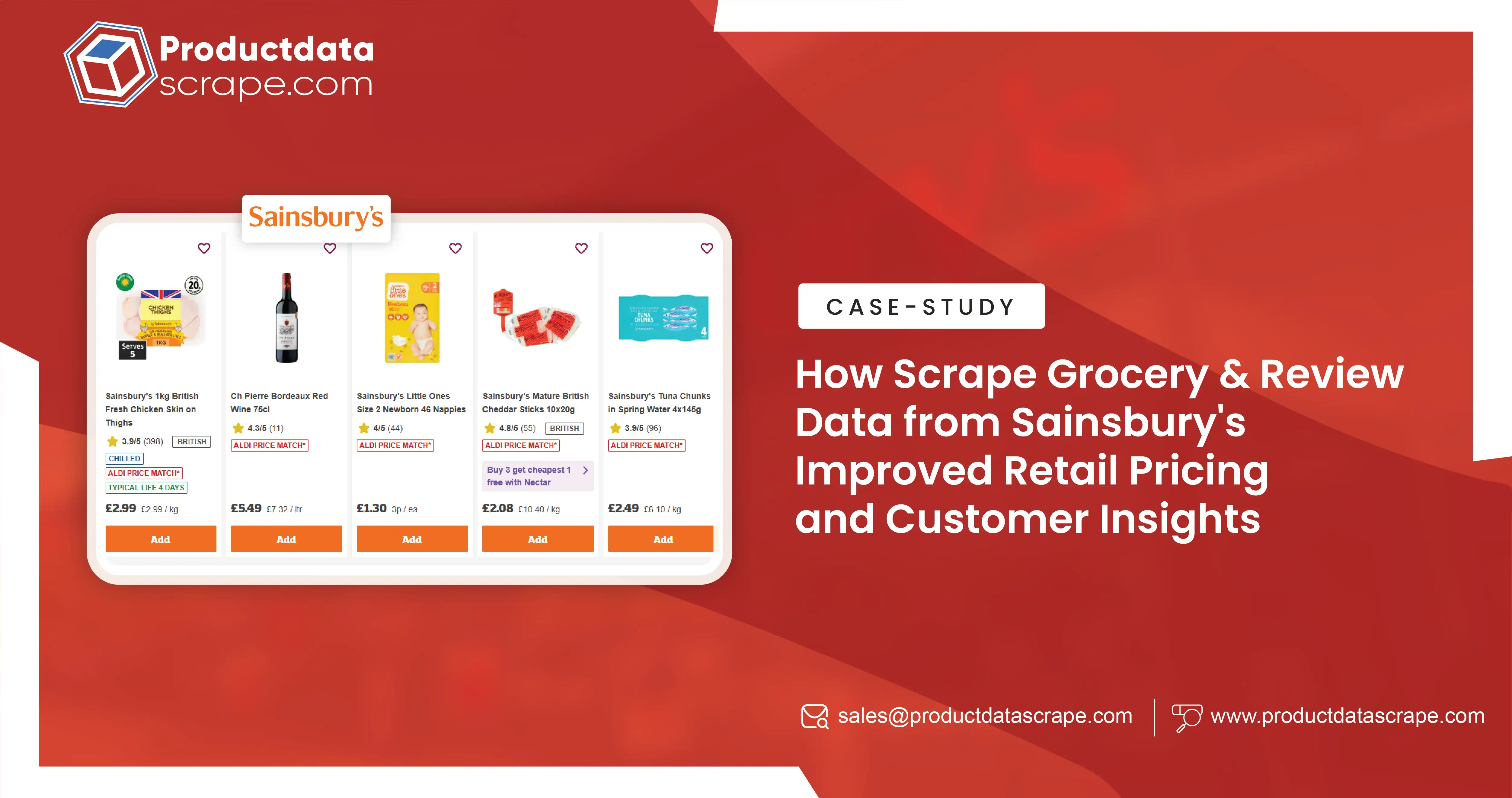
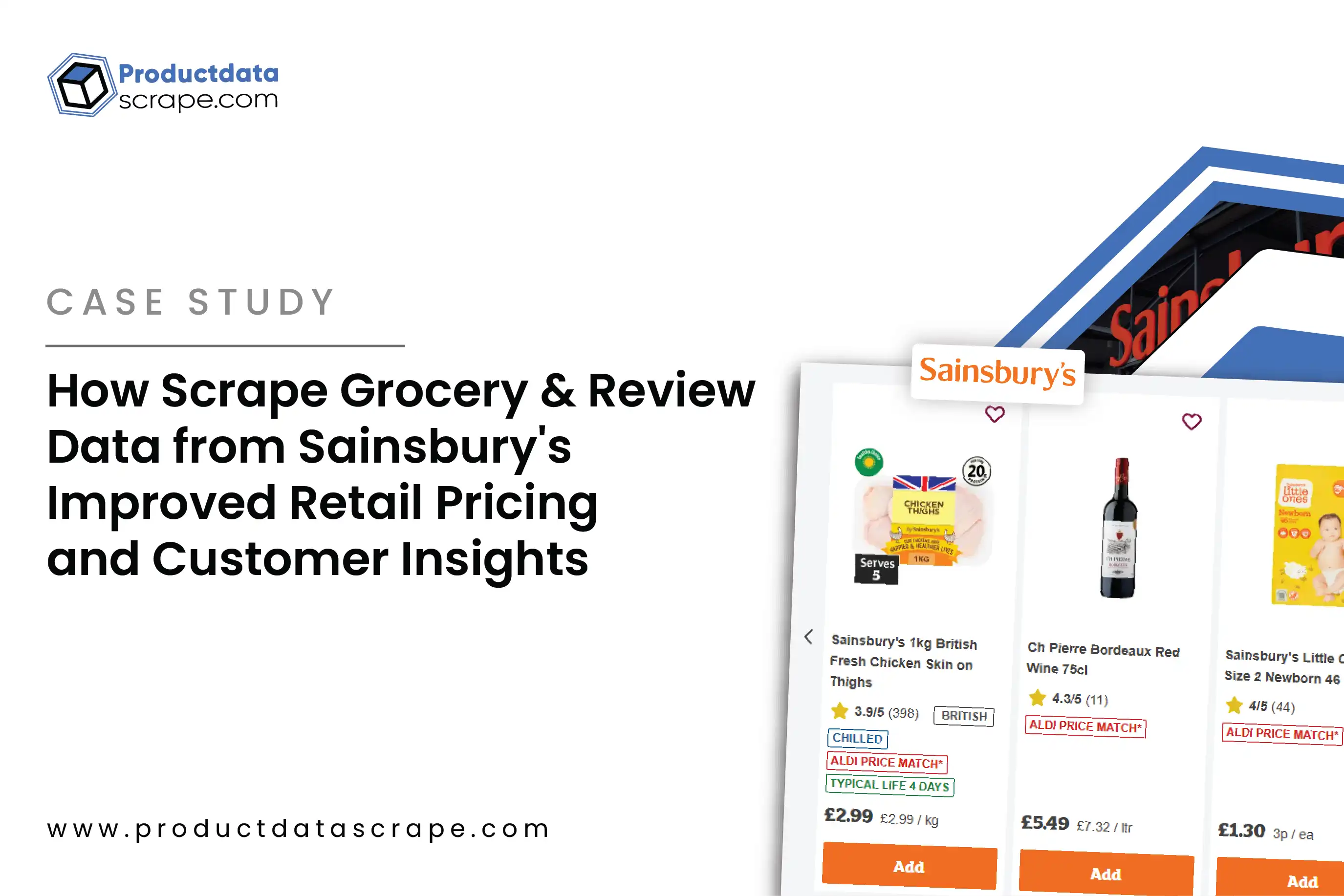
The client partnered with Product Data Scrape to build a structured grocery intelligence workflow focused on products, prices, promotions, ratings, and customer reviews. Scrape Grocery & Review Data from Sainsbury's enabled automated collection of grocery information across multiple categories and helped transform scattered online data into analysis-ready datasets. The project supported pricing intelligence, customer sentiment analysis, assortment benchmarking, and promotional monitoring. Products from brands such as Heinz, Coca-Cola, Kellogg's, Cadbury, Nestlé, and Sainsbury's own-label ranges provided valuable category-level insights. The resulting workflow improved data collection speed, product-level accuracy, monitoring consistency, and the client's ability to identify changes in grocery pricing and customer preferences.
Client Name / Industry: Confidential Retail Intelligence Company / Grocery & E-commerce Analytics
Service / Duration: Grocery Product, Price, Promotion & Review Data Extraction / Multi-Phase Engagement
Key Impact Metrics: Faster recurring product-data collection, improved consistency across grocery records, and stronger visibility into pricing, promotions, ratings, and customer feedback. The workflow also supported Sainsbury's Delivery Pass Data Scraping for broader delivery and service-level analysis.
The Client
The client was a retail intelligence company supporting brands, retailers, and e-commerce businesses with market and customer insights. Grocery retail had become increasingly competitive, with shoppers comparing prices, promotions, product availability, pack sizes, ratings, and reviews across multiple online retailers.
Sainsbury's represented an important source of grocery-market information because its online assortment covers everyday essentials, beverages, packaged foods, household products, personal care, and other consumer categories. However, continuously monitoring such a large catalog presented significant operational challenges.
Before the partnership, the client relied on fragmented collection processes that made it difficult to maintain consistent product, pricing, and review records. Changes in promotional pricing, product availability, descriptions, and customer feedback could occur frequently, creating a need for more systematic monitoring.
The client also needed to understand whether customer sentiment was changing alongside product and price movements. For example, a retailer might want to compare customer reactions to Heinz ketchup, Kellogg's cereals, Coca-Cola beverages, Cadbury chocolate, or Sainsbury's own-brand products while monitoring their pricing and promotional activity.
The transformation became essential because manual collection could not provide the desired combination of scale, speed, and consistency. The solution therefore incorporated Sainsbury's Rating & Review Trend Analysis, Pricing intelligence to connect customer feedback with broader grocery-market signals and provide a stronger foundation for retail decision-making.
Goals & Objectives
Build a scalable grocery-data collection workflow.
Improve the speed and consistency of product monitoring.
Track prices, ratings, reviews, promotions, and product attributes.
Support category and brand-level competitive analysis.
Improve visibility into changing customer preferences.
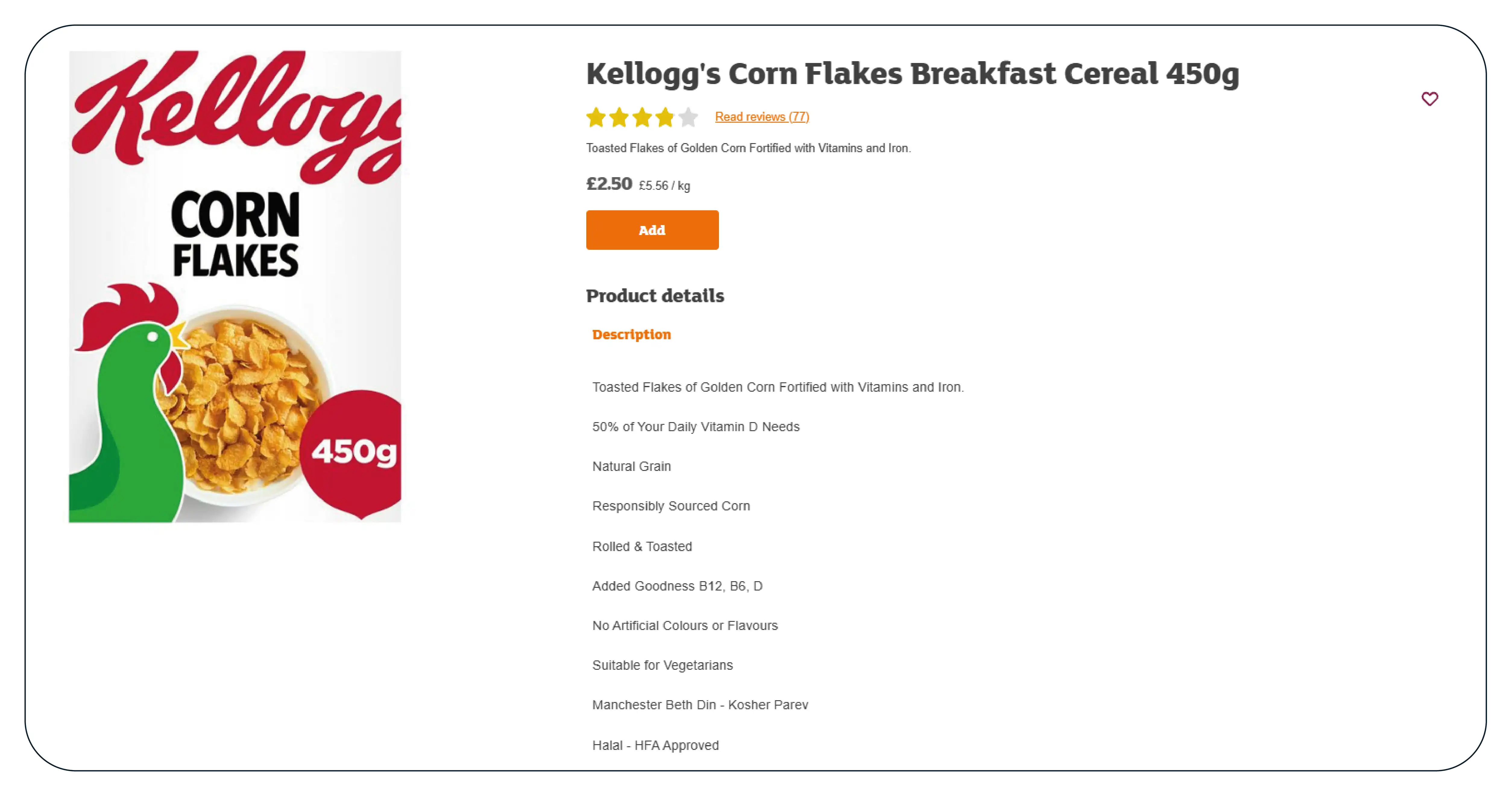
Monitor products from brands such as Heinz, Coca-Cola, Kellogg's, Nestlé, Cadbury, and Sainsbury's own-label ranges.
Automate collection of grocery product information from Sainsbury's.
Capture structured product names, categories, brands, prices, ratings, reviews, and promotional information.
Standardize grocery data for reliable comparisons.
Connect review information with corresponding products and categories.
Enable recurring data collection for trend analysis.
Prepare datasets for dashboards, databases, and analytics platforms.
Establish Scrape Sainsbury's Grocery Products capabilities that could scale across larger product catalogs.
Collection speed: Reduce the time required to collect recurring grocery information.
Data completeness: Increase coverage of essential product, pricing, and review attributes.
Accuracy: Improve product-to-record matching and reduce duplicate or inconsistent entries.
Automation: Increase the percentage of recurring monitoring tasks handled automatically.
Refresh frequency: Enable more frequent updates of grocery-market information.
Analytical coverage: Expand monitoring across brands, categories, products, promotions, ratings, and reviews.
The Core Challenge
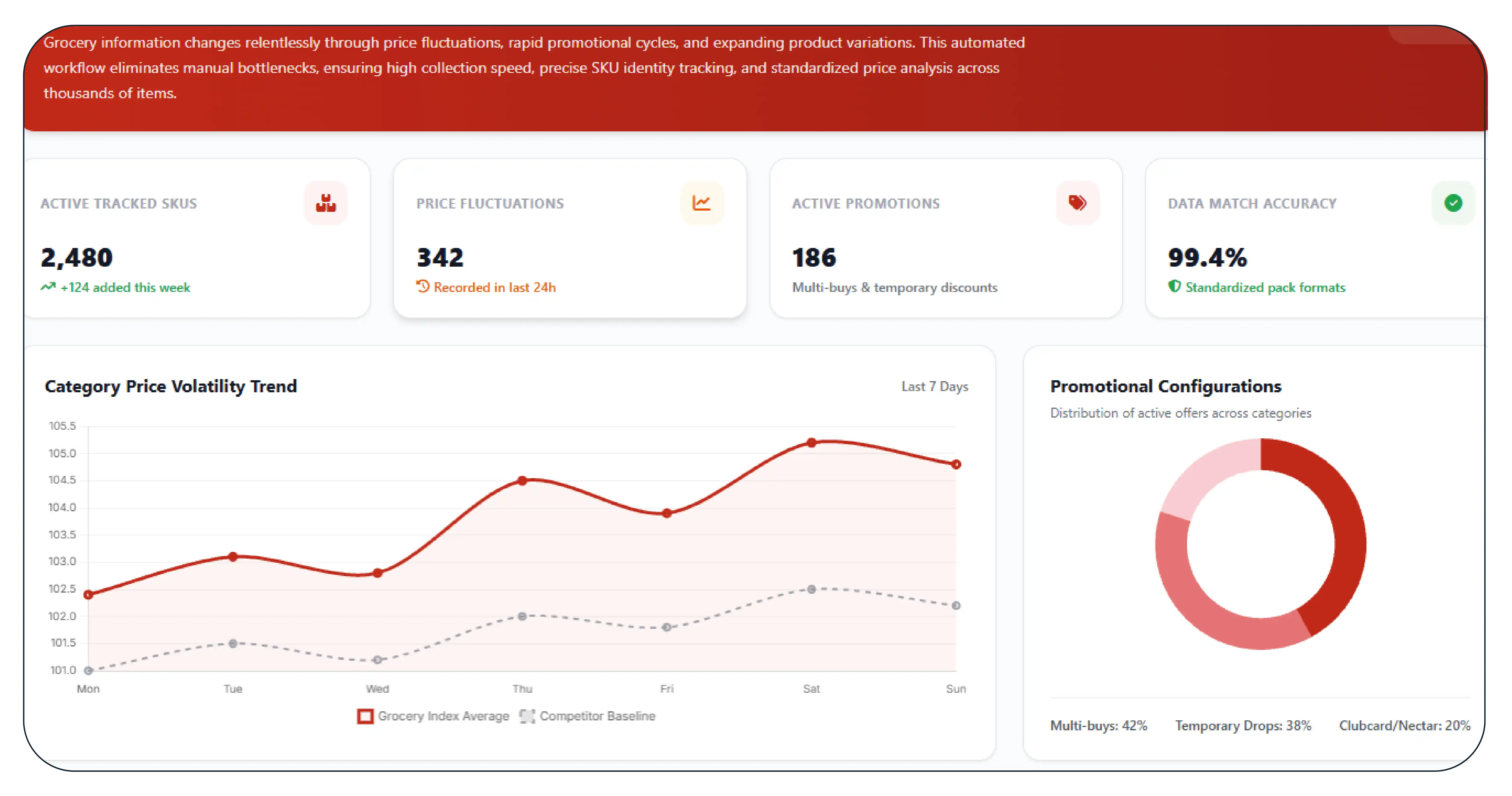
The client's primary challenge was the speed at which grocery-market information changed. Prices could fluctuate, promotional offers could appear or disappear, product availability could change, and customer reviews could continuously increase.
Manual monitoring created significant operational bottlenecks. Analysts needed to locate product pages, record prices, capture promotional information, organize reviews, and compare products across categories. Repeating these activities across hundreds or thousands of SKUs made the process difficult to scale.
Another challenge was maintaining consistent product identities. Grocery products frequently have multiple pack sizes, flavors, variants, and promotional configurations. A Coca-Cola multipack, for example, could appear alongside individual bottles or different pack quantities. Similarly, Kellogg's cereals could have different sizes and flavors requiring accurate product-level differentiation.
Pricing comparisons were also complicated by changing promotions and pack formats. A product could appear cheaper because of a temporary discount or a different pack size, making standardized data essential for meaningful analysis.
The client needed a dependable Sainsbury's Grocery Price Tracking workflow that could collect current information while maintaining structured historical records. Without automation, delays between collection and analysis could reduce the usefulness of the data.
The solution therefore had to address collection speed, data quality, product matching, promotional monitoring, and review organization simultaneously.
Our Solution
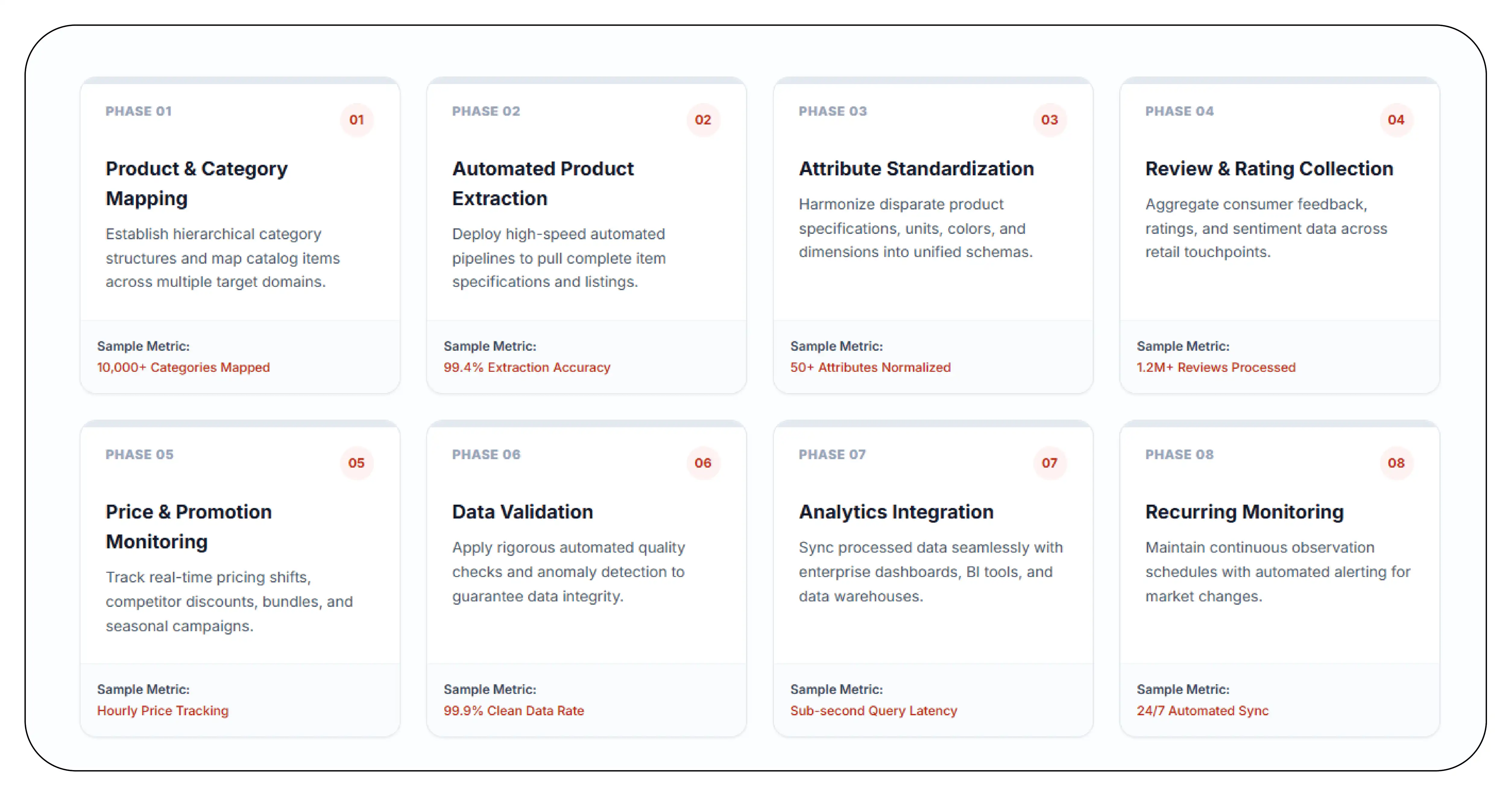
Product Data Scrape implemented a phased solution designed to convert Sainsbury's online grocery information into structured and reusable intelligence.
Phase 1: Product and Category Mapping
The first stage established the product universe and organized it into relevant grocery categories. Products were grouped by brand, category, pack size, and other available identifiers. Categories could include beverages, breakfast cereals, confectionery, sauces, dairy, household essentials, and personal care. Brands such as Heinz, Coca-Cola, Kellogg's, Cadbury, Nestlé, and Sainsbury's own-brand products were incorporated into the monitoring structure.
Phase 2: Automated Product Extraction
Automated extraction workflows collected product names, brands, categories, prices, pack sizes, descriptions, availability information, ratings, reviews, and other relevant fields. The workflow was designed to accommodate different product-page structures while maintaining standardized output.
Phase 3: Attribute Standardization
The collected information was normalized into predefined fields. Product names, brand names, categories, pack sizes, pricing fields, ratings, and review information were standardized. This made it easier to compare similar products and analyze changes over time. The workflow also captured Sainsbury's Product Attribute Data, Scrape Grocery & Review Data from Sainsbury's, giving the client a broader product-level dataset instead of relying solely on pricing information.
Phase 4: Review and Rating Collection
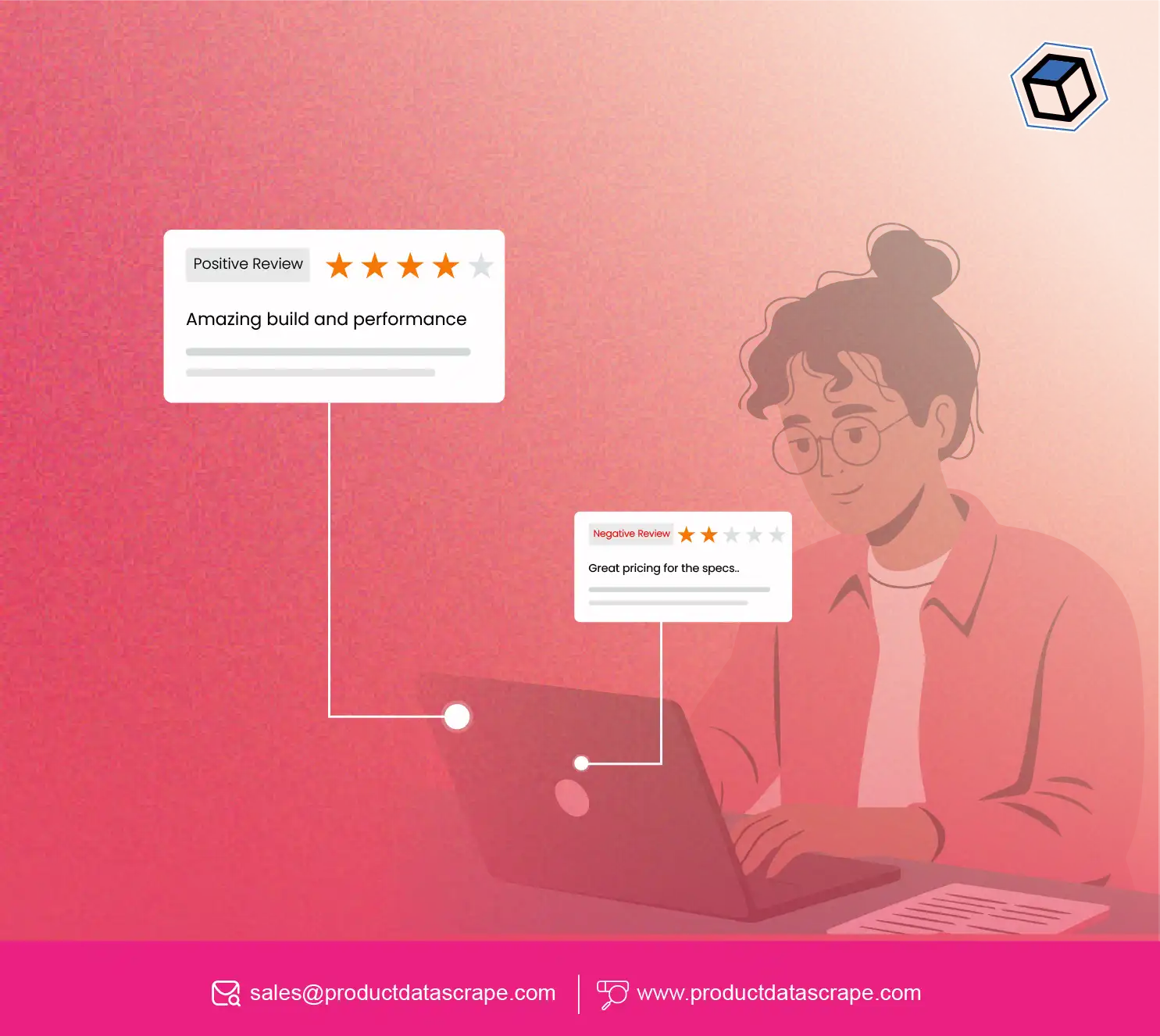
Customer reviews and ratings were connected to their corresponding products. Review text could then be prepared for sentiment analysis, theme identification, and customer feedback monitoring. For example, reviews of a household appliance or grocery product could be categorized according to recurring themes such as taste, packaging, quality, value, freshness, or product performance.
Phase 5: Price and Promotion Monitoring
Pricing records were captured alongside promotional information so the client could distinguish standard pricing from promotional activity. This enabled monitoring of products such as Heinz ketchup, Cadbury chocolate, Coca-Cola drinks, and Kellogg's cereals as their prices or promotional status changed.
Phase 6: Data Validation
Automated quality checks identified missing fields, duplicates, unexpected values, and inconsistencies. Product matching rules helped ensure that similar products and pack-size variants were not incorrectly combined.
Phase 7: Analytics Integration
The final datasets were structured for use in analytics platforms and internal reporting systems. This allowed teams to combine product, price, promotion, rating, and review information in a unified analytical environment. The workflow supported Sainsbury's Grocery Promotion Tracking, Scrape Grocery & Review Data from Sainsbury's, giving the client a repeatable approach for monitoring promotional activity and customer response.
Phase 8: Recurring Monitoring
The solution was designed for recurring collection, allowing the client to refresh grocery information at defined intervals. This transformed one-time data collection into an ongoing retail intelligence process capable of identifying changes in product pricing, customer sentiment, and promotional activity.
Results & Key Metrics
Faster collection cycles: Automated workflows reduced the time required to gather recurring grocery information.
Improved product coverage: More monitored SKUs could be processed consistently across multiple categories.
Higher data consistency: Standardized fields improved comparison across brands, products, and pack sizes.
Better review coverage: Product ratings and customer feedback became easier to organize for downstream analysis.
Improved promotional visibility: Recurring monitoring provided clearer visibility into changes in discounts and offers.
Greater scalability: The workflow could accommodate catalog growth without equivalent increases in manual processing.
Results Narrative
The project transformed grocery monitoring into a structured, recurring intelligence workflow. Sainsbury's Grocery Promotion Tracking, Scrape Grocery & Review Data from Sainsbury's helped the client bring product, pricing, promotional, rating, and review information into a unified analytical framework. Teams could monitor products such as Heinz sauces, Coca-Cola beverages, Kellogg’s cereals, Cadbury confectionery, and Nestlé products while examining changes in customer feedback. The resulting datasets supported more consistent competitive analysis, faster pricing research, and stronger understanding of customer sentiment. Automation also reduced repetitive data-handling activities, allowing analysts to focus more heavily on interpreting market trends and turning grocery data into actionable insights.
What Made Product Data Scrape Different
Product Data Scrape differentiated the project by combining automated extraction, product-level normalization, review processing, and recurring monitoring into a unified workflow. Sainsbury's Grocery Price Data Scraping, Scrape Grocery & Review Data from Sainsbury's allowed the client to move beyond isolated price checks and develop a broader view of grocery-market behavior. Smart automation helped identify changes in product records, prices, promotions, ratings, and reviews while validation rules supported data consistency. Category-specific structures also made it possible to handle products as diverse as Coca-Cola beverages, Heinz sauces, Kellogg’s cereals, Cadbury chocolates, and household essentials. The framework was designed for scalability, making it suitable for ongoing retail intelligence programs.
Client's Testimonial
"The solution significantly improved how we collect and interpret grocery-market information. Previously, our analysts spent considerable time gathering product details, checking prices, and organizing customer feedback. The automated workflow gave us a much more consistent dataset and improved our ability to monitor changes across brands and categories. We particularly valued having product, pricing, promotion, rating, and review information available in a structured format. This has helped our team identify market movements faster and spend more time analyzing what those changes mean for our clients."
— Senior Retail Intelligence Manager, Confidential Client
The enriched dataset also supported Grocery Brand Tracked Daily Prices, giving the client a structured foundation for monitoring price movements and competitive retail activity.
Conclusion
Grocery e-commerce is highly dynamic, making timely and reliable product intelligence increasingly important for retailers, brands, and market analysts. By combining automated product extraction with pricing, promotional, rating, and review monitoring, the client gained a scalable approach to understanding grocery-market changes. The project improved data consistency, expanded product visibility, accelerated recurring collection, and created stronger opportunities for customer sentiment and competitive analysis. The resulting workflow can be extended across categories, brands, and retailers to support broader retail intelligence programs. With structured Grocery data scraping, Scrape Grocery & Review Data from Sainsbury's, businesses can build richer datasets for pricing decisions, assortment planning, promotion analysis, and customer-focused strategies.
FAQs
1. What grocery information can be collected from Sainsbury's?
Depending on availability, structured datasets can include product names, brands, categories, prices, pack sizes, descriptions, availability, promotional information, ratings, reviews, and other relevant product attributes.
2. Which brands can be monitored?
A grocery-monitoring workflow can cover numerous brands and categories. Examples include Heinz, Coca-Cola, Kellogg's, Cadbury, Nestlé, Pepsi, Walkers, and Sainsbury's own-brand products.
3. How can grocery review data support retailers?
Review information can reveal customer preferences, recurring complaints, perceived product quality, value perceptions, and satisfaction trends. Combining reviews with pricing and promotional information can provide deeper customer insights.
4. Can Sainsbury's grocery prices be monitored regularly?
Yes. Automated recurring collection can capture available pricing information at defined intervals. Historical datasets can then help businesses analyze price changes, promotional activity, and competitive positioning over time.
5. Why combine grocery, price, and review data?
Combining these datasets creates a more complete picture of marketplace behavior. Businesses can investigate relationships between price changes, promotions, customer ratings, review sentiment, product attributes, and competitive activity, supporting more informed retail decisions.


 Singapore
 EMAIL
EMAIL
 PHONE
PHONE










.webp)