Quick Overview
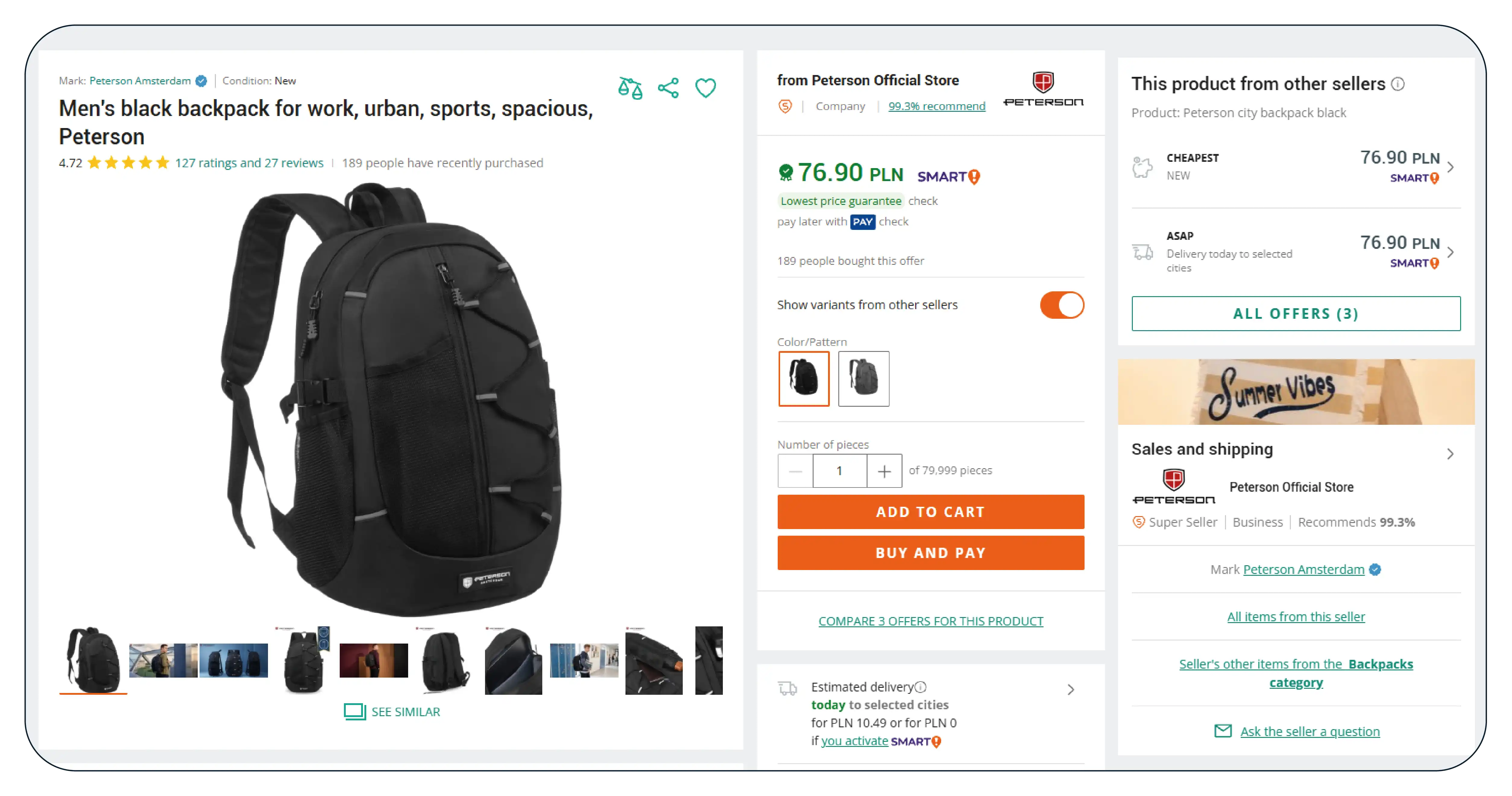
A growing e-commerce brand partnered with Product Data Scrape to improve marketplace visibility and understand seller activity across Allegro. The project used Scrape Sellers Information from Allegro capabilities to collect structured seller profiles, listings, ratings, product associations, and pricing signals at scale. Through automated Scraping Allegro Seller Card Data, the brand replaced fragmented manual research with a repeatable data pipeline. The solution improved seller discovery, competitive benchmarking, and marketplace monitoring while reducing repetitive research. The implementation delivered a scalable foundation for ongoing seller intelligence and enabled business teams to access cleaner, more consistent data for strategic marketplace decisions.
Client Name / Industry: E-commerce Brand / Online Retail
Service / Duration: Allegro Seller Data Scraping & Intelligence / 6 Months
Key Impact Metrics: 95%+ data accuracy | 75% reduction in manual research | 3× faster seller-data processing
The Client
The client was an established e-commerce brand operating in a highly competitive online marketplace environment. As marketplace participation increased, sellers were competing more aggressively for customer attention through pricing, assortment, ratings, promotions, and product availability. Understanding these dynamics became increasingly important for the brand's growth strategy.
The client needed reliable marketplace intelligence to identify active sellers, understand their product portfolios, compare pricing behavior, and recognize changes in seller activity. However, its existing research process relied heavily on manual browsing and spreadsheet-based collection. This made it difficult to maintain updated seller records and consistently compare large volumes of marketplace listings.
The transformation became essential as the number of sellers and products continued to grow. The brand wanted a scalable way to Scrape Allegro Seller Intelligence Data without depending on repetitive manual workflows. At the same time, collecting structured Competitive pricing data was necessary to understand how sellers positioned similar products.
Before partnering with Product Data Scrape, the client faced fragmented information, inconsistent seller records, slow research cycles, and limited historical visibility. Analysts spent substantial time identifying sellers and manually organizing information.
Product Data Scrape introduced an automated and structured approach that transformed marketplace information into usable intelligence. The resulting workflow helped the brand improve seller discovery, competitive analysis, and ongoing marketplace decision-making.
Goals & Objectives
The project focused on building a reliable seller-intelligence system that could scale with the client's marketplace requirements. The business needed faster data collection, stronger accuracy, and a consistent process for monitoring sellers and their product activity.
Build scalable seller-data collection capabilities.
Improve the speed and consistency of marketplace research.
Increase seller and listing data accuracy.
Support competitive benchmarking.
Reduce dependency on manual marketplace research.
The technical objectives centered on automation, structured extraction, integration, and analytics readiness. The system needed to capture seller information consistently and prepare it for downstream analysis.
Automate seller and listing data collection.
Standardize seller attributes and product associations.
Develop repeatable data-processing workflows.
Support Allegro Seller Listing Analysis.
Enable structured datasets for dashboards and analytics.
Prepare the architecture for expanded marketplace monitoring.
Achieve 95%+ seller-data accuracy.
Reduce manual research time by 75%.
Process seller records 3× faster.
Improve duplicate-record detection.
Increase consistency of scheduled data updates.
The Core Challenge
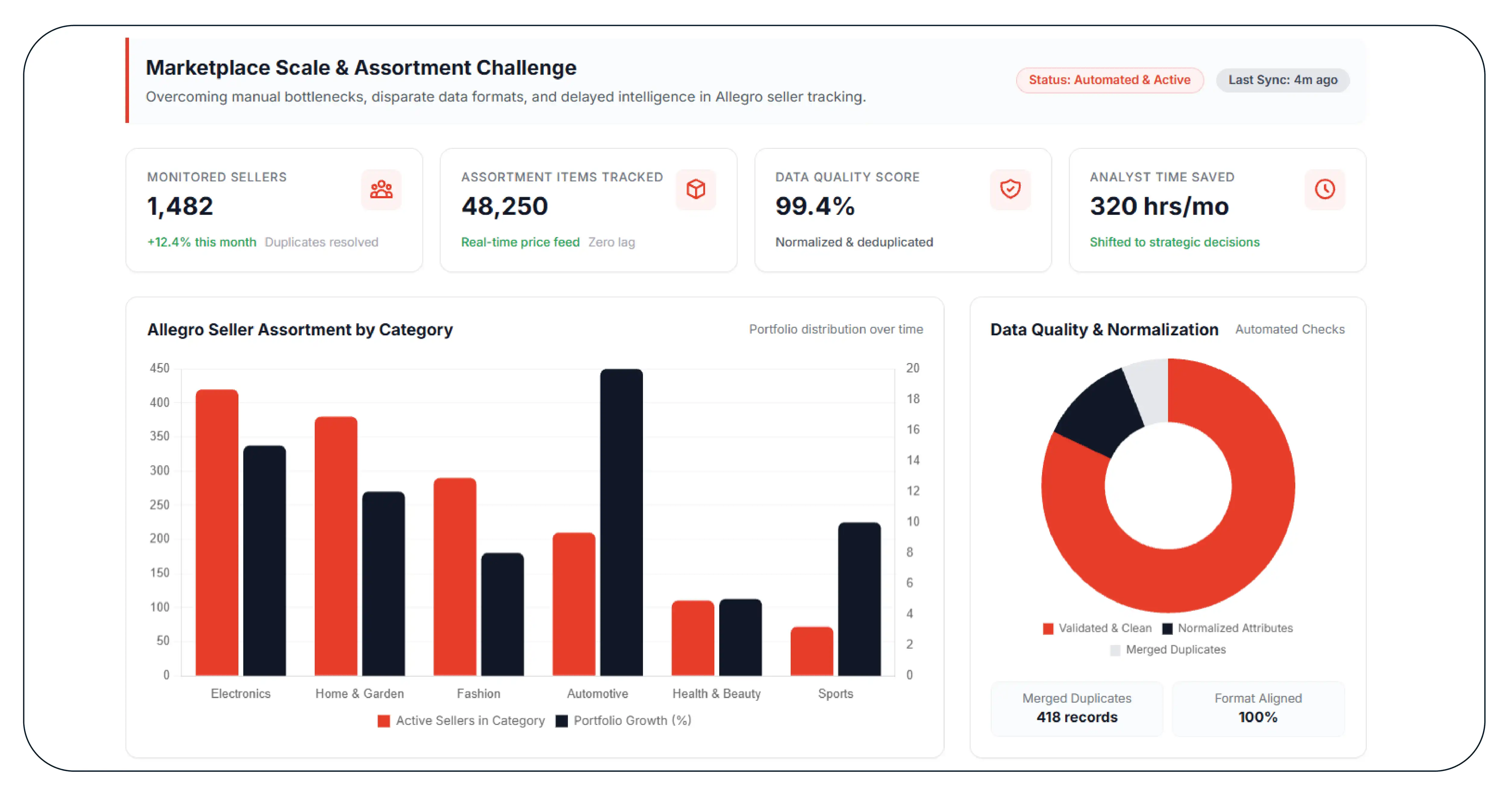
The client's biggest challenge was maintaining accurate and current seller intelligence while the Allegro marketplace continued to expand. Sellers could offer multiple products, compete across similar categories, change prices, receive new ratings, or update their marketplace presence. Tracking these changes manually became increasingly inefficient.
A major operational bottleneck was the time required to discover sellers and organize their associated products. Analysts had to navigate marketplace pages individually, record seller information, verify listings, and repeatedly update spreadsheets. This process was difficult to scale and created opportunities for missing or outdated records.
Data quality presented another issue. Seller names, product associations, ratings, review counts, and listing information could appear in different formats. Duplicate seller records and inconsistent product attributes made comparative analysis more difficult.
The client also lacked an efficient mechanism for Allegro Seller Assortment Analysis, limiting its ability to understand which sellers were active in specific categories and how their product portfolios changed over time.
These limitations affected both speed and accuracy. Analysts spent more time preparing information and less time interpreting it. Delayed updates also reduced the usefulness of seller intelligence for competitive decision-making.
The solution therefore needed to automate discovery, extract structured information, validate records, and create a scalable foundation for ongoing marketplace monitoring.
Our Solution
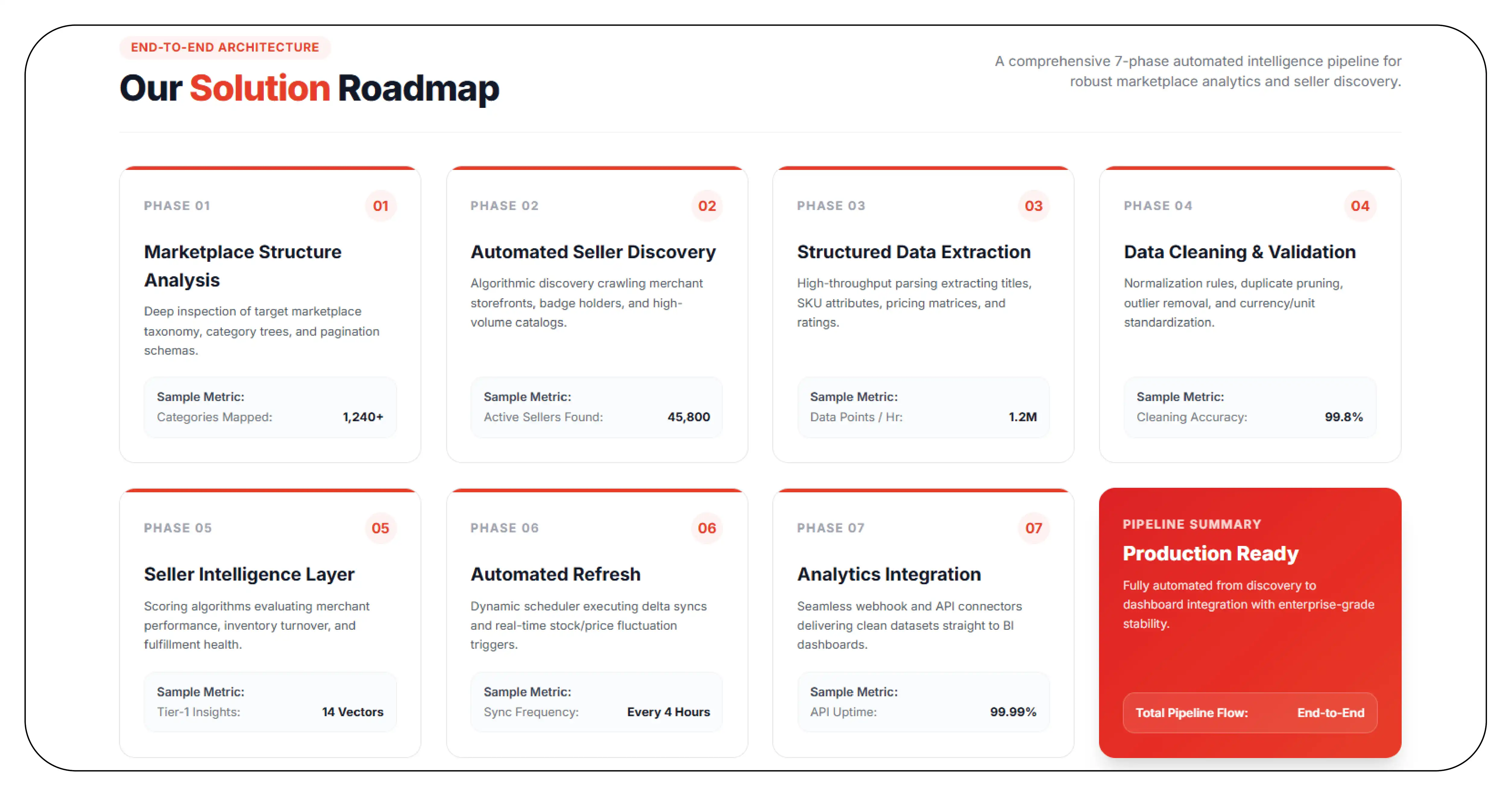
Product Data Scrape designed a phased seller-intelligence pipeline focused on automation, data quality, standardization, and scalable analytics.
Phase 1: Marketplace Structure Analysis
The project began with an assessment of Allegro's seller and product-page structures. Relevant attributes were mapped, including seller identity, ratings, reviews, product associations, listing information, pricing signals, and other available marketplace fields.
Phase 2: Automated Seller Discovery
Automated workflows were developed to identify seller profiles and associated marketplace listings. This reduced the need for analysts to manually search individual seller pages and improved the consistency of seller discovery.
Phase 3: Structured Data Extraction
The pipeline collected relevant seller and listing attributes and transformed them into standardized records. Product associations were maintained so teams could understand which products and categories were connected to specific sellers.
Phase 4: Data Cleaning & Validation
Automated quality checks identified missing fields, duplicate records, inconsistent seller names, and incomplete product associations. Validation rules helped improve the reliability of the final dataset.
Phase 5: Seller Intelligence Layer
The structured dataset supported Allegro Seller Performance Analysis, enabling the client to evaluate seller activity, product coverage, ratings, listing volumes, and other marketplace indicators.
Phase 6: Automated Refresh
Scheduled workflows were implemented to refresh seller and listing information consistently. This helped the brand maintain a more current view of marketplace activity instead of relying exclusively on periodic manual research.
Phase 7: Analytics Integration
Finally, the collected Scrape Sellers Information from Allegro dataset was prepared for integration with analytics and reporting environments. Standardized outputs allowed business teams to compare sellers, identify competitive movements, and develop marketplace strategies.
This phased approach transformed fragmented marketplace information into an automated seller-intelligence workflow that could scale as the client's monitoring requirements expanded.
Results & Key Metrics
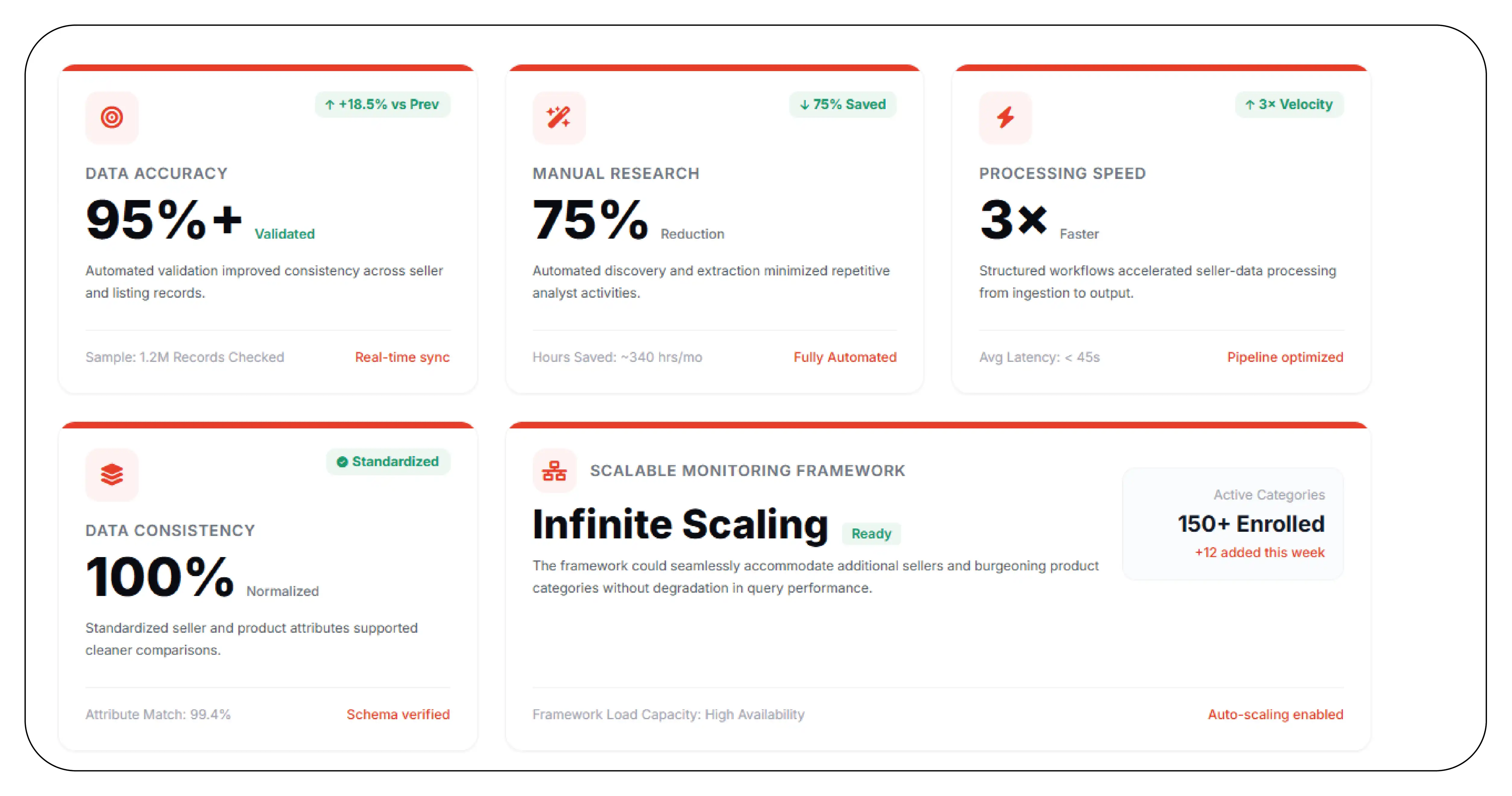
The implementation generated measurable improvements in seller-data collection and marketplace research.
95%+ data accuracy: Automated validation improved consistency across seller and listing records.
75% reduction in manual research: Automated discovery and extraction minimized repetitive analyst activities.
3× faster processing: Structured workflows accelerated seller-data processing.
Improved data consistency: Standardized seller and product attributes supported cleaner comparisons.
Scalable monitoring: The framework could accommodate additional sellers and product categories.
Results Narrative
The project gave the client a more dependable foundation for marketplace intelligence. Allegro Seller Product Performance information could be organized consistently, making it easier to evaluate seller activity and product-level competition. Automated extraction reduced the time analysts previously spent navigating marketplace pages and maintaining spreadsheets. Standardized records also improved the quality of downstream analysis by reducing duplicate and incomplete entries. With scheduled updates, the client gained a more current view of seller movements and marketplace changes. The resulting framework supported faster competitive research while creating a scalable foundation for future seller, product, pricing, and promotional intelligence initiatives.
What Made Product Data Scrape Different
Product Data Scrape approached the project as a complete marketplace intelligence workflow rather than a basic data-extraction exercise. The solution combined automated seller discovery, structured extraction, validation, normalization, and scheduled refreshes within one scalable architecture.
The platform supported Allegro product ad extraction alongside seller and listing intelligence, allowing product-level information to complement seller-level analysis. Automated validation helped detect incomplete records, duplicate entries, and inconsistent attributes before they reached analytics workflows.
Another differentiator was scalability. Instead of designing a process around a fixed number of sellers, the framework could accommodate expanding seller populations, product categories, and monitoring requirements. This enabled the client to develop a sustainable marketplace intelligence capability.
By combining automation with structured datasets and analytics-ready outputs, Product Data Scrape helped turn Allegro marketplace information into actionable business intelligence.
Client's Testimonial
"Product Data Scrape transformed how our team approaches marketplace research. Previously, collecting seller information required extensive manual browsing and spreadsheet management, which made frequent updates difficult. The automated workflow gave us cleaner seller and product information while significantly reducing the time required for research. We can now evaluate seller activity, product coverage, and competitive movements much more efficiently. The structured data has also made it easier for our analysts to build reports and identify marketplace opportunities. Product Data Scrape delivered a scalable solution that has strengthened our overall marketplace selling intelligence and provided a much more reliable foundation for competitive analysis."
— Head of E-commerce Strategy, Client Organization
Conclusion
The project demonstrated how automated seller intelligence can help brands compete more effectively in dynamic online marketplaces. Product Data Scrape transformed fragmented Allegro information into structured, scalable, and analytics-ready datasets. The solution improved seller discovery, data accuracy, processing speed, and competitive visibility while reducing manual research requirements. By combining seller profiles, product associations, pricing signals, and Promotion and deal intelligence, the brand gained broader visibility into marketplace activity. The Scrape Sellers Information from Allegro framework also provides a foundation for future expansion into additional categories, sellers, and intelligence use cases. With automated monitoring and structured data, brands can make faster, more informed marketplace decisions.
FAQs
1. What seller information can be collected from Allegro?
Depending on source availability, seller datasets can include seller names, ratings, reviews, product associations, listing information, prices, availability, and other publicly displayed marketplace attributes.
2. Why is Allegro seller data important for brands?
Seller data helps brands understand marketplace competition, identify active sellers, evaluate product coverage, compare pricing behavior, and recognize changes in competitive positioning.
3. Can Allegro seller data collection be automated?
Yes. Automated workflows can discover seller profiles, collect relevant attributes, standardize records, validate data, and refresh datasets according to predefined schedules.
4. How can brands use seller intelligence?
Brands can use seller intelligence for competitor benchmarking, assortment research, pricing analysis, seller discovery, product monitoring, marketplace strategy, and performance evaluation.
5. Can the solution scale to large seller volumes?
Yes. A properly designed scraping architecture can scale across larger seller populations and product categories. Automated processing, standardized schemas, validation rules, and scheduled collection help maintain data quality as marketplace coverage expands.


 Singapore
 EMAIL
EMAIL
 PHONE
PHONE











.webp)