Introduction
Businesses can solve product quality, pricing, and customer satisfaction challenges by systematically analyzing customer reviews, ratings, sentiment, and recurring feedback patterns. Scrape Amazon Review & Rating Data helps brands convert large volumes of publicly available customer feedback into structured intelligence for product improvement, competitive benchmarking, pricing decisions, and reputation management.
Customer feedback often reveals problems that sales data alone cannot explain. A product may have strong sales but receive recurring complaints about quality, packaging, sizing, delivery, or usability. Similarly, a competitor's consistently high ratings can reveal product attributes customers value.
For e-commerce brands, Amazon Price Monitoring can complement review intelligence by connecting customer sentiment with observed pricing conditions. When these datasets are analyzed together, businesses can better understand how price, product quality, ratings, and customer expectations interact.
This article explains how businesses can build a practical review intelligence framework, identify actionable patterns, and use structured customer feedback to improve product and commercial decisions.
How can businesses connect customer sentiment with pricing intelligence?
Customer sentiment becomes more valuable when businesses analyze it alongside commercial signals. A positive rating does not necessarily mean a product is competitively positioned, while a low rating does not automatically indicate a pricing problem. Businesses need to understand the relationship between customer feedback, product attributes, pricing, and competitor performance.
An Amazon review sentiment dashboard, Pricing intelligence framework can bring these signals together in one analytical environment. Teams can monitor average ratings, review volume, positive and negative sentiment, frequently mentioned issues, price changes, and competitor movements.
| Year |
Review Intelligence Focus |
Illustrative KPI |
Business Application |
| 2020 |
Basic ratings |
Average star rating |
Product benchmarking |
| 2021 |
Review volume |
Reviews per product |
Popularity assessment |
| 2022 |
Sentiment |
Positive/negative ratio |
Customer satisfaction |
| 2023 |
Topic analysis |
Issues per 1,000 reviews |
Quality improvement |
| 2024 |
Price correlation |
Rating vs. price |
Pricing research |
| 2025 |
Competitive analysis |
Review-share comparison |
Market positioning |
| 2026 |
Predictive intelligence |
Sentiment change rate |
Proactive decisions |
For example, a brand may discover that a product's rating declines after a price increase. That observation does not prove that the price caused dissatisfaction, but it provides a useful signal for further investigation. Businesses can examine whether review complaints also changed during the same period.
Similarly, a competitor may maintain a higher price while receiving better ratings. The difference could indicate stronger perceived quality, better features, improved packaging, or stronger brand trust.
The dashboard should therefore avoid reducing customer feedback to a single sentiment score. Decision-makers should be able to drill into the underlying review themes and compare them with product and pricing information.
This approach helps product managers, pricing teams, and brand managers work from the same evidence. Instead of analyzing reviews separately from pricing, they can evaluate how different commercial and product signals interact.
For e-commerce businesses, that creates a more complete picture of customer expectations and competitive positioning.
How can brands use reviews to improve product decisions?
Product teams often have access to sales data, but sales figures do not explain every reason behind customer satisfaction or dissatisfaction. Reviews can provide qualitative information about product performance, usability, durability, features, packaging, and perceived value.
Amazon review data analysis for brands helps transform individual customer comments into recurring themes that product managers can prioritize. At scale, thousands of reviews can be categorized by sentiment, topic, product attribute, and complaint type.
| Year |
Analytical Capability |
Illustrative Output |
| 2020 |
Rating collection |
Average product score |
| 2021 |
Review categorization |
Product feedback groups |
| 2022 |
Sentiment analysis |
Positive/negative trends |
| 2023 |
Topic extraction |
Recurring customer concerns |
| 2024 |
Product comparison |
Competitor feedback gaps |
| 2025 |
Trend detection |
Emerging complaints |
| 2026 |
Predictive analysis |
Potential quality risks |
Suppose a consumer electronics brand receives thousands of reviews. A manual review might identify a few common complaints, but automated analysis can systematically identify recurring themes across a much larger dataset.
The business might discover that customers consistently praise battery life but complain about charging speed. That insight can influence future product development and marketing communication.
Another useful application is identifying differences between customer expectations and product positioning. If customers repeatedly describe a product as expensive despite strong technical specifications, the brand may need to reassess its value communication rather than immediately reduce its price.
Review analysis can also help identify product variants that perform differently. One size, color, model, or configuration may receive significantly different feedback from another.
The most actionable workflow combines automated analysis with human validation. Machine-assisted classification can identify patterns quickly, while product teams can investigate important themes before making strategic decisions.
For brands, this transforms reviews from a customer-service resource into a product intelligence asset.
What can customer feedback reveal about product quality?
Customer feedback can expose recurring quality issues that may not appear in conventional performance metrics. Businesses can use review patterns to identify problems related to materials, functionality, durability, packaging, instructions, fit, compatibility, or usability.
Amazon customer feedback analysis allows organizations to examine customer comments at scale and identify recurring issues across products and competitors.
| Year |
Feedback Analysis Area |
Illustrative Business Question |
| 2020 |
Star ratings |
Which products perform best? |
| 2021 |
Complaint themes |
What problems recur? |
| 2022 |
Feature sentiment |
Which features drive satisfaction? |
| 2023 |
Quality monitoring |
Are complaints increasing? |
| 2024 |
Competitor comparison |
What do competitors do better? |
| 2025 |
Early-warning signals |
Which issues are emerging? |
| 2026 |
Predictive quality |
Which risks need attention? |
A useful approach is to classify reviews into operational themes. For example, a home appliance brand might categorize comments into performance, durability, noise, installation, packaging, and customer support.
The frequency of a complaint matters, but so does its trend. A problem mentioned by 1% of customers may become strategically important if its occurrence is increasing rapidly.
Businesses can therefore monitor changes in topic frequency over time. A sudden increase in negative comments related to packaging could indicate a logistics or supplier issue. An increase in comments about product compatibility could indicate unclear product descriptions.
Review sentiment can also be compared across product variants. If one model consistently receives negative feedback about a specific feature while another does not, the difference may provide a useful product-development signal.
Customer feedback analysis should not treat every review as equally representative. Reviews reflect the experiences of customers who choose to provide feedback and may contain subjective opinions. Therefore, businesses should use review data as one input among multiple sources.
When combined with returns, support tickets, sales, and product-quality data, review intelligence becomes significantly more useful.
How can brands monitor customer sentiment at scale?
Manual review analysis becomes increasingly difficult as product catalogs and review volumes grow. Brands need a repeatable process for collecting, organizing, and analyzing customer feedback across products and competitors.
Amazon review scraping for brands, Scrape Amazon Review & Rating Data can support structured review intelligence workflows where collection is permitted and implemented in accordance with applicable requirements. The objective is to organize publicly available feedback into datasets that can be analyzed consistently.
| Year |
Review Monitoring Stage |
Illustrative Scale |
| 2020 |
Manual review checks |
100 reviews |
| 2021 |
Structured collection |
500 reviews |
| 2022 |
Automated processing |
2,000 reviews |
| 2023 |
Sentiment classification |
5,000 reviews |
| 2024 |
Multi-product monitoring |
10,000 reviews |
| 2025 |
Competitor intelligence |
25,000 reviews |
| 2026 |
Continuous monitoring |
50,000+ reviews |
A scalable system can capture relevant review fields, normalize timestamps and ratings, identify duplicate records, and organize feedback by product. The dataset can then be enriched with sentiment, topic, and entity classifications.
This creates a searchable history of customer feedback. Product teams can identify whether complaints are isolated or recurring. Brand teams can monitor changes in overall sentiment. Competitive intelligence teams can compare customer themes across competing products.
One important consideration is review authenticity and context. Businesses should not assume every review represents the same customer profile or purchasing situation. Where available and appropriate, additional metadata can help analysts interpret feedback more accurately.
Another important consideration is privacy. Data collection should focus on information necessary for the intended business purpose and follow applicable privacy and platform requirements.
The ultimate objective is faster discovery of meaningful patterns. Instead of asking employees to read thousands of reviews individually, businesses can use structured datasets to surface the themes that require attention.
This enables customer feedback to become an ongoing intelligence workflow rather than an occasional research exercise.
How can reviews support broader consumer insights?
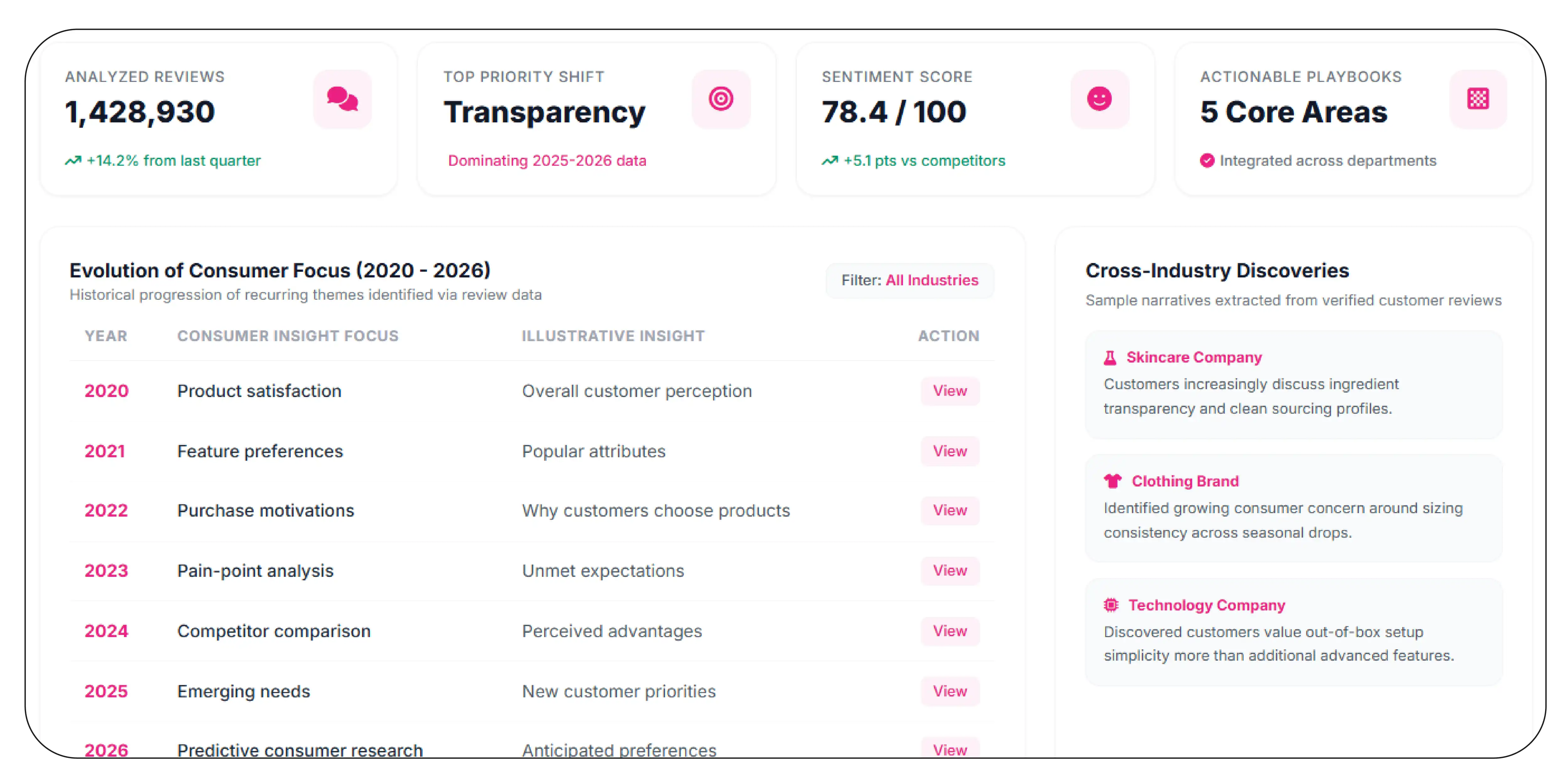
Reviews provide a direct source of customer language. Customers frequently describe what they like, what they dislike, what they expected, and how a product compares with alternatives. This information can help businesses understand consumer priorities beyond simple star ratings.
Amazon review data for consumer insights can help researchers identify recurring preferences, unmet needs, purchase motivations, and product attributes that customers discuss most frequently.
| Year |
Consumer Insight Focus |
Illustrative Insight |
| 2020 |
Product satisfaction |
Overall customer perception |
| 2021 |
Feature preferences |
Popular attributes |
| 2022 |
Purchase motivations |
Why customers choose products |
| 2023 |
Pain-point analysis |
Unmet expectations |
| 2024 |
Competitor comparison |
Perceived advantages |
| 2025 |
Emerging needs |
New customer priorities |
| 2026 |
Predictive consumer research |
Anticipated preferences |
For example, a skincare company may discover that customers increasingly discuss ingredient transparency. A clothing brand might identify growing concern around sizing consistency. A technology company could find that customers value setup simplicity more than an additional advanced feature.
These insights can influence product development, packaging, marketing, content strategy, and customer support.
Review language can also help businesses improve product descriptions. If customers repeatedly misunderstand a feature, the product page may need clearer explanations. If customers frequently praise a specific attribute, that attribute could receive greater prominence in marketing content.
Competitive review analysis can reveal gaps between products. A business might discover that its product receives strong feedback for durability while competitors receive more praise for design. That insight can help inform positioning and product roadmap decisions.
Consumer insight analysis is strongest when businesses combine review language with quantitative signals such as ratings, review frequency, sales, pricing, and product availability.
The result is a more nuanced understanding of what customers value and where the market may be underserved.
How can businesses turn ratings and reviews into measurable intelligence?
Ratings provide a useful quantitative signal, while reviews provide the qualitative context needed to understand why those ratings exist. Businesses can combine both to build product-performance indicators and identify changes in customer satisfaction.
Extract Customer Ratings and Reviews to create structured datasets that can support rating trends, sentiment analysis, complaint detection, competitor benchmarking, and product-performance research.
| Year |
Rating & Review Metric |
Illustrative Application |
| 2020 |
Average rating |
Product comparison |
| 2021 |
Rating distribution |
Satisfaction analysis |
| 2022 |
Review velocity |
Product engagement |
| 2023 |
Sentiment score |
Customer perception |
| 2024 |
Topic frequency |
Quality monitoring |
| 2025 |
Competitor comparison |
Market positioning |
| 2026 |
Sentiment forecasting |
Proactive product strategy |
A useful rating dataset should preserve the original rating and review context. Analysts can then calculate average ratings, rating distributions, changes over time, and relationships between review volume and product performance.
Review velocity can also be informative. A sudden increase in reviews may correspond with a product launch, promotional campaign, or increased sales activity. The business can investigate whether the additional feedback is predominantly positive or negative.
Sentiment trends provide another layer. A product with a stable four-star rating may still experience a growing number of negative comments about one particular issue. Topic-level analysis can reveal this before the overall rating changes significantly.
Businesses can also create competitive benchmarks. Instead of comparing only average ratings, they can compare complaint categories, positive attributes, review volume, and sentiment trends.
This provides a richer understanding of competitive product performance.
The most effective dashboards should allow users to move from summary metrics to individual themes. For example, a product manager might see that sentiment has declined and then identify that packaging-related complaints increased during the same period.
That connection between measurement and explanation makes review intelligence actionable.
Why Choose Product Data Scrape?
Businesses need more than raw review records; they need structured datasets that can be integrated into research and analytics workflows. Extract amazon API Product Data can support broader product intelligence by connecting product attributes with ratings, reviews, pricing, and availability information where appropriate.
The solution can be customized around product categories, required attributes, collection schedules, and output formats. This helps brands build datasets suited to pricing analysis, customer feedback research, competitor monitoring, and product intelligence.
Data validation and structured delivery can also make large datasets easier to analyze. Instead of manually reviewing scattered information, teams can work with consistent fields and historical records.
For brands managing large product catalogs, scalable collection can reduce repetitive research and help analysts focus on interpreting customer behavior and market signals.
Conclusion
Customer reviews and ratings provide valuable evidence about product quality, customer expectations, competitive positioning, and perceived value. Brand Protection, Scrape Amazon Review & Rating Data can help businesses monitor customer feedback at scale and identify recurring issues that may affect reputation and commercial performance.
The strongest approach combines review sentiment, rating trends, pricing, product attributes, and competitor intelligence. This creates a more complete picture than any single metric can provide.
The tables in this article are clearly labeled illustrative analytical frameworks rather than Amazon-reported statistics. Actual insights depend on product categories, review volumes, collection periods, and business requirements.
Want to turn customer feedback into actionable product intelligence? Contact Product Data Scrape to build a customized review, rating, pricing, and product data solution for your business!
FAQs
1. Why should brands analyze Amazon reviews?
Brands can identify recurring complaints, product strengths, customer expectations, and competitive gaps, helping teams improve products, positioning, pricing, and customer satisfaction.
2. What information can review datasets contain?
Depending on permitted availability, datasets may include ratings, review text, dates, product identifiers, verified-purchase indicators, and other relevant publicly displayed attributes.
3. Can review data support sentiment analysis?
Yes. Structured reviews can be processed using sentiment and topic models to identify positive, negative, and neutral themes across products and customer segments.
4. How does review intelligence help pricing teams?
Review intelligence can be compared with observed prices and competitor ratings to understand perceived value and identify potential pricing-positioning opportunities.
5. Can Product Data Scrape create customized datasets?
Yes. Customized datasets can be structured around selected products, attributes, review fields, collection schedules, and analytical requirements.


 Singapore
 EMAIL
EMAIL
 PHONE
PHONE











.webp)