Introduction
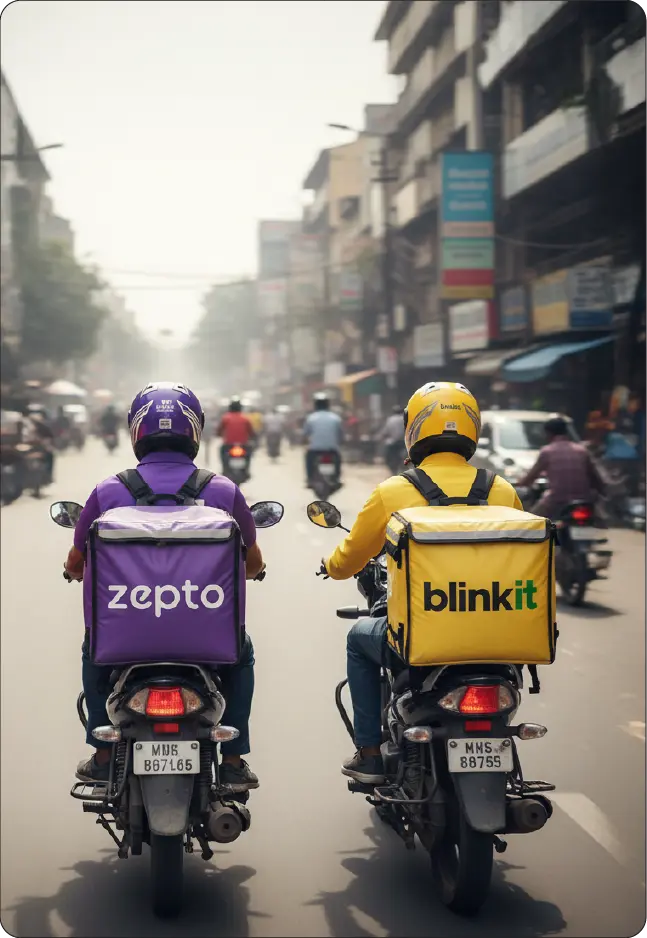
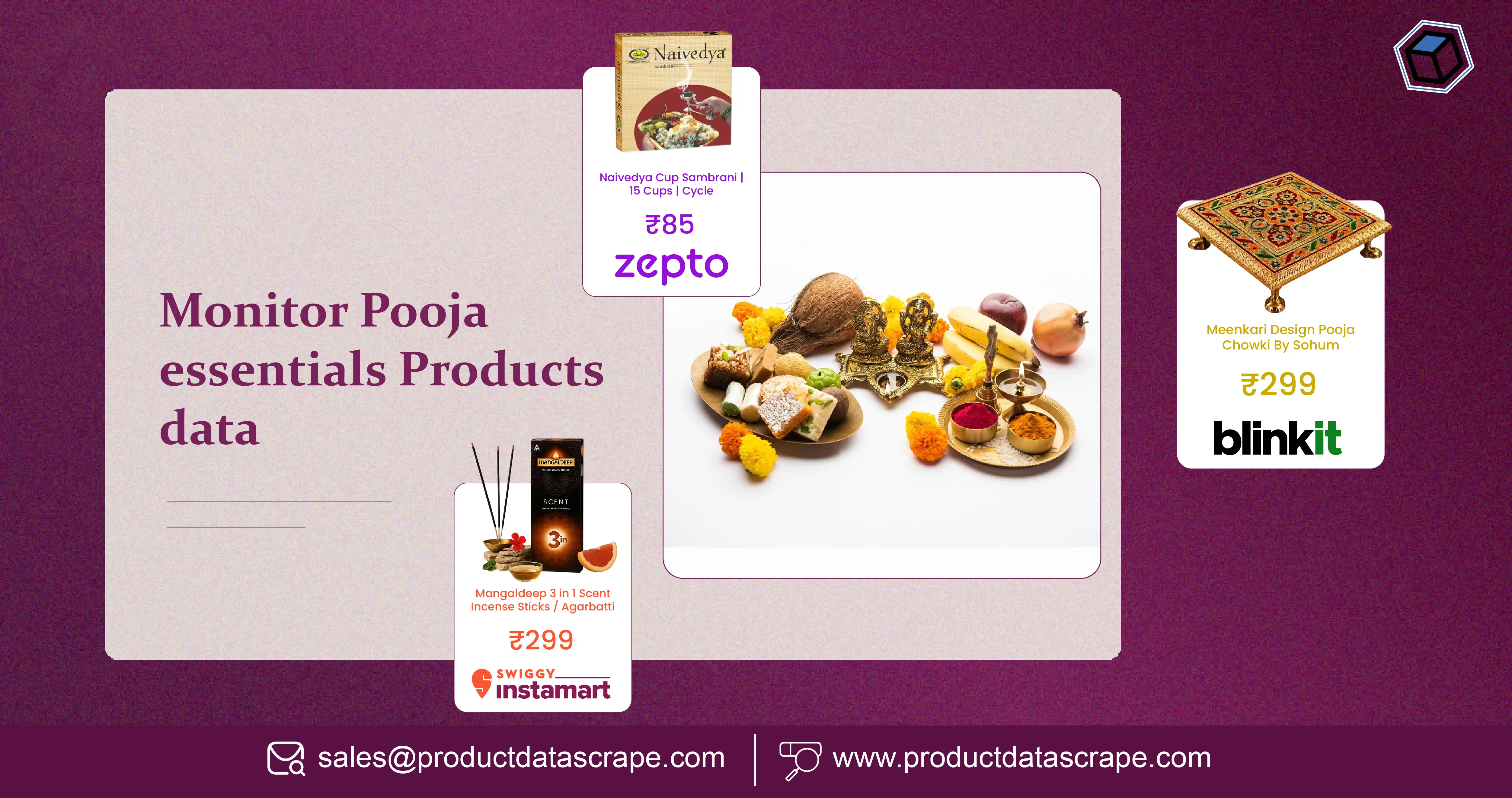
Retailers can improve festive assortment and pricing decisions by continuously monitoring product prices, promotions, availability, pack sizes, and delivery information across quick-commerce platforms. Monitor Pooja essentials data Zepto Blinkit Instamart gives brands a structured way to identify market changes before festive demand peaks.
The opportunity is significant. During India's 2025 festive season, quick-commerce order volumes increased sharply, while platforms expanded beyond traditional grocery into gifting, beauty, electronics accessories, décor, and religious products. Unicommerce data reported a 120% year-on-year increase in quick-commerce order volumes during the 2025 Diwali season.
Pooja essentials are particularly time-sensitive. Diyas, incense, camphor, cotton wicks, kumkum, roli, puja oils, flowers, festive décor, idols, and related products can experience sudden demand increases around Diwali, Navratri, Dhanteras, Ganesh Chaturthi, and regional festivals.
A structured Scrape Fee Delivery Changes Blinkit, Zepto & Instamart Data workflow can add another layer of intelligence by capturing delivery charges, minimum-order conditions, promotions, and other checkout-related signals alongside product information.
For FMCG brands, retailers, distributors, and category managers, the core pain point is fragmented visibility. Manual checks may capture one platform, one pincode, and one time of day. Automated monitoring can create a historical dataset that shows what changed, when it changed, and where it changed.
How Can Retailers Track Pooja Product Prices Across Quick-Commerce Platforms?
Pooja Essentials Price Tracking helps retailers compare the selling price of similar products across Blinkit, Zepto, and Swiggy Instamart. The objective is not simply to identify the lowest price. It is to understand price positioning, discount depth, promotional frequency, and SKU-level movement.
This becomes increasingly important during festive periods. In 2025, industry data showed that quick commerce became a major channel for last-minute festive purchases, including puja essentials, diyas, décor, gifting items, and sweets.
Quick-Commerce Monitoring Indicators
| Metric |
What retailers can measure |
Business value |
| Listed price |
Current product price |
Price benchmarking |
| Sale price |
Promotional selling price |
Discount analysis |
| Discount % |
Difference between regular and sale price |
Promotion intensity |
| SKU availability |
In-stock/out-of-stock status |
Inventory visibility |
| Product assortment |
Number of comparable SKUs |
Range benchmarking |
| Price frequency |
Number of changes over time |
Volatility analysis |
| Pincode |
Local product visibility |
Hyperlocal intelligence |
From 2020 onward, Indian consumers increasingly adopted digital purchasing channels. By 2024–2025, quick commerce had evolved into a broader convenience channel rather than a grocery-only proposition. Datum Intelligence projected quick commerce to account for 12% of India's 2025 festive online sales, up from 8% in 2024.
For retailers, this evolution changes the monitoring requirement. In 2020, a periodic online price check could provide useful information. By 2026, festive categories require more granular observation because pricing and availability can change multiple times during high-demand periods.
The recommended dataset should therefore capture SKU, brand, product title, pack size, MRP where available, selling price, discount, stock status, pincode, platform, timestamp, and product URL. Comparing these fields creates a more accurate picture of competitive pricing than looking at price alone.
How Does Availability Monitoring Reveal Festive Demand Changes?
Pooja Product Availability Monitoring provides retailers with an additional signal beyond price. A product being unavailable can indicate inventory pressure, high demand, assortment changes, or temporary platform restrictions. Combining this information with promotion Tracking helps distinguish whether demand is connected to a discount or broader seasonal activity.
Availability and Promotion Signals
| Signal |
Possible observation |
Actionable interpretation |
| Price decreases + stock remains high |
Active promotion |
Promotional campaign |
| Price decreases + stock falls |
Strong promotional demand |
Monitor replenishment |
| Product disappears |
Stock-out or listing change |
Investigate availability |
| New SKU appears |
Assortment expansion |
Track competitor strategy |
| Promotion disappears |
Campaign ended |
Recalculate price position |
| Delivery window increases |
Possible operational pressure |
Monitor service levels |
The festive context is particularly relevant. In 2025, reports indicated that quick-commerce platforms saw strong last-minute demand for gifts, sweets, lights, diyas, and puja products.
Between 2020 and 2022, digital shopping adoption accelerated significantly. During 2023 and 2024, quick-commerce platforms increasingly expanded assortment and geographic coverage. In 2025, festive demand demonstrated that consumers were using these services for urgent and occasion-based purchases rather than only everyday groceries. For 2026, retailers can use historical observations to identify recurring demand windows.
A practical monitoring model should record availability at consistent intervals. If a diya pack is available in the morning but unavailable by evening, that change becomes an important demand signal. If the same product remains available but receives a 15% discount, the event represents a different commercial strategy.
This distinction helps category teams avoid interpreting every product disappearance or price movement as a competitor action.
What Product Intelligence Can Retailers Build From Pooja Essentials Data?
Quick Commerce Pooja Product Intelligence combines pricing, assortment, availability, promotion, and geographic information into one analytical view. This is particularly useful for brands selling multiple festive SKUs across different cities and platforms.
Recommended Intelligence Layer
| Data layer |
Example fields |
Use case |
| Product |
Name, brand, category, pack size |
SKU matching |
| Pricing |
MRP, selling price, discount |
Price intelligence |
| Promotion |
Coupon, offer, bundle |
Campaign monitoring |
| Availability |
Stock status |
Supply tracking |
| Geography |
Pincode, city |
Local benchmarking |
| Delivery |
ETA, delivery fee |
Convenience comparison |
| Time |
Date and timestamp |
Trend analysis |
The market context supports this approach. A 2025 NielsenIQ report highlighted a 45X surge in e-commerce volumes during festive periods and emphasized the importance of convenience, speed, regional differences, and quick-commerce influence on consumer decisions.
From 2020 to 2022, product intelligence was often focused on basic online availability and price collection. In 2023–2024, businesses increasingly needed competitive assortment information. In 2025, festive demand demonstrated that product intelligence also needed to capture occasion-specific categories. In 2026, the emphasis can move toward predictive use of historical data through Pincode-Level Q-Commerce Price & Availability.
Retailers can calculate metrics such as average price, median price, discount frequency, stock-out rate, platform availability rate, and price variance. They can also compare equivalent pack sizes rather than relying on product titles alone.
For example, a 100-stick incense pack and a 20-stick pack should not be treated as direct price competitors. Normalizing price by unit, weight, or quantity can create a more meaningful benchmark.
This structured approach helps FMCG teams identify assortment gaps, pricing opportunities, promotional windows, and location-specific differences.
How Can Retailers Monitor Instamart's Festive Assortment?
Instamart Pooja Product Monitoring can help retailers understand how religious and festive categories change during high-demand periods. Swiggy Instamart has been part of the broader expansion of quick commerce into festive categories, alongside Blinkit and Zepto. Reports from the 2025 festive period highlighted curated assortments covering idols, puja products, décor, fasting products, sweets, dry fruits, lights, and related items.
Example Monitoring Calendar
| Period |
Potential category focus |
Monitoring priority |
| Jan–Mar |
General religious essentials |
Baseline assortment |
| Apr–Jun |
Regional festival products |
Regional demand |
| Jul–Aug |
Monsoon and festival preparation |
Assortment changes |
| Sep–Oct |
Navratri, Dussehra, Diwali |
High-frequency monitoring |
| Nov |
Diwali/Dhanteras continuation |
Price and availability |
| Dec |
Gifting and year-end demand |
Promotional tracking |
The 2020–2026 shift shows why a seasonal monitoring calendar is useful. Digital commerce initially expanded because consumers needed convenient access to everyday products. As quick commerce matured, platforms began adding occasion-based products that could satisfy immediate purchasing requirements through Q-Commerce data scraping.
In 2025, the last-mile nature of quick commerce became particularly relevant to festive shopping. Economic Times reported that consumers increasingly turned to quick-commerce platforms for last-minute festive purchases, while platforms created dedicated festive sections.
For retailers, Instamart monitoring should therefore cover more than price. Product title, category, pack size, availability, promotion, delivery information, and location should be captured together.
Historical monitoring can then answer questions such as: Which products appeared before Navratri? Which SKUs remained available during peak demand? Which brands increased promotional activity? Which products disappeared during the final days before Diwali?
How Can Brands Capture Zepto Pooja Essentials Data at Scale?
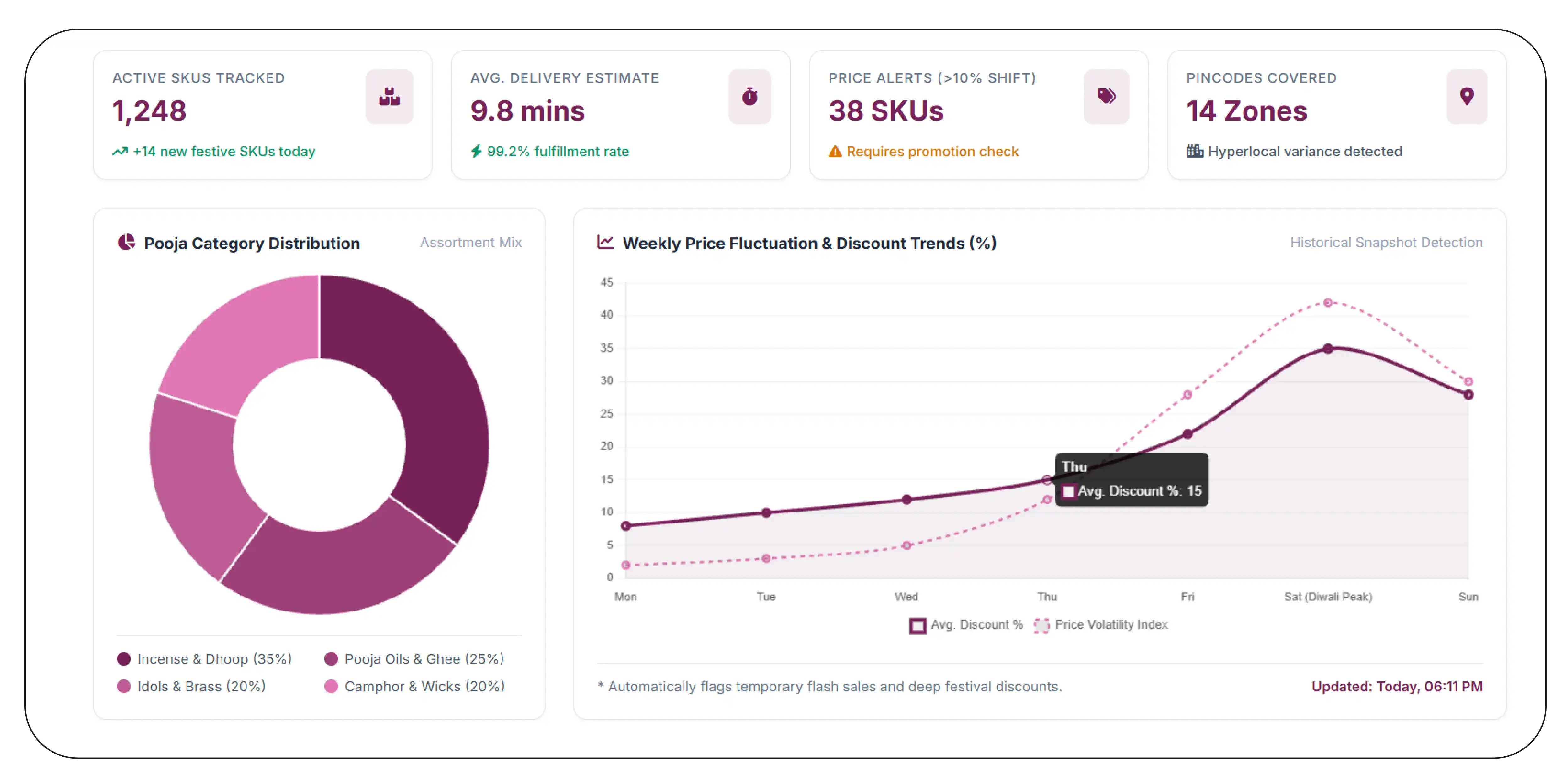
Scrape Zepto Pooja Essentials Data to create structured datasets for price comparison, assortment analysis, promotion tracking, and availability monitoring. The main advantage of recurring collection is that retailers can compare snapshots instead of depending on one-time manual checks.
Key Fields for Zepto Monitoring
| Field |
Why it matters |
| Product name |
Product identification |
| Brand |
Brand comparison |
| Category |
Category mapping |
| Pack size |
Like-for-like benchmarking |
| Selling price |
Competitive pricing |
| Discount |
Promotion measurement |
| Availability |
Stock monitoring |
| Pincode |
Hyperlocal comparison |
| Delivery estimate |
Service-level analysis |
| Timestamp |
Historical change detection |
| Product URL |
Verification and reference |
Festive demand makes timestamped information especially important. In 2025, quick-commerce order volumes grew 120% year over year during the Diwali period according to Unicommerce data reported by Fortune India.
A retailer tracking the same SKU only once per week could miss short promotional campaigns or temporary stock-outs. A more frequent schedule during peak festive weeks can reveal these changes.
From 2020 through 2024, many digital retail datasets were designed around stable product catalogs. By 2025–2026, the faster pace of quick commerce makes event-based monitoring more useful. Retailers can define rules such as "alert when price changes by more than 10%," "flag a previously available SKU that becomes unavailable," or "identify newly listed festive products."
Pincode-level collection adds another dimension. The same product may be available in one neighborhood but absent in another because quick-commerce inventory is organized around localized fulfillment networks.
For category managers, these observations can support replenishment planning, promotional benchmarking, assortment decisions, and competitor monitoring.
How Can Retailers Compare Blinkit Pooja Prices and Promotions?
Scrape Blinkit Pooja Product Prices Data to analyze product-level price movements, discount depth, assortment, and availability across festive periods. Blinkit has been one of the prominent quick-commerce platforms involved in expanding festive product categories.
During 2025, reports noted that Blinkit introduced festival-focused categories featuring products such as lights, diyas, candles, flowers, and rangoli colors.
Cross-Platform Benchmarking Model
| Metric |
Blinkit |
Zepto |
Instamart |
| Product availability |
Track |
Track |
Track |
| Selling price |
Track |
Track |
Track |
| Discount |
Track |
Track |
Track |
| Pack size |
Normalize |
Normalize |
Normalize |
| Promotion |
Track |
Track |
Track |
| Pincode |
Track |
Track |
Track |
| Delivery information |
Track |
Track |
Track |
Between 2020 and 2022, festive e-commerce largely focused on established online shopping behavior. From 2023 onward, quick commerce increasingly became part of consumers' immediate-purchase journey. By 2025, industry reporting showed strong demand for last-minute puja and festive purchases.
For 2026, retailers can use this historical context to create a more structured festive intelligence program. Instead of checking individual products manually, they can establish a common schema across platforms.
The most useful comparison is not necessarily "which platform is cheapest?" A stronger question is: How does each platform position the same product under comparable conditions?
Analysts should normalize pack sizes, separate regular prices from temporary offers, record timestamps, and compare the same pincode where possible. This creates a cleaner benchmark and prevents misleading conclusions caused by different locations or product configurations.
The final dataset can support pricing teams, category managers, FMCG brands, distributors, and marketplace sellers.
Why Choose Product Data Scrape?
Quick Commerce Price Monitoring API India can help brands convert recurring platform observations into structured feeds for dashboards, analytics systems, and pricing workflows. Monitor Pooja essentials data Zepto Blinkit Instamart enables retailers to examine product prices, promotions, stock availability, assortment, and geographic differences during important festive periods. A structured pipeline can normalize SKU information, capture timestamps, compare equivalent products, and maintain historical records. This is especially valuable for FMCG brands and retailers that need faster visibility without depending on manual checks. Data can be organized for category benchmarking, promotional analysis, competitor monitoring, and seasonal planning, helping commercial teams turn fragmented marketplace observations into repeatable intelligence for decision-making.
Conclusion
Tracking 10-Minute Delivery Assortments gives retailers a practical way to understand how fast-moving festive categories change across quick-commerce platforms. Monitor Pooja essentials data Zepto Blinkit Instamart helps combine pricing, promotions, availability, assortment, delivery, and pincode-level observations into one structured intelligence layer.
The 2025 festive season showed the growing role of quick commerce in last-minute purchases, with industry data reporting strong increases in order volumes and growing demand for puja essentials.
For 2026, retailers can build on this trend by monitoring products more frequently during critical festival windows and comparing equivalent SKUs across platforms.
Partner with Product Data Scrape to build structured quick-commerce datasets for festive price tracking, product availability, promotion intelligence, and pincode-level competitive monitoring!
FAQs
1. Why monitor pooja essentials on quick-commerce platforms?
Monitoring helps retailers identify price changes, promotional activity, stock availability, new listings, and assortment differences across major quick-commerce platforms during festive demand periods.
2. What pooja product information can be tracked?
Depending on platform availability, datasets can include product names, brands, pack sizes, prices, discounts, stock status, delivery information, categories, pincodes, timestamps, and URLs.
3. Why is pincode-level monitoring important?
Quick-commerce inventory is localized. Pincode-level monitoring helps retailers identify geographic differences in product availability, pricing, assortment, promotions, and delivery conditions.
4. How frequently should festive product data be collected?
During major festivals, daily or multiple daily observations can capture short-lived price changes, promotions, stock-outs, and new listings that weekly monitoring may miss.
5. How can Product Data Scrape help retailers?
Product Data Scrape can organize recurring marketplace observations into structured datasets that support price benchmarking, availability monitoring, assortment analysis, and festive competitive intelligence.


 Singapore
 EMAIL
EMAIL
 PHONE
PHONE


.webp "thumb")









.webp)