Introduction
Dentsu marketing agency web data intelligence 2026 can help marketing teams turn fragmented online information into structured signals for campaign planning, competitor monitoring, pricing analysis, audience research, and AI-enabled decision-making. The core challenge is speed: agencies need fresh market evidence before campaigns, not weeks after them.
Dentsu's current strategy places data, identity, technology, and AI at the center of marketing execution. Its 2026 materials also emphasize how algorithms increasingly influence attention, discovery, connection, and commerce. (Dentsu Group)
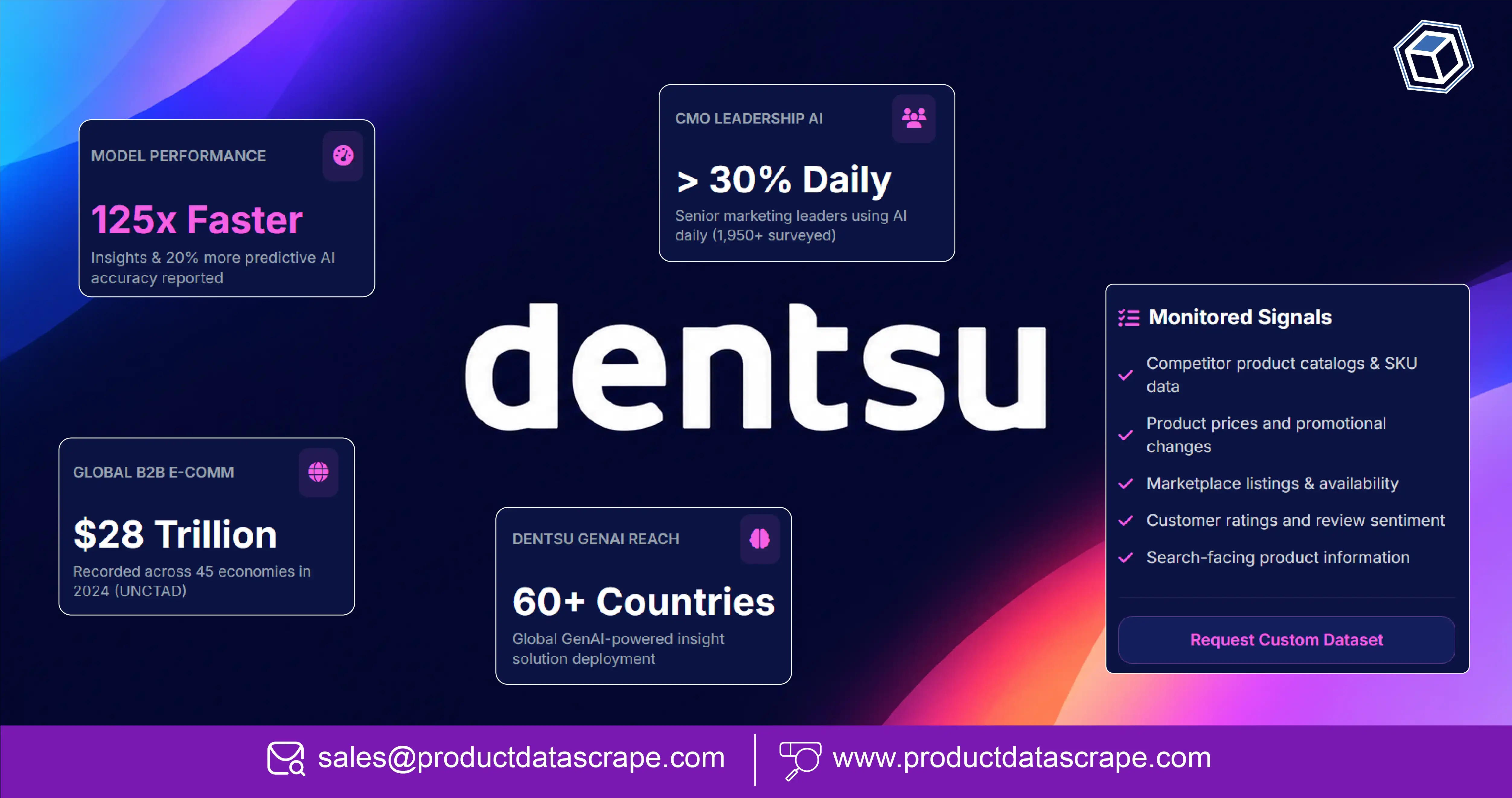
At the same time, the scale of digital commerce creates an enormous external data environment. UN Trade and Development reports that business e-commerce sales across 45 economies reached $28 trillion in 2024, 4.4% above 2023. (UNCTADstat)
For agencies serving retail, FMCG, consumer electronics, fashion, travel, and other digital-first categories, this creates a practical opportunity. Web data can reveal competitor prices, product launches, promotional activity, content changes, consumer reviews, marketplace availability, and category trends.
The objective is not to scrape everything. It is to collect the right signals, normalize them, validate them, and make them available to strategists, media planners, analysts, and AI systems.
How has digital commerce changed the data requirements for marketing agencies?
Marketing agencies now operate in an environment where consumer journeys cross search engines, marketplaces, brand websites, social platforms, review pages, and digital advertising ecosystems. Static research can therefore become outdated quickly.
Dentsu consumer behavior data analytics can be strengthened by external web signals that show what consumers encounter in real digital environments. This includes product prices, promotions, ratings, reviews, availability, content changes, search-facing information, and competitor positioning. Pricing intelligence adds another layer by showing how brands and retailers change their commercial positioning over time.
| Year |
Real-world digital-commerce signal |
Marketing intelligence implication |
| 2020 |
Online purchasing accelerated during the pandemic |
Agencies needed faster digital monitoring |
| 2021 |
Business e-commerce sales approached $25T across 43 economies |
Competitive online intelligence expanded |
| 2022 |
Business e-commerce sales approached $27T |
Broader digital market benchmarking became important |
| 2023 |
E-commerce continued expanding across major markets |
Agencies could increase longitudinal monitoring |
| 2024 |
Business e-commerce sales reached $28T across 45 economies |
More online activity created larger external data pools |
| 2025 |
AI became increasingly embedded in marketing workflows |
Structured datasets became more valuable for AI |
| 2026 |
Algorithms increasingly influence discovery and commerce |
Real-time external signals support faster decisions |
UNCTAD reports that 2021 business e-commerce sales approached $25 trillion across 43 developed and developing economies, while 2022 sales were estimated at almost $27 trillion. Its latest data places 2024 sales at $28 trillion across 45 economies. These figures are not consumer-retail-only measurements, but they demonstrate the scale of the digital commercial environment. (UNCTAD)
For agencies, the actionable layer is SKU-, brand-, retailer-, and market-level data. A campaign team can compare a brand's price against competitors, identify promotional changes, monitor review sentiment, and detect assortment expansion.
The most useful approach connects behavioral signals with commercial signals. For example, increased consumer interest in a category becomes more actionable when an agency can simultaneously see competitor promotions, new product launches, price movements, and availability changes.
How can AI and real-time data improve campaign decisions?
AI can accelerate marketing analysis, but its usefulness depends heavily on the quality, freshness, and structure of the underlying information. Agencies therefore need reliable external data pipelines alongside internal customer and campaign data.
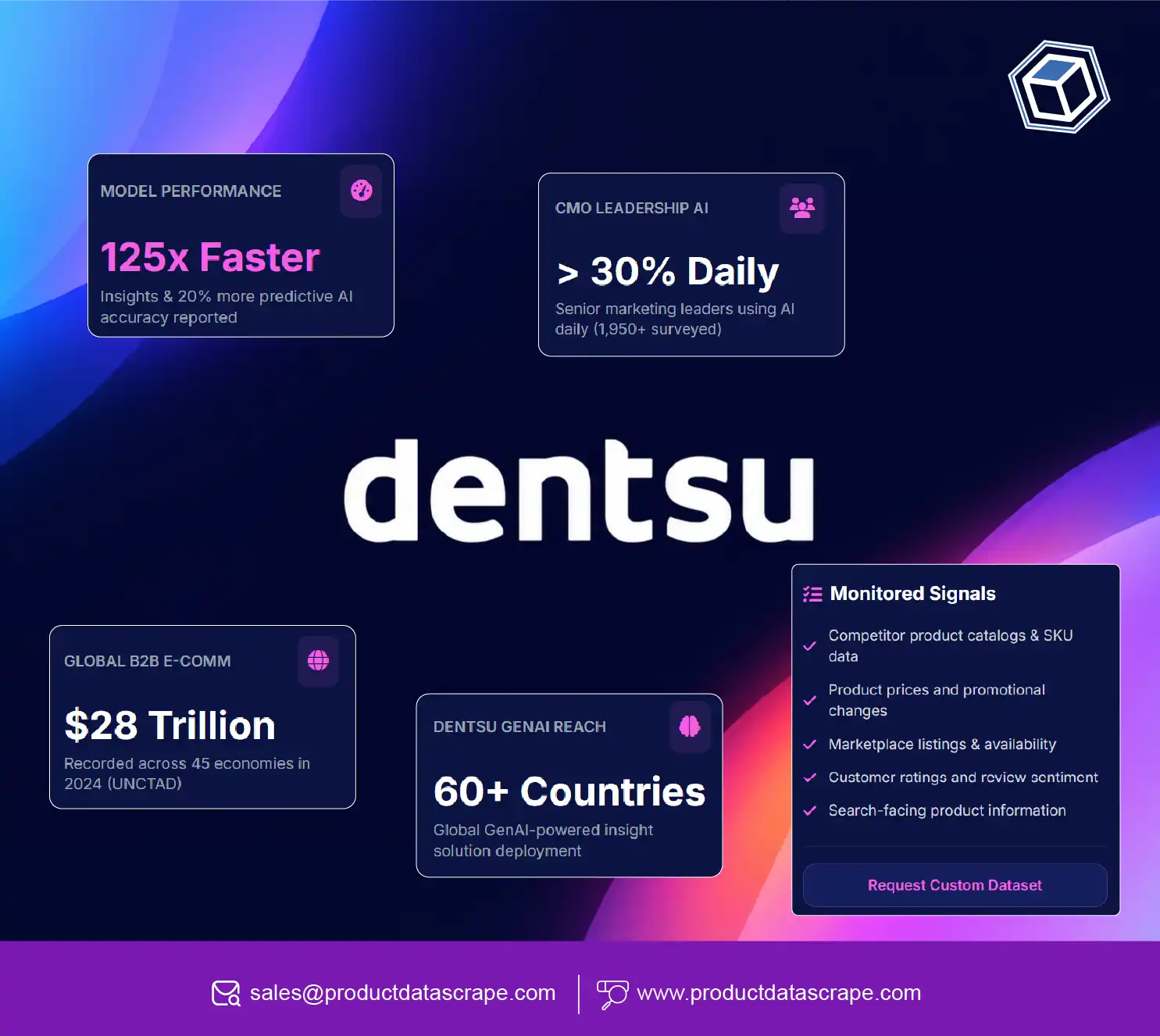
Dentsu AI Marketing Intelligence 2026 reflects a broader industry direction toward AI-assisted planning, audience understanding, optimization, and activation. Dentsu reported in 2026 that its global GenAI-powered insights solution had been used across more than 60 countries, while its January 2026 Generative Audiences launch combined deterministic data with AI-generated audience simulations. (Dentsu)
Real-time price tracking can complement these capabilities by providing current commercial signals from online retailers and marketplaces.
| Year |
Technology/data development |
Possible agency application |
| 2020 |
Rapid shift toward digital channels |
Monitor online competitor activity |
| 2021 |
E-commerce sales approached $25T across sampled economies |
Expand digital market datasets |
| 2022 |
E-commerce sales approached $27T |
Track broader category movements |
| 2023 |
AI experimentation accelerated |
Prepare structured data for models |
| 2024 |
$28T business e-commerce sales across 45 economies |
Increase automated market monitoring |
| 2025 |
Dentsu reported AI increasingly embedded in marketing workflows |
Integrate external web signals with AI |
| 2026 |
AI-powered audience and insight capabilities expand |
Move toward faster insight-to-action cycles |
Dentsu's 2025 integrated report describes an AI-powered platform spanning audience creation, planning, activation, measurement, and optimization, and reports 125x faster insights, 20% more predictive AI, and 30% better outcomes for its data-science models. These are Dentsu-reported figures about its own capabilities, not universal industry benchmarks. (Dentsu Group)
For agencies, this distinction matters. AI should not be treated as a replacement for source validation. A pricing model trained on stale or duplicated listings can generate misleading conclusions.
A better workflow continuously collects external signals, validates them, and then provides clean records to analytics and AI systems. This supports campaign teams that need to respond to competitor promotions, pricing changes, new products, and market shifts quickly.
Why is web data scraping becoming important for agencies?
Marketing agencies often manage multiple clients simultaneously. Each client may require different competitors, marketplaces, categories, geographies, and data fields. Manual research creates inconsistent processes and makes frequent monitoring difficult.
Web Data Scraping for Marketing Agencies can create repeatable datasets from publicly accessible web sources, subject to applicable website terms, laws, and data-use requirements.
| Year |
Market development |
Agency requirement |
| 2020 |
Digital shopping behavior expanded |
Increase online research coverage |
| 2021 |
2.3B people reportedly shopped online |
Scale consumer-market monitoring |
| 2022 |
E-commerce sales approached $27T in covered economies |
Expand structured datasets |
| 2023 |
More brands operated across digital channels |
Monitor broader competitive sets |
| 2024 |
$28T business e-commerce sales in UNCTAD's covered economies |
Automate recurring data collection |
| 2025 |
AI became mainstream in marketing workflows |
Improve data readiness |
| 2026 |
Algorithmic discovery shapes digital journeys |
Deliver fresher external signals |
UNCTAD reported that 2.3 billion people shopped online in 2021, up 68% from 2017, while e-commerce sales across 43 covered economies reached almost $27 trillion in 2022. (UNCTAD)
A practical agency pipeline can monitor:
- Competitor product catalogs
- Product prices and promotions
- Marketplace listings
- Customer ratings and reviews
- Product availability
- Brand content
- Retailer assortment
- Category pages
- Search-facing product information
- Publicly accessible campaign and promotional information
The value comes from structuring this information consistently. Product names can be normalized, duplicate listings removed, prices standardized, timestamps retained, and historical records preserved.
Agencies can then deliver dashboards or datasets to strategy teams instead of asking analysts to repeatedly browse hundreds of pages.
This also supports client-specific monitoring. A fashion client may require product and price tracking, while a travel client may need destination and accommodation signals. The underlying collection architecture can remain consistent while the monitored entities and attributes change.
How can digital data strengthen competitive campaign planning?
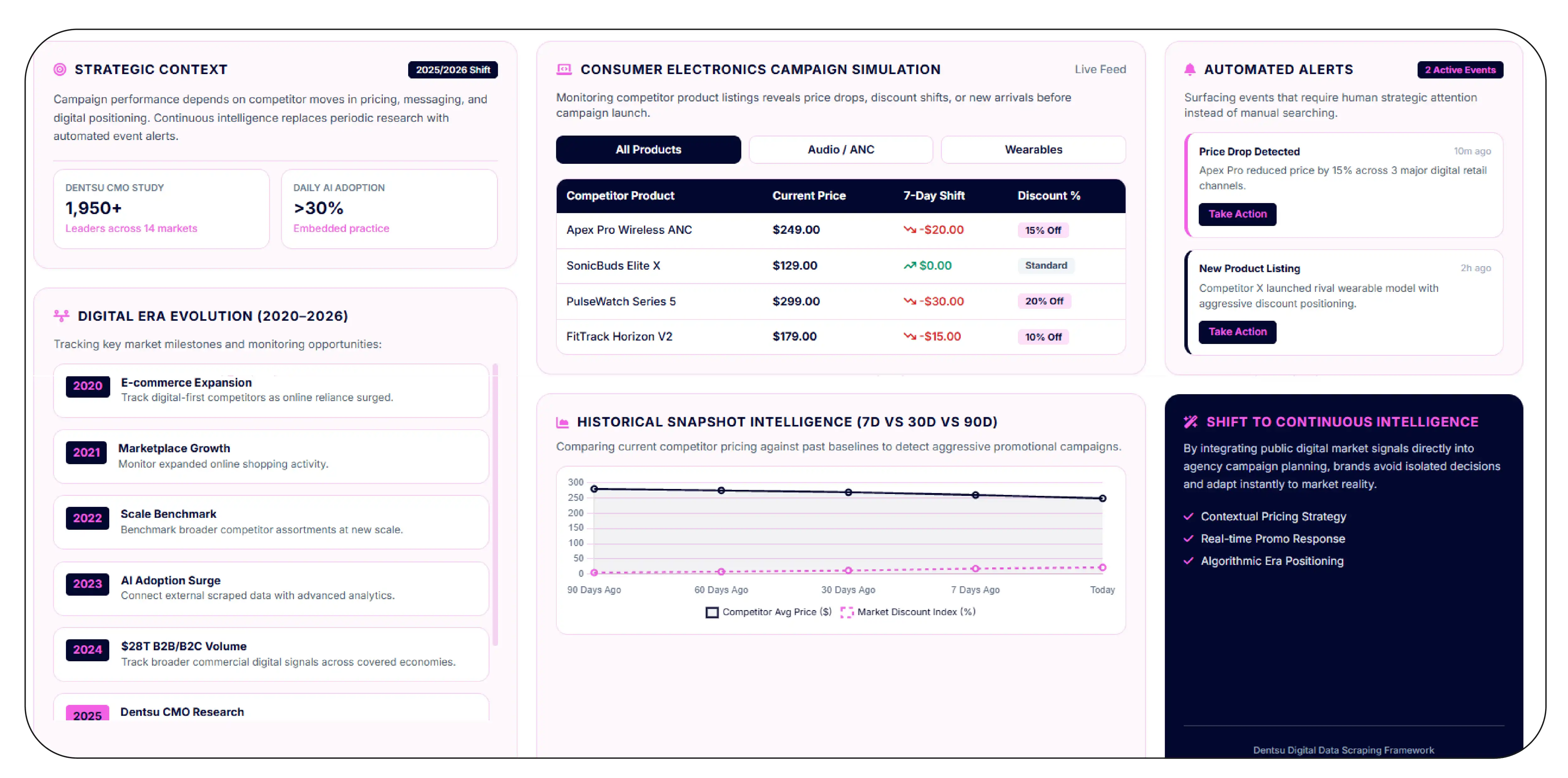
Campaign performance depends partly on what competitors are doing at the same time. A brand may change its pricing, promotional message, product assortment, or digital positioning while an agency is preparing a campaign.
Dentsu Digital Marketing Data Scraping can be viewed as a structured approach to collecting public digital-market signals for campaign research and competitive analysis.
| Year |
Key digital environment |
Competitive monitoring opportunity |
| 2020 |
E-commerce became more important |
Track digital-first competitors |
| 2021 |
Online shopping expanded substantially |
Monitor marketplace activity |
| 2022 |
E-commerce reached new scale |
Benchmark broader competitors |
| 2023 |
AI adoption increased |
Connect external data with analytics |
| 2024 |
$28T business e-commerce sales across covered economies |
Track more digital commercial signals |
| 2025 |
Dentsu surveyed 1,950+ senior marketing leaders across 14 markets |
Study changing AI and marketing priorities |
| 2026 |
Dentsu emphasizes algorithmic-era media behavior |
Monitor signals affecting digital discovery |
Dentsu's 2025 CMO research surveyed more than 1,950 senior marketing leaders across 14 markets and reported that AI had become embedded in everyday marketing practice, with more than 30% of surveyed leaders using AI daily. (Dentsu)
Competitive data can make campaign planning more contextual. Suppose a consumer electronics brand is preparing a product campaign. Monitoring competitor listings can reveal whether competing products have become cheaper, whether discounts have increased, or whether a new product has entered the category.
The agency can then incorporate those signals into campaign planning rather than treating the client's product in isolation.
Historical snapshots are equally important. A competitor's price today means more when the agency can compare it with the same product's price 7, 30, or 90 days earlier.
This creates a shift from periodic competitor research toward continuous intelligence. Strategists can investigate significant changes, while automated alerts can surface only the events that require human attention.
How can agencies build a unified intelligence layer?
Agencies typically have data from multiple systems: advertising platforms, CRM environments, analytics tools, social listening systems, customer research, and campaign reports. External web data can add another layer—but only if it is standardized.
Dentsu Data-Driven Marketing Intelligence requires more than collecting large volumes of online information. The dataset must be relevant, clean, timestamped, comparable, and connected to business questions.
| Year |
Data maturity milestone |
Recommended capability |
| 2020 |
Rapid digital-channel adoption |
Establish source lists |
| 2021 |
Online commerce expanded |
Build category datasets |
| 2022 |
Digital sales approached $27T across covered economies |
Increase source coverage |
| 2023 |
Generative AI gained visibility |
Improve structured data quality |
| 2024 |
$28T business e-commerce sales across 45 economies |
Integrate historical monitoring |
| 2025 |
AI increasingly embedded in marketing |
Prepare machine-readable datasets |
| 2026 |
Algorithmic discovery becomes central |
Combine AI with continuously refreshed signals |
A unified intelligence layer should normally include five components:
- Source layer: Websites, marketplaces, retailer pages, public digital sources.
- Extraction layer: Automated collection of selected fields.
- Normalization layer: Standardized names, prices, categories, brands, and identifiers.
- Validation layer: Duplicate detection, missing-field checks, anomaly identification, and timestamp verification.
- Analytics layer: Dashboards, alerts, APIs, reports, and machine-readable datasets.
The result is more useful than a large unstructured scrape. Agencies can connect product-level observations with campaign calendars, category performance, and competitive events.
For example, a price reduction can be linked to a promotion period. A new product listing can be connected to a competitor launch. A sudden review increase can identify a product gaining consumer attention.
This creates a bridge between external market intelligence and internal marketing analytics.
How can web data support AI model development?
AI systems require data that is relevant, structured, legally usable, and appropriately documented. For marketing applications, web-derived information can provide examples of products, descriptions, categories, prices, reviews, promotions, and other public digital content.
Web Scraping for AI Training can provide structured source material for appropriate AI and machine-learning applications, provided collection and usage follow applicable laws, contractual restrictions, privacy requirements, copyright rules, and source terms.
| Year |
AI/data environment |
Dataset requirement |
| 2020 |
Digital content volumes expanded |
Establish structured collection |
| 2021 |
Online commerce and shopping increased |
Capture product-market examples |
| 2022 |
Business e-commerce approached $27T in covered economies |
Scale category datasets |
| 2023 |
Generative AI accelerated |
Increase machine-readable data |
| 2024 |
$28T business e-commerce sales in covered economies |
Expand high-quality datasets |
| 2025 |
AI became increasingly embedded in marketing |
Improve dataset governance |
| 2026 |
AI-powered marketing intelligence expands |
Prioritize freshness, provenance, and validation |
Dentsu's 2026 materials show the increasing integration of AI into audience intelligence and marketing workflows. Its Generative Audiences announcement describes combining deterministic data with AI-generated audience simulations, while its 2026 media-trends research focuses on how algorithms shape attention, connection, and commerce. (Dentsu)
For AI applications, raw volume is not enough. Agencies and technology teams should prioritize:
- Source provenance
- Collection timestamps
- Duplicate removal
- Consistent schemas
- Attribute normalization
- Quality checks
- Version control
- Category labels
- Human review where appropriate
- Documentation of collection methodology
A clean dataset can support classification, entity matching, recommendation, sentiment, forecasting, retrieval, and other applications.
The strongest AI datasets are therefore designed around a specific use case rather than collected indiscriminately.
Why Choose Product Data Scrape?
Product Data Scrape can help agencies create structured external datasets for competitive research, product intelligence, pricing analysis, and market monitoring.
The workflow can cover source discovery, automated collection, normalization, validation, deduplication, historical storage, and delivery. Agencies can define sources, categories, geographies, products, attributes, and refresh schedules according to campaign requirements.
AI training data can also be prepared with consistent schemas and metadata where the intended use permits it. This makes datasets easier to integrate into analytics environments, dashboards, machine-learning workflows, and research systems.
The focus is on producing usable intelligence rather than simply maximizing record counts. Agencies can receive datasets organized around specific business questions and client requirements.
What should agencies prioritize in 2026?
The central lesson from 2020–2026 is that digital market intelligence has shifted from occasional research toward continuous data operations.
Dentsu's own 2026 positioning emphasizes data, AI, algorithms, attention, and changing consumer journeys. Its 2026 reporting also highlights the importance of connecting insight with action. (Dentsu)
Agencies therefore need datasets that are:
- Fresh: Updated according to the decision cycle.
- Structured: Organized into consistent fields.
- Comparable: Normalized across brands and sources.
- Historical: Capable of showing changes over time.
- Traceable: Supported by timestamps and source information.
- Actionable: Connected to campaign, pricing, audience, or competitive questions.
- AI-ready: Formatted for appropriate analytical and machine-learning workflows.
The opportunity is particularly significant in e-commerce. UNCTAD's latest statistics show business e-commerce sales across its 45-economy sample reached $28 trillion in 2024. (UNCTADstat)
For agencies, that means the online environment is not merely a media destination. It is also a continuously changing source of market intelligence.
Why does external web intelligence matter for campaign performance?
Pre-built AI-ready datasets can reduce the time required to move from external online information to analysis. Instead of beginning every project with manual research, agencies can work from standardized records designed around specific categories, markets, and business questions.
The practical advantage is speed with context. A campaign team can understand competitor activity, pricing changes, product launches, promotions, reviews, and assortment shifts before finalizing recommendations.
A well-designed dataset also creates historical continuity. Teams can compare today's market with previous weeks, months, or campaign periods and identify meaningful changes rather than reacting to isolated observations.
Dentsu marketing agency web data intelligence 2026 represents this broader transition toward combining external digital signals with AI, analytics, and human strategy.
The goal should remain straightforward: collect relevant data, validate it, turn it into interpretable signals, and give decision-makers enough context to act confidently.
Conclusion
Marketing agencies need external intelligence that is timely, structured, comparable, and connected to business decisions. From pricing and competitor monitoring to consumer research and AI applications, web data can provide valuable signals across digital markets.
Dentsu's 2026 research and technology direction demonstrates the growing importance of AI, data, algorithms, and integrated marketing intelligence. (Dentsu)
Dentsu marketing agency web data intelligence 2026 can therefore be understood as part of a broader movement toward continuous, AI-assisted market intelligence.
Partner with Product Data Scrape to build reliable web intelligence pipelines, structured datasets, and actionable competitive data for your next marketing intelligence project!
Frequently Asked Questions
1. What is web data intelligence for marketing agencies?
It is the structured collection and analysis of online market signals such as prices, products, promotions, reviews, competitor activity, and content changes.
2. How does web data support campaign planning?
It helps agencies identify competitor changes, market trends, pricing movements, product launches, promotional activity, and consumer signals before campaign decisions are finalized.
3. Can Product Data Scrape provide recurring market datasets?
Yes. Product Data Scrape can structure recurring collection around selected websites, products, categories, markets, attributes, and refresh frequencies.
4. Is web data useful for AI applications?
Yes. Properly collected and governed datasets can support suitable AI applications, provided their collection, licensing, privacy, copyright, and intended use requirements are addressed.
5. Why is historical web data important for agencies?
Historical observations reveal how prices, products, promotions, competitors, and consumer-facing content change over time, providing context that a single snapshot cannot deliver.


 Singapore
 EMAIL
EMAIL
 PHONE
PHONE


.webp "thumb")









.webp)