Quick Overview
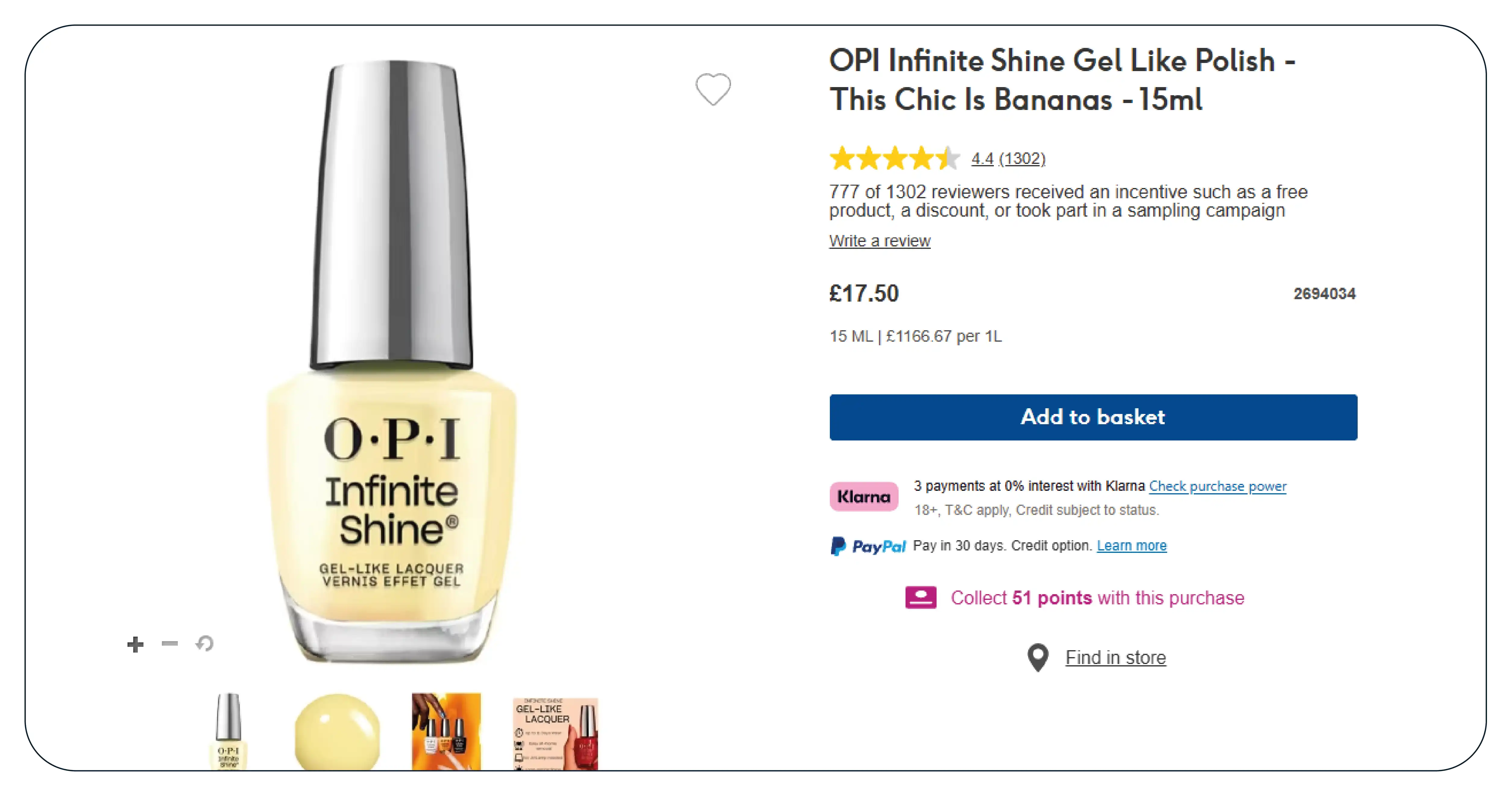
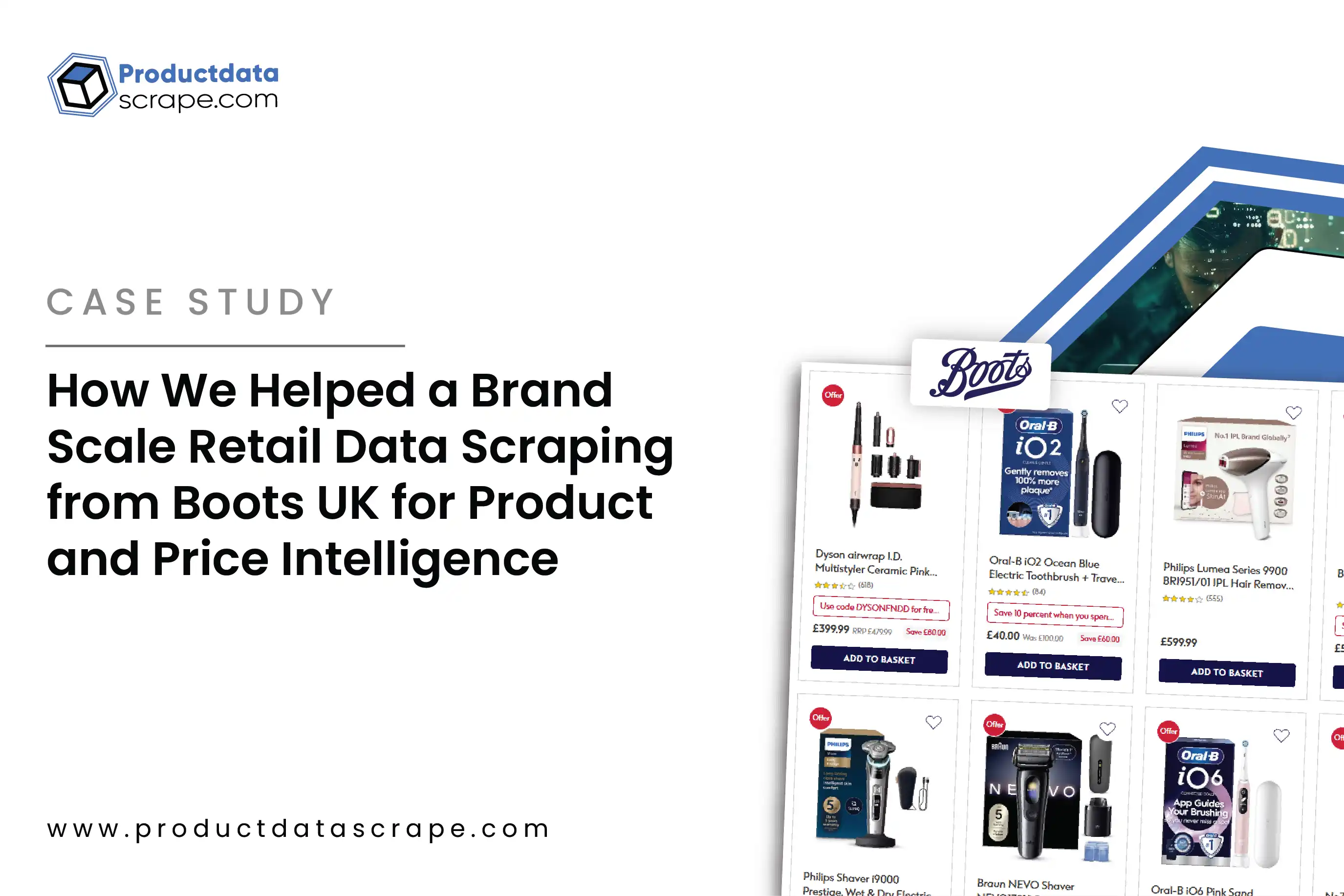
A consumer retail brand partnered with Product Data Scrape to strengthen its product and pricing intelligence across Boots UK. The project implemented Retail Data Scraping from Boots UK to collect structured product information, prices, discounts, availability, ratings, and category-level details at scale. The solution also supported Boots beauty & Health pricing analytics, helping the client compare market movements and identify pricing opportunities more efficiently. Automated extraction and validation replaced fragmented manual research with a repeatable data pipeline. The project improved data consistency, accelerated research workflows, and established a scalable foundation for ongoing retail intelligence and competitive monitoring.
Client Name / Industry: Consumer Retail Brand / Beauty & Health
Service / Duration: Boots UK Product & Price Data Scraping / 6 Months
Key Impact Metrics: 95%+ data accuracy | 80% reduction in manual processing | 3× faster data analysis
The Client
The client was a consumer retail brand operating in the competitive beauty, health, and personal-care sector. With customers increasingly comparing products, prices, promotions, reviews, and availability across online retailers, the brand needed timely market intelligence to support informed commercial decisions.
Boots UK represented an important source of competitive retail information because of its extensive assortment across beauty, healthcare, personal care, and wellness categories. However, monitoring such a broad product ecosystem manually created significant operational pressure. The client's existing process involved visiting product pages, recording pricing information, checking availability, and maintaining spreadsheets. As product volumes increased, keeping these records current became increasingly difficult.
The transformation was essential to help the client move from fragmented research toward an automated and scalable data workflow. Using Scrape Boots UK Product Data, the project captured product-level attributes in a structured format. The implementation also explored Web Scraping Boots workflows to support systematic collection and standardized processing.
Before partnering with Product Data Scrape, the client faced inconsistent updates, repetitive manual work, limited historical visibility, and challenges in comparing products across categories. Analysts spent considerable time collecting and cleaning information instead of focusing on strategic analysis.
Product Data Scrape introduced automated extraction, validation, normalization, and scheduled data processing, giving the client a stronger foundation for retail intelligence.
Goals & Objectives
The primary business goal was to create a scalable and reliable system for monitoring Boots UK product information. The client wanted faster access to accurate data while reducing repetitive manual research.
Improve product and pricing data accuracy.
Scale data collection across multiple categories.
Reduce manual research requirements.
Accelerate competitive analysis.
Establish a repeatable retail-data workflow.
Technical objectives focused on automation, integration, standardization, and analytics readiness. The solution needed to capture product attributes consistently while supporting future expansion.
Automate product-data extraction.
Standardize product, price, availability, and review fields.
Integrate structured datasets with analytics workflows.
Support Boots UK Product Availability Tracking.
Enable scheduled data refreshes.
Create analytics-ready outputs for business teams.
Achieve 95%+ data accuracy.
Reduce manual processing by 80%.
Improve data-processing speed by 3×.
Increase consistency of scheduled updates.
Reduce duplicate and incomplete product records.
The Core Challenge
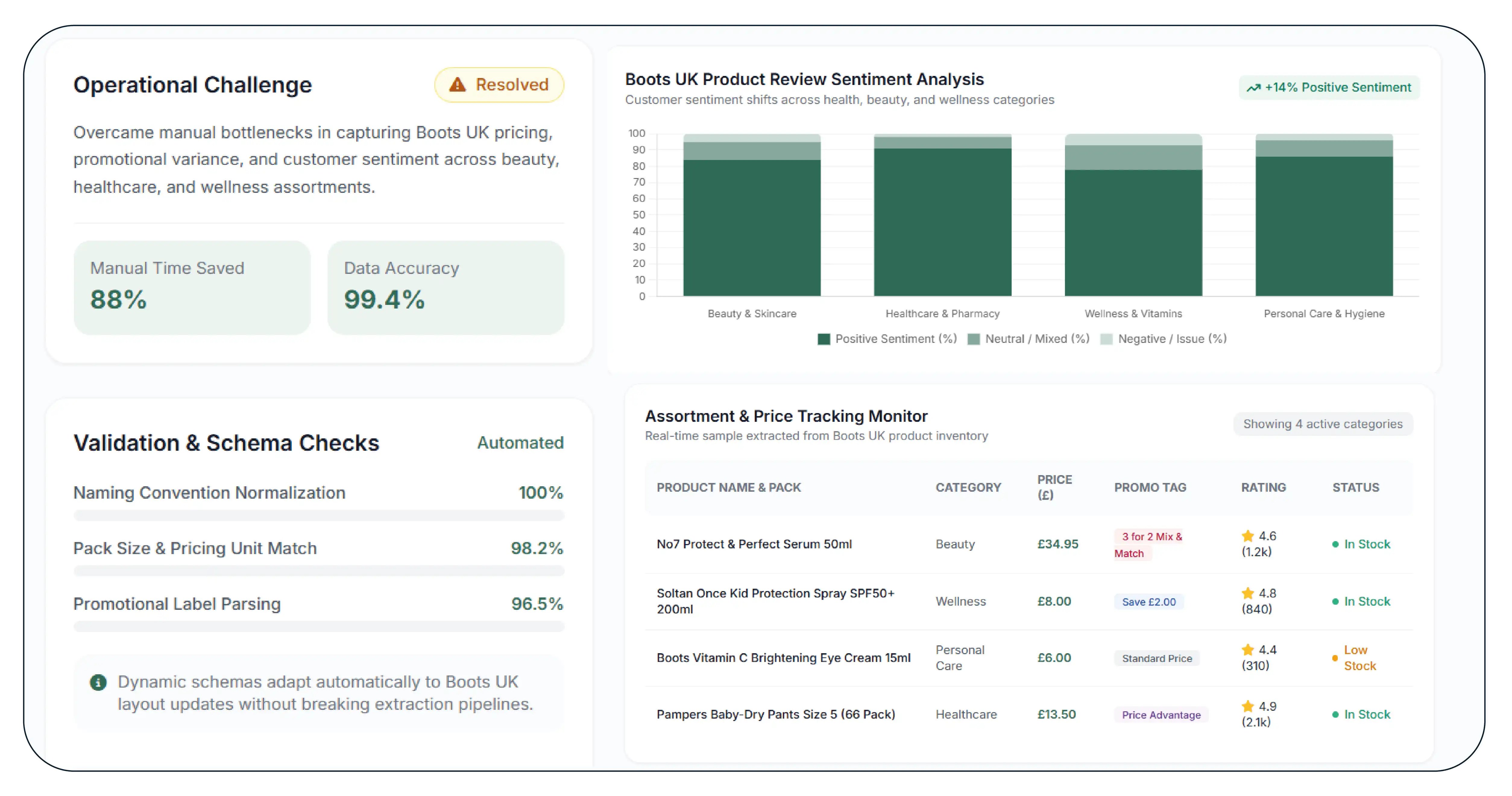
The client's existing retail intelligence workflow faced several operational and technical limitations. Boots UK contains a large and frequently changing assortment across beauty, healthcare, wellness, and personal-care categories. Product prices, promotional offers, availability, ratings, and customer feedback can change over time, creating a continuous monitoring requirement.
Manual collection was one of the largest bottlenecks. Analysts had to navigate multiple product pages, capture information, verify records, and update spreadsheets. This process became increasingly difficult as the number of products and categories grew.
Data quality was another concern. Product information could contain inconsistent naming conventions, different pack sizes, changing promotional labels, and incomplete fields. Without automated validation, these inconsistencies could affect competitive analysis.
The client also needed deeper Boots UK Product Review Analysis to understand product sentiment and customer response alongside pricing and assortment information. However, collecting and organizing review-related data manually added another layer of complexity.
Frequent website changes could further disrupt conventional extraction processes. A scalable solution therefore needed automated workflows, structured schemas, validation mechanisms, and flexible processing.
These challenges affected the speed at which analysts could obtain actionable information. Delayed or incomplete data reduced the usefulness of competitive intelligence and made it harder to respond quickly to market changes.
Our Solution
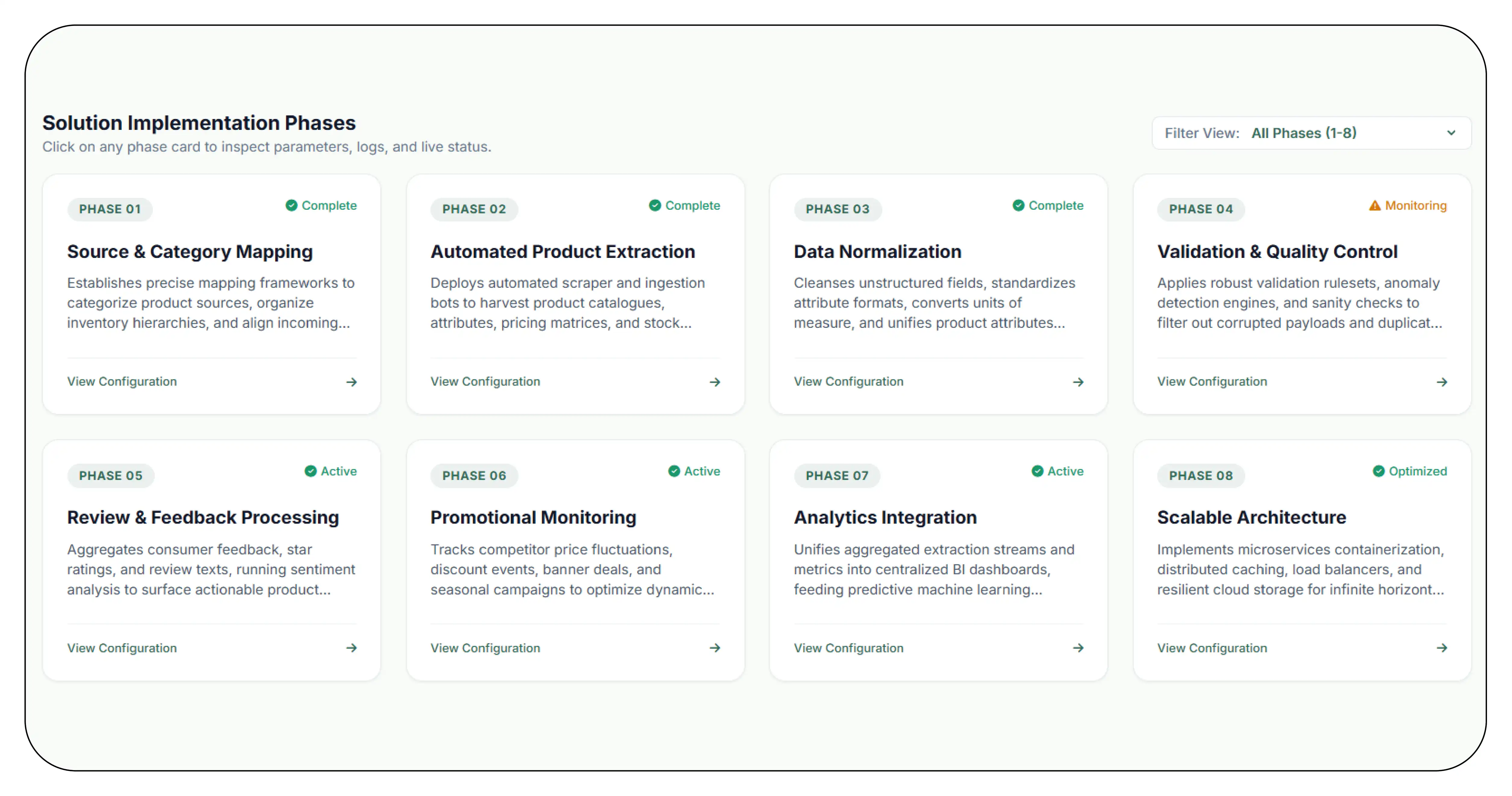
Product Data Scrape developed a phased data-collection and analytics workflow designed around scalability, consistency, and automation.
Phase 1: Source & Category Mapping
The first phase identified relevant Boots UK product categories and mapped key attributes such as product names, brands, prices, discounts, availability, ratings, reviews, pack sizes, and product identifiers. This created a consistent extraction framework.
Phase 2: Automated Product Extraction
Automated workflows were implemented to collect product information at scale. The system captured relevant fields and organized them into structured records, reducing repetitive manual collection.
Phase 3: Data Normalization
Because product information can vary across categories, normalization rules were applied to standardize names, pricing formats, units, categories, and availability indicators. This made cross-product analysis more consistent.
Phase 4: Validation & Quality Control
Automated checks identified missing attributes, duplicate products, inconsistent values, and unusual changes. Validation improved dataset reliability before information entered analytical workflows.
Phase 5: Review & Feedback Processing
The workflow incorporated Boots UK Customer Feedback Data to complement product and pricing information. Structured customer-feedback attributes could be associated with relevant products, supporting deeper product-performance analysis.
Phase 6: Promotional Monitoring
The system was configured to capture promotional information, allowing teams to identify changes in discounts and promotional positioning. This created a stronger foundation for competitive retail analysis.
Phase 7: Analytics Integration
Processed data was organized into structured outputs suitable for business intelligence and reporting environments. Automated workflows helped teams work with refreshed information without repeatedly collecting records manually.
Phase 8: Scalable Architecture
The final framework was designed to support additional categories, products, attributes, and monitoring frequencies. The resulting Retail Data Scraping from Boots UK workflow gave the client a repeatable foundation for product, pricing, availability, and competitive intelligence.
Results & Key Metrics
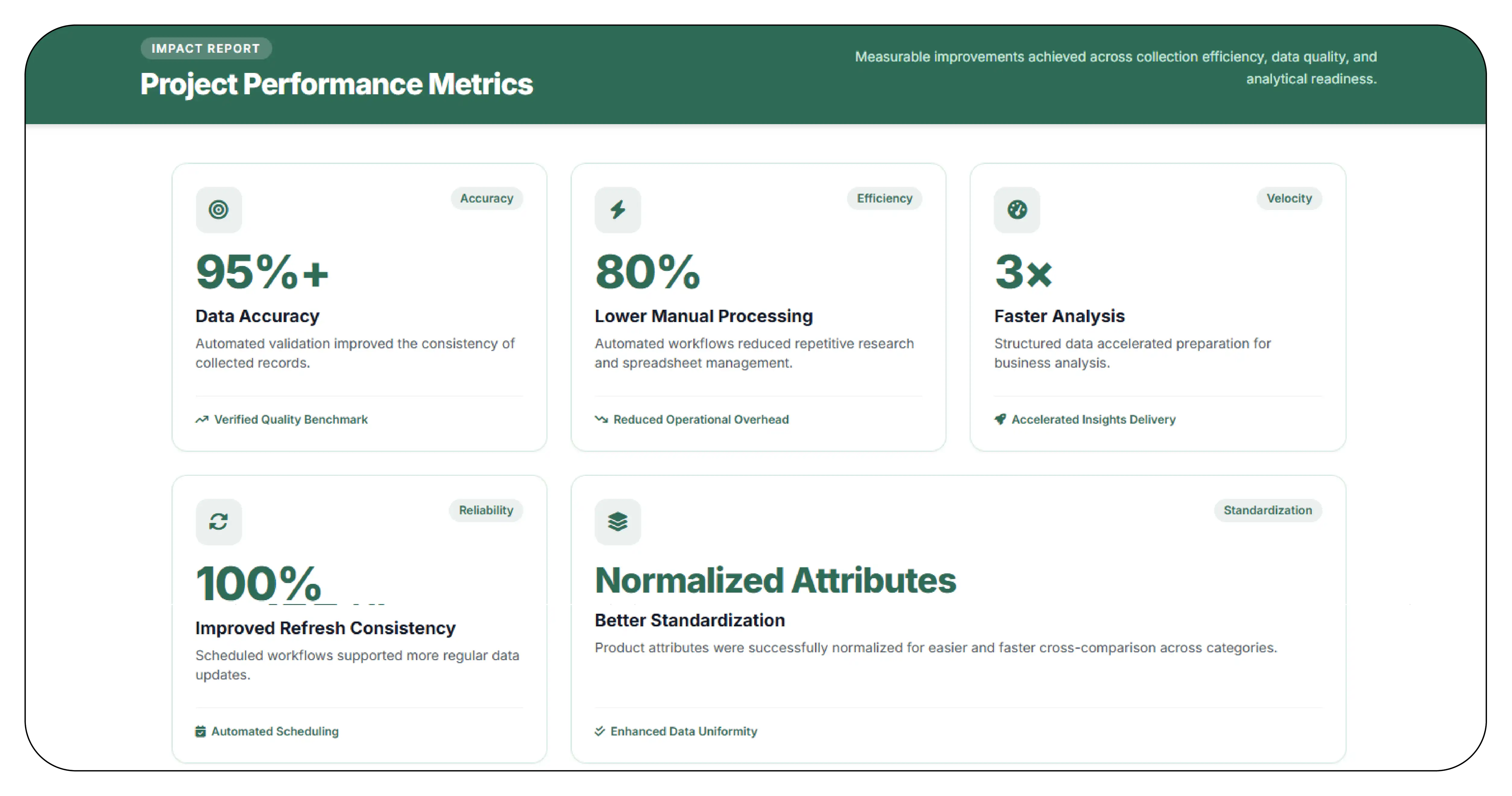
The project delivered measurable improvements across collection efficiency, data quality, and analytical readiness.
95%+ data accuracy: Automated validation improved the consistency of collected records.
80% lower manual processing: Automated workflows reduced repetitive research and spreadsheet management.
3× faster analysis: Structured data accelerated preparation for business analysis.
Improved refresh consistency: Scheduled workflows supported more regular data updates.
Better standardization: Product attributes were normalized for easier comparison.
Results Narrative
The implementation gave the client a stronger foundation for retail intelligence. Boots UK Promotional Product Data could be systematically collected and analyzed alongside product attributes, pricing, and availability information. Automation reduced the burden on analysts while improving the consistency of the resulting dataset. Historical records could also support comparisons of product and promotional movements over time. By replacing fragmented manual workflows with structured processing, the client gained faster access to actionable information and improved its ability to identify competitive changes. The architecture also provided flexibility for expanding monitoring across additional categories and retail intelligence use cases.
What Made Product Data Scrape Different
Product Data Scrape differentiated its approach by combining automated extraction, intelligent validation, structured data processing, and scalable delivery into one workflow. Rather than simply collecting individual product pages, the solution created an analytics-ready retail data infrastructure.
The framework could support integrations with Boots API Product Data workflows where applicable, while maintaining standardized schemas across product, price, availability, promotional, and review information.
Automated validation helped identify missing records, duplicates, inconsistent attributes, and unexpected changes. The architecture was also designed for expansion, allowing new product categories and monitoring requirements to be incorporated efficiently.
This combination of automation, data quality controls, structured outputs, and scalable architecture enabled the client to move beyond basic scraping and develop a sustainable product and price intelligence capability.
Client's Testimonial
"Product Data Scrape helped us significantly improve how we collect and analyze retail information. Previously, our team spent considerable time manually checking product pages, prices, promotions, and availability. The automated workflow gave us structured information that was easier to analyze and maintain. We also gained better visibility into product-level changes and competitive movements. The consistency of the data made our reporting processes more efficient and helped our analysts spend more time interpreting insights rather than preparing datasets. The solution has become an important part of our retail intelligence workflow and has strengthened our use of E-Commerce Datasets for strategic decision-making."
— Director of E-commerce Analytics, Client Organization
Conclusion
The Boots UK project demonstrated how automated retail data collection can help brands improve product and pricing intelligence. Product Data Scrape transformed fragmented product information into structured, validated, and analytics-ready data. The solution improved collection efficiency, reduced manual processing, and strengthened visibility into product availability, promotions, reviews, and pricing movements. By creating a scalable framework, the client can continue expanding its retail monitoring capabilities across categories and intelligence use cases. The resulting Pricing intelligence foundation supports faster competitive analysis and more informed commercial decisions. As online retail continues to evolve, reliable and regularly refreshed data can help brands respond to market changes with greater speed, consistency, and confidence.
FAQs
1. What data can be collected from Boots UK?
Depending on source availability, retail datasets can include product names, brands, categories, prices, discounts, availability, ratings, reviews, pack sizes, product identifiers, and promotional information.
2. Why is Boots UK product data valuable for brands?
Boots UK product data can help brands monitor competitors, benchmark prices, track promotions, analyze assortment, understand availability, and identify product-level market movements.
3. Can Boots UK data collection be automated?
Yes. Automated workflows can collect, normalize, validate, and organize product information at scale. Scheduled processes can also support recurring data updates.
4. How can businesses use Boots UK pricing data?
Businesses can use pricing data for competitor benchmarking, promotional analysis, assortment planning, price monitoring, market research, and commercial strategy.
5. Can the scraping solution scale across product categories?
Yes. A scalable architecture can expand across beauty, healthcare, personal care, wellness, and other categories. Standardized schemas and automated validation help maintain data consistency as product coverage grows.


 Singapore
 EMAIL
EMAIL
 PHONE
PHONE










.webp)