Introduction
Private Label Price Data Scraping helps retailers identify competitor pricing gaps, track market movements, compare private-label products with national brands, and uncover opportunities to improve margins and sales. The core benefit is simple: retailers gain structured, recurring price intelligence instead of relying on occasional manual checks.
Private labels have become increasingly important to retail strategy. McKinsey reported that private-label penetration increased across many European markets during 2023, while private brands continued gaining consumer acceptance in multiple categories. In the United States, private-label dollar sales reached $236 billion in 2024, according to PLMA data reported by industry publications.
Retailers, grocery chains, marketplaces, consumer brands, category managers, pricing teams, private-label CPG teams, and retail executives.
The growth has been supported by changing consumer behavior, inflation, and retailer efforts to provide value while protecting margins. During the 2020–2022 period, grocery prices increased substantially, encouraging shoppers to consider lower-priced alternatives. The U.S. Bureau of Labor Statistics reported that food-at-home prices rose 3.5% in 2020, 3.5% in 2021, and 11.4% in 2022.
By 2026, private-label competition is no longer limited to basic value products. Retailers increasingly position private brands across value, premium, organic, wellness, convenience, and specialty categories.
This creates a complex pricing environment. A retailer must determine not only whether its private label is cheaper than a national brand, but whether the price difference is large enough to motivate switching while still delivering acceptable margins.
Analyze Private Label pricing using product-level, retailer-level, category-level, and historical data. A structured dataset can reveal where private-label products are overpriced, underpriced, unavailable, or poorly positioned against competing products.
For category managers, pricing teams, retail executives, and private-label CPG teams, the objective is to answer five practical questions:
- Where are competitors cheaper?
- Which categories have the largest price gaps?
- Which private-label products are gaining or losing price competitiveness?
- Where are products unavailable?
- Which pricing gaps represent genuine revenue opportunities?
Why has private-label competition become a major pricing issue?
Private-label pricing is no longer simply about offering the cheapest alternative. Retailers must balance consumer value, brand positioning, competitor prices, promotional intensity, pack sizes, and profitability.
The 2020–2026 period provides a useful backdrop. Food-at-home inflation accelerated dramatically in 2022, when U.S. prices increased 11.4%. Although inflation moderated afterward, elevated price levels continued to influence consumer purchasing behavior.
At the same time, private-label products gained greater visibility. PLMA reported that U.S. store-brand sales reached record levels in 2024, with store brands accounting for approximately 20% of unit sales across tracked categories.
| Period |
Market development |
Pricing implication |
| 2020 |
Food-at-home inflation +3.5% |
Value positioning gains importance |
| 2021 |
Food-at-home inflation +3.5% |
Private-label comparison expands |
| 2022 |
Food-at-home inflation +11.4% |
Strong value pressure |
| 2023 |
Inflation moderates |
Price gaps remain important |
| 2024 |
U.S. store brands reach record sales |
Private labels become more strategic |
| 2025 |
Continued private-label competition |
Greater need for price benchmarking |
| 2026 |
Data-driven retail pricing expands |
Continuous monitoring becomes valuable |
The figures above are reported market indicators from the cited sources, not a single private-label market-size series.
A private-label product priced 15% below a national brand may be attractive in one category but unnecessary in another. If consumers perceive the products as highly comparable, a smaller gap may preserve more margin. If brand loyalty is strong, a larger discount may be required.
That is why pricing teams need historical competitive data rather than one-time observations.
How can retailers compare private-label prices with national brands?
Grocery Private Label Price Tracking allows retailers to monitor how their private-label products compare with competing products over time. The analysis becomes more valuable when each product is mapped by category, pack size, unit price, retailer, and competitor.
A major challenge is comparing equivalent products. A 500g private-label cereal should not automatically be compared with a 750g national-brand cereal simply because both are breakfast cereals.
The dataset should normalize:
- Product category
- Brand type
- Pack size
- Unit count
- Unit price
- Product formulation
- Flavor or variant
- Promotional status
- Retailer
- Collection date
National Brands should also be segmented by price tier. A private label may compete with mainstream brands differently from premium brands.
| Comparison |
What retailers learn |
| Private label vs value brand |
Minimum competitive price |
| Private label vs mainstream brand |
Core price gap |
| Private label vs premium brand |
Premium positioning |
| Regular vs promotional price |
Promotion dependency |
| Price per unit |
True value comparison |
| Price history |
Competitive movement |
According to BLS data, food-at-home prices increased sharply in 2022, making price-value comparisons particularly important.
A useful metric is the private-label price index:
Private-Label Price Index = Private-Label Unit Price ÷ Comparable National-Brand Unit Price × 100
If the result is 80, the private label is priced at 80% of the comparable national brand.
Retailers can calculate this at SKU, category, retailer, city, and month levels. A category manager might discover that private labels are 18% cheaper than national brands in snacks but only 7% cheaper in cleaning products.
That insight can guide selective pricing changes rather than broad discounts.
The goal is not always to maximize the price gap. It is to determine the smallest competitive gap that preserves the desired value perception and margin.
How can retailers prevent private-label sales losses caused by poor availability?
Private Label Product Availability Monitoring identifies whether shoppers can actually purchase the private-label products being tracked.
Price intelligence without availability data can produce misleading conclusions. A private-label SKU may appear competitively priced, but if it is frequently out of stock, the retailer may still be losing sales to national brands or competing retailers.
Availability should therefore be measured alongside price.
Useful metrics include:
- In-stock rate
- Out-of-stock frequency
- Out-of-stock duration
- Retailer coverage
- Store-level availability
- Online availability
- Competitor availability
- Price during availability periods
| Situation |
Likely business problem |
Recommended action |
| Low price + high availability |
Strong position |
Maintain |
| Low price + frequent OOS |
Lost sales opportunity |
Improve replenishment |
| High price + high availability |
Margin opportunity |
Test pricing |
| High price + low availability |
Weak position |
Review assortment |
| Competitor available + private label OOS |
Switching risk |
Prioritize inventory |
| Both unavailable |
Supply/category issue |
Investigate upstream |
Private-label growth makes this particularly important. PLMA reported that U.S. store-brand sales reached record levels in 2024, showing that private labels are increasingly important to retailer revenue.
The analysis can also identify hidden assortment problems. A retailer may technically carry a category but fail to offer its key private-label SKU in important locations.
For example, if a retailer's private-label olive oil is available in 85% of stores while the leading national brand is available in 97%, the retailer has a distribution disadvantage even if its price is lower.
Combining price and availability creates a more useful competitive metric.
Competitive Value Score = Price Competitiveness × Availability Rate
A low-priced product with poor availability should not be treated as a fully competitive offer.
This approach helps category managers distinguish pricing problems from supply problems and prioritize corrective action.
How does retailer-level monitoring reveal local pricing opportunities?
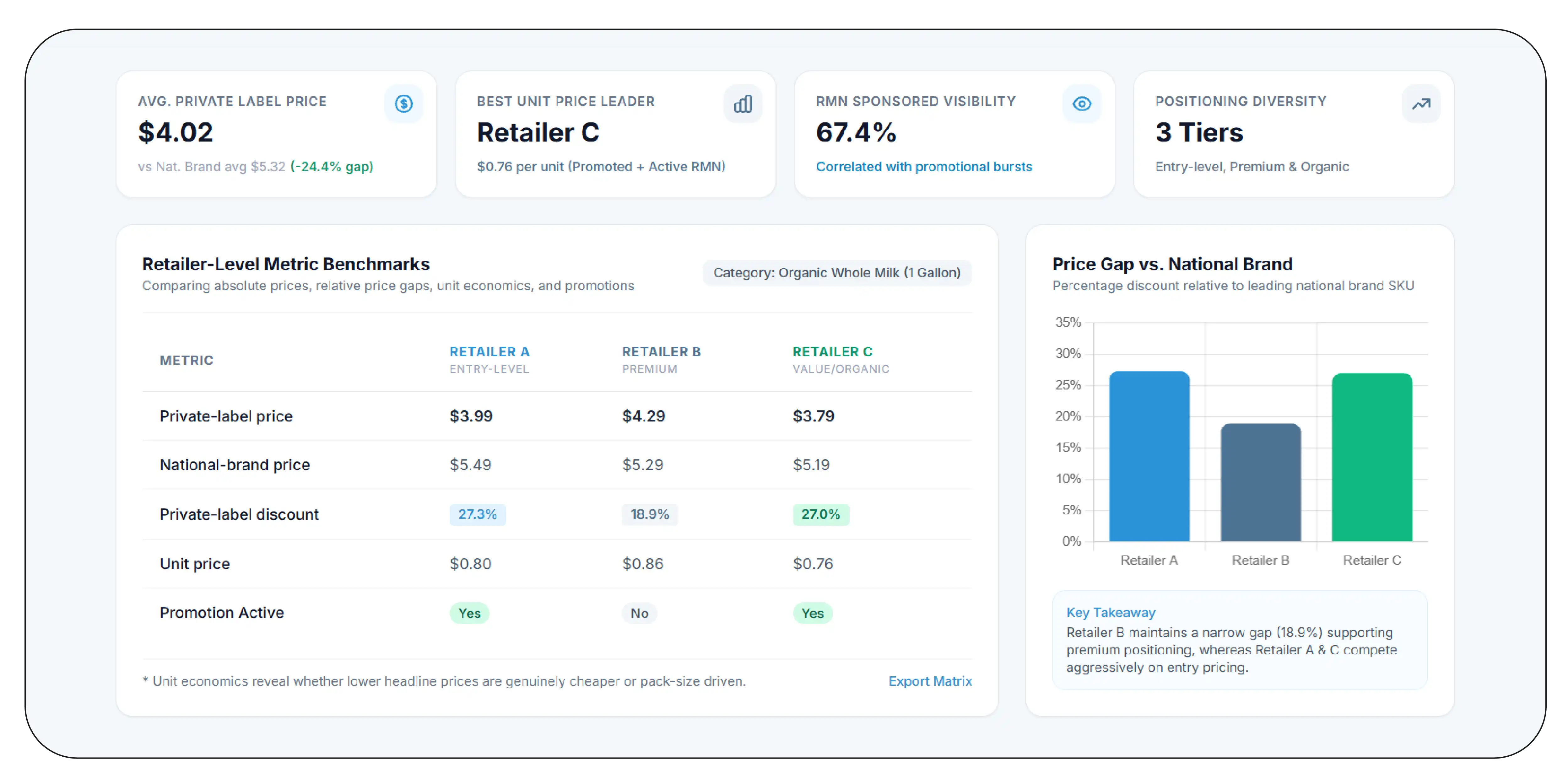
Private Label Price Monitoring Across Retailers enables businesses to compare private-label prices across multiple grocery retailers and marketplaces.
This matters because private-label products often have different positioning between retailers. One retailer may position its store brand as an entry-level alternative, while another may market its equivalent product as premium or organic.
Pricing teams should therefore monitor both absolute prices and relative price gaps.
For example:
| Metric |
Retailer A |
Retailer B |
Retailer C |
| Private-label price |
$3.99 |
$4.29 |
$3.79 |
| National-brand price |
$5.49 |
$5.29 |
$5.19 |
| Private-label discount |
27.3% |
18.9% |
27.0% |
| Unit price |
$0.80 |
$0.86 |
$0.76 |
| Promotion |
Yes |
No |
Yes |
The retailer can then determine whether its private label is genuinely competitive or simply appears cheaper because of different pack sizes.
Retail media adds another layer. Retail media networks increasingly connect advertising, product visibility, promotions, and shopper data. A private-label product may receive sponsored placement even when its price is not the most competitive.
This creates an opportunity to evaluate price and visibility together.
Questions worth monitoring include:
- Does a lower price generate stronger product visibility?
- Are private-label products promoted more heavily?
- Does promotional placement coincide with price reductions?
- Which products receive sponsored exposure?
- Are national brands spending more to maintain visibility?
Retail media spending has grown substantially as retailers develop advertising businesses around their first-party shopper data. The Interactive Advertising Bureau projected U.S. retail media ad spending at $54.48 billion in 2024, demonstrating the increasing commercial importance of this channel.
For private-label teams, this means pricing should not be analyzed separately from digital shelf visibility.
A product can be cheaper but less visible. Another can be more expensive but supported by stronger placement.
The combination of price, availability, promotion, and visibility gives retailers a clearer understanding of actual competitive positioning.
How can brands measure the price gap between store brands and national products?
National Brand vs Private Label Price Scraping helps retailers calculate consistent price differences between private-label products and comparable branded products.
The most useful comparison is not simply shelf price. It is normalized unit economics.
For example, if a private-label 400g product costs $3.20 and a national brand's 500g product costs $4.50, the national brand appears 29% more expensive at shelf level. But unit pricing reveals a different comparison:
- Private label: $8.00/kg
- National brand: $9.00/kg
- Actual unit-price gap: 11.1%
This distinction can significantly change pricing decisions.
Unit Price Comparison Example
| Measure |
Private label |
National brand |
Gap |
| Pack size |
400g |
500g |
Different |
| Shelf price |
$3.20 |
$4.50 |
40.6% |
| Unit price |
$8/kg |
$9/kg |
11.1% |
| Promotion |
No |
Yes |
Different |
| Availability |
95% |
98% |
Different |
Historical data can then show whether the gap is widening or narrowing.
During the inflationary period of 2022, food-at-home prices rose 11.4% in the U.S. That environment created strong incentives for consumers to seek value, making private-label price positioning particularly important.
Retailers should monitor four types of gaps:
- Shelf-price gap — difference in displayed price.
- Unit-price gap — difference after pack-size normalization.
- Promotional gap — difference during discounts.
- Availability-adjusted gap — price difference when both products are actually purchasable.
The fourth metric is especially useful for digital grocery.
If a national brand is priced higher but consistently available while a cheaper private label is unavailable, the observed price gap may overstate the private label's competitive advantage.
This is why historical product-level datasets are more valuable than isolated screenshots or manual price checks.
Retailers can identify categories where price reductions may increase private-label share and categories where the current price already provides enough consumer value.
How can retailers build a scalable private-label intelligence dataset?
Private Label Retail Data Extraction creates structured datasets from online grocery stores, marketplaces, retailer websites, and other digital retail environments.
The goal is to collect more than prices. A useful dataset should contain enough context to support reliable comparison.
| Data field |
Purpose |
| Product name |
Product identification |
| Brand |
Private vs national classification |
| SKU |
Retailer-level identification |
| GTIN/UPC/EAN |
Product matching |
| Category |
Competitive grouping |
| Pack size |
Unit-price normalization |
| Regular price |
Baseline comparison |
| Sale price |
Promotion analysis |
| Availability |
Purchase opportunity |
| Product URL |
Source traceability |
| Image |
Product validation |
| Rating/reviews |
Consumer context |
| Retailer |
Cross-retailer analysis |
| Timestamp |
Historical tracking |
The collection frequency should match the volatility of the category. Highly promotional categories may require daily or more frequent collection, while slower-moving categories may need less frequent monitoring.
Price Scraping becomes more valuable when the dataset preserves historical snapshots rather than replacing old prices.
A retailer can then calculate:
- Average price
- Minimum price
- Maximum price
- Price volatility
- Promotional frequency
- Competitor price index
- Private-label discount
- Availability-adjusted price
- Category price spread
The 2020–2026 period demonstrates why historical context matters. Food inflation changed sharply during these years, with food-at-home inflation reaching 11.4% in 2022 before moderating.
A historical dataset allows teams to distinguish structural pricing changes from temporary promotional movements.
It can also support regional analysis. A private-label product may be priced differently across cities because of local competition, logistics, demand, or retailer strategy.
For enterprise retailers, the most useful architecture connects product data to a central product master. Every observation should retain its retailer, product, category, price, promotion, availability, location, and timestamp.
This turns raw collection into an analytical asset.
How can historical price data reveal revenue opportunities?
Price Scraping creates the historical evidence needed to identify persistent competitive patterns rather than reacting to isolated price changes.
Private Label Price Data Scraping becomes particularly powerful when price observations are connected to product availability, promotions, competitors, categories, and time.
Consider a private-label product priced at 85% of a national brand for six consecutive months. If competitors maintain similar gaps, the retailer may have an opportunity to increase price modestly while retaining a meaningful value advantage.
Conversely, if the private-label product is only 3% cheaper than a well-known national brand, the retailer may need to either reduce price or strengthen perceived value through packaging, quality, promotion, or positioning.
| Pattern |
Potential opportunity |
| Private label far below competitors |
Test margin improvement |
| Private label nearly equal to national brand |
Increase value gap |
| Competitor price declining |
Review price strategy |
| Promotional price gap shrinking |
Reassess promotion |
| Private label high availability |
Increase visibility |
| Private label low availability |
Fix distribution first |
| Large regional price variation |
Test localized pricing |
Revenue opportunity should be calculated rather than assumed.
A simple model is:
Potential Revenue Impact = Estimated Incremental Units × Adjusted Contribution Margin
Pricing teams can model multiple scenarios.
- Scenario A: Maintain current price.
- Scenario B: Increase price by 3%.
- Scenario C: Reduce price by 5%.
- Scenario D: Maintain price but increase promotional visibility.
Historical competitive data can help identify which scenario is most consistent with market conditions.
Private-label growth provides additional strategic context. PLMA reported record U.S. store-brand sales in 2024, reinforcing the growing role of private labels in retail strategy.
By 2026, the competitive question is no longer simply "Is our private label cheaper?"
The better questions are:
- Is the product priced appropriately for its perceived value?
- Is the price gap stable?
- Are competitors changing prices faster?
- Does availability support the price strategy?
- Are promotions creating incremental demand?
- Where can the retailer improve margin without weakening value perception?
These questions transform price data into commercial intelligence.
Why Should Retailers Choose Product Data Scrape?
Product Data Scrape helps retailers, grocery marketplaces, FMCG businesses, and private-label teams organize product-level data for pricing, availability, assortment, and competitor analysis.
A major advantage is the ability to structure recurring observations instead of relying on isolated manual checks. Teams can compare prices by retailer, category, SKU, pack size, and time period.
For a Private Label CPG Brand, this creates a practical way to understand how products are positioned against national brands and competing store brands.
The resulting data can support price indexes, competitive dashboards, assortment analysis, promotion tracking, and availability monitoring.
Private Label Price Data Scraping also supports historical analysis, allowing teams to identify persistent price gaps rather than reacting to one-day changes.
For category managers, pricing analysts, retail strategists, and commercial leaders, structured competitive data can make pricing decisions faster and more defensible.
Conclusion
Private-label pricing decisions require more than occasional competitor checks. Assortment and availability monitoring adds the context needed to understand whether a product's price is genuinely competitive and whether shoppers can purchase it when needed.
Private Label Price Data Scraping enables retailers to track prices, promotions, product availability, pack sizes, and competitor movements over time. This helps identify categories where private labels are underpriced, overpriced, poorly distributed, or positioned against the wrong competitive benchmark.
Historical data also supports scenario planning. Teams can evaluate price changes against competitor movements and identify opportunities to improve margins without weakening value perception.
The most effective strategy connects product, price, promotion, visibility, and availability into one intelligence framework.
Use Product Data Scrape to monitor private-label prices, benchmark competitors, uncover pricing gaps, and identify revenue opportunities with structured retail intelligence!
FAQs
1. What is private-label price data scraping?
Private-label price data scraping collects online product prices, promotions, availability, pack sizes, and competitor information so retailers can benchmark private-label products and improve pricing decisions.
2. Why compare private labels with national brands?
Comparing private labels with national brands helps retailers measure price gaps, understand consumer value positioning, identify competitive weaknesses, and determine whether pricing supports desired margins.
3. How often should private-label prices be monitored?
Monitoring frequency depends on category volatility. Highly promotional grocery categories may benefit from daily collection, while slower-moving categories can use less frequent historical monitoring.
4. Can pricing data reveal revenue opportunities?
Yes. Historical price gaps can identify products where prices may be increased, reduced, or promoted differently while maintaining a competitive position against comparable products.
5. How does Product Data Scrape support private-label analysis?
Product Data Scrape can help organize product, pricing, availability, assortment, and competitor observations into structured datasets for historical benchmarking and commercial analysis.


 Singapore
 EMAIL
EMAIL
 PHONE
PHONE










.webp)