Introduction
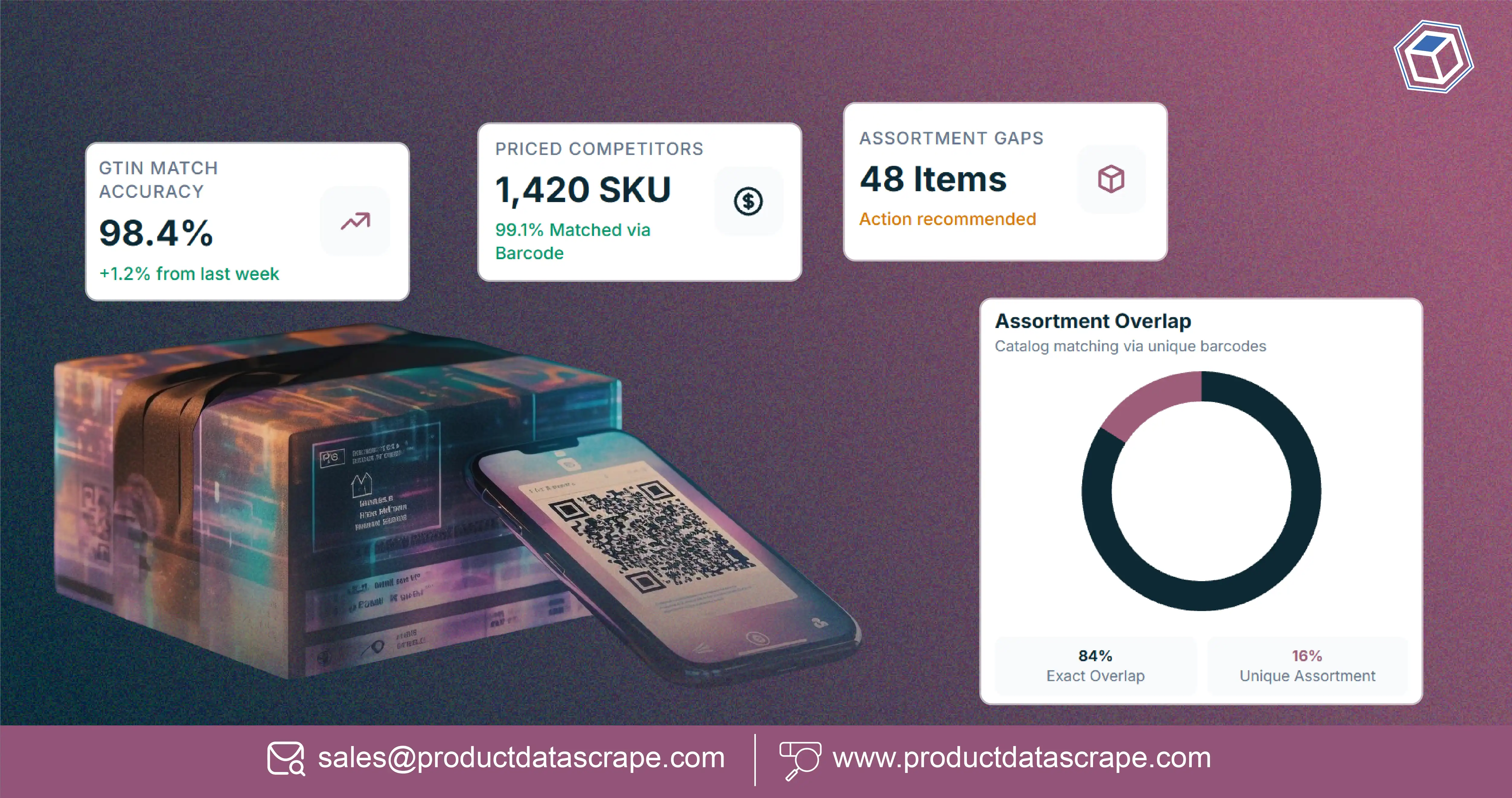
Barcode and GTIN Matching for Grocery Data matters because grocery products frequently appear across retailers with different names, descriptions, pack sizes, retailer IDs, and images. Matching these records to a consistent product identity allows brands and retailers to compare equivalent products accurately, eliminate duplicates, monitor pricing, and analyze assortment without confusing similar SKUs.
The need for reliable product identification has grown alongside digital grocery. In the United States, grocery-store sales increased from $759.7 billion in 2020 to $858.3 billion in 2022, according to the U.S. Census Bureau. Meanwhile, e-commerce expanded sharply during the pandemic, with U.S. e-commerce sales increasing 43% in 2020.
GS1 reports that more than 1 billion products now carry GS1 barcodes and that barcodes are scanned billions of times every day worldwide. In 2024, GS1 marked the 50th anniversary of the first barcode scan and highlighted the industry's transition toward next-generation 2D barcodes.
For grocery brands, marketplaces, retailers, pricing teams, and competitive-intelligence professionals, this creates a critical data challenge. A retailer may list a 500g cereal pack under one title, another may use a shortened brand name, and a third may emphasize a promotional bundle. Without a reliable product identifier, automated comparison can mistakenly treat these records as different products—or combine genuinely different variants.
Barcode Data Scraping can capture identifiers alongside product names, pack sizes, prices, images, descriptions, and retailer information. When those identifiers are standardized and validated, product datasets become much more useful for pricing intelligence, assortment analysis, catalog enrichment, and competitor benchmarking.
The core principle is simple: accurate product identity must come before accurate product comparison.
Why is consistent product identification essential for grocery analytics?
Grocery catalogs contain enormous variation. A single brand can sell different sizes, flavors, bundles, formulations, and regional packs. Retailers may structure these products differently, creating duplicate or fragmented records.
For example, "Brand X Organic Milk 1L," "Brand X Organic Whole Milk 1000ml," and "Organic Milk – Brand X – 1 Litre" may represent the same underlying trade item. A simple text-matching system can either fail to connect them or connect two products that only look similar.
GTINs provide a standardized identification framework. GS1 describes the GTIN as a globally unique identifier for trade items, while its registry and data services support product verification and trusted product information exchange.
The commercial impact is significant because product matching sits underneath several business processes.
| Business requirement |
Why product identity matters |
| Price comparison |
Ensures prices belong to equivalent products |
| Assortment analysis |
Prevents duplicate SKU counting |
| Competitor tracking |
Creates comparable retailer datasets |
| Catalog management |
Reduces duplicate records |
| Product enrichment |
Connects missing attributes |
| Image management |
Associates correct images with products |
| Promotion analysis |
Links discounts to the correct SKU |
| Market research |
Improves category-level comparisons |
The 2020–2026 period demonstrates why this infrastructure has become more important. Online commerce expanded rapidly during the pandemic, while grocery remained a large retail category. U.S. grocery-store sales rose from $759.7 billion in 2020 to $793.4 billion in 2021 and $858.3 billion in 2022.
As digital grocery catalogs expanded, the number of product records requiring normalization also increased.
For a pricing manager, the practical lesson is important: comparing prices before confirming product identity can create misleading price indexes. For a category manager, counting retailer listings before matching products can exaggerate assortment breadth. For a data team, inconsistent identifiers can undermine downstream machine-learning and analytics workflows.
How can brands connect different product identifiers accurately?
UPC EAN GTIN Product Matching connects different standardized identifiers and product records so that equivalent grocery items can be recognized across retailers, countries, and datasets.
A UPC is commonly used in North America, while EAN-13 is widely used internationally. Both belong to the broader GS1 identification system. The important point for analytics teams is not simply storing a barcode string. The identifier needs to be associated with the correct trade item and validated against other attributes.
Automated Product Matching can then combine identifiers with product name, brand, manufacturer, size, flavor, category, images, and other attributes.
A reliable matching hierarchy might work as follows:
- Exact valid GTIN match.
- Exact normalized barcode match.
- Brand + product identifier match.
- Brand + product name + pack size match.
- Image and attribute similarity.
- Fuzzy text matching for unresolved records.
- Human review for ambiguous cases.
This layered approach reduces false matches.
| Matching method |
Accuracy potential |
Best use |
| Exact GTIN |
Very high when validated |
Same product |
| UPC/EAN normalization |
High |
Cross-format records |
| Brand + size |
Medium |
Missing identifiers |
| Text similarity |
Variable |
Candidate generation |
| Image similarity |
Variable |
Visual confirmation |
| Manual validation |
High |
Difficult exceptions |
GS1's 2023/2024 review notes that more than 1 billion products carry GS1 barcodes and that the organization is supporting the transition toward 2D barcodes.
This evolution reinforces the importance of building matching systems that are identifier-aware rather than dependent only on product titles.
From 2020 to 2026, grocery data became increasingly digital, making automated matching more valuable. The U.S. Census Bureau reported that e-commerce sales rose 43% in 2020 alone, from $571.2 billion in 2019 to $815.4 billion.
For grocery businesses, the practical objective is to create a persistent product master where every retailer record can be linked to a trusted product identity.
How does identifier collection improve grocery product datasets?
GTIN Data Scraping for Grocery Products enables teams to collect product identifiers together with the surrounding information required for validation.
A barcode without context is not enough for robust competitive intelligence. Teams should ideally capture the GTIN or UPC/EAN alongside brand, title, pack size, unit quantity, category, price, promotional price, availability, seller, product URL, images, and timestamp.
This creates a richer product record.
For example:
| Field |
Example |
| GTIN |
Product identifier |
| UPC/EAN |
Retail barcode representation |
| Brand |
Manufacturer or consumer brand |
| Product name |
Retailer-facing title |
| Pack size |
500 g |
| Category |
Breakfast cereal |
| Regular price |
Current listed price |
| Sale price |
Promotional price |
| Availability |
In stock |
| Image |
Primary product image |
| Retailer |
Grocery marketplace |
| Timestamp |
Collection date/time |
This information becomes particularly useful when retailers expose different levels of product detail.
One retailer might display a complete barcode, another might show the product in structured metadata, and another might expose the identifier only through page-level information. A collection system should therefore normalize multiple representations.
The 2020–2026 retail environment provides a strong business reason for doing this at scale. U.S. grocery-store sales grew from $694.3 billion in 2019 to $759.7 billion in 2020, a 9.4% increase. By 2022, grocery-store sales had reached $858.3 billion.
At the same time, e-commerce continued becoming a larger component of retail. The Census Bureau reported that e-commerce represented 16.1% of total U.S. retail sales in Q2 2020, compared with 0.6% in Q4 1999.
For brands, collecting identifiers with product attributes creates the foundation for reliable historical comparison. A product can then be tracked even when its retailer title, promotional description, or displayed category changes.
How can retailers compare identical products across different grocery websites?
GTIN Matching Across Grocery Retailers helps businesses determine whether products listed on different grocery websites represent the same trade item.
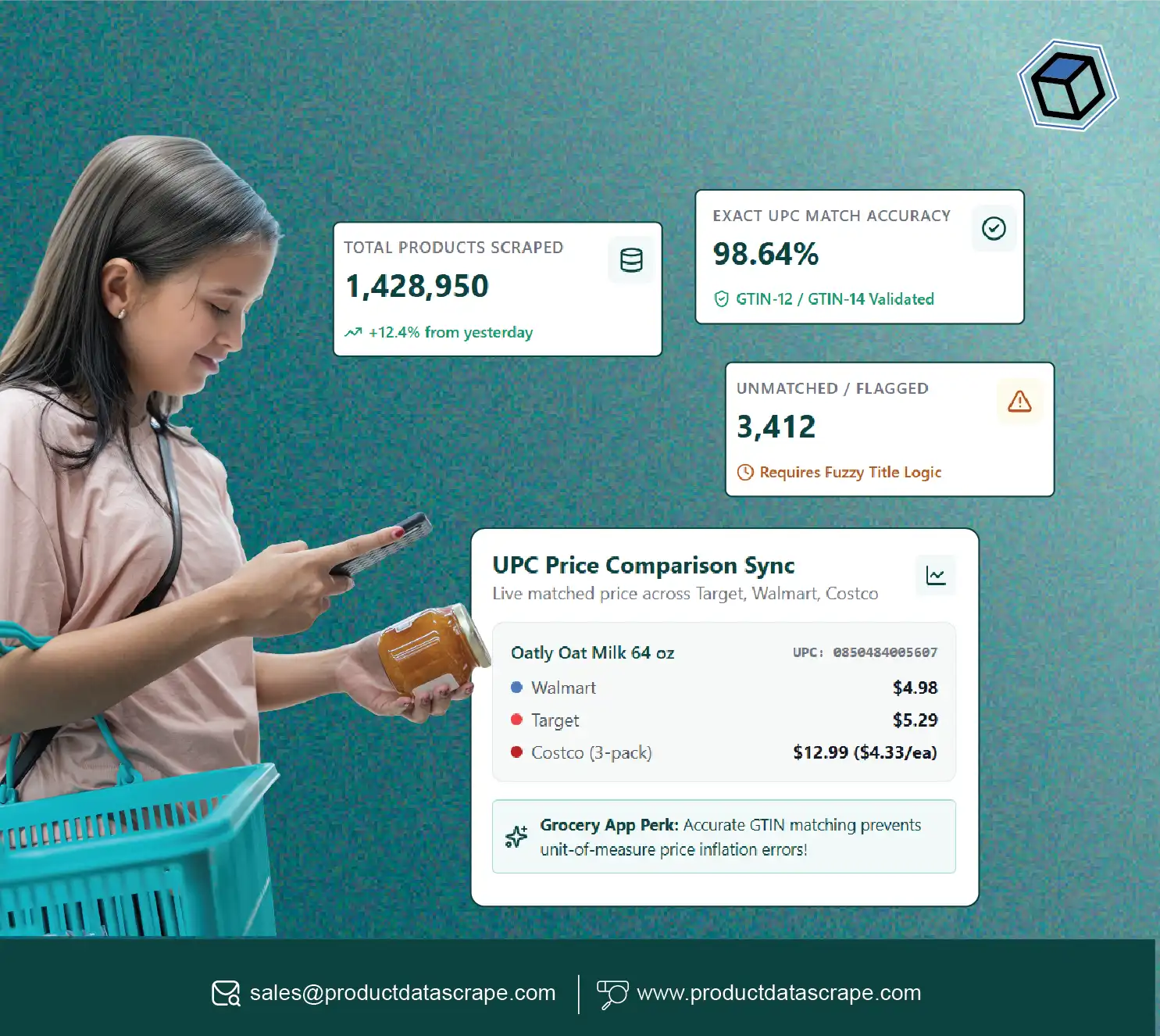
This is essential for price benchmarking. Suppose Retailer A lists a branded 750ml juice bottle at $4.99 while Retailer B lists a 1L bottle at $5.49. A basic title-based comparison might incorrectly conclude that Retailer B is cheaper. Product identity and pack-size normalization reveal that the products are not directly equivalent.
A robust comparison should therefore consider:
- GTIN
- UPC/EAN
- Brand
- Product family
- Net quantity
- Unit count
- Flavor or variant
- Packaging format
- Retailer SKU
- Promotion status
| Comparison layer |
Example question |
| Exact product |
Is the GTIN identical? |
| Pack size |
Are both packs 500g? |
| Variant |
Is the flavor identical? |
| Unit count |
Is it a single item or multipack? |
| Price |
What is the current selling price? |
| Unit price |
Which retailer offers better value? |
| Promotion |
Is one price promotional? |
| Availability |
Can shoppers actually buy it? |
This enables more sophisticated pricing metrics.
Instead of comparing raw shelf prices, brands can calculate unit-price differences, promotional price gaps, retailer price indexes, and price movement over time.
GS1's data ecosystem is designed to support accurate product information exchange. Its Global Data Synchronisation Network provides statistics around GTINs, GLNs, items, subscriptions, and participating companies, reflecting the broader need for standardized product information across trading partners.
Between 2020 and 2026, this need has become increasingly relevant as grocery shopping moved across physical stores, retailer websites, marketplaces, delivery apps, and omnichannel platforms.
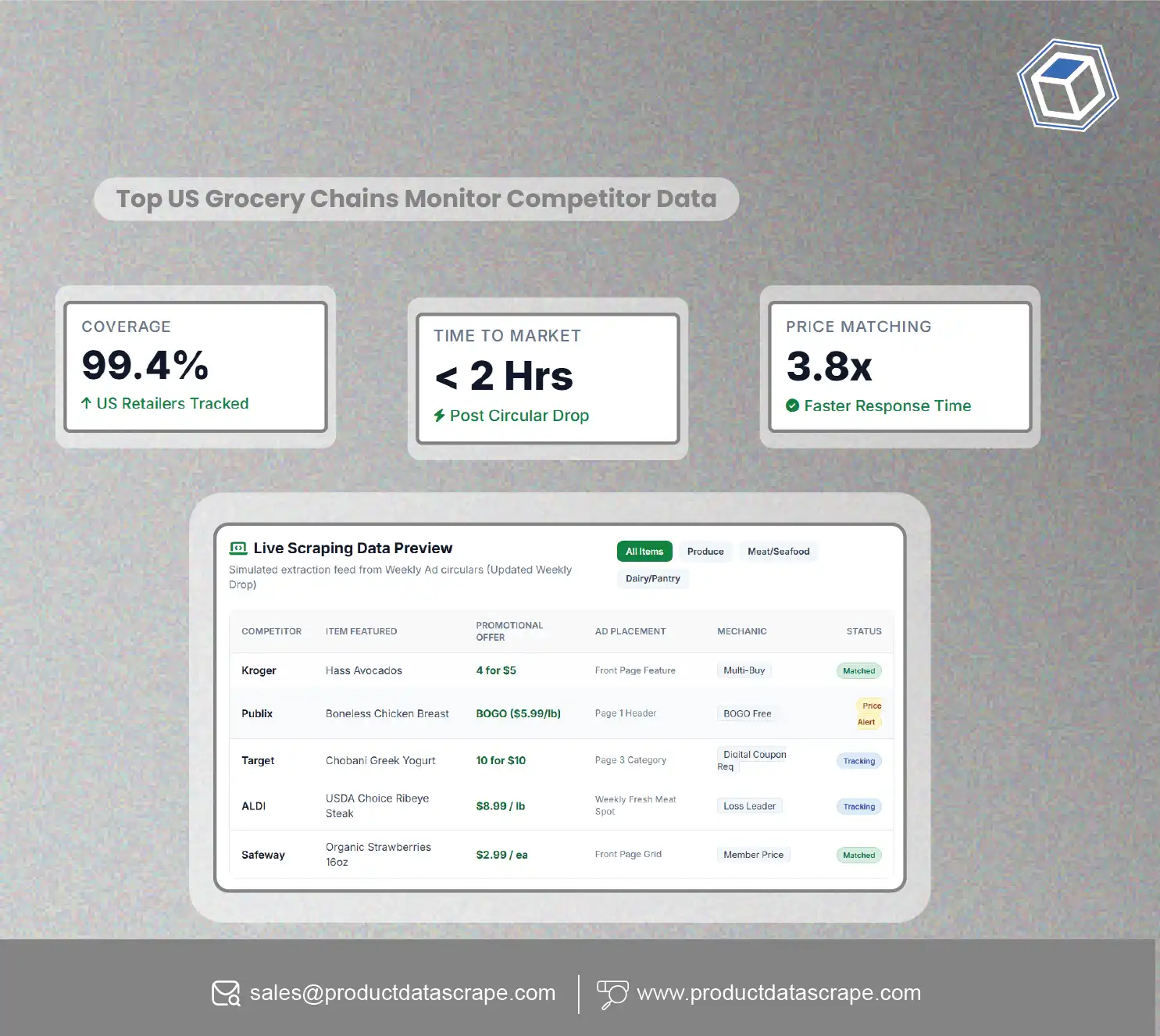
For competitive-intelligence teams, cross-retailer matching prevents false conclusions. Without it, a retailer with more product-title variations may appear to have a larger assortment than it actually does.
The result is cleaner market-share analysis, more accurate price monitoring, and stronger category benchmarking.
How can automated matching reduce manual catalog work?
Automated GTIN Matching for Grocery Data allows large product datasets to be reconciled using a combination of exact identifiers, normalized attributes, similarity models, and validation rules.
Manual matching becomes difficult when a grocery dataset contains hundreds of thousands or millions of records. Analysts cannot reliably inspect every title, image, pack size, and barcode combination.
Automation can divide records into three groups:
| Match status |
Meaning |
Action |
| Confirmed |
Strong identifier or attribute agreement |
Automatically accept |
| Probable |
High similarity but incomplete evidence |
Secondary validation |
| Ambiguous |
Conflicting or insufficient evidence |
Human review |
A good matching system should also preserve confidence scores. A 100% identifier match is different from a 78% text-and-image similarity match.
This distinction matters for downstream analytics. Pricing reports may require stricter confidence thresholds than exploratory assortment research.
The system should also identify common data-quality problems:
- Missing GTIN
- Invalid barcode length
- Duplicate identifier
- Different GTINs assigned to variants
- Incorrect pack-size mapping
- Multipack versus single-unit confusion
- Retailer-specific SKU conflicts
- Product discontinued but still present in old datasets
GS1's Verified by GS1 services are designed to help users verify product identity and access basic product information shared by brand owners.
The broader trend from 2020 through 2026 is toward more structured digital commerce. The Census Bureau maintains extensive e-commerce datasets covering quarterly and annual activity, demonstrating how deeply digital retail measurement has become embedded in commerce analysis.
For a grocery retailer or brand, automated matching should therefore be treated as data infrastructure rather than a one-time cleanup project.
Products change. Retailers change titles. Pack sizes change. Promotions change. New identifiers can appear. Continuous reconciliation keeps the product master usable.
How can barcodes strengthen grocery catalog intelligence?
Barcode-Based Product Catalog Intelligence extends beyond identifying products. Once records are consistently connected, brands can build a much richer view of their grocery categories.
A matched catalog can connect price histories, availability histories, retailer presence, product images, descriptions, promotions, ratings, reviews, and assortment changes to the same product identity.
That enables questions such as:
- Which retailers carry the most products from a category?
- Which SKUs have the largest price differences?
- Which products are consistently out of stock?
- Which variants are missing from competitor catalogs?
- Which products have recently changed packaging?
- Which retailers introduce new products first?
- Which products appear under multiple retailer-specific names?
| Intelligence use case |
Required product connection |
| Price monitoring |
Product + retailer + timestamp |
| Assortment analysis |
Product + category + retailer |
| Availability monitoring |
Product + store/retailer |
| Promotion tracking |
Product + regular/sale price |
| Packaging analysis |
Product + image history |
| Competitor benchmarking |
Product + cross-retailer identity |
| Catalog enrichment |
Product + attributes + images |
GS1 celebrated the 50th anniversary of the first barcode scan in 2024, noting that barcodes are now scanned more than 10 billion times each day.
GS1 also describes the evolution toward QR Codes powered by GS1 and other 2D formats, which can connect physical products to richer digital information.
This creates an important opportunity for grocery businesses. Product identity can become the common key connecting traditional retail data with digital product content.
From 2020 to 2026, the expansion of online retail made that common key increasingly valuable. E-commerce growth means the same product may now be represented across websites, apps, marketplaces, fulfillment platforms, and physical stores.
The business benefit is consistency. When every observation is attached to the right product, analysts can trust the resulting comparisons.
How can product images and barcodes improve matching accuracy?
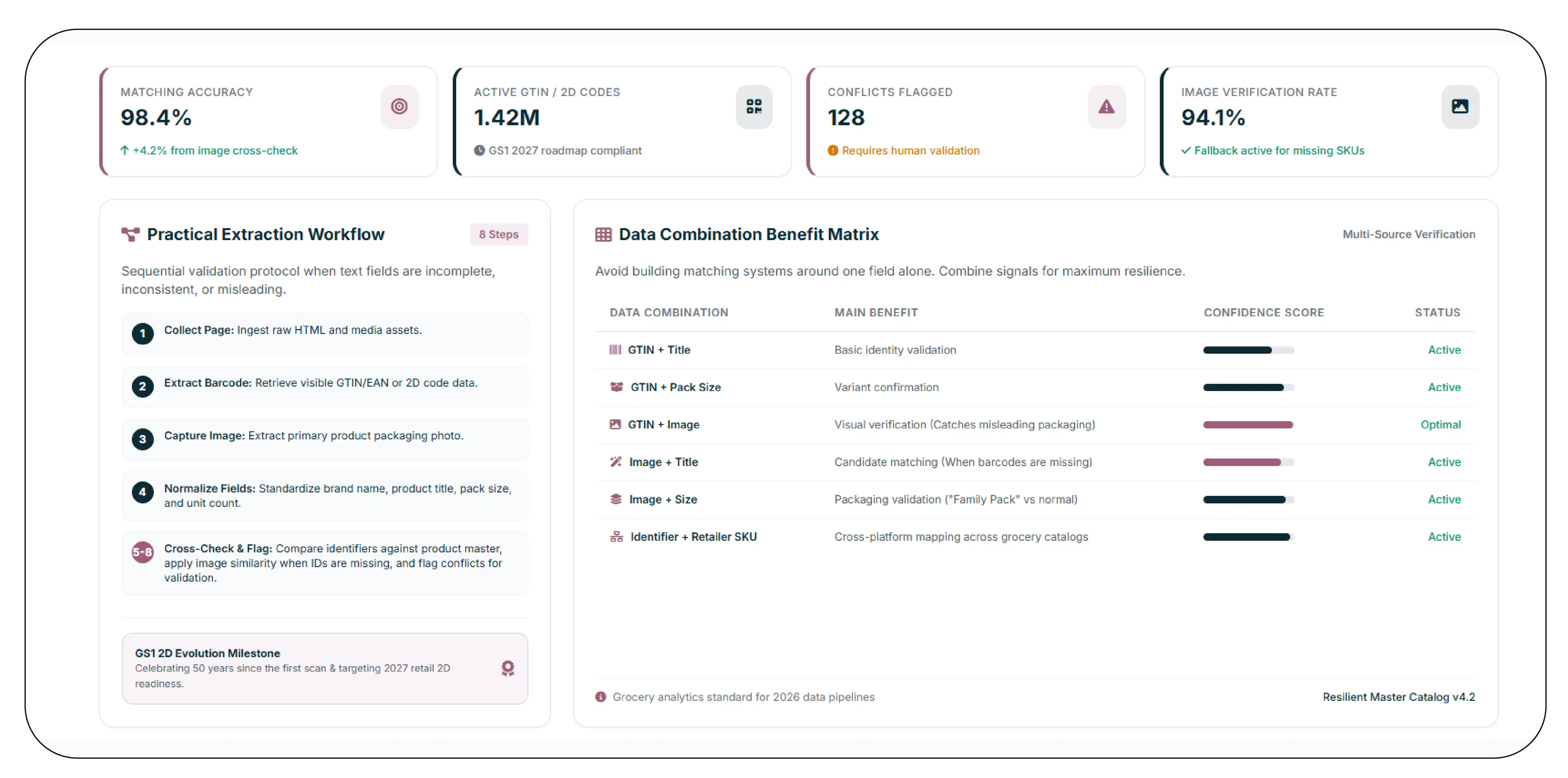
Scrape Product Images & Barcodes (GTIN/EAN) to strengthen product matching when text fields are incomplete, inconsistent, or misleading.
Images provide a valuable secondary verification layer. A product title may say "Family Pack," while the image shows a different pack size. A retailer may omit the GTIN from visible page content while displaying packaging that contains a barcode.
Combining image and identifier data allows teams to cross-check product records.
A practical workflow is:
- Collect the product page.
- Extract the visible barcode or identifier.
- Capture the primary product image.
- Normalize brand and product name.
- Normalize pack size and unit count.
- Compare identifiers against the product master.
- Use image similarity when identifiers are missing.
- Flag conflicts for validation.
| Data combination |
Main benefit |
| GTIN + title |
Basic identity validation |
| GTIN + pack size |
Variant confirmation |
| GTIN + image |
Visual verification |
| Image + title |
Candidate matching |
| Image + size |
Packaging validation |
| Identifier + retailer SKU |
Cross-platform mapping |
This becomes particularly important as barcode technology evolves. GS1's 2020 timeline highlights GS1 Digital Link as a way of connecting products to online information, while its 2021 roadmap targeted broader retail adoption of 2D barcode reading by the end of 2027.
The 2024 milestone was also significant: GS1 marked 50 years since the first barcode scan and highlighted the transition toward richer 2D product experiences.
For grocery analytics teams in 2026, the lesson is to avoid building matching systems around one field alone.
A resilient product master should accommodate identifiers, text, images, pack information, retailer SKUs, and historical records. This makes the dataset more robust when one source field is missing or inconsistent.
Why should grocery businesses choose Product Data Scrape?
Product Data Scrape helps grocery brands, retailers, marketplaces, and data teams build structured product datasets for matching, pricing analysis, assortment intelligence, and competitive benchmarking.
The biggest advantage is organization. Product information collected from multiple retailers can be normalized around identifiers, product names, pack sizes, categories, prices, availability, images, and retailer-specific SKUs.
Product matching becomes more reliable when barcode identifiers are combined with supporting product attributes rather than evaluated in isolation. This helps teams reduce duplicates, connect equivalent products, and build cleaner cross-retailer datasets.
Barcode and GTIN Matching for Grocery Data can support workflows including price comparison, assortment mapping, competitor research, catalog cleanup, and product enrichment.
The resulting datasets can also support historical analysis. Teams can identify when products appeared, disappeared, changed price, changed packaging, or moved between retailers.
For grocery businesses dealing with large catalogs, this creates a scalable alternative to spreadsheet-based reconciliation and manual product matching.
How can brands build a stronger product catalog for future analytics?
A reliable product catalog should be treated as a continuously maintained data asset rather than a static spreadsheet. Catalog Enrichment Services can help organizations add missing identifiers, product attributes, images, categories, pack information, and retailer mappings.
The process should begin with product identity and then expand outward.
First, establish the correct product record. Next, connect retailer-specific records. Then enrich the record with attributes, images, prices, availability, and historical observations.
This sequence prevents a common problem: enriching the wrong product.
Barcode and GTIN Matching for Grocery Data provides the identity layer needed to connect these datasets consistently. Once products are correctly mapped, brands can create reliable price indexes, assortment comparisons, competitive reports, and catalog intelligence.
A practical governance framework should include:
- Identifier validation
- Duplicate detection
- Pack-size normalization
- Variant classification
- Retailer SKU mapping
- Image verification
- Confidence scoring
- Historical version control
- Exception management
This becomes increasingly important as grocery commerce expands across channels. The U.S. Census Bureau's e-commerce reporting infrastructure now includes quarterly historical releases through 2026, reflecting the continuing importance of digital retail measurement.
For data teams, the goal should be simple: every product observation should answer what product is this, which variant is it, where was it found, what did it cost, and when was it observed?
That level of consistency turns raw grocery listings into dependable business intelligence.
Conclusion
Accurate grocery analytics starts with accurate product identity. Catalog Enrichment Services can strengthen product records by connecting identifiers with names, attributes, pack sizes, images, prices, and retailer-specific information.
Barcode and GTIN Matching for Grocery Data helps brands and retailers compare equivalent products instead of relying on inconsistent titles or retailer SKUs. This improves pricing analysis, assortment benchmarking, competitive intelligence, catalog management, and historical product tracking.
The strongest approach combines standardized identifiers with supporting evidence such as images, product attributes, and retailer data. It also maintains confidence scores and exception workflows for ambiguous records.
Use Product Data Scrape to build cleaner grocery product datasets with reliable identifiers, richer catalog attributes, and accurate cross-retailer product matching for smarter pricing and competitive decisions!
FAQs
1. What is GTIN matching in grocery data?
GTIN matching connects grocery product records using standardized trade-item identifiers, helping businesses recognize equivalent products across retailers despite different names, descriptions, categories, and retailer-specific SKUs.
2. Why are barcodes useful for product matching?
Barcodes provide machine-readable product identifiers that can strengthen cross-retailer matching, reduce duplicate records, support accurate price comparisons, and distinguish product variants with greater confidence.
3. Can GTIN matching improve competitor pricing analysis?
Yes. Matching equivalent products allows brands to compare like-for-like prices, promotions, pack sizes, and unit values instead of accidentally comparing different grocery variants.
4. How do images support barcode matching?
Product images provide secondary evidence when identifiers are missing or conflicting. Packaging visuals can help validate brand, variant, size, and multipack information during product reconciliation.
5. Can Product Data Scrape help with grocery product matching?
Yes. Product Data Scrape can support structured grocery data collection and organization, helping teams connect product identifiers with retailer listings, prices, attributes, availability, and images.


 Singapore
 EMAIL
EMAIL
 PHONE
PHONE










.webp)