Quick Overview
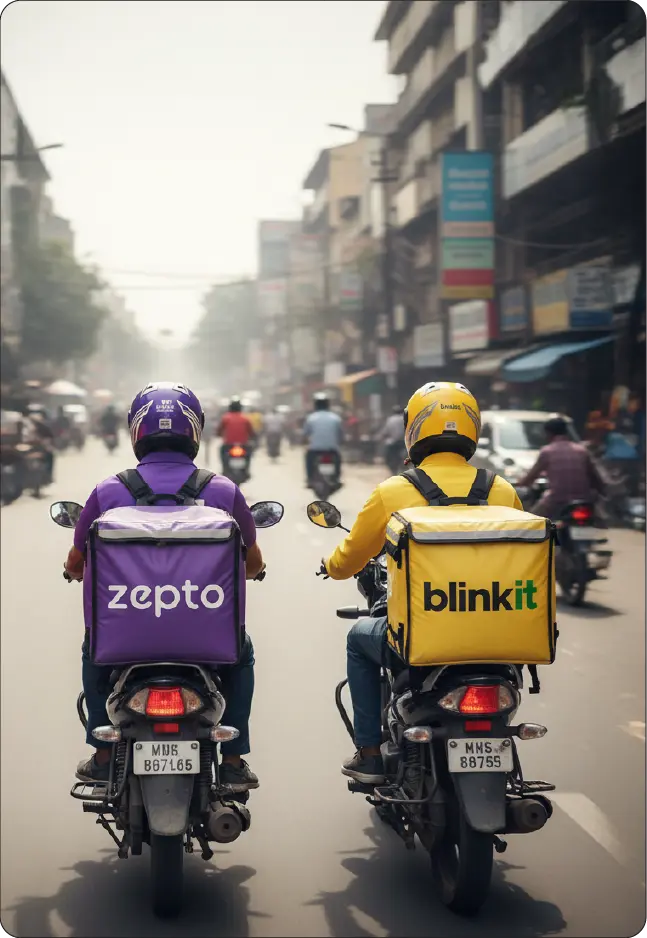
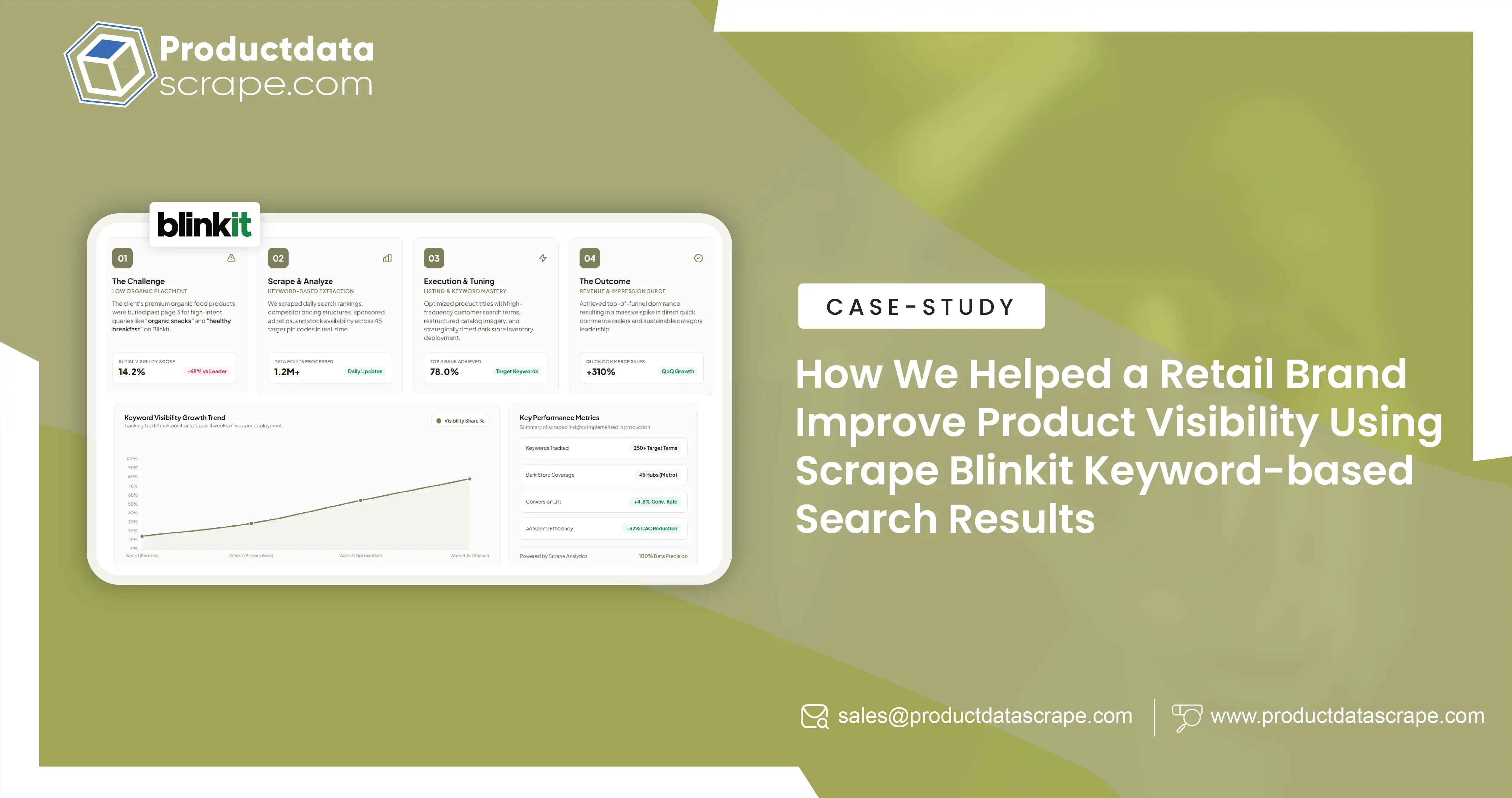
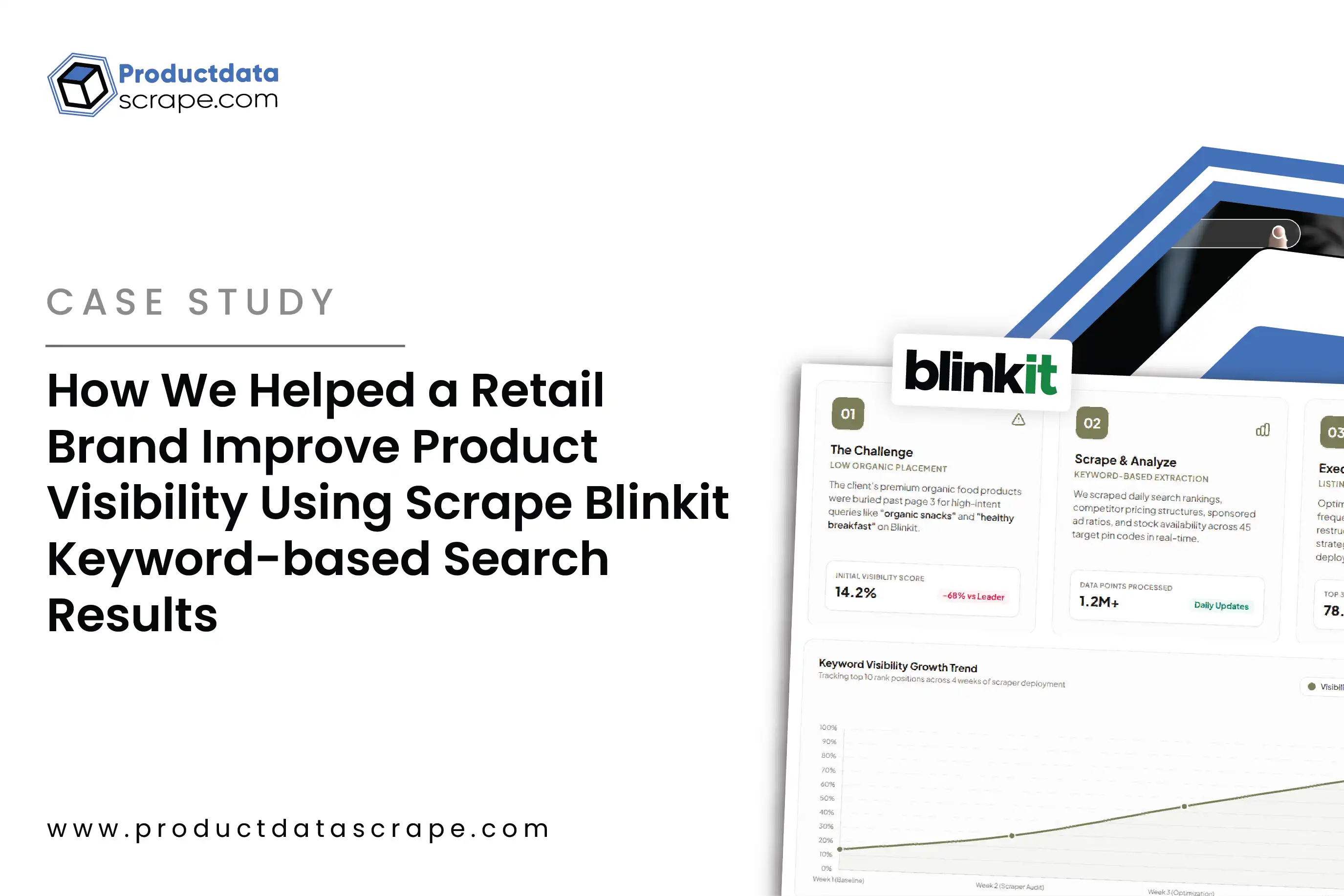
A leading FMCG and retail brand partnered with Product Data Scrape to improve its visibility across Blinkit's rapidly changing quick-commerce marketplace. The project focused on Scrape Blinkit Keyword-based Search Results to capture keyword-level product rankings, pricing, availability, and competitor visibility across selected locations. Through automated Blinkit data scraping, the brand replaced fragmented manual checks with a structured and recurring data pipeline. The engagement covered keyword discovery, search-result extraction, product matching, validation, location-level monitoring, and analytics-ready delivery. The solution helped the brand improve search visibility tracking, accelerate competitive monitoring, and create a scalable foundation for digital shelf intelligence across products such as beverages, snacks, packaged foods, and household essentials.
Client Name / Industry: Anonymized Leading FMCG & Retail Brand
Service / Duration: Blinkit Search Data Collection & Monitoring / 12 Weeks
Key Impact Metrics: 92% reduction in manual monitoring effort, 4.5× faster data availability, 96%+ validated record accuracy.
The Client
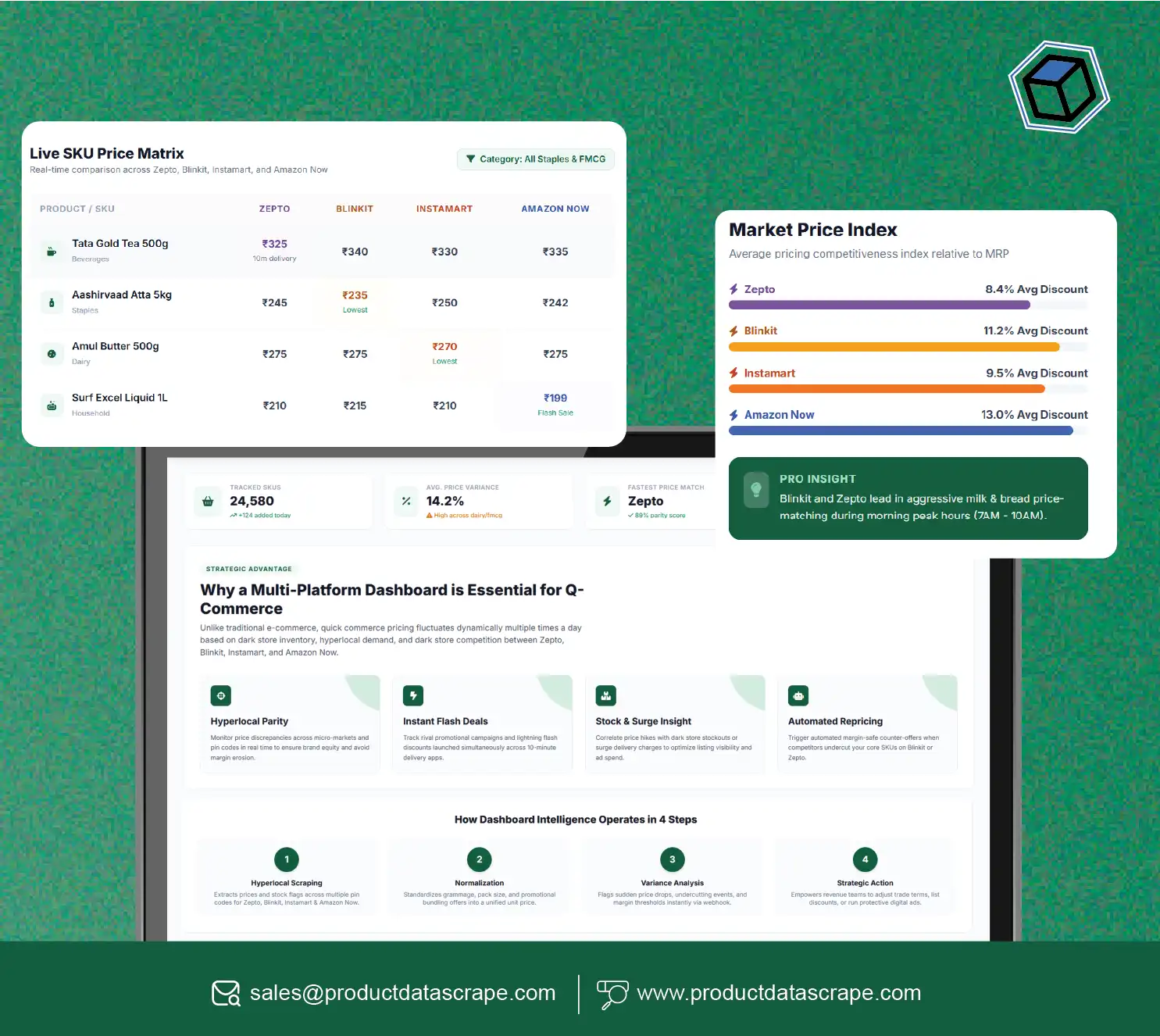
The client was a large FMCG and retail organization managing a diverse portfolio of packaged foods, beverages, snacks, personal-care products, and household essentials. Its products competed against established brands such as Coca-Cola, Pepsi, Amul, Nestlé, Maggi, Lay's, and other regional and private-label products across quick-commerce channels. To remain competitive in this rapidly evolving market, the organization also needed Hyperlocal pricing intelligence to understand how product prices, promotions, and competitive positioning varied across different locations and dark-store service areas.
The rapid growth of Blinkit and similar platforms had changed how consumers discovered and purchased everyday products. Instead of visiting a physical store or browsing a traditional e-commerce catalog, shoppers increasingly searched for products using short, category-driven terms such as "cold drink," "chips," "milk," "instant noodles," or "detergent."
This created pressure to understand search-level visibility rather than simply tracking whether a product was listed. The client needed Blinkit Keyword Visibility Tracking to determine how frequently its products appeared for important consumer searches, how competitors ranked, and whether visibility varied by location.
Before the partnership, teams depended heavily on manual searches and spreadsheets. Businesses Track Competitor Keywords through repetitive checks, but this approach was difficult to scale across hundreds of keywords, products, and locations. Data could quickly become outdated as prices, availability, rankings, and assortments changed.
Transformation was therefore essential. The client needed a structured solution capable of collecting recurring search-result data, connecting keywords with products and brands, validating records, and making the information available for commercial and category teams.
Goals & Objectives
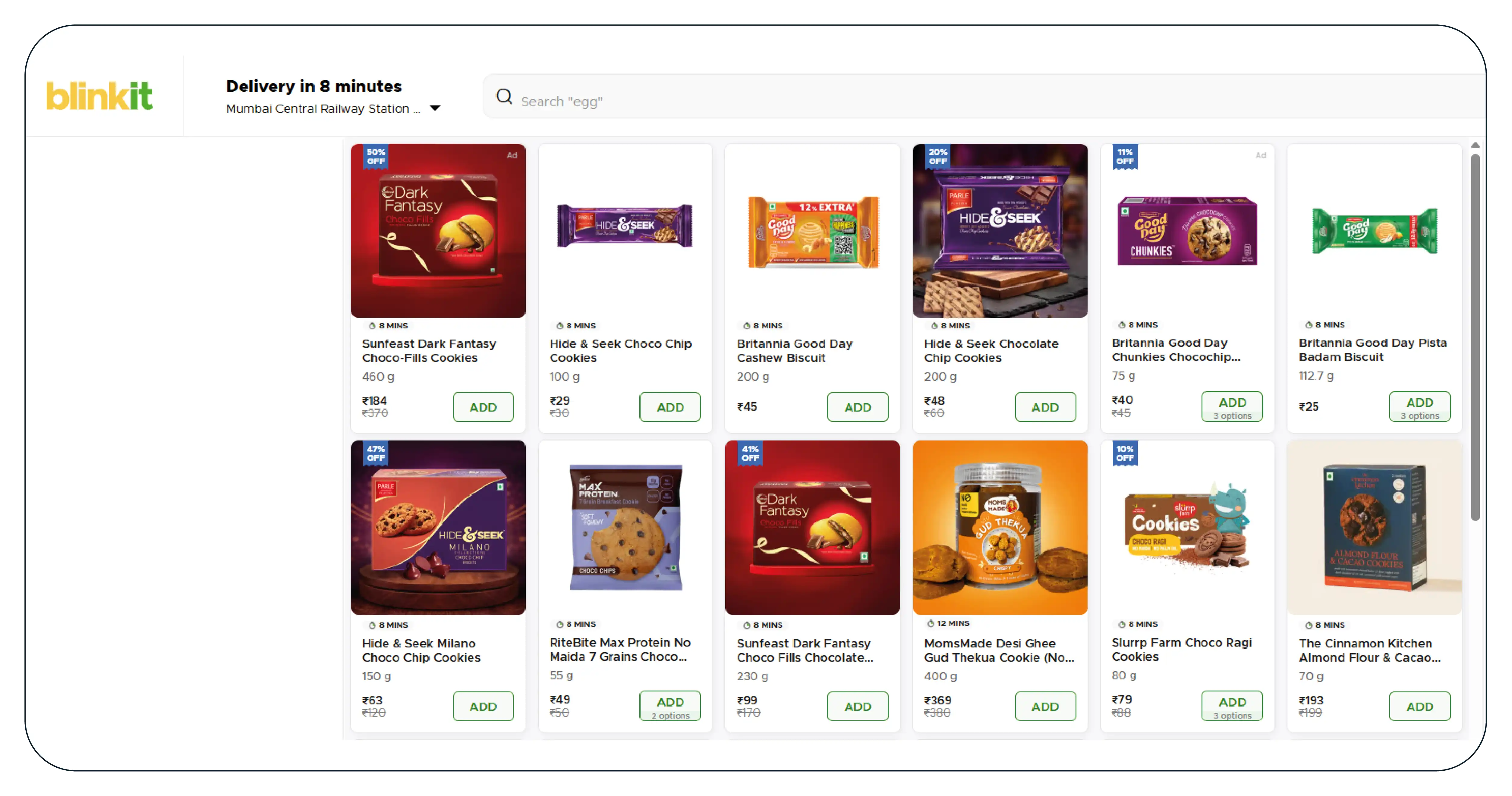
The project was designed around three connected priorities: creating a scalable data collection framework, increasing monitoring speed, and improving the reliability of keyword-level insights. The client wanted to move from periodic manual observations toward automated intelligence that could support category managers, pricing teams, brand teams, and e-commerce analysts.
Build scalable Blinkit Assortment Analysis by Keyword across priority FMCG categories.
Improve speed of product and competitor visibility monitoring.
Increase accuracy through standardized extraction and validation.
Track keyword-level rankings across selected locations.
Reduce repetitive manual search and spreadsheet activities.
Establish a repeatable framework that could support additional products, categories, and locations.
Automate keyword-based Blinkit search collection.
Integrate product, brand, price, discount, availability, ranking, and URL fields.
Normalize products across recurring search-result datasets.
Connect search terms with relevant SKUs and brands.
Support scheduled data refreshes for ongoing monitoring.
Create structured outputs compatible with internal analytics workflows and dashboards.
Enable faster identification of changes in product visibility and competitor positioning.
90%+ reduction in manual search monitoring.
4× or higher improvement in data availability speed.
95%+ validated product-record accuracy.
90%+ keyword coverage across the agreed monitoring universe.
More frequent visibility checks across priority locations.
Faster identification of ranking, assortment, price, and availability changes.
The Core Challenge
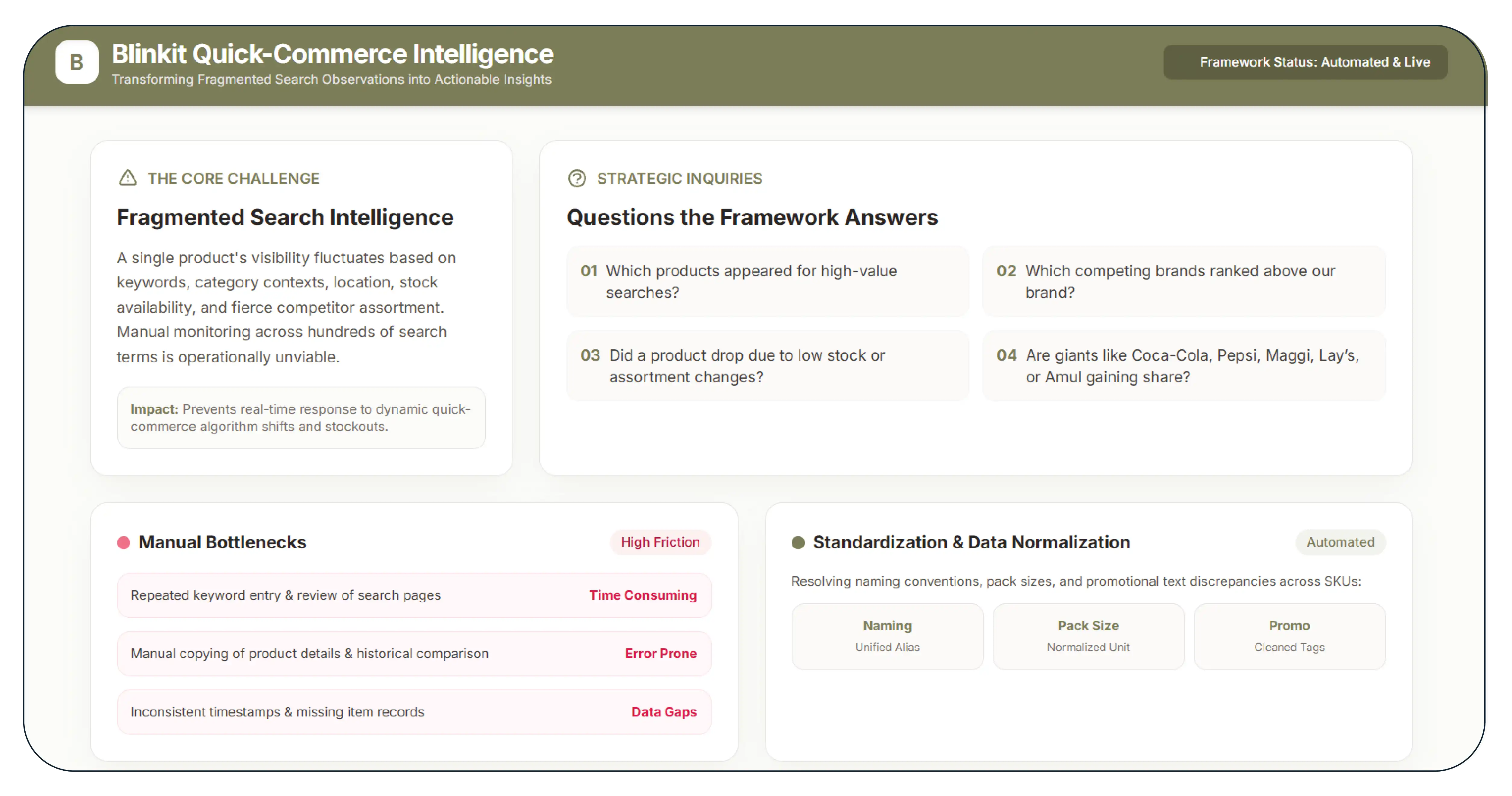
The client's biggest challenge was the fragmented nature of quick-commerce search intelligence. A single product could appear differently depending on the keyword, category context, location, availability, and competitive assortment. Monitoring one brand manually was manageable, but repeating the same process across hundreds of search terms and locations quickly became operationally expensive.
The team needed Blinkit Competitive Keyword Data that could answer practical questions: Which products appeared for high-value searches? Which competing brands ranked above the client? Did a product disappear because of low availability or because the assortment changed? Were products such as Coca-Cola, Pepsi, Maggi, Lay's, or Amul gaining stronger search visibility for relevant consumer queries?
Manual collection introduced several bottlenecks. Analysts had to repeatedly enter keywords, review search pages, copy product details, compare historical files, and identify changes. This created inconsistent timestamps and increased the possibility of missing products or recording outdated information.
Another issue was data standardization. Similar products could appear under different naming conventions, pack sizes, or promotional descriptions. Without normalization, it was difficult to compare products accurately across keywords and dates.
Location-level variation added another layer of complexity. A product available in one dark-store service area might be unavailable elsewhere. Consequently, a single national-level snapshot could not provide sufficient insight into the client's actual digital shelf presence.
The client therefore required an automated, validated, and scalable framework capable of converting recurring Blinkit search observations into structured competitive intelligence.
Our Solution
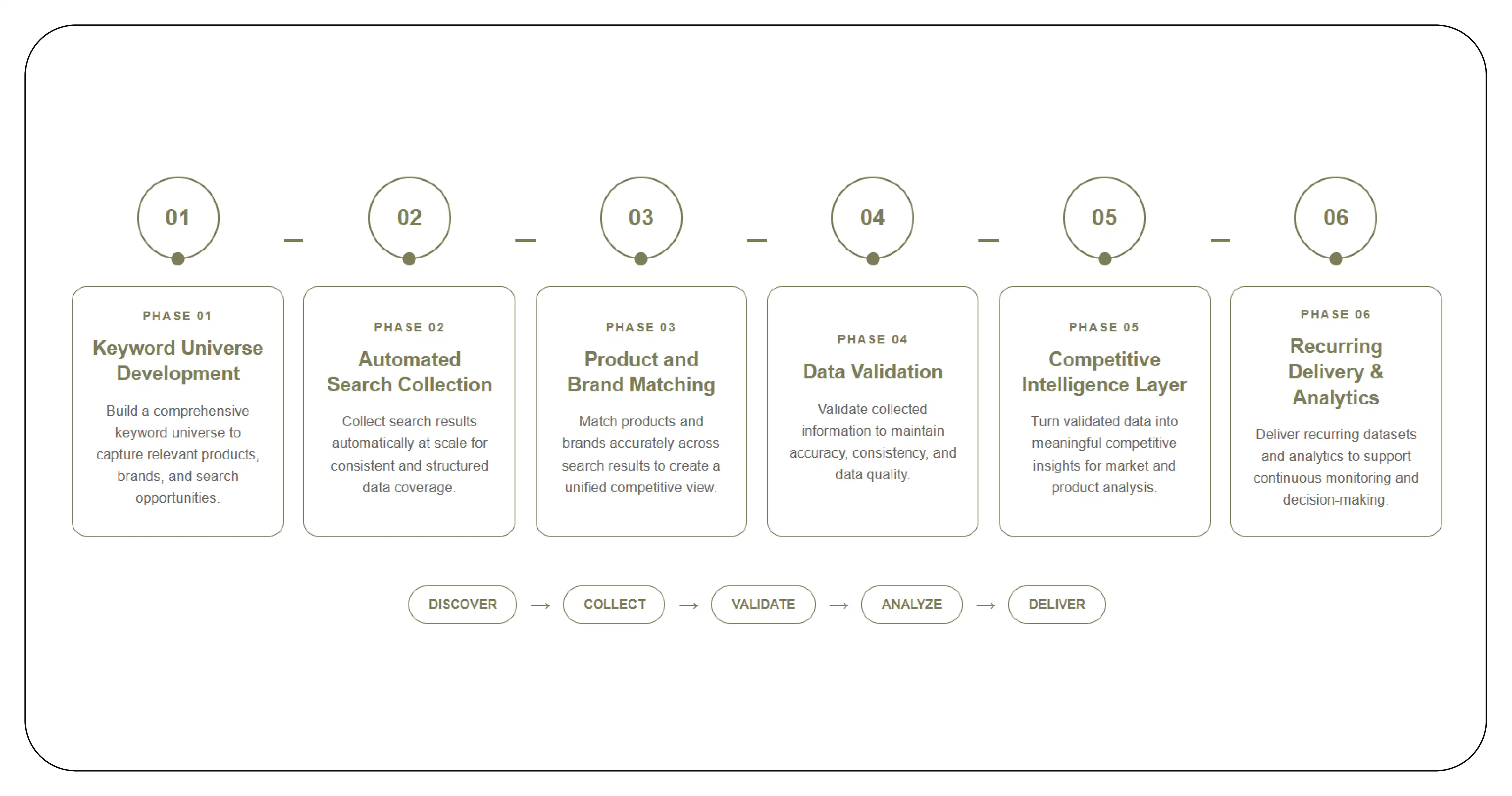
Product Data Scrape implemented a phased data collection and processing framework designed around the client's keyword universe, product portfolio, and monitoring requirements.
Phase 1: Keyword Universe Development
The project began by organizing priority consumer and category searches. Keywords were grouped around product categories, brands, pack sizes, generic searches, and high-value commercial terms. For example, searches related to beverages could include terms such as "soft drinks," "cola," or "cold drinks," while packaged-food monitoring could include "instant noodles," "chips," or "snacks." This helped the team understand visibility beyond exact product-name searches.
Phase 2: Automated Search Collection
The next phase introduced automated Blinkit Location-Based Keyword Scraping across the agreed monitoring locations. The system collected search-result information according to predefined schedules instead of requiring analysts to perform repetitive searches. Captured fields included search keyword, product name, brand, SKU/product identifier where accessible, category, pack size, listed price, discount information, availability status, search position/rank, product URL, location, and collection timestamp. This structure allowed the client to analyze every search observation as an individual data point.
Phase 3: Product and Brand Matching
Raw search results were normalized to create consistent product and brand identities. Product names, pack sizes, and brand references were standardized so that the same item could be tracked across different keywords and collection cycles. For designer visuals, a product such as Maggi 2-Minute Noodles 70g could be shown appearing for searches such as "instant noodles," while Lay's Classic Salted Chips could be represented against "chips" or "snacks."
Phase 4: Data Validation
Validation rules were introduced to identify incomplete records, duplicate observations, inconsistent product attributes, and unexpected changes. This helped separate genuine marketplace changes from collection anomalies. The process also supported historical comparison, allowing teams to identify whether a product's ranking or availability changed between monitoring cycles.
Phase 5: Competitive Intelligence Layer
The normalized dataset was transformed into analytical views covering brand visibility, keyword ranking, assortment presence, pricing, and availability. A search such as "cold drinks" could therefore be analyzed to compare the visibility of Coca-Cola, Pepsi, Sprite, and other beverage products. Similar views could be created for snacks, dairy, packaged foods, and household categories.
Phase 6: Recurring Delivery & Analytics
Finally, recurring extraction schedules and structured data delivery were established. The resulting datasets could be integrated into spreadsheets, BI environments, or internal analytics systems. This phased approach transformed Blinkit search activity from a manual observation process into a repeatable digital shelf monitoring workflow.
Results & Key Metrics
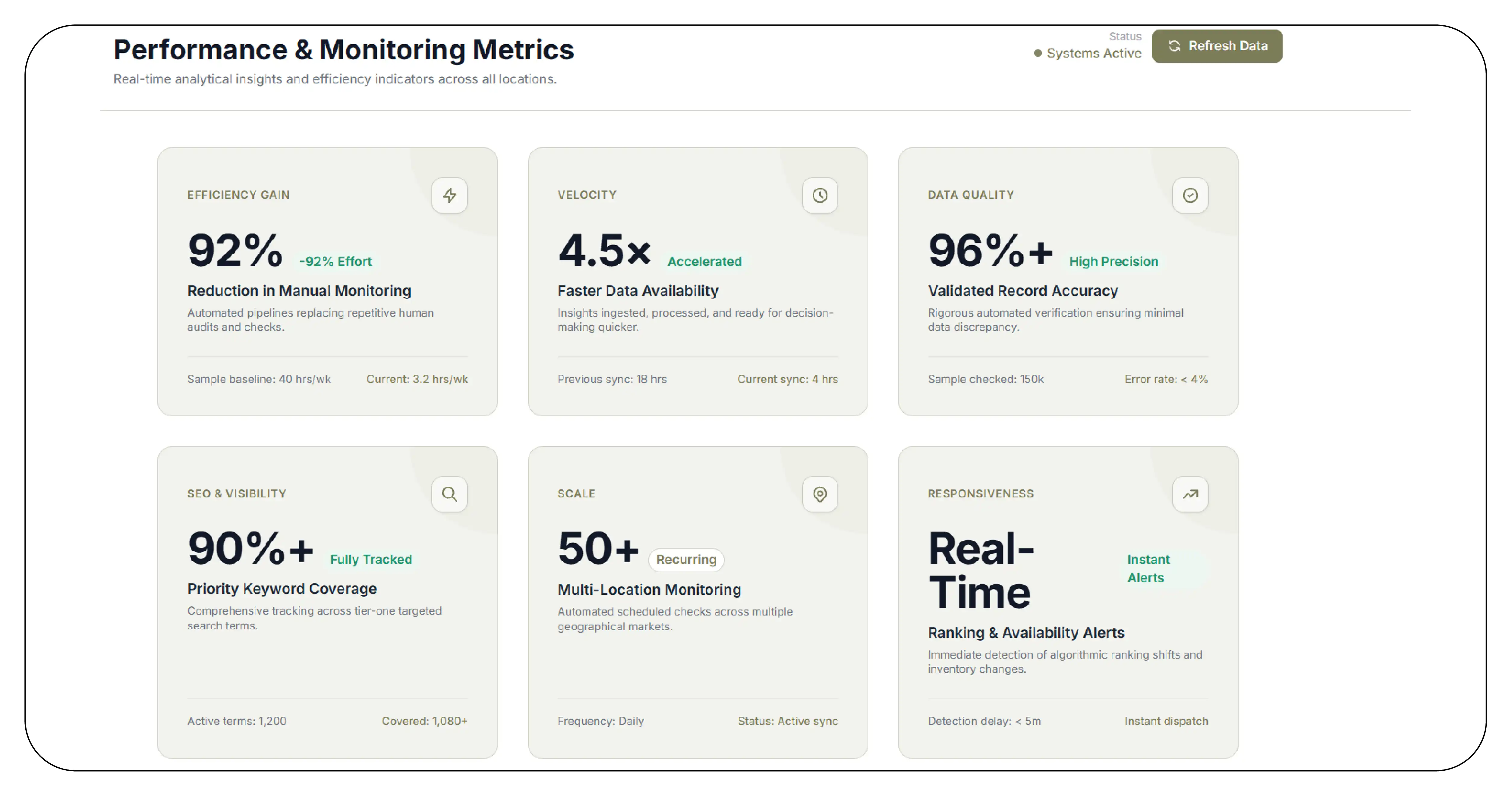
The implementation produced measurable improvements across monitoring speed, operational efficiency, and data quality. The automated workflow reduced repetitive manual activities by approximately 92%, allowing analysts to focus on interpretation rather than data collection. Data availability improved by around 4.5× compared with the previous manual process. Validation routines delivered more than 96% accuracy across the monitored product records. The framework also expanded monitoring capacity from periodic manual checks to recurring keyword-level observations across multiple locations. This gave commercial teams a more consistent view of search visibility, assortment movement, pricing, and availability.
92% reduction in manual monitoring effort.
4.5× faster data availability.
96%+ validated record accuracy.
90%+ priority keyword coverage.
Multi-location recurring monitoring.
Faster identification of ranking and availability changes.
Results Narrative
The new workflow gave the client a significantly clearer understanding of how products performed within Blinkit search results. Instead of relying on occasional manual snapshots, teams could compare keyword visibility over recurring collection periods. Blinkit Product Pricing by Keyword became easier to evaluate alongside ranking, availability, and competitive assortment.
The structured dataset also allowed category teams to identify products that appeared consistently, products that lost visibility, and competitor brands that gained stronger positions. Scrape Blinkit Keyword-based Search Results became an operational intelligence process rather than a one-time data exercise.
The improved monitoring framework supported quicker responses to assortment changes and strengthened the client's ability to prioritize products and keywords requiring attention.
What Made Product Data Scrape Different
Product Data Scrape differentiated the project through a combination of automated collection, keyword-level structuring, product normalization, validation, and recurring monitoring. Rather than treating every search result as an isolated record, the framework connected keywords with products, brands, locations, prices, availability, and ranking signals.
The solution supported Blinkit Keyword and Dark Store Search Rank Data, helping the client understand how search visibility changed across locations instead of relying only on a broad marketplace-level view.
Smart automation reduced repetitive analyst work while scheduled extraction supported consistent data refreshes. Validation and normalization rules improved comparability between collection cycles, while the scalable architecture made it easier to expand from a small keyword set to broader FMCG categories.
For brands competing with products such as Coca-Cola, Pepsi, Maggi, Lay's, Amul, and Nestlé, this level of structured visibility can help transform marketplace observations into actionable digital shelf intelligence.
Client's Testimonial
"Before this engagement, our Blinkit monitoring process involved repeated manual searches, spreadsheet updates, and separate checks across locations. Product Data Scrape helped us establish a much more structured approach to search visibility, pricing, assortment, and competitor monitoring. The automated workflow gave our teams faster access to consistent data and reduced the time spent on repetitive collection activities. We can now identify changes in product visibility more efficiently and use recurring insights to support category and e-commerce decisions. The solution also provides a scalable foundation for expanding our monitoring across additional keywords, products, and locations."
— Head of E-Commerce & Digital Analytics, Leading FMCG Brand
With the new framework, the organization could Track Blinkit Prices in Real Time alongside search visibility, availability, and competitor positioning, creating a more connected view of quick-commerce performance.
Conclusion
Blinkit has become an increasingly important channel for brands seeking rapid product discovery and consumer conversion. For FMCG businesses, simply knowing whether a product is listed is no longer enough. Brands need to understand where products appear, which keywords drive visibility, how competitors rank, and how pricing and availability vary across locations.
The project demonstrated how Scrape Blinkit Keyword-based Search Results can help turn fragmented marketplace observations into structured business intelligence. Through automation, validation, product matching, and recurring monitoring, Product Data Scrape helped the client strengthen its digital shelf visibility process.
The resulting framework provides a scalable foundation for future expansion across categories, keywords, products, and locations while supporting faster, more data-driven quick-commerce decisions.
Product Data Scrape can help brands build scalable keyword, product, pricing, assortment, and competitive intelligence datasets for evolving quick-commerce marketplaces!
FAQs
1. What can brands collect from Blinkit keyword searches?
Brands can collect structured information such as search keywords, product names, brands, prices, discounts, availability, rankings, product URLs, locations, and timestamps, depending on accessible marketplace information.
2. Why is keyword-level monitoring important?
Keyword-level monitoring shows how consumers may discover products through generic or brand-related searches. It can reveal visibility gaps that a standard product-listing check may not identify.
3. Can Blinkit data be monitored across multiple locations?
Yes. A structured monitoring framework can be designed to compare search results across selected locations, helping brands understand differences in assortment, availability, pricing, and rankings.
4. How can FMCG brands use this data?
FMCG brands can use the resulting datasets for digital shelf analytics, competitor monitoring, assortment analysis, pricing intelligence, product visibility tracking, and category-level decision-making.
5. Can the data collection process be automated?
Yes. Automated workflows can be configured around predefined keywords, products, locations, and schedules. The collected information can then be validated, normalized, and delivered in an analytics-ready format.


 Singapore
 EMAIL
EMAIL
 PHONE
PHONE










.webp)