Quick Overview
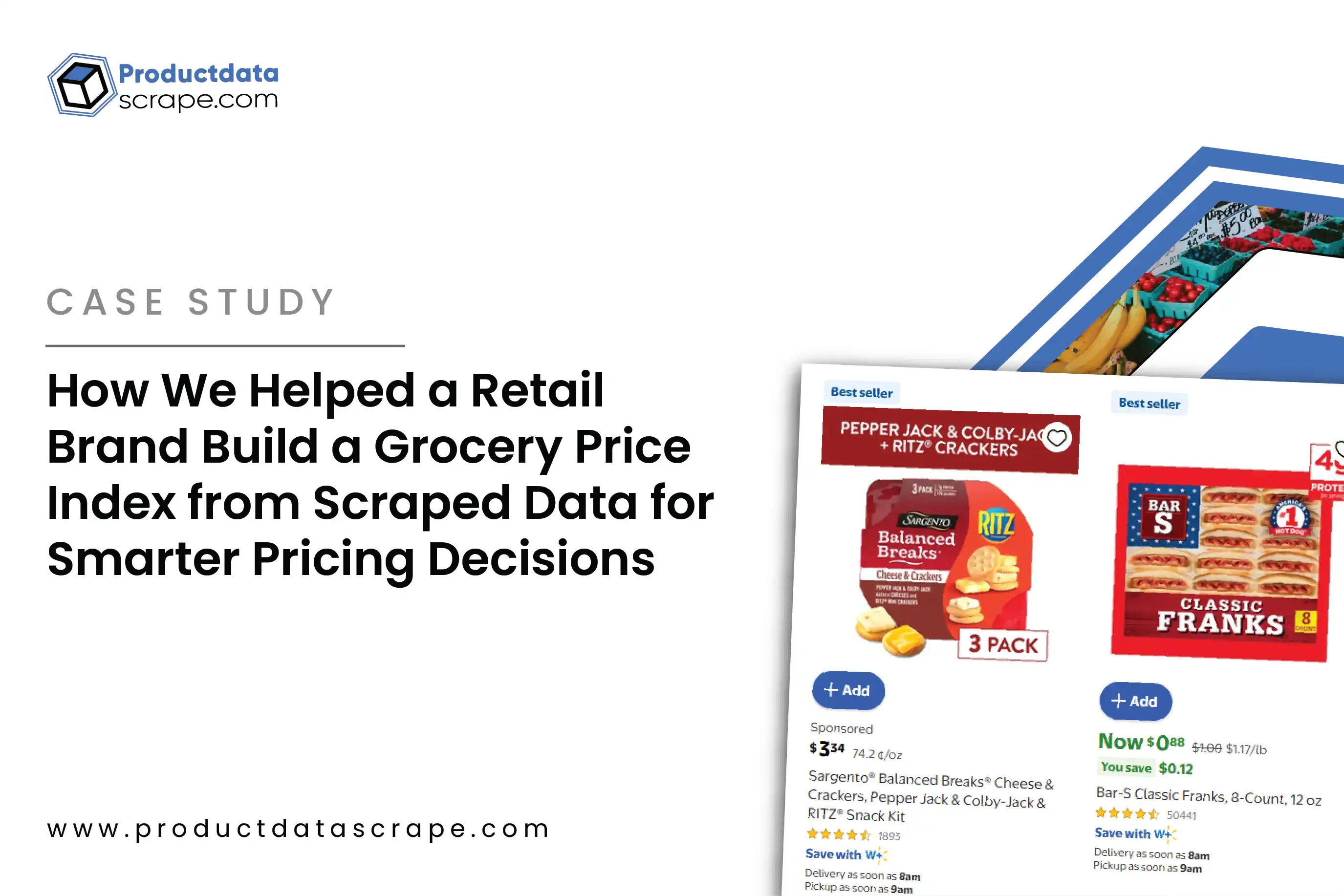
A leading Indian retail and FMCG organization partnered with Product Data Scrape to develop a structured pricing intelligence framework for grocery categories. The project focused on building a Grocery Price Index from Scraped Data by collecting recurring online prices across retailers, products, pack sizes, and categories. Using Scrape India Grocery Data, the solution transformed fragmented marketplace pricing into standardized, comparable datasets. The initiative helped the client benchmark competitors, identify price movements, improve pricing visibility, and support faster commercial decisions. Product categories included staples, dairy, beverages, snacks, packaged foods, personal care, and household essentials, with recognizable products such as Amul Milk, Tata Salt, Maggi Noodles, Fortune Oil, and Aashirvaad Atta.
Client Name / Industry: Anonymized Leading Indian Retail & FMCG Company
Service / Duration: Grocery Price Intelligence & Data Collection / 16 Weeks
Key Impact Metrics: 94% reduction in manual price tracking, 4.2× faster data availability, 97%+ validated pricing records.
The Client
The client was a large Indian retail organization operating across grocery, packaged food, beverages, household essentials, and personal-care categories. Its portfolio covered high-frequency products such as Amul Milk, Tata Salt, Fortune Cooking Oil, Aashirvaad Atta, Maggi Noodles, Britannia Biscuits, Coca-Cola beverages, Pepsi products, and Surf Excel detergents.
The Indian grocery market was becoming increasingly competitive as traditional supermarkets, online grocery platforms, quick-commerce services, and digital-first retailers competed for price-sensitive consumers. Retailers needed more than periodic competitor checks; they required consistent visibility into how prices changed across retailers, categories, pack sizes, and locations.
The client wanted a Grocery Price Index Dataset by Retailer to compare its pricing position against competing sellers and identify where products were priced above or below market benchmarks. The organization also needed reliable data to Estimate your sales performance by connecting pricing movements with product visibility, assortment, and competitive positioning.
Before partnering with Product Data Scrape, the client relied heavily on manual price checks, spreadsheets, and disconnected marketplace observations. Teams could collect individual prices but struggled to maintain a consistent historical dataset. Differences in product names, pack sizes, promotions, and retailer formats made direct comparison difficult.
Transformation became essential as the number of monitored products and retailers increased. The client needed an automated framework capable of collecting recurring grocery prices, standardizing product information, validating records, and producing comparable pricing intelligence for category and commercial teams.
Goals & Objectives
The client wanted to replace fragmented pricing observations with a scalable intelligence framework that could support recurring market monitoring. The initiative was designed to improve speed, accuracy, and coverage while giving pricing and category teams a consistent source of market-level information.
Create scalable Daily Grocery Price Data for Index Tracking.
Improve the speed and consistency of competitive price monitoring.
Increase accuracy across product, pack-size, retailer, and price records.
Expand monitoring across priority grocery categories.
Reduce manual spreadsheet-based price collection.
Build a reusable pricing intelligence foundation for future categories and retailers.
Automate recurring collection of online grocery prices.
Integrate product name, brand, pack size, price, discount, retailer, category, and timestamp fields.
Normalize equivalent products across retailers.
Match comparable SKUs and pack sizes for reliable benchmarking.
Create historical datasets for price-change analysis.
Support dashboard and business-intelligence integration.
Enable frequent data refreshes for near-real-time market visibility.
Establish validation rules to detect incomplete or inconsistent records.
94% reduction in manual price monitoring effort.
4.2× faster pricing data availability.
97%+ validated pricing records.
90%+ coverage of priority products and retailers.
Improved historical price-change tracking.
Faster identification of competitive pricing gaps.
Increased frequency of market-price refreshes.
The Core Challenge
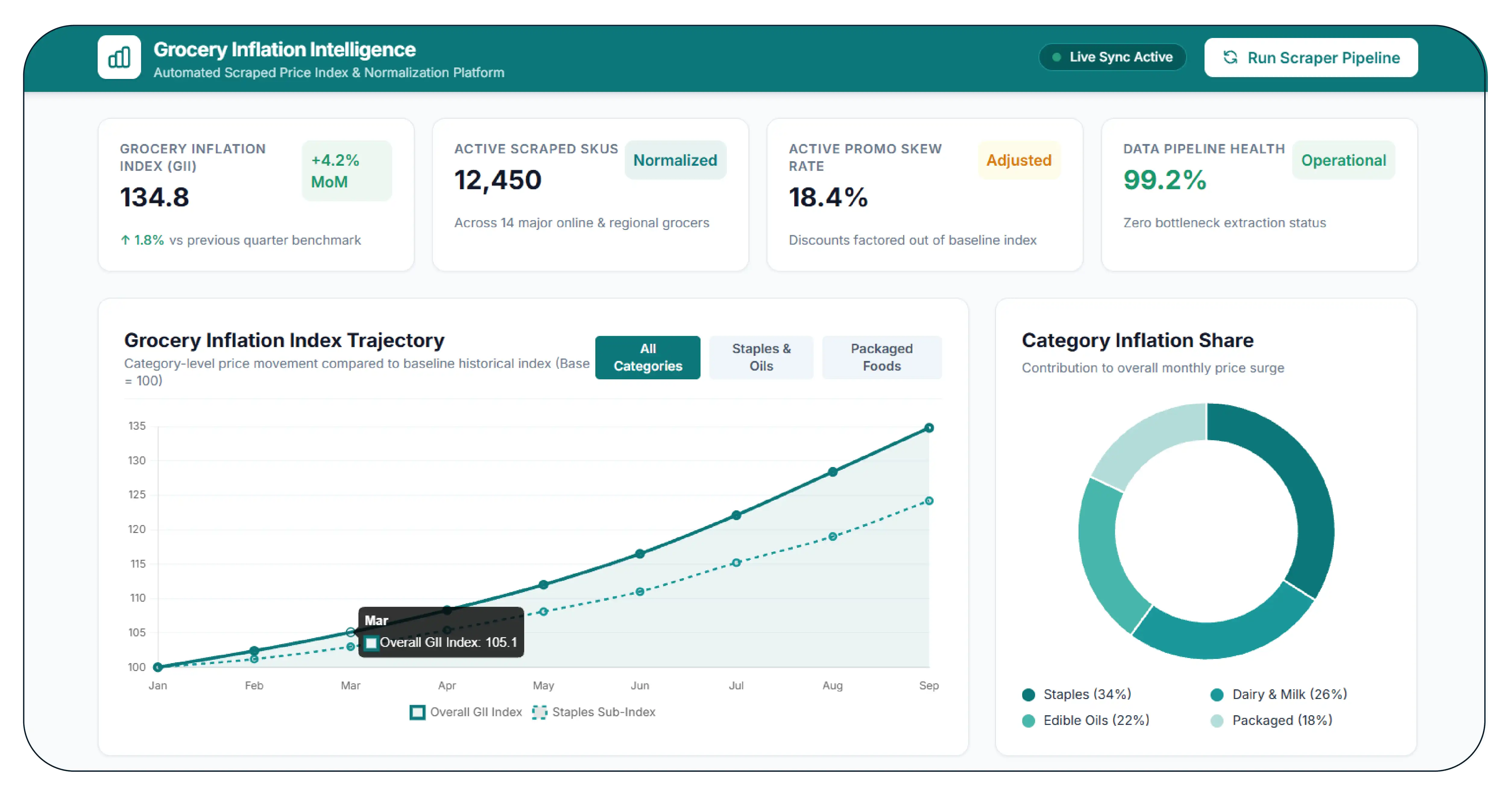
The client's primary challenge was the complexity of maintaining comparable grocery pricing information across a fragmented retail environment. Grocery products are sold in multiple pack sizes, variants, brands, and promotional formats, making simple price collection insufficient for reliable benchmarking.
The organization required a Grocery Inflation Index from Scraped Prices to understand broader category-level price movements and identify whether changes were isolated to individual products or reflected wider market trends.
Manual Price scraping created significant operational bottlenecks. Analysts had to visit multiple retailer websites, search for products individually, copy prices into spreadsheets, and repeat the process at regular intervals. This made large-scale monitoring slow and difficult to maintain.
Product matching was another major issue. For example, Tata Salt 1 kg, Tata Salt 500 g, and other pack variants could not be compared directly without pack-size normalization. Similar problems occurred across products such as Amul Milk, Fortune Oil, Maggi Noodles, Aashirvaad Atta, and Britannia Biscuits.
Promotions further complicated the process. A temporary discount could make a product appear significantly cheaper than its standard price. Without recording the underlying pricing context, historical comparisons could become misleading.
Location and retailer differences added another challenge. Grocery prices could vary between supermarkets, online stores, and regional sellers. Consequently, isolated observations did not provide enough information for strategic pricing decisions.
The client therefore needed a structured, automated system capable of collecting large volumes of grocery pricing data, normalizing products, validating records, and generating reliable historical comparisons.
Our Solution
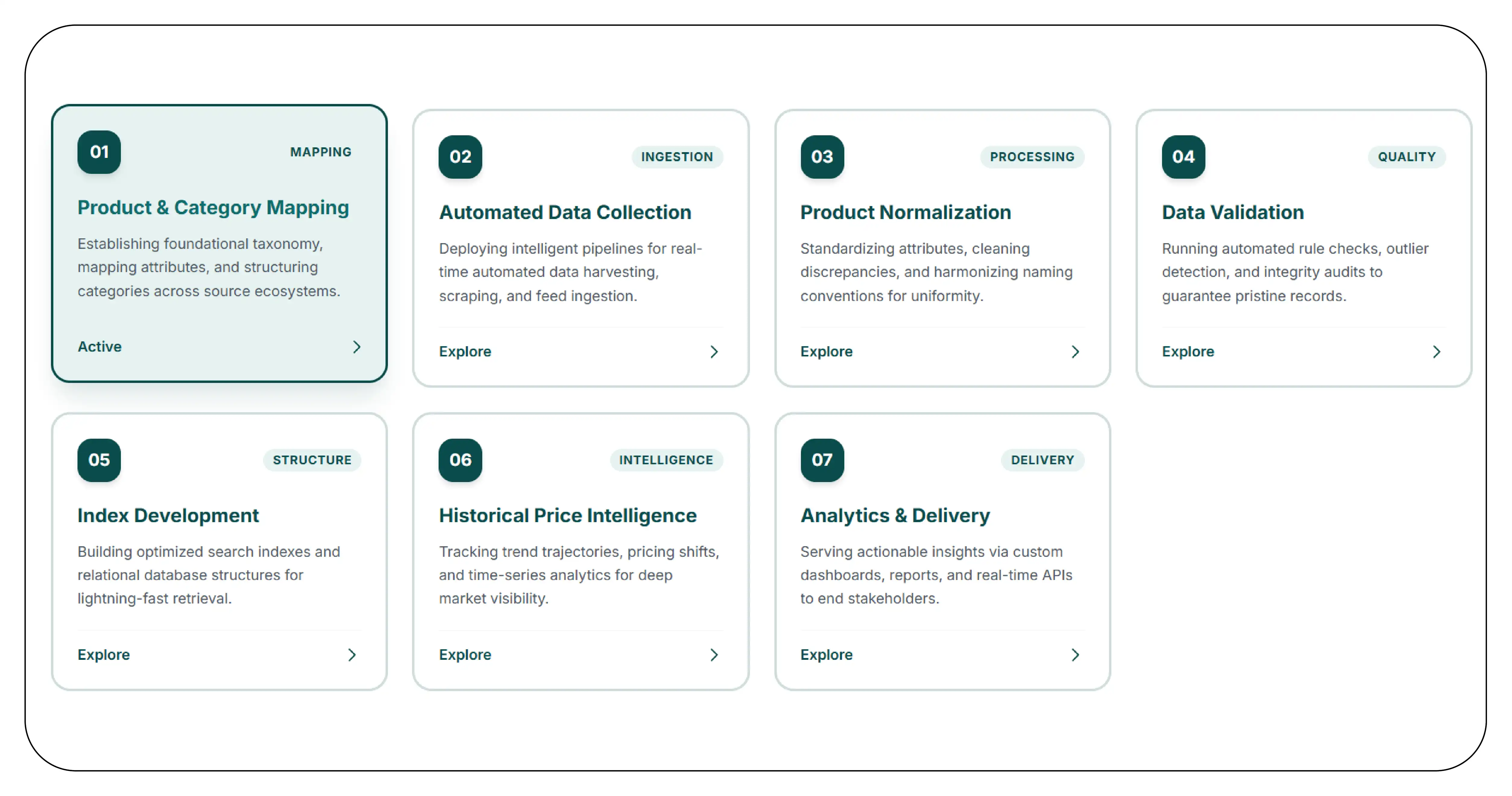
Product Data Scrape designed a phased data collection and pricing intelligence framework that converted online grocery information into structured datasets suitable for benchmarking and index development.
Phase 1: Product & Category Mapping
The project started by defining the client's priority product universe. Categories included staples, dairy, edible oils, packaged foods, beverages, snacks, personal care, and household essentials. Representative products included Amul Milk, Tata Salt, Fortune Sunflower Oil, Aashirvaad Atta, Maggi 2-Minute Noodles, Britannia Good Day Biscuits, Coca-Cola, Pepsi, and Surf Excel. Products were mapped using brand, product name, category, variant, and pack-size attributes.
Phase 2: Automated Data Collection
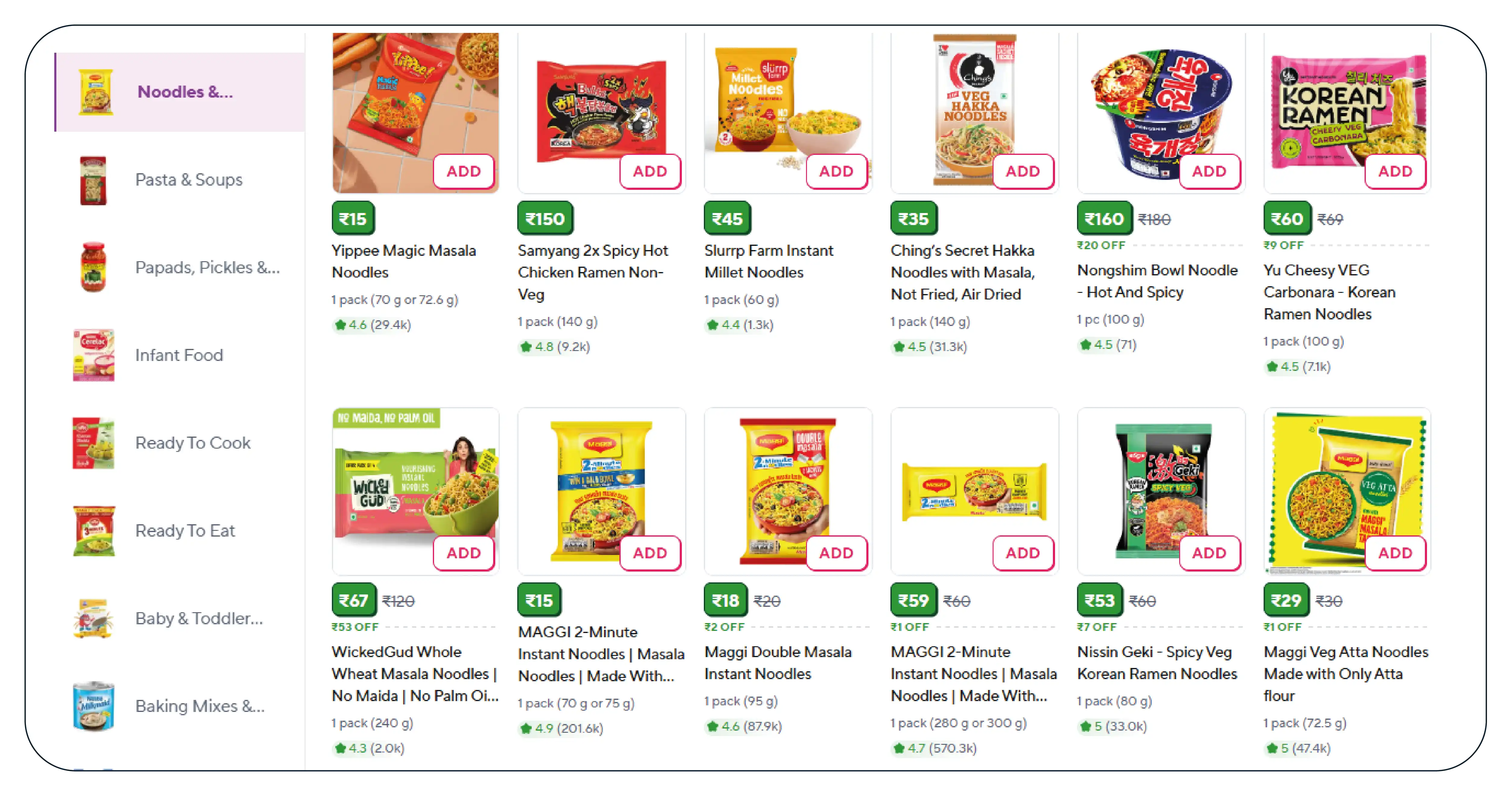
Automated collection workflows were configured to capture recurring product information across selected online grocery retailers. The framework collected retailer name, product name, brand, category, pack size, listed price, discounted price, discount information, availability, product URL, location where available, and collection timestamp. This reduced dependence on manual monitoring and created consistent historical observations.
Phase 3: Product Normalization
Raw product records were standardized to ensure comparable products were grouped correctly. Pack sizes were converted into consistent units where appropriate, allowing analysts to compare products on both absolute and normalized price bases. For example, Fortune Cooking Oil products could be evaluated across different bottle sizes, while Aashirvaad Atta could be compared across 5 kg and 10 kg packs using standardized unit-price calculations.
Phase 4: Data Validation
Validation rules checked for duplicate records, missing prices, inconsistent pack sizes, abnormal values, and incomplete product attributes. Historical comparisons were also used to identify unusual price movements that required review. This ensured that the index was based on reliable observations rather than unverified marketplace snapshots.
Phase 5: Index Development
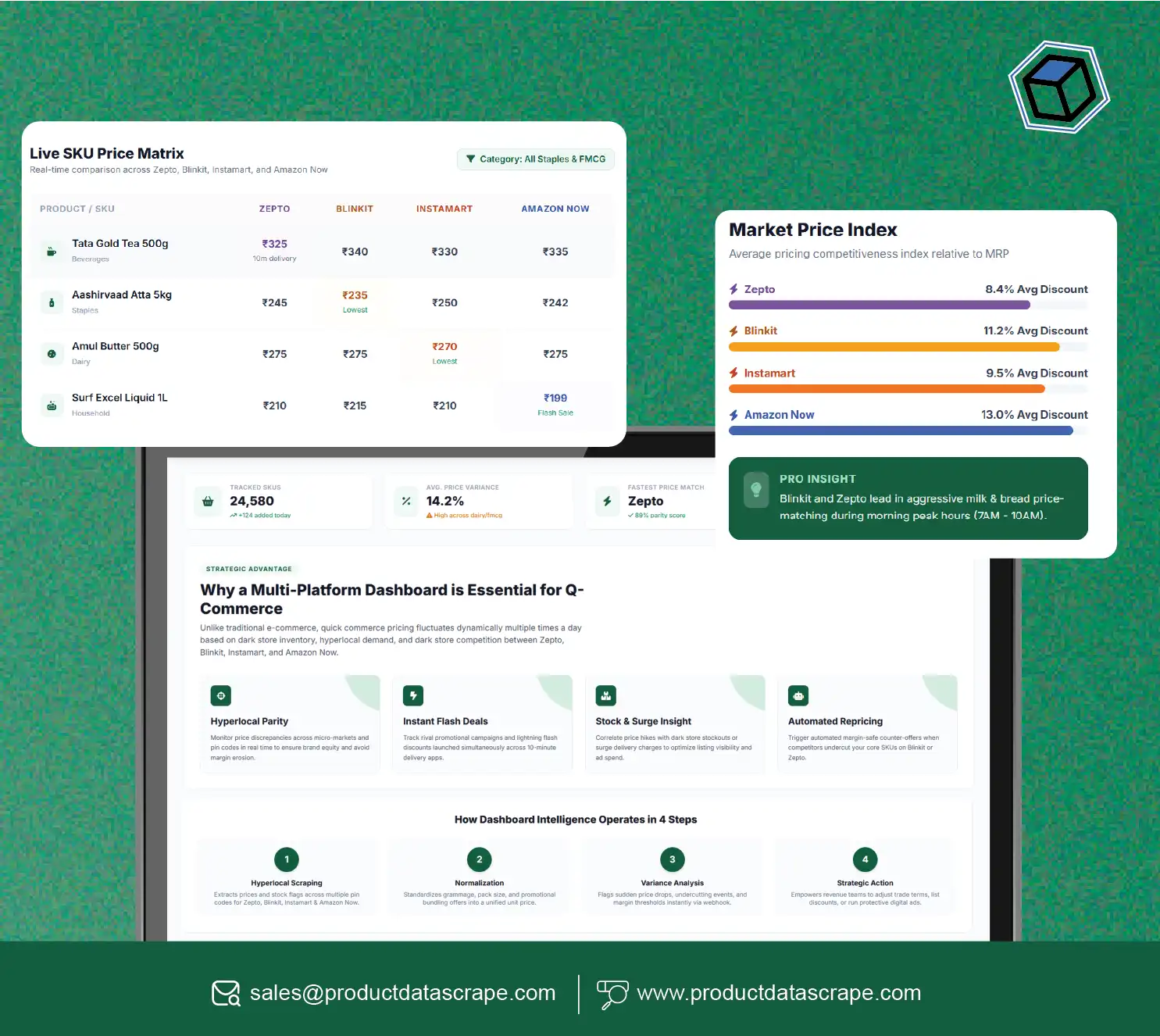
The standardized pricing dataset was transformed into category and retailer-level index views. Products could be grouped by category and weighted according to the client's selected methodology. The framework enabled comparison of grocery price movements across retailers and time periods, helping commercial teams identify whether categories were becoming more or less expensive.
Phase 6: Historical Price Intelligence
Recurring data collection created a historical pricing database. Teams could review daily, weekly, and monthly movements for individual products, brands, categories, and retailers. This supported Grocery Price Change Analysis by showing when prices changed, which products experienced the largest movements, and whether competitors followed similar pricing patterns.
Phase 7: Analytics & Delivery
The resulting datasets were structured for analytics environments, dashboards, spreadsheets, and internal reporting workflows. This allowed category managers and pricing teams to move from manual data gathering toward continuous market intelligence.
Results & Key Metrics
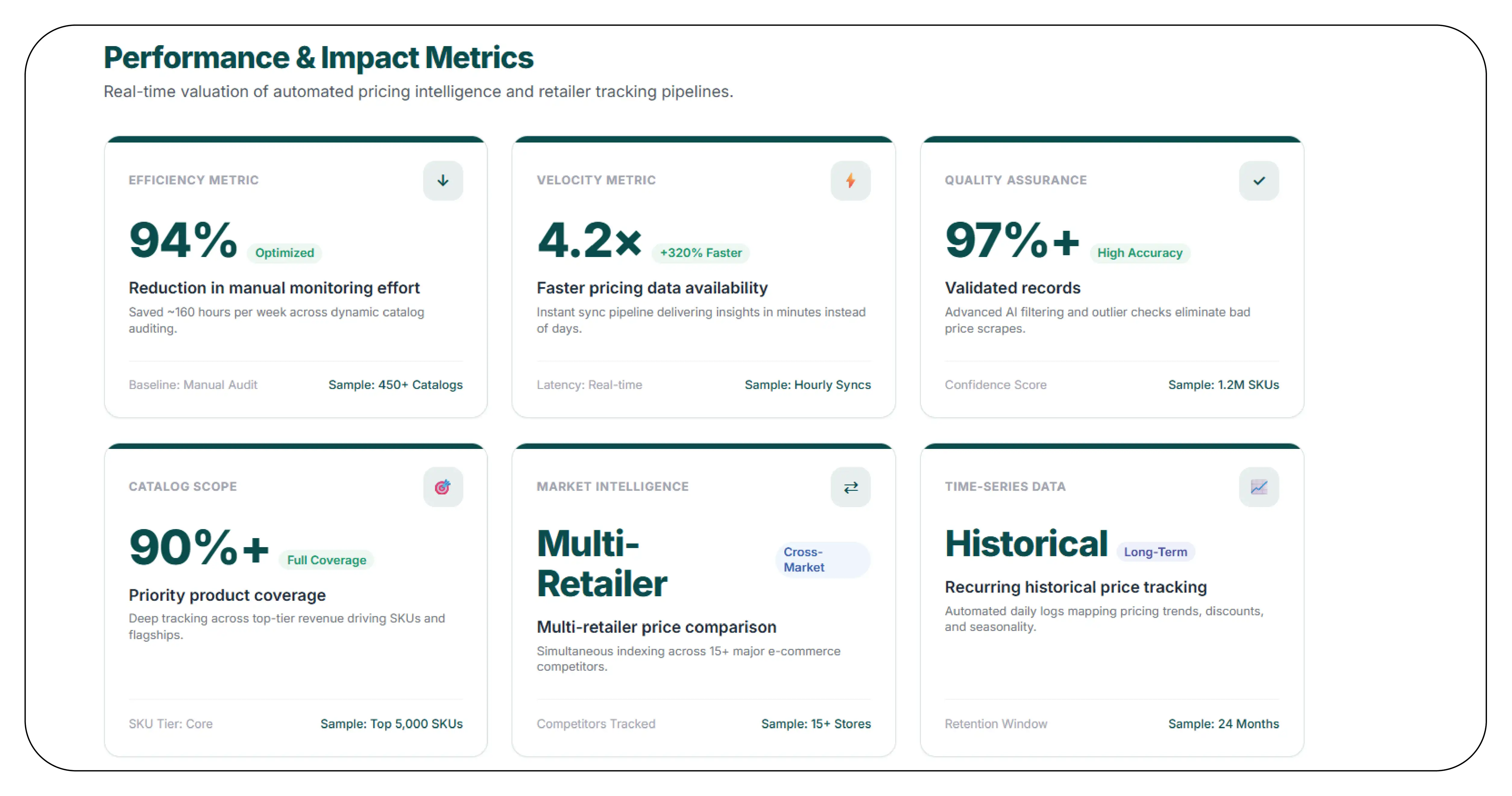
The implementation significantly improved the client's grocery pricing monitoring process. Manual tracking effort declined by approximately 94%, while pricing data became available 4.2× faster than under the previous workflow. Automated validation achieved more than 97% accuracy across the monitored pricing records. The solution also increased monitoring coverage across priority products and retailers and created a consistent historical record for evaluating price movements. Recurring collection allowed the organization to identify competitive pricing changes faster and gave commercial teams a reliable foundation for retailer benchmarking and category-level analysis.
94% reduction in manual monitoring effort.
4.2× faster pricing data availability.
97%+ validated records.
90%+ priority product coverage.
Multi-retailer price comparison.
Recurring historical price tracking.
Results Narrative
The new framework gave the client a unified view of grocery prices across retailers and categories. Instead of relying on disconnected spreadsheet observations, teams could compare products using standardized attributes and historical records.
The Grocery Price Index for Supermarket Products enabled commercial teams to identify category-level movements and retailer-specific pricing gaps. Products such as Amul Milk, Tata Salt, Fortune Oil, Maggi Noodles, and Coca-Cola could be monitored consistently across the selected marketplace universe.
The resulting intelligence helped pricing teams identify competitive movements sooner, prioritize products requiring review, and understand whether price changes were isolated or part of broader category trends.
What Made Product Data Scrape Different
Product Data Scrape differentiated the project by combining automated collection with product normalization, pack-size matching, validation, historical tracking, and index-oriented analysis. Instead of simply delivering raw prices, the framework created structured Grocery data scraping workflows designed around business benchmarking requirements.
The solution could distinguish between comparable and non-comparable product variants, normalize pack sizes, identify duplicate records, and maintain historical observations. Automated scheduling reduced repetitive analyst activities and enabled consistent data refreshes.
The resulting Grocery Price Index from Scraped Data provided a structured foundation for evaluating retailer-level pricing, category movements, and competitive positioning. The architecture could also be expanded to new retailers, product categories, brands, locations, and pricing attributes without rebuilding the entire workflow.
Client's Testimonial
"Product Data Scrape transformed the way our team monitors grocery pricing. Previously, we relied on manual checks and spreadsheets, which made it difficult to maintain consistent historical comparisons across retailers and products. The new automated framework gave us structured pricing information at a much faster pace and significantly reduced repetitive work. We can now compare products such as Amul, Tata Salt, Fortune, Maggi, and other key brands using standardized product and pack-size information. The historical dataset has also helped our commercial teams understand price movements more clearly and respond faster to competitive changes. The scalability of the solution gives us confidence that we can expand monitoring across additional categories and retailers as our pricing intelligence requirements grow."
— Director of Pricing & Category Intelligence, Leading Indian Retail Organization
Conclusion
Grocery pricing is increasingly influenced by competition between supermarkets, online grocery platforms, quick-commerce providers, FMCG brands, and regional retailers. For businesses operating in this environment, relying on occasional manual price checks can create significant visibility gaps.
A structured Grocery Datasets framework gives retailers a stronger foundation for tracking products, comparing competitors, monitoring category movements, and understanding pricing trends over time.
The project demonstrated how automated collection, product normalization, validation, and recurring monitoring can transform fragmented online grocery prices into actionable intelligence. Product Data Scrape helped the client improve monitoring speed, data quality, and competitive visibility while creating a scalable foundation for future pricing analytics.
The next opportunity is to connect pricing intelligence with Retail media and ad intelligence, assortment, promotions, availability, and digital shelf performance to build a more comprehensive view of grocery-market competitiveness.
FAQs
1. What is a grocery price index?
A grocery price index measures changes in the prices of a selected basket of grocery products over time. It can help retailers and FMCG organizations understand category-level price movements and competitive trends.
2. What grocery products can be monitored?
A monitoring framework can cover products across staples, dairy, packaged foods, beverages, snacks, personal care, and household essentials. Examples include Amul Milk, Tata Salt, Fortune Oil, Aashirvaad Atta, Maggi Noodles, Britannia Biscuits, Coca-Cola, and Surf Excel.
3. Why is pack-size normalization important?
Pack-size normalization makes comparisons more meaningful. A 500 g product and a 1 kg product cannot be compared directly using only their listed prices. Unit-level calculations help establish a more consistent benchmark.
4. How frequently can grocery prices be collected?
Collection frequency depends on the business requirement. Daily, weekly, or more frequent monitoring can be implemented for selected products and retailers, creating a historical dataset for trend analysis.
5. How can retailers use scraped grocery pricing data?
Retailers can use structured pricing data for competitor benchmarking, category intelligence, price-change monitoring, assortment analysis, promotional analysis, and pricing strategy. Historical observations can also help identify recurring market patterns and support more informed commercial decisions.


 Singapore
 EMAIL
EMAIL
 PHONE
PHONE










.webp)