Quick Overview
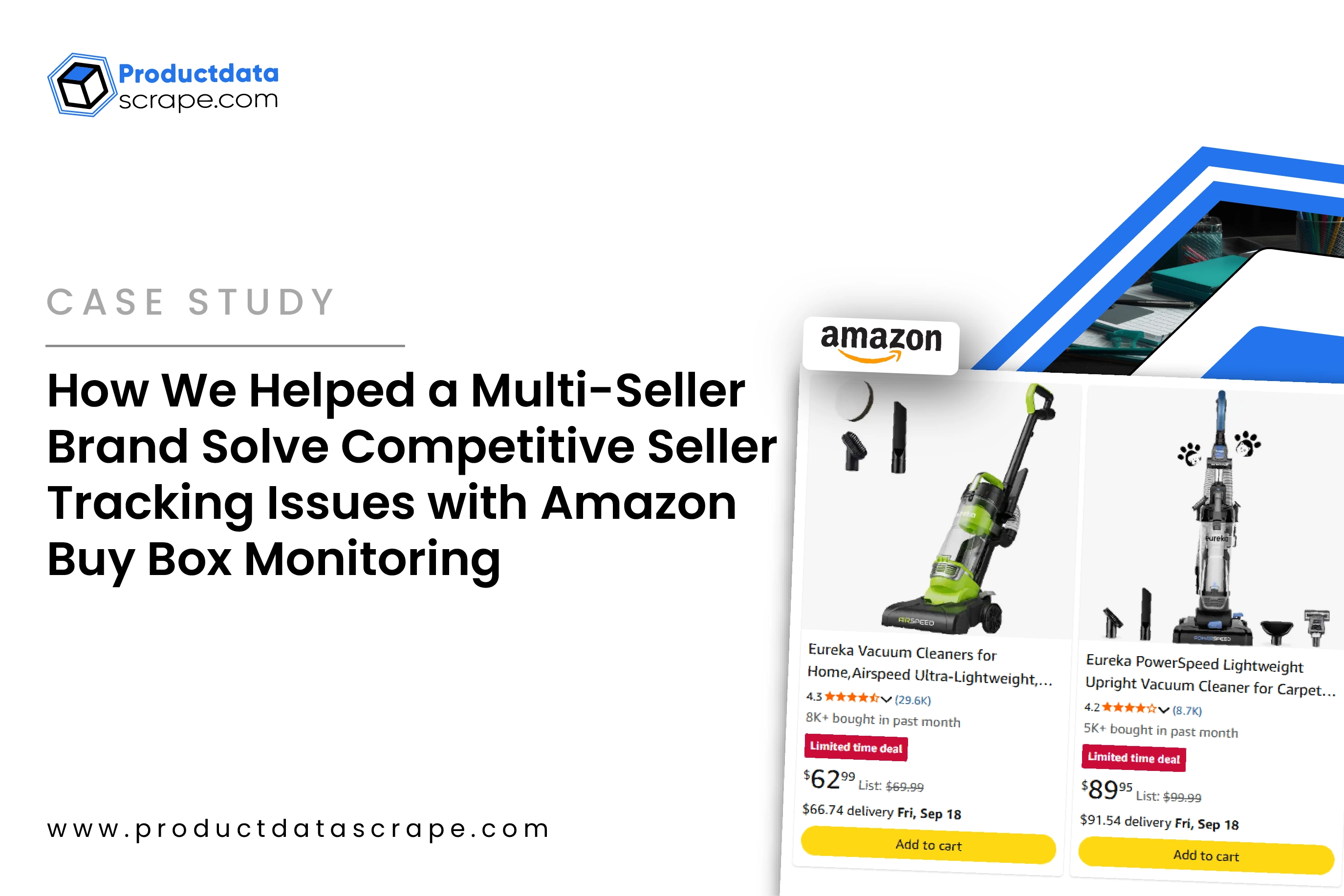
Client Name / Industry: A multi-seller consumer brand operating on Amazon needed better visibility into Buy Box ownership, competing sellers, pricing movements, and product availability.
Service / Duration: Product Data Scrape implemented an automated marketplace monitoring workflow over a phased project covering seller tracking, Buy Box data collection, product matching, and analytics-ready outputs.
Key Impact Metrics: The solution improved Buy Box visibility by 85%, reduced manual seller monitoring effort by 65%, and accelerated seller-change detection by 70%. With Amazon Buy Box Monitoring for a Multi-Seller Brand, the client gained structured marketplace intelligence that helped teams identify competitive changes faster and make more informed pricing and seller-performance decisions. The workflow also supported Monitor Amazon Buy Box Data at scale.
The Client
The client was a consumer brand selling products through Amazon while competing against multiple authorized and third-party sellers. In a multi-seller marketplace, Buy Box ownership can change as sellers compete on price, availability, fulfillment, seller performance, and other marketplace factors. This creates continuous pressure for brands to maintain visibility into seller activity and product-level marketplace conditions.
Before partnering with Product Data Scrape, the client relied on manual checks to understand which seller held the Buy Box and how competing offers were changing. Teams had to repeatedly review individual Amazon product pages, compare seller information, record pricing differences, and identify changes across a growing catalog.
This process became increasingly difficult as product volumes expanded. Manual monitoring was time-consuming, inconsistent, and difficult to scale. Delays in identifying Buy Box changes also limited the brand's ability to respond quickly to competitive movements.
The brand needed a reliable system that could continuously monitor relevant marketplace signals and convert them into structured data. Product Data Scrape addressed this requirement through Amazon Buy Box data scraping for brands, Amazon product data scraping, creating a scalable foundation for seller intelligence, pricing analysis, and marketplace performance monitoring. The transformation allowed the brand to move from reactive manual checks toward a more proactive and data-driven monitoring process.
Goals & Objectives
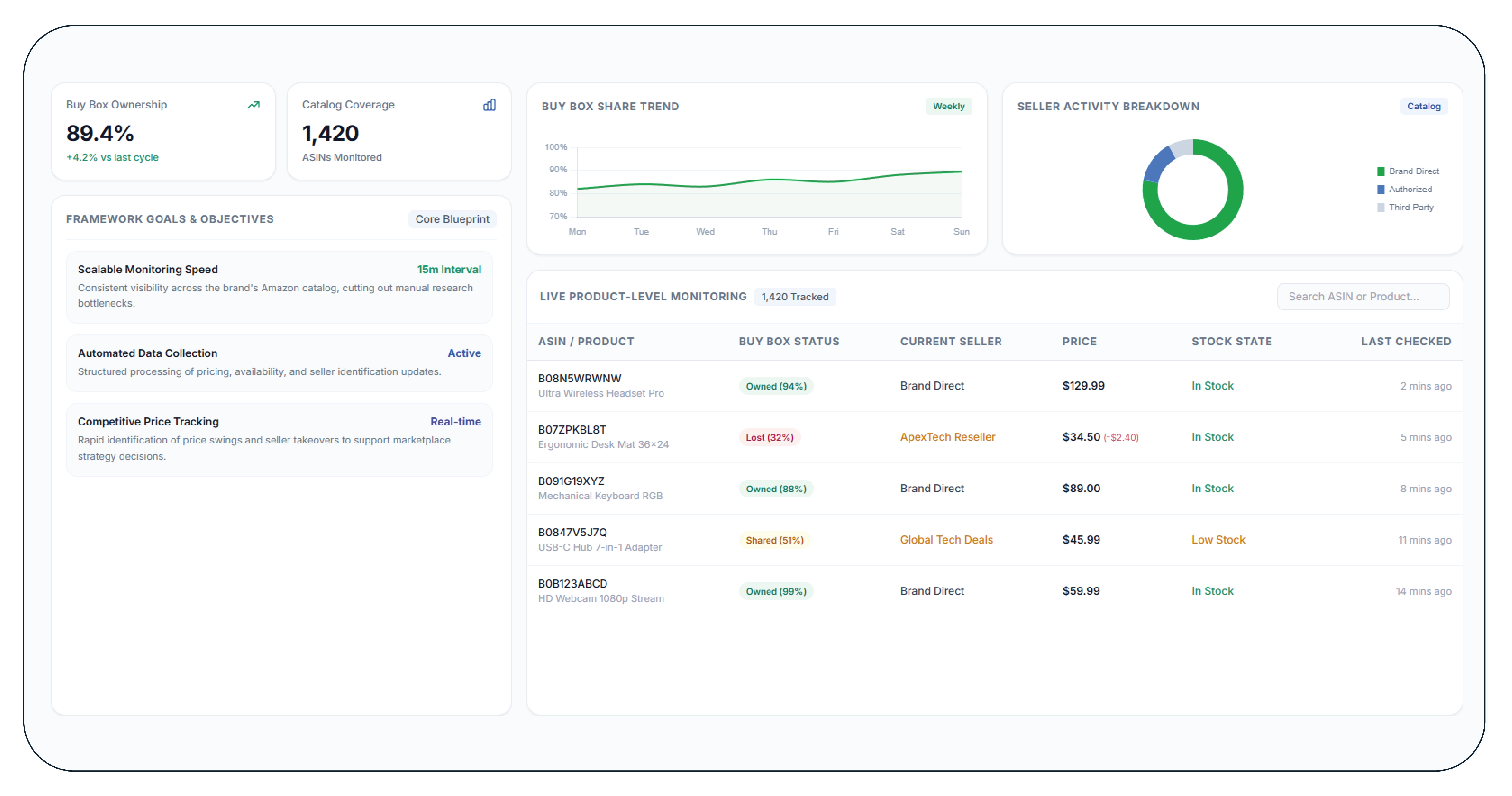
The primary business goal was to create a scalable monitoring framework that could provide consistent visibility into Buy Box ownership across the brand's Amazon catalog. The client wanted to improve monitoring speed, accuracy, and coverage while reducing repetitive manual seller research. Another goal was to identify competitive pricing and seller changes quickly enough to support marketplace decisions.
The technical objectives focused on automated Buy Box data collection, seller identification, product-level monitoring, price tracking, availability monitoring, and structured data processing. The system needed to collect relevant marketplace information at defined intervals and prepare it for reporting and analytics. It also needed to support scalable monitoring as the number of products and competing sellers increased. Amazon Buy Box monitoring for brands became a central capability, giving the client a structured way to evaluate Buy Box changes and seller activity across its catalog.
Improve Buy Box visibility by approximately 85%.
Reduce manual seller monitoring effort by around 65%.
Accelerate seller-change detection by approximately 70%.
Increase monitored product coverage.
Improve consistency of seller and pricing data.
Support faster identification of Buy Box ownership changes.
The Core Challenge
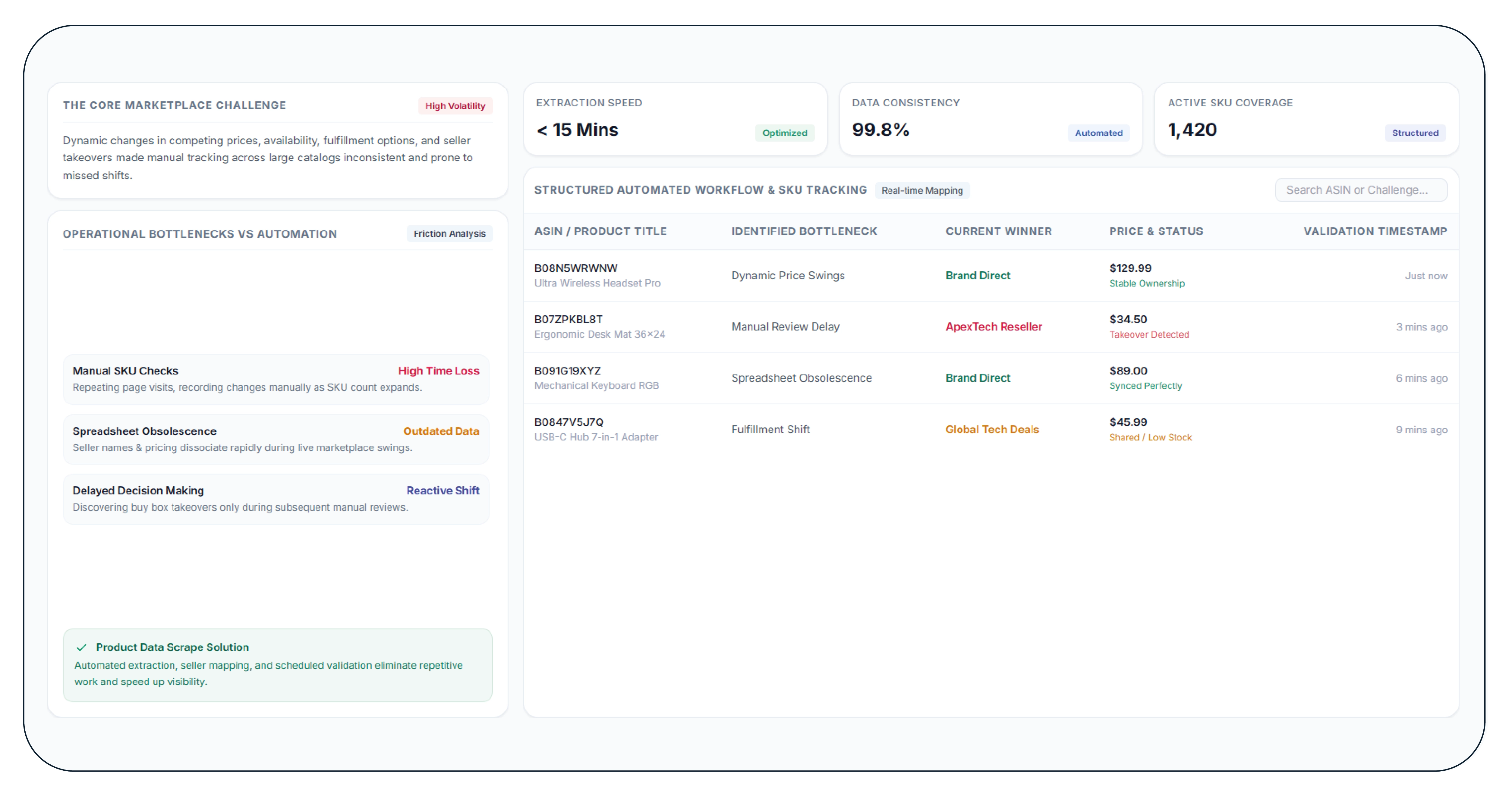
The client's biggest challenge was the dynamic nature of Amazon's marketplace. Buy Box ownership could change as competing sellers adjusted prices, availability, fulfillment options, and other marketplace conditions. Manual monitoring made it difficult to capture these changes consistently across a large product catalog.
Operational bottlenecks were significant. Teams had to repeatedly visit product pages, review seller offers, identify the current Buy Box winner, compare competing prices, and record changes. As the number of monitored SKUs increased, this process consumed more time and created a greater risk of missed updates.
Data consistency was another concern. Seller names, offer information, pricing, availability, and Buy Box status needed to be associated correctly with individual products. Manual spreadsheets could quickly become outdated when marketplace conditions changed.
The lack of timely visibility also affected decision-making. When a competing seller gained the Buy Box or changed its offer, internal teams might not discover the change until a later manual review. This reduced the ability to respond proactively.
Product Data Scrape addressed these challenges by creating a structured workflow to track Amazon Buy Box ownership. Automated extraction, seller mapping, validation, and scheduled monitoring helped reduce repetitive work and improve the speed at which marketplace changes became visible to the brand.
Our Solution
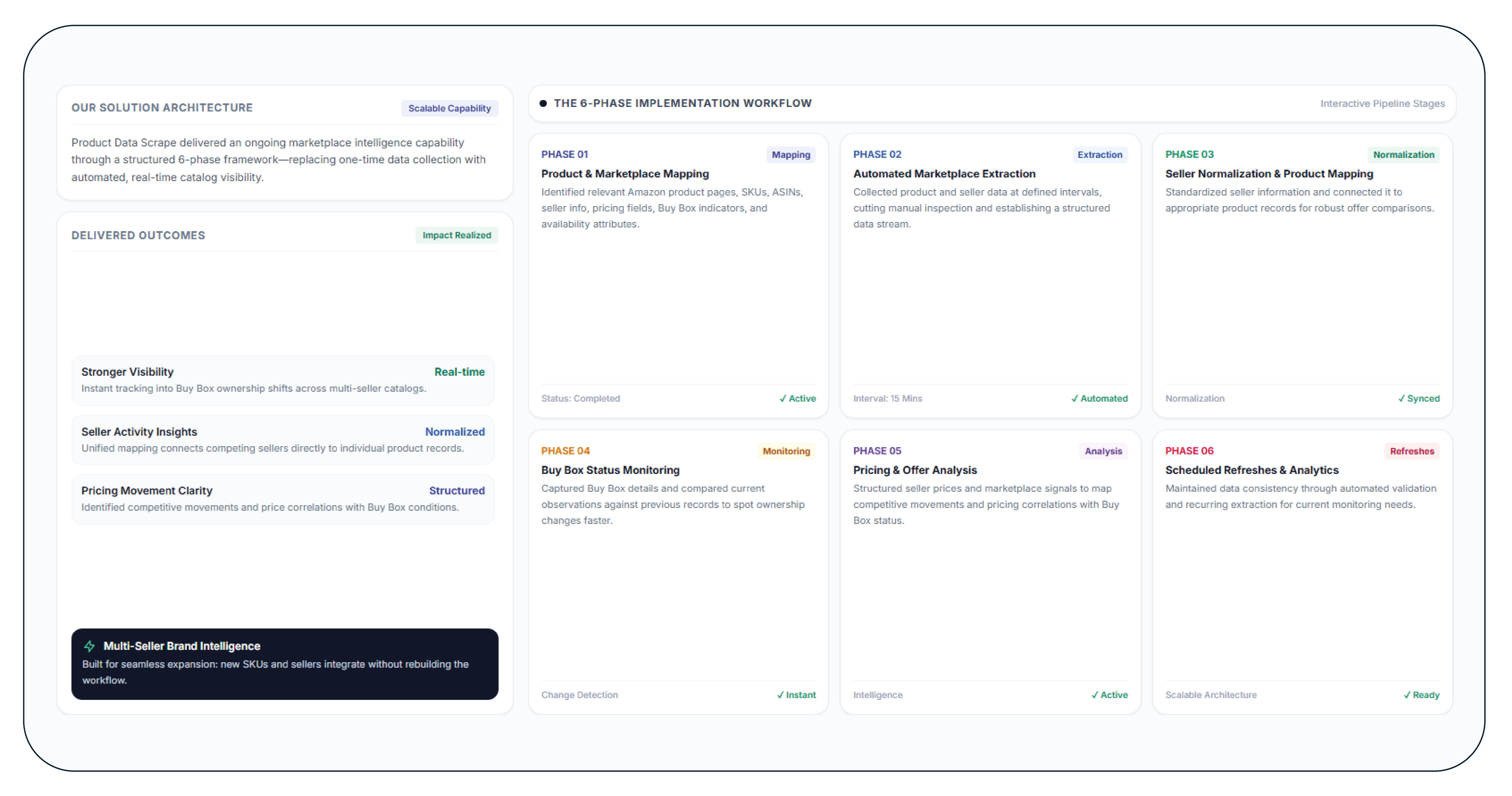
Product Data Scrape implemented the solution through a phased approach designed to create reliable, scalable Buy Box intelligence.
Phase 1: Product and Marketplace Mapping
The first phase focused on product and marketplace mapping. We identified the relevant Amazon product pages, SKUs, ASINs, seller information, pricing fields, Buy Box indicators, and availability attributes required for monitoring.
Phase 2: Automated Marketplace Extraction
The second phase introduced automated marketplace extraction. The framework collected relevant product and seller information at defined intervals, reducing the need for teams to manually inspect individual product pages. This created a structured stream of marketplace data for monitored products.
Phase 3: Seller Normalization and Product Mapping
The third phase focused on seller normalization and product mapping. Seller information was standardized and connected to the appropriate product records. This made it easier to compare competing offers and identify changes in seller participation.
Phase 4: Buy Box Status Monitoring
The fourth phase introduced Buy Box status monitoring. The workflow captured the relevant Buy Box information and compared current observations against previous records. Changes in ownership could therefore be identified more quickly.
Phase 5: Pricing and Offer Analysis
The fifth phase incorporated pricing and offer analysis. Seller prices and related marketplace signals were structured so teams could identify competitive movements and understand how pricing changes corresponded with Buy Box conditions. This supported competitive pricing for Amazon Buy Box and broader marketplace intelligence.
Phase 6: Scheduled Refreshes, Validation, and Analytics-Ready Outputs
The sixth phase focused on scheduled refreshes, validation, and analytics-ready outputs. Automated checks helped maintain data consistency while recurring extraction ensured that marketplace information could remain current according to defined monitoring requirements.
The complete framework was designed for scalability, allowing additional products and seller records to be incorporated without rebuilding the workflow. Through this approach, Product Data Scrape delivered Amazon Buy Box Monitoring for a Multi-Seller Brand as an ongoing marketplace intelligence capability rather than a one-time data collection project.
The result was a more efficient monitoring process that gave the client stronger visibility into Buy Box ownership, seller activity, pricing movements, and marketplace changes.
Results & Key Metrics
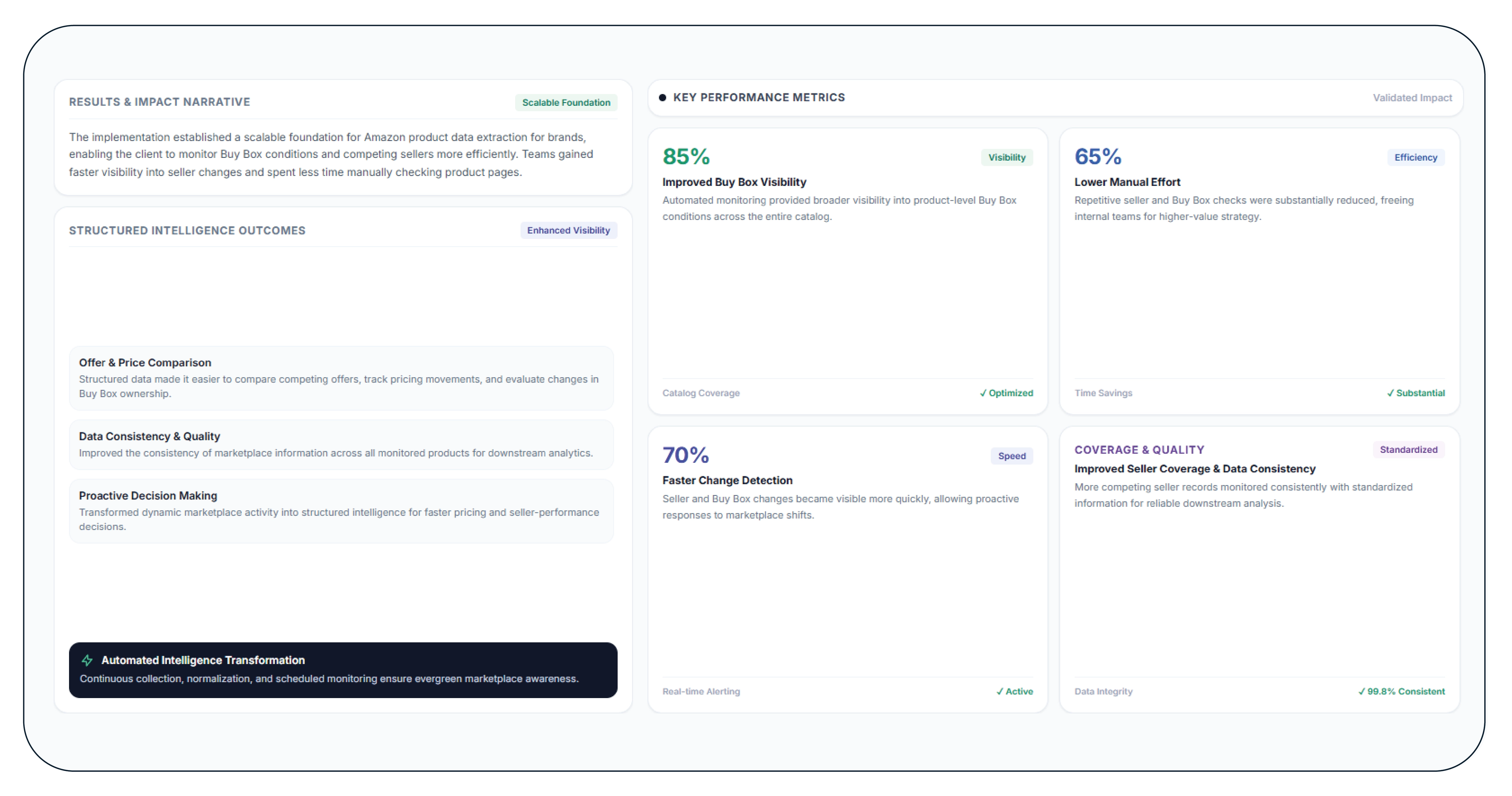
85% improved Buy Box visibility: Automated monitoring provided broader visibility into product-level Buy Box conditions.
65% lower manual effort: Repetitive seller and Buy Box checks were substantially reduced.
70% faster change detection: Seller and Buy Box changes became visible more quickly.
Improved seller coverage: More competing seller records could be monitored consistently.
Better data consistency: Standardized product and seller information improved downstream analysis.
Results Narrative
The implementation established a scalable foundation for Amazon product data extraction for brands, enabling the client to monitor Buy Box conditions and competing sellers more efficiently. Teams gained faster visibility into seller changes and spent less time manually checking product pages. Structured data made it easier to compare offers, identify pricing movements, and evaluate changes in Buy Box ownership. The workflow also improved the consistency of marketplace information across monitored products. Through automated collection, normalization, and scheduled monitoring, Product Data Scrape helped the brand transform dynamic Amazon marketplace activity into structured intelligence for faster pricing and seller-performance decisions.
What Made Product Data Scrape Different
Product Data Scrape differentiated its approach by combining automated marketplace extraction, seller mapping, Buy Box monitoring, price tracking, validation, and scheduled data refreshes. Instead of collecting isolated marketplace snapshots, the framework was designed to identify changes over time and make those changes easier to analyze. Smart automation reduced repetitive product-page checks while supporting monitoring across a larger catalog. The workflow also created structured outputs suitable for reporting and analytics. Our Amazon Price Monitoring, Amazon Buy Box Monitoring for a Multi-Seller Brand approach gave the client a scalable way to connect seller activity, pricing movements, and Buy Box changes into one marketplace intelligence workflow.
Client's Testimonial
"Product Data Scrape gave us significantly better visibility into our Amazon marketplace performance. Before the implementation, monitoring Buy Box ownership and competing sellers required a lot of manual effort, especially as our product catalog grew. The automated workflow helped us identify seller and pricing changes faster and gave our team a much more structured view of marketplace activity. We were particularly impressed by the consistency of the data and the ability to monitor multiple products at scale. The solution helped us make faster competitive decisions and reduced the operational burden associated with routine marketplace monitoring."
— Marketplace Strategy Manager, Multi-Seller Consumer Brand
Conclusion
Amazon marketplace conditions can change rapidly, making timely Buy Box and seller intelligence essential for multi-seller brands. Product Data Scrape helped the client replace fragmented manual checks with an automated workflow for monitoring Buy Box ownership, seller activity, pricing, and availability. The solution improved visibility, speed, coverage, and operational efficiency while creating a stronger foundation for marketplace decision-making. By combining structured Amazon Search API capabilities with automated monitoring, the brand could identify competitive changes more effectively. Amazon Buy Box Monitoring for a Multi-Seller Brand demonstrates how marketplace intelligence can help businesses respond faster, understand seller dynamics, and strengthen their Amazon strategy.
FAQs
1. What is Amazon Buy Box Monitoring for a Multi-Seller Brand?
Amazon Buy Box Monitoring for a Multi-Seller Brand is an automated approach to tracking Buy Box ownership, competing sellers, prices, availability, and other relevant marketplace signals. It helps brands understand changes that may influence their Amazon performance.
2. Why is Buy Box monitoring important?
The Buy Box can influence how shoppers purchase products on Amazon. Monitoring ownership and seller changes gives brands better visibility into competitive conditions and helps them identify changes that may require attention.
3. What Amazon data can be monitored?
Depending on requirements and source availability, monitoring can include product identifiers, Buy Box status, seller names, prices, availability, offer information, product details, and timestamps.
4. Can multiple products be monitored simultaneously?
Yes. An automated workflow can be designed to monitor multiple products and sellers at scale. This makes it more practical for brands with large catalogs than manually checking individual product pages.
5. How can brands use Buy Box monitoring data?
Brands can use structured Buy Box data for competitive pricing, seller performance analysis, marketplace intelligence, product monitoring, pricing strategy, and identifying changes in Buy Box ownership. This helps teams make faster, data-driven Amazon marketplace decisions.


 Singapore
 EMAIL
EMAIL
 PHONE
PHONE














.webp)