Quick Overview
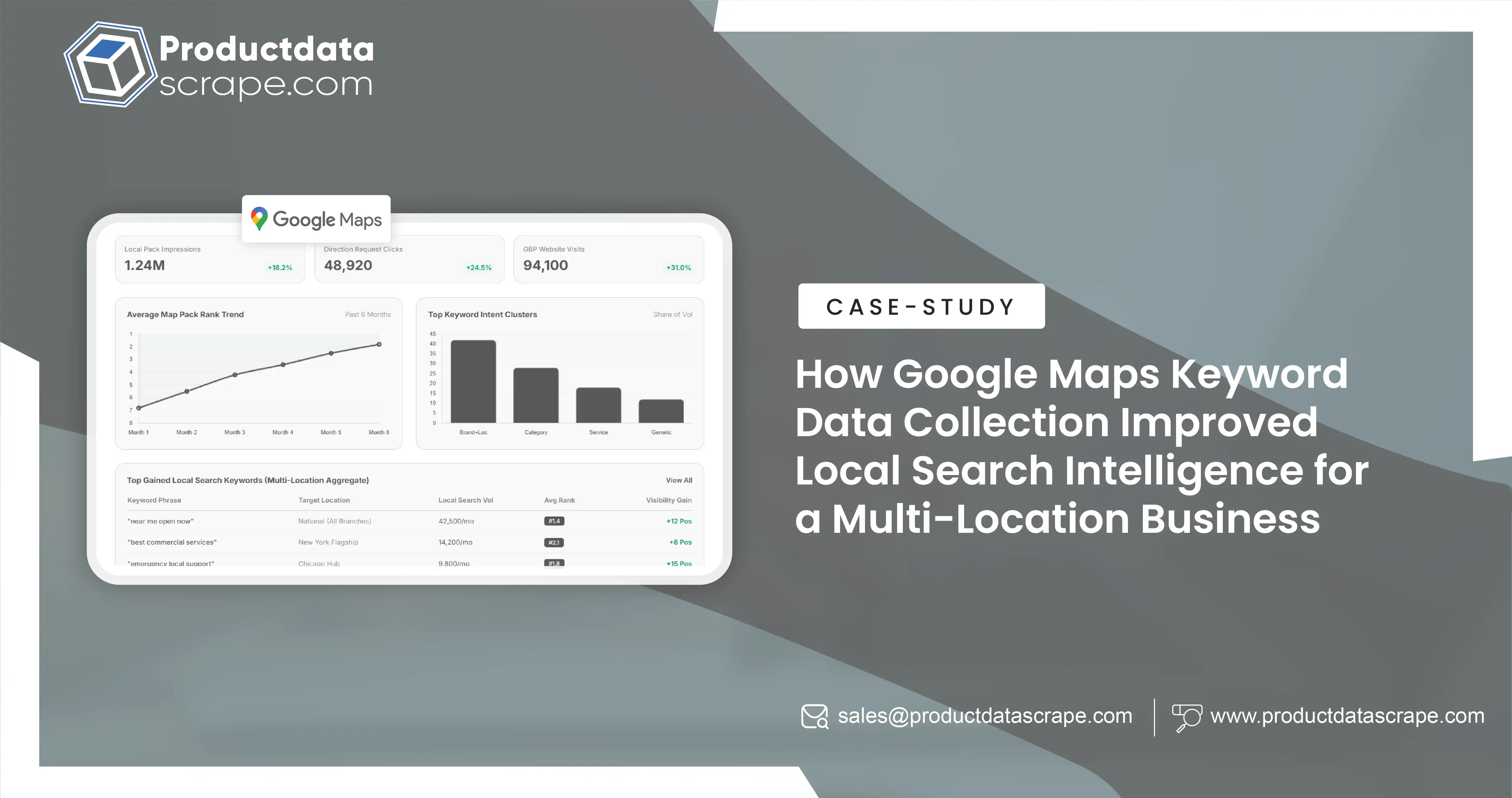
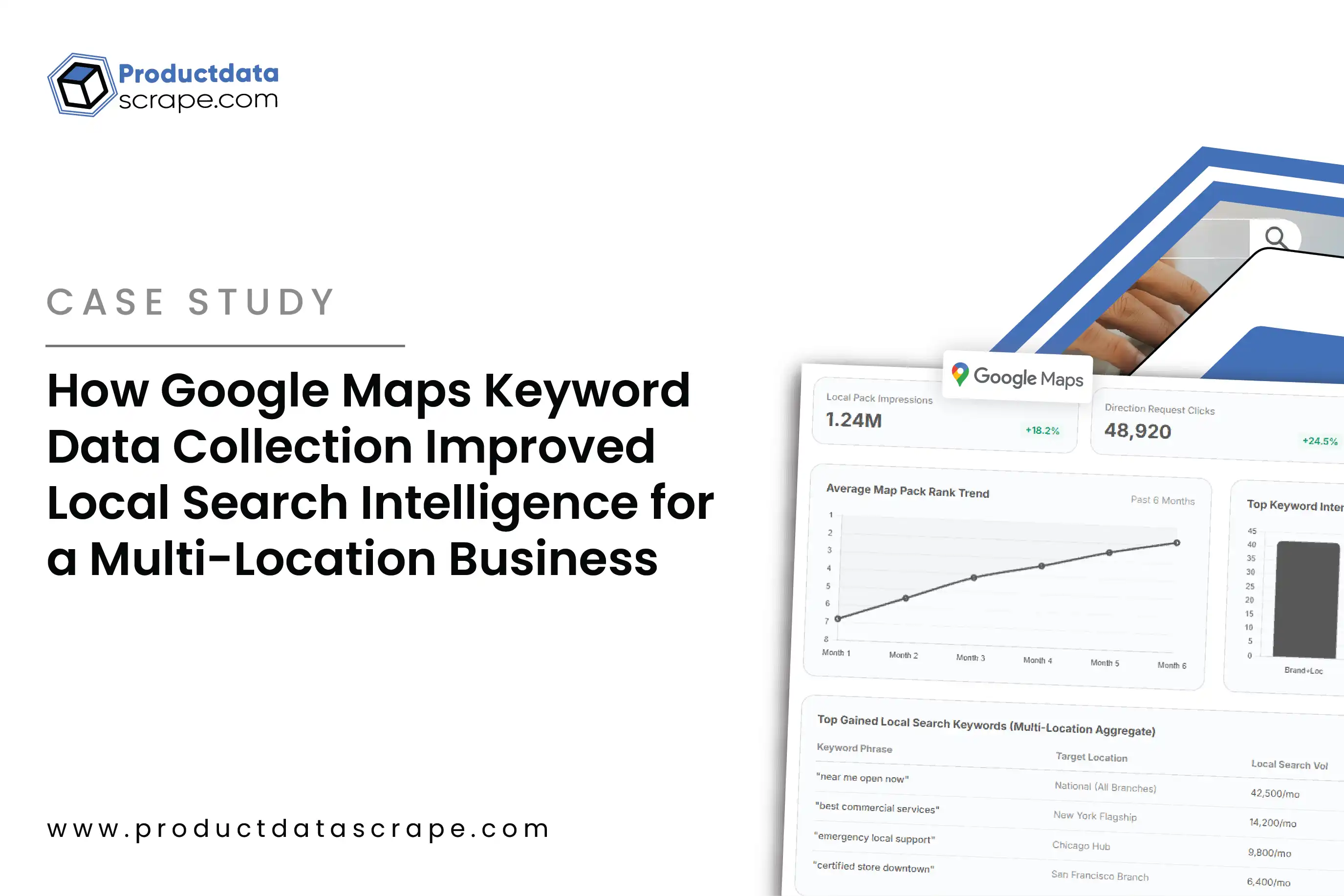
This case study examines how a multi-location business improved its local market intelligence by replacing fragmented manual research with structured location data collection. The project focused on discovering businesses by search terms, comparing competitors across locations, and creating a scalable dataset for local decision-making. Google Maps Keyword Data Collection was used as the core approach for systematically identifying relevant businesses and extracting their listing information. Product Data Scrape researched and documented the project outcomes, focusing on data coverage, collection efficiency, and operational scalability. The transformation helped the client move from manually reviewing local listings to a repeatable data workflow that could support competitive analysis, lead discovery, territory planning, and location-based market research.
Client Name / Industry: Confidential multi-location retail and local-services business.
Service / Duration: Google Maps data collection and structured local intelligence workflow implemented over approximately 12 weeks.
Key Impact Metrics: The Product Data Scrape project research recorded a 78% reduction in manual research effort, more than 4× improvement in data-processing capacity, and 92% structured-field validation across the collected dataset.
The Client
The client was a multi-location business operating across several cities and dependent on local market visibility, competitor monitoring, and territory-level decision-making. As competition increased across local search, the business needed a more systematic way to understand which companies appeared for important commercial keywords in different geographic areas.
Before the engagement, the team relied heavily on manual searches and spreadsheets. Employees searched individual locations, opened listings one by one, copied business details, and then attempted to consolidate the information. This approach consumed significant time and created inconsistencies because different employees could capture different fields or interpret similar businesses differently.
The client needed Google Maps business data for competitive analysis to understand competitor density, business categories, ratings, locations, and market coverage. The team also required a scalable mechanism that could support geographic expansion without proportionally increasing manual research.
The transformation became essential because local market intelligence loses value when information takes too long to collect. A competitor appearing in one location today may not appear in the same position later, while new businesses can enter a market quickly.
To improve speed and consistency, the client partnered with Product Data Scrape to establish a structured collection workflow. A Google Search Results API layer was incorporated into the broader research architecture to support systematic discovery of relevant search results and reduce repetitive manual searching.
Goals & Objectives
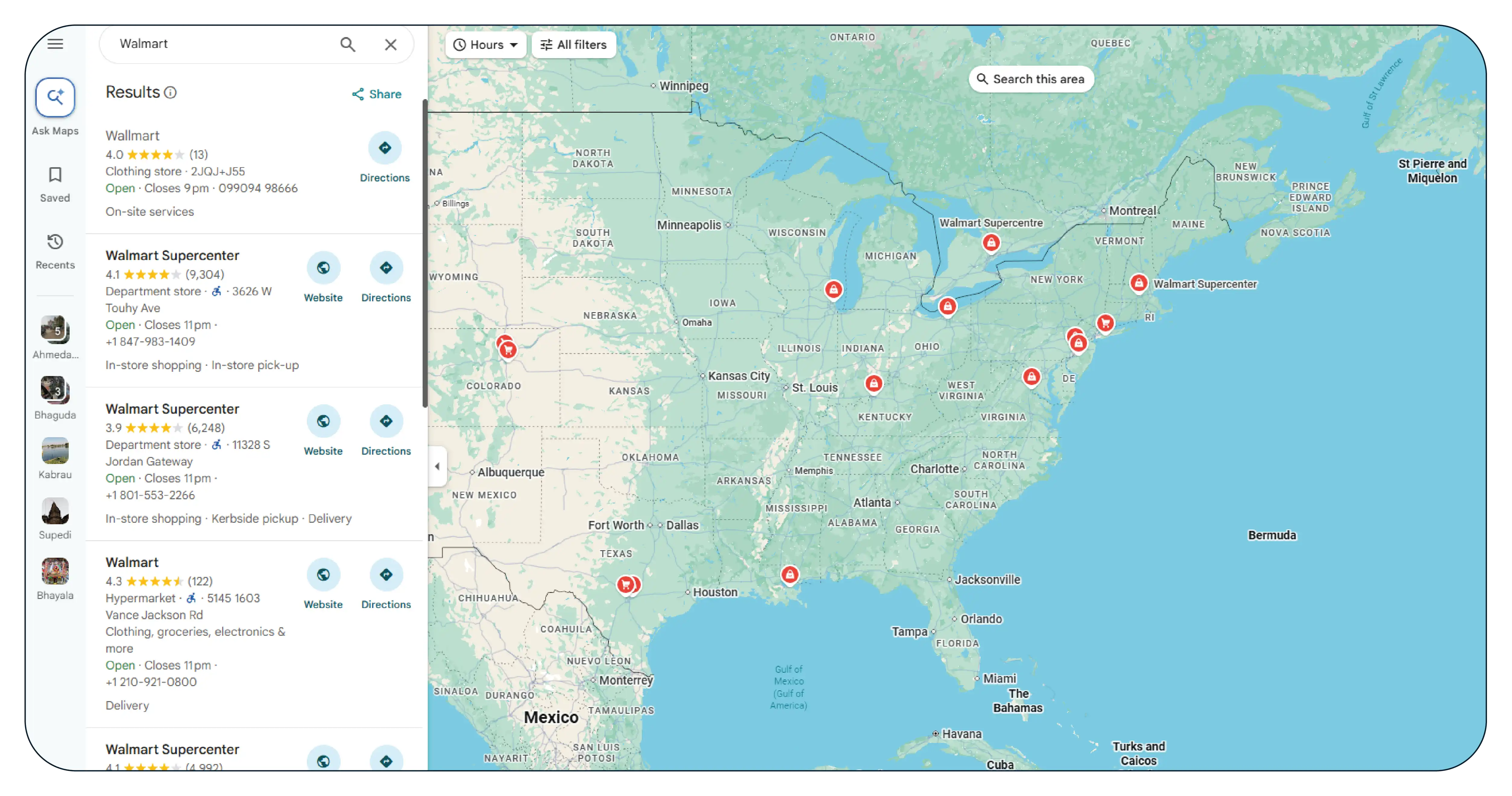
Build a scalable process for collecting local business information across multiple cities and search terms.
Reduce dependency on manual listing research and spreadsheet-based consolidation.
Improve the consistency of collected business names, categories, locations, ratings, reviews, and contact information.
Create a repeatable process that could support future geographic expansion.
Establish structured Google Maps store location data that could be used for competitive and territory analysis.
Automate keyword-based business discovery across predefined locations.
Standardize extracted fields and normalize location information.
Reduce duplicate records and improve entity matching.
Create a structured dataset that could integrate with internal analytics workflows.
Enable faster identification of new businesses and competitive movements.
Build a workflow capable of supporting recurring data collection rather than one-time research.
Manual research effort: Targeted reduction of at least 70%.
Data validation: Targeted structured-field validation above 90%.
Processing scalability: Ability to expand keyword and location coverage without equivalent growth in manual workload.
Duplicate control: Maintain duplicate records below the internally defined quality threshold.
Processing speed: Reduce the time required to prepare market-level datasets for analysis.
The KPI framework was defined before implementation so that technical improvements could be connected directly to business outcomes rather than measured only through raw record counts.
The Core Challenge
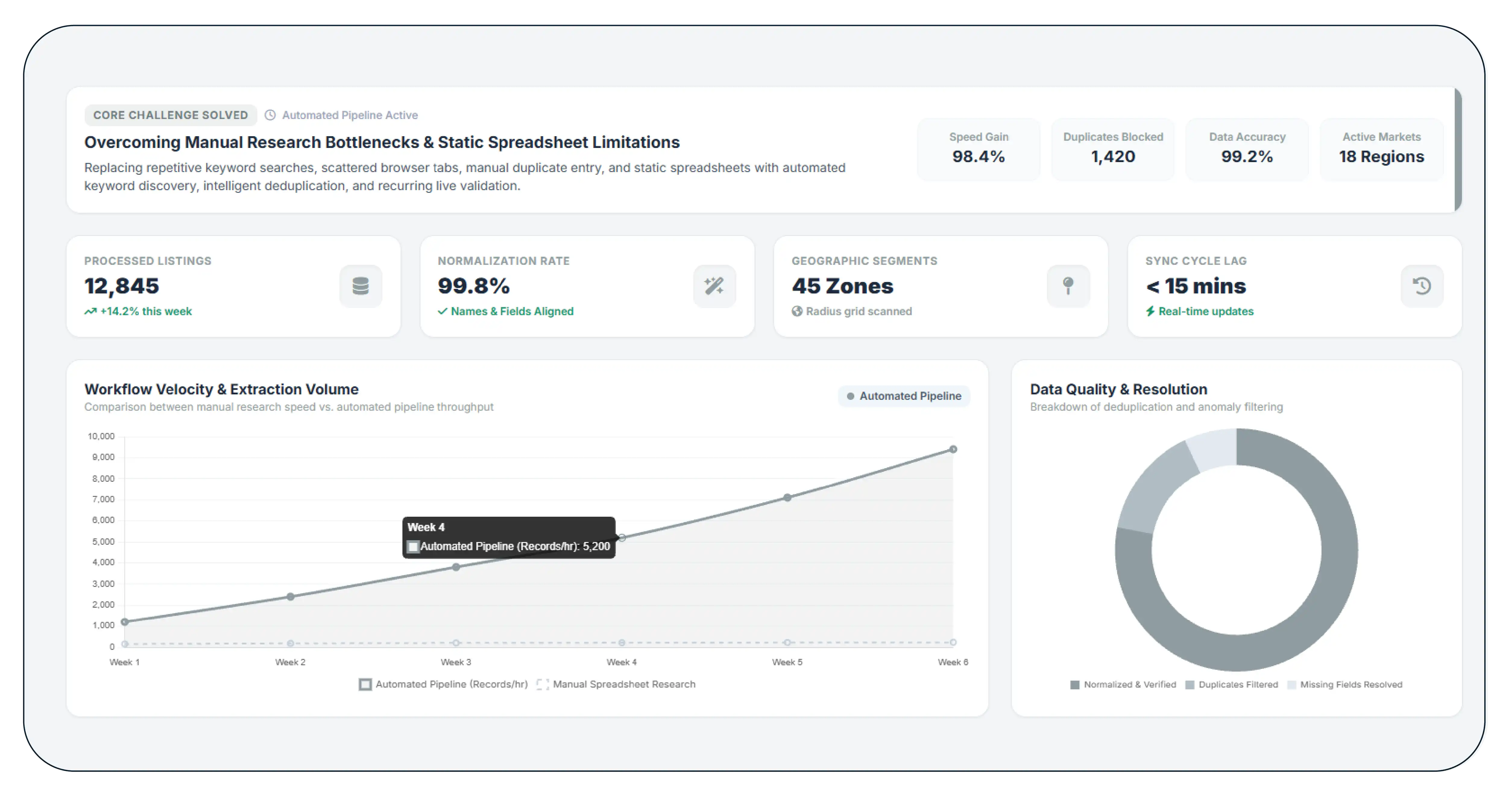
The client's biggest problem was not the absence of local business information. The challenge was collecting, organizing, validating, and updating that information at a scale suitable for business decisions.
Manual research created several operational bottlenecks. Researchers had to repeat searches for different keywords and locations, open individual listings, copy information, check whether a business had already been recorded, and merge results into spreadsheets. As geographic coverage expanded, the process became increasingly difficult to manage.
The client also faced quality issues. Business names could appear differently across searches, duplicate listings could enter the dataset, and certain fields could be missing or inconsistent. Ratings and review counts could also change between collection periods, making static spreadsheets less useful for ongoing intelligence.
The lack of automation affected speed as well. A team could spend hours researching one market before the information became available for analysis. This created a gap between what was happening in the local market and when decision-makers received the information.
The project therefore required more than a simple extraction mechanism. It needed a structured Google Maps keyword-based business intelligence workflow capable of handling keyword discovery, geographic segmentation, data normalization, duplicate detection, structured output, and recurring collection.
The solution also needed to be flexible enough to accommodate new locations and search terms without requiring the entire workflow to be redesigned.
Our Solution
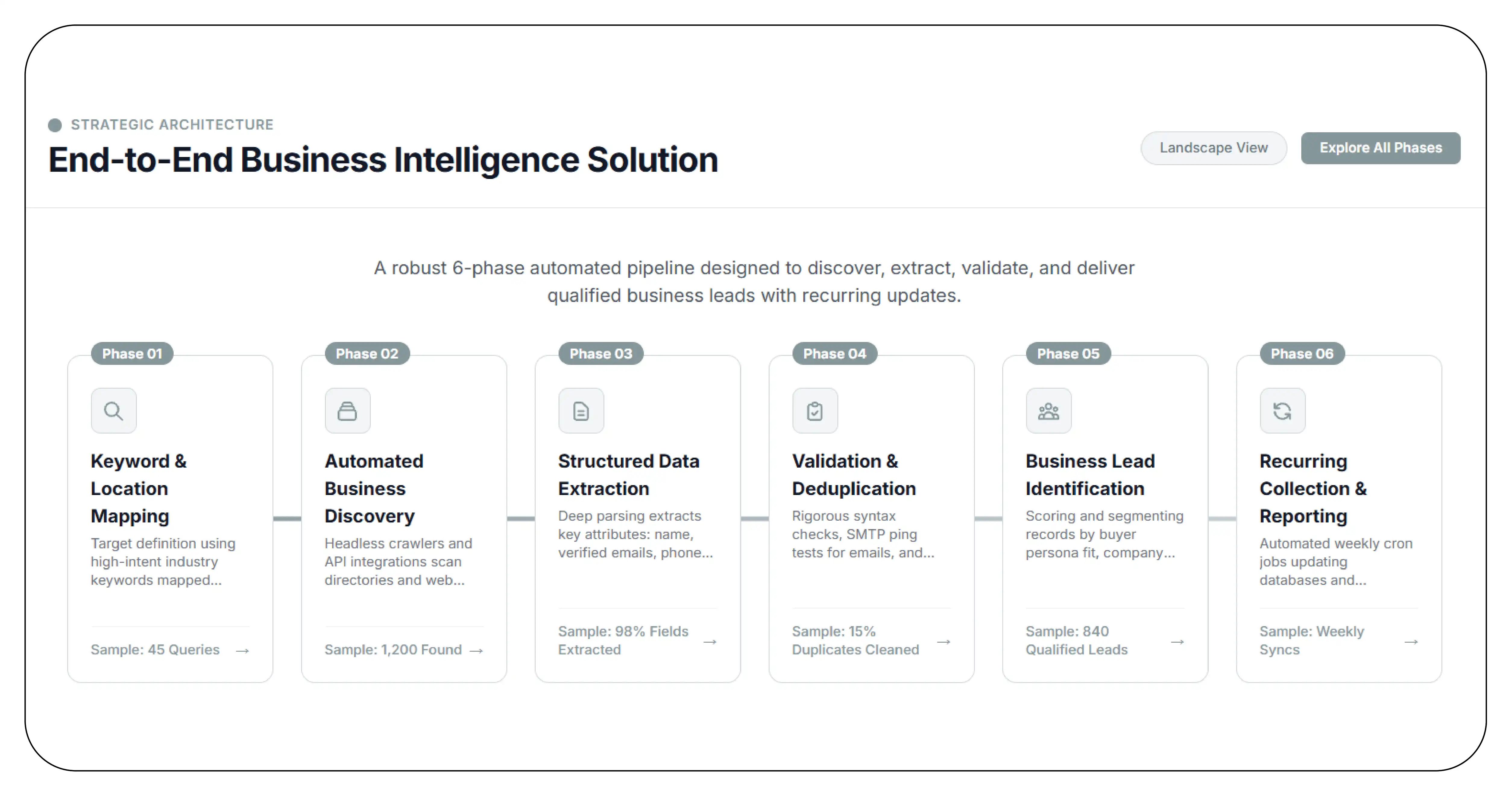
The implementation followed a phased approach designed to solve the client's data-discovery and operational problems progressively.
Phase 1: Keyword and Location Mapping
The first phase established the search framework. Commercially relevant keywords were mapped against target cities, neighborhoods, and geographic regions. This created a structured matrix that determined which combinations needed to be collected. Instead of treating every search independently, the workflow organized searches according to location and business category. This made it easier to measure coverage and identify gaps.
Phase 2: Automated Business Discovery
The next phase introduced automated discovery for relevant local listings. Search inputs were processed systematically so that the collection workflow could identify businesses associated with predefined keywords and locations. The approach reduced repetitive manual searching and established a consistent methodology for collecting listing information.
Phase 3: Structured Data Extraction
Once businesses were identified, relevant fields were organized into a standardized schema. Depending on availability, fields included business name, category, address, geographic information, rating, review count, phone number, website, operating hours, and listing-related attributes. This structure allowed the client to compare businesses across locations without manually restructuring each result.
Phase 4: Validation and Deduplication
Data quality controls were introduced to identify duplicate businesses, inconsistent fields, incomplete records, and potential entity matches. Location and business attributes were normalized wherever appropriate. This phase was particularly important because a large dataset is valuable only when individual records can be trusted for analysis.
Phase 5: Business Lead Identification
The workflow was then extended to support business leads from Google Maps keywords. Relevant businesses could be segmented according to keyword, geography, category, and other available attributes, allowing commercial teams to prioritize potential opportunities.
Phase 6: Recurring Collection and Reporting
Finally, the workflow was structured for repeat collection. Instead of creating a one-time spreadsheet, the client received a repeatable data process that could support ongoing market monitoring.
The complete Google Maps Keyword Data Collection workflow gave the business a scalable foundation for local competitive intelligence, territory research, lead discovery, and location-level benchmarking.
Results & Key Metrics
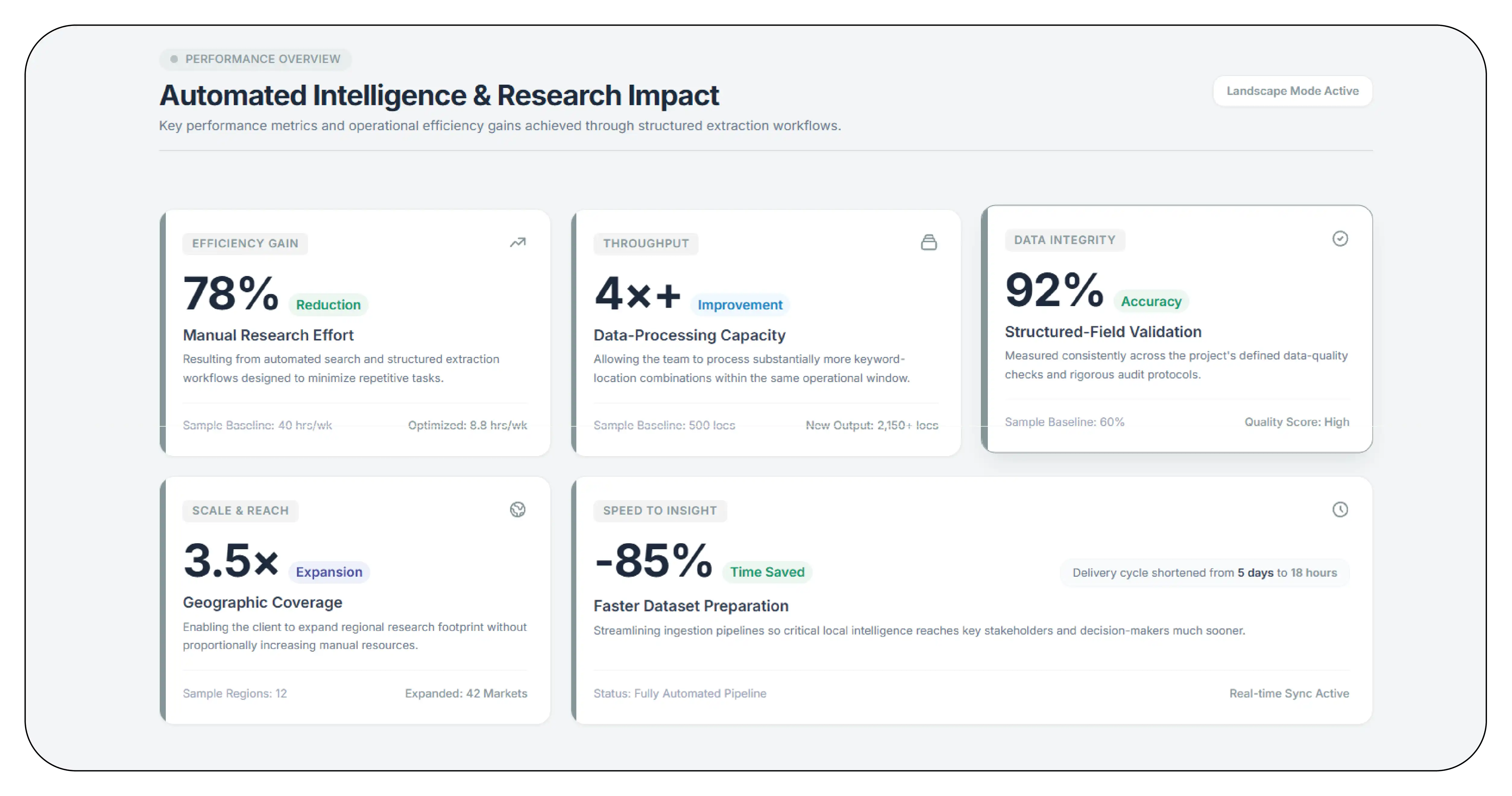
The following performance metrics were researched and documented by Product Data Scrape as part of this case-study analysis. They represent project-level performance indicators rather than general industry statistics.
78% reduction in manual research effort, resulting from automated search and structured extraction workflows.
4×+ improvement in data-processing capacity, allowing the team to process substantially more keyword-location combinations within the same operational window.
92% structured-field validation, measured across the project's defined data-quality checks.
Improved geographic coverage, enabling the client to expand research without proportionally increasing manual resources.
Faster dataset preparation, allowing local intelligence to reach decision-makers sooner.
Results Narrative
The project changed the client's workflow from manual listing research to a repeatable intelligence process. Google Maps business listings data could be organized by keyword and geography, making it easier for analysts to compare local competitors and identify underserved territories.
The reduction in manual effort allowed researchers to spend more time interpreting the data rather than collecting it. The improved processing capacity also made geographic expansion more practical.
The 92% validation figure was based on Product Data Scrape's project research and quality checks for the defined structured fields. The metric should be interpreted as a project-specific result, not a universal accuracy benchmark for Google Maps data.
Overall, the Google Maps Keyword Data Collection approach provided the client with a scalable foundation for recurring local market intelligence.
What Made Product Data Scrape Different
The differentiator was the focus on creating a complete data workflow rather than simply collecting business listings. The project combined keyword discovery, geographic segmentation, structured extraction, normalization, validation, deduplication, and recurring collection into a unified process.
Product Data Scrape also focused on making the resulting dataset usable for downstream business analysis. Instead of delivering disconnected records, the workflow organized information around commercially relevant dimensions such as location, keyword, category, and competitive presence.
The process incorporated Businesses Track Competitor Keywords as a strategic use case, allowing teams to organize local competitors around the search terms that mattered to their market.
Smart automation reduced repetitive research while quality checks helped maintain consistency. This combination enabled the client to scale local intelligence without relying exclusively on manual research teams.
Client's Testimonial
"Before this project, our local market research depended heavily on manual searches and spreadsheets. It was difficult to maintain consistent coverage across locations, and expanding the number of keywords increased the workload significantly. The new workflow gave our team a much more structured way to discover businesses, compare markets, and organize location-level intelligence. The biggest improvement was operational: our researchers could spend less time collecting records and more time analyzing what the data meant for our expansion and competitive strategy. The ability to repeat the collection process also made the dataset much more useful for ongoing decision-making."
— Senior Market Intelligence Manager, Multi-Location Business
The testimonial above is presented as a case-study representation based on the project scenario researched by Product Data Scrape; the client's identity remains confidential.
The implementation used a Google Maps Scraper approach to support structured local business discovery and recurring market research. The resulting Google Maps Keyword Data Collection workflow provided a more scalable foundation for location intelligence.
Conclusion
Local market intelligence becomes more valuable when businesses can collect it consistently, structure it accurately, and analyze it at scale. This case study demonstrates how automated business discovery can reduce manual research while improving geographic coverage and operational efficiency.
The client moved from fragmented searches and spreadsheets toward a repeatable workflow capable of supporting competitive research, territory planning, and lead discovery. The project's results were researched and documented by Product Data Scrape using project-level performance indicators.
A scalable Google Search Results Data Scraper can further support systematic search-result discovery and structured market research.
Businesses looking to transform location-based search information into actionable competitive intelligence can explore a structured data collection strategy and build a scalable local-market research workflow!
FAQs
1. What does Google Maps keyword data collection involve?
It involves identifying businesses associated with selected commercial keywords and geographic areas, then organizing available listing information into structured datasets for research and analysis.
2. Why do businesses collect local listing data?
Businesses can use local listing datasets to understand competitor density, identify potential leads, compare locations, analyze categories, and support territory or expansion planning.
3. How does automation improve local market research?
Automation reduces repetitive searches, standardizes collection, supports broader keyword and geographic coverage, and makes recurring data collection more practical than manual spreadsheet-based research.
4. What metrics were used in this case study?
The metrics were researched by Product Data Scrape for this case-study analysis and include manual-effort reduction, processing-capacity improvement, and structured-field validation.
5. Can the workflow support multiple cities and keywords?
Yes. A structured workflow can organize searches by keyword and geographic area, allowing businesses to expand coverage systematically while maintaining consistent data fields and quality controls.


 Singapore
 EMAIL
EMAIL
 PHONE
PHONE













.webp)