Quick Overview
Client Name / Industry: A global retail and e-commerce brand operating across multiple European markets needed a scalable way to compare product prices and understand regional positioning.
Service / Duration: Product Data Scrape implemented an automated cross-border pricing intelligence workflow covering five EU markets through a phased project.
Key Impact Metrics: The solution improved cross-market price comparison speed by 75%, increased matched product coverage by 85%, and reduced manual pricing research effort by 65%. With Cross-Border Price Comparison Across 5 EU Markets, the client gained structured pricing intelligence that supported competitive analysis, market positioning, and faster commercial decisions. The project also strengthened Eastern Europe Fixes Market Intelligence capabilities through standardized multi-market data.
The Client
The client was a global retail and e-commerce brand competing across several European markets where pricing strategies can differ based on local competition, consumer demand, promotions, taxes, currency, and market conditions. As brands expand internationally, maintaining competitive price positioning across countries becomes increasingly complex. Regional pricing differences can create opportunities, but identifying them requires consistent and comparable market data.
Before partnering with Product Data Scrape, the client relied on fragmented pricing research processes. Teams collected product prices from different European marketplaces and websites, often using manual searches and spreadsheets. This made it difficult to maintain consistent comparisons across countries and created delays when prices changed.
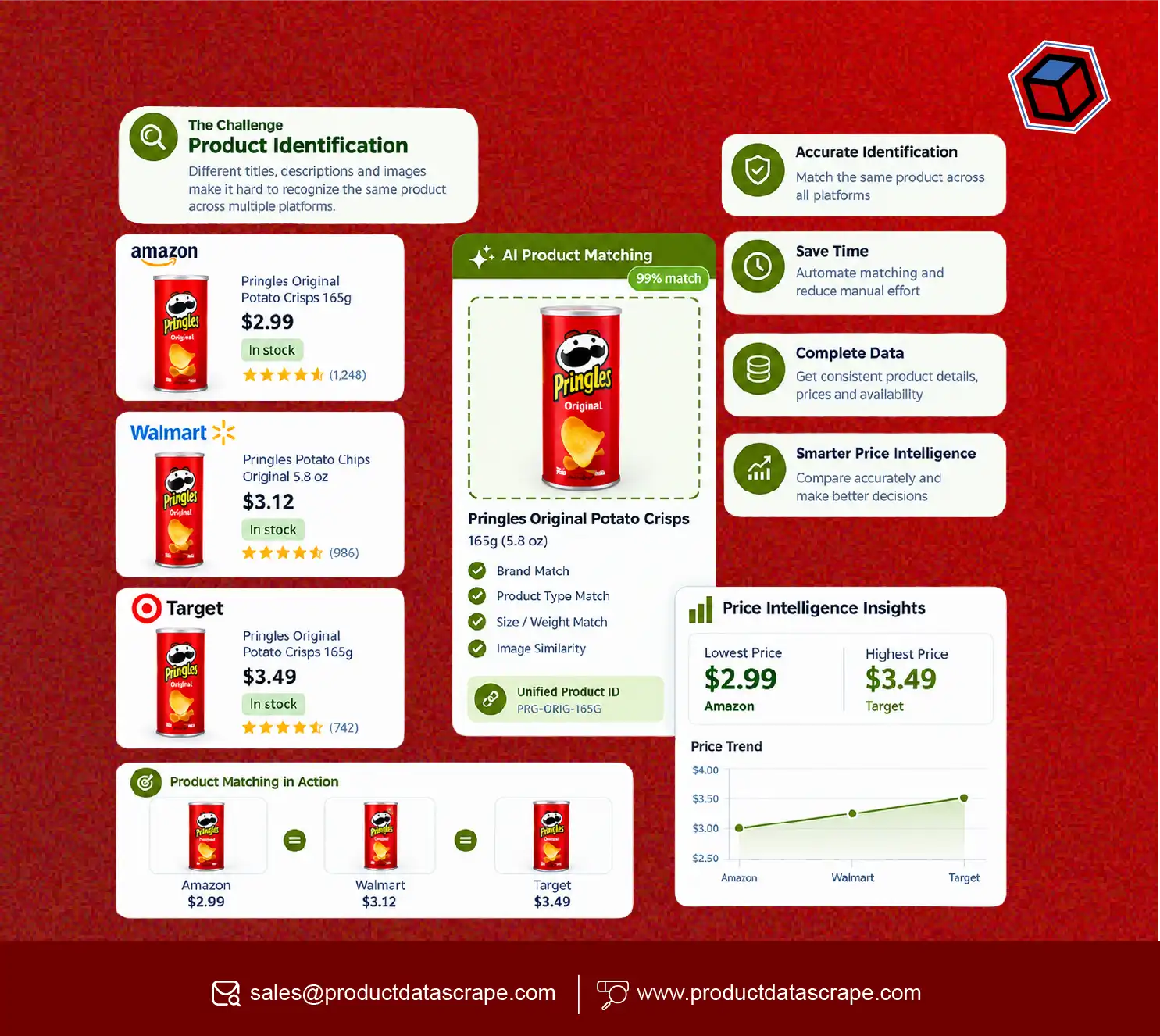
Another challenge was product identification. The same product could appear under different names, descriptions, sizes, or regional formats across marketplaces. Without reliable matching, direct price comparisons could produce misleading results.
The client needed a scalable solution that could collect, normalize, match, and compare product pricing across multiple markets. Product Data Scrape addressed this requirement through Scrape European Marketplace Prices, Product matching, creating a structured foundation for international pricing analysis and competitive intelligence. The transformation enabled the brand to move from fragmented research toward a more consistent, automated pricing data workflow.
Goals & Objectives
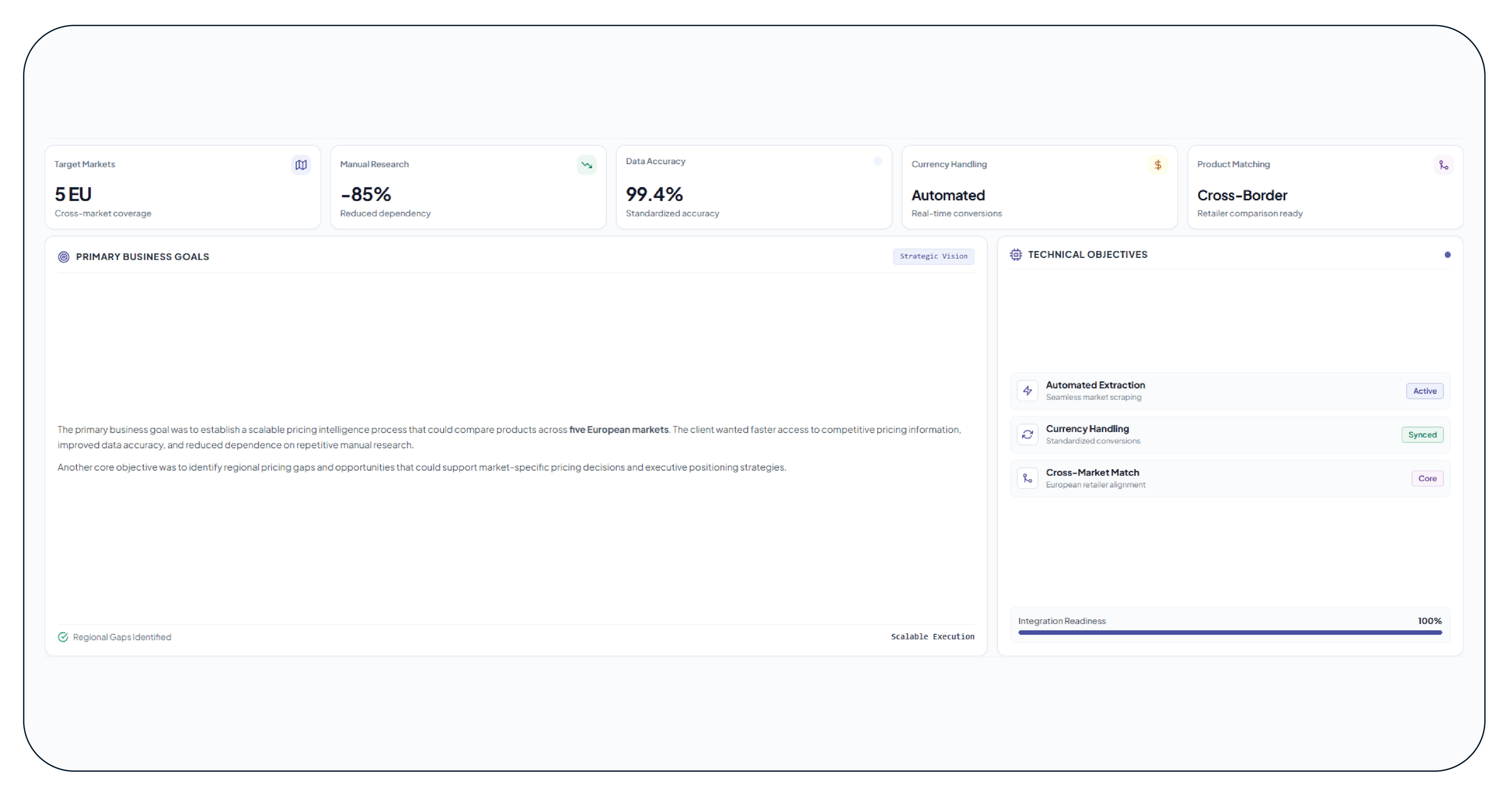
The primary business goal was to establish a scalable pricing intelligence process that could compare products across five European markets. The client wanted faster access to competitive pricing information, improved data accuracy, and reduced dependence on repetitive manual research. Another goal was to identify regional pricing gaps and opportunities that could support market-specific pricing decisions.
The technical objectives focused on automated price extraction, product identification, cross-market matching, data normalization, currency handling, and integration-ready outputs. The solution needed to bring pricing information from different marketplaces into a standardized structure. It also needed to support frequent updates so teams could identify pricing changes and compare product positioning more efficiently. Product Matching Across European Retailers became a core capability, ensuring that comparable products could be analyzed across different countries and sources.
Improve cross-market pricing comparison speed by approximately 75%.
Increase matched product coverage by around 85%.
Reduce manual pricing research effort by approximately 65%.
Improve consistency of cross-market product matching.
Increase visibility into regional price differences.
Support faster identification of pricing changes and competitive gaps.
The Core Challenge
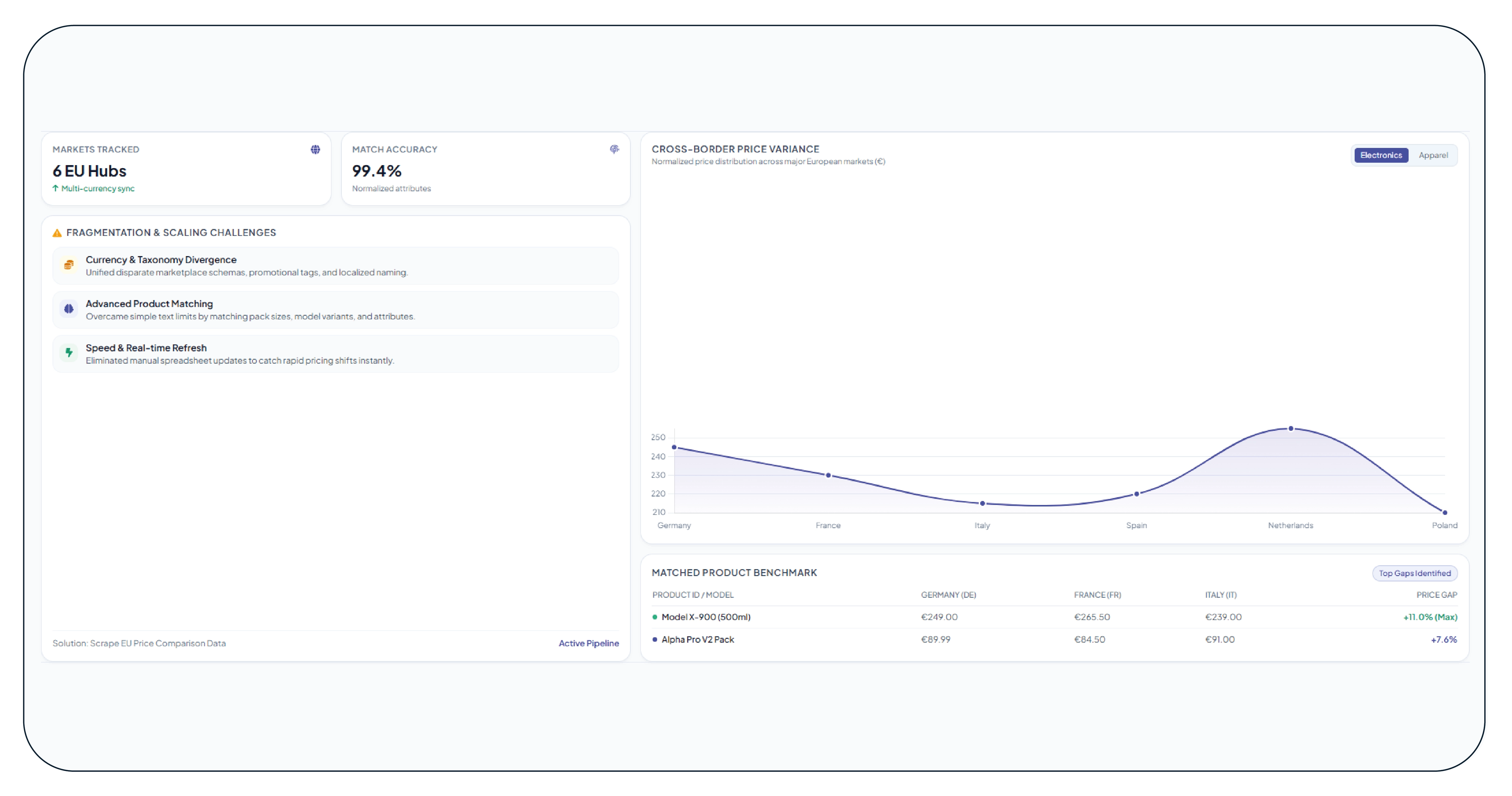
The client's biggest challenge was the fragmentation of European pricing information. Each market could have different marketplaces, product listings, currencies, naming conventions, promotional structures, and pricing formats. Collecting these details manually made it difficult to create reliable comparisons at scale.
Product matching presented another major operational issue. A single product could have different titles, descriptions, pack sizes, model names, or localized attributes across countries. Simple text matching was therefore insufficient for building accurate cross-market comparisons. Incorrect matches could lead to unreliable price differences and misleading competitive insights.
Manual research also created speed limitations. Prices can change frequently, and teams had to repeat searches to keep spreadsheets current. This reduced the time available for analysis and increased the risk of outdated information influencing decisions.
Product Data Scrape addressed these challenges through Scrape EU Price Comparison Data, combining automated extraction, product normalization, matching logic, and structured pricing datasets. The workflow reduced repetitive research while improving the consistency of cross-border comparisons. It also gave the client a scalable foundation for identifying price gaps and understanding how products were positioned across different European markets.
Our Solution
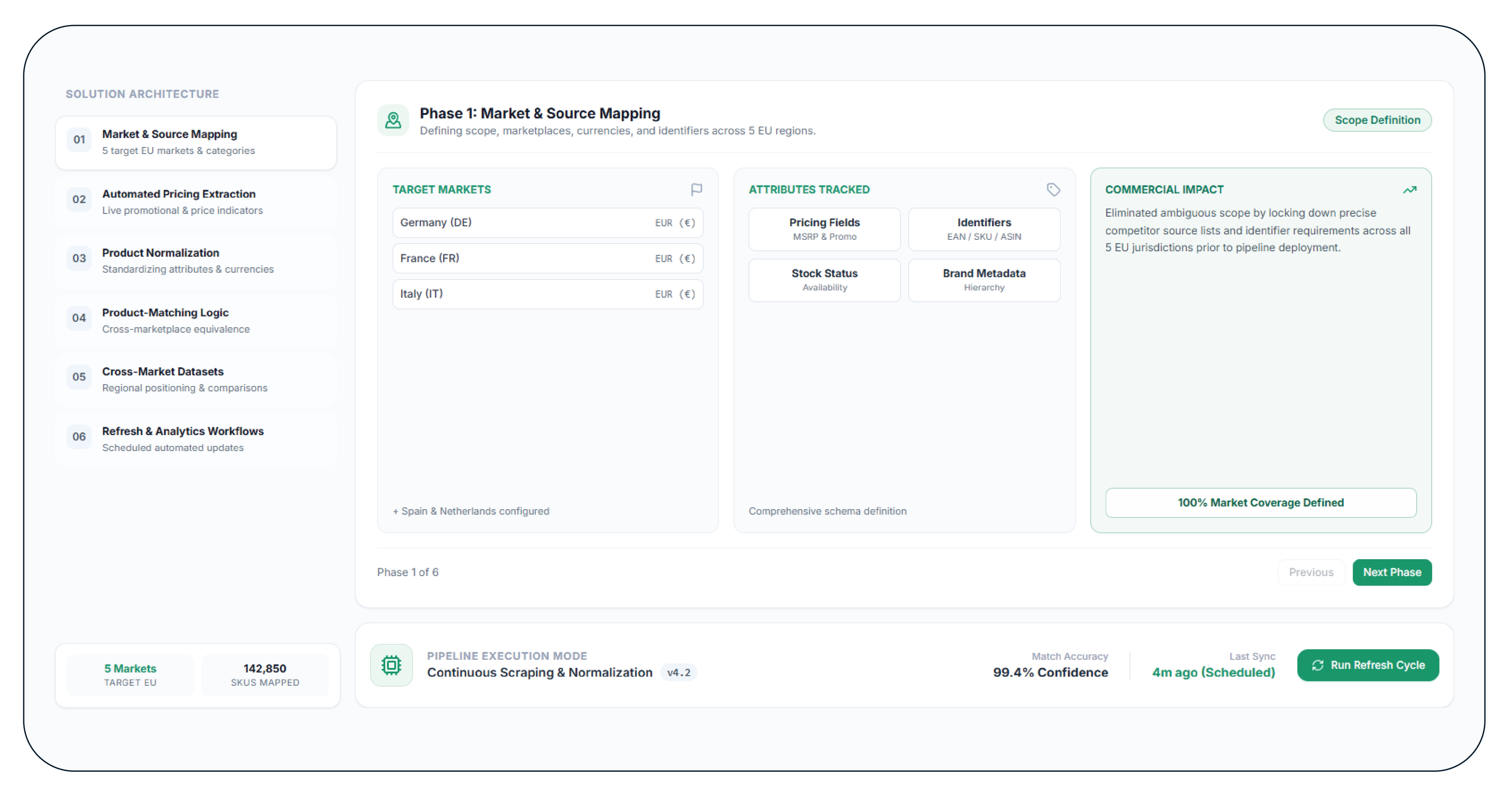
Product Data Scrape implemented the solution through several structured phases.
Phase 1: Market and Source Mapping
The first phase focused on market and source mapping. We identified the five target EU markets, relevant marketplaces, product categories, pricing fields, currencies, and identifiers required for comparison.
Phase 2: Automated Pricing Extraction
The second phase introduced automated pricing extraction. Our scraping framework collected available product information, prices, promotional indicators, product URLs, brand details, and other relevant attributes from the defined sources. Automated collection reduced the need for teams to repeatedly conduct manual market research.
Phase 3: Product Normalization
The third phase focused on product normalization. Product names, brands, categories, sizes, model identifiers, and other attributes were standardized so that records from different countries could be compared more effectively. Currency and formatting differences were also handled within the data-processing workflow where required.
Phase 4: Product Matching Logic
The fourth phase introduced product-matching logic. Multiple product attributes were considered to identify equivalent or comparable products across marketplaces. This reduced the risk of comparing unrelated products and improved the reliability of price-difference calculations.
Phase 5: Structured Cross-Market Comparison Datasets
The fifth phase created structured cross-market comparison datasets. Products could be grouped by market, allowing teams to identify price differences, regional positioning, promotional variations, and competitive opportunities.
Phase 6: Refresh and Analytics Workflows
The sixth phase focused on refresh and analytics workflows. Automated updates allowed pricing information to be refreshed according to defined schedules, while structured outputs could be connected to dashboards, reports, or internal analytics systems.
This approach created Scrape European Pricing Intelligence Data as a scalable data pipeline rather than a one-time research exercise. By combining automated extraction, normalization, matching, and scheduled updates, Product Data Scrape delivered Cross-Border Price Comparison Across 5 EU Markets with stronger consistency and improved accessibility for commercial teams.
The resulting workflow helped the client compare products more efficiently, understand regional price positioning, and use structured pricing intelligence to support faster market decisions.
Results & Key Metrics
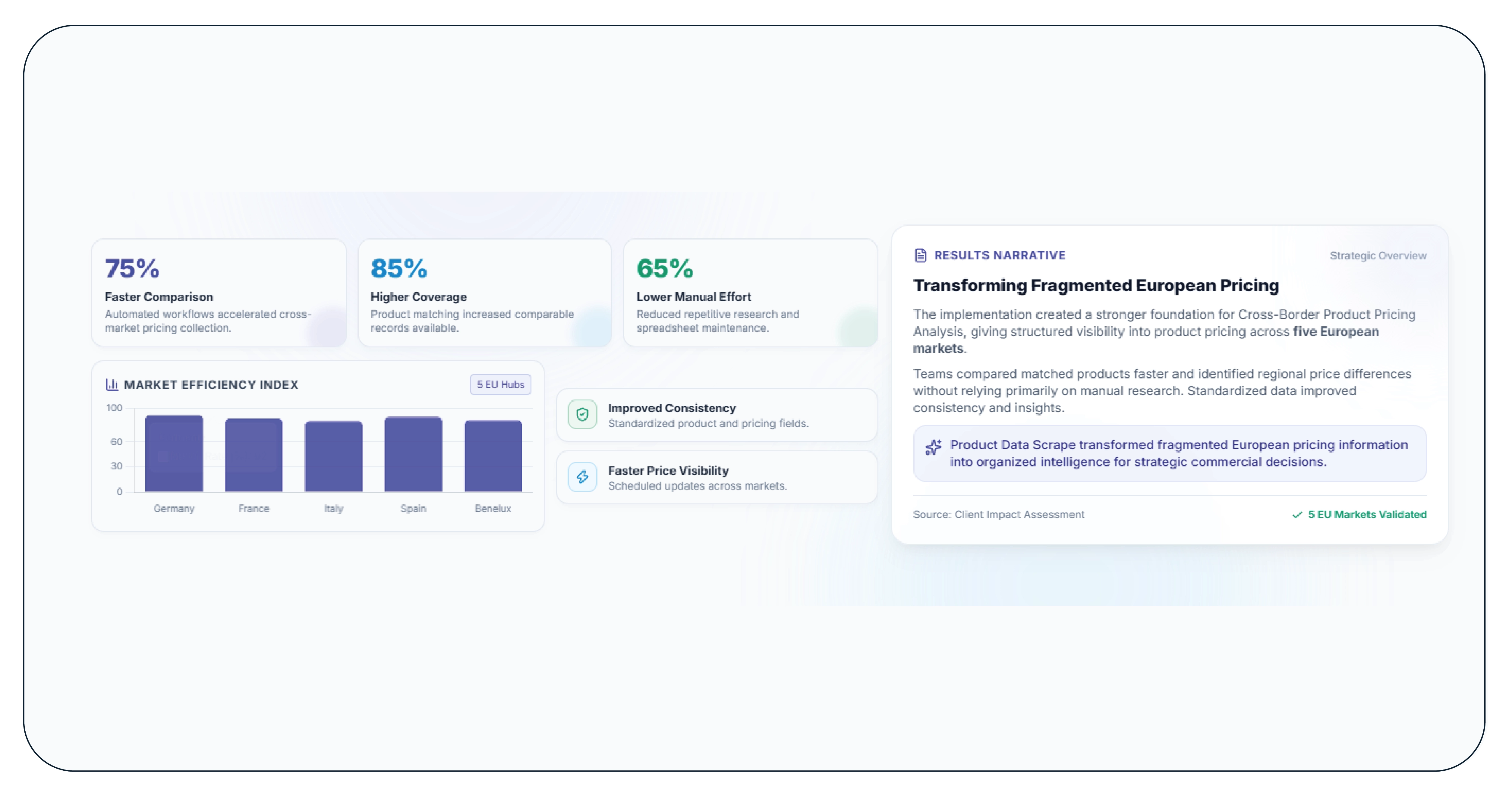
75% faster comparison: Automated workflows accelerated the process of collecting and comparing pricing information across five markets.
85% higher matched coverage: Product-matching processes increased the number of comparable product records available for analysis.
65% lower manual effort: Automated extraction reduced repetitive market research and spreadsheet maintenance.
Improved consistency: Standardized product and pricing fields created more reliable cross-market comparisons.
Faster price-change visibility: Scheduled updates improved awareness of pricing movements across monitored markets.
Results Narrative
The implementation created a stronger foundation for Cross-Border Product Pricing Analysis, giving the client structured visibility into product pricing across five European markets. Teams could compare matched products more quickly and identify regional price differences without relying primarily on manual research. Standardized data also improved the consistency of market comparisons and made pricing information easier to analyze. The workflow supported faster identification of competitive gaps, pricing movements, and market-specific opportunities. Through Cross-Border Price Comparison Across 5 EU Markets, Product Data Scrape helped transform fragmented European pricing information into organized intelligence for commercial and strategic decision-making.
What Made Product Data Scrape Different
Product Data Scrape differentiated its approach by combining automated extraction with intelligent product matching, normalization, currency handling, validation, and scheduled data refreshes. Instead of simply collecting prices from different websites, the solution focused on making those prices genuinely comparable across markets. Matching logic considered multiple product attributes to reduce incorrect comparisons, while standardized datasets made analysis easier. The framework could also support categories such as European fashion alongside broader retail segments. This combination of automation and data intelligence helped create a scalable cross-border pricing workflow that could adapt as products, marketplaces, and market requirements changed.
Client's Testimonial
"Product Data Scrape gave us a much clearer view of how our products were positioned across European markets. Previously, comparing prices across countries involved significant manual research and spreadsheet work, and product matching was a recurring challenge. The automated workflow improved both the speed and consistency of our pricing analysis. We were able to work with structured information across multiple markets and identify regional differences more efficiently. The solution also gave our commercial teams more confidence when evaluating competitive pricing. Product Data Scrape understood the complexity of cross-border data and delivered a scalable approach that supported our international growth."
— Head of Pricing & Market Intelligence, Global Retail Brand
Conclusion
Cross-border pricing requires reliable, comparable, and frequently refreshed market data. Product Data Scrape helped the client replace fragmented manual research with an automated workflow covering product extraction, matching, normalization, and pricing comparison across five EU markets. The solution improved speed, matched-product coverage, data consistency, and operational efficiency while creating a stronger foundation for international pricing decisions. Through structured Price monitoring, the brand could identify regional pricing differences, competitive gaps, and market opportunities more effectively. Cross-Border Price Comparison Across 5 EU Markets demonstrated how automated pricing intelligence can help global brands make faster, more informed decisions while maintaining stronger visibility across diverse European markets.
FAQs
1. What is Cross-Border Price Comparison Across 5 EU Markets?
Cross-Border Price Comparison Across 5 EU Markets is a structured approach to collecting, matching, and comparing product prices across five European markets. It helps brands understand regional price positioning and identify competitive differences.
2. Why is product matching important for European price comparison?
The same product may have different names, descriptions, sizes, or identifiers across countries. Accurate product matching helps ensure that businesses compare equivalent products rather than unrelated listings, improving the reliability of pricing insights.
3. What pricing data can be collected?
Depending on source availability and project requirements, datasets can include product names, prices, currencies, brands, categories, product identifiers, promotional information, URLs, and other publicly available product attributes.
4. Can pricing data be refreshed automatically?
Yes. Automated workflows can be configured to collect updated information at defined intervals. This allows brands to monitor pricing changes and maintain more current cross-market datasets.
5. How can brands use cross-border pricing data?
Brands can use the data for competitive pricing, market positioning, price monitoring, assortment analysis, regional strategy, competitor benchmarking, and identifying pricing gaps across European markets.


 Singapore
 EMAIL
EMAIL
 PHONE
PHONE










.webp)