The Client
A sporting-goods brand — fitness, racket sports, and training equipment — selling across marketplaces including Amazon, while competing in a market where Decathlon's private-label ranges set much of the price expectation. The brand sold on its own listings and needed to price against a field that included both marketplace sellers and a dominant private-label retailer.
Client details are anonymised. Figures are representative of the engagement.
The Problem: Benchmarking Against the Wrong Field
The brand priced its equipment against other marketplace sellers of comparable branded products and kept losing share it couldn't explain — until it became clear it was benchmarking against the wrong field entirely.
In many sporting-goods categories, the reference price a shopper carries is set by Decathlon's private-label range, not by other branded sellers. A shopper considering a yoga mat, a set of dumbbells, or a badminton racket often anchors on Decathlon's price for the equivalent, and evaluates everything else against it. The brand, benchmarking only against branded competitors on marketplaces, was blind to the price anchor that actually governed its categories — and was frequently priced against a reference point that made it look far more expensive than it realised.
The pricing lead's summary: we're carefully pricing against other brands, and our customers are comparing us to Decathlon. We're benchmarking a race our shoppers aren't even running.
Why the Existing Benchmark Missed the Point
Pricing against the wrong reference set produces confident, wrong decisions.
The price anchor is often the private label, not the branded field. Where a private-label retailer holds strong category presence, its price sets the shopper's expectation. Ignoring it means benchmarking against a reference the customer isn't using.
Cross-retailer comparison requires matching across very different catalogues. Decathlon's private-label products and the brand's branded products aren't identical SKUs; comparing them requires matching on equivalent function and specification across different naming, which manual comparison does poorly.
Prices sit on different platforms. The relevant prices live across Amazon, other marketplaces, and Decathlon's own channel. Without consolidating them, the brand had a partial view.
Positioning is invisible without the full field. Whether the brand's premium over the private-label anchor was justified — by quality, brand, warranty — or simply uncompetitive was only answerable by seeing the whole field, including the anchor, on one map.
The Solution: Cross-Retailer Sports Equipment Pricing Intelligence
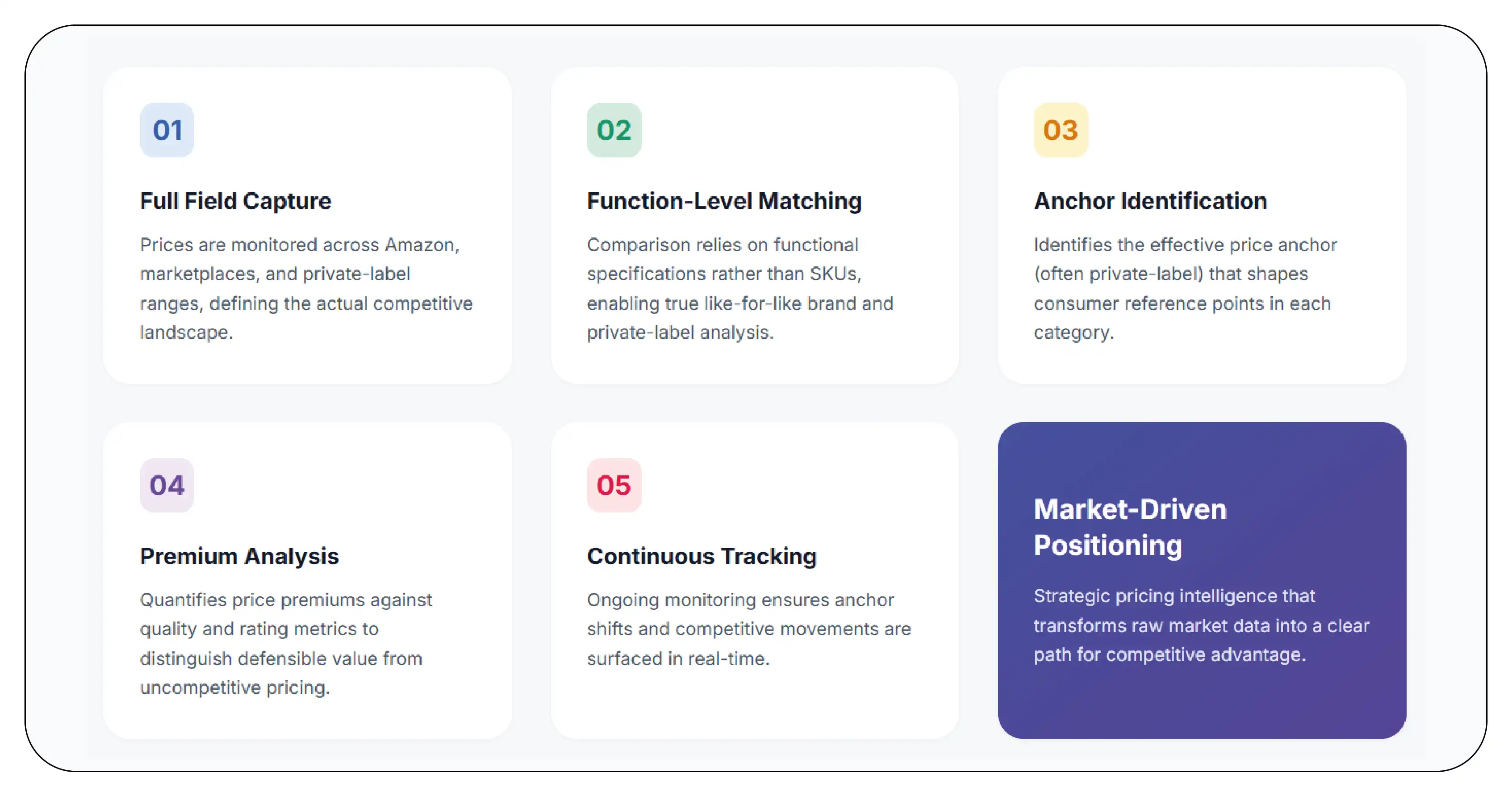
Product Data Scrape built sports equipment pricing intelligence spanning Amazon, other marketplaces, and Decathlon's private-label range — the full field the brand actually competed in.
- Full field capture. Prices were captured across marketplaces and Decathlon's channel for the brand's categories — branded competitors and private-label equivalents alike.
- Function-level matching. Products were matched on equivalent function and specification rather than exact SKU, so a branded dumbbell set could be compared to the private-label equivalent on a like-for-like basis.
- Anchor identification. Within each category, the effective price anchor — frequently the private-label range — was identified, so the brand could see the reference point its shoppers actually used.
- Premium analysis. The brand's price premium over the anchor was quantified per category, and placed against the quality, warranty, and rating differences that might justify it — separating a defensible premium from an uncompetitive one.
- Continuous tracking. The full field was tracked over time, so anchor moves and competitive shifts surfaced as they happened.
Sample Data: The Full-Field Price Map
An illustrative cross-retailer comparison for one category.
| Product (Yoga Mat, comparable spec) |
Retailer |
Price |
vs Anchor |
| Decathlon private label (anchor) |
Decathlon |
799 |
— |
| Our branded mat |
Amazon |
1,299 |
+63% over anchor |
| Branded competitor A |
Amazon |
1,199 |
+50% |
| Branded competitor B |
Marketplace |
1,099 |
+38% |
Illustrative figures.
The structured record:
{
  "category": "yoga_mat_6mm",
  "captured_at": "2026-07-15T12:00:00+05:30",
  "price_anchor": {
    "source": "decathlon_private_label",
    "price": 799,
    "rating": 4.3
  },
  "our_product": {
    "price": 1299,
    "premium_over_anchor_pct": 63,
    "rating": 4.5,
    "warranty_months": 12
  },
  "branded_field": [
    {"seller": "Competitor A", "price": 1199, "premium_pct": 50, "rating": 4.4},
    {"seller": "Competitor B", "price": 1099, "premium_pct": 38, "rating": 4.2}
  ],
  "verdict": "premium_high_vs_anchor_and_branded_field"
}
The finding that reset the brand's pricing: its yoga mat carried a 63% premium over the Decathlon anchor and was also the most expensive in the branded field — while its quality and rating advantage, though real, did not obviously justify sitting that far above both the anchor and every branded competitor. The brand had been comparing itself only to branded sellers and still mispricing; against the anchor its shoppers actually used, the gap was starker still.
What the Brand Did
Repriced against the real anchor. In categories where its premium over the private-label anchor was indefensibly high, the brand adjusted price to a premium its quality and brand could actually support — narrowing the gap to the anchor while staying competitive within the branded field.
Defended justified premiums. Where quality, warranty, and ratings genuinely supported a premium over the anchor, the brand held its price and sharpened its listings to communicate why it cost more — turning the premium from a liability into a justified position.
Prioritised by category. Because the analysis was per category, the brand focused repricing where the anchor gap was worst and shoppers most price-sensitive, rather than cutting across the board.
Tracked the anchor. Ongoing monitoring of the private-label anchor meant the brand priced against a live reference, not an assumption.
The Results (Two Quarters)
| Metric |
Before |
After Two Quarters |
| Benchmark field |
Branded sellers only |
Full field incl. private-label anchor |
| Categories priced against the real anchor |
None |
All key categories |
| Indefensible anchor-premium categories |
Several |
Repriced |
| Justified premiums defended with listing content |
Few |
Communicated clearly |
| Category revenue, indexed |
100 |
127 |
| Margin (protected on justified premiums), indexed |
100 |
104 (held) |
Figures are representative of the engagement outcome.
The pricing lead's follow-up: we were pricing against the wrong opponents. Once we benchmarked against the price our customers actually anchor on, the whole strategy corrected.
The Lesson
You have to benchmark against the field your customer actually uses — and in sporting goods, that field is frequently anchored by a private-label retailer, not by other branded sellers. A brand that carefully prices against branded competitors while its shoppers anchor on Decathlon is optimising against a reference no one is using, and its "competitive" price can be badly exposed against the one that actually governs the category.
Cross-retailer pricing intelligence didn't just add Decathlon to the comparison. It identified the true price anchor per category and quantified the brand's premium against it, so the brand could tell a defensible premium from an uncompetitive one — and price, and justify, accordingly. Benchmarking is only as good as the field you benchmark against.
Work With Product Data Scrape
Product Data Scrape delivers sports equipment pricing intelligence across Amazon, marketplaces, and private-label retailers like Decathlon: full-field capture, function-level matching, price-anchor identification, and premium analysis against quality and rating differences — as JSON, CSV, API, or dashboard-ready feeds.
Ask us to map the full price field in your categories — we will show you the anchor your shoppers actually use and where your premium sits against it.
Product Data Scrape — turning marketplace complexity into decision-ready data.


 Singapore
 EMAIL
EMAIL
 PHONE
PHONE


.webp "thumb")
.webp "thumb")
.webp "thumb")











.webp)