The Client
An outdoor and adventure gear brand — camping, trekking, and travel equipment — with strongly seasonal demand, selling across marketplaces and its own site. Getting the right products in stock at the right time each season was the difference between a strong quarter and a warehouse full of the wrong gear.
Client details are anonymised. Figures are representative of the engagement.
The Problem: Always Planning for Last Season
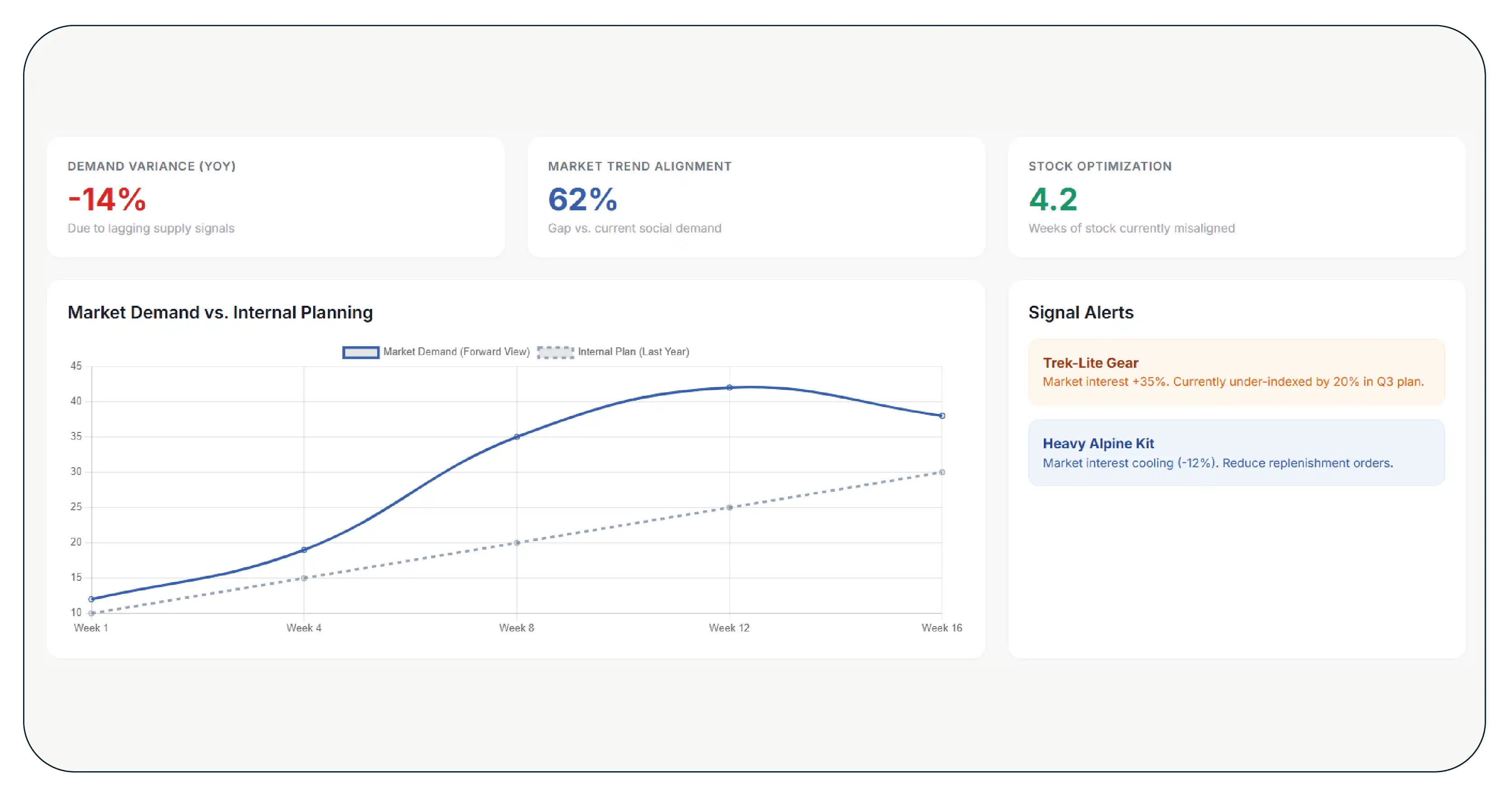
The brand's assortment planning was backward-looking, and in a seasonal category that meant it was always slightly wrong.
It planned each season by looking at what had sold the previous year — a reasonable starting point that systematically missed shifts. When a category surged — a particular trek style, a new gear format, a trending destination driving specific equipment — the brand found out from its own sales after the season had already begun, by which point stocking up meant paying rush prices and arriving late, or missing the surge entirely. When a category cooled, the brand over-stocked it on last year's momentum and marked it down.
The planning was based on the brand's own rear-view mirror. It had no forward view of where market demand was actually heading this season.
The planning lead's summary: we plan every season by looking at last season, so we're always one season behind the market.
Why Last Year's Sales Were the Wrong Input
Historical own-sales planning has a structural blind spot in a trend-driven seasonal category.
Own sales are a lagging, narrow signal. They tell the brand what it sold, not what the market is moving toward. A category surging across the market but under-stocked by the brand shows up weakly in the brand's own numbers precisely because it couldn't sell what it didn't stock — the rear-view mirror hides the biggest opportunities.
Seasonal shifts happen at the season's start, not in last year's data. The signals that this season differs from last — new products gaining traction, categories accelerating, price points shifting — appear in the current market as the season opens, not in a year-old sales report.
Lead times punish late detection. Outdoor gear often carries meaningful sourcing lead times. Detecting a surge from your own sales mid-season is too late to stock it well; the decision has to be made early, on forward signals.
Trends are visible in the market before they're visible in your sales. New-arrival velocity, review acceleration, and rank movement across the category are leading indicators — and the brand was watching none of them.
The Solution: Trend-Driven Assortment Planning
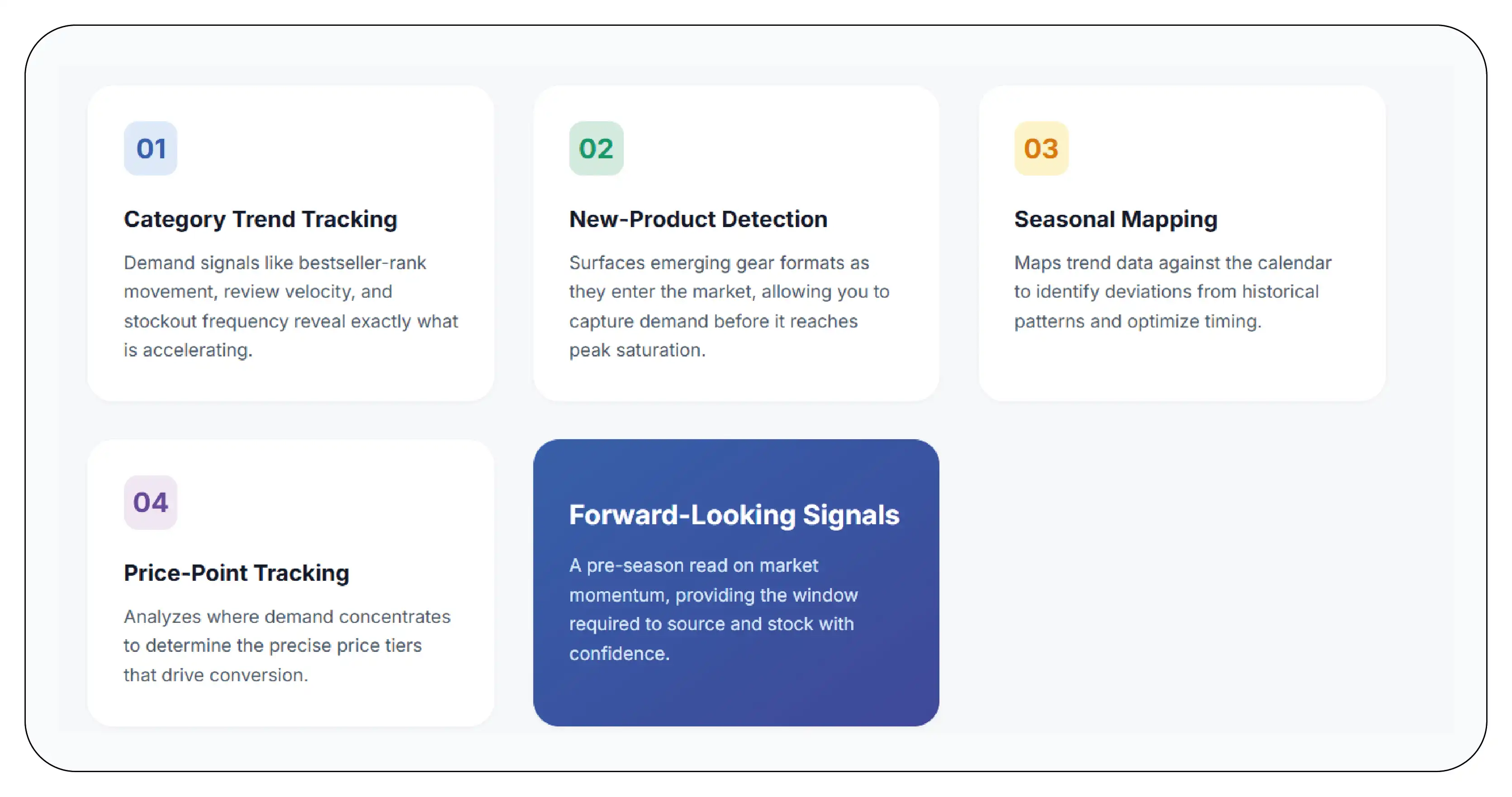
Product Data Scrape built outdoor gear assortment planning on marketplace trend data — a forward view of category momentum across the market, ahead of each season.
- Category trend tracking. Across the outdoor category, demand signals were tracked over time — bestseller-rank movement, review-accumulation velocity, new-arrival density, and stockout frequency — by sub-category, revealing what was accelerating and what was cooling.
- New-product and format detection. New products and gear formats entering the category were surfaced as they appeared, with early-traction signals, so emerging demand was visible before it peaked.
- Seasonal pattern mapping. Trend data was mapped against the seasonal calendar, so the brand could see how each sub-category typically built and where the current season was diverging from the historical pattern.
- Price-point tracking. The price points where demand was concentrating within each sub-category were tracked, informing not just what to stock but at what price tier.
- Early, forward-looking signals. The output was a pre-season read on where market demand was heading — delivered while there was still time to source and stock accordingly.
Sample Data: Category Momentum Ahead of Season
An illustrative pre-season trend read by sub-category.
| Sub-Category |
Rank Trend |
Review Velocity |
New Arrivals |
Stockout Rate |
Verdict |
| Ultralight tents |
Rising fast |
High |
Many |
Rising |
Stock up early |
| Trekking poles |
Rising |
Medium |
Some |
Stable |
Stock normally |
| Heavy camp tents |
Falling |
Low |
Few |
Low |
Reduce |
| Insulated bottles |
Rising |
High |
Many |
Rising |
Stock up |
| Traditional sleeping bags |
Falling |
Low |
Few |
Low |
Reduce |
Illustrative.
The structured record:
{
  "sub_category": "ultralight_tents",
  "captured_window": "pre_season_2026",
  "signals": {
    "bestseller_rank_trend": "rising_fast",
    "review_velocity": "high",
    "new_arrival_density": "high",
    "stockout_frequency": "rising",
    "demand_price_band": [4999, 8999]
  },
  "seasonal_context": "accelerating vs same period last year",
  "recommended_action": "stock_up_early",
  "confidence": "high"
}
The forward signal the brand had never had: ultralight tents were accelerating hard across the market — rising ranks, high review velocity, dense new arrivals, and rising stockouts — well before the season peaked, while heavy camp tents (which the brand had over-stocked the prior year) were clearly cooling. The demand was concentrating in a specific price band, telling the brand not just to stock ultralight tents but where to price them.
What the Brand Did
Stocked ahead of the surge. Sub-categories accelerating in the pre-season read — ultralight tents, insulated bottles — were sourced and stocked early, while lead times and prices were favourable and before the peak, rather than chasing them mid-season.
Cut the cooling categories. Sub-categories the data showed cooling — heavy tents, traditional sleeping bags — were reduced despite last year's momentum, avoiding the over-stock-and-markdown cycle.
Priced to the demand band. New stock was priced into the bands where demand was concentrating, informed by the trend data rather than last year's price sheet.
Planned on a forward view. Seasonal planning shifted from "what did we sell last year" to "where is the market heading this season," with own-sales history as one input rather than the only one.
The Results (One Season)
| Metric |
Before |
After One Season |
| Planning basis |
Last year's own sales |
Forward market trend data |
| Surging categories stocked ahead of peak |
Rarely |
Consistently |
| Rush-sourcing to chase mid-season demand |
Frequent |
Sharply reduced |
| End-of-season markdown on over-stocked lines |
High |
Materially lower |
| Full-price sell-through, indexed |
100 |
131 |
| Seasonal margin, indexed |
100 |
123 |
Figures are representative of the engagement outcome.
The planning lead's follow-up: we stopped planning for last season. The market tells you where it's going before your own sales do — we just had to look at it.
The Lesson
In a seasonal, trend-driven category, planning from your own historical sales guarantees you are one season behind, because your own numbers are a lagging, narrow mirror that hides the surges you under-stocked and over-weights the momentum that's fading. The signals that this season differs from last live in the current market — new-arrival velocity, rank movement, review acceleration — and they appear early enough to act on, if you're watching them.
Trend-driven assortment planning didn't make the brand a better forecaster in the abstract. It gave it a forward view of category momentum, ahead of the season, so it could stock the surge early and cut the fade — the two decisions that decide a seasonal quarter, both of which the rear-view mirror gets wrong.
Work With Product Data Scrape
Product Data Scrape delivers outdoor gear assortment planning on marketplace trend data: category momentum tracking, new-product and format detection, seasonal pattern mapping, and demand-price-band signals — as JSON, CSV, API, or dashboard-ready feeds, ahead of each season.
Ask us for a pre-season trend read on your category — we will show you what's accelerating and what's fading before your own sales do.
Product Data Scrape — turning marketplace complexity into decision-ready data.


 Singapore
 EMAIL
EMAIL
 PHONE
PHONE


.webp "thumb")
.webp "thumb")
.webp "thumb")









.webp)