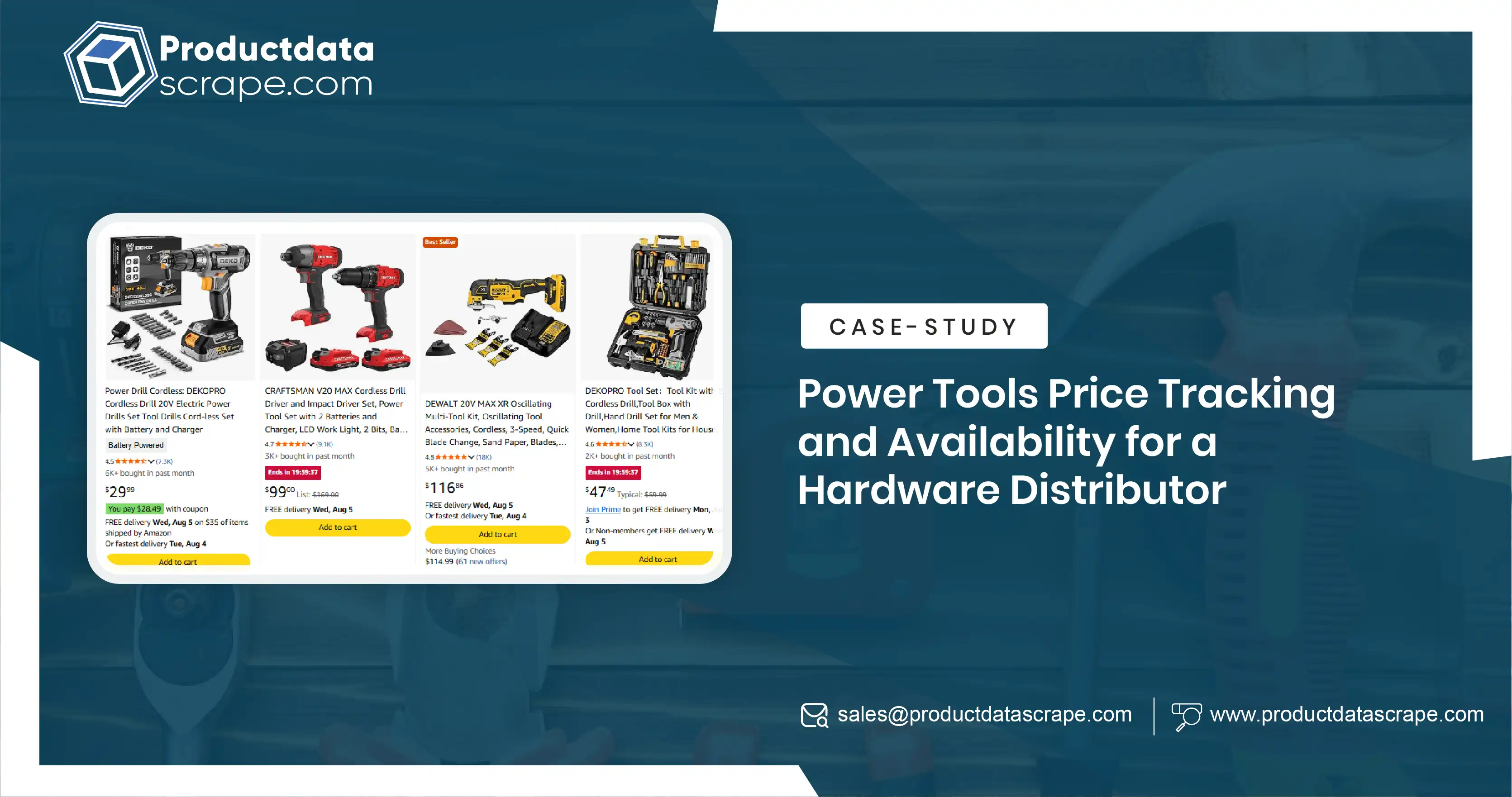
Power Tools Price Tracking and Availability for a Hardware Distributor

The Client

A distributor of power tools and hardware — drills, saws, grinders, and accessories across multiple brands — supplying trade customers and reselling through marketplaces. Its business depended on quoting competitive prices and promising accurate availability, both of which required knowing the market in real time.

Client details are anonymised. Figures are representative of the engagement.

The Problem: Quoting Blind on Price and Stock
the problem

The distributor was making two kinds of avoidable error, both rooted in a lack of live market data.

On price, its quotes drifted out of the market. Power tool prices move — brand promotions, competitor discounting, distributor undercutting — and the distributor's price lists were updated periodically, so between updates its quotes were often above the market (losing the deal) or below it (leaving margin on the table). Trade customers shop hard on price, and a stale quote lost business.

On availability, it over-promised. When quoting lead times and stock, the distributor relied on its own inventory and assumptions about the market. When a popular tool was short across the market — because a brand had a supply gap or demand had spiked — the distributor sometimes promised availability it couldn't deliver, damaging trade relationships that run on reliability.

The sales lead's summary: we quote price and stock all day, and we're guessing at both. When we guess high on price we lose the order; when we guess wrong on stock we lose the customer.

Why Periodic Price Lists Failed

Static price lists and inventory assumptions cannot support real-time quoting in a moving market.

Prices move between list updates. A price list accurate on Monday is wrong by Thursday as the market shifts. Quoting from it means quoting from a snapshot that's already aged, in both directions.

Availability is a market condition, not just an inventory number. Whether a tool is easy or hard to get depends on stock across the market, not only the distributor's shelf. A tool short everywhere carries different quoting risk than one widely available — and the distributor's own inventory number didn't capture that.

Manual market-checking doesn't scale. Checking competitor prices and market stock by hand, across many tools and brands, for every quote, is impossible at the pace a distributor quotes.

No signal on market shifts. The distributor had no alert when a tool's market price moved sharply or when market-wide availability tightened — so it learned about both from lost deals and failed promises.

The Solution: Live Price and Availability Tracking
the solutions

Product Data Scrape built power tools price tracking and availability monitoring across the market the distributor competed in.

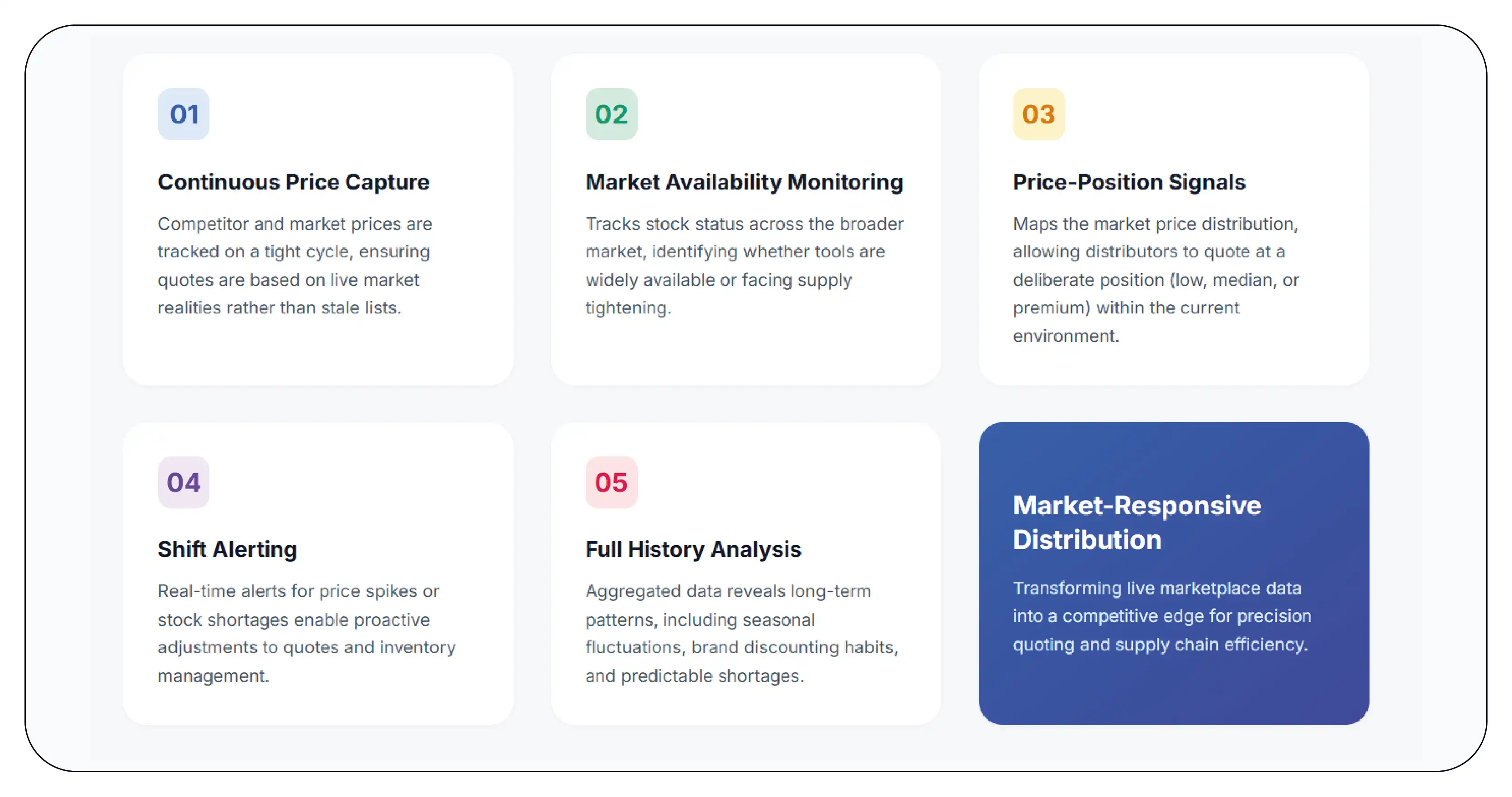
  • Continuous price capture. For every tool the distributor carried, competitor and market prices were captured on a tight cycle across marketplaces and sellers, giving a live market price to quote against instead of a stale list.
  • Market availability monitoring. Stock status across the market was tracked per tool — widely available, tightening, or short across sellers — so the distributor could see market-wide availability, not just its own inventory.
  • Price-position signals. Each tool's market price distribution was surfaced — the going range, the low, the median — so the distributor could quote to a deliberate position within the live market rather than guessing.
  • Shift alerting. Sharp market price moves and tightening availability fired alerts, so the distributor knew when to adjust quotes or manage stock promises before it lost deals or over-promised.
  • Full history. Price and availability were logged over time, revealing patterns — which tools moved seasonally, which brands discounted regularly, which ran short predictably.

Sample Data: Live Price and Market Stock

An illustrative market view for one tool.

Tool Our Quote (old list) Market Low Market Median Market Stock Signal
Cordless drill 18V 6,499 5,999 6,199 Tightening Quote high + stock short
Angle grinder 750W 2,299 2,349 2,499 Widely available Under market — raise
Circular saw 1400W 4,999 4,899 5,099 Available At market

Illustrative figures.

The structured record:

{
  "tool_id": "PT-DRILL-18V-CORDLESS",
  "captured_at": "2026-07-15T13:00:00+05:30",
  "our_current_quote": 6499,
  "market_price": {
    "low": 5999,
    "median": 6199,
    "high": 6699,
    "our_position": "above_market"
  },
  "market_availability": {
    "status": "tightening",
    "sellers_in_stock_ratio": 0.4,
    "note": "40% of tracked sellers in stock, down from 85%"
  },
  "signals": ["reprice_down_to_compete", "manage_stock_promise_carefully"],
  "action": "quote_at_6199_confirm_lead_time"
}

Both errors in one record. The distributor's standing quote of 6,499 was above the market median of 6,199 — it was quoting high and losing deals. Simultaneously, market availability was tightening sharply (40% of sellers in stock, down from 85%), so the distributor needed to be careful about promising fast delivery on this tool. Live data corrected the price and flagged the stock risk in the same view.

What the Distributor Did

Quoted to the live market. Quotes moved from a periodic price list to the live market price, positioned deliberately — competitive on price-sensitive tools, holding margin where the distributor's service justified it — instead of drifting above or below the market by accident.

Managed stock promises with market context. When market availability tightened on a tool, the distributor tightened its own lead-time promises accordingly, protecting trade relationships by promising what it could actually deliver.

Captured margin on under-priced tools. Where its old list sat below the market — as on the angle grinder — the distributor raised quotes to the market, recovering margin it had been giving away.

Acted on shift alerts. Sharp market moves and tightening availability triggered proactive quote and stock adjustments, so the distributor got ahead of shifts rather than learning from lost deals.

The Results (Two Quarters)

Metric Before After Two Quarters
Quoting basis Periodic price list Live market price
Quotes above market (losing deals) Common Sharply reduced
Quotes below market (margin left) Common Corrected
Over-promised availability incidents Recurring Materially reduced
Quote win rate, indexed 100 126
Gross margin, indexed 100 112

Figures are representative of the engagement outcome.

The sales lead's follow-up: we stopped guessing on price and stock. A live view of both meant we won more quotes and stopped making promises we couldn't keep.

The Lesson

A distributor lives on two numbers it quotes all day — price and availability — and quoting either from a stale source is a slow leak of both deals and relationships. A periodic price list is wrong the moment the market moves, in both directions; an inventory number without market context can't tell a widely-available tool from one that's short everywhere. Both errors are invisible until they cost a deal or a customer.

Live price and availability tracking didn't make the distributor cheaper or better-stocked. It gave it a real-time view of the two numbers its business runs on, so it could quote to the market instead of a snapshot and promise stock it could actually deliver. In distribution, that live view is the difference between guessing and knowing on every quote.

Work With Product Data Scrape

Product Data Scrape delivers power tools price tracking and availability monitoring: continuous market price capture, market-wide stock monitoring, price-position signals, shift alerting, and full price-and-availability history — as JSON, CSV, API, or a live feed into your quoting systems.

Ask us to put a live market view behind your quotes — we will show you where you're quoting above the market and where availability risk is hiding.

Product Data Scrape — turning marketplace complexity into decision-ready data.

LATEST BLOG

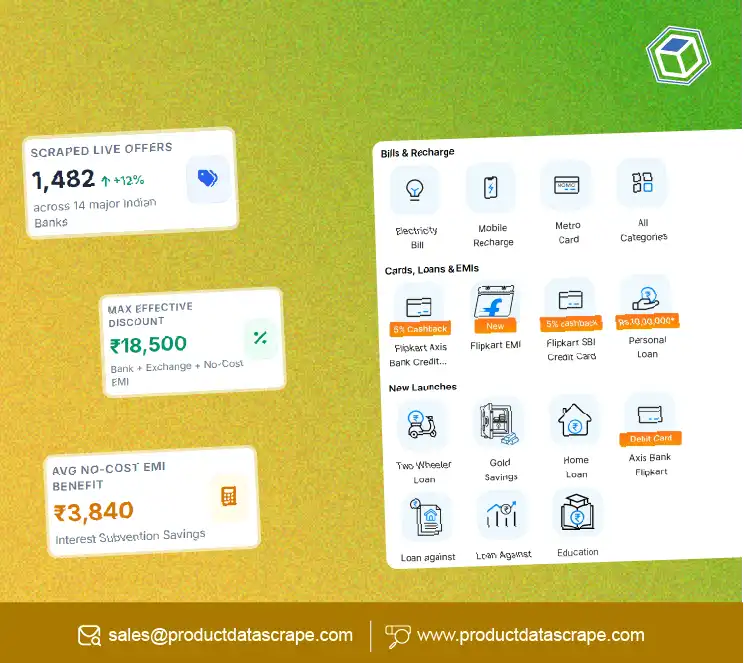
Flipkart Bank Offers Data: Scraping EMI, Exchange, and Discount Terms to Calculate Effective Consumer Price

Flipkart bank offers data, no-cost EMI and exchange discounts decide what a customer really pays. Learn which fields to capture and how to compute effective price.

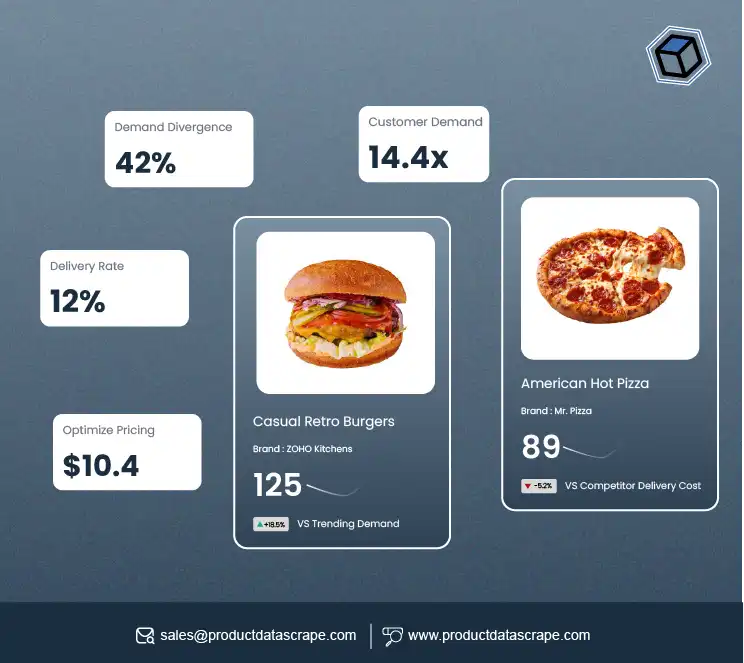
How Food Delivery Business Data Before Launch Helps Optimize Pricing, Delivery Zones, and Customer Demand

Food Delivery Business Data Before Launch helps analyze demand, competitors, pricing, and delivery zones for a successful market entry.

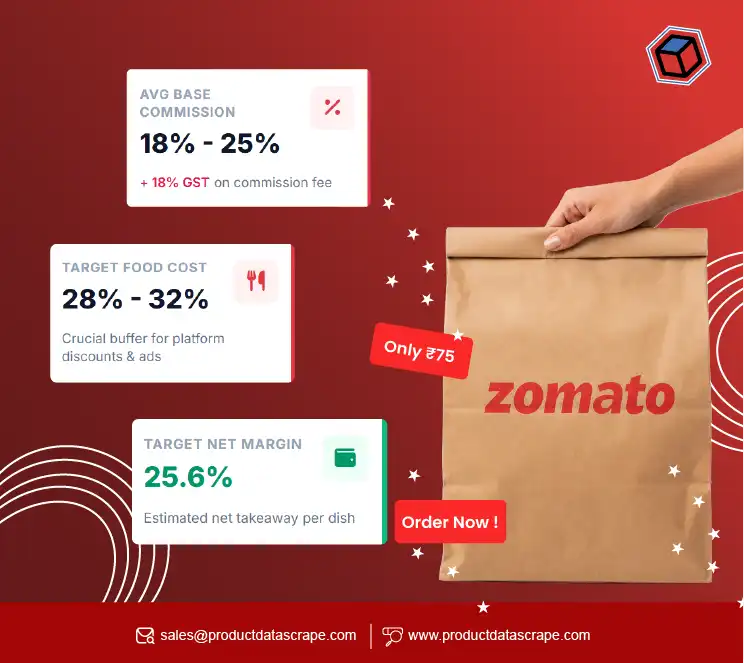
Analyze Zomato Delivery Pricing Before Opening a Restaurant - A Complete Guide to Smarter Restaurant Launch Planning

Analyze Zomato Delivery Pricing Before Opening a Restaurant to optimize menu pricing, delivery costs, profits, and market positioning.

Case Studies

Discover our scraping success through detailed case studies across various industries and applications.

WHY CHOOSE US?

Product Data Scrape for Retail Web Scraping

Choose Product Data Scrape to access accurate data, enhance decision-making, and boost your online sales strategy effectively.

Reliable Insights

Reliable Insights

With our Retail Data scraping services, you gain reliable insights that empower you to make informed decisions based on accurate product data and market trends.

Data Efficiency

Data Efficiency

We help you extract Retail Data product data efficiently, streamlining your processes to ensure timely access to crucial market information and operational speed.

Market Adaptation

Market Adaptation

By leveraging our Retail Data scraping, you can quickly adapt to market changes, giving you a competitive edge with real-time analysis and responsive strategies.

Price Optimization

Price Optimization

Our Retail Data price monitoring tools enable you to stay competitive by adjusting prices dynamically, attracting customers while maximizing your profits effectively.

Competitive Edge

Competitive Edge

THIS IS YOUR KEY BENEFIT.
With our competitive price tracking, you can analyze market positioning and adjust your strategies, responding effectively to competitor actions and pricing in real-time.

Feedback Analysis

Feedback Analysis

Utilizing our Retail Data review scraping, you gain valuable customer insights that help you improve product offerings and enhance overall customer satisfaction.

5-Step Proven Methodology

How We Scrape E-Commerce Data?

01
Identify Target Websites

Identify Target Websites

Begin by selecting the e-commerce websites you want to scrape, focusing on those that provide the most valuable data for your needs.

02
Select Data Points

Select Data Points

Determine the specific data points to extract, such as product names, prices, descriptions, and reviews, to ensure comprehensive insights.

03
Use Scraping Tools

Use Scraping Tools

Utilize web scraping tools or libraries to automate the data extraction process, ensuring efficiency and accuracy in gathering the desired information.

04
Data Cleaning

Data Cleaning

After extraction, clean the data to remove duplicates and irrelevant information, ensuring that the dataset is organized and useful for analysis.

05
Analyze Extracted Data

Analyze Extracted Data

Once cleaned, analyze the extracted e-commerce data to gain insights, identify trends, and make informed decisions that enhance your strategy.

Start Your Data Journey
99.9% Uptime
GDPR Compliant
Real-time API

See the results that matter

Read inspiring client journeys

Discover how our clients achieved success with us.

6X

Conversion Rate Growth

“I used Product Data Scrape to extract Walmart fashion product data, and the results were outstanding. Real-time insights into pricing, trends, and inventory helped me refine my strategy and achieve a 6X increase in conversions. It gave me the competitive edge I needed in the fashion category.”

7X

Sales Velocity Boost

“Through Kroger sales data extraction with Product Data Scrape, we unlocked actionable pricing and promotion insights, achieving a 7X Sales Velocity Boost while maximizing conversions and driving sustainable growth.”

"By using Product Data Scrape to scrape GoPuff prices data, we accelerated our pricing decisions by 4X, improving margins and customer satisfaction."

"Implementing liquor data scraping allowed us to track competitor offerings and optimize assortments. Within three quarters, we achieved a 3X improvement in sales!"

Resource Hub: Explore the Latest Insights and Trends

The Resource Center offers up-to-date case studies, insightful blogs, detailed research reports, and engaging infographics to help you explore valuable insights and data-driven trends effectively.

Get In Touch

Flipkart Bank Offers Data: Scraping EMI, Exchange, and Discount Terms to Calculate Effective Consumer Price

Flipkart bank offers data, no-cost EMI and exchange discounts decide what a customer really pays. Learn which fields to capture and how to compute effective price.

How Food Delivery Business Data Before Launch Helps Optimize Pricing, Delivery Zones, and Customer Demand

Food Delivery Business Data Before Launch helps analyze demand, competitors, pricing, and delivery zones for a successful market entry.

Analyze Zomato Delivery Pricing Before Opening a Restaurant - A Complete Guide to Smarter Restaurant Launch Planning

Analyze Zomato Delivery Pricing Before Opening a Restaurant to optimize menu pricing, delivery costs, profits, and market positioning.

Power Tools Price Tracking and Availability for a Hardware Distributor

Power Tools Price Tracking and availability monitoring gave a distributor a live view of market price and stock — so it quoted competitively and never oversold.

Sports Equipment Pricing Intelligence Across Decathlon and Amazon

Sports Equipment Pricing Intelligence across Decathlon and Amazon showed a brand it was benchmarking against the wrong prices — and losing to a private label.

Seasonal Outdoor Gear Assortment Planning Using Marketplace Trend Data

Outdoor Gear Assortment Planning built on marketplace trend data let a brand stock the right seasonal gear early — instead of chasing demand a season after it peaked.

Albertsons Grocery Delivery Scraper API - Market Intelligence, Inventory Monitoring, and Grocery Retail Benchmarking

ASDA Grocery Data Scraping helps track grocery prices, promotions, inventory, and competitor trends across the UK retail market.

Costco Alcohol & Liquor Price Data scraping to Track Consumer Buying Trends and Inventory Intelligence

Costco Alcohol & Liquor Price Data scraping helps brands track pricing, promotions, inventory trends, and competitor insights.

B&M Stores Pet Supplies Data Scraping for Market Research and Pet Product Trend Analysis in Retail Chains

B&M Stores Pet Supplies Data Scraping helps businesses collect pricing, stock, and product insights to optimize pet retail strategies.

Reducing Returns with Myntra AND AJIO Customer Review Datasets

Analyzed Myntra and AJIO customer review datasets to identify sizing issues, helping brands reduce garment return rates by 8% through data-driven insights.

Before vs After Web Scraping - How E-Commerce Brands Unlock Real Growth

Before vs After Web Scraping: See how e-commerce brands boost growth with real-time data, pricing insights, product tracking, and smarter digital decisions.

Scrape Data From Any Ecommerce Websites

Easily scrape data from any eCommerce website to track prices, monitor competitors, and analyze product trends in real time with Real Data API.

Fresh Citrus Price Wars - Coles vs Aldi — What Does the Data Say?

Fresh Citrus Price Wars — Coles vs Aldi: data-driven comparison of prices, trends, and savings to see which retailer wins on value for shoppers.

Retail Inflation 2025 – Comparing Grocery Baskets in Dubai vs. Abu Dhabi (Noon)

Retail Inflation 2025 – Comparing Grocery Baskets in Dubai vs. Abu Dhabi (Noon) highlights price differences and real-world grocery costs across UAE cities.

Unlock Winning Products on Pinduoduo - How Scraping Bestseller Data Reveals Top Titles, Prices & Sales Trends

Scrape Pinduoduo bestseller data to analyze top-selling products, pricing trends, sales performance, for smarter eCommerce and intelligence decisions.

FAQs

E-Commerce Data Scraping FAQs

Our E-commerce data scraping FAQs provide clear answers to common questions, helping you understand the process and its benefits effectively.

E-commerce scraping services are automated solutions that gather product data from online retailers, providing businesses with valuable insights for decision-making and competitive analysis.

We use advanced web scraping tools to extract e-commerce product data, capturing essential information like prices, descriptions, and availability from multiple sources.

E-commerce data scraping involves collecting data from online platforms to analyze trends and gain insights, helping businesses improve strategies and optimize operations effectively.

E-commerce price monitoring tracks product prices across various platforms in real time, enabling businesses to adjust pricing strategies based on market conditions and competitor actions.

Get a free sample dataset

See the exact fields, accuracy and format — for your products, on your target sites — before you spend a rupee or a dollar.

  • Sample delivered within 24 hours
  • Scoped to your real use case, not a generic demo
  • No obligation, no long contract

Tell us what you need

A specialist replies within one business day.