Quick Overview
Client Name / Industry: A retail and FMCG brand operating in the grocery and e-commerce sector needed structured product catalog intelligence from a major Canadian grocery platform.
Service / Duration: Product Data Scrape delivered an automated product, image, pricing, and attribute extraction solution through a phased implementation.
Key Impact Metrics: The project improved catalog data processing speed by 75%, increased structured product coverage by 90%, and reduced manual catalog collection effort by 65%. With Scrape Product & Image Data Collection from Metro.ca, the client gained organized product information that could support catalog management, competitive analysis, assortment planning, and digital commerce decisions. The workflow also supported Scrape Product Images & Barcodes, creating richer product-level datasets for business intelligence.
The Client
The client was a retail and FMCG business operating in a highly competitive grocery market where accurate product information, pricing, imagery, and assortment visibility play an important role in digital commerce. As shoppers increasingly research and compare products online, retailers and brands need reliable catalog intelligence to understand how products are presented, categorized, priced, and positioned across digital channels.
Before partnering with Product Data Scrape, the client relied on fragmented and partially manual processes to collect product information. Teams needed to gather product names, descriptions, categories, prices, images, and other attributes from online grocery sources. This approach became increasingly difficult as the number of products and data points grew.
Manual catalog collection also created challenges around data freshness and consistency. Product information could change frequently, while image URLs, product attributes, and pricing details required repeated verification. As a result, internal teams spent considerable time collecting and cleaning information instead of using it for strategic analysis.
The client needed a scalable data collection process that could provide structured and regularly refreshed product information. Product Data Scrape addressed this requirement through Scrape Metro.ca Product Image URLs, Pricing strategy services, creating a stronger foundation for catalog intelligence, product comparison, pricing analysis, and digital shelf monitoring.
Goals & Objectives
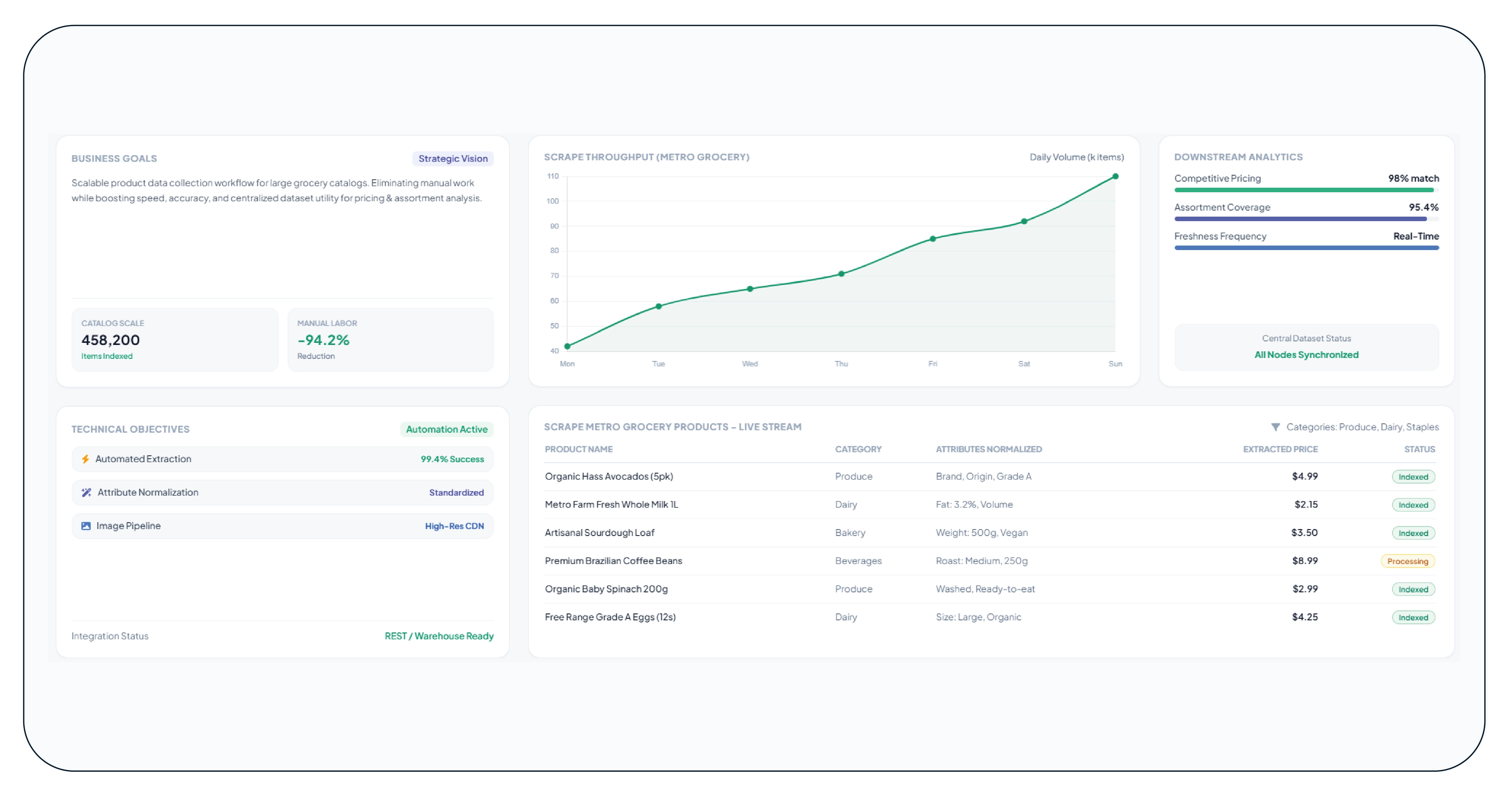
The primary business goal was to create a scalable product data collection workflow capable of handling a large grocery catalog. The client wanted to improve the speed, accuracy, and consistency of product information collection while reducing repetitive manual work. Another goal was to create a centralized dataset that could support catalog management, competitive research, assortment analysis, and pricing decisions.
The technical objectives focused on automated extraction, structured data processing, image collection, attribute normalization, and integration-ready outputs. The workflow needed to capture relevant product information consistently while handling a large number of products and categories. Automated processing also needed to support regular updates so business teams could work with fresher catalog information. Scrape Metro Grocery Products became a key capability, helping transform online grocery catalog information into a structured dataset suitable for analytics and business workflows.
Improve product data processing speed by approximately 75%.
Increase structured catalog coverage by around 90%.
Reduce manual collection effort by approximately 65%.
Improve product attribute consistency.
Increase image and product-data availability for analysis.
Support scalable extraction across grocery categories.
The Core Challenge
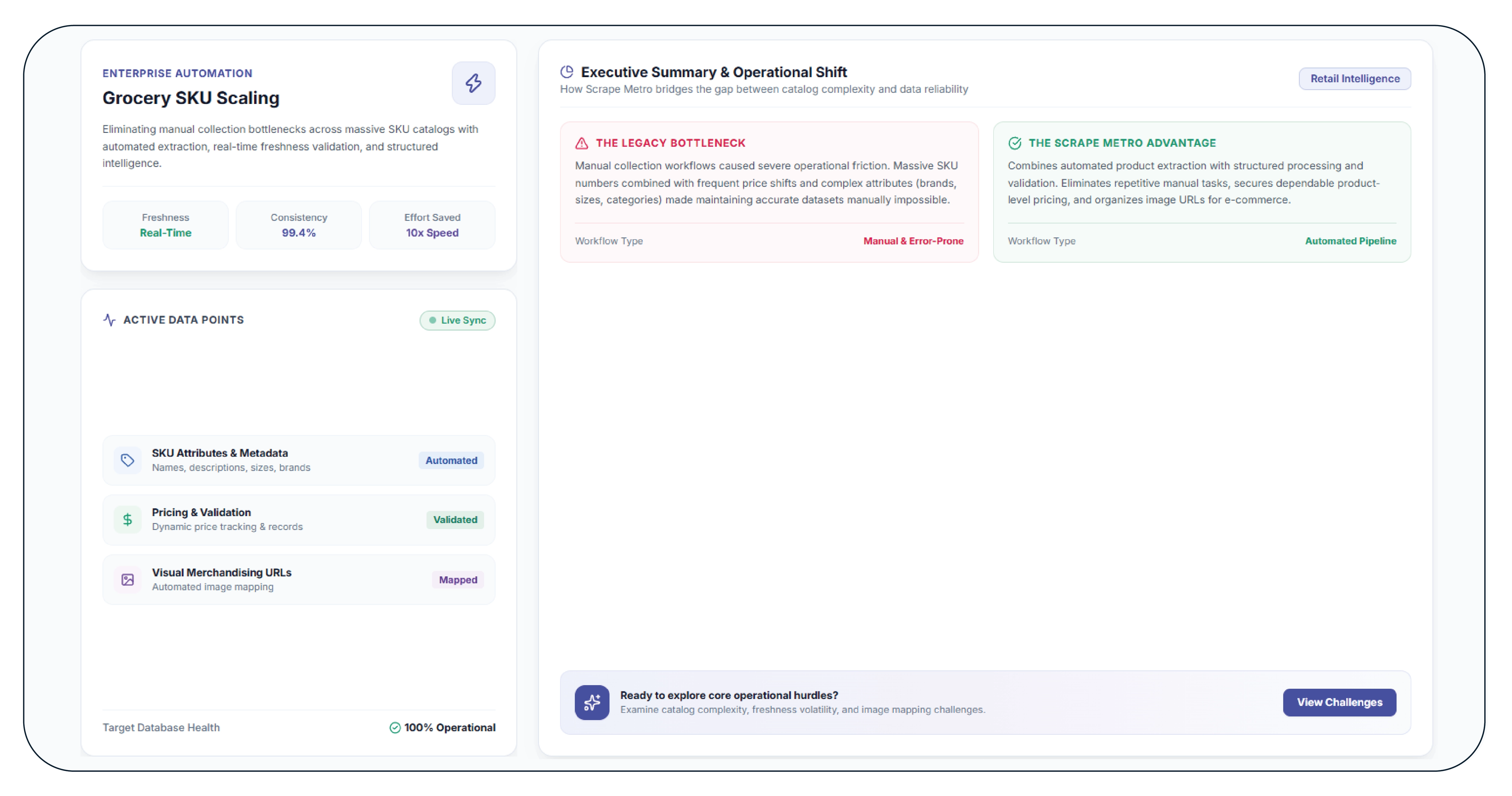
The client's main challenge was the complexity of collecting product catalog information at scale. Grocery catalogs contain large numbers of SKUs, and each product can include multiple data points such as product names, descriptions, prices, categories, images, brands, sizes, and other attributes. Manually collecting these details created significant operational bottlenecks.
Data freshness was another concern. Product prices and catalog information can change frequently, requiring repeated collection and validation. Manual workflows made it difficult to maintain a consistently updated dataset, while differences in product presentation could introduce inconsistencies between records.
Image collection created an additional challenge. Product images are valuable for digital catalog management, visual merchandising, product matching, and marketplace intelligence, but manually locating and organizing image URLs across a large catalog is inefficient.
The client also needed reliable product-level pricing information for comparison and analysis. Without an automated workflow, gathering and validating these records required substantial effort.
Product Data Scrape addressed these challenges through Scrape Metro Product Prices, combining automated product extraction with structured processing and validation. This approach helped reduce repetitive collection work, improve catalog consistency, and create a more dependable source of product intelligence for the client's retail and e-commerce operations.
Our Solution
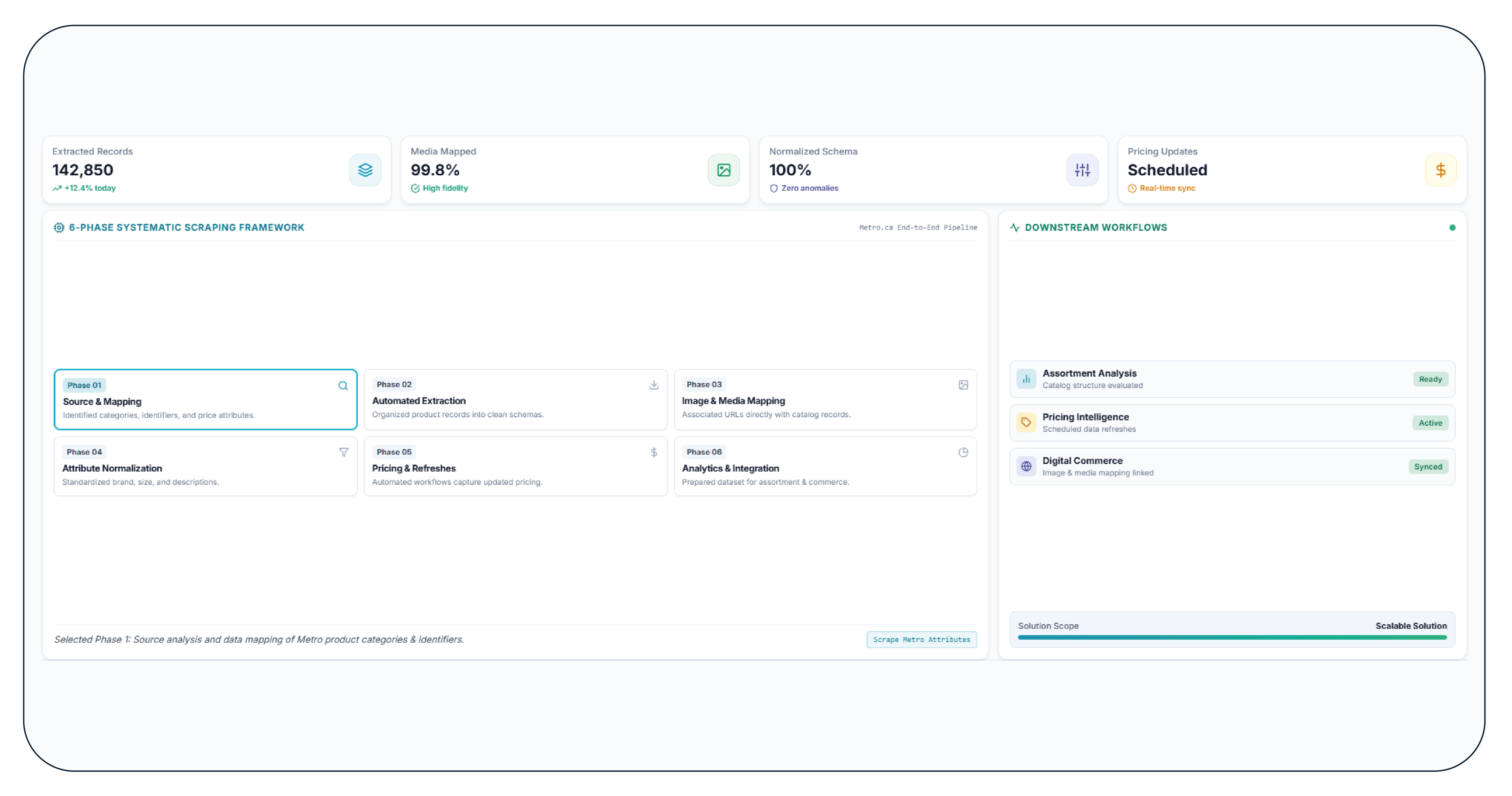
Product Data Scrape implemented a phased solution designed to address the client's catalog collection challenges systematically.
Phase 1: Source Analysis and Data Mapping
The first phase involved source analysis and data mapping. We identified the relevant product categories, required fields, image attributes, pricing information, product identifiers, and other catalog elements needed by the client.
Phase 2: Automated Product Extraction
The second phase focused on automated product extraction. Our framework collected available product information and organized records according to predefined schemas. This allowed the client to receive standardized information rather than fragmented page-level data.
Phase 3: Image Extraction and Product-Media Mapping
The third phase focused on image extraction and product-media mapping. Product image URLs were captured and associated with their corresponding product records. This created a structured relationship between product information and visual assets, supporting digital catalog and merchandising use cases.
Phase 4: Attribute Normalization
The fourth phase introduced attribute normalization. Product names, categories, brands, sizes, descriptions, and other available attributes were standardized to improve consistency. This made the resulting dataset easier to compare, filter, analyze, and integrate with downstream systems.
Phase 5: Pricing and Catalog Updates
The fifth phase focused on pricing and catalog updates. Automated workflows captured product pricing information and supported scheduled data refreshes, helping the client work with more current catalog intelligence.
Phase 6: Dataset Preparation and Integration
The final stage prepared the dataset for business analytics and integration. The structured output could support assortment analysis, competitive research, catalog management, pricing intelligence, and digital commerce workflows.
The complete framework was built around Scrape Metro Product Attributes, ensuring that product-level information could be collected in a consistent and scalable manner. By combining product extraction, image collection, attribute normalization, pricing capture, and automated processing, Product Data Scrape delivered Scrape Product & Image Data Collection from Metro.ca as a scalable catalog intelligence solution rather than a one-time data collection exercise.
Results & Key Metrics
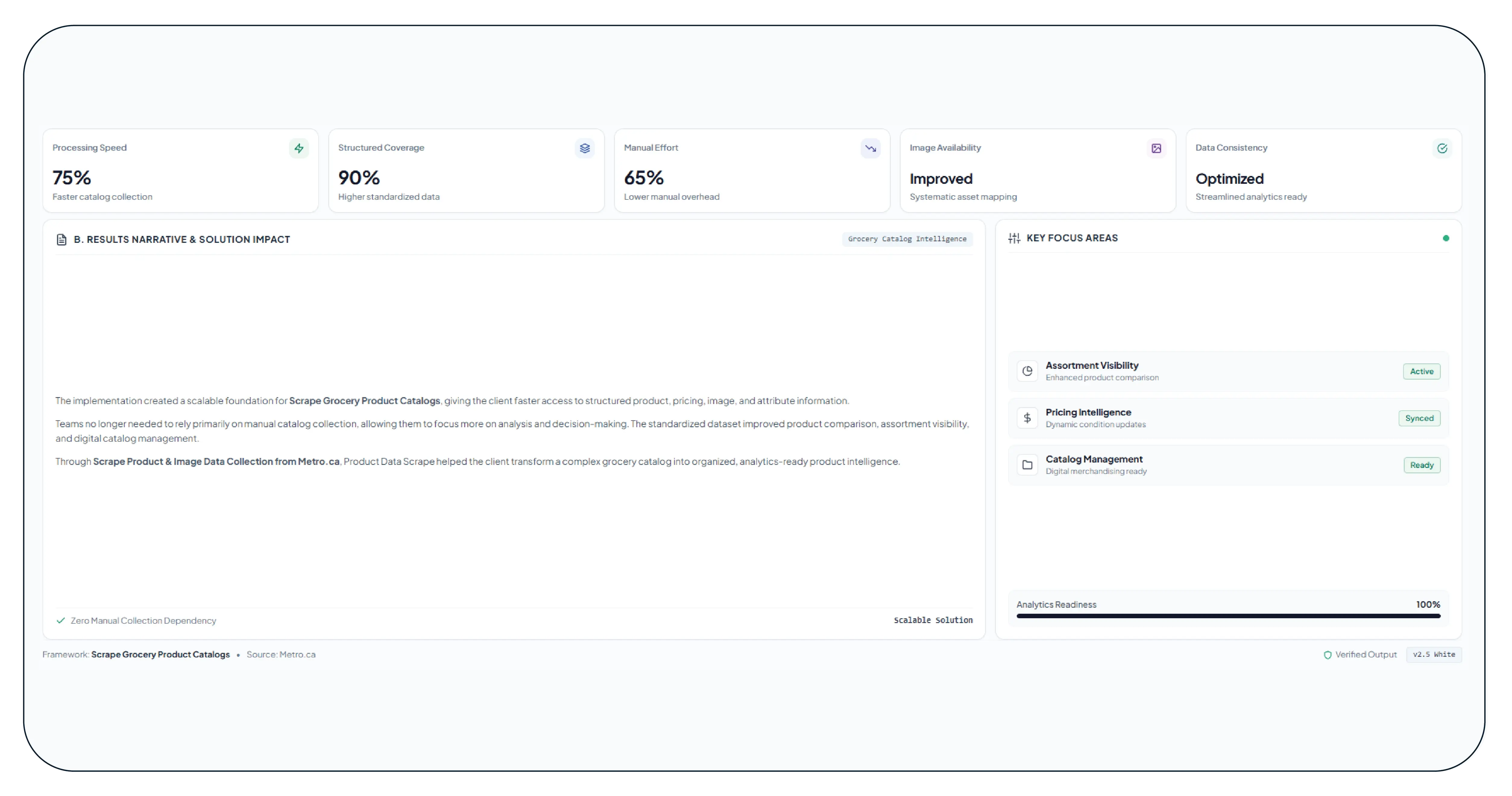
75% faster processing: Automated extraction significantly accelerated product catalog collection and processing.
90% higher structured coverage: More product records were captured and organized into standardized datasets.
65% lower manual effort: Automation reduced repetitive catalog research and collection activities.
Improved image availability: Product image URLs were systematically associated with relevant product records.
Better data consistency: Standardized attributes improved usability for analytics and catalog workflows.
Results Narrative
The implementation created a scalable foundation for Scrape Grocery Product Catalogs, giving the client faster access to structured product, pricing, image, and attribute information. Teams no longer needed to rely primarily on manual catalog collection, allowing them to focus more on analysis and decision-making. The standardized dataset improved product comparison, assortment visibility, and digital catalog management. Automated extraction also made it easier to refresh information as catalog conditions changed. Through Scrape Product & Image Data Collection from Metro.ca, Product Data Scrape helped the client transform a complex grocery catalog into organized, analytics-ready product intelligence.
What Made Product Data Scrape Different
Product Data Scrape combined automated extraction with structured catalog processing, image mapping, attribute normalization, validation, and scalable data workflows. Rather than simply collecting individual product pages, the solution was designed to produce an organized dataset that could support multiple downstream business applications. Our Product Data Scraping from Metro.ca approach helped connect product information with images, pricing, categories, and attributes in a consistent format. Smart automation reduced repetitive collection work while supporting large catalog volumes. The framework could also be adapted for recurring extraction and additional data requirements, giving the client a flexible foundation for ongoing retail intelligence.
Client's Testimonial
"Product Data Scrape helped us significantly improve the way we collect and organize grocery product information. Previously, gathering product details, images, pricing, and attributes required considerable manual effort and repeated verification. Their automated solution gave us a much more structured dataset and reduced the time our team spent on repetitive catalog collection. The quality and consistency of the output made the information easier to use for product analysis and digital commerce activities. We particularly valued the scalable approach because it allowed us to work with a larger catalog without increasing manual workload at the same rate."
— Digital Commerce Manager, Retail & FMCG Brand
Conclusion
Accurate product information is essential for retailers and brands seeking stronger digital commerce intelligence. Product Data Scrape helped the client replace fragmented catalog collection with a scalable automated workflow covering product details, images, attributes, and pricing information. The solution improved processing speed, structured coverage, data consistency, and operational efficiency while creating a stronger foundation for catalog analysis. Through Grocery data scraping, the client could transform complex grocery product information into organized, analytics-ready intelligence. Scrape Product & Image Data Collection from Metro.ca demonstrated how automated catalog extraction can support smarter assortment decisions, product management, competitive research, digital merchandising, and broader retail intelligence initiatives.
FAQs
1. What product information can be collected?
Depending on source availability and project requirements, product datasets can include product names, descriptions, categories, brands, prices, sizes, product identifiers, image URLs, and other publicly available attributes.
2. Can product images be collected along with catalog information?
Yes. Product image URLs can be extracted and mapped to the relevant product records. This creates a more complete catalog dataset that can support digital merchandising, product matching, and visual catalog management.
3. Why is automated grocery product data collection useful?
Automated collection helps businesses process large catalogs more efficiently than manual workflows. It can improve data consistency, reduce repetitive work, and make it easier to maintain structured product intelligence for analysis.
4. Can the data support pricing analysis?
Yes. Structured product pricing information can support price comparisons, competitive analysis, assortment research, and broader pricing intelligence workflows, depending on the client's requirements.
5. Can the solution support recurring data updates?
Yes. Automated workflows can be configured for scheduled extraction and refreshes. This allows businesses to maintain more current product, pricing, image, and attribute datasets and use them for ongoing retail intelligence and e-commerce analysis.


 Singapore
 EMAIL
EMAIL
 PHONE
PHONE










.webp)