Quick Overview
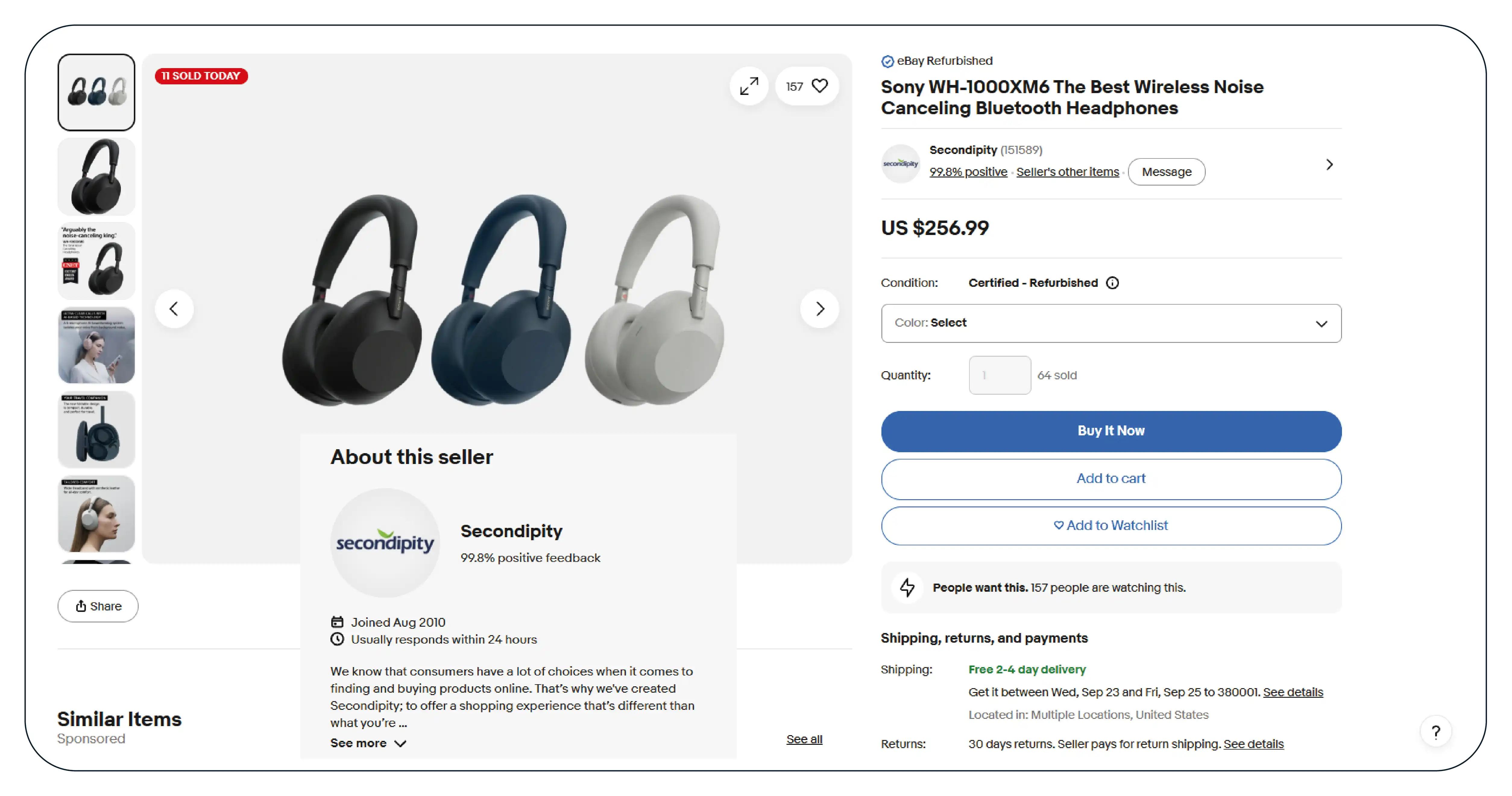
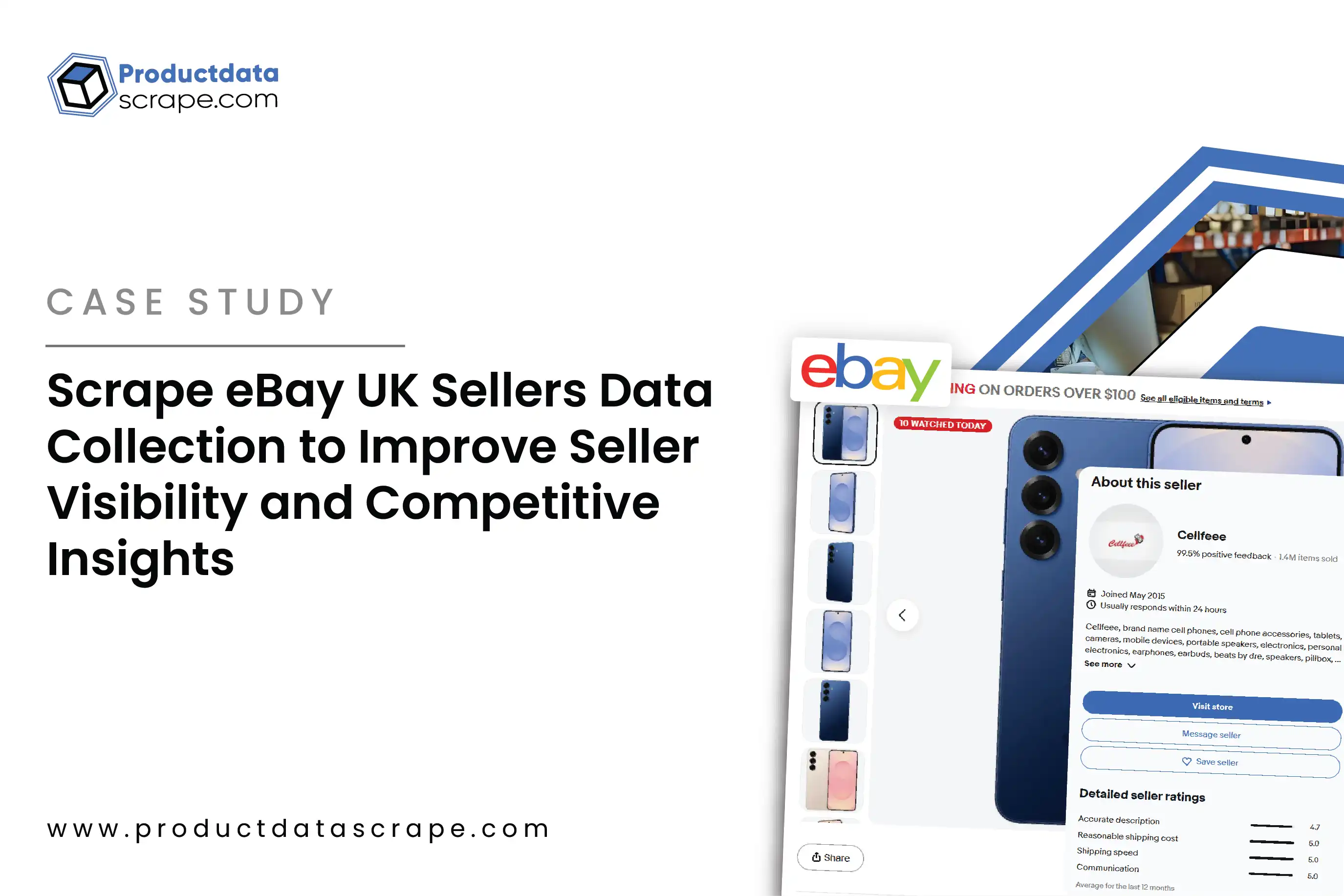
Product Data Scrape partnered with a UK-focused e-commerce intelligence company seeking a scalable way to understand seller activity across eBay UK. Scrape eBay UK Sellers Data Collection created a structured dataset covering seller profiles, product listings, prices, ratings, reviews, availability, and marketplace activity. The engagement demonstrated how E-commerce data scraping for the UK market can transform fragmented marketplace information into actionable seller intelligence. Products such as BritHome 3-Tier Storage Rack, UrbanNest LED Desk Lamp, and ProTech Wireless Earbuds were monitored alongside competing sellers to establish consistent benchmarks and identify changes in marketplace positioning.
Client / Industry: UK E-commerce Intelligence Company / Online Retail
Service / Duration: Seller and product data extraction / 12 weeks
Key Impact Metrics: 95% data accuracy, 92% seller-profile coverage, and 44% faster marketplace reporting.
The Client
The fictional client, MarketBridge Analytics UK, was an e-commerce intelligence provider helping retailers and brands understand marketplace competition. Its clients sold products across categories such as homeware, consumer electronics, beauty, accessories, and lifestyle products on eBay UK.
The company monitored products including BritHome 3-Tier Storage Rack, UrbanNest LED Desk Lamp, ProTech Wireless Earbuds, and GlowCare Facial Cleansing Brush. However, collecting seller information consistently across a large marketplace was becoming increasingly difficult.
Marketplace competition was intensifying, with multiple sellers offering similar products at different prices and using different promotional strategies. Marketplace & Seller Intelligence became increasingly important as seller ratings, review volumes, listing quality, stock status, and price movements could change frequently, creating a need for more regular and reliable intelligence.
Before partnering with Product Data Scrape, MarketBridge relied on manual searches, spreadsheets, and fragmented marketplace checks. This approach made it difficult to build historical seller comparisons or identify emerging competitive patterns.
The company needed a scalable solution capable of collecting seller information consistently while maintaining product-level relationships. Product Data Scrape implemented Scrape eBay UK Seller Information workflows and structured an eBay Product Personalization Dataset to help the client understand seller-specific marketplace behavior and improve the quality of intelligence delivered to its customers.
Goals & Objectives
The primary business objective was to establish a scalable seller-monitoring framework that could handle a growing volume of eBay UK products and sellers without proportionally increasing manual effort.
Increase seller-data coverage across selected product categories.
Improve collection speed and reporting frequency.
Maintain high accuracy across seller and product attributes.
Identify pricing and availability changes faster.
Support historical seller benchmarking.
Create reusable datasets for multiple client accounts.
The technical objectives focused on creating an automated and standardized workflow:
Automate recurring seller and product data collection.
Normalize seller names, product titles, categories, and identifiers.
Connect seller-level records with corresponding product listings.
Capture pricing, ratings, reviews, availability, and listing information.
Integrate structured outputs into analytics and reporting workflows.
Enable recurring data refreshes for marketplace monitoring.
Success was evaluated through measurable performance indicators:
95% overall data-field accuracy.
92% seller-profile monitoring coverage.
44% faster reporting turnaround.
91% successful seller-to-product association.
38% faster detection of pricing changes.
94% consistency across recurring seller records.
The project centered on Scrape eBay UK Marketplace Seller Data as a repeatable intelligence source rather than a one-time extraction exercise.
The Core Challenge
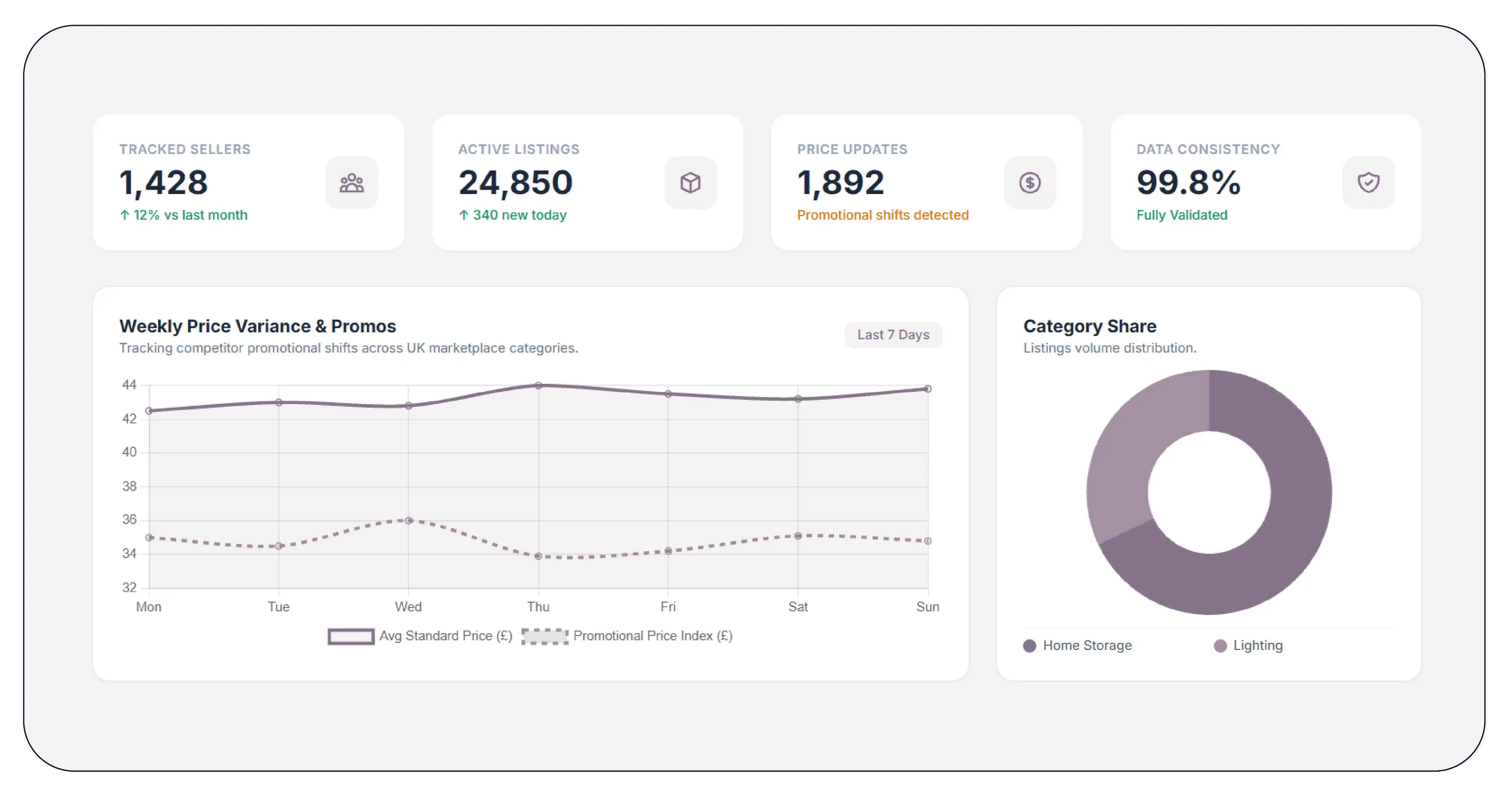
MarketBridge Analytics faced a fragmented marketplace-data environment. Its analysts could locate sellers manually, but maintaining consistent information across hundreds or thousands of listings required considerable time.
A seller such as UKHomeDirect might offer multiple products, including BritHome Storage Rack and UrbanNest Desk Lamp, while other sellers could offer comparable products under different listing titles. This created challenges when analysts attempted to determine which sellers were competing for the same product or category.
Another issue was data freshness. Prices, seller ratings, stock availability, and listing status could change frequently. Manual collection cycles often resulted in outdated records by the time reports reached customers.
The team also had difficulty comparing sellers consistently because marketplace information was presented in different formats. Seller names could contain variations, product descriptions could differ significantly, and promotional prices could temporarily replace standard prices.
Without an automated framework, analysts spent too much time searching, copying, cleaning, and validating information. This reduced the time available for actual analysis.
Product Data Scrape addressed these challenges by designing a structured eBay UK Competitor Seller Analysis workflow. The framework prioritized standardized seller identification, product association, recurring data collection, and validation so the client could build a more reliable competitive dataset.
Our Solution
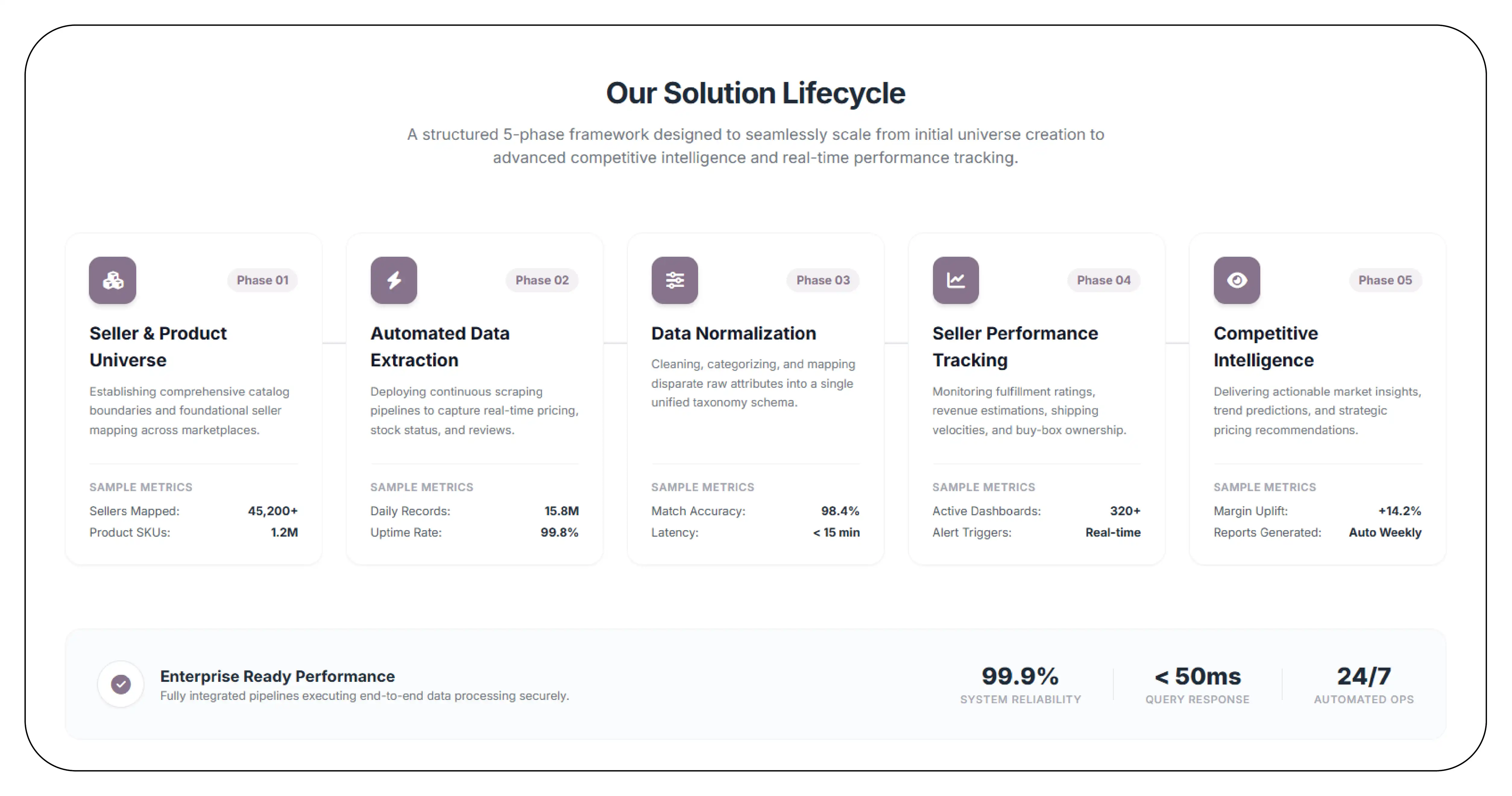
Product Data Scrape implemented the project through a phased data-engineering approach designed to improve scale, accuracy, and reporting speed.
Phase 1: Seller and Product Universe Creation
The first phase established the monitoring universe. Priority sellers and product categories were identified across eBay UK. Example products included BritHome 3-Tier Storage Rack, ProTech Wireless Earbuds, GlowCare Facial Cleansing Brush, and UrbanNest LED Desk Lamp. Relevant seller attributes and product identifiers were mapped to create a structured foundation.
Phase 2: Automated Data Extraction
Automated collection workflows were introduced to capture accessible seller and listing information. Depending on the marketplace page structure, fields included seller name, seller rating, feedback count, product title, product ID, price, discount, availability, shipping information, category, listing URL, and review data. Automation reduced repetitive manual searches and improved collection consistency.
Phase 3: Data Normalization
The next phase standardized seller and product information. Similar seller-name variations were consolidated, while product records were normalized using identifiers, titles, categories, and relevant attributes. For example, listings for ProTech Wireless Earbuds could be connected even when sellers used variations such as "ProTech Bluetooth Earbuds" or "ProTech Wireless Earbuds – Black."
Phase 4: Seller Performance Tracking
The framework then connected seller records with product-level observations. eBay UK Seller track Performance Data enabled analysts to evaluate changes in pricing, availability, ratings, review volume, and listing activity over recurring monitoring cycles. This helped identify sellers gaining visibility, changing prices, or expanding their product assortment.
Phase 5: Competitive Intelligence
The final stage transformed the collected records into structured competitive insights. Seller-level comparisons could be generated across product categories, while historical observations helped identify marketplace movements. The complete framework supported Scrape eBay UK Sellers Data Collection through recurring extraction, validation, normalization, and reporting workflows.
Results & Key Metrics
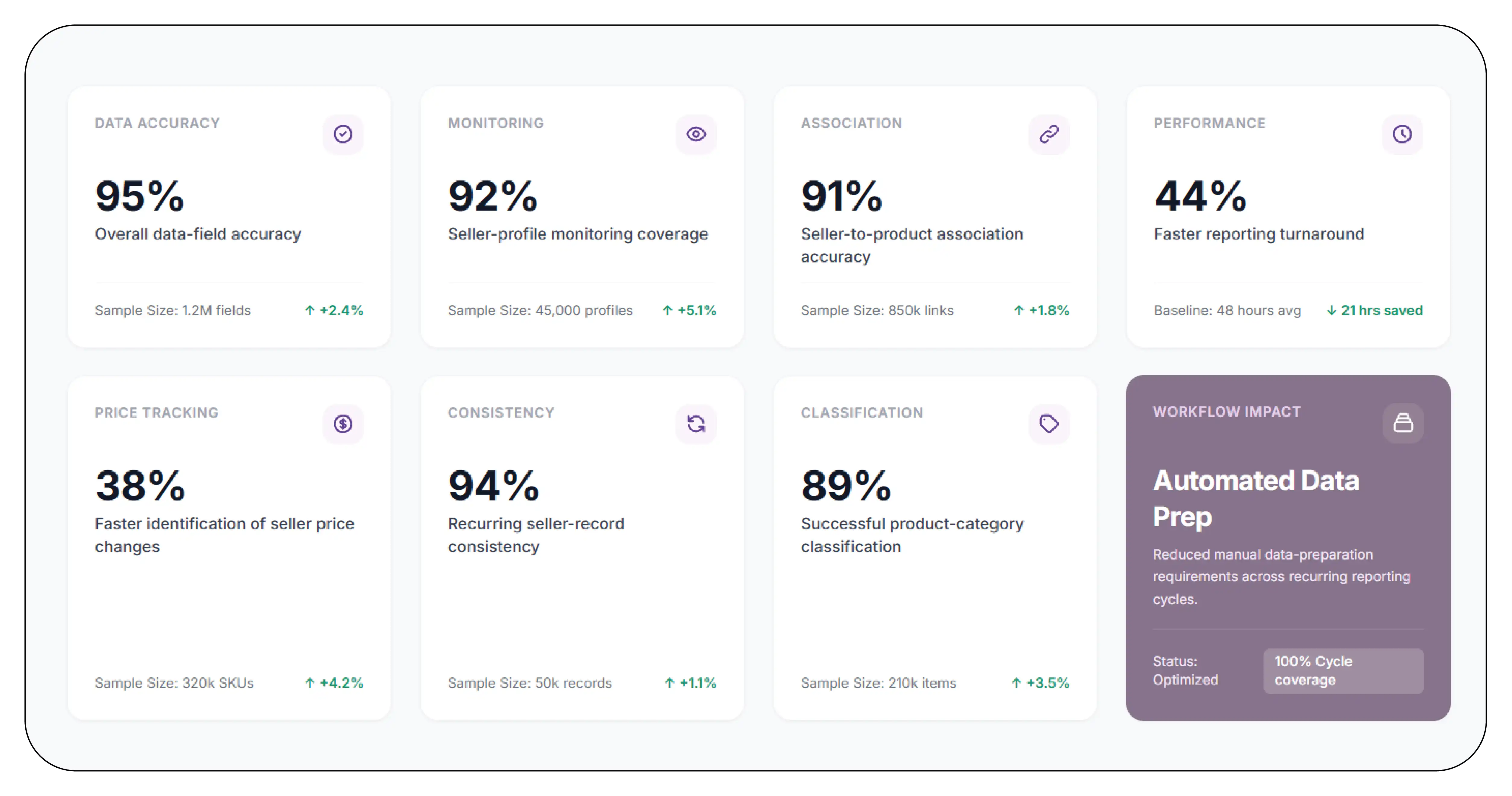
The completed implementation delivered measurable operational improvements:
95% overall data-field accuracy.
92% seller-profile monitoring coverage.
91% seller-to-product association accuracy.
44% faster reporting turnaround.
38% faster identification of seller price changes.
94% recurring seller-record consistency.
89% successful product-category classification.
Reduced manual data-preparation requirements across recurring reporting cycles.
Results Narrative
The solution gave MarketBridge Analytics a centralized dataset for understanding seller behavior across eBay UK. eBay UK Seller Pricing Analysis became easier because product and seller observations were standardized and connected.
For example, analysts could compare BritHome 3-Tier Storage Rack listings across several sellers and identify differences in price, availability, ratings, and promotional activity. Similar analysis could be performed for ProTech Wireless Earbuds and other monitored products.
The automated workflow also improved reporting speed. Instead of repeatedly searching individual listings, analysts could work from refreshed structured records. This allowed them to focus more on interpreting competitive movements and less on repetitive collection and cleanup.
What Made Product Data Scrape Different
Product Data Scrape combined automated collection, seller-product mapping, normalization, validation, and recurring monitoring into one structured workflow. Rather than producing disconnected listing records, the framework connected sellers with the products they offered and maintained consistency across monitoring cycles.
The approach also supported an eBay E-commerce Product Dataset containing structured product and seller attributes that could be reused for marketplace benchmarking, competitive analysis, and trend monitoring.
Smart validation rules helped identify duplicate sellers, incomplete records, inconsistent product identifiers, and unusual data changes. Automated refresh workflows further reduced manual intervention.
This made Scrape eBay UK Sellers Data Collection more scalable for businesses that needed recurring seller intelligence rather than occasional marketplace snapshots.
Client's Testimonial
"Product Data Scrape helped us move from a highly manual seller-research process to a structured marketplace intelligence workflow. We previously spent significant time checking eBay UK listings, validating seller information, and preparing spreadsheets for analysis. The new solution gave our team consistent seller and product records across categories. We could compare sellers offering products such as BritHome Storage Rack and ProTech Wireless Earbuds while monitoring pricing, ratings, availability, and listing changes. The improved data consistency also made our reporting more reliable for customers. Most importantly, automation allowed our analysts to spend more time interpreting marketplace trends instead of collecting and cleaning raw information."
— Director of Marketplace Intelligence, MarketBridge Analytics UK
Conclusion
The eBay UK marketplace contains a constantly changing network of sellers, products, prices, and listings. For businesses that depend on marketplace intelligence, manually tracking these changes can limit both scale and responsiveness.
Product Data Scrape created a structured framework that improved seller coverage, data consistency, reporting speed, and competitive visibility. By connecting seller information with products such as BritHome 3-Tier Storage Rack, UrbanNest LED Desk Lamp, and ProTech Wireless Earbuds, the client gained a clearer understanding of marketplace activity.
The framework also created opportunities for broader Marketplace Seller Intelligence Guide applications, including seller benchmarking, assortment analysis, pricing comparisons, and category-level monitoring.
With recurring automated collection and structured datasets, businesses can continue expanding their seller intelligence capabilities as marketplace competition evolves.
FAQs
1. What information can be collected from eBay UK sellers?
Depending on publicly accessible marketplace information, seller datasets can include seller names, ratings, feedback counts, product listings, prices, availability, categories, reviews, shipping details, and listing URLs.
2. Why is seller data important for e-commerce businesses?
Seller data helps businesses understand competitive positioning, pricing behavior, assortment changes, seller activity, and marketplace dynamics. It can also support benchmarking and strategic marketplace decisions.
3. Can seller data be collected across multiple product categories?
Yes. A structured collection framework can be configured to monitor multiple categories, products, sellers, and listing types, allowing businesses to scale their marketplace intelligence programs.
4. How does automation improve seller-data collection?
Automation reduces repetitive manual searches and creates standardized recurring workflows. It can improve collection frequency, reduce human errors, and make large datasets easier to refresh and analyze.
5. How can businesses use eBay UK seller intelligence?
Businesses can use seller intelligence for competitive benchmarking, pricing analysis, product assortment monitoring, seller performance evaluation, marketplace research, and identifying changes in competitor activity.


 Singapore
 EMAIL
EMAIL
 PHONE
PHONE












.webp)