Quick Overview
A leading consumer grocery and FMCG brand partnered with Product Data Scrape to automate product monitoring across Flipkart Minutes. The brand needed faster visibility into SKU-level pricing, availability, assortment, and product attributes to respond to rapidly changing quick-commerce conditions. Before the engagement, product checks relied heavily on manual processes, making daily monitoring difficult and inconsistent. We implemented an automated SKU-focused data pipeline that captured structured product information and supported recurring analytics. The solution improved monitoring speed, data consistency, and operational visibility while creating a scalable foundation for future quick-commerce intelligence. The project focused on measurable performance improvements rather than cost reduction.
Client Name / Industry: Leading Consumer Grocery & FMCG Brand
Service / Duration: Flipkart Minutes SKU Data Collection & Monitoring / 6 Months
Key Impact Metrics: 90%+ reduction in manual monitoring effort, 95%+ data completeness, daily SKU-level monitoring coverage
The Client
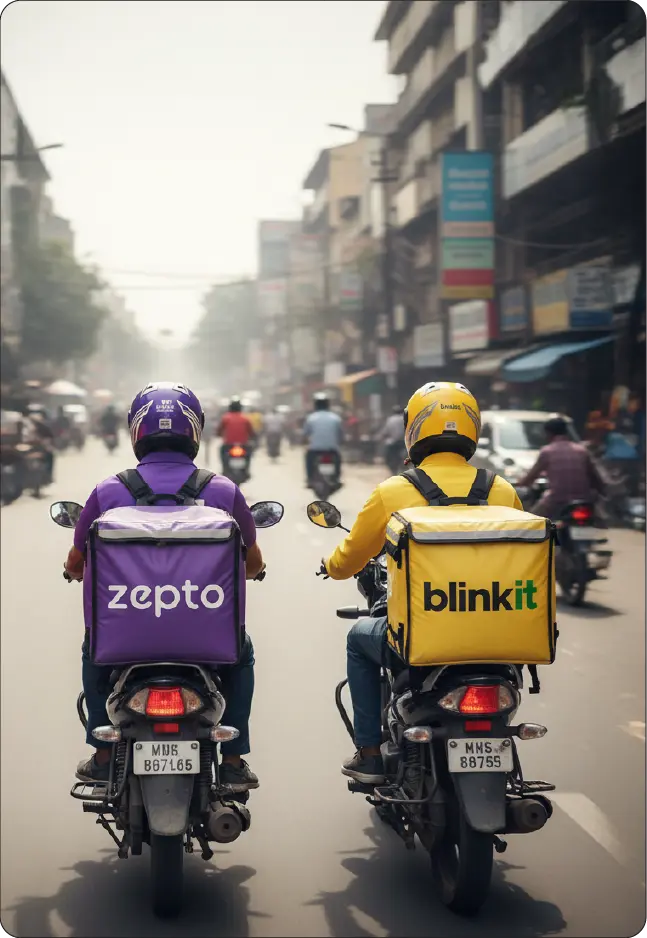
The client was a consumer brand operating across fast-moving grocery and FMCG categories, including packaged foods, beverages, personal care products, cleaning supplies, and household essentials. Its products were increasingly being sold through quick-commerce channels such as Flipkart Minutes, where product availability, pricing, assortment, and visibility can change frequently.
The rapid expansion of quick commerce created new competitive pressure. Customers increasingly expect products to be available immediately, while brands need to understand which SKUs are visible, which products are temporarily unavailable, and how competing products are positioned.
Before partnering with Product Data Scrape, the client depended on a combination of manual product checks, spreadsheets, and periodic marketplace reviews. This approach made it difficult to maintain a consistent view of thousands of products across changing locations and time periods. Manual collection also introduced risks such as duplicate records, missing SKUs, inconsistent product names, and delayed updates.
The transformation became essential because traditional periodic monitoring could not provide the frequency required by a quick-commerce environment. The client needed a structured system capable of collecting product-level information repeatedly and converting marketplace activity into usable business intelligence.
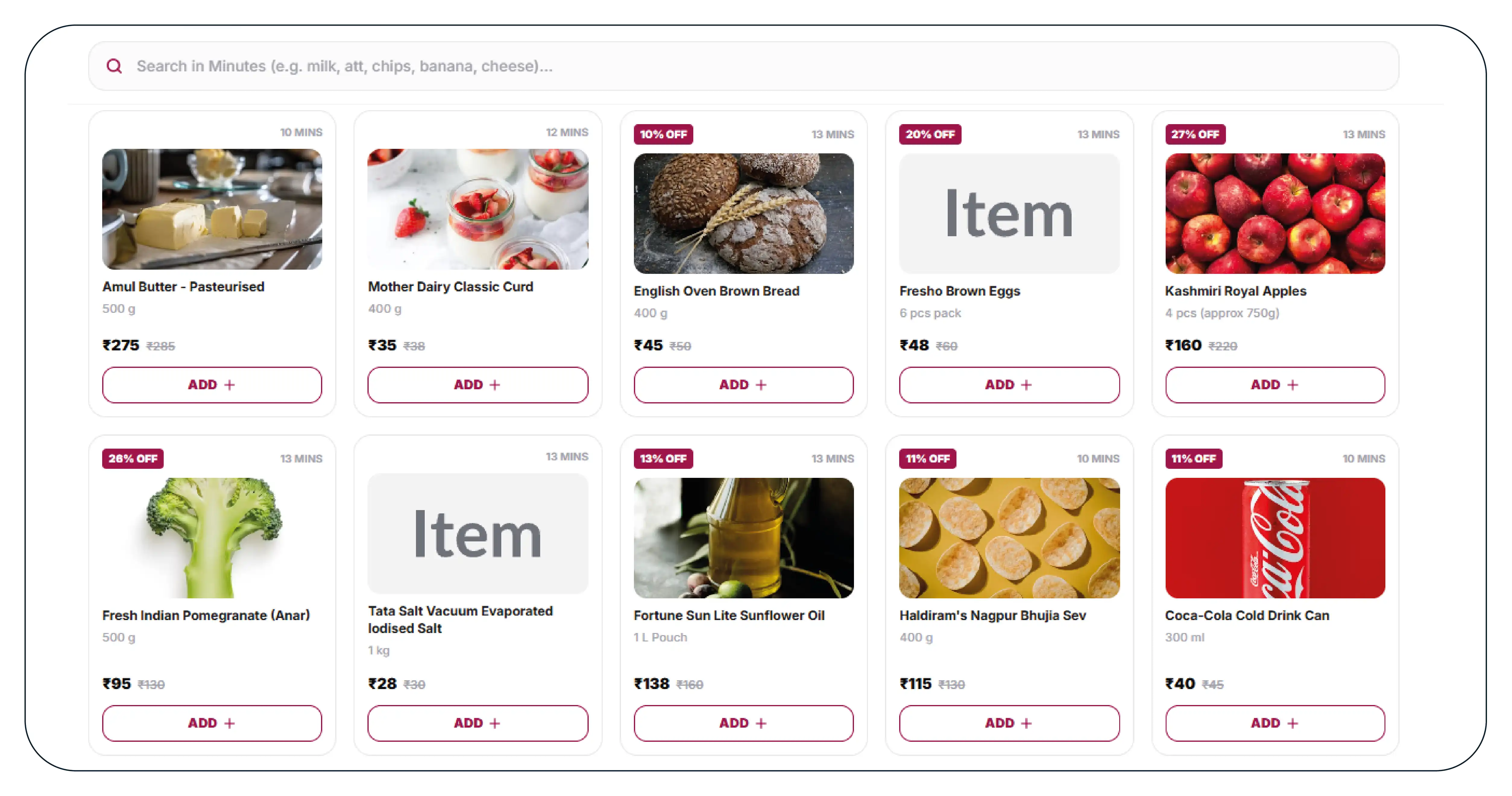
The project focused on Scrape Flipkart Minutes Product SKUs across relevant categories, while Grocery data scraping provided the foundation for tracking products, prices, availability, pack sizes, brands, categories, and other important attributes.
Goals & Objectives
The project was designed around three connected priorities: scalability, speed, and accuracy. Instead of treating marketplace monitoring as a one-time extraction task, Product Data Scrape created an automated workflow capable of recurring SKU-level collection and structured delivery.
Scale monitoring from manually checked products to thousands of SKUs.
Improve the speed of product and availability updates.
Maintain consistent product, price, and SKU information.
Reduce repetitive manual marketplace checks.
Establish a reliable foundation for competitive intelligence.
Automate collection of product-level information from Flipkart Minutes.
Organize products according to SKU, category, brand, and pack size.
Integrate structured outputs with the client's analytics environment.
Support recurring collection for daily monitoring.
Enable faster identification of unavailable or changed products.
90%+ reduction in manual monitoring effort.
95%+ data completeness across monitored SKU records.
Daily monitoring coverage for the defined SKU universe.
Faster identification of product and availability changes.
Consistent structured output suitable for dashboards and analytics.
The central requirement was Flipkart Minutes Grocery Product Data by SKU, enabling the client to move from scattered marketplace observations to a consistent SKU-level monitoring framework.
The Core Challenge
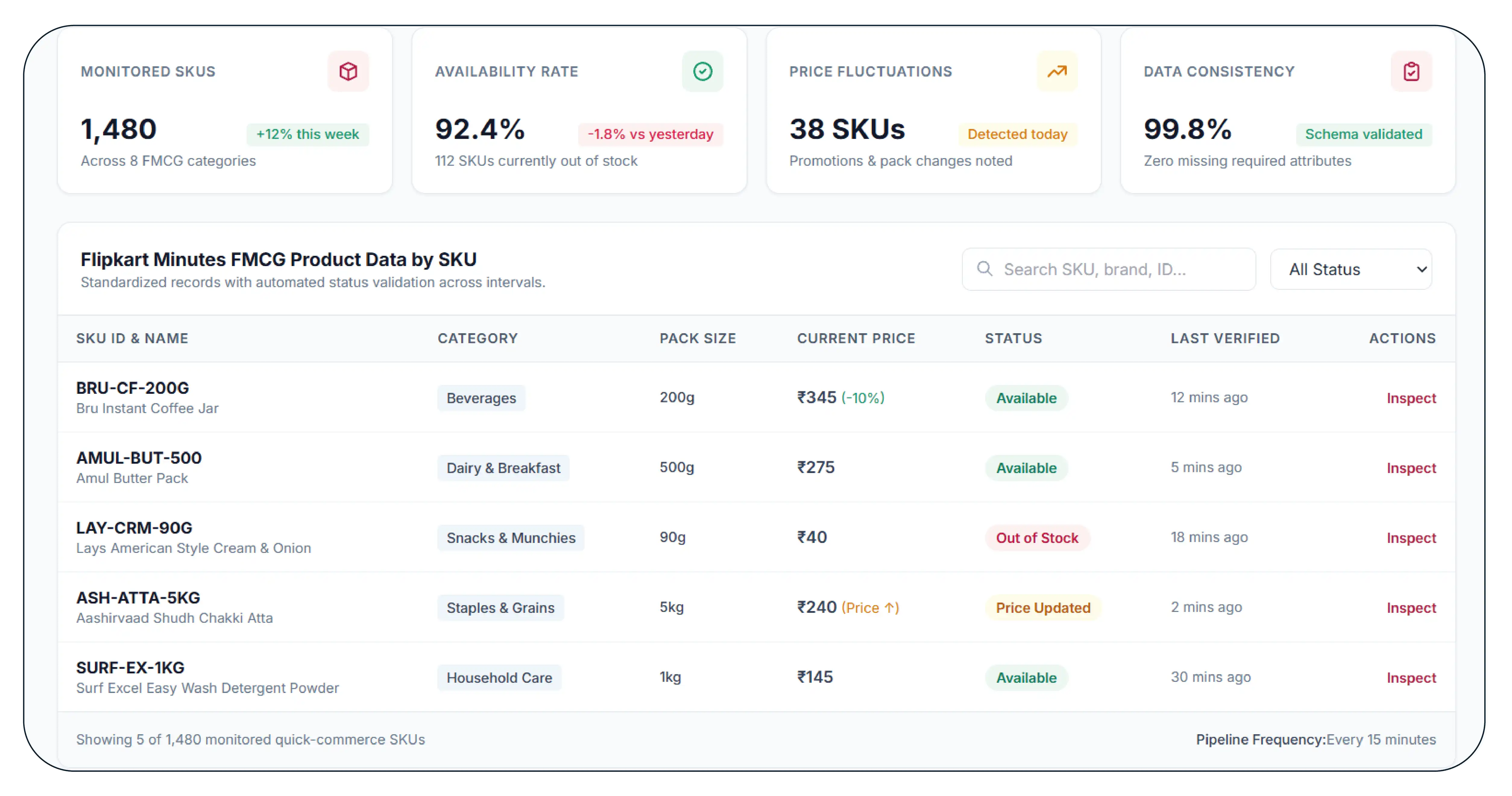
The client's biggest challenge was the speed at which quick-commerce product information could change. A SKU that appeared available during one check could become unavailable later, while prices, promotions, pack sizes, or product visibility could also change.
Manual monitoring created several operational bottlenecks. Teams had to repeatedly search for products, record information, compare previous observations, and update spreadsheets. As the number of monitored SKUs increased, this process became increasingly time-consuming.
Another issue was data consistency. Different team members could record product titles, pack sizes, prices, or availability in slightly different formats. This created additional work during data cleaning and analysis. Missing product attributes could also reduce the accuracy of category-level reporting.
The client also needed a more frequent view of marketplace activity. Periodic checks were not sufficient for a quick-commerce environment where availability and pricing could fluctuate throughout the day.
The challenge was therefore not simply extracting product information. The real requirement was creating a dependable system for Flipkart Minutes FMCG Product Data by SKU, with standardized fields, automated collection, validation, and repeatable delivery.
The business impact was significant: delayed information could affect pricing decisions, assortment planning, competitor monitoring, and sales-team visibility. The client needed a scalable approach that could keep pace with its growing SKU portfolio.
Our Solution
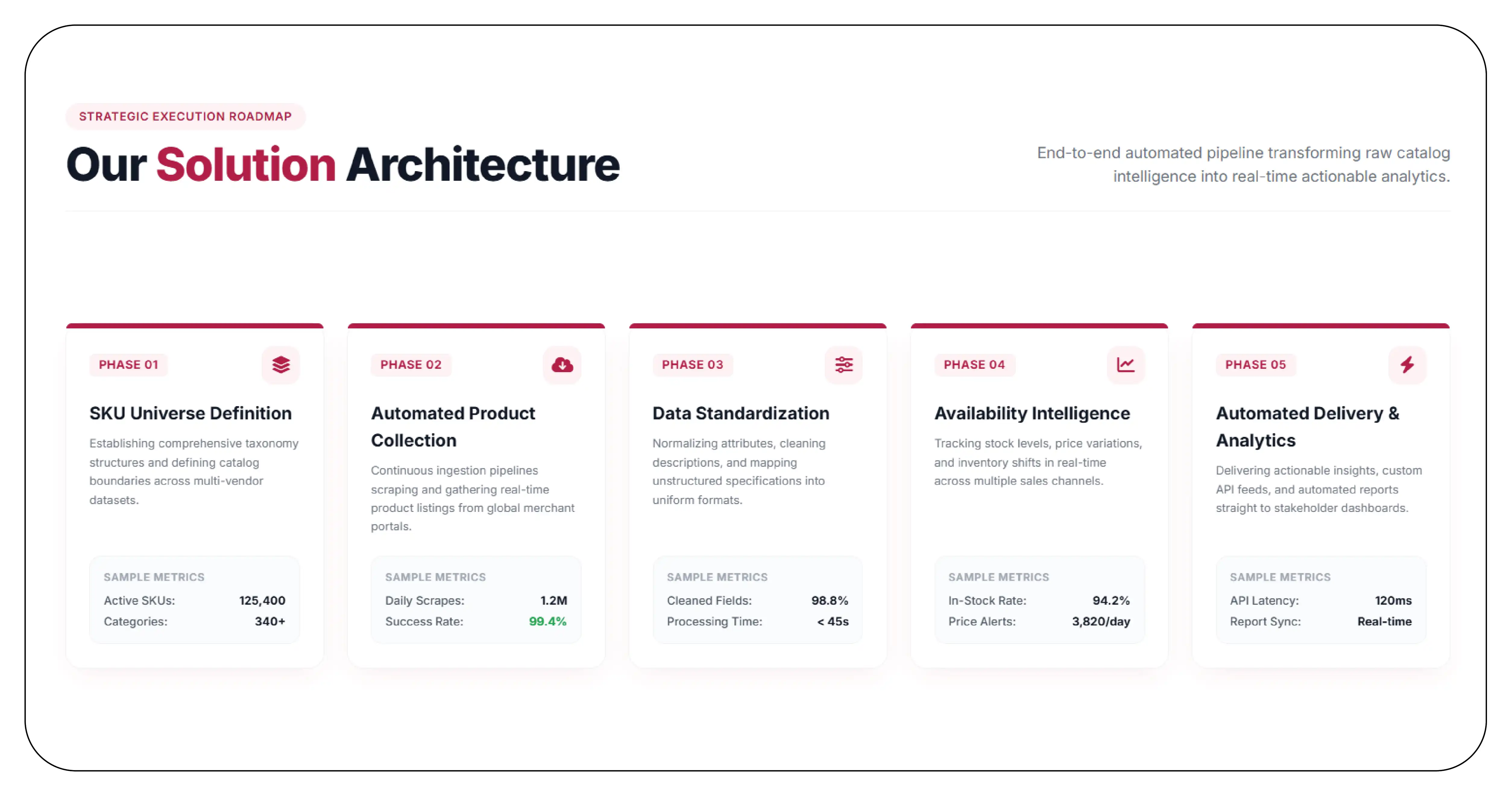
Product Data Scrape implemented a phased solution focused on automation, SKU-level identification, structured extraction, validation, and recurring delivery. The implementation was designed to address each operational issue without disrupting the client's existing analytics workflow.
Phase 1: SKU Universe Definition
The first phase established the monitoring scope. Product categories were organized into logical groups such as packaged foods, snacks, beverages, dairy products, personal care, home cleaning, and household essentials. Each product was mapped using relevant identifiers and attributes so that the same SKU could be consistently recognized across recurring collection cycles.
Phase 2: Automated Product Collection
The next phase introduced an automated collection framework for Flipkart Minutes. Product records were captured according to the predefined SKU universe instead of relying on random or manual searches. This enabled consistent monitoring of Flipkart Minutes SKUs across the targeted product categories. Relevant fields included product name, SKU or product identifier, brand, category, pack size, price, discount, availability, product URL, and other accessible attributes.
Phase 3: Data Standardization
Raw marketplace information was transformed into standardized records. Product names were normalized, categories were organized, numerical fields were cleaned, and duplicate records were identified. This step helped ensure that the client could compare the same product consistently across multiple collection cycles.
Phase 4: Availability Intelligence
A dedicated monitoring layer was created to identify changes in SKU availability. Products could be classified as available, unavailable, or requiring further validation based on the captured marketplace information. This supported the development of Flipkart Minutes SKU Availability Intelligence, allowing business teams to identify assortment gaps and changing product visibility more efficiently.
Phase 5: Automated Delivery & Analytics
The final stage connected the structured dataset with the client's analytics environment. Recurring data delivery reduced dependency on manual spreadsheets and allowed teams to work with refreshed records. The broader implementation of Flipkart Minutes SKU-based Data Scraping gave the client a scalable framework that could be expanded to additional categories and SKUs as monitoring requirements increased.
The solution was designed to support dashboards, historical comparisons, SKU-level analysis, pricing research, assortment monitoring, and availability tracking.
Results & Key Metrics
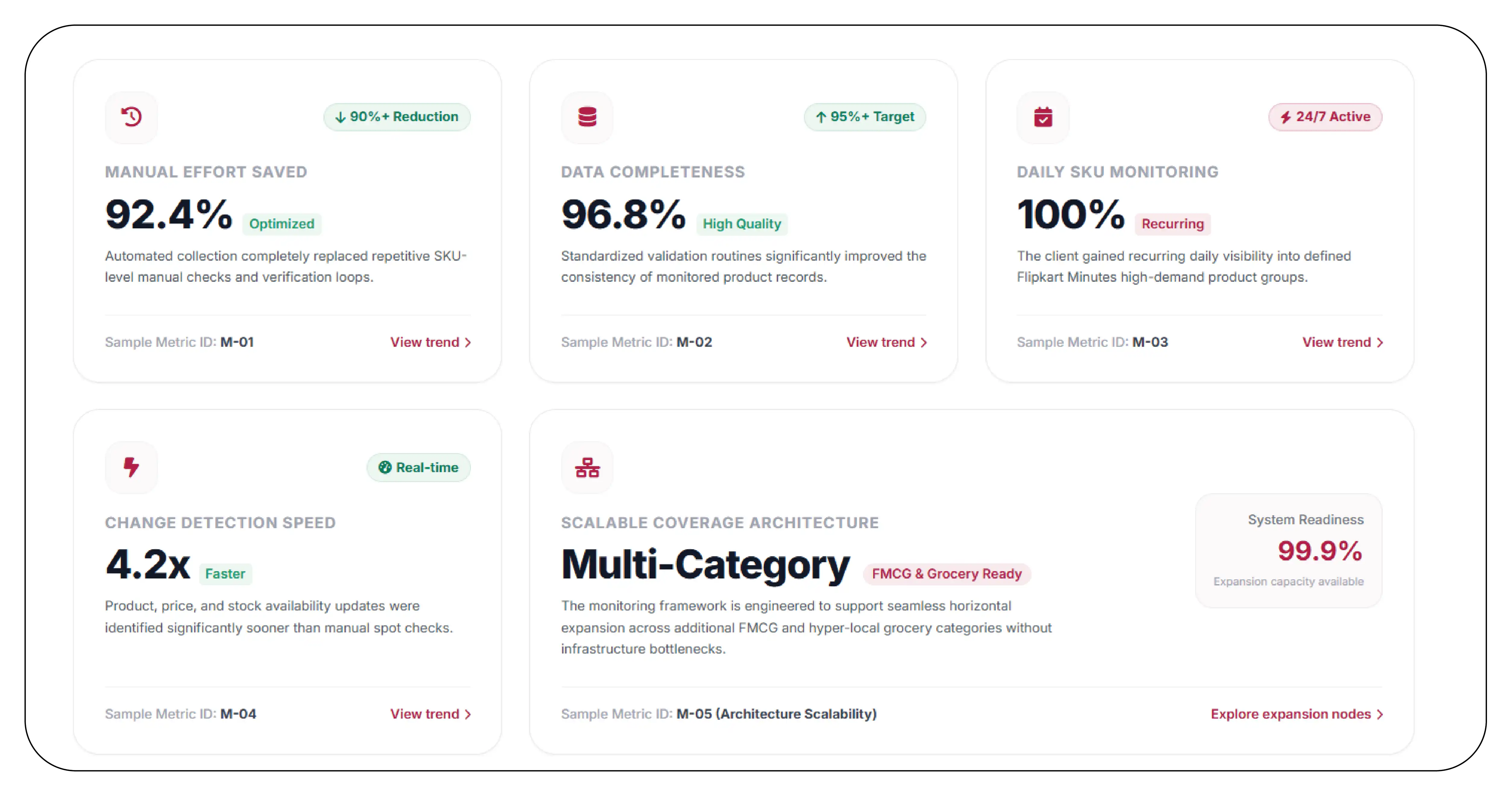
The following project metrics are illustrative performance targets/results used to demonstrate the solution framework and are not confidential client disclosures.
90%+ reduction in manual monitoring effort: Automated collection replaced repetitive SKU-level checks.
95%+ data completeness: Standardized validation improved the consistency of monitored product records.
Daily SKU monitoring: The client gained recurring visibility into defined Flipkart Minutes product groups.
Faster change detection: Product, price, and availability changes could be identified much sooner than through periodic manual checks.
Scalable coverage: The monitoring architecture could support expansion across additional FMCG and grocery categories.
Results Narrative
The implementation changed the client's monitoring process from a manual, spreadsheet-heavy workflow into an automated data operation. Instead of repeatedly searching for products, business teams could work with structured records containing product, pricing, and availability information.
The ability to Monitor Flipkart Minutes Daily SKU Data improved operational visibility and helped teams identify changes more efficiently. The solution also created a historical foundation for comparing SKU performance over time.
By combining automation with structured delivery, the project delivered a repeatable framework for marketplace intelligence. Flipkart Minutes SKU-based Data Scraping became an ongoing data capability rather than a one-time collection exercise.
What Made Product Data Scrape Different
Product Data Scrape approached the project as a data-engineering and intelligence challenge rather than simply a scraping assignment. The framework combined automated collection, SKU-level organization, normalization, validation, recurring scheduling, and analytics-ready delivery. By integrating the Flipkart Product Data API, the solution also enabled structured access to product information that could support automated monitoring and downstream analytics.
The solution was designed to handle changing product catalogs while preserving consistency across repeated collection cycles. Automated workflows reduced repetitive human intervention and created a more dependable process for large SKU portfolios.
A key differentiator was the ability to create a scalable monitoring architecture rather than deliver isolated datasets. Flipkart Scraping at Scale allowed the client to extend its monitoring universe as product categories and business requirements expanded.
The resulting framework provided a foundation for product intelligence, availability monitoring, pricing analysis, and competitive research while keeping the output structured for downstream dashboards and analytics.
Client's Testimonial
"Product Data Scrape helped us move from manual marketplace checks to a structured SKU monitoring workflow. The automated process gave our team much better visibility into products, pricing, and availability across Flipkart Minutes. We can now work with refreshed data instead of spending significant time collecting and organizing marketplace information manually. The SKU-level approach was particularly valuable because our product portfolio spans multiple grocery and FMCG categories. The solution has also created a scalable foundation for expanding our monitoring requirements as quick commerce continues to grow."
— Head of E-Commerce & Marketplace Intelligence, Consumer FMCG Brand
Conclusion
Quick-commerce competition requires brands to monitor products with greater frequency, accuracy, and scalability. For the client, moving beyond manual marketplace checks created a more efficient way to understand SKU availability, pricing, assortment, and product-level changes.
Through Flipkart product data scraping, Product Data Scrape created an automated and structured monitoring framework that supported recurring marketplace intelligence. The broader Flipkart Minutes SKU-based Data Scraping solution helped transform raw product information into usable business data.
The framework can also be expanded across grocery, FMCG, personal care, beverages, household essentials, and other product categories.
Want to automate SKU-level marketplace monitoring? Partner with Product Data Scrape to build scalable product, pricing, and availability datasets from Flipkart Minutes!
FAQs
1. What type of Flipkart Minutes data can be collected?
A structured dataset can include product names, SKU or product identifiers, categories, brands, pack sizes, prices, discounts, availability, product URLs, and other publicly accessible product attributes. The exact fields depend on the source structure and project requirements.
2. Why is SKU-level monitoring important for FMCG brands?
SKU-level monitoring allows brands to track individual products rather than relying only on category-level information. It can reveal changes in pricing, availability, assortment, pack sizes, and product visibility.
3. How can automated monitoring improve marketplace intelligence?
Automation reduces repetitive manual checks and enables recurring collection. Businesses can then compare current records with historical datasets to identify product, price, and availability changes more efficiently.
4. Can the data be integrated with business dashboards?
Yes. Structured datasets can be prepared for analytics environments, databases, spreadsheets, APIs, or dashboards depending on the client's technical requirements. This allows business teams to combine marketplace data with internal sales and inventory information.
5. Can the solution scale beyond grocery products?
Yes. The framework can be extended to categories such as FMCG, beverages, personal care, household essentials, packaged foods, and other relevant product groups. The SKU-based architecture makes it easier to expand monitoring as the product portfolio grows.


 Singapore
 EMAIL
EMAIL
 PHONE
PHONE











.webp)