Introduction
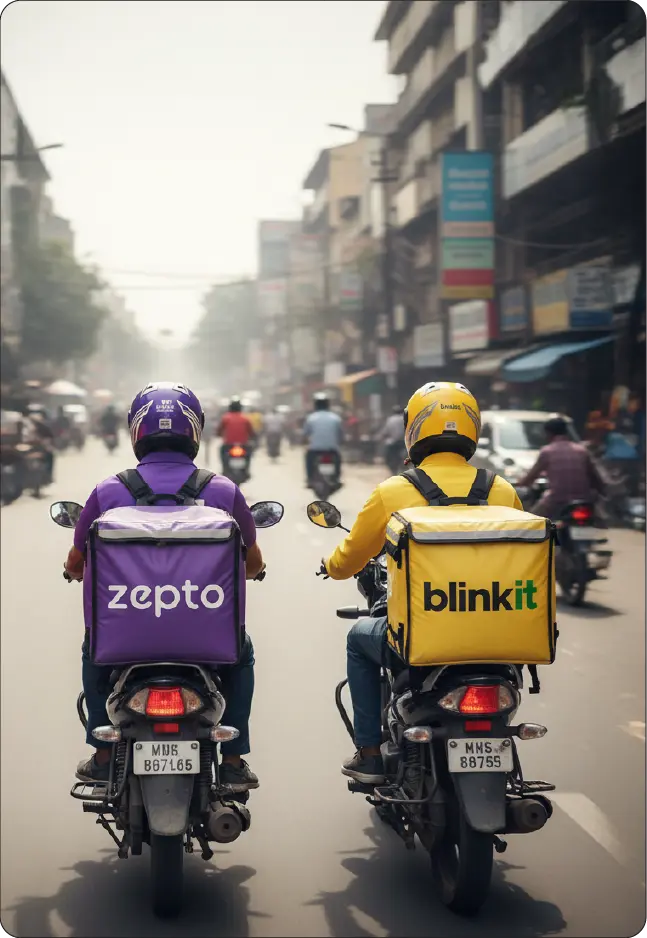
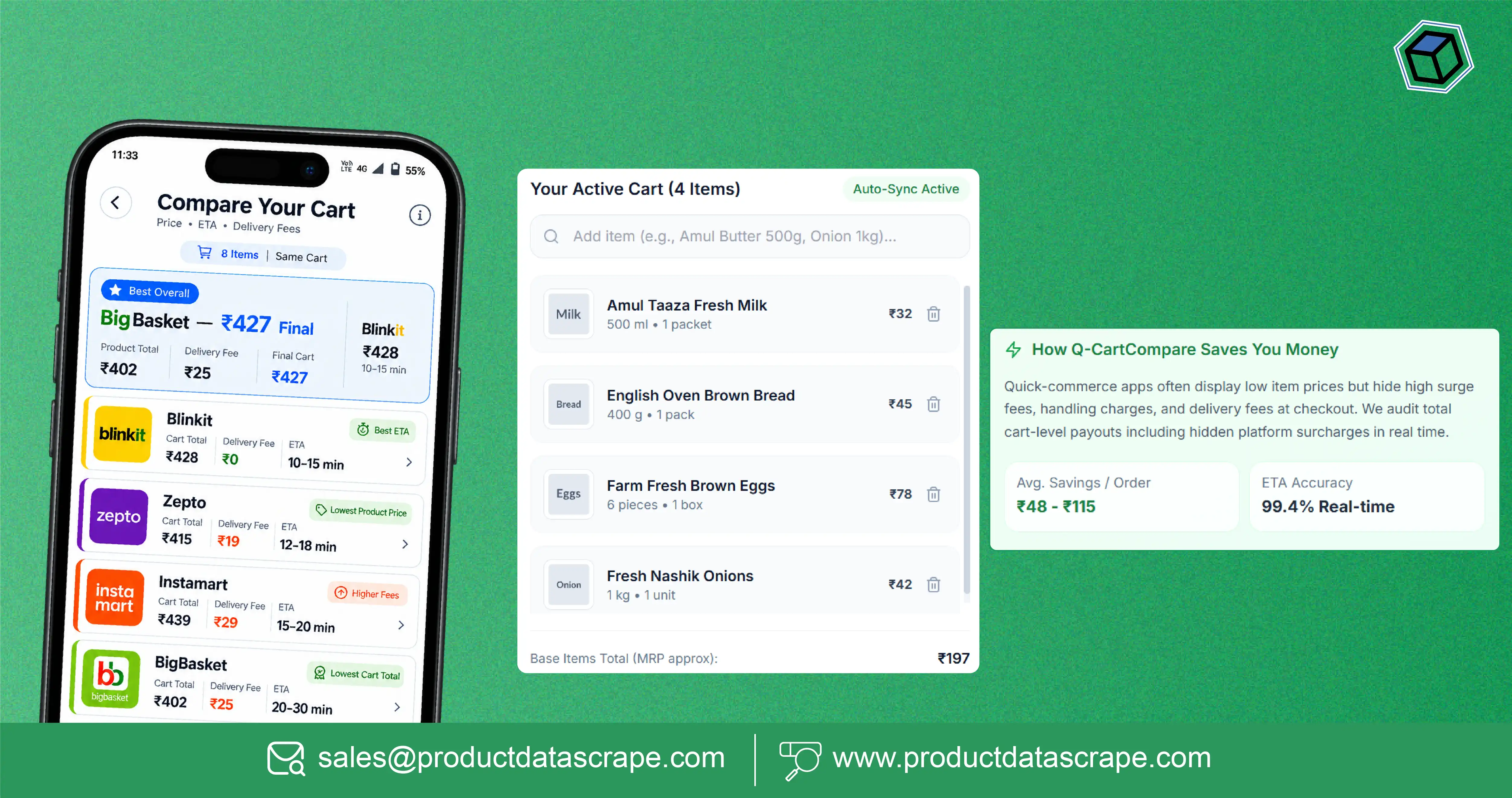
A Quick-commerce cart-comparison app helps shoppers and businesses compare the complete checkout cost instead of just product prices. It analyzes cart-level pricing, delivery ETA, handling charges, platform fees, and surge fees across Blinkit, Zepto, Instamart, and BigBasket. This enables consumers to save money while helping retailers and analytics companies improve pricing strategies through Q-Commerce Price Intelligence.
Industry Insight: India's quick-commerce market is projected to surpass $9–10 billion by 2026, with average delivery times dropping below 15 minutes in major cities. At the same time, hidden platform and delivery charges have become one of the biggest reasons for cart abandonment, making transparent price comparison increasingly valuable.
Target Audience: Grocery retailers, FMCG brands, pricing analysts, market researchers, shopping comparison platforms, and retail intelligence companies.
Pain Point Solved:
- Hidden delivery and platform fees
- Different ETAs for identical carts
- Cart-level price differences
- Limited visibility into competitor pricing
- Lack of real-time pricing intelligence
Online grocery shopping has evolved beyond simply finding the lowest product price. Today's consumers compare the final checkout amount, expected delivery time, convenience fees, and promotional offers before placing an order. A small difference in handling fees or surge pricing can change which platform offers the best value.
This is where a Quick-commerce cart-comparison app creates a better shopping experience. Instead of manually checking multiple applications, shoppers can compare identical carts across Blinkit, Zepto, Instamart, and BigBasket in real time. The comparison includes product prices, estimated delivery times, delivery charges, handling costs, platform fees, and promotional discounts.
For businesses, these insights support Q-Commerce Price Intelligence, enabling retailers, FMCG brands, and pricing teams to understand competitor pricing strategies, optimize promotions, monitor market trends, and improve customer retention. Real-time grocery data also helps analysts measure pricing consistency across cities, identify seasonal fluctuations, and evaluate operational efficiency.
As quick commerce continues expanding, accurate pricing intelligence is becoming essential for both consumers and businesses. Reliable comparison data allows companies to improve profitability while helping shoppers make faster and more informed purchasing decisions.
How Can Businesses Monitor Complete Checkout Costs Instead of Product Prices?
Most retailers already monitor individual product prices. However, customers make buying decisions based on the final amount displayed at checkout. Delivery charges, handling fees, platform fees, taxes, discounts, and surge pricing collectively determine the actual purchase cost.
Businesses therefore require complete cart visibility instead of isolated SKU monitoring. This is where Quick Commerce Delivery Fee Analysis becomes valuable. By combining it with Grocery data scraping, organizations can capture every pricing component across competing quick-commerce platforms and understand why identical carts produce different final totals.
Retailers can monitor:
- Product-level pricing changes
- Delivery fee fluctuations
- Platform fee adjustments
- Handling charges
- Peak-hour surge pricing
- Coupon effectiveness
- Cart-level promotional discounts
- Final checkout value
- Delivery promise accuracy
Instead of reacting after customers switch platforms, companies can proactively adjust pricing strategies using competitive intelligence.
Sample Industry Trends (2020–2026)
| Year |
Avg. Delivery Fee (₹) |
Avg. Platform Fee (₹) |
Avg. ETA (Minutes) |
| 2020 |
12 |
0 |
35 |
| 2021 |
18 |
2 |
28 |
| 2022 |
22 |
3 |
22 |
| 2023 |
28 |
5 |
18 |
| 2024 |
32 |
7 |
15 |
| 2025* |
35 |
8 |
13 |
| 2026* |
38 |
10 |
10 |
*Projected industry estimates.
These trends demonstrate that while delivery speeds continue improving, additional checkout charges have steadily increased. Organizations using Product Data Scrape can monitor these pricing changes across competitors, identify regional pricing variations, and build data-driven pricing strategies that improve customer satisfaction while protecting margins.
How Does Faster Delivery Influence Customer Purchase Decisions?
Consumers increasingly expect groceries to arrive within minutes. However, the fastest delivery option is not always the most affordable. Delivery speed often changes alongside platform fees, surge pricing, and promotional discounts. Businesses that understand this relationship can optimize both pricing and customer experience.
This is where Quick Commerce ETA Price Benchmarking becomes essential. By continuously tracking delivery promises across Blinkit, Zepto, Instamart, and BigBasket, businesses can identify which platform consistently offers the fastest service at the most competitive total cart value. Comparing ETA alongside pricing helps retailers determine whether customers are paying more for convenience or receiving genuine value.
For grocery retailers and FMCG brands, ETA benchmarking supports several strategic decisions:
- Measure delivery performance across cities.
- Compare promised versus actual delivery windows.
- Identify peak-hour delays.
- Evaluate premium delivery pricing.
- Optimize promotional campaigns based on delivery speed.
- Improve customer satisfaction and retention.
When combined with real-time pricing intelligence, ETA analysis reveals how delivery speed affects customer purchasing behavior. A retailer offering a slightly higher product price but significantly faster delivery may achieve higher conversion rates than competitors with lower prices but slower fulfillment.
ETA Trends Across Quick-Commerce Platforms (2020–2026)
| Year |
Avg. ETA (Minutes) |
Orders Delivered Under 15 Minutes |
Customer Satisfaction (%) |
| 2020 |
35 |
8% |
74% |
| 2021 |
28 |
18% |
78% |
| 2022 |
22 |
34% |
82% |
| 2023 |
18 |
57% |
86% |
| 2024 |
15 |
71% |
89% |
| 2025* |
13 |
81% |
91% |
| 2026* |
10 |
89% |
93% |
*Projected industry estimates.
The data highlights a clear industry trend. Delivery promises continue improving while customer expectations grow. Retailers that benchmark ETA against pricing gain a competitive advantage by balancing speed, operational efficiency, and profitability.
Why Is Comparing the Final Checkout Amount More Valuable Than Comparing Individual Product Prices?
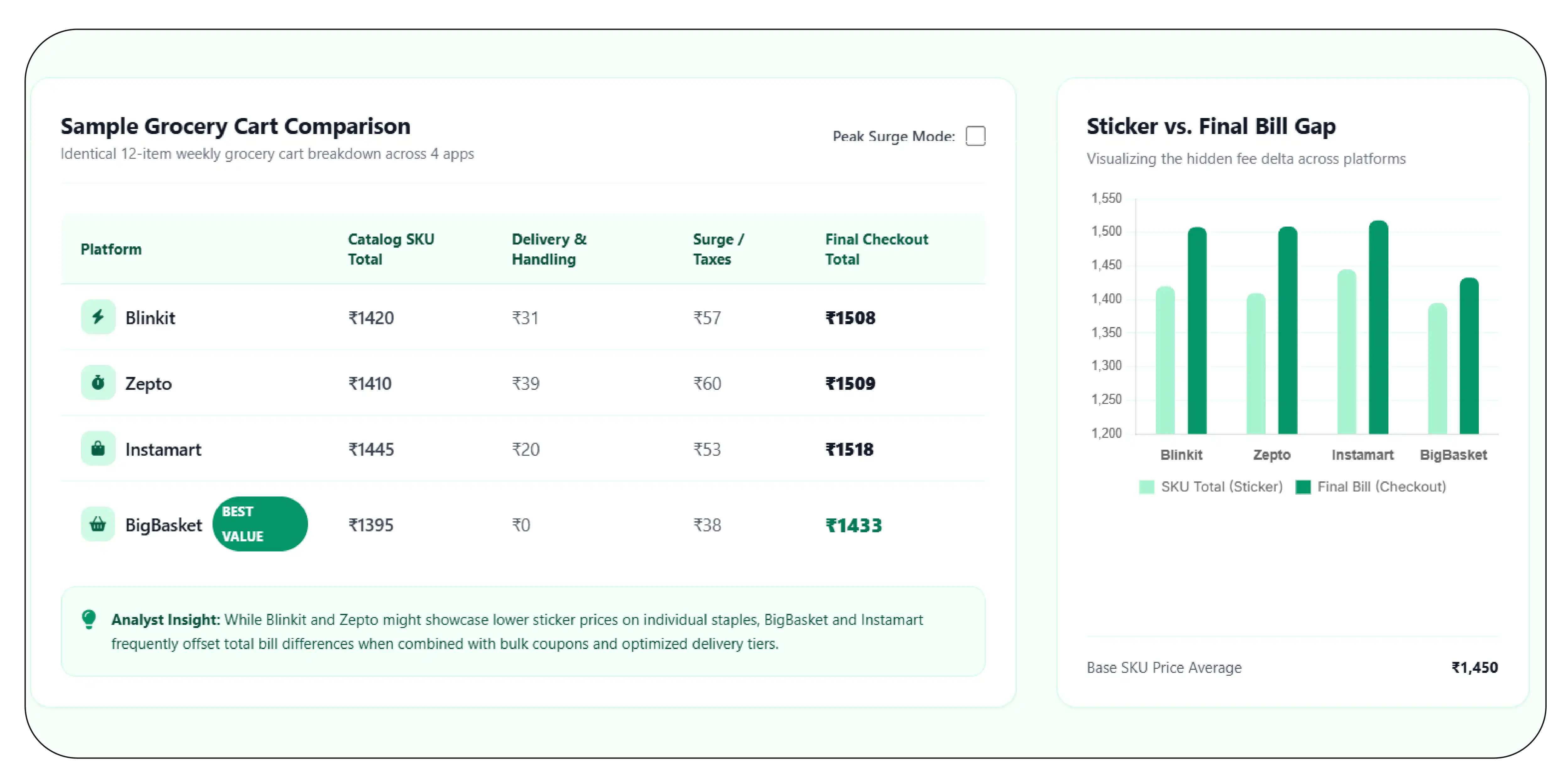
Many shoppers believe they are choosing the cheapest platform because individual products appear less expensive. In reality, the final bill often changes after delivery charges, handling fees, platform fees, taxes, and surge pricing are added. This is why Grocery Delivery Cost Comparison is becoming more important than simple product price tracking.
A cart containing identical grocery items can produce very different checkout totals across Blinkit, Zepto, Instamart, and BigBasket. For retailers and market analysts, understanding these differences provides valuable insight into pricing strategies, promotional effectiveness, and customer acquisition tactics.
Businesses benefit by tracking:
- Complete cart totals instead of SKU prices.
- Hidden delivery and convenience charges.
- Regional pricing variations.
- Dynamic fee changes during peak demand.
- Discount and coupon effectiveness.
- Seasonal promotional campaigns.
- Customer savings opportunities.
Analyzing complete checkout costs also enables businesses to forecast pricing trends and improve competitive positioning. Instead of reacting to isolated product price changes, organizations gain a holistic understanding of customer spending patterns and platform profitability.
Sample Cart Cost Comparison Trends (2020–2026)
| Year |
Avg. Cart Value (₹) |
Hidden Fees (%) |
Avg. Savings Through Cart Comparison (%) |
| 2020 |
720 |
3% |
2% |
| 2021 |
780 |
4% |
3% |
| 2022 |
860 |
5% |
5% |
| 2023 |
930 |
6% |
7% |
| 2024 |
1,020 |
8% |
9% |
| 2025* |
1,090 |
9% |
11% |
| 2026* |
1,180 |
10% |
13% |
*Projected industry estimates.
These figures demonstrate that total checkout costs have increased steadily due to additional fees, even when product prices remain competitive. Businesses that analyze cart-level pricing can better understand consumer purchasing behavior, improve promotional planning, and create more transparent shopping experiences that encourage long-term customer loyalty.
How Can Retailers Stay Competitive When Instant Pricing Changes Every Minute?
Quick-commerce platforms constantly adjust prices based on demand, inventory availability, promotions, and customer location. A product that is affordable in the morning may cost significantly more during evening peak hours. Retailers and FMCG brands need continuous monitoring to understand these fluctuations and respond before losing customers.
This is where Instant Delivery Price Comparison helps businesses make smarter pricing decisions. Instead of tracking only a handful of products, organizations can compare thousands of SKUs, complete shopping carts, promotional discounts, and checkout charges across Blinkit, Zepto, Instamart, and BigBasket. Real-time insights reveal which competitor is leading on price, where surge pricing occurs, and how discounts influence customer purchasing behavior.
Businesses can leverage instant pricing intelligence to:
- Monitor competitor pricing throughout the day.
- Detect surge pricing during peak demand.
- Compare promotional campaigns across platforms.
- Analyze category-level price fluctuations.
- Improve dynamic pricing strategies.
- Forecast demand using historical pricing data.
- Optimize promotional investments.
- Reduce customer churn caused by higher checkout costs.
Instead of reacting after competitors change prices, retailers can proactively adjust offers to maintain competitiveness while protecting margins. Continuous monitoring also enables better inventory planning and improves promotional effectiveness across multiple locations.
Instant Pricing Trends (2020–2026)
| Year |
Daily Price Changes |
Avg. Discount Events/Month |
Surge Pricing Frequency |
| 2020 |
5 |
12 |
Low |
| 2021 |
8 |
18 |
Moderate |
| 2022 |
12 |
24 |
Moderate |
| 2023 |
18 |
33 |
High |
| 2024 |
24 |
42 |
High |
| 2025* |
29 |
50 |
Very High |
| 2026* |
35 |
58 |
Very High |
*Projected industry estimates.
The data indicates that pricing has become increasingly dynamic. Businesses equipped with real-time comparison insights can react faster to market changes and improve pricing accuracy.
Why Should Businesses Benchmark Delivery Performance Across Multiple Apps?
Consumers often choose the platform that delivers the fastest without significantly increasing the total checkout cost. Delivery speed has become a key differentiator in quick commerce, making ETA comparison across grocery delivery apps essential for retailers seeking to improve customer satisfaction.
Comparing ETA across Blinkit, Zepto, Instamart, and BigBasket provides valuable operational intelligence. Businesses can identify regional delivery strengths, monitor service consistency, evaluate peak-hour performance, and understand how delivery promises influence conversion rates.
Key advantages include:
- Compare city-wise delivery performance.
- Track delivery promise consistency.
- Measure actual versus estimated arrival times.
- Identify service gaps during busy hours.
- Optimize warehouse locations.
- Improve last-mile logistics.
- Reduce customer complaints.
- Increase repeat purchases through better delivery experiences.
When ETA insights are combined with cart-level pricing analysis, businesses gain a complete picture of customer decision-making. Faster delivery alone does not guarantee success if checkout costs remain significantly higher than competitors. The most successful retailers balance competitive pricing with reliable fulfillment.
Delivery Performance Trends (2020–2026)
| Year |
Avg. ETA (Minutes) |
On-Time Deliveries (%) |
Repeat Purchase Rate (%) |
| 2020 |
34 |
76% |
52% |
| 2021 |
27 |
81% |
58% |
| 2022 |
22 |
86% |
63% |
| 2023 |
18 |
90% |
69% |
| 2024 |
15 |
93% |
74% |
| 2025* |
13 |
95% |
79% |
| 2026* |
10 |
97% |
84% |
*Projected industry estimates.
Organizations that continuously benchmark delivery performance can improve operational efficiency while strengthening customer loyalty through consistent service quality.
What Makes Complete Market Visibility Essential for Smarter Shopping Decisions?
Consumers no longer compare only product prices. They evaluate total checkout costs, delivery speed, platform fees, and available discounts before placing an order. Modern Price Comparison Websites provide valuable transparency, but integrating a Quick-commerce cart-comparison app delivers a much deeper view by comparing identical carts across multiple quick-commerce platforms in real time.
For retailers, analytics companies, and FMCG brands, complete market visibility enables better pricing decisions and more effective promotional strategies. Businesses can identify pricing trends, monitor competitor campaigns, and understand how checkout costs influence buying behavior.
Comprehensive comparison solutions help organizations:
- Compare complete cart totals.
- Monitor hidden checkout charges.
- Analyze promotional effectiveness.
- Evaluate regional pricing strategies.
- Track competitor discounts.
- Measure delivery fee trends.
- Improve pricing transparency.
- Support customer-focused pricing decisions.
These insights enable businesses to move beyond simple SKU monitoring and understand the complete customer journey from product selection to checkout. Better visibility leads to improved pricing strategies, stronger customer retention, and increased profitability.
Market Comparison Adoption (2020–2026)
| Year |
Consumers Comparing Multiple Apps |
Avg. Monthly Cart Comparisons |
Businesses Using Pricing Intelligence |
| 2020 |
18% |
4 |
14% |
| 2021 |
27% |
7 |
21% |
| 2022 |
39% |
11 |
33% |
| 2023 |
51% |
16 |
47% |
| 2024 |
64% |
22 |
59% |
| 2025* |
72% |
29 |
68% |
| 2026* |
81% |
36 |
77% |
*Projected industry estimates.
As quick commerce continues expanding, organizations that leverage advanced comparison intelligence are better positioned to deliver transparent pricing, competitive offers, and superior customer experiences in an increasingly dynamic market.
Why Choose Product Data Scrape?
Businesses need accurate and timely data to stay ahead in the fast-moving quick-commerce market. Product Data Scrape delivers reliable retail intelligence by collecting pricing, inventory, delivery charges, ETAs, promotions, and checkout costs from leading grocery platforms. Whether you want to Track every deal or build a smarter Quick-commerce cart-comparison app, our scalable data solutions provide structured, real-time insights for competitive benchmarking, dynamic pricing, and market analysis. With automated data collection, customizable datasets, and high-quality APIs, organizations can make faster decisions, improve customer experiences, and respond confidently to changing market conditions.
Conclusion
A transparent shopping experience begins with complete visibility into cart-level pricing, delivery speed, and hidden checkout charges. Businesses and consumers alike benefit from Quick commerce & FMCG data that reveals real-time market trends and enables smarter purchasing decisions. A Quick-commerce cart-comparison app simplifies comparisons across Blinkit, Zepto, Instamart, and BigBasket by bringing every cost component together in one place.
Ready to power your pricing intelligence with Product Data Scrape? Contact our experts today to build scalable quick-commerce data solutions that help you compare carts, monitor competitors, and deliver better value to every customer!
FAQs
1. What is a quick-commerce cart comparison solution?
A quick-commerce cart comparison solution compares complete checkout values, including product prices, delivery charges, handling fees, platform fees, discounts, and ETAs across multiple grocery delivery platforms for smarter purchasing decisions.
2. Why is cart-level pricing more useful than product-level pricing?
Cart-level pricing reflects the actual amount customers pay after adding delivery fees, handling charges, taxes, platform fees, and promotional discounts, providing a more accurate basis for comparison.
3. How can businesses benefit from quick-commerce pricing intelligence?
Businesses gain visibility into competitor pricing, delivery performance, promotional campaigns, and checkout costs, helping improve pricing strategies, customer retention, and overall operational efficiency.
4. How does Product Data Scrape support quick-commerce analytics?
Product Data Scrape provides structured datasets and APIs that capture pricing, ETAs, promotions, inventory availability, and checkout charges, enabling businesses to monitor competitors and make data-driven decisions.
5. Which metrics should businesses monitor across grocery delivery platforms?
Key metrics include cart value, delivery charges, platform fees, handling costs, ETAs, discount effectiveness, surge pricing, inventory availability, customer savings, and regional pricing trends to optimize competitive strategies.


 Singapore
 EMAIL
EMAIL
 PHONE
PHONE


.webp "thumb")








.webp)