The Client
A gifting brand and retailer — hampers, personalised gifts, decor, and seasonal gift sets — whose year concentrated heavily into festive windows. Getting the right gift categories stocked and merchandised ahead of each festival was the difference between the season the business depended on and a warehouse of unsold gifts.
Client details are anonymised. Figures are representative of the engagement.
The Problem: Festive Peaks That Arrived Faster Than the Planning
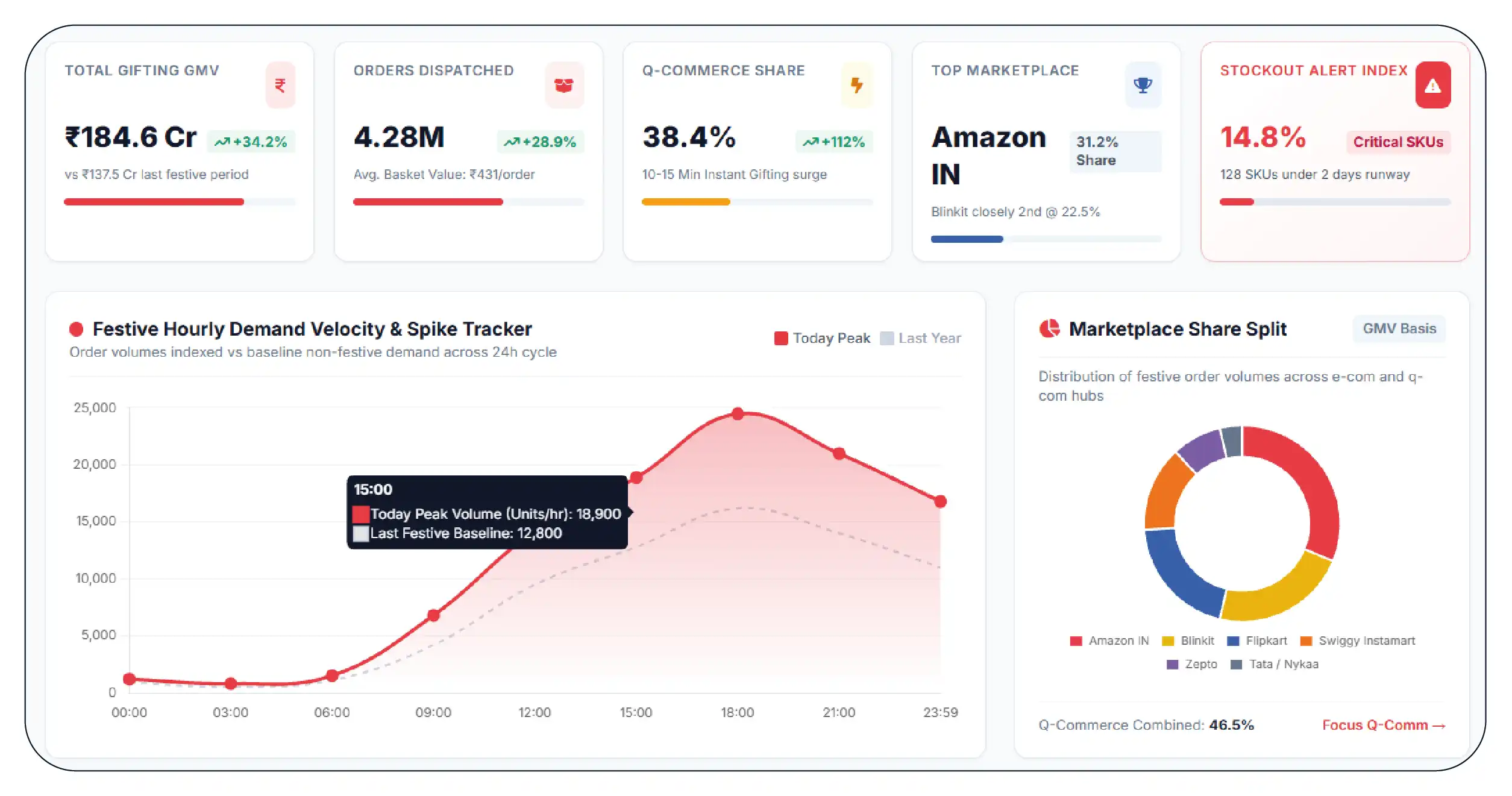
The brand's revenue concentrated into short, intense festive windows, and its planning couldn't keep pace with how fast those windows moved.
Each festive season, certain gift categories would surge — a personalised-gift format, a hamper type, a decor trend, a price point — and demand would build and peak within a compressed window. The brand planned from the previous year's festive sales, which meant it was always calibrated to last year's winners and blind to this year's shifts. When a category surged, the brand often under-stocked it because last year it hadn't been the winner; when a category faded, the brand over-stocked it on last year's success and marked it down after the festival, when gifting demand collapses to near zero.
The planning was backward-looking in a category where every season is a little different, and the peaks arrived faster than a rear-view mirror could react to.
The merchandising lead's summary: we plan every festive season from last festive season, and every year the winners are a bit different. We're always slightly stocked for the wrong festival.
Why Last Year's Festive Sales Failed as a Plan
Historical festive planning has a specific weakness in a shifting seasonal category.
Own sales reflect last year's assortment, not this year's demand. The brand's festive numbers show what it stocked and sold last year — under-weighting categories it under-stocked and over-weighting last year's momentum. It's a mirror of past decisions, not a forecast of current demand.
Festive shifts appear in the current season, early. The signals that this festival differs from last — which gift categories are accelerating, which price points are concentrating — appear in the current market as the season builds, not in a year-old report.
The window is short and post-peak demand collapses. Gifting demand spikes and then falls off a cliff after the festival. Detecting a surge too late means missing the entire window, and over-stocking means markdowns into a category that's suddenly dead.
Lead times demand early decisions. Sourcing and merchandising festive assortment takes time; the decisions have to be made on early signals, ahead of the peak.
The Solution: Cross-Marketplace Festive Gifting Demand Tracking
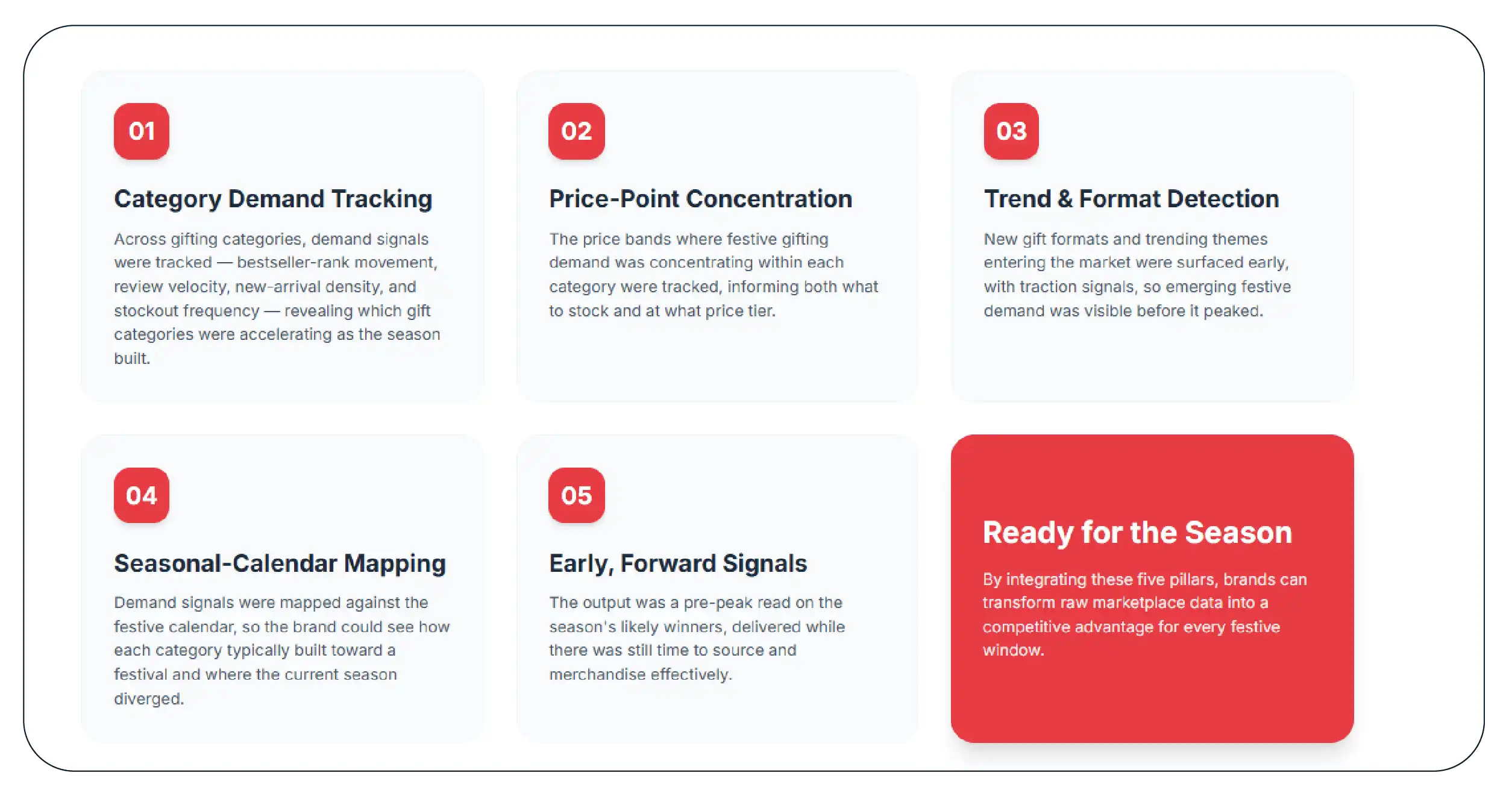
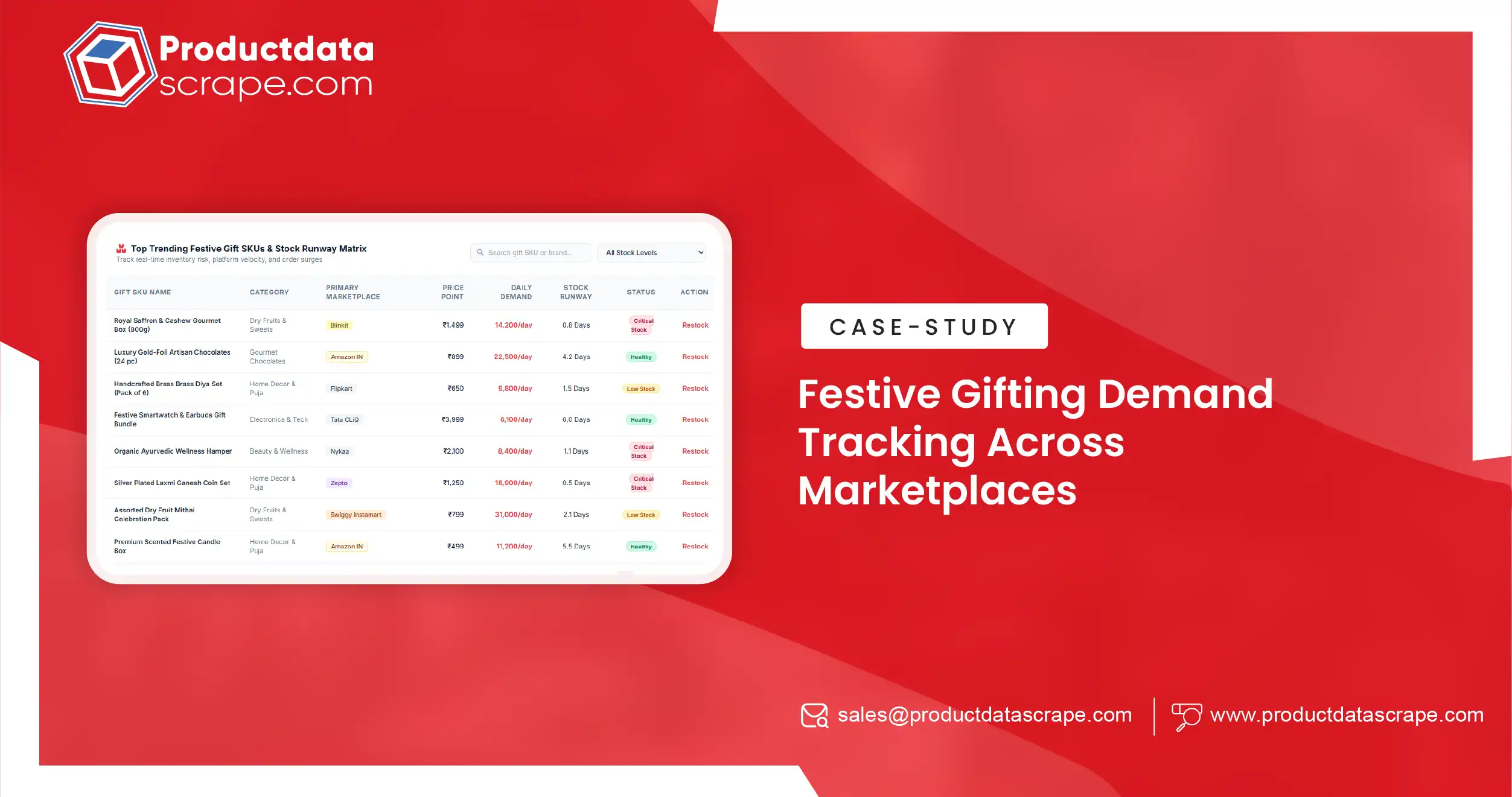
Product Data Scrape built festive gifting demand tracking across marketplaces — an early, forward read on where festive gifting demand was heading each season.
- Category demand tracking. Across gifting categories, demand signals were tracked over time — bestseller-rank movement, review velocity, new-arrival density, and stockout frequency — revealing which gift categories were accelerating as the season built.
- Price-point concentration. The price bands where festive gifting demand was concentrating within each category were tracked, informing both what to stock and at what price tier.
- Trend and format detection. New gift formats and trending themes entering the market were surfaced early, with traction signals, so emerging festive demand was visible before it peaked.
- Seasonal-calendar mapping. Demand signals were mapped against the festive calendar, so the brand could see how each category typically built toward a festival and where the current season diverged.
- Early, forward signals. The output was a pre-peak read on the season's likely winners, delivered while there was still time to source and merchandise.
Sample Data: Festive Category Momentum, Early
An illustrative pre-peak festive demand read by category.
| Gift Category |
Rank Trend |
Review Velocity |
New Arrivals |
Demand Price Band |
Verdict |
| Personalised photo gifts |
Surging |
High |
Many |
599–1,499 |
Stock up early |
| Premium dry-fruit hampers |
Rising |
Medium |
Some |
999–2,499 |
Stock up |
| Traditional sweets boxes |
Stable |
Low |
Few |
499–999 |
Stock normally |
| Generic decor items |
Falling |
Low |
Few |
299–799 |
Reduce |
| Scented candle sets |
Rising |
High |
Many |
699–1,799 |
Stock up |
Illustrative.
The structured record:
{
  "gift_category": "personalised_photo_gifts",
  "captured_window": "pre_festive_2026",
  "signals": {
    "bestseller_rank_trend": "surging",
    "review_velocity": "high",
    "new_arrival_density": "high",
    "stockout_frequency": "rising",
    "demand_price_band": [599, 1499]
  },
  "seasonal_context": "accelerating earlier than last year",
  "recommended_action": "stock_up_early",
  "confidence": "high"
}
The forward signal the brand had never had: personalised photo gifts and scented candle sets were surging early across the market — rising ranks, high review velocity, dense new arrivals, rising stockouts — well before the festive peak, while generic decor (which the brand had over-stocked last year) was clearly fading. Demand was concentrating in specific price bands, telling the brand not just which categories to back but where to price them.
What the Brand Did
Stocked the surging categories ahead of the peak. Categories the pre-peak read showed accelerating — personalised photo gifts, scented candle sets — were sourced and merchandised early, ahead of the festive peak, rather than chasing them mid-season.
Cut the fading categories. Categories the data showed fading — generic decor — were reduced despite last year's momentum, avoiding the post-festival markdown into dead demand.
Priced to the demand band. Festive stock was priced into the bands where demand was concentrating, guided by the data rather than last year's price sheet.
Merchandised on a forward view. Festive planning shifted from "last year's winners" to "this season's accelerating categories," with own history as one input among several.
The Results (One Festive Season)
| Metric |
Before |
After One Season |
| Planning basis |
Last year's festive sales |
Forward market demand data |
| Surging categories stocked ahead of peak |
Rarely |
Consistently |
| Under-stocking on this year's winners |
Common |
Sharply reduced |
| Post-festival markdown on faded categories |
High |
Materially lower |
| Full-price festive sell-through, indexed |
100 |
134 |
| Festive-season margin, indexed |
100 |
125 |
Figures are representative of the engagement outcome.
The merchandising lead's follow-up: we stopped planning for last year's festival. The market shows you which gifts are surging before your own sales do — we just started stocking the winners early instead of chasing them.
The Lesson
In a category that lives and dies by short festive windows, planning from last year's festive sales guarantees you're calibrated to last year's winners — and every season is a little different, so you under-stock this year's surges and over-stock last year's fades. The signals that this festival differs from last live in the current market, appear early enough to source on, and are exactly what a rear-view mirror can't see.
Festive gifting demand tracking didn't make the brand a better guesser. It gave it a forward, cross-marketplace read on which gift categories were accelerating and which were fading, ahead of the peak, so it could stock the winners early and cut the fades — the two decisions that decide a festive season, both of which last year's numbers get wrong.
Work With Product Data Scrape
Product Data Scrape delivers festive gifting demand tracking across marketplaces: category demand tracking, price-point concentration, trend and format detection, and seasonal-calendar mapping — as JSON, CSV, API, or dashboard-ready feeds, ahead of each festive window.
Ask us for a pre-peak festive demand read on your categories — we will show you which gifts are surging before your own sales do.
Product Data Scrape — turning marketplace complexity into decision-ready data.


 Singapore
 EMAIL
EMAIL
 PHONE
PHONE













.webp)