Introduction
E-commerce Data for AI Shopping Assistants is the foundation for accurate product discovery, pricing comparisons, personalization, and AI-led purchase decisions. In 2026, shoppers increasingly expect AI to understand intent, compare alternatives, identify deals, and recommend products using current information rather than static catalogs.
The shift is measurable. Salesforce reported in July 2026 that agentic search as the first step in the shopping journey grew 200% year over year, while 86% of commerce leaders said LLMs will be essential to product discovery within the next year. Adobe also found that 43% of marketers and business owners were already optimizing for AI-driven product search, while another 26% planned to do so within a year.
For retailers, marketplaces, brands, and AI shopping platforms, the central problem is therefore not simply building an intelligent model. The problem is supplying that model with accurate, fresh, structured, and context-rich commerce information.
AI Shelf Visibility Tracking helps solve this problem by monitoring whether products remain discoverable, available, competitively priced, and correctly represented across digital shopping environments.
How Can Shopping Agents Make Better Decisions With Live Commerce Signals?
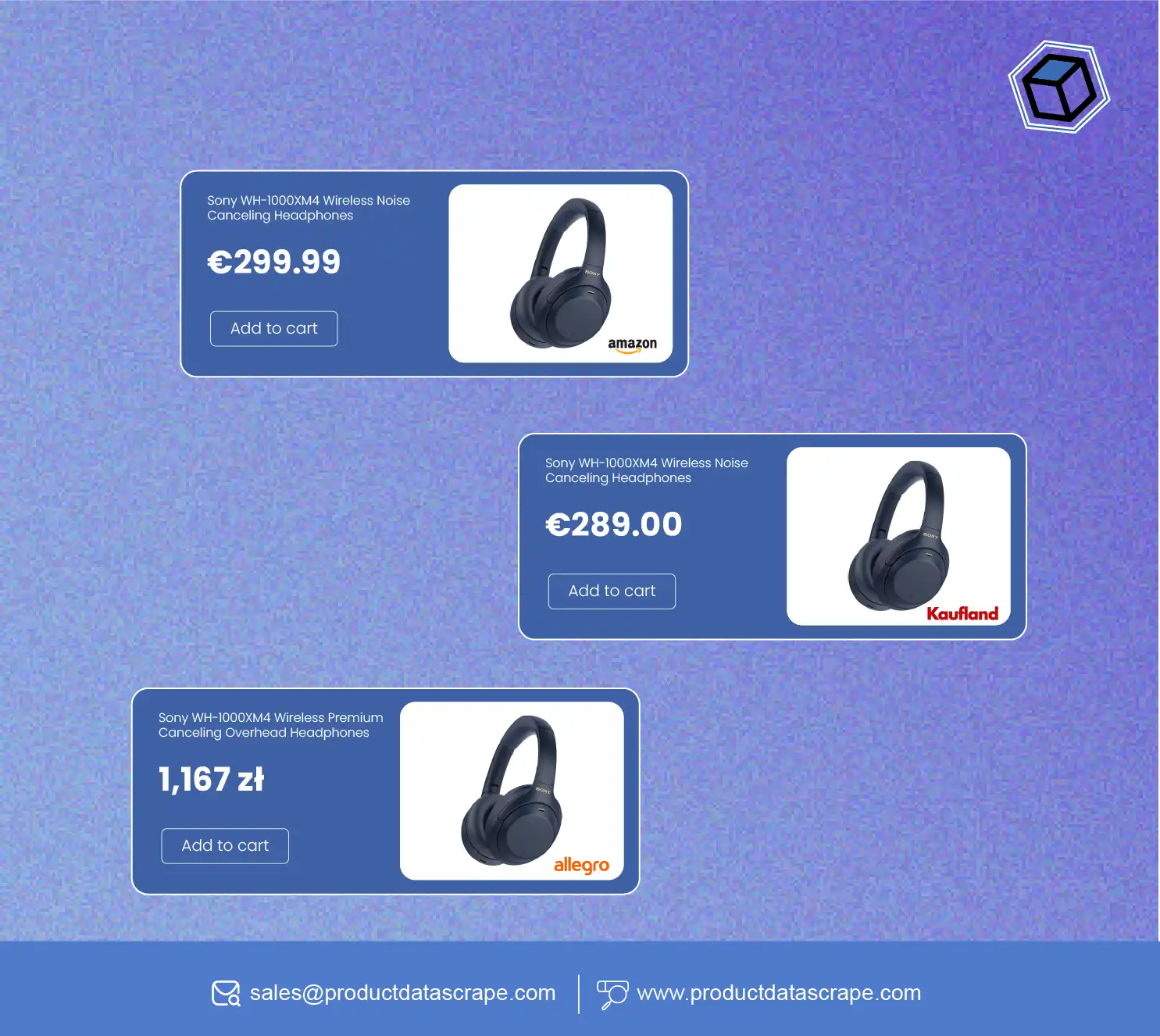
AI shopping agents need more than product descriptions. They require product attributes, prices, availability, reviews, specifications, promotions, seller information, and contextual signals to answer shopping questions reliably. product data for AI shopping agents transforms fragmented retail information into structured inputs that an agent can interpret and compare.
This becomes particularly important when shoppers ask compound questions such as "Which laptop under $1,000 has the best battery life?" or "Find the cheapest available organic coffee in my preferred pack size." An AI agent must combine product specifications, price, stock status, ratings, and potentially retailer location before generating an answer.
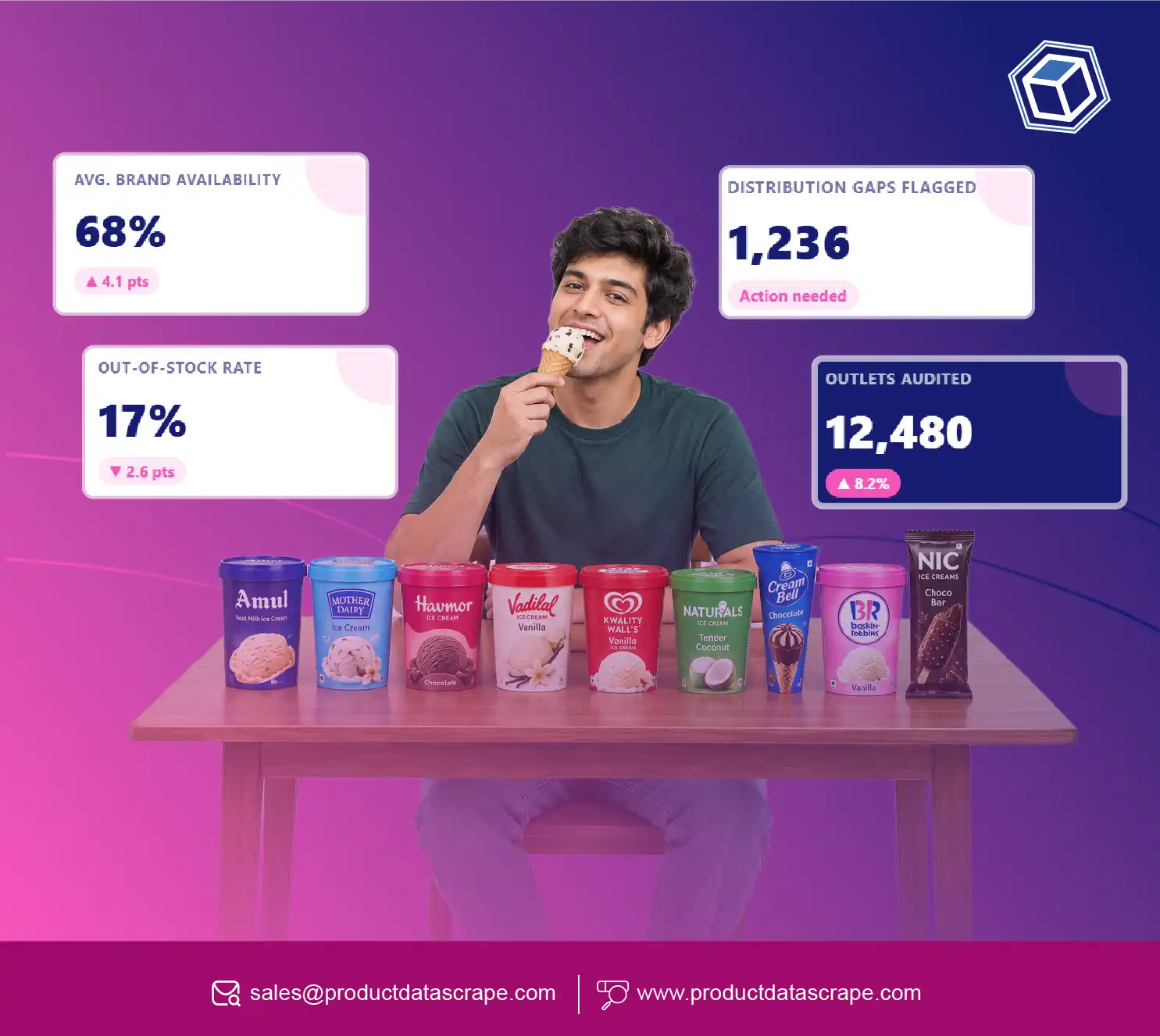
Assortment and availability monitoring adds another layer. A product recommendation is only useful if the recommended SKU is actually available. Retailers can therefore monitor whether products disappear, become out of stock, change pack sizes, or receive new variants.
| Year |
E-commerce/AI development |
Data implication |
| 2020 |
Digital shopping accelerated |
More online product information became available |
| 2021 |
Online catalogs expanded |
Larger product datasets required normalization |
| 2022 |
Generative AI development accelerated |
Structured commerce data gained importance |
| 2023 |
AI assistants became mainstream |
Product attributes became conversational inputs |
| 2024 |
Multimodal shopping expanded |
Images and specifications became more important |
| 2025 |
AI product discovery increased |
Freshness and discoverability became strategic |
| 2026 |
Agentic shopping accelerated |
Real-time product and availability signals become critical |
The table is a strategic industry timeline, not a claim that every market experienced identical adoption. Stanford's 2026 AI Index reports that organizational AI adoption reached 88% in its survey, while agent deployment remained relatively early, showing both the rapid adoption of AI and the continuing need to improve operational foundations.
For AI shopping platforms, the actionable lesson is straightforward: product data should be continuously refreshed, normalized, timestamped, and connected to availability signals before being delivered to an agent.
What Makes Commerce Information Useful to AI Shopping Assistants?
The quality of an AI shopping response depends heavily on the quality of the information supplied to the model. product data for AI shopping assistants should therefore be structured around the questions shoppers actually ask rather than simply mirroring retailer webpages.
A useful product record can contain title, brand, category, SKU, GTIN or UPC where available, description, specifications, images, price, discount, currency, seller, rating, review count, availability, delivery information, and timestamp. These attributes allow an AI system to compare products using multiple criteria simultaneously.
Salesforce describes AI shopping assistants as systems capable of helping customers browse, compare, and purchase products using natural language, with product data acting as a key knowledge source. Adobe's 2025 consumer research similarly found that 39% of consumers had used generative AI for online shopping, with research and product recommendations among the leading use cases.
| Year |
Shopper-AI capability |
Required data maturity |
| 2020 |
Keyword-based discovery |
Basic catalog data |
| 2021 |
Better filtering |
Structured attributes |
| 2022 |
Conversational experimentation |
Rich descriptions |
| 2023 |
Generative recommendations |
Contextual product data |
| 2024 |
Multimodal discovery |
Text, image, and specification data |
| 2025 |
AI-assisted comparison |
Price, review, and availability data |
| 2026 |
Agentic shopping |
Fresh, machine-readable commerce data |
The practical difference is that AI assistants can reason across fields. A conventional search engine may return products containing "running shoes," while an AI shopping agent can interpret requirements involving budget, terrain, cushioning, brand preference, size, and availability.
For businesses, this creates a new data-quality requirement. Missing specifications can produce incomplete recommendations. Stale prices can damage trust. Incorrect stock information can send shoppers toward unavailable products. AI-ready commerce information must therefore be treated as a continuously maintained business asset.
How Can Retailers Keep AI-Facing Product Information Current?
The next challenge is freshness. Track AI-ready eCommerce product data means continuously monitoring the information that AI systems use when discovering and recommending products.
Traditional catalog management often focuses on whether a product exists in a retailer's database. AI-driven commerce requires a broader perspective. Businesses need to know whether the product is correctly described, competitively priced, available, categorized accurately, and represented consistently across channels.
This matters because AI-driven product discovery is already affecting traffic patterns. Adobe reported that traffic to U.S. retail websites from generative-AI sources increased substantially, while visitors arriving from those sources demonstrated stronger engagement than visitors from conventional sources. Salesforce's 2026 data also reported that AI-chat referrals were growing rapidly and that retailers were responding by improving product content quality and submitting commerce data to AI search platforms.
| Year |
Monitoring priority |
Example business question |
| 2020 |
Product presence |
Is the SKU online? |
| 2021 |
Catalog completeness |
Are core attributes available? |
| 2022 |
Price accuracy |
Has the listed price changed? |
| 2023 |
Content quality |
Is product information sufficiently detailed? |
| 2024 |
Omnichannel consistency |
Do channels show consistent information? |
| 2025 |
AI discoverability |
Can AI systems understand the product? |
| 2026 |
Agent readiness |
Is information current enough for autonomous decisions? |
A practical monitoring system should compare new observations against historical records. Large changes in price, title, category, pack size, or availability can trigger validation rules. Timestamping each observation also enables businesses to distinguish a permanent change from a temporary promotion.
The 2026 AI trend tie-in is especially important because AI agents increasingly operate as decision-making systems rather than simple chat interfaces. Stanford's 2026 AI Index reports major gains in agent performance, although agents still fail a significant share of structured benchmark tasks. Better data quality can reduce one important source of failure: incomplete or outdated commerce information.
What Should an AI-Ready Product Dataset Contain?

An AI-ready eCommerce product dataset should be designed for machine interpretation, comparison, retrieval, and reasoning. Simply exporting a retailer's raw product pages into a spreadsheet does not automatically create an AI-ready dataset.
The dataset should combine structured fields with contextual information. Core fields can include product ID, product title, brand, category, subcategory, attributes, dimensions, package size, price, currency, promotional price, availability, seller, rating, reviews, image references, product URL, and collection timestamp.
The importance of structured product information is reflected in current AI-search trends. Adobe's research found that 50% of surveyed marketers and business owners were concerned that poor data hygiene could prevent their products from appearing in AI search results.
| Year |
Dataset evolution |
Strategic objective |
| 2020 |
Basic catalog records |
Digitize product information |
| 2021 |
Attribute enrichment |
Improve filtering |
| 2022 |
Historical snapshots |
Track changes |
| 2023 |
Semantic categorization |
Improve AI understanding |
| 2024 |
Multimodal fields |
Support text and image reasoning |
| 2025 |
Real-time signals |
Improve recommendation accuracy |
| 2026 |
Agent-ready structures |
Support autonomous shopping workflows |
A strong dataset should also preserve provenance. Each observation should identify where the information came from and when it was collected. This makes it easier to investigate incorrect recommendations and update stale information.
Normalization is equally important. Prices should retain original currency while optionally supporting standardized conversions. Weight, volume, dimensions, and pack quantities should be normalized so AI systems do not compare fundamentally different products as if they were identical.
For product comparison, entity resolution is critical. "Apple AirPods Pro 2," "AirPods Pro 2nd Generation," and retailer-specific product names may refer to the same underlying product. A well-designed dataset should support product matching while retaining retailer-specific identifiers.
How Does Availability Data Improve Agent-Led Shopping?
Price alone does not determine whether an AI recommendation is useful. product availability data for AI shopping agents helps agents determine whether a product can actually be purchased when a shopper asks for a recommendation.
Availability can include in-stock status, quantity indicators where available, regional availability, store availability, delivery windows, shipping restrictions, and product discontinuation signals. These fields can prevent an AI assistant from recommending an attractive product that cannot be delivered to the shopper.
This becomes increasingly important as AI moves from recommendation toward action. Salesforce reported in 2026 that 28% of commerce organizations were already using agentic AI, while another 44% planned to adopt it within six months. The closer AI gets to completing transactions, the more damaging stale availability information becomes.
| Year |
Availability capability |
AI-shopping impact |
| 2020 |
Online/offline status |
Basic product discovery |
| 2021 |
Stock indicators |
Better filtering |
| 2022 |
Regional inventory |
Location-aware recommendations |
| 2023 |
Delivery information |
Purchase feasibility |
| 2024 |
Channel-level availability |
Omnichannel comparison |
| 2025 |
Frequent refresh cycles |
More reliable recommendations |
| 2026 |
Agent-ready availability |
Supports autonomous purchase decisions |
A useful implementation connects availability records to timestamps and product identifiers. When the same SKU changes from available to unavailable, the system should update the AI-facing record quickly.
This also supports better personalization. A shopper asking for "a black jacket available in my size" is not asking for the best black jacket in the abstract. They are asking for an actionable recommendation. Availability, size, location, delivery, and price all become part of the recommendation context.
The business value extends beyond consumers. Retailers can identify frequently unavailable products, brands can monitor lost visibility, and marketplaces can detect assortment gaps. In this sense, availability data becomes both an AI input and a competitive intelligence signal.
How Can Training Data Improve the Next Generation of Shopping AI?
AI training datasets provide the historical and structured information needed to develop, evaluate, and improve commerce-focused AI systems. While real-time product feeds are important for current recommendations, historical datasets help models learn product relationships, category structures, attribute patterns, price behavior, and shopper-relevant distinctions.
Training datasets can include product titles, descriptions, specifications, categories, historical prices, promotions, ratings, reviews, availability records, seller information, and product relationships. Carefully prepared datasets can support tasks such as product classification, attribute extraction, entity matching, recommendation, query understanding, and retrieval.
The AI environment in 2026 makes this increasingly relevant. Stanford's 2026 AI Index reports that generative AI reached 53% adoption within three years, faster than previous major technologies such as the personal computer and internet. It also reports that AI capabilities continue to advance rapidly while deployment of AI agents remains comparatively early.
| Year |
Training-data focus |
Example application |
| 2020 |
Product text |
Classification |
| 2021 |
Product attributes |
Attribute extraction |
| 2022 |
Reviews and sentiment |
Recommendation signals |
| 2023 |
Product relationships |
Similar-product discovery |
| 2024 |
Multimodal information |
Image-text matching |
| 2025 |
Commerce interactions |
Personalized recommendations |
| 2026 |
Agent workflows |
Decision and action support |
Historical data also helps evaluate whether an AI system is making robust decisions. A model that recommends the cheapest product should be tested against historical price and availability records rather than only current examples.
Businesses should distinguish between training data and live retrieval data. Historical datasets can support model development and evaluation, while fresh product feeds can provide current prices and availability. Combining both creates a more reliable architecture: the model understands commerce concepts while the retrieval layer supplies current facts.
Why Should Businesses Invest in Structured Commerce Data?
E-Commerce Datasets are becoming a strategic input for AI-powered commerce because product discovery is moving from keyword matching toward natural-language reasoning and agentic decision-making. Businesses need data that is structured, current, comparable, and easy for AI systems to retrieve.
A strong data layer can connect product attributes, pricing, availability, reviews, sellers, and historical observations. It can also support AI search optimization, recommendation engines, competitive intelligence, and shopping assistants.
Product Data Scrape can help businesses build these structured commerce data pipelines around their specific retailers, categories, markets, and use cases. The focus should be on data completeness, freshness, normalization, and consistent delivery rather than simply collecting large volumes of raw listings.
The result is a reusable information foundation for brands, retailers, marketplaces, AI developers, and comparison platforms preparing for agentic commerce.
Conclusion
The future of shopping is shifting from search-and-click experiences toward AI-led discovery, comparison, recommendation, and action. AI-ready datasets provide the structured foundation required for these experiences to work reliably.
The 2026 trend is clear: shoppers are increasingly using AI for research and product discovery, while commerce organizations are preparing for agentic systems. Salesforce reports that agentic search has already grown rapidly, while Adobe research highlights the importance of product-data quality for AI visibility.
For businesses, the priority should be building a continuously refreshed data layer covering products, prices, attributes, reviews, sellers, and availability. Product Data Scrape can help turn fragmented retail information into structured inputs for AI shopping applications.
Build accurate, fresh, AI-ready commerce data with Product Data Scrape and prepare your product catalog for the next generation of AI-powered shopping!
FAQs
1. What data do AI shopping assistants need?
AI shopping assistants need product attributes, prices, availability, reviews, specifications, seller information, images, promotions, and timestamps to compare products and provide accurate recommendations.
2. Why is product freshness important for AI shopping?
Fresh data prevents AI systems from recommending discontinued, unavailable, or incorrectly priced products. Regular updates help assistants provide actionable recommendations based on current commerce conditions.
3. How does AI improve product personalization?
AI can combine shopper intent with product attributes, preferences, budgets, and historical interactions to identify products that better match individual requirements instead of returning generic search results.
4. What is the role of Product Data Scrape?
Product Data Scrape can support structured commerce-data collection for AI applications, including product attributes, pricing, availability, reviews, and other fields required for product discovery and comparison.
5. Why are AI agents important for e-commerce in 2026?
AI agents can interpret shopping goals, compare products, identify deals, and potentially complete approved actions. Reliable commerce data helps agents make those decisions using current and relevant information.


 Singapore
 EMAIL
EMAIL
 PHONE
PHONE














.webp)