Quick Overview
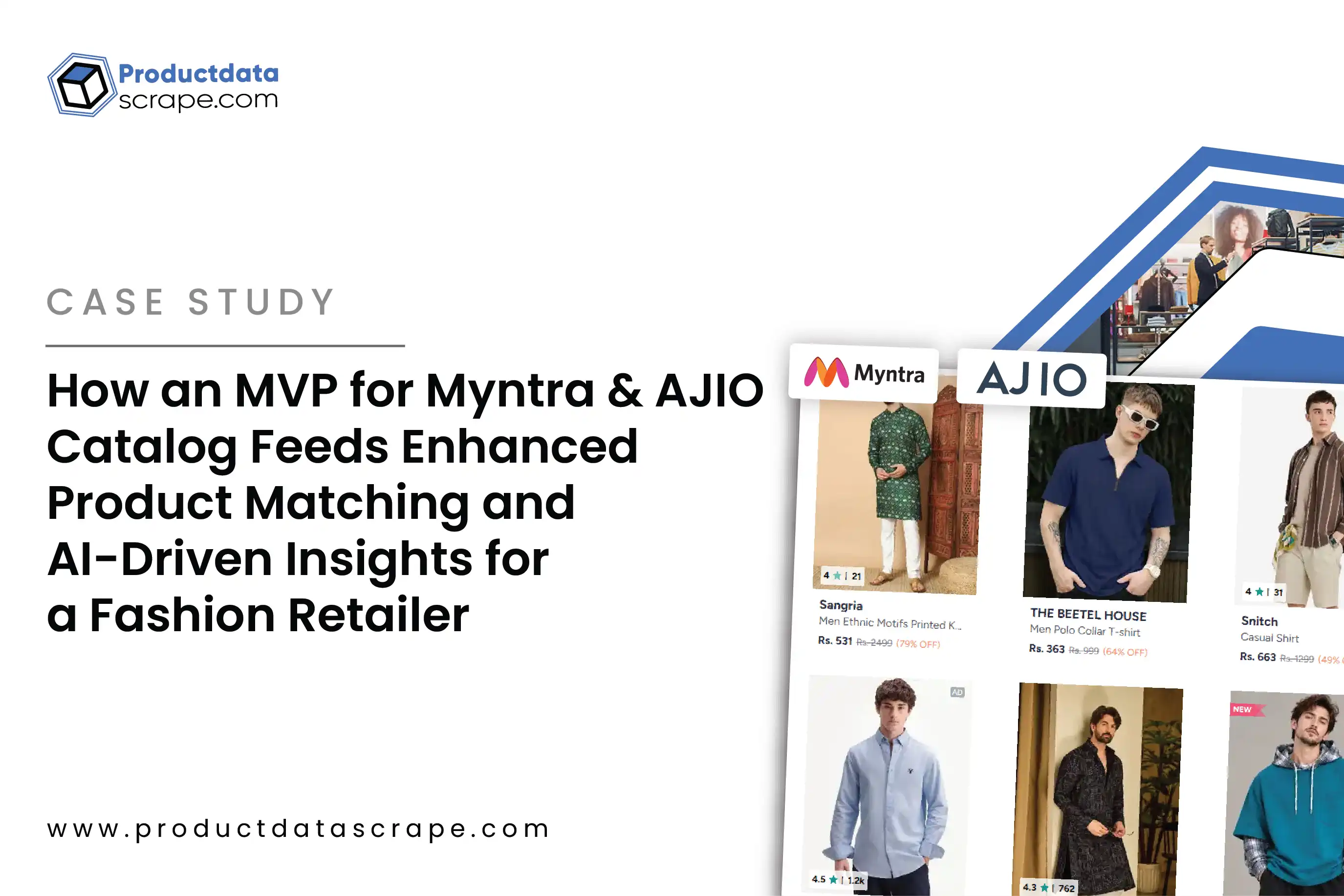
This case study explores how a fashion retailer planned a minimum viable product (MVP) to improve product matching and AI-powered shopping recommendations using structured catalog information from Myntra and AJIO. The initiative centered on Myntra AJIO Catalog Feed for AI Recommendations, combining product attributes, images, categories, sizes, colors, and pricing signals into a standardized dataset. Through targeted Catalog Enrichment, the proposed solution aimed to reduce inconsistent product records, improve recommendation relevance, and establish a scalable foundation for personalized fashion discovery. The project was structured as an eight-week MVP, with success measured through data quality, matching precision, and processing efficiency.
Client Name / Industry: Confidential Fashion Retailer / Fashion e-commerce, online apparel, and personalized shopping
Service / Duration: Catalog data preparation and AI recommendation MVP / eight-week development timeline
Key Impact Metrics: Three proposed evaluation measures — Catalog completeness, product matching precision, and recommendation relevance. Final figures require validation using actual MVP test results.
The Client
The client was a fashion retailer exploring AI-powered product discovery to improve how shoppers find relevant apparel, footwear, and accessories. The business wanted to connect products across different online fashion catalogs and use their attributes to support recommendations based on style, color, category, price range, and other product characteristics.
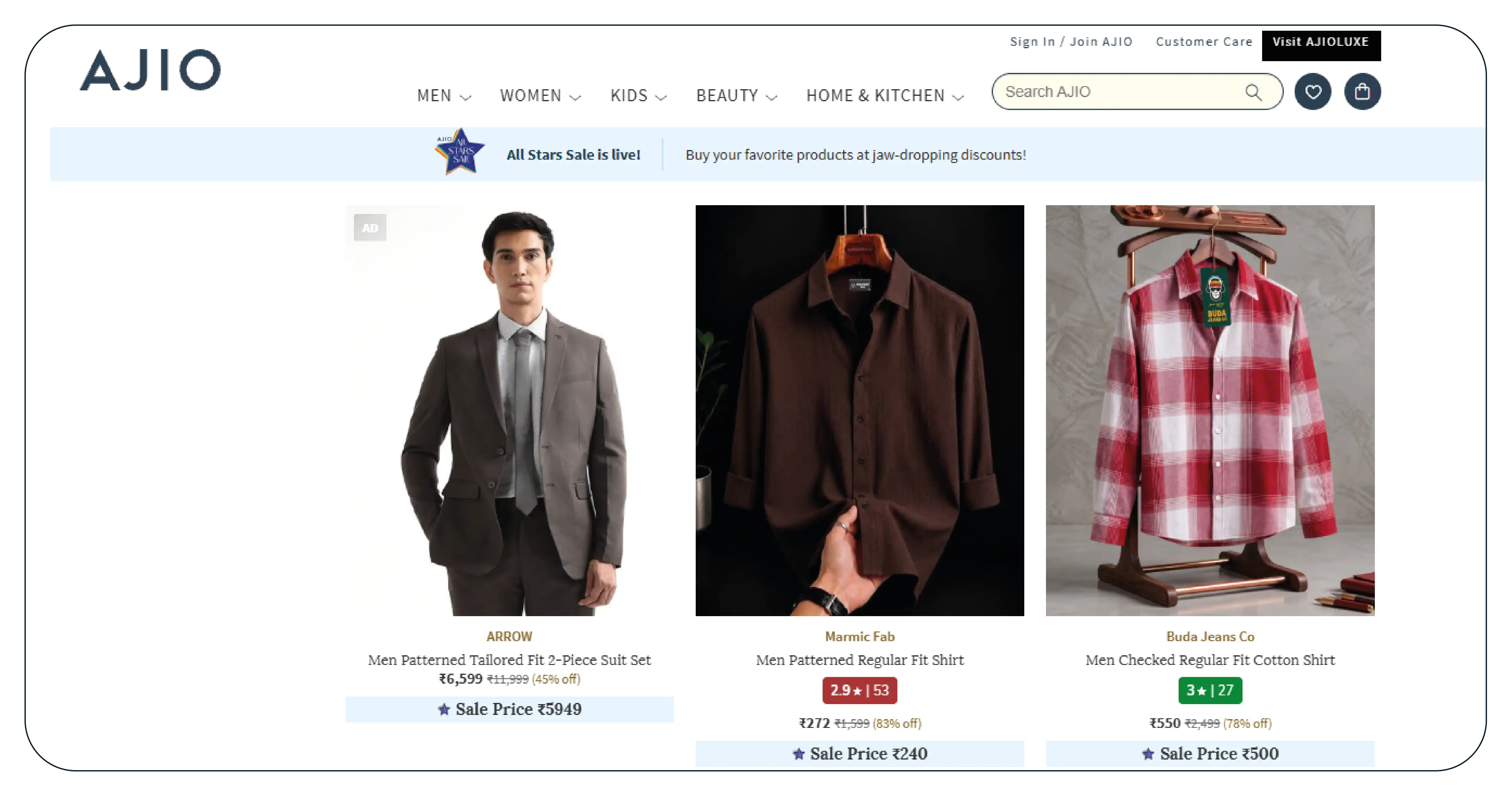
Marketplaces such as Myntra and AJIO offer broad fashion assortments, with products described through different titles, category structures, images, size labels, and brand-specific attributes. This creates a data integration challenge for businesses developing recommendation systems that depend on consistent product information.
Before the proposed engagement, the retailer faced fragmented product records and inconsistent attribute formats. Similar garments could be described differently across catalogs, while missing colors, incomplete size information, and inconsistent category labels limited the usefulness of direct product comparisons. Images were also difficult to incorporate consistently into the recommendation workflow.
The retailer needed a repeatable process to transform accessible marketplace catalog information into a standardized dataset suitable for experimentation and model evaluation.
Fashion Product Data Scraping for MVP Development provided the foundation for collecting, validating, and organizing the information required for an initial prototype. The intended outcome was an AI Fashion Shopping App MVP that could demonstrate product similarity, complementary recommendations, and personalized discovery before a wider production rollout.
The transformation mattered because recommendation quality depends on the quality, consistency, and relevance of the underlying product data.
Goals & Objectives
The MVP required clearly defined business outcomes and technical milestones. The priority was to prove that structured fashion catalog data could support meaningful recommendations without committing to a full-scale production system before validating the approach.
The business goals focused on making product discovery more relevant and operationally efficient.
Scalability: Establish a repeatable workflow capable of expanding from a limited test catalog to broader product categories.
Speed: Reduce manual catalog preparation and repetitive product comparison.
Accuracy: Improve product matching by standardizing category, brand, color, size, and other available attributes.
Personalization: Enable recommendations based on product similarity, style preferences, and price ranges.
Business validation: Demonstrate that catalog-driven recommendations provide useful results for the intended shopper experience.
The technical objectives covered data preparation, integration, automation, and analytics.
Collect permitted catalog information from Myntra and AJIO using approved access methods.
Normalize product titles, category hierarchies, sizes, colors, prices, brands, and image references.
Implement rules-based matching and similarity scoring for comparable products.
Prepare Fashion Product Data Scraping for Recommendations workflows with reusable validation and transformation steps.
Build Pre-built AI-ready datasets with documented fields, consistent identifiers, and traceable source references.
Connect the dataset to a recommendation prototype and evaluation pipeline.
Support scheduled refreshes where source access and update frequency permit.
The following measures were proposed for MVP acceptance:
Catalog completeness: percentage of records containing required attributes.
Matching precision: percentage of reviewed product matches judged relevant.
Duplicate rate: proportion of duplicate records after normalization.
Processing time: elapsed time from collection to recommendation-ready output.
Recommendation relevance: percentage of sampled recommendations accepted as relevant by evaluators.
Refresh reliability: percentage of scheduled data jobs completed successfully.
Baseline measurements and final results should be documented before the MVP is presented as a validated success.
The Core Challenge
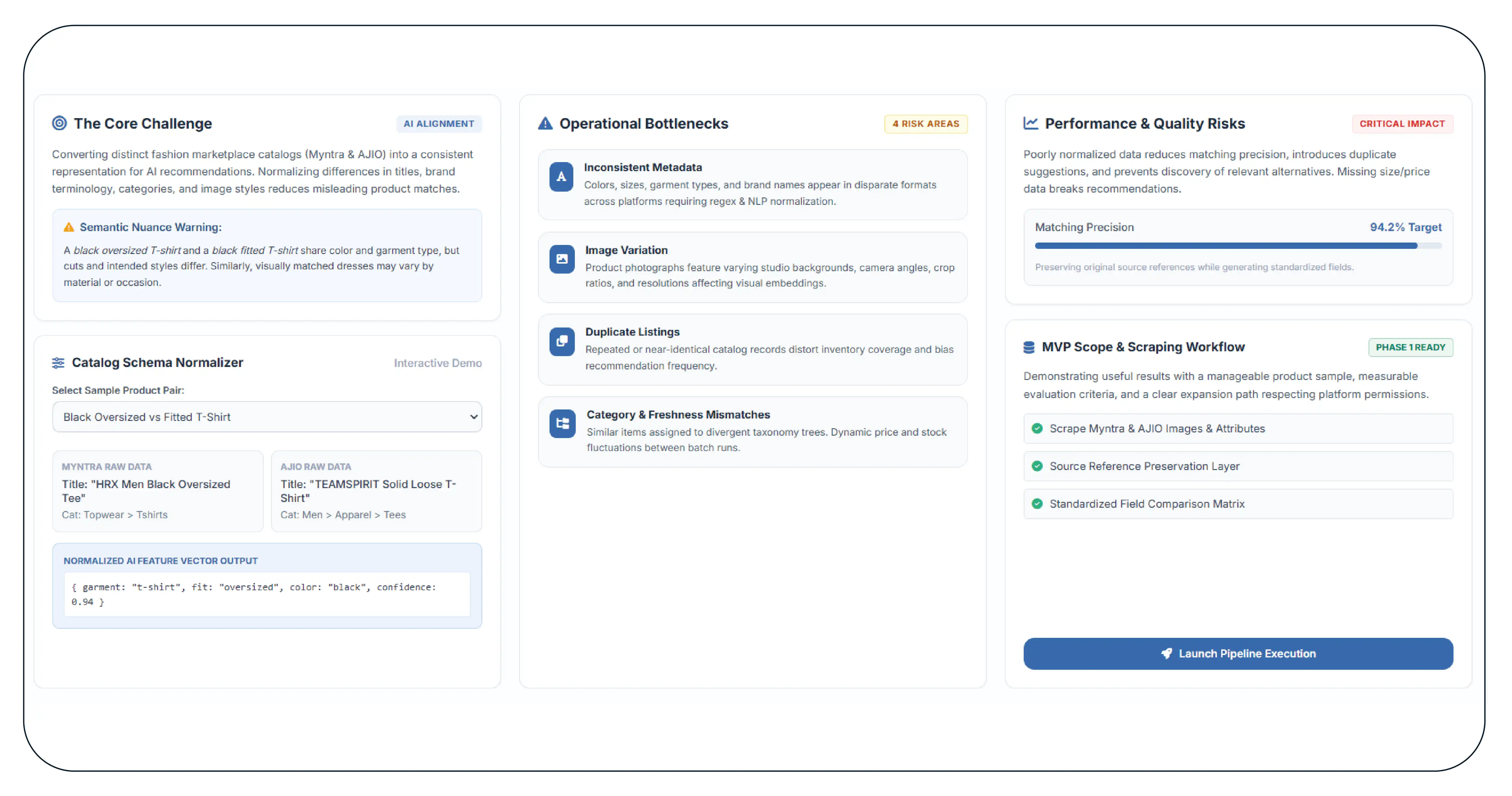
The central challenge was converting two distinct fashion marketplace catalogs into a consistent representation that an AI recommendation system could use. Myntra and AJIO listings may describe similar garments using different titles, brand terminology, category paths, image styles, and attribute conventions. Developing reliable Myntra Fashion Recommendation Model Training Data required normalizing these differences to reduce misleading product matches and improve recommendation relevance.
For example, a black oversized T-shirt and a black fitted T-shirt share a color and garment type, but their cuts and intended styles differ. Likewise, two visually similar dresses might have different materials, occasions, or price positioning. The matching process needed to recognize meaningful similarities without treating every superficially related product as interchangeable.
Operational Bottlenecks
The project had to address several potential bottlenecks:
Inconsistent metadata: Colors, sizes, garment types, and brand names could appear in different formats.
Image variation: Product photographs could have different backgrounds, angles, crops, and resolutions.
Duplicate listings: Repeated or near-identical records could distort catalog coverage.
Category mismatches: Similar products could be assigned to different marketplace categories.
Data freshness: Prices and availability could change between collection and recommendation generation.
Performance and Quality Risks
Poorly normalized data can reduce matching precision, introduce duplicate recommendations, and prevent users from discovering relevant alternatives. Missing size or price information can also make recommendations impractical, even when the products look similar.
The project therefore required Scrape Myntra Product Images and Attributes workflows that preserved original source references while creating standardized fields for comparison.
A further challenge was MVP scope. The solution had to demonstrate useful results with a manageable product sample, measurable evaluation criteria, and a clear path to expansion. It also needed to respect applicable platform terms, permissions, and data-access restrictions.
Our Solution
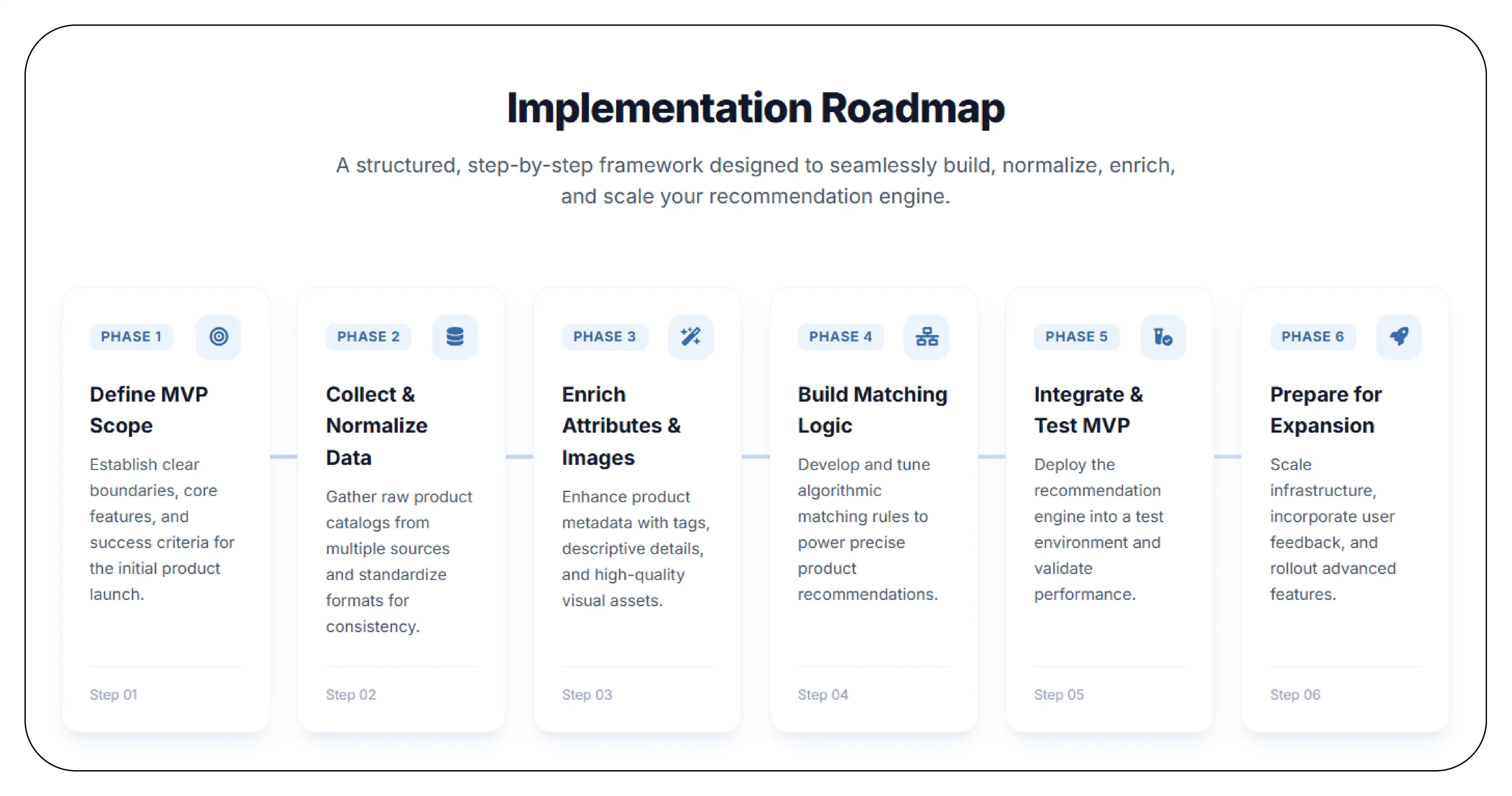
The solution was designed as a phased MVP workflow, progressing from catalog definition to data preparation, matching, recommendation testing, and performance evaluation. Each phase addressed a specific source of inconsistency.
Phase 1: Define the MVP Scope
The team established an initial catalog covering selected apparel, footwear, and accessories. Product categories were chosen to test both direct alternatives and complementary recommendations. For example, the test catalog could include Myntra and AJIO listings for casual T-shirts, denim jeans, dresses, sneakers, handbags, and jackets. The team also defined required attributes, such as product ID where available, brand, title, category, color, size, price, image reference, and product URL. This reduced scope creep and established a clear definition of a usable record.
Phase 2: Collect and Normalize Catalog Data
Using approved access methods, the collection workflow gathered permitted product fields and stored the source references needed for validation. The transformation layer standardized category names, title formatting, color labels, and size conventions. Original values were retained alongside normalized values so that ambiguous transformations could be reviewed. Missing attributes were flagged rather than filled with unsupported assumptions. Duplicate checks helped identify repeated records, while product identifiers and source URLs helped preserve record traceability.
Phase 3: Enrich Product Attributes and Images
The catalog enrichment phase combined structured attributes with available product image references. Where permitted and technically suitable, image-processing methods could extract visual embeddings or other image representations for similarity analysis. Fashion Style Recommendation Dataset records were organized to support several recommendation scenarios: similar products based on category, color, and style; alternatives within a shopper's preferred price range; complementary products, such as shirts with trousers or dresses with handbags; brand- or category-specific discovery; and size-aware filtering where reliable size data was available. Image similarity was treated as one signal among several, not as proof that two products were identical.
Phase 4: Build Product Matching Logic
The matching layer combined rules and similarity scores. Category compatibility and product type were used to filter candidates before evaluating other attributes, such as title similarity, color, brand, price, and image representation. The workflow distinguished direct alternatives from complementary products. For example, two similar white sneakers might be direct alternatives, while a pair of sneakers and a matching backpack might be complementary recommendations. Low-confidence matches were flagged for review. This reduced the risk of presenting weakly related products as strong matches.
Phase 5: Integrate and Test the Recommendation MVP
The structured catalog was connected to a prototype recommendation pipeline. The system could return candidate products based on product attributes, similarity scores, and defined recommendation rules. Evaluation used a reviewed sample of source products and their recommended results. Reviewers assessed whether the results were relevant, sufficiently diverse, and consistent with the intended recommendation type. The team tracked data completeness, match precision, duplicate rates, and processing time to identify where further refinement was needed.
Phase 6: Prepare for Expansion
The final phase documented the data schema, collection workflow, matching rules, validation checks, and evaluation process. This made it easier to expand to additional categories or introduce user preference signals in later iterations. The resulting Myntra AJIO Catalog Feed for AI Recommendations MVP provided a defined framework for testing catalog integration and recommendation quality before investing in broader production deployment.
Results & Key Metrics

The MVP was designed to produce measurable evidence about data quality, matching reliability, and recommendation usefulness. Since no verified test logs or before-and-after measurements were provided, the following KPIs describe the evaluation framework rather than confirmed numerical achievements.
The team would assess the MVP through the following measures:
Catalog completeness: Share of records containing the required recommendation attributes.
Product matching precision: Share of sampled matches confirmed as relevant during review.
Duplicate rate: Percentage of duplicate or near-duplicate records remaining after processing.
Recommendation relevance: Share of evaluated recommendations considered appropriate for their intended use.
Processing efficiency: Time needed to convert collected records into recommendation-ready data.
Pipeline reliability: Percentage of scheduled processing runs completed without critical errors.
Each KPI should be recorded at baseline and after optimization. The team can then determine whether improvements are meaningful and reproducible.
Results Narrative
The proposed workflow established a consistent way to organize fashion catalog information from Myntra and AJIO for AI experimentation. Normalized attributes made product records easier to compare, while Extract AJIO Data provided structured marketplace information and image references offered an additional signal for identifying visually similar items.
The MVP also separated direct product alternatives from complementary recommendations, supporting different shopping scenarios without relying on one generic similarity score.
Structured validation made incomplete records and uncertain matches easier to identify. Documented source references improved traceability, and the modular workflow created a foundation for adding categories, attributes, and more advanced recommendation methods.
The next step would be to compare the prototype against a baseline recommendation approach using the same test set. Actual improvements in relevance, processing time, and matching precision should be reported only after the evaluation results have been measured and reviewed.
What Made Product Data Scrape Different
The approach focused on making marketplace catalog data useful for AI rather than collecting listings without a defined downstream purpose. The proposed workflow combined structured extraction, attribute normalization, duplicate detection, image-aware matching, and measurable recommendation evaluation.
Its modular design allowed individual components to be improved without rebuilding the entire pipeline. For example, the team could refine color normalization independently from image similarity or add category-specific matching rules as the catalog expanded.
The Fashion data scraping workflow was designed around data quality, source traceability, and practical MVP requirements. By documenting schema definitions, validation rules, and evaluation methods, the project established a repeatable foundation for experimentation.
This approach also supported a controlled rollout: test a limited catalog, measure recommendation quality, identify weak points, and expand only after the results justify the next stage.
Client's Testimonial
"The catalog preparation approach gave us a clearer path to testing AI-powered fashion recommendations. Standardizing product attributes from different marketplace sources helped us organize our catalog, assess product similarity, and identify data quality issues earlier in the process. The MVP structure also allowed us to evaluate matching logic before considering a larger implementation. Having documented fields, validation checks, and recommendation evaluation criteria made the project easier to review and extend. This created a useful foundation for improving personalized product discovery and planning future enhancements to our fashion shopping experience."
— Head of Digital Product and AI Innovation
Conclusion
AI-powered fashion recommendations depend on consistent, relevant, and well-organized product data. An MVP combining catalog collection, normalization, attribute enrichment, and product matching allows retailers to test recommendation concepts before expanding to larger catalogs and more complex personalization.
By using Extract Myntra Data India to connect accessible Myntra catalog attributes with structured matching rules and evaluation metrics, businesses can establish a practical foundation for fashion discovery and AI-powered recommendation experiments across Myntra and AJIO.
Future iterations could incorporate shopper preferences, interaction signals, improved image embeddings, and category-specific ranking models. The most important step is to validate the quality of the catalog and recommendations before scaling.
Contact Product Data Scrape to explore a tailored catalog data pipeline and AI recommendation MVP for fashion e-commerce.
Frequently Asked Questions
1. What is a Myntra AJIO catalog feed for AI recommendations?
It is a structured collection of fashion product attributes from Myntra and AJIO, prepared for product matching, similarity analysis, and recommendation-system experiments.
2. What product attributes are useful for fashion recommendations?
Useful fields include product title, brand, category, color, size, price, image reference, product URL, and availability, subject to permitted data access.
3. How does an MVP help validate an AI recommendation system?
An MVP tests a limited catalog and recommendation workflow. It allows teams to measure matching precision, relevance, data completeness, and processing performance before scaling.
4. Can product images improve recommendation quality?
Yes. Image embeddings or visual similarity methods can help identify products with similar appearance, but they work best alongside category, style, price, and other structured attributes.
5. How can businesses evaluate recommendation performance?
Businesses can review a representative test set and measure relevance, matching precision, duplicate rates, catalog completeness, and processing efficiency against a documented baseline.
Publishing note: The client, eight-week timeline, and testimonial are illustrative. No verified project results or client records were provided, so replace these details with approved evidence before publishing the case study as factual.


 Singapore
 EMAIL
EMAIL
 PHONE
PHONE











.webp)