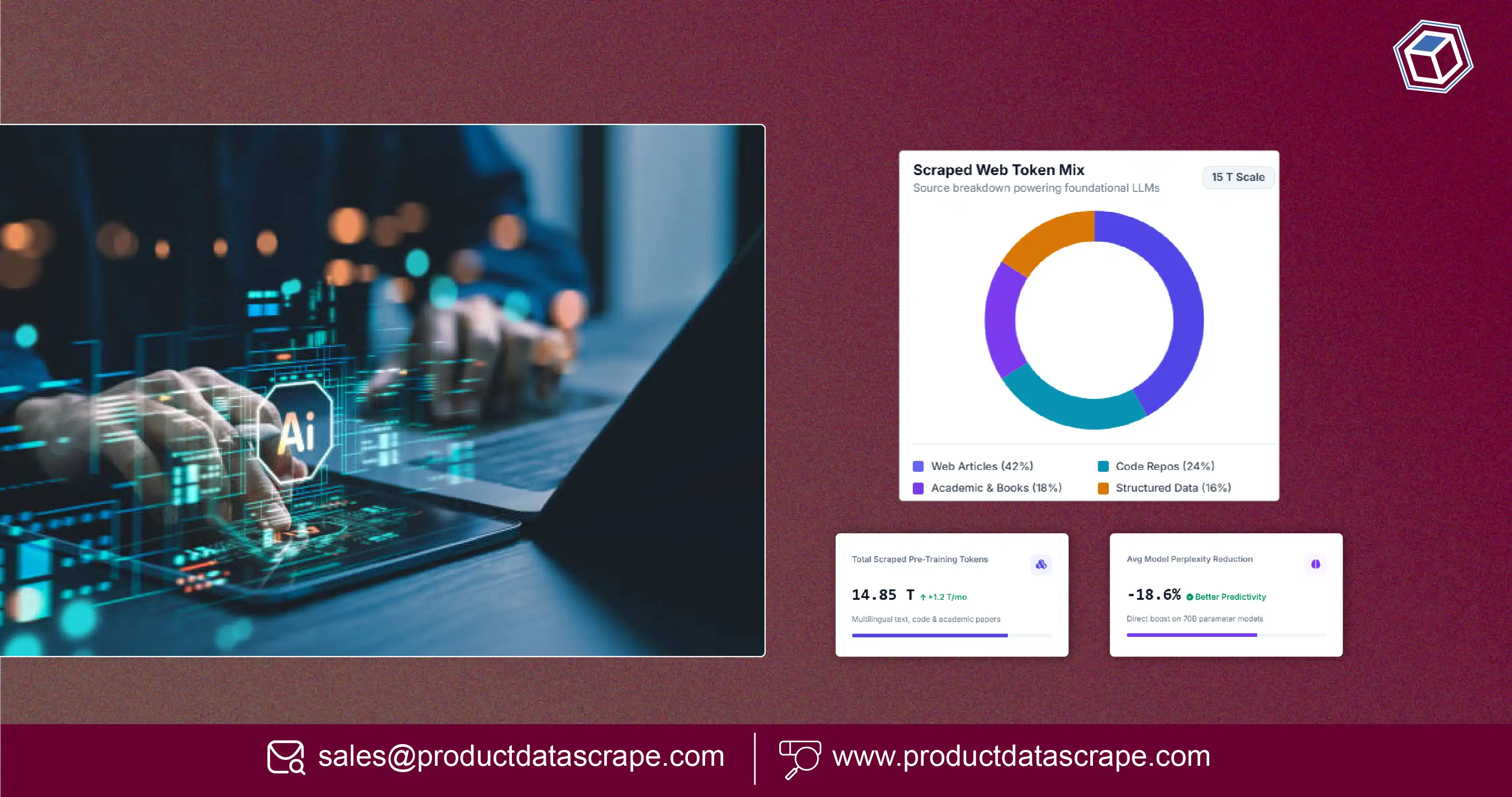
Introduction
Artificial intelligence has transformed the way businesses analyze information,
automate decisions, and deliver personalized customer experiences. However, the success of every
AI model depends on one critical factor—high-quality training data. Modern machine learning
systems, including large language models (LLMs), require massive volumes of structured,
accurate, and continuously updated datasets to improve prediction accuracy and generate
meaningful insights. This is where Web Scraping for AI Training Data becomes an essential
strategy for organizations across retail, eCommerce, finance, healthcare, and logistics.
For AI engineers, data scientists, and developers, collecting diverse web data
manually is neither practical nor scalable. Automated web scraping enables businesses to gather
product information, customer reviews, pricing data, business listings, and other publicly
available datasets from thousands of sources in real time. These datasets help train AI models
to recognize patterns, understand customer behavior, improve recommendation engines, and power
advanced generative AI applications.
This article serves as one of the Technology
Guides for engineers, explaining how modern web scraping solutions support AI
development through reliable, scalable, and compliant data collection while helping
organizations create smarter machine learning models.
Creating High-Quality AI Datasets from Structured Information
Building reliable AI systems starts with collecting structured, accurate, and
consistent datasets. Machine learning algorithms learn from patterns hidden inside millions of
records, making data quality more important than model complexity. Organizations today gather
structured information from eCommerce platforms, retailer websites, marketplaces, public
catalogs, and business portals to enrich AI training datasets. Using automated data extraction
pipelines allows developers to continuously update datasets, ensuring models stay relevant as
products, prices, descriptions, and customer preferences evolve.
Businesses developing recommendation systems, intelligent search engines,
retail analytics platforms, and generative AI assistants increasingly rely on Scrape Structured
Data for LLM Training workflows that automate the collection of standardized product attributes,
pricing, inventory availability, categories, metadata, and specifications. Combining these
datasets with Retail media intelligence enables
organizations to understand advertising performance, consumer engagement, and competitive
positioning while improving AI model accuracy.
Instead of relying on static datasets collected once a year, organizations now
maintain continuously refreshed training repositories. This improves language understanding,
entity recognition, semantic search, product matching, and AI-powered personalization.
Modern AI pipelines also integrate automated data validation, duplicate
detection, taxonomy normalization, and metadata enrichment before datasets reach machine
learning models. This significantly improves downstream model performance while reducing bias
caused by incomplete or outdated information.
AI Dataset Growth (2020–2026)
| Year |
Structured Records Collected (Billions) |
AI Training Adoption |
| 2020 |
18 |
Low |
| 2021 |
27 |
Growing |
| 2022 |
41 |
Moderate |
| 2023 |
63 |
High |
| 2024 |
89 |
Very High |
| 2025 |
118 |
Enterprise Scale |
| 2026 |
152 |
Industry Standard |
The steady increase illustrates how organizations are investing in automated
structured data pipelines to support increasingly sophisticated AI applications.
Transforming Customer Feedback into Machine Intelligence
Customer reviews represent one of the richest sources of human-generated
information available online. Every review contains opinions, emotions, product experiences,
feature comparisons, complaints, and recommendations that help AI systems understand consumer
language more naturally. For retail AI, recommendation engines, conversational commerce, and
generative AI applications, review datasets significantly improve contextual understanding.
Organizations increasingly Scrape Product Reviews for LLM Models to create
datasets containing customer sentiment, buying intent, product strengths, weaknesses, feature
requests, and frequently discussed topics. Unlike structured product specifications, review
content introduces natural language variability, helping language models better understand
conversational queries and real-world customer expressions.
Review datasets also support sentiment classification, aspect-based sentiment
analysis, intent recognition, chatbot training, automated customer support, review
summarization, and personalized product recommendations. AI systems trained on continuously
updated review datasets are better equipped to answer customer questions using current market
information instead of outdated knowledge.
Modern data pipelines further enrich reviews with timestamps, verified purchase
indicators, product categories, geographic information, and reviewer metadata. This additional
context improves supervised learning while enabling more accurate predictions across multiple
retail scenarios.
Organizations also combine review data with pricing history, inventory trends,
promotional campaigns, and product metadata to build richer AI datasets capable of powering
advanced recommendation systems and conversational shopping assistants.
Customer Review Data Growth (2020–2026)
.webp)
The rapid growth in review-based datasets highlights the increasing role of
customer-generated content in improving AI understanding, recommendation accuracy, and natural
language processing capabilities across retail and eCommerce ecosystems.
Building Smarter Retail Intelligence Through Data Collection
Retail has become one of the largest sources of AI-ready datasets, generating
millions of updates every day across product catalogs, pricing pages, promotional campaigns,
inventory records, and marketplace listings. AI models trained on retail information can
forecast demand, optimize pricing strategies, improve inventory planning, and enhance customer
experiences. However, achieving these outcomes requires continuously updated datasets rather
than static snapshots.
Businesses increasingly Scrape Retail Data for AI Models to capture product
availability, pricing fluctuations, discounts, seller information, stock levels, delivery
timelines, and assortment changes across multiple online platforms. These dynamic datasets
enable machine learning models to recognize market trends, seasonal buying patterns, and
competitive pricing behavior.
Retail AI systems also combine structured product information with historical
sales signals, promotional events, and customer interactions to improve recommendation engines
and predictive analytics. Continuous data collection ensures AI models adapt quickly to changing
consumer preferences instead of relying on outdated training information.
Another important advantage is scalability. Automated retail data pipelines
allow organizations to monitor thousands of categories simultaneously while maintaining data
consistency through normalization, validation, and deduplication processes. These enriched
datasets support demand forecasting, assortment optimization, fraud detection, pricing
intelligence, and conversational AI assistants that deliver relevant shopping recommendations.
As retailers expand into omnichannel commerce, AI models trained on refreshed
retail datasets become increasingly valuable for delivering personalized experiences, improving
operational efficiency, and identifying emerging market opportunities.
Retail AI Dataset Growth (2020–2026)
.webp)
The consistent growth demonstrates how automated retail data collection has
become a foundational component of enterprise AI development.
Strengthening AI Models with Rich Product Catalogs
Large language models require diverse and comprehensive datasets to understand
products, attributes, categories, specifications, and customer queries accurately. Product
catalogs available across eCommerce websites provide one of the richest structured data sources
for retail-focused AI applications. These datasets help AI systems improve search relevance,
product recommendations, intelligent merchandising, and conversational shopping assistants.
Organizations increasingly Extract Product Listings for AI Training from
multiple online marketplaces to create standardized product datasets. These datasets typically
include product names, descriptions, technical specifications, categories, images, pricing,
availability, brand information, seller details, and attribute variations. Combining information
from multiple sources creates broader and more representative training datasets.
Another critical capability is Building Training Datasets for Retail LLMs,
where structured product information is continuously enriched with taxonomy mapping, metadata
normalization, multilingual descriptions, and category relationships. These enhancements allow
language models to understand complex product hierarchies and respond more accurately to
customer queries.
Well-organized product datasets also improve entity recognition, semantic
search, automated product matching, duplicate detection, and recommendation quality. AI
developers increasingly use refreshed product catalogs to fine-tune retail-specific language
models capable of understanding industry terminology and evolving consumer preferences.
As product assortments expand rapidly across global marketplaces, automated
extraction ensures AI systems remain aligned with current inventory, product innovations, and
changing market dynamics.
Product Listing Dataset Expansion (2020–2026)
| Year |
Product Listings Collected (Billions) |
Average AI Accuracy |
| 2020 |
12 |
74% |
| 2021 |
18 |
78% |
| 2022 |
27 |
82% |
| 2023 |
40 |
86% |
| 2024 |
58 |
90% |
| 2025 |
79 |
93% |
| 2026 |
103 |
96% |
The increasing volume of structured product listings reflects the growing
demand for high-quality retail datasets used in modern AI development.
Enhancing AI Understanding Through Consumer Opinions
While structured product data provides factual information, customer opinions
introduce the context, emotions, and experiences that make AI models more intelligent. Reviews
explain why customers prefer certain products, highlight recurring issues, describe usage
scenarios, and reveal emerging trends that structured datasets alone cannot capture.
Businesses continue to Scrape Product Reviews for LLM Models because review
datasets improve natural language understanding, conversational AI, sentiment analysis, and
recommendation quality. Every review contributes valuable linguistic diversity, allowing
language models to interpret informal expressions, abbreviations, comparative statements, and
real-world purchasing behavior.
Review datasets also help AI systems detect frequently mentioned product
features, identify common complaints, summarize customer feedback, and understand regional
differences in consumer preferences. Combining review content with structured product metadata
creates balanced training datasets that support multiple machine learning tasks.
Organizations increasingly apply automated review classification, duplicate
removal, language detection, spam filtering, and sentiment scoring before integrating reviews
into AI training pipelines. These preprocessing techniques significantly improve dataset quality
while reducing noise that could negatively impact model performance.
As generative AI becomes more capable of interacting with customers,
continuously refreshed review datasets help ensure AI responses remain accurate, relevant, and
aligned with evolving consumer expectations.
Consumer Review Analytics Growth (2020–2026)
.webp)
The steady increase in review datasets demonstrates their importance in
training AI systems capable of understanding customer language, product experiences, and
purchasing intent.
Expanding AI Knowledge with Verified Business Information
Business directories, local listings, retailer profiles, and company databases
provide valuable structured information that helps AI systems understand organizations,
locations, services, and commercial relationships. These datasets are widely used in
recommendation engines, location intelligence, fraud detection, entity resolution, and knowledge
graph development. As AI applications become more sophisticated, organizations require
continuously updated business information to improve model relevance and accuracy.
Businesses increasingly Extract Business Listings for AI Training to gather
structured details such as company names, addresses, contact information, business categories,
operating hours, service offerings, ratings, geographic coverage, and website information. These
datasets help language models answer location-based queries, recommend businesses, improve
search accuracy, and enhance customer support applications.
Business listing data also supports entity matching, duplicate detection,
geographic intelligence, market segmentation, and local commerce analytics. By integrating
business information with product catalogs, customer reviews, and retail datasets, organizations
can build comprehensive AI training repositories capable of powering advanced machine learning
applications.
To maintain high data quality, automated extraction workflows typically include
validation, normalization, taxonomy mapping, and regular updates. This ensures AI models receive
reliable information despite frequent changes in business operations, locations, or service
offerings. The result is a richer knowledge base that enables AI systems to deliver more
contextual, accurate, and trustworthy responses across industries.
Business Listing Dataset Growth (2020–2026)
| Year |
Business Listings Collected (Millions) |
AI Knowledge Coverage |
| 2020 |
180 |
68% |
| 2021 |
245 |
73% |
| 2022 |
320 |
79% |
| 2023 |
430 |
85% |
| 2024 |
560 |
90% |
| 2025 |
710 |
94% |
| 2026 |
890 |
97% |
The consistent expansion of business datasets demonstrates their growing
importance in developing AI systems capable of understanding real-world commercial ecosystems.
Why Choose Product Data Scrape?
Modern AI development depends on reliable, scalable, and continuously refreshed
datasets. Product Data Scrape helps organizations automate web data collection across retail
platforms, marketplaces, business directories, and product catalogs while maintaining high data
accuracy and consistency. Our solutions are designed to support AI training data for LLM & ML teams, enabling
businesses to create structured datasets that improve machine learning performance,
recommendation engines, predictive analytics, and generative AI applications. With advanced
automation, data validation, and customized extraction pipelines, we deliver enterprise-ready
solutions for Web Scraping for AI Training Data that scale with your business requirements and
accelerate AI innovation.
Conclusion
As AI continues to evolve, the quality of training data remains the single most
important factor influencing model accuracy, reliability, and business value. Organizations that
invest in automated data collection gain access to richer datasets that improve predictive
analytics, recommendation systems, conversational AI, and intelligent decision-making. Combining
structured product information with Ratings, reviews and sentiment
analysis creates comprehensive datasets capable of powering next-generation AI
solutions. Web Scraping for AI Training Data enables organizations to build scalable,
continuously updated knowledge repositories that support long-term AI success.
Ready to accelerate your AI initiatives? Partner with Product Data Scrape for enterprise-grade Web
Scraping for AI Training Data solutions that deliver accurate, scalable, and AI-ready datasets
for your business!
FAQs
1. Why is web scraping important for AI training?
Web scraping automates the collection of structured and unstructured public data, helping AI
models learn from accurate, diverse, and continuously updated datasets that improve prediction
accuracy and language understanding.
2. What types of data are commonly collected for AI models?
Organizations collect product catalogs, pricing, customer reviews, business listings, inventory
information, specifications, images, metadata, and publicly available content to create
high-quality machine learning datasets.
3. How frequently should AI training datasets be updated?
AI datasets should be refreshed regularly to reflect pricing changes, new products, customer
feedback, market trends, and evolving business information, ensuring models remain relevant and
accurate over time.
4. Can web scraping improve retail-focused machine learning models?
Yes. Retail datasets help AI systems understand customer preferences, product relationships,
demand patterns, inventory trends, and competitive pricing, leading to more accurate
recommendations and predictive analytics.
5. Why should businesses use Product Data Scrape for AI data collection?
Product Data Scrape provides scalable web scraping solutions, customized data extraction
pipelines, automated validation, and enterprise-ready datasets that support AI development,
machine learning projects, and large language model training efficiently.


 Singapore
 EMAIL
EMAIL
 PHONE
PHONE













.webp)