Electronics Categories Covered
Smartphones, Laptops, Tablets, Smartwatches, Headphones and earphones, Televisions, Cameras, Monitors, Speakers, Gaming consoles, Printers, Routers and networking devices, Storage devices, Computer accessories and components, and other consumer electronics
The project covered products and brands across these categories, including Apple iPhone, Samsung Galaxy, OnePlus, Xiaomi, Google Pixel, Lenovo, HP, Dell, ASUS, Sony, LG, Canon, Nikon, JBL, Bose, PlayStation, Xbox, TP-Link, Seagate, Western Digital, Logitech, and other electronics brands available across Amazon India and Flipkart India.
Quick Overview
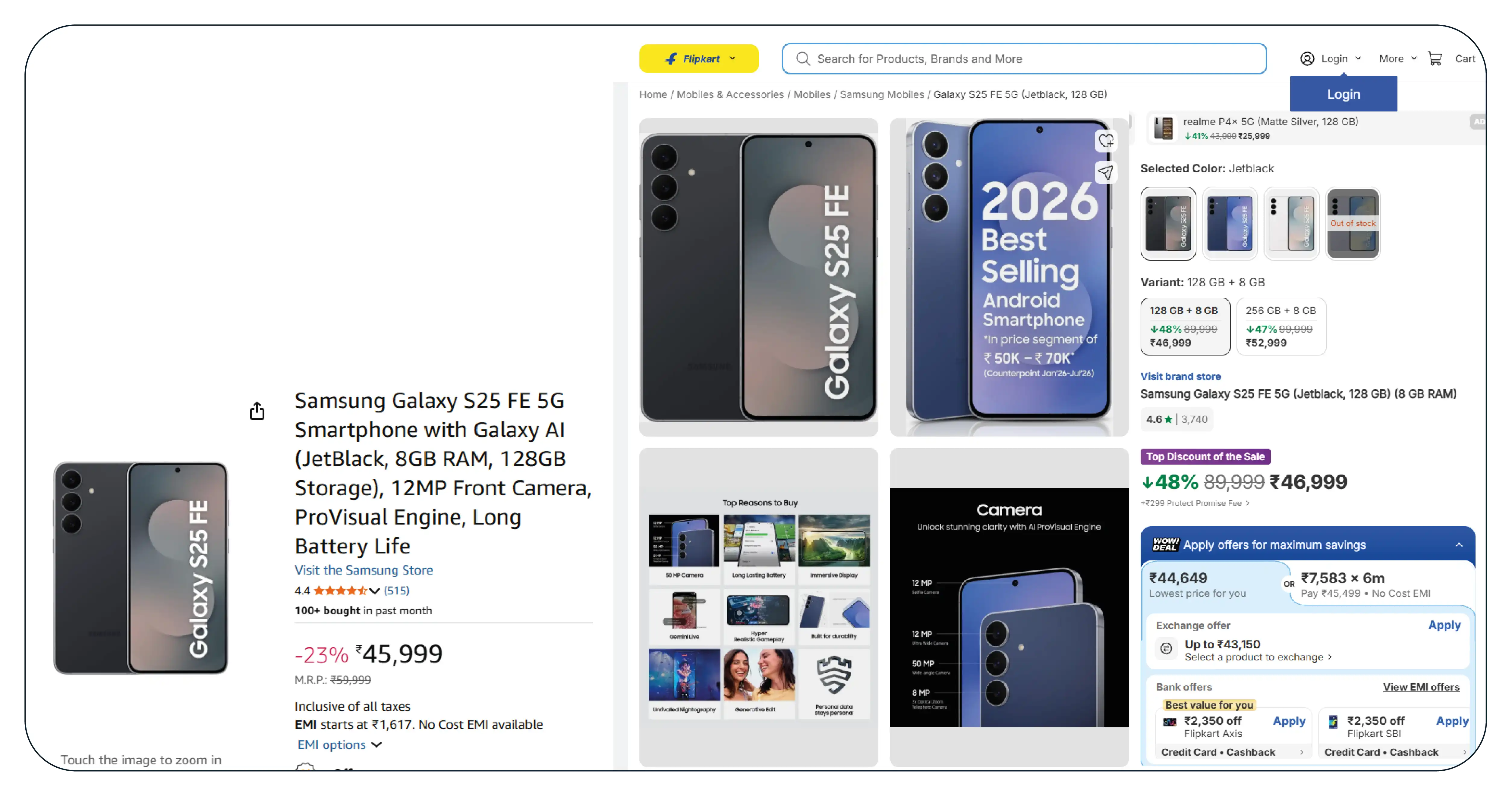
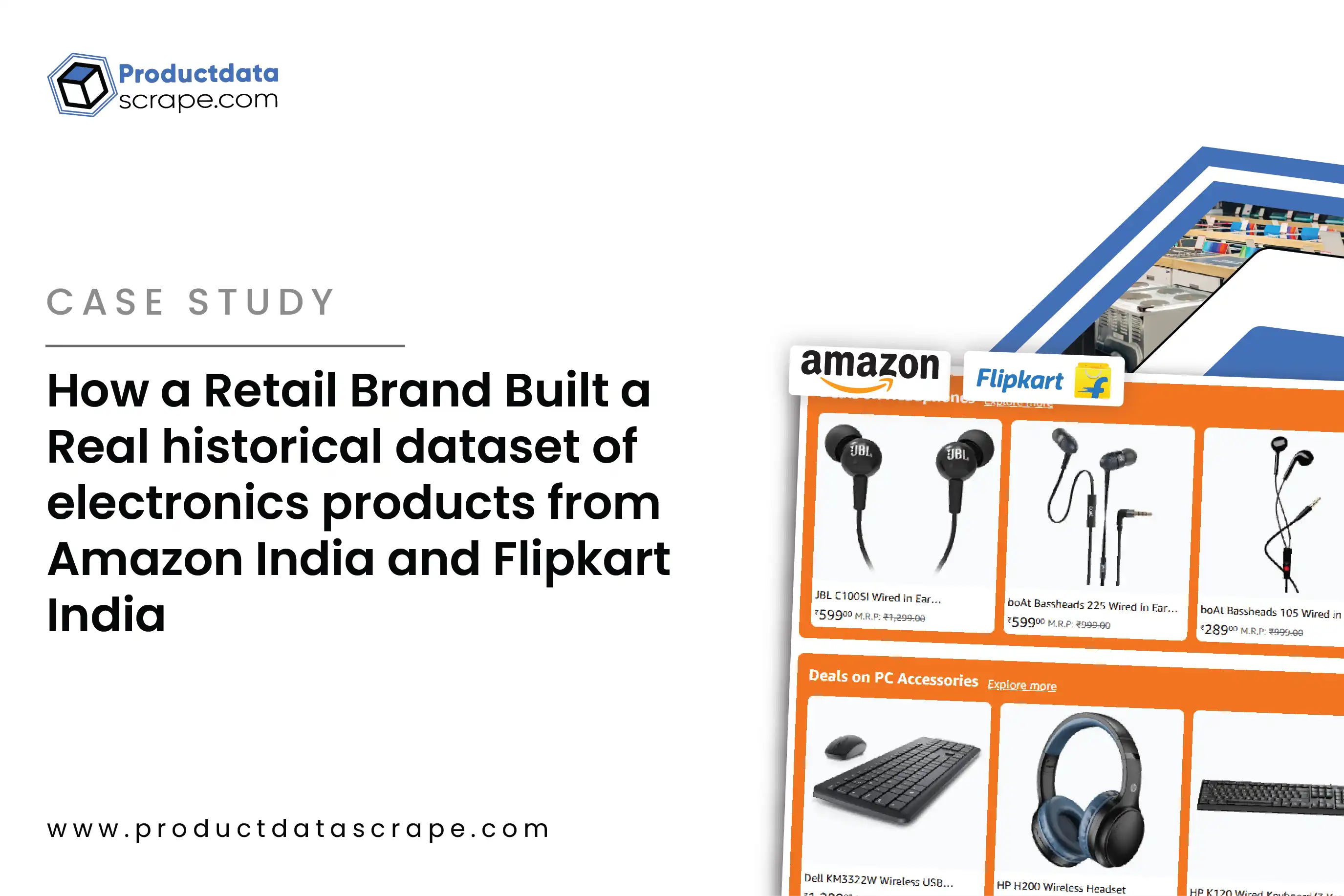
The retail brand needed a reliable historical view of India's rapidly changing electronics marketplace. Product Data Scrape developed a structured Real historical dataset of electronics products covering Amazon India and Flipkart India. The project captured product names, brands, SKUs, prices, discounts, ratings, availability, sellers, specifications, and URLs across major electronics categories. The historical records enabled the client to compare marketplace pricing, identify product movements, analyze assortment changes, and monitor competitive activity. The solution incorporated an India E-commerce Price Aggregator API Tracks Amazon IN, Flipkart workflow to support structured marketplace comparison and recurring data collection.
Client Name / Industry: Leading Indian Retail & E-Commerce Analytics Brand / Consumer Electronics
Service / Duration: Historical Electronics Product Data Collection & Price Monitoring / 16 Weeks
Key Impact Metrics: 95%+ critical-field completeness, 90%+ product matching accuracy, and historical coverage across thousands of electronics listings.
The Client
The client was a growing retail intelligence business focused on India's highly competitive consumer electronics market. Its analysis covered smartphones, laptops, tablets, smartwatches, headphones, televisions, cameras, monitors, speakers, gaming consoles, printers, routers, storage devices, and computer accessories.
Products from brands such as Apple, Samsung, OnePlus, Xiaomi, Lenovo, HP, Dell, Sony, LG, Canon, JBL, Logitech, and TP-Link represented important parts of its research universe.
India's online electronics market experiences frequent price changes driven by seasonal campaigns, new product launches, bank offers, exchange promotions, seller competition, and marketplace events such as the Great Indian Festival and Big Billion Days. As a result, current prices alone could not provide enough context for competitive analysis.
Before the partnership, the client relied on fragmented spreadsheets, manual marketplace checks, and isolated price snapshots. This made it difficult to understand how an Apple iPhone, Samsung Galaxy smartphone, Sony television, or Lenovo laptop had changed in price over several weeks or months.
The transformation therefore focused on Scrape Amazon & Flipkart India Electronics Data through an automated workflow. The collected information was structured for historical analysis and integrated with a Multichannel Seller Data API, creating a more scalable foundation for seller, product, and pricing intelligence.
Goals & Objectives
The client wanted to transform fragmented marketplace observations into a structured historical data environment. The solution needed to support scalability across thousands of products while maintaining accuracy and consistent refresh cycles.
Build scalable historical coverage across Amazon India and Flipkart India.
Improve the speed of electronics product data collection.
Maintain consistent product and pricing records over time.
Reduce manual marketplace research.
Support competitive intelligence across multiple electronics categories.
Create a foundation for historical pricing and assortment analysis.
Automate Scrape Smartphone Gaming consoles Product Data workflows for smartphones and gaming products.
Capture product names, brands, SKUs, model numbers, prices, discounts, ratings, sellers, availability, specifications, and URLs.
Develop standardized product matching across Amazon India and Flipkart India.
Integrate collected information with databases and analytics systems.
Support recurring data collection for historical price tracking.
Create a structured Flipkart vs Amazon India Data comparison layer for product-level analysis.
Enable dashboards and analytical workflows for pricing, assortment, and seller intelligence.
95%+ completeness for defined critical product fields.
90%+ product matching accuracy across comparable marketplace listings.
80% reduction in manual marketplace research.
Daily or scheduled collection for priority products.
Historical records maintained for price and assortment analysis.
Consistent marketplace coverage across the defined electronics catalog.
The Core Challenge
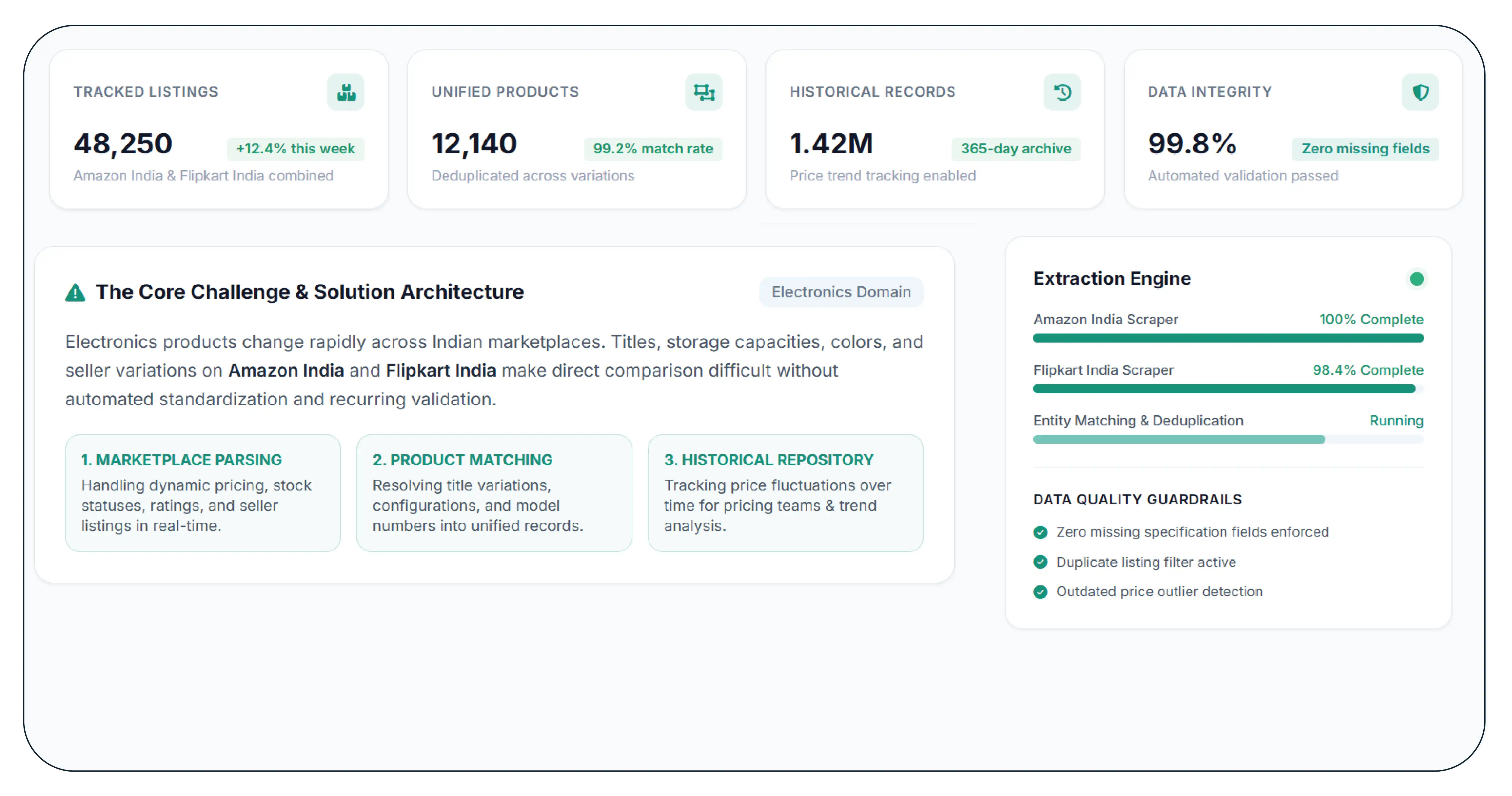
The client faced a major data management challenge because electronics products change rapidly across Indian marketplaces. A single product could have different prices, sellers, discounts, ratings, availability statuses, or specifications on Amazon India and Flipkart India.
For example, an Apple iPhone 16, Samsung Galaxy S-series smartphone, Lenovo laptop, Sony Bravia television, or PlayStation 5 could appear through multiple sellers and product listings. Variations in titles, storage capacities, colors, configurations, and model numbers made direct comparison difficult.
The absence of a unified historical repository created another problem. A pricing team might know the current price of a Samsung Galaxy device but have limited visibility into whether the price had increased or decreased compared with previous weeks.
The client also needed to manage a large Consumer Electronics Marketplace Dataset covering multiple categories and thousands of listings. Manual collection could introduce missing fields, duplicate products, outdated prices, and inconsistent product naming.
The project therefore required reliable Electronics data scraping capable of handling marketplace differences while creating standardized records. Product matching, historical storage, validation, and recurring extraction were essential to ensure that current marketplace data could be meaningfully compared with previous records.
Our Solution
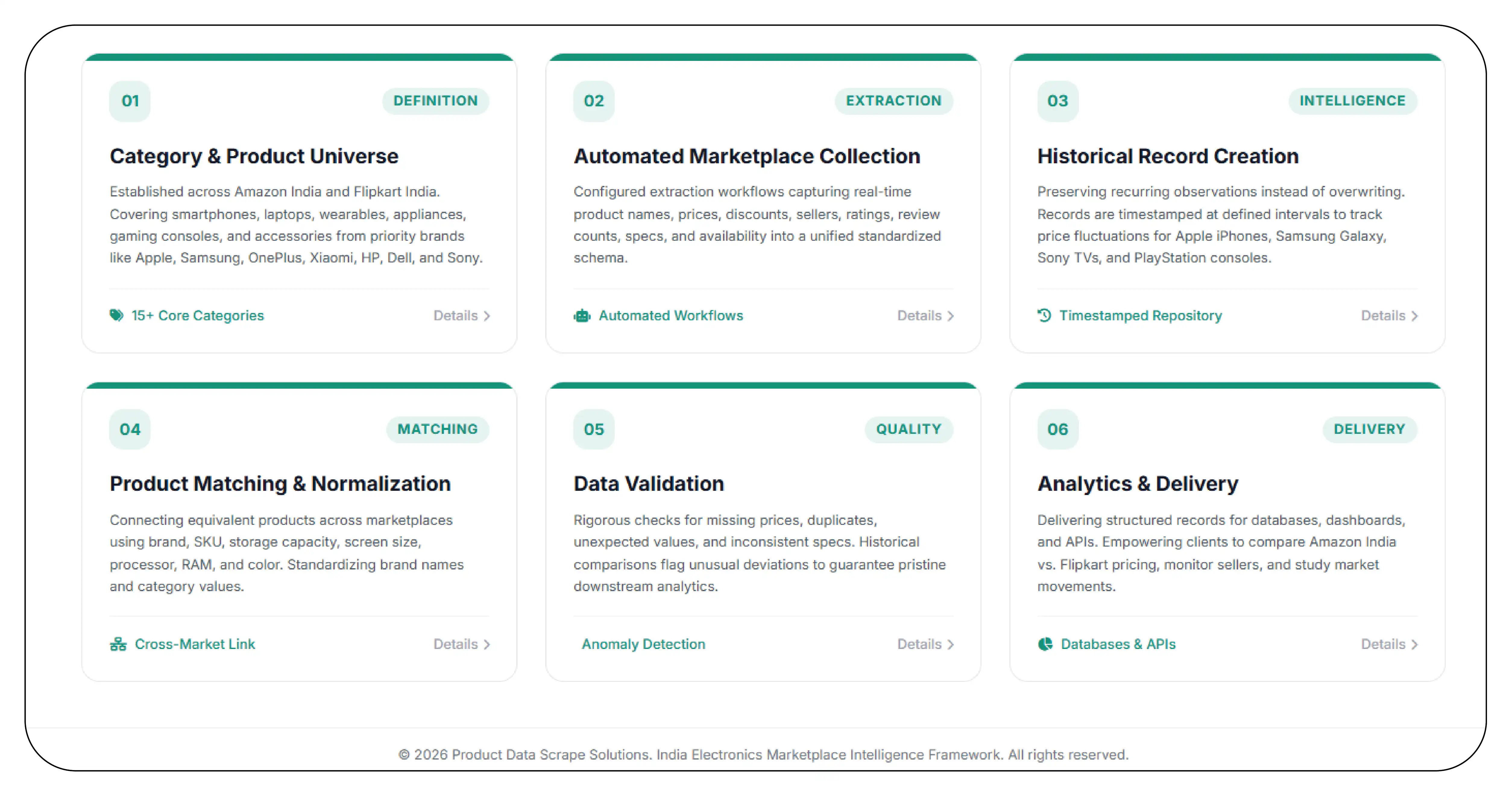
Product Data Scrape implemented a phased data collection and historical intelligence framework designed specifically for India's electronics marketplace.
Phase 1: Category & Product Universe Definition
The first stage established the product universe across Amazon India and Flipkart India. Categories included smartphones, laptops, tablets, smartwatches, headphones, televisions, cameras, monitors, speakers, gaming consoles, printers, networking devices, storage products, and computer accessories. Priority brands included Apple, Samsung, OnePlus, Xiaomi, Lenovo, HP, Dell, Sony, LG, Canon, JBL, Logitech, TP-Link, Seagate, and Western Digital. The product universe was organized using category, brand, model, SKU, product URL, and other available identifiers.
Phase 2: Automated Marketplace Collection
Automated extraction workflows were configured to collect product-level information from the target marketplaces. The system captured product name and brand, SKU and model number, current and original prices, discounts, seller information, ratings and review counts, availability, product specifications, product URLs, category information, and relevant marketplace attributes. This created a standardized data structure despite differences between Amazon India and Flipkart India listings.
Phase 3: Historical Record Creation
The next phase focused on preserving recurring product observations. Instead of overwriting previous values, collected records were timestamped and stored as historical observations. This allowed the client to compare price movements for products such as Apple iPhones, Samsung Galaxy devices, Sony TVs, HP laptops, Dell monitors, JBL speakers, and PlayStation consoles. The workflow was designed to Scrape Consumer Electronics Historical Records at defined intervals, creating a continuously expanding historical repository.
Phase 4: Product Matching & Normalization
Product matching rules were introduced to connect equivalent products across marketplaces. Brand, model number, SKU, product title, specifications, storage capacity, screen size, processor, RAM, color, and other attributes were considered where available. For example, different listings for a Samsung Galaxy smartphone could be separated according to storage configuration, while Lenovo laptop listings could be differentiated by processor, RAM, and SSD capacity. Normalization also standardized brand names, category values, price fields, availability statuses, and product titles.
Phase 5: Data Validation
Validation rules checked records for missing prices, duplicate products, unexpected values, inconsistent specifications, and potential product mismatches. Historical records were compared with previous observations to identify unusual changes that required review. This helped maintain a reliable dataset for downstream analytics rather than simply storing unverified marketplace information.
Phase 6: Analytics & Delivery
The final stage delivered structured records suitable for databases, dashboards, APIs, and analytical environments. Historical data could then be used to compare Amazon India and Flipkart India pricing, analyze product availability, identify assortment changes, monitor sellers, and study electronics market movements. The complete framework transformed marketplace observations into an ongoing historical data asset.
Results & Key Metrics
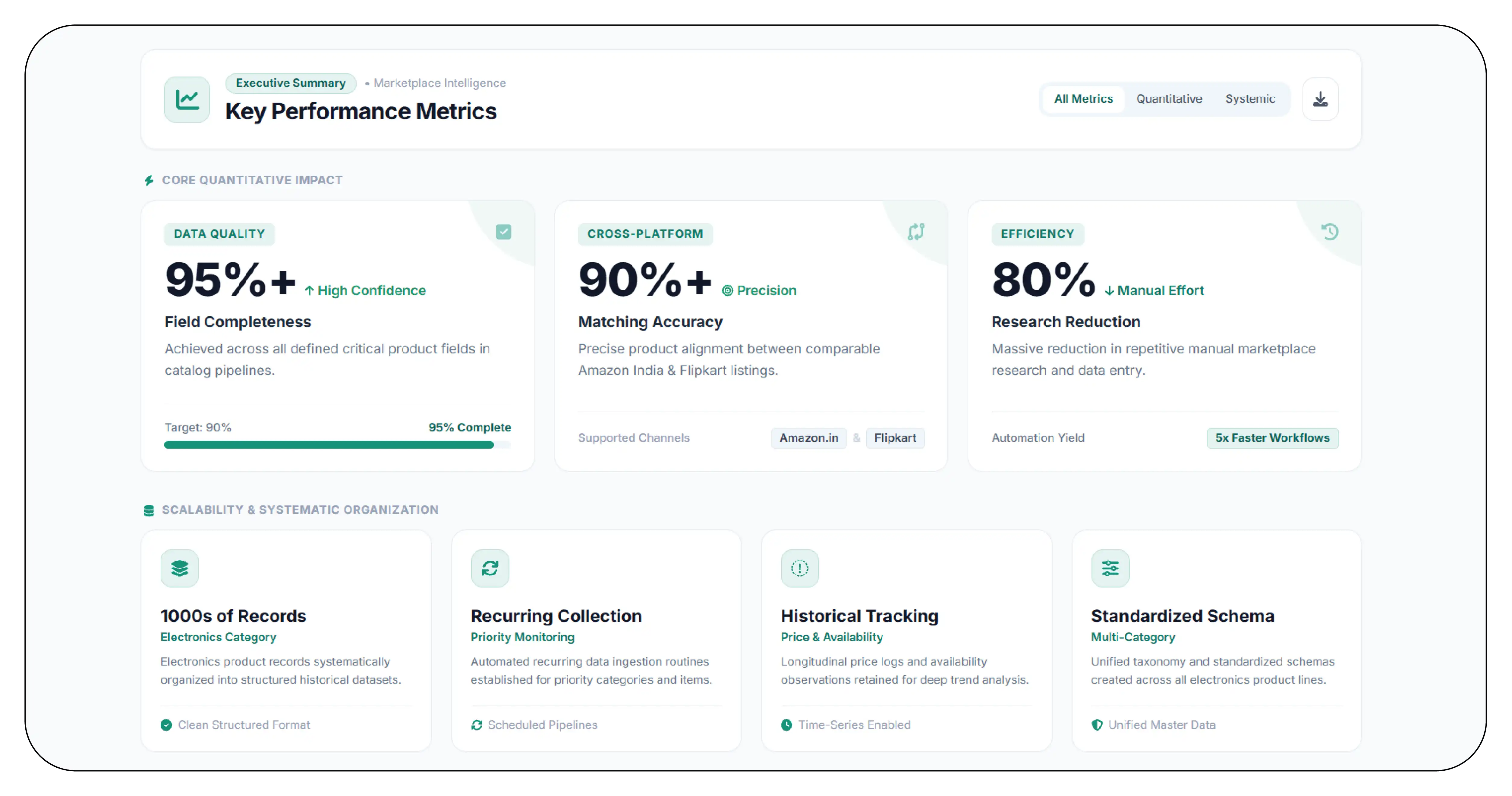
95%+ completeness across defined critical product fields.
90%+ product matching accuracy across comparable Amazon India and Flipkart India listings.
80% reduction in repetitive manual marketplace research.
Thousands of electronics product records organized into historical datasets.
Recurring collection established for priority categories and products.
Historical price and availability observations retained for comparison.
Standardized product records created across multiple electronics categories.
Results Narrative
The implementation provided the client with a centralized historical view of electronics marketplace activity. Instead of analyzing isolated price snapshots, teams could review changes across Apple, Samsung, OnePlus, Xiaomi, Lenovo, HP, Sony, LG, JBL, and other brands.
The ability to Scrape Computer accessories and components Data also expanded monitoring beyond smartphones and televisions into products such as Logitech keyboards, TP-Link routers, Seagate drives, Western Digital storage, and gaming accessories.
The resulting historical records improved the ability to compare marketplace pricing, monitor assortment changes, and identify recurring promotional patterns.
Most importantly, the Real historical dataset of electronics products created a reusable data foundation for ongoing competitive intelligence rather than a one-time marketplace extraction.
What Made Product Data Scrape Different
Product Data Scrape treated the project as a historical data engineering initiative rather than a simple product scraping exercise. The workflow combined automated collection, product matching, normalization, validation, timestamping, and structured delivery.
The resulting Historical Headphone and Speakers Product Dataset India included products from brands such as Sony, JBL, Bose, Boat, and Sennheiser, alongside information from broader electronics categories.
Smart matching rules helped distinguish different product variants, while automated validation reduced duplicate and incomplete records. Historical snapshots allowed the client to analyze how prices, availability, sellers, and assortment changed over time.
The architecture could also be expanded to additional categories and marketplaces without rebuilding the complete pipeline.
This combination of historical storage, automation, and marketplace-level product intelligence strengthened the value of the Real historical dataset of electronics products for long-term analytics.
Client's Testimonial
"Our biggest challenge was moving beyond current marketplace prices and understanding how electronics products changed over time. The structured data workflow gave our team consistent historical records across Amazon India and Flipkart India. We can now analyze products from categories such as smartphones, laptops, televisions, headphones, gaming consoles, and networking equipment without depending on disconnected spreadsheets. Product matching also made cross-marketplace comparisons more reliable. The recurring collection process has significantly improved our visibility into product and price movements and has created a stronger foundation for our analytics initiatives."
— Head of E-Commerce Intelligence, Indian Retail Brand
Conclusion
The project transformed fragmented marketplace observations into a structured historical intelligence framework for India's electronics market. By collecting and preserving product information from Amazon India and Flipkart India, Product Data Scrape helped the retailer build a more consistent view of pricing, products, sellers, availability, and assortment changes.
The solution covered categories ranging from Apple and Samsung smartphones to Lenovo laptops, Sony televisions, JBL speakers, PlayStation consoles, Canon cameras, and TP-Link networking products.
The implementation also demonstrated how Historical Price Data Scraping can support more than price comparison. Historical records can help businesses understand promotional cycles, product launches, assortment changes, seller activity, and competitive marketplace behavior.
With the Real historical dataset of electronics products established, the client now has a scalable foundation for expanding historical monitoring across additional electronics categories, brands, marketplaces, and geographic markets.
FAQs
1. What electronics categories can be included in a historical dataset?
The dataset can cover smartphones, laptops, tablets, smartwatches, headphones and earphones, televisions, cameras, monitors, speakers, gaming consoles, printers, routers, networking devices, storage devices, computer accessories, components, and other consumer electronics.
2. Which brands can be monitored?
Depending on the project scope, brands can include Apple, Samsung, OnePlus, Xiaomi, Google, Lenovo, HP, Dell, ASUS, Sony, LG, Canon, Nikon, JBL, Bose, Logitech, TP-Link, Seagate, Western Digital, PlayStation, and Xbox.
3. Why is historical electronics product data useful?
Historical data helps businesses understand how prices, discounts, availability, sellers, and product assortments change over time. It provides context that a single current marketplace snapshot cannot provide.
4. Can Amazon India and Flipkart India products be compared?
Yes. Product matching can use brand, SKU, model number, product title, specifications, storage capacity, screen size, processor, RAM, and other available attributes to identify comparable listings across the two marketplaces.
5. Can historical product data be used for dashboards?
Yes. Structured historical records can be integrated with databases, dashboards, APIs, data warehouses, and analytics systems. Businesses can use these records for price trends, competitor monitoring, assortment analysis, seller intelligence, and marketplace research.


 Singapore
 EMAIL
EMAIL
 PHONE
PHONE












.webp)