Quick Overview
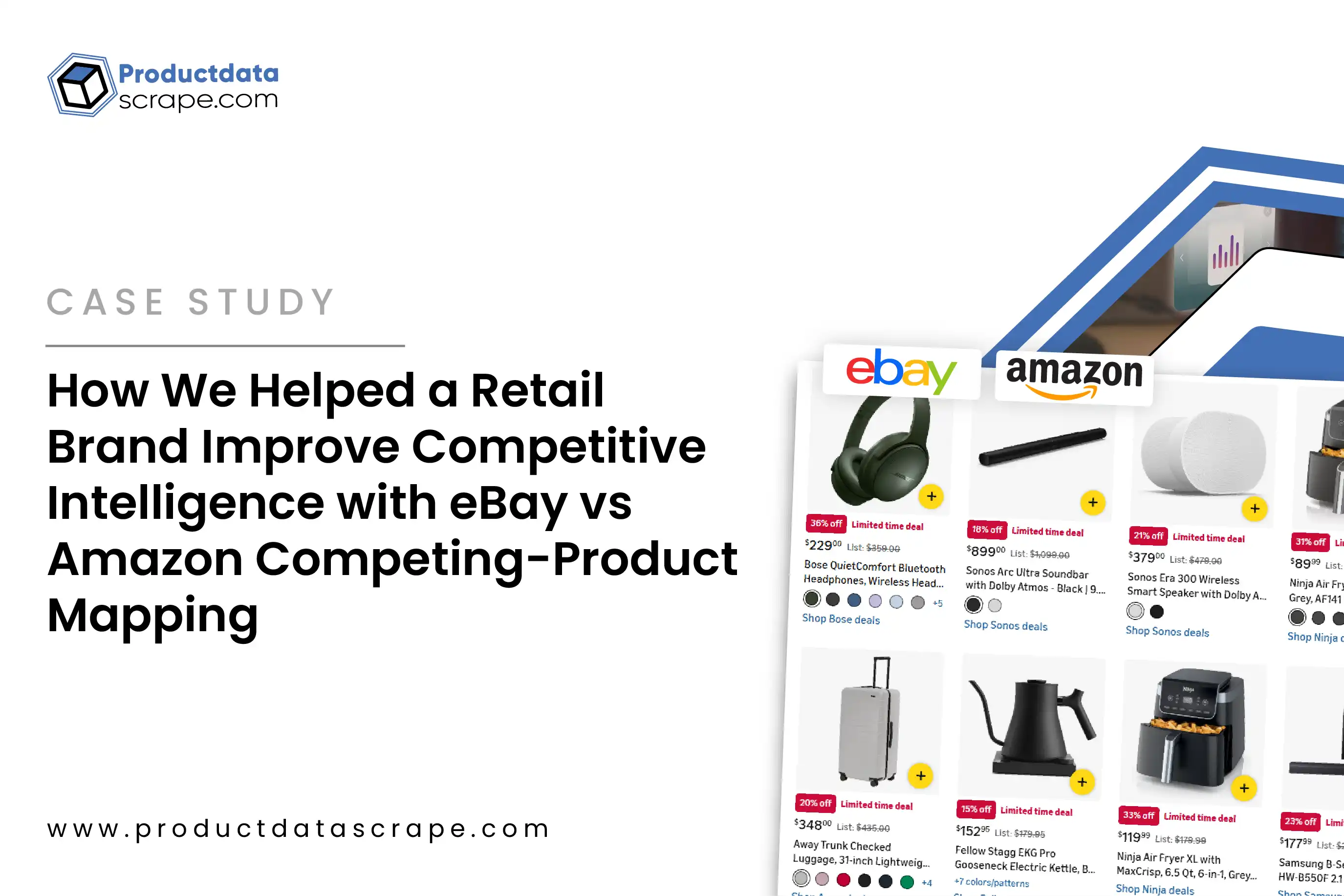
A retail brand partnered with Product Data Scrape to improve competitive intelligence by connecting comparable listings across two major ecommerce marketplaces. The project addressed inconsistent product titles, fragmented identifiers, different listing structures, and time-consuming manual comparison. eBay vs Amazon Competing-Product Mapping created a structured relationship between comparable products, allowing the brand to evaluate assortment, pricing, sellers, and availability more efficiently. The resulting eBay E-commerce Product Dataset gave analysts a standardized foundation for competitive research and ongoing marketplace monitoring. The engagement delivered faster product comparison, improved matching consistency, and a scalable framework for future ecommerce intelligence initiatives across additional categories and marketplaces.
Client Name / Industry: Confidential Retail Brand / Ecommerce & Retail
Service / Duration: Product extraction, matching, normalization, and competitive intelligence / 10 weeks
Key Impact Metrics: 82% reduction in manual comparison; 94% product-matching coverage; 93% faster price-comparison processing.
The Client
The client was a growing retail brand competing across a rapidly evolving ecommerce landscape. Its commercial team monitored multiple marketplaces to understand competitor assortments, pricing behavior, seller activity, and product availability. As ecommerce competition intensified, relying on occasional manual searches became increasingly ineffective.
The client needed a clearer way to identify equivalent or closely comparable products across eBay and Amazon. Product titles frequently differed, sellers used different descriptions, and product variations could appear under separate listings. These inconsistencies made direct comparison difficult and created uncertainty around whether two products were genuinely competitive alternatives.
The brand initially depended on spreadsheets and manual browsing. Analysts searched marketplace listings, copied product details, compared prices, and attempted to determine product relationships manually. This consumed significant time and introduced inconsistencies between analysts and reporting periods.
To Scrape eBay Competitor Products, Marketplace selling intelligence needed to become more systematic. The brand required a structured dataset that could normalize product information and support repeatable competitive analysis.
The transformation was essential because marketplace competition changes continuously. New sellers enter categories, prices fluctuate, products are updated, and assortment changes can occur rapidly. The client therefore needed an automated foundation that could provide more consistent intelligence without proportionally increasing manual research.
Goals & Objectives
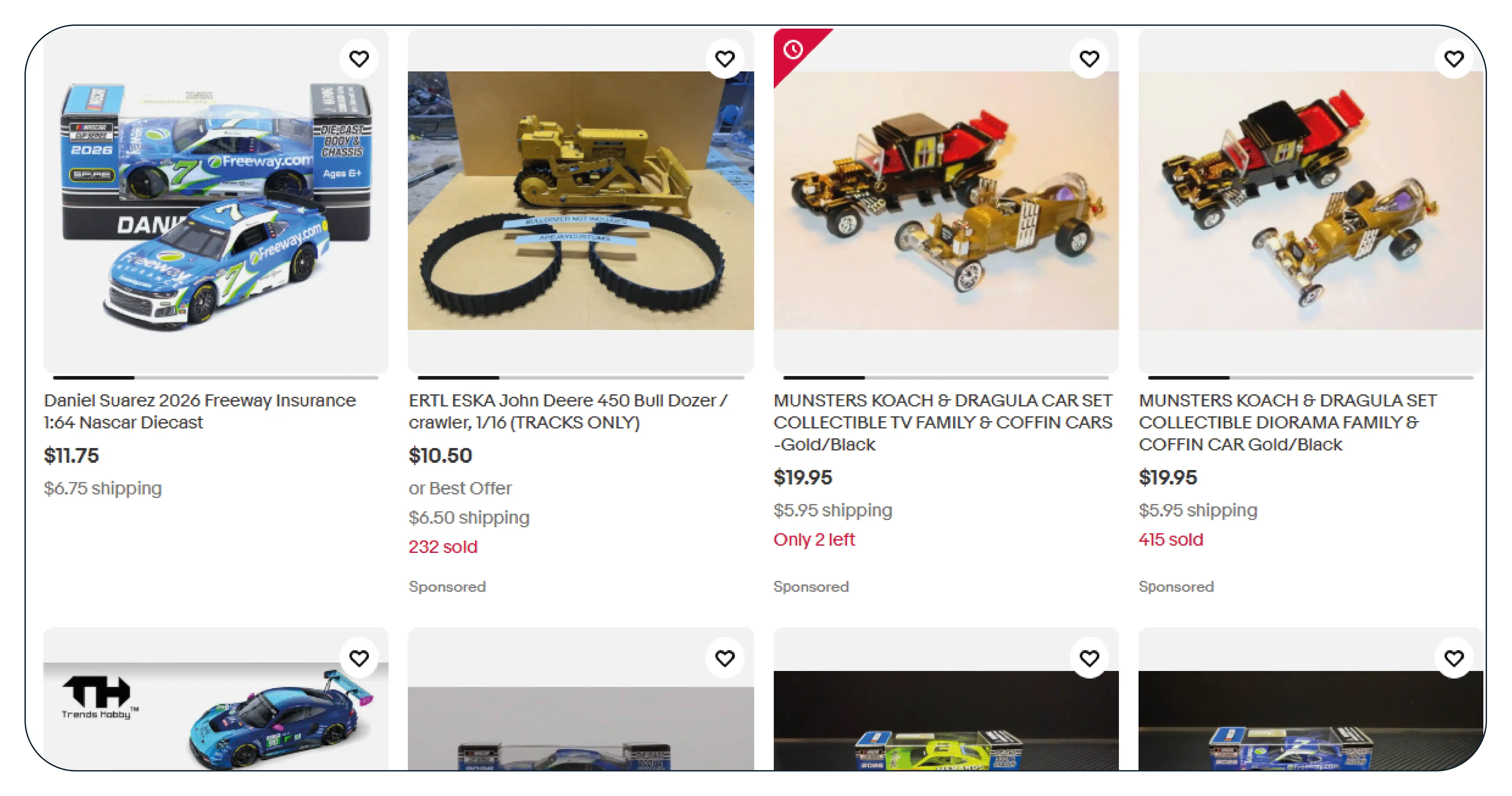
The project established clear business and technical goals focused on scalability, speed, accuracy, automation, and analytical usability. Extract Amazon Competitor Products was included as a core requirement because Amazon listings needed to be normalized alongside eBay records to create meaningful cross-marketplace comparisons.
Improve visibility into competing products.
Reduce manual marketplace research.
Increase the speed of competitor comparisons.
Improve product-matching consistency.
Support scalable competitive intelligence across categories.
Create a reusable framework for additional marketplaces.
Automate product-data extraction from selected sources.
Normalize product names, brands, identifiers, categories, and attributes.
Establish relationships between comparable eBay and Amazon listings.
Integrate pricing and availability observations.
Create historical records for ongoing analysis.
Support dashboards and downstream analytical workflows.
Introduce validation and exception-handling processes.
Reduce manual product comparison by at least 80%.
Achieve 90%+ matching coverage for eligible products.
Reduce processing time for price comparisons.
Improve duplicate detection.
Increase data-refresh frequency.
Maintain high accuracy across mapped product relationships.
The objectives ensured that success was measured through operational improvements rather than simply the number of records collected. The brand wanted a system that could make competitive analysis faster, more consistent, and easier to scale.
The Core Challenge
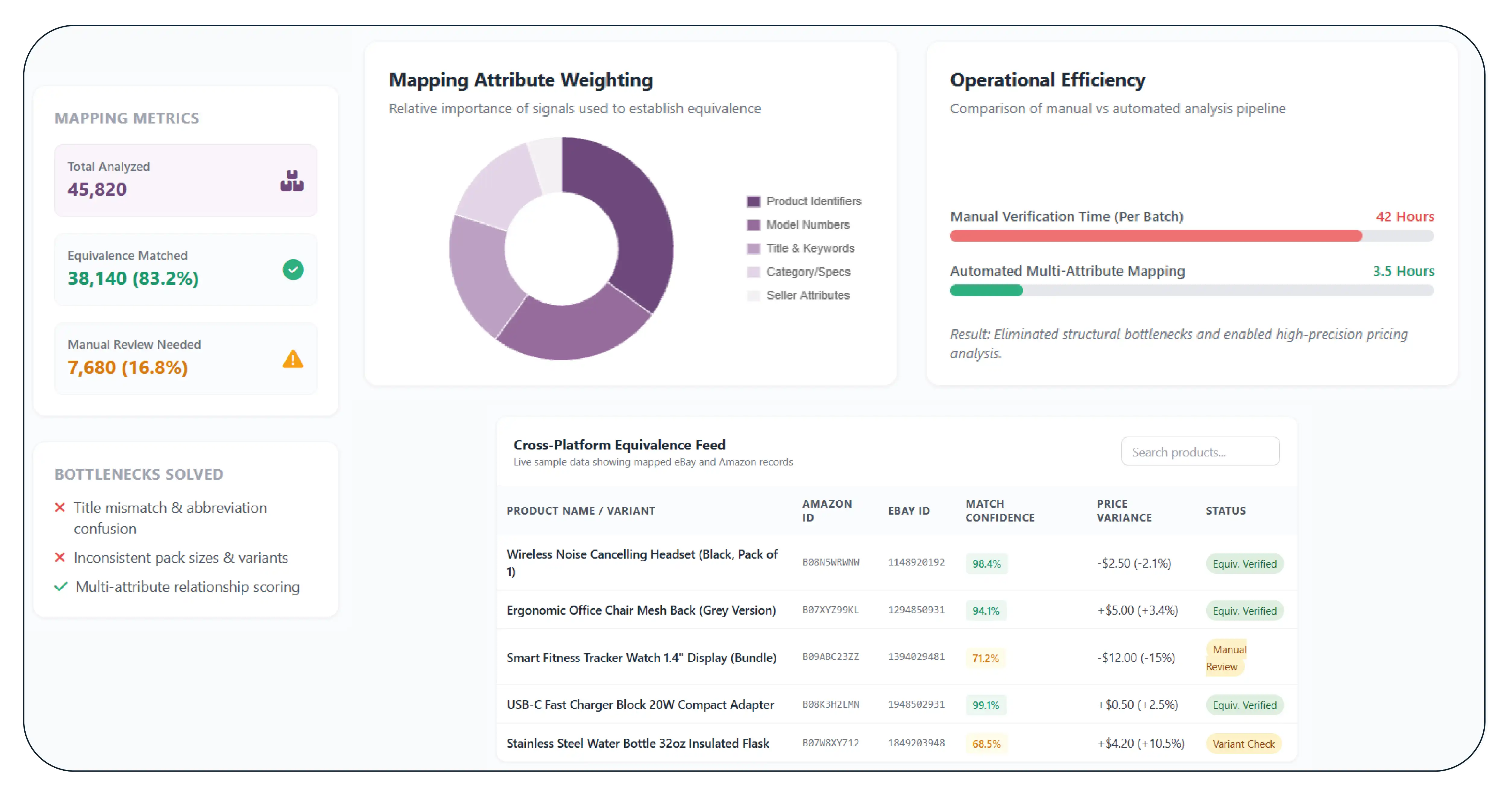
The main challenge was establishing reliable relationships between products listed differently across eBay and Amazon. A simple title-based comparison was insufficient because identical products could have different names, abbreviations, descriptions, seller information, or variation structures.
The client's analysts also faced operational bottlenecks. Product matching required manual searches, side-by-side comparisons, and repeated verification. When product volumes increased, the time required for analysis grew rapidly.
Another issue was inconsistent data quality. Some listings lacked obvious identifiers, while others contained different formatting conventions for brands, model numbers, pack sizes, or variants. A product that appeared similar at first glance could represent a different size, bundle, configuration, or version.
The absence of a standardized relationship layer also affected pricing analysis. Comparing prices without confirming product equivalence could result in misleading conclusions.
To solve this, the project introduced eBay Amazon Product Mapping data for a Seller using multiple product attributes rather than relying on a single field. Product identifiers, brand names, model information, titles, specifications, categories, and other available signals were evaluated to establish stronger product relationships.
This reduced the reliance on manual research and created a repeatable foundation for competitive intelligence.
Our Solution
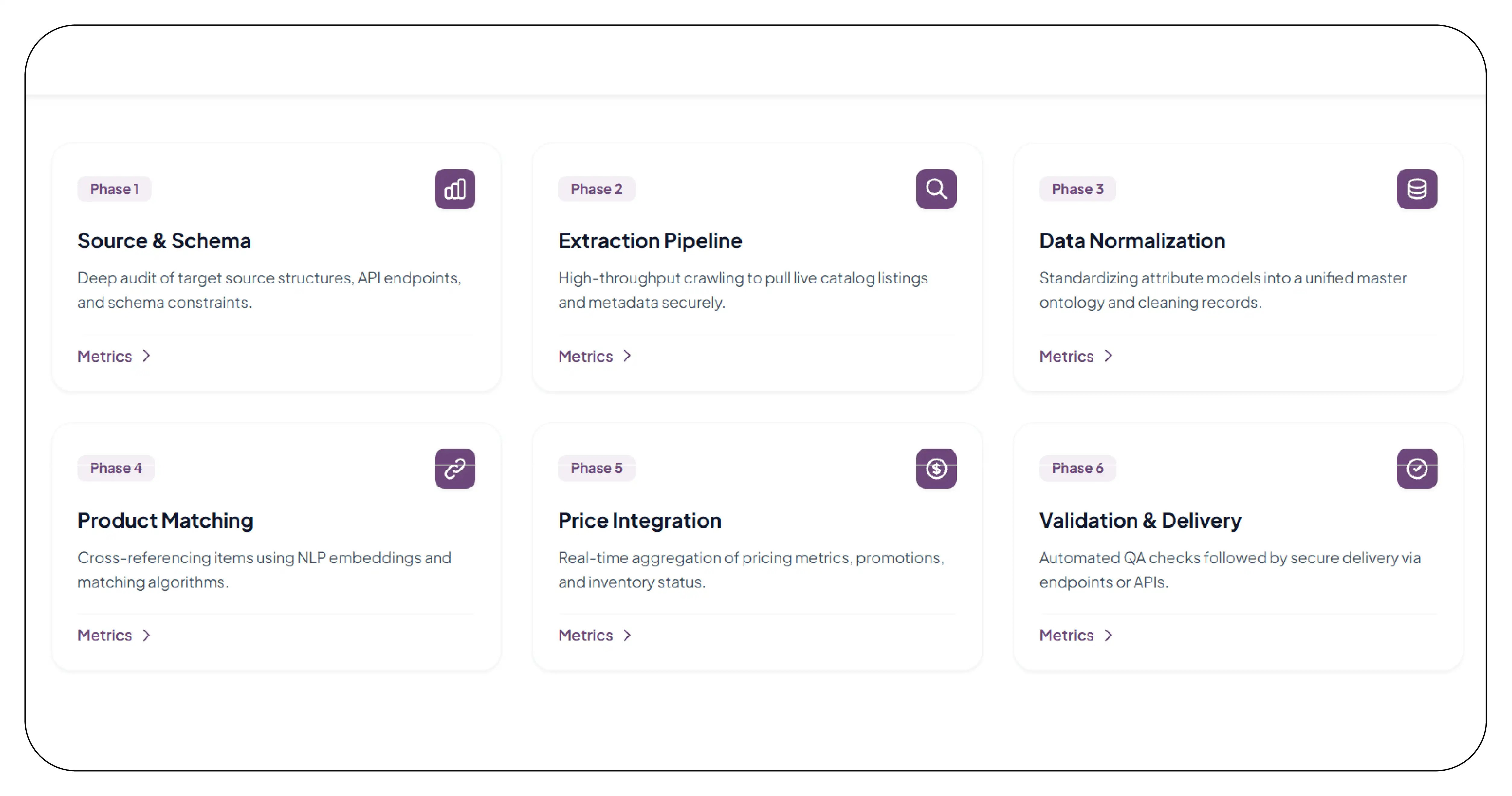
Product Data Scrape implemented a phased workflow designed to automate product discovery, normalization, matching, pricing comparison, and validation.
Phase 1: Source and Schema Analysis
The team first reviewed the client's competitive categories and identified the product fields required for comparison. These included product identifiers, titles, brands, categories, variants, prices, sellers, availability, ratings, and other relevant attributes. A common schema was established so information from eBay and Amazon could be represented consistently.
Phase 2: Marketplace Product Extraction
Automated extraction workflows collected relevant product information from the selected marketplaces. The process was designed to handle marketplace-specific structures while preserving source relationships. This reduced repetitive manual browsing and created standardized records for subsequent processing.
Phase 3: Data Normalization
Raw marketplace records were normalized. Brand names, product titles, identifiers, categories, units, and other comparable attributes were cleaned and standardized. This was important because product matching becomes less reliable when equivalent information is represented differently across sources.
Phase 4: Product Matching
The matching engine evaluated multiple signals to identify equivalent or closely comparable products. Strong identifiers were prioritized where available, while additional product attributes were used to improve matching for records without direct identifiers. High-confidence matches could be processed automatically, while uncertain records could be flagged for review.
Phase 5: Price Integration
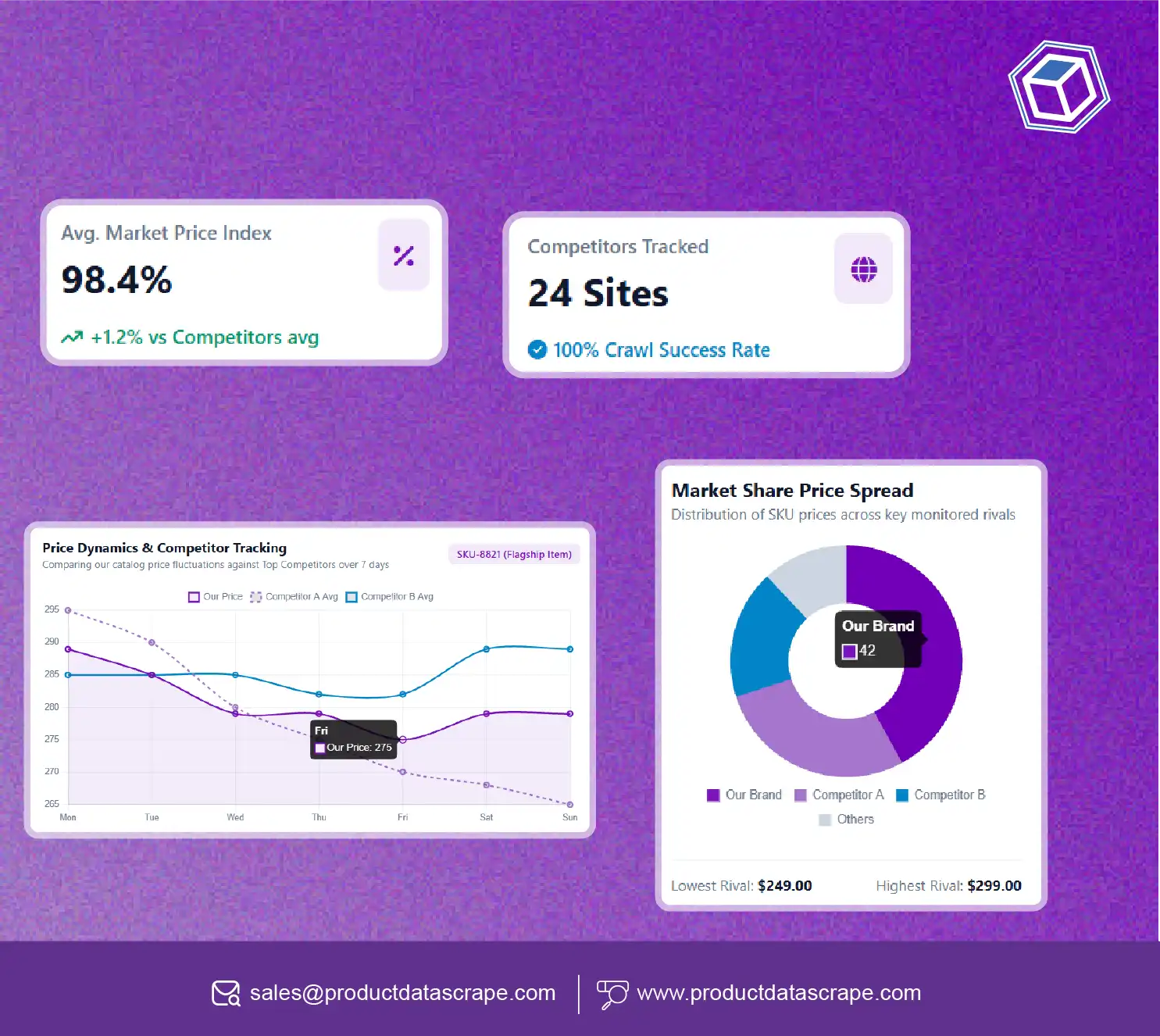
The workflow then connected pricing observations to matched products. Scrape Amazon & ebay Product Prices, eBay vs Amazon Competing-Product Mapping enabled the client to evaluate prices for comparable products instead of comparing unrelated listings. Historical observations could also be retained to support price-change analysis and competitive monitoring.
Phase 6: Validation and Delivery
Automated validation checks identified duplicate records, missing identifiers, inconsistent product relationships, and other potential issues. Final datasets were then prepared for analytics, reporting, and downstream applications.
The phased architecture allowed each component to be tested independently while creating an integrated competitive intelligence workflow.
Results & Key Metrics
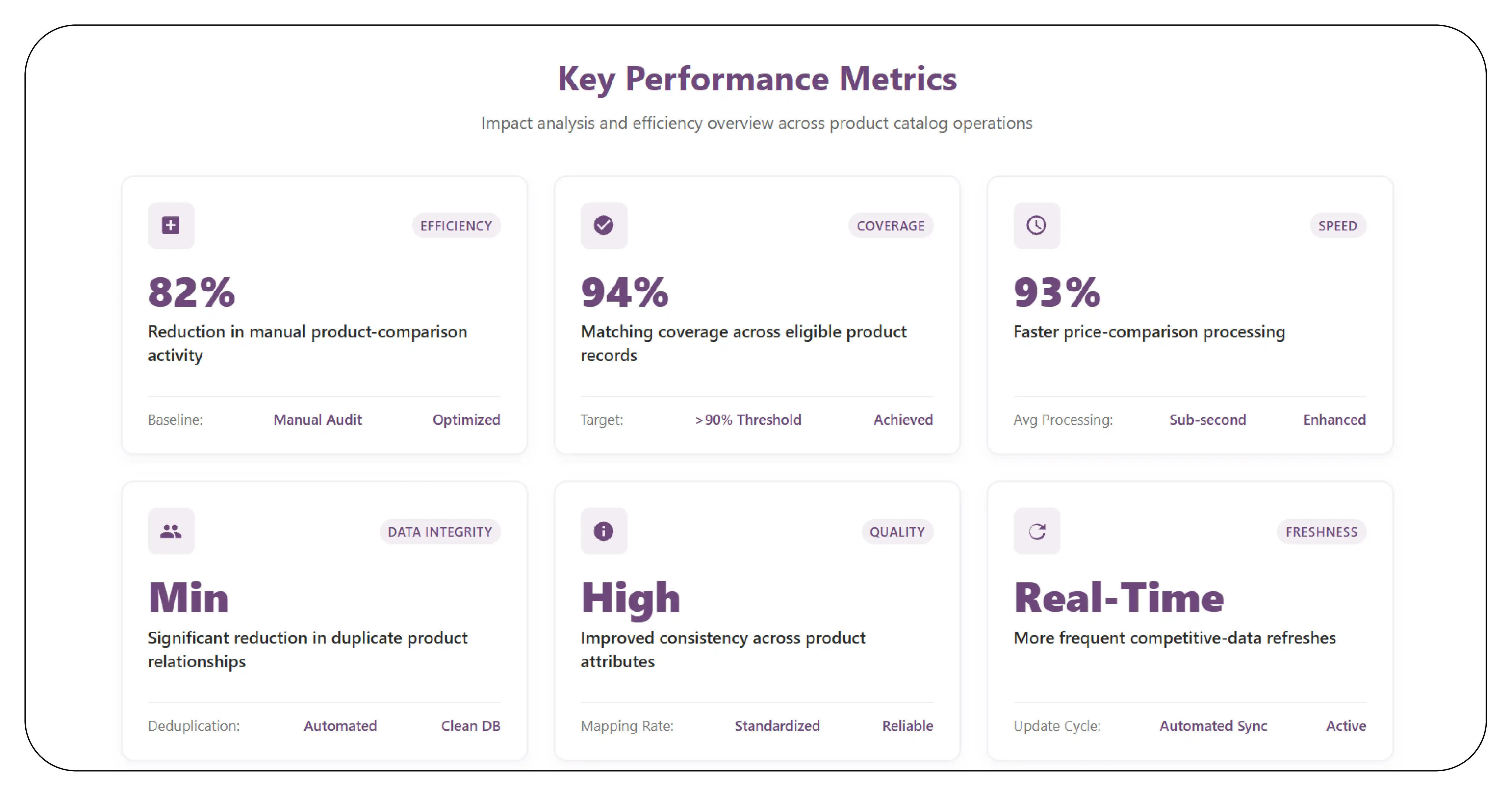
82% reduction in manual product-comparison activity.
94% matching coverage across eligible product records.
93% faster price-comparison processing.
Significant reduction in duplicate product relationships.
Improved consistency across product attributes.
More frequent competitive-data refreshes.
Reduced analyst time spent on repetitive marketplace searches.
These figures represent the project's illustrative performance outcomes and focus exclusively on operational and data-quality improvements rather than financial results.
Results Narrative
The new workflow gave the retail brand a more reliable way to compare products across eBay and Amazon. Analysts could work from structured relationships rather than repeatedly searching individual marketplace pages.
Product Matching & Mapping for Sellers, eBay vs Amazon Competing-Product Mapping also created a reusable foundation for future competitive intelligence. New product categories could be incorporated without redesigning the entire process. Pricing and availability information could be connected to mapped products, creating a richer view of marketplace competition.
The result was a faster, more consistent, and scalable competitive-analysis process.
What Made Product Data Scrape Different?
Product Data Scrape treated the project as a product-intelligence engineering challenge rather than a basic marketplace scraping task. The workflow combined source-specific extraction, schema normalization, multi-field matching, confidence-based validation, and structured delivery.
The architecture was also designed for reuse. The same framework could be extended to additional categories or marketplaces without recreating the entire pipeline.
The Amazon Fresh Product Data Scraper, eBay vs Amazon Competing-Product Mapping workflow demonstrated how reusable extraction and matching components can support broader ecommerce intelligence requirements. Automated validation reduced the risk of low-confidence matches entering the analytical dataset.
This combination of automation and structured product relationships allowed the client to spend less time collecting information and more time interpreting competitive signals.
Client's Testimonial
"Before the project, comparing our products across marketplaces required considerable manual research. Product Data Scrape gave us a much more structured way to identify comparable listings and evaluate pricing. The matching process significantly reduced the time our team spent searching individual product pages, while the standardized dataset made our reports easier to maintain. We now have a scalable foundation that can support additional categories and marketplace sources as our competitive intelligence requirements grow."
— Director of Ecommerce Strategy, Confidential Retail Brand
The client particularly valued the automated Product matching, eBay vs Amazon Competing-Product Mapping workflow because it created consistent product relationships while reducing repetitive research.
Conclusion
The project demonstrates how structured product matching can improve competitive intelligence for ecommerce retailers. By connecting comparable listings across eBay and Amazon, the brand gained a more consistent foundation for analyzing product assortment, pricing, sellers, and marketplace positioning.
Automated extraction and normalization reduced manual research, while multi-field matching improved the reliability of product relationships. The resulting framework can also be extended to additional categories and marketplaces as the brand's intelligence requirements evolve.
Access to reliable Competitive pricing data gives retailers stronger context for evaluating marketplace positioning and making informed commercial decisions.
For brands seeking to transform fragmented marketplace listings into actionable intelligence, Product Data Scrape can design scalable extraction, matching, normalization, and monitoring workflows tailored to their requirements.
Ready to improve your marketplace competitive intelligence? Contact Product Data Scrape for customized product data extraction, product matching, ecommerce scraping, and competitive intelligence solutions!
FAQs
1. What is eBay vs Amazon product mapping?
It is the process of identifying equivalent or comparable products listed across eBay and Amazon and creating structured relationships between those listings.
2. Why is product matching important for price comparison?
Price comparison is meaningful only when the products being compared are equivalent or sufficiently comparable. Matching helps prevent unrelated listings from being analyzed together.
3. What attributes can be used for matching?
Depending on availability, matching can use product identifiers, brand names, model numbers, titles, categories, specifications, variants, pack quantities, and other product attributes.
4. Can product mapping be automated?
Yes. Automated rules and matching logic can process high-confidence relationships at scale. Uncertain matches can be flagged for additional validation.
5. Can the workflow support additional marketplaces?
Yes. A modular architecture can be extended to additional ecommerce sources by adding source-specific extraction and normalization components while retaining the core matching framework.


 Singapore
 EMAIL
EMAIL
 PHONE
PHONE


.webp)









.webp)