Introduction
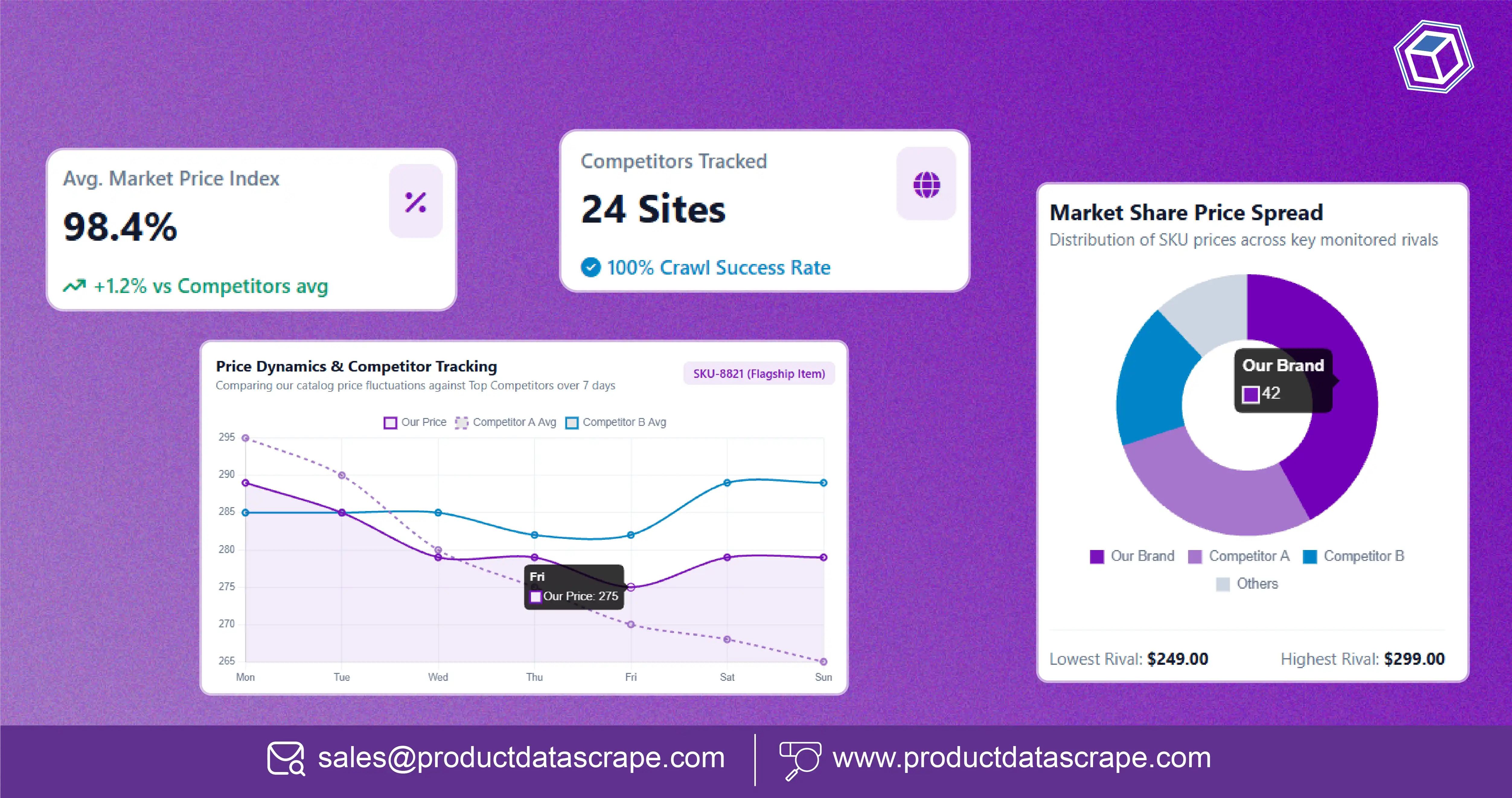
Dynamic Pricing Intelligence helps e-commerce brands, retailers, marketplaces, and pricing teams monitor competitor prices, promotions, product availability, and market movements so they can make faster pricing decisions. A structured Web Scraping API can automate permitted public data collection and turn changing marketplace signals into usable pricing intelligence.
The global retail environment has become increasingly data-driven. McKinsey reported that companies using advanced pricing capabilities can achieve significant margin improvements, with pricing often producing a larger profit impact than changes in volume or fixed costs.
The main problem is speed. Competitors can change prices many times during a selling period. Manual monitoring cannot reliably capture every change across thousands of products.
A scalable pricing workflow can help teams:
- Monitor competitor prices.
- Track discounts and promotions.
- Compare product availability.
- Identify pricing gaps.
- Measure historical price movements.
- Detect unusual price changes.
- Support automated pricing rules.
- Improve product-level benchmarking.
- Feed pricing dashboards.
- Create datasets for AI and analytics.
This article addresses e-commerce brands, retailers, marketplace sellers, pricing analysts, and data teams that need to solve the specific pain point of slow, fragmented, and manual competitor price monitoring.
The objective is not simply to collect prices. The goal is to understand when prices change, why they may be changing, how competitors respond, and what action a business should consider next.
How Does Automated Price Collection Improve Market Visibility?
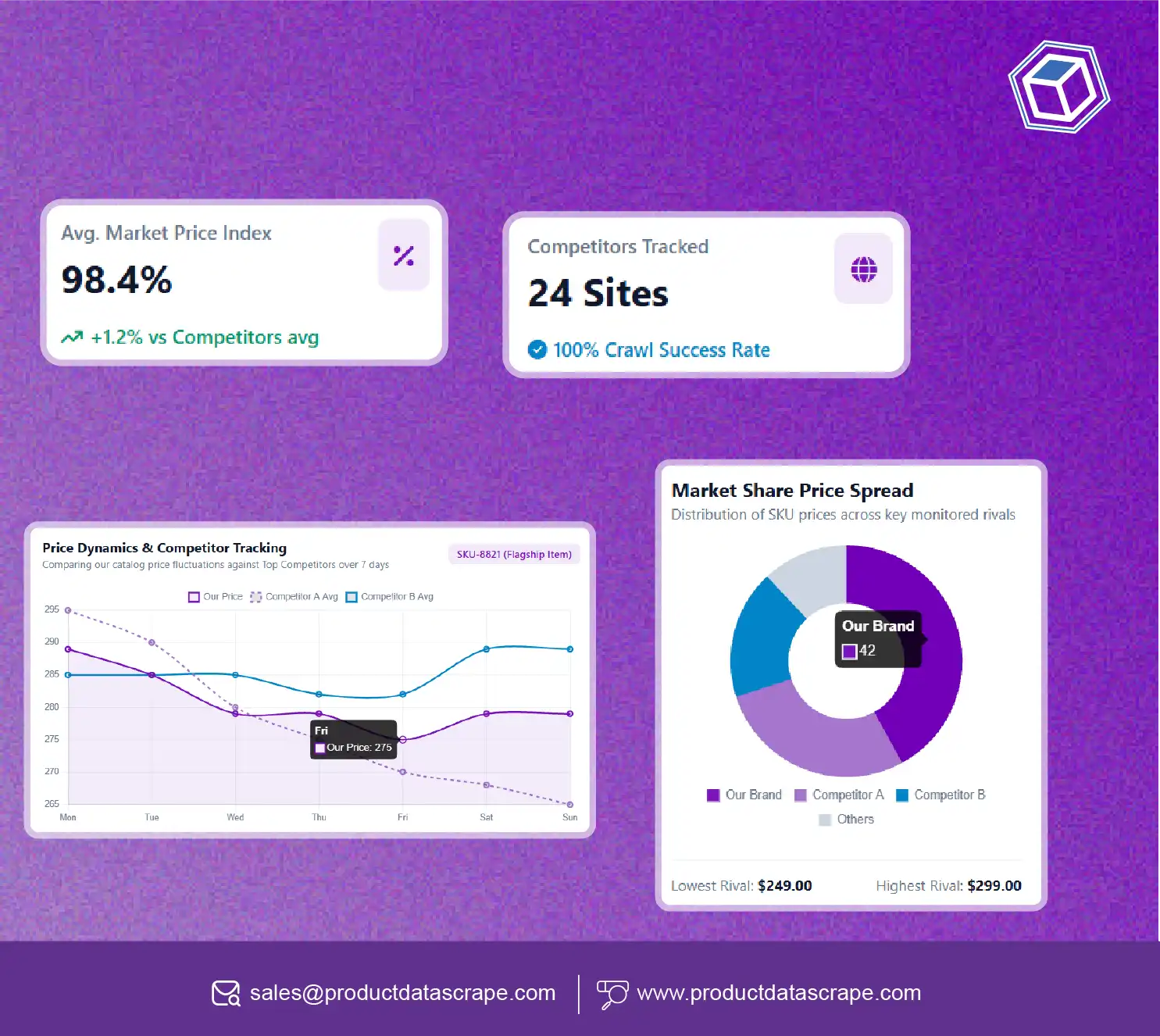
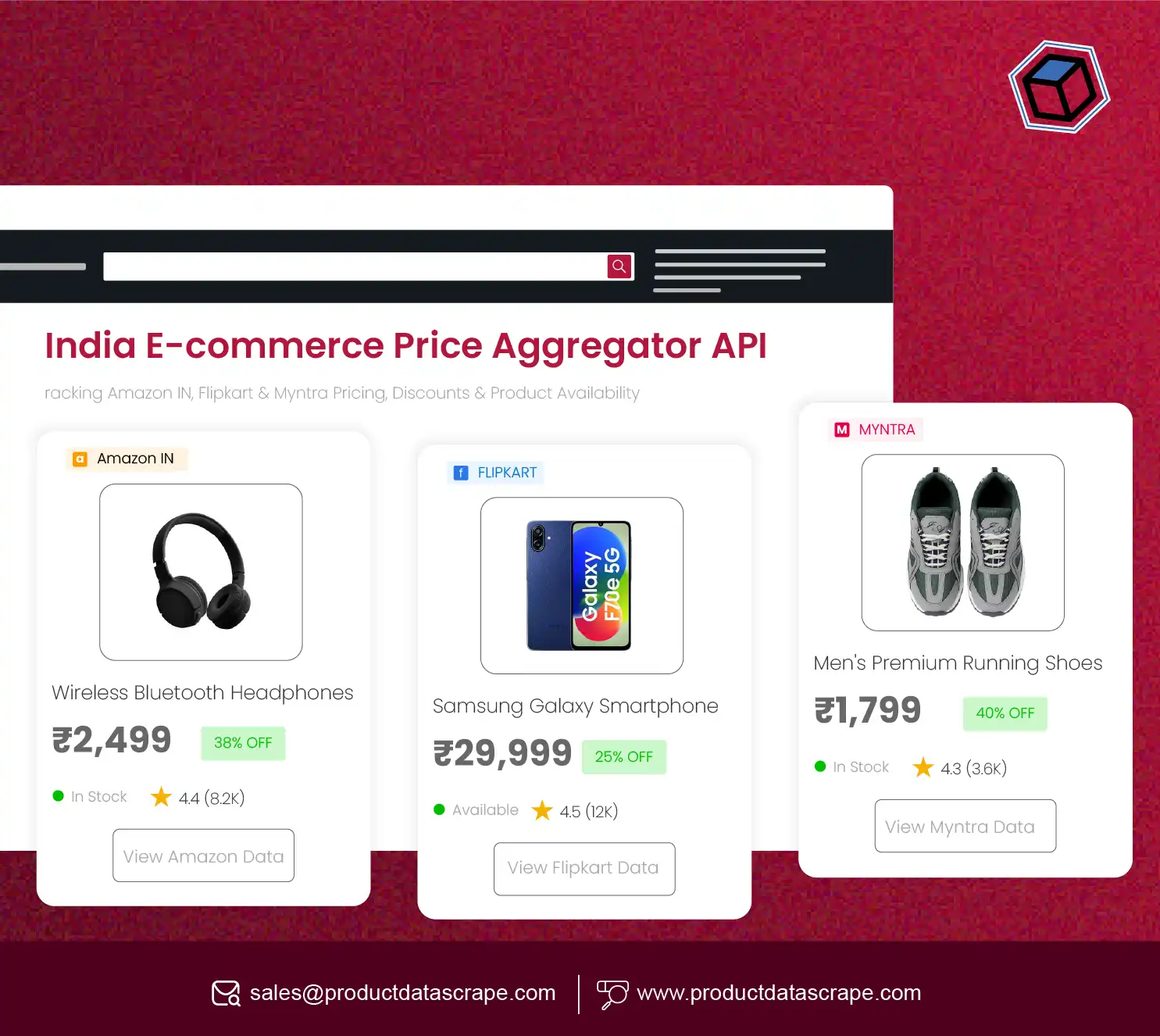
dynamic pricing data scraping can help businesses collect permitted public pricing information at recurring intervals and transform it into structured historical records. This creates a consistent view of how products and competitors behave over time.
A pricing dataset can include product name, SKU, brand, seller, current price, previous price, discount, availability, rating, review count, promotion, timestamp, and marketplace.
Historical snapshots matter because one price does not tell the full story. A product priced at $49 today may have been $59 yesterday and $45 last week. Without historical data, analysts cannot easily identify the pattern.
The same datasets can also support Web Scraping for AI Training when organizations have the necessary rights and permissions to use the collected information for model development.
What can businesses monitor?
| Data signal |
Pricing use |
| Current price |
Competitive benchmarking |
| Previous price |
Price-change detection |
| Discount |
Promotion tracking |
| Availability |
Supply context |
| Seller |
Competitor identification |
| Product ID |
Product matching |
| Timestamp |
Historical analysis |
| Rating |
Customer signal |
| Reviews |
Market feedback |
| Category |
Market segmentation |
What did e-commerce growth look like from 2020 to 2026?
| Year |
Example market-development focus |
| 2020 |
Rapid digital shopping adoption |
| 2021 |
Marketplace expansion |
| 2022 |
Omnichannel and price competition |
| 2023 |
Personalization and automation |
| 2024 |
AI-supported retail analytics |
| 2025 |
Real-time commerce optimization |
| 2026 |
AI-driven pricing and decision systems |
These years represent analytical stages rather than universal market statistics. Individual sectors and countries experienced different levels of e-commerce growth.
Automated collection becomes particularly useful when a company manages thousands of SKUs. An analyst cannot realistically check every competitor listing every hour.
An automated pipeline can collect defined fields, validate them, timestamp each observation, and store them in a database.
The system can then calculate:
- Price difference.
- Discount percentage.
- Average market price.
- Lowest competitor price.
- Highest competitor price.
- Price volatility.
- Frequency of price changes.
- Competitor price position.
For AI applications, historical data can also provide examples of changing market conditions. However, businesses must confirm data rights, licensing, privacy requirements, and applicable terms before using scraped data to train models.
The combination of historical data and automation creates a stronger foundation for pricing research.
How Can Competitor Behavior Improve Pricing Decisions?
dynamic pricing based on competitor analysis helps businesses understand where their prices sit within the market and how competitors respond to changes.
A retailer may want to remain within a competitive price range without always becoming the cheapest seller. A premium brand may instead want to maintain a price premium while monitoring competitor discounts.
Both strategies require reliable market data.
Which competitor signals matter?
| Signal |
What it can reveal |
| Competitor price |
Relative market position |
| Price change |
Competitive movement |
| Discount |
Promotional pressure |
| Stock status |
Supply conditions |
| Seller count |
Competitive intensity |
| Product rating |
Customer perception |
| Review growth |
Product engagement |
| Promotion timing |
Market-event response |
Consider a hypothetical product with an average market price of $100.
If competitors move to $95, $97, and $99, the market average becomes $97. A business priced at $110 may now be significantly above the market.
But price alone does not determine the correct response.
The product could have stronger reviews, faster delivery, better warranty coverage, or a premium brand reputation. Those factors may justify a higher price.
Therefore, competitor intelligence should provide context, not just a price number.
How can historical data help?
Suppose a competitor normally sells at $100 but drops to $85 every Friday. That pattern may indicate a recurring promotion rather than a permanent price reduction.
A business that sees only today's $85 price could react unnecessarily.
A historical dataset can identify the recurring pattern.
From 2020 to 2026, pricing teams have increasingly had access to larger volumes of marketplace and customer data. The strategic shift is from occasional price checks toward continuous monitoring.
Businesses can create alerts when:
- A competitor changes price by more than 10%.
- A competitor becomes cheaper than the target product.
- A product goes out of stock.
- A new seller appears.
- A promotion begins.
- The market average changes significantly.
This allows analysts to focus on meaningful changes instead of reviewing every record.
The system can also support category-level analysis. A business may discover that competitors frequently discount entry-level products but maintain higher prices on premium models.
That insight can inform assortment and pricing strategy.
How Can AI Make Pricing More Responsive?
AI-Powered Dynamic Pricing can help businesses process large volumes of pricing, demand, inventory, and competitor data faster than traditional manual analysis.
AI can identify relationships across thousands of products. It can detect recurring patterns, classify pricing events, estimate price sensitivity, and generate recommendations based on predefined business rules.
However, AI should not operate without controls.
A pricing system needs clear boundaries. Businesses may define minimum margins, maximum discounts, brand restrictions, inventory rules, or competitive thresholds.
What data can AI analyze?
| Data category |
AI application |
| Competitor prices |
Market-position analysis |
| Historical prices |
Trend detection |
| Demand signals |
Demand estimation |
| Inventory |
Supply-aware pricing |
| Promotions |
Promotion analysis |
| Reviews |
Customer sentiment signals |
| Product category |
Segment-level pricing |
| Seasonality |
Periodic demand patterns |
A simplified AI workflow might look like this:
- Collect permitted market data.
- Normalize product and competitor records.
- Add historical observations.
- Combine internal sales and inventory data.
- Detect pricing patterns.
- Apply business constraints.
- Generate a pricing recommendation.
- Send the recommendation for approval or automation.
The 2020–2026 period shows why historical context matters. COVID-19 accelerated online shopping in many markets in 2020 and 2021. Later years brought stronger omnichannel competition, increased personalization, and wider use of AI in retail.
An AI model trained only on recent data may fail to understand unusual market periods.
A broader historical dataset can provide more diverse examples.
But more data does not automatically produce better AI. Poor product matching, duplicate records, missing timestamps, and incorrect prices can introduce errors.
Data quality therefore becomes a core requirement.
AI pricing systems should also be monitored for unexpected behavior. A model might recommend aggressive discounts when a competitor temporarily lowers its price. Without business rules, that could reduce margins unnecessarily.
The safest approach combines machine intelligence with business constraints.
AI can identify opportunities. Human teams or predefined rules can control the final decision.
How Can Online Retailers Use Flexible Pricing Strategies?
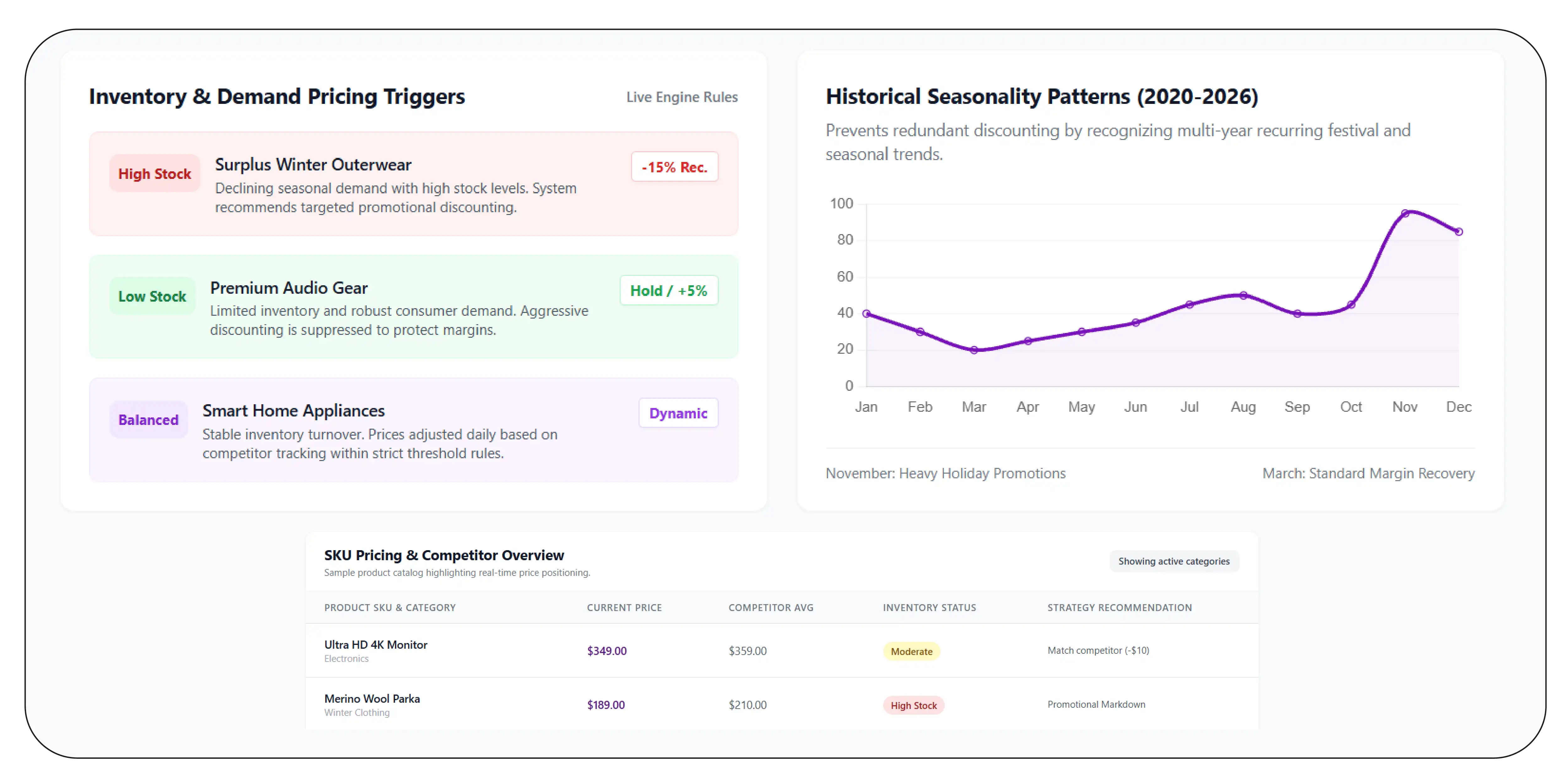
Dynamic Pricing for eCommerce can help retailers adapt prices to market conditions while balancing revenue, competitiveness, inventory, and customer expectations.
Dynamic pricing does not always mean changing prices every few minutes. It can also mean updating prices once per day, during promotions, by region, or when specific competitive conditions occur.
Which pricing models can businesses consider?
| Model |
Example use |
| Competitor-based |
Respond to market price changes |
| Demand-based |
Adjust according to demand |
| Inventory-based |
Reduce excess inventory |
| Time-based |
Apply seasonal pricing |
| Promotion-based |
Manage campaign discounts |
| Segment-based |
Adjust by customer or market rules |
| Rule-based |
Maintain predefined price boundaries |
For example, a retailer could establish a rule:
If the market average falls by more than 5%, review the product price.
Another rule could be:
Do not reduce the price below the target gross margin.
This approach gives businesses control while still using market intelligence.
What should retailers measure?
- Revenue.
- Gross margin.
- Conversion rate.
- Average selling price.
- Competitor price position.
- Inventory turnover.
- Discount frequency.
- Price-change frequency.
The goal should not be to maximize price changes. Too many changes can confuse customers and create operational problems.
Instead, businesses should identify the right frequency for each category.
High-competition electronics may require frequent monitoring. Specialty products may need much less frequent updates.
Seasonality also matters.
A retailer selling winter clothing can monitor competitor prices more closely as the season progresses. An electronics retailer may focus on major shopping festivals and product launches.
Historical data from 2020 to 2026 can help businesses identify recurring seasonal patterns.
A product that experiences strong discounting every November may not require the same strategy in March.
The same logic applies to inventory.
If a product has high inventory and declining demand, a pricing system may recommend a promotion. If inventory is limited and demand is strong, aggressive discounting may be unnecessary.
Dynamic pricing therefore works best when multiple signals are combined.
Competitor price is one variable. It should not be the only variable.
How Can Web Data Support Real-Time Pricing Workflows?
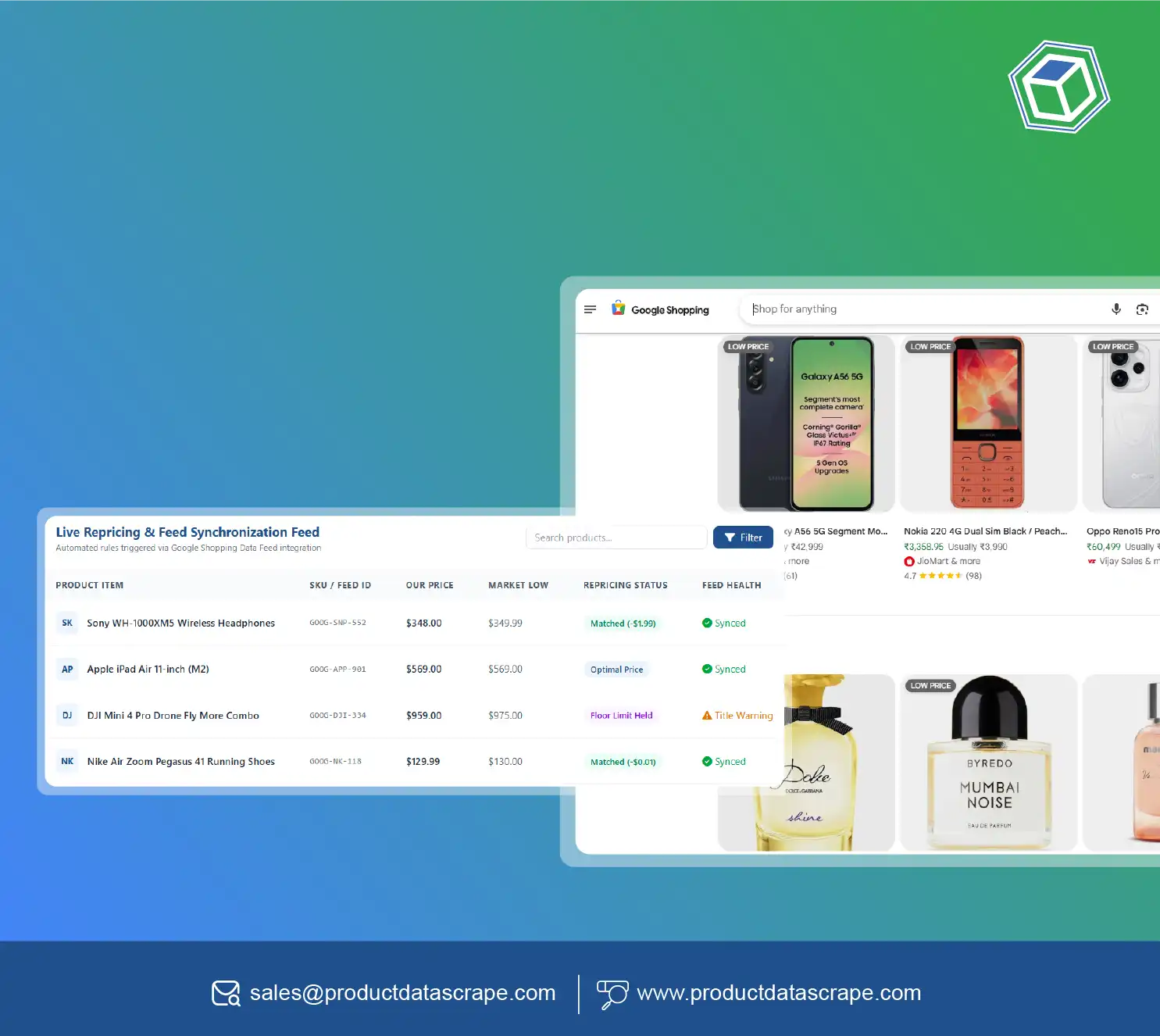
web scraping for dynamic pricing can provide the external market signals required for competitive pricing systems.
Businesses can collect permitted public information from marketplaces, retailer websites, product catalogs, and other relevant sources. The collected records can then be compared with internal pricing and inventory information.
What does a pricing workflow look like?
- Step 1: Identify competitors. Select relevant retailers, marketplaces, brands, or sellers.
- Step 2: Match products. Connect equivalent SKUs, models, sizes, and variants.
- Step 3: Collect prices. Capture permitted public price information at scheduled intervals.
- Step 4: Store history. Save each observation with a timestamp.
- Step 5: Calculate market metrics. Determine averages, ranges, gaps, and changes.
- Step 6: Trigger alerts. Flag significant movements.
- Step 7: Apply business rules. Consider margins, inventory, demand, and pricing policies.
- Step 8: Analyze results. Use dashboards or automated reporting.
Example market-monitoring table
| Metric |
Example |
| Target product price |
$100 |
| Competitor A |
$98 |
| Competitor B |
$95 |
| Competitor C |
$103 |
| Market average |
$98.67 |
| Target premium |
1.35% |
| Lowest competitor gap |
5.26% |
These values are hypothetical and demonstrate the type of calculation a pricing system can perform.
Historical records make the analysis stronger.
If the same product was $110 last month, $105 last week, and $100 today, the business can see a downward trend.
If all three competitors reduced prices at the same time, the event may indicate broader market pressure.
If only one competitor reduced price, the change may represent a company-specific promotion.
This distinction is valuable.
Pricing intelligence can also support category-level dashboards.
A category manager might see:
- 20 products below target price.
- 15 products with new competitor discounts.
- 8 products with significant market price increases.
- 5 products experiencing stock shortages.
This allows teams to prioritize action.
The system can also store competitor histories for later analysis.
A six-year dataset from 2020 to 2026 can reveal long-term pricing behavior, while shorter intervals can capture recent market changes.
The collection frequency should match the business use case and technical permissions. Not every product requires minute-by-minute monitoring.
How Can Pricing Intelligence Improve Business Decisions?
Pricing intelligence gives businesses a structured way to understand competitive prices, promotions, market positioning, and historical pricing behavior.
The value comes from combining multiple signals.
A pricing team can compare current prices with:
- Historical prices.
- Competitor prices.
- Market averages.
- Internal costs.
- Inventory levels.
- Demand.
- Product ratings.
- Promotion calendars.
Which decisions can pricing intelligence support?
| Decision |
Useful intelligence |
| Repricing |
Competitor and market prices |
| Promotion planning |
Historical discounts |
| Product launches |
Competitive price ranges |
| Inventory management |
Stock and price relationship |
| Category strategy |
Segment-level trends |
| Margin management |
Price and cost comparison |
| Competitor monitoring |
Price-change alerts |
A good pricing intelligence system should also distinguish between data collection and decision-making.
The collection layer gathers information.
The analytics layer calculates metrics.
The business layer decides what action is appropriate.
This separation makes the system easier to manage.
For example, a retailer could collect prices every six hours. The analytics layer could calculate the average market price. The business rules could then flag products where the retailer is more than 8% above the market.
An analyst can review those alerts.
The same system could monitor thousands of products without requiring thousands of manual checks.
2020–2026 strategic progression
| Period |
Pricing intelligence focus |
| 2020 |
Digital shopping expansion |
| 2021 |
Marketplace competition |
| 2022 |
Omnichannel pricing |
| 2023 |
Personalized commerce |
| 2024 |
AI-assisted analysis |
| 2025 |
Automated decision workflows |
| 2026 |
Integrated AI pricing systems |
The most advanced systems can combine external market data with internal business data.
This is more useful than competitor price alone.
It also reduces overreaction.
A competitor may lower its price temporarily. A business with historical data can recognize the pattern instead of immediately matching it.
Pricing intelligence can therefore improve both speed and discipline.
The ultimate goal is not to always offer the lowest price. It is to understand the market well enough to choose a price that supports the company's strategy.
Why Choose Product Data Scrape?
For businesses managing large product catalogs, reliable pricing data is essential. Track AI shelf workflows can support AI-based product and pricing analysis by providing structured market observations for approved use cases.
Dynamic Pricing Intelligence becomes more valuable when pricing data is historical, normalized, timestamped, and easy to integrate with analytics systems.
Product Data Scrape can help businesses build scalable data pipelines for product prices, competitor monitoring, availability, and marketplace intelligence. The workflow can support recurring collection, structured output, validation, and API-based delivery.
The main advantages include:
- Automated market monitoring.
- Historical price tracking.
- Product matching.
- Competitor benchmarking.
- Structured datasets.
- Scalable processing.
- Analytics-ready output.
- Custom pricing workflows.
This approach reduces manual research and gives pricing teams more time to focus on strategy.
Conclusion
Competitor price monitoring gives businesses the market visibility needed to understand price movements, promotions, and competitive positioning. Dynamic Pricing Intelligence turns those observations into structured insights that can support faster and more informed pricing decisions.
From 2020 through 2026, e-commerce has moved toward greater automation, personalization, and data-driven decision-making. Businesses now need more than occasional price checks. They need historical context, product matching, alerts, and scalable data workflows.
A strong system can monitor competitor prices, compare market averages, track promotions, identify pricing gaps, and connect external signals with internal inventory and demand data.
The best approach balances automation with business rules. It protects margins while allowing teams to respond to meaningful market changes.
Ready to strengthen your pricing strategy with scalable market data? Contact Product Data Scrape to build automated pricing and competitor-monitoring solutions tailored to your e-commerce business!
FAQs
What is dynamic pricing intelligence?
Dynamic pricing intelligence combines competitor prices, market changes, demand signals, inventory, and historical data to help businesses evaluate pricing opportunities and respond to changing conditions.
How does automated price monitoring help retailers?
Automated monitoring tracks competitor prices and promotions continuously, reducing manual research and helping retailers identify significant market changes faster across large product catalogs.
Can pricing data support AI systems?
Yes. Structured historical pricing data can support AI analytics and model development when businesses have appropriate data rights, permissions, licensing, and quality controls.
What products benefit most from dynamic pricing?
Competitive categories with frequent price changes, such as electronics, fashion, travel, and consumer goods, can benefit strongly from automated pricing intelligence and historical competitor monitoring.
How does Product Data Scrape help?
Product Data Scrape can help businesses build structured workflows for collecting permitted market pricing data, tracking changes, benchmarking competitors, and supporting scalable pricing analytics.


 Singapore
 EMAIL
EMAIL
 PHONE
PHONE










.webp)