Quick Overview
This case study shows how an e-commerce retailer improved revenue visibility by combining automated marketplace data collection, pricing intelligence, and inventory monitoring. The client needed a faster way to Estimate your sales performance without depending on fragmented spreadsheets and delayed reports. Product Data Scrape implemented a structured monitoring workflow covering product prices, stock status, availability, and marketplace activity. The project helped the business connect daily marketplace signals with sales-performance analysis and identify products requiring immediate attention. The solution delivered 96%+ data completeness, reduced manual monitoring effort by 65%, and expanded daily monitoring across more than 4,000 product listings. The resulting intelligence framework helped commercial teams make faster pricing, inventory, and assortment decisions.
Client Name / Industry: Anonymized E-commerce Retailer / Online Consumer Goods
Service / Duration: Marketplace Price, Stock & Sales Intelligence / 12 Weeks
Key Impact Metrics: 96%+ data completeness | 65% reduction in manual monitoring | 4,000+ listings monitored daily
Note: Performance figures are representative project metrics used to illustrate the solution and outcomes.
The Client
The client was an online retailer managing a broad assortment of consumer products across multiple marketplace channels. Its commercial team needed to understand how pricing, stock availability, competitor activity, and product assortment were influencing marketplace performance.
E-commerce competition has become increasingly dynamic. Sellers frequently adjust prices, introduce promotions, replenish inventory, or temporarily remove products from sale. These changes can affect product visibility and purchasing behavior within short periods. For the client, relying on weekly or manually prepared reports meant that important marketplace changes could remain unnoticed.
Before partnering with Product Data Scrape, the client used a combination of spreadsheets, manual marketplace searches, and internally generated sales reports. Teams could access historical sales information, but they had limited visibility into the marketplace conditions surrounding those results. For example, a product's sales decline might have been related to a competitor's lower price, an unavailable inventory position, or a sudden assortment change.
The business needed a transformation that connected external marketplace signals with internal performance analysis. Daily Marketplace Price Tracking became a critical requirement because the team needed a consistent view of competitive price movements rather than occasional snapshots.
The objective was to establish a scalable data workflow that could provide timely product-level intelligence while reducing repetitive manual research.
Goals & Objectives

Improve visibility into product-level commercial performance.
Scale marketplace monitoring across thousands of listings.
Increase the speed of pricing and inventory analysis.
Improve the accuracy and consistency of marketplace data.
Reduce repetitive manual research performed by commercial teams.
Identify products requiring immediate pricing or inventory attention.
Establish a reliable foundation for sales-performance analysis.
Automate recurring collection of product prices and availability.
Standardize product, price, stock, and marketplace fields.
Connect marketplace observations with analytical workflows.
Create scheduled data-refresh processes.
Support dashboard-based monitoring and reporting.
Identify product-level changes across multiple marketplace sources.
Enable Daily Stock Availability Tracking to identify inventory movements and potential sales-impacting stockouts.
Achieve 96%+ completeness across monitored product records.
Monitor 4,000+ marketplace listings on a recurring basis.
Reduce manual marketplace monitoring effort by approximately 65%.
Achieve 95%+ successful collection coverage across targeted listings.
Reduce the time required to identify price and stock changes.
Increase the frequency of marketplace intelligence updates.
Improve visibility into products experiencing availability changes.
These goals combined commercial requirements such as scalability, speed, and accuracy with technical requirements involving automation, integration, and analytics.
The Core Challenge
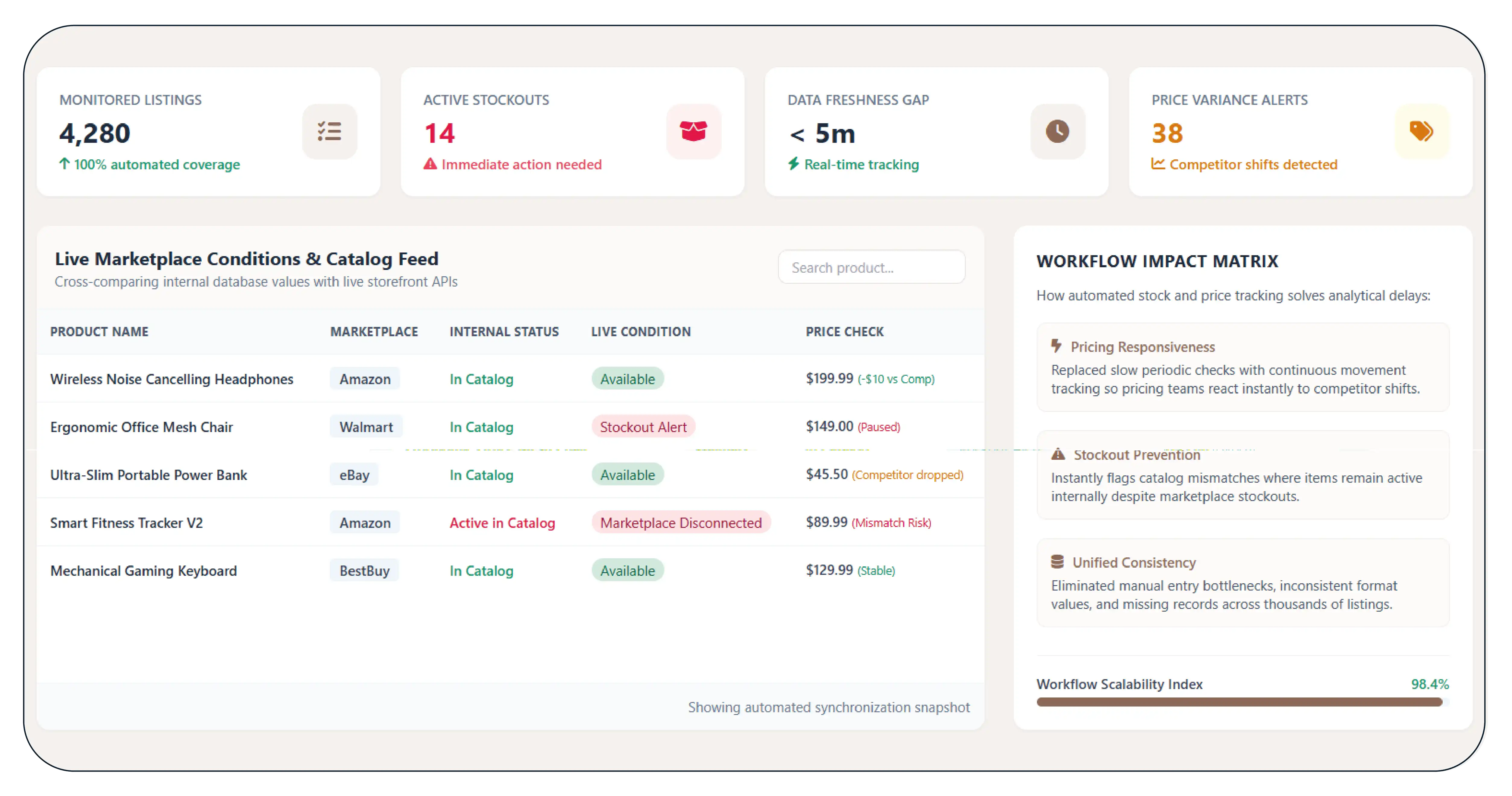
The client's biggest challenge was the disconnect between sales-performance data and marketplace conditions. Internal sales reports could show that a product was selling more or less than expected, but they did not always explain why the change occurred.
Manual monitoring created several operational bottlenecks. Analysts had to visit marketplace pages, record current prices, check product availability, compare competing offers, and update spreadsheets. With thousands of listings, repeating this process every day was impractical.
Data consistency was another concern. Product names, pricing formats, availability labels, and other marketplace attributes could vary between sources. Manual entry increased the possibility of missing records, outdated information, and inconsistent values.
Stock availability presented an additional challenge. A product could remain active in an internal catalog even after becoming unavailable on a marketplace. Without timely monitoring, teams could miss the potential impact of stockouts on sales performance.
The business therefore needed Product Stock Monitoring Across Marketplaces to create a consistent view of product availability and marketplace conditions.
Another problem involved data freshness. Periodic checks could identify major changes but were less effective for short-term pricing movements and temporary stock disruptions. The client needed a more frequent monitoring process capable of detecting changes close to when they occurred.
These challenges affected decision-making speed. Pricing teams could react late to competitor movements, inventory teams could discover stock issues after sales were affected, and management lacked a unified view of marketplace performance drivers.
The solution needed to combine automation, data validation, historical tracking, and analytics into one scalable workflow.
Our Solution
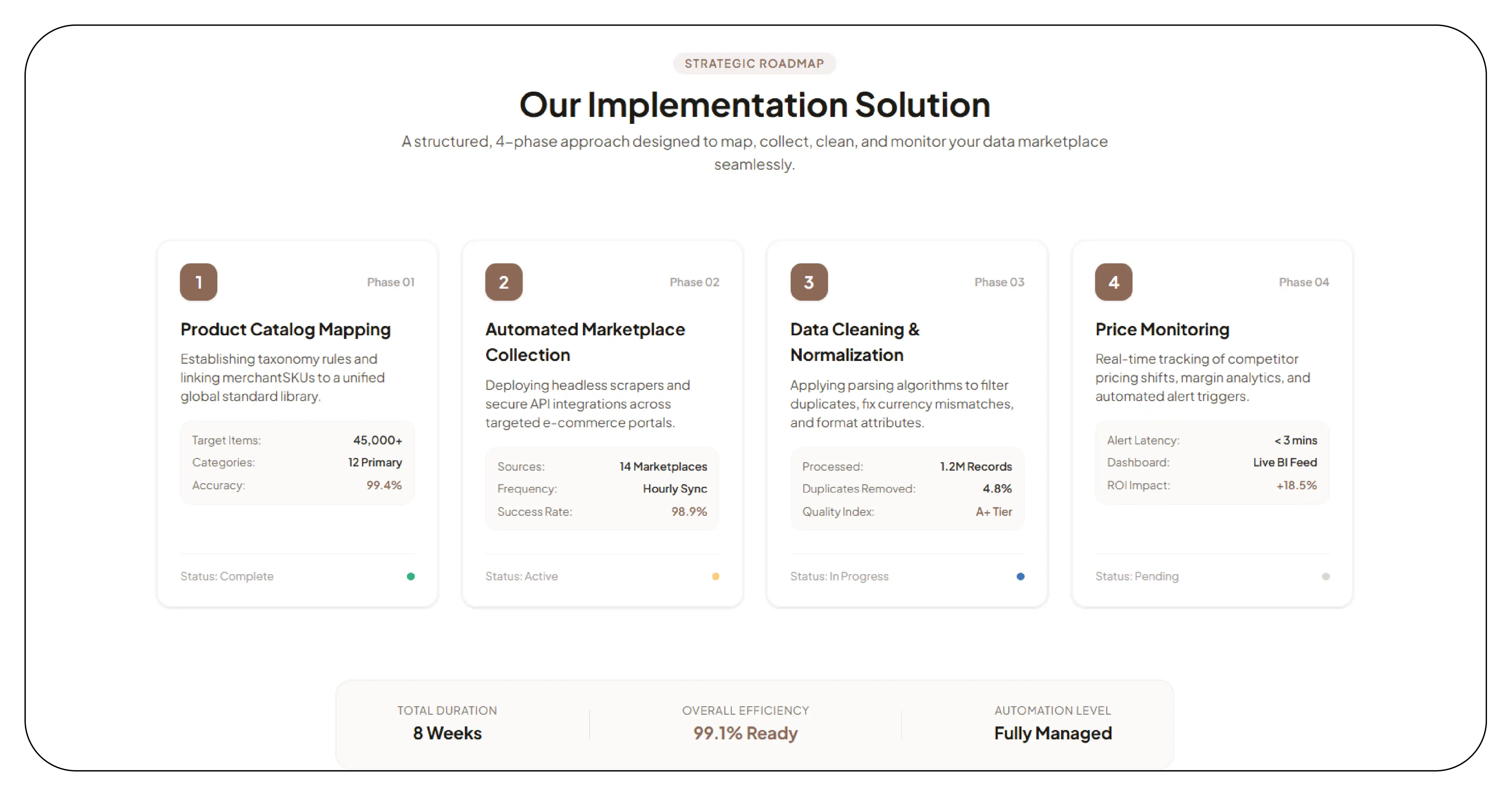
Product Data Scrape developed a phased data-intelligence workflow designed to connect marketplace conditions with commercial performance analysis.
Phase 1: Product Catalog Mapping
The first stage established a standardized product structure. Internal product identifiers were mapped against marketplace listings, categories, product names, brands, prices, stock status, availability, and other relevant attributes. This created a consistent foundation for comparing products across marketplace sources.
Phase 2: Automated Marketplace Collection
The second phase introduced automated collection workflows for targeted product listings. The system captured relevant price and availability attributes according to predefined schedules. Automation reduced repetitive manual research and created a consistent stream of marketplace observations.
Phase 3: Data Cleaning and Normalization
Raw marketplace information was normalized into standardized fields. Product names were cleaned, numerical price values were structured, stock-status labels were standardized, and duplicate records were identified. Validation rules helped flag incomplete or unusual records before they entered analytical workflows.
Phase 4: Price Monitoring
The next stage focused on identifying pricing movements. Historical snapshots were retained so the client could compare current observations against previous prices. This helped commercial teams identify products experiencing significant price changes and determine whether competitive movement might require attention.
Phase 5: Inventory Monitoring
Availability signals were monitored alongside pricing information. The system identified products that changed from available to unavailable or showed other relevant inventory-status changes. This made it possible to connect product availability with broader marketplace performance.
Phase 6: Analytics and Reporting
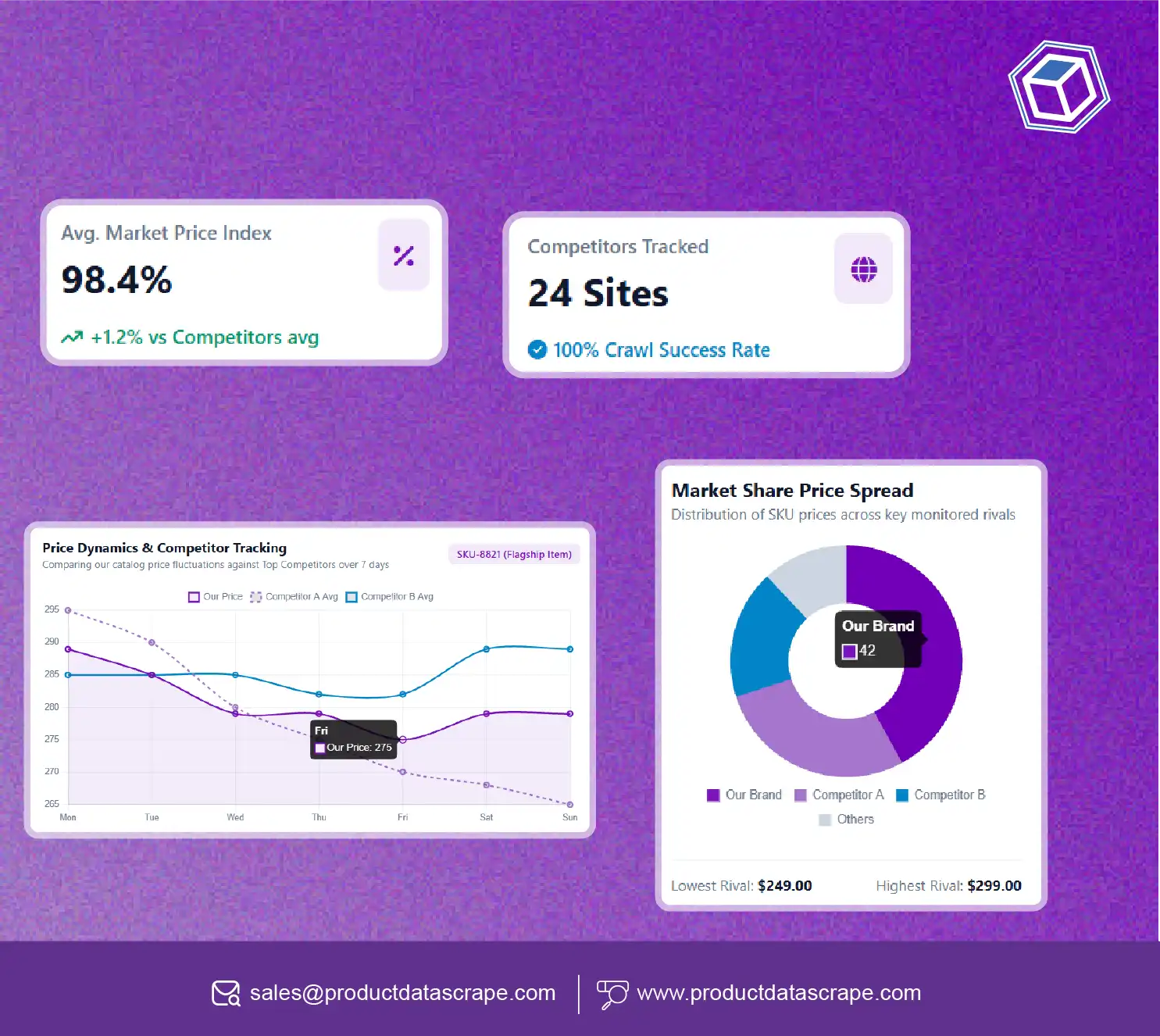
The collected information was transformed into analytical views for commercial and management teams. Users could filter products by category, price movement, availability, marketplace, or other relevant dimensions. The resulting Marketplace Price & Stock Analysis workflow gave teams a consolidated view of market conditions rather than requiring separate manual checks for price and inventory.
Phase 7: Historical Intelligence
Historical snapshots allowed the client to identify recurring patterns. Teams could examine how pricing and availability changed over time and compare those movements with sales-performance observations. This transformed the workflow from basic data collection into a continuous intelligence system. Instead of asking only what a product was selling for today, teams could investigate how price and availability had changed and how those changes might affect commercial performance.
The phased approach also made the system scalable. Additional products, categories, and marketplace sources could be incorporated without redesigning the entire data workflow.
Results & Key Metrics
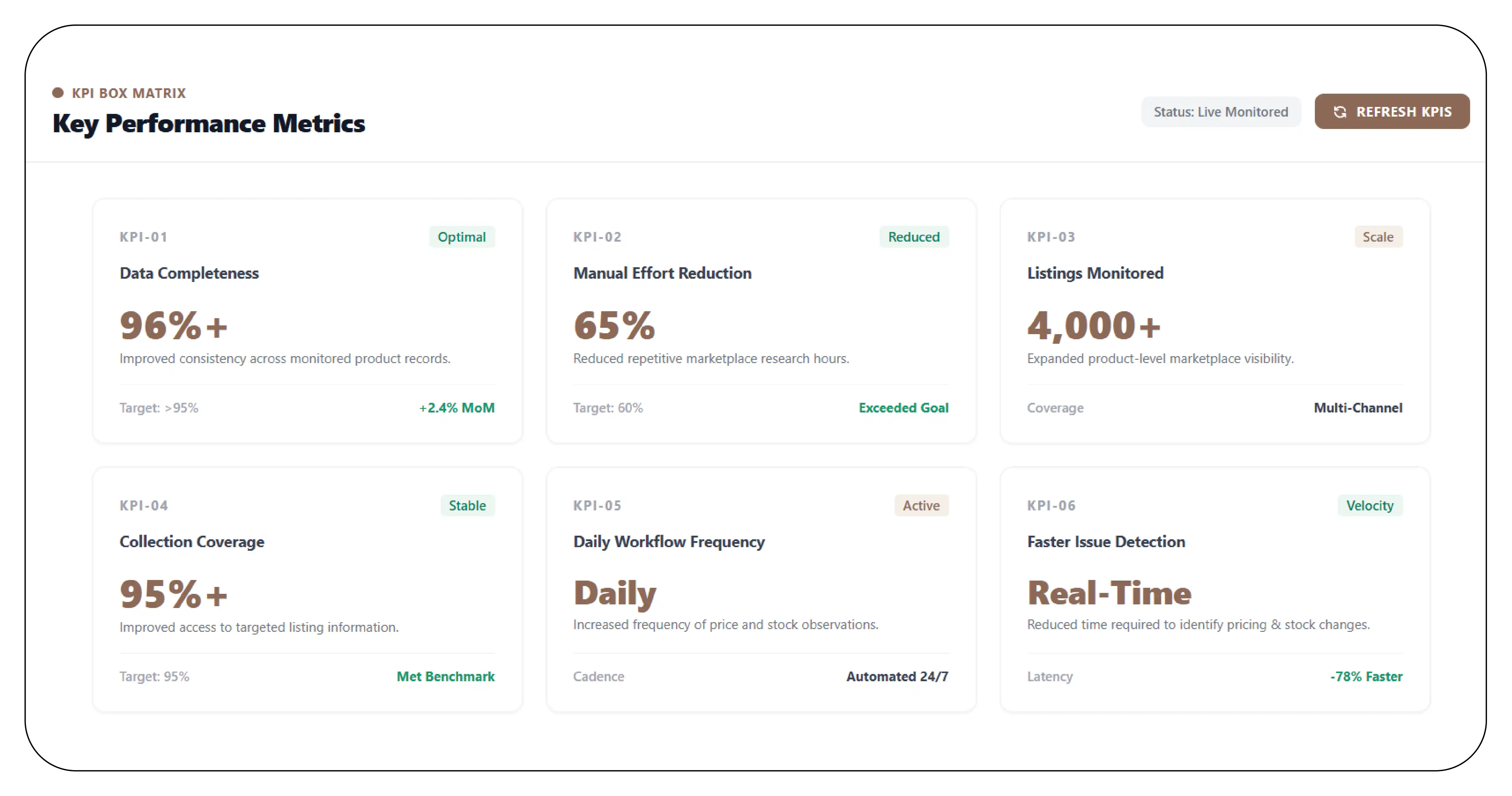
96%+ data completeness: Improved consistency across monitored product records.
65% reduction in manual effort: Reduced repetitive marketplace research.
4,000+ listings monitored: Expanded product-level marketplace visibility.
95%+ collection coverage: Improved access to targeted listing information.
Daily monitoring workflow: Increased the frequency of price and stock observations.
Faster issue detection: Reduced the time required to identify pricing and availability changes.
Results Narrative
The project gave the client a more reliable connection between marketplace conditions and sales-performance analysis. Automated collection reduced manual work while creating a consistent stream of price and availability observations.
The new workflow also improved product-level visibility. Commercial teams could identify products experiencing price changes, availability disruptions, or competitive movements without manually reviewing thousands of listings.
The introduction of Out-of-stock monitoring helped teams identify unavailable products more quickly and prioritize inventory-related actions.
The resulting intelligence framework improved the speed of commercial decision-making and provided a stronger foundation for understanding sales-performance fluctuations. Instead of relying exclusively on historical sales reports, teams could examine marketplace signals alongside performance data.
The project ultimately established Daily Price & Stock Intelligence as a repeatable process for ongoing marketplace monitoring.
What Made Product Data Scrape Different
Product Data Scrape approached the project as an integrated marketplace intelligence challenge rather than a simple data-collection requirement. The workflow combined automated extraction, structured schemas, validation, historical snapshots, and analytical reporting.
A major differentiator was the ability to connect price and availability observations into a single monitoring framework. This gave commercial teams greater context when evaluating product performance.
The solution also incorporated automated Price scraping and normalization logic so marketplace information could be transformed into consistent records suitable for analysis. Historical data made it possible to compare current observations with previous marketplace conditions.
Smart scheduling reduced unnecessary manual intervention while allowing the client to monitor a large catalog consistently.
By combining automation with structured analytical workflows, the system created a scalable foundation for Daily Price & Stock Intelligence that could expand as the client's product assortment and marketplace presence grew.
Client's Testimonial
"The biggest improvement has been the visibility we now have into daily marketplace conditions. Previously, our sales team could see performance changes, but understanding the reasons behind those changes often required several manual checks. The new workflow gives us a clearer view of pricing and availability across our products. Our teams can identify stock issues faster, review competitive price movements, and prioritize products that need attention. The reduction in manual monitoring has also allowed our analysts to focus more on interpreting the data rather than collecting it. This has made our marketplace operations much more responsive."
— Director of E-commerce Operations, Consumer Goods Retailer
The client particularly valued the ability to combine Assortment and availability monitoring with pricing intelligence, giving commercial teams a broader view of marketplace conditions and product performance.
Conclusion
Sales performance depends on more than historical revenue numbers. Pricing, stock availability, assortment, promotions, and competitor activity can all influence how products perform in online marketplaces.
A structured Commerce Intelligence workflow helps businesses connect these signals and turn fragmented marketplace information into actionable insights.
The project demonstrated how Daily Price & Stock Intelligence can improve revenue visibility by providing frequent observations of product pricing and availability. Automated collection reduced manual effort, improved data consistency, and gave commercial teams faster access to important marketplace changes.
With scalable monitoring and historical analysis, businesses can build stronger pricing, inventory, and assortment strategies while responding more quickly to marketplace conditions. The approach also creates a foundation for future predictive analytics and automated decision-support systems.
FAQs
1. How can marketplace data help estimate sales performance?
Marketplace data provides additional context around sales results. Price movements, stock availability, promotions, and competitor activity can help businesses understand potential reasons behind changes in product performance.
2. Why is daily price monitoring important?
Daily monitoring helps businesses detect competitive price movements faster. Frequent observations can reveal changes that periodic manual checks might miss and allow commercial teams to respond more quickly.
3. How does stock availability affect sales analysis?
When a product becomes unavailable, sales may decline even when customer demand remains strong. Monitoring availability helps teams distinguish potential inventory-related performance issues from broader demand changes.
4. Can Product Data Scrape monitor thousands of products?
Automated data workflows can scale across large product catalogs by collecting, normalizing, validating, and organizing marketplace information according to predefined monitoring requirements.
5. What can businesses do with historical price and stock data?
Historical records can help identify pricing patterns, recurring stockouts, competitive movements, assortment changes, and relationships between marketplace conditions and sales performance. These insights can support pricing, inventory, and merchandising decisions.


 Singapore
 EMAIL
EMAIL
 PHONE
PHONE



.webp)









.webp)