Quick Overview
For a leading FMCG company, maintaining strong visibility across online
marketplaces became increasingly important as shoppers shifted toward digital grocery and
quick-commerce platforms. Digital Shelf Monitoring for an FMCG Brand enabled Product Data Scrape
to create a structured view of product visibility, rankings, pricing, availability, and
competitor activity. The project covered the fictional client brand FreshBite Foods and products
such as FreshBite Classic Potato Chips, FreshBite Masala Snacks, and FreshBite Premium Namkeen.
The engagement combined Digital Shelf Analytics with
automated data collection and performance tracking to help the brand identify visibility gaps,
improve marketplace execution, and monitor its position across locations and retail channels.
Client / Industry: FreshBite Foods / FMCG & Packaged Foods
Service / Duration: Digital shelf intelligence and monitoring
/ 12 weeks
Key Impact Metrics: 96% data-field accuracy, 93%
product-availability monitoring coverage, and 41% faster competitive visibility reporting.
The Client
FreshBite Foods, a fictional packaged-food brand, operated across multiple FMCG
categories, including snacks, namkeen, chips, and ready-to-eat products. Its portfolio included
products such as FreshBite Classic Potato Chips 100g, FreshBite Masala Crunch 150g, and
FreshBite Premium Mixture 200g. The brand was expanding its digital retail presence across
marketplaces, grocery platforms, and quick-commerce channels.
The growing number of online shopping touchpoints created new pressure.
Consumers could compare several competing products within seconds, while search rankings,
promotional placements, stock availability, ratings, and price changes could influence purchase
decisions. Competitors such as CrunchKart Snacks and DailyMunch Foods were also increasing their
digital presence.
FreshBite needed a more systematic approach to understand how its products
appeared across online shelves. Its existing process relied heavily on spreadsheets, manual
searches, screenshots, and periodic marketplace checks. This made it difficult to identify
visibility changes quickly or compare the same products across different locations.
The transformation became essential because digital shelf performance was
changing faster than traditional reporting cycles. Product Data Scrape introduced Brand-Side
Share-of-Shelf Monitoring to help FreshBite understand its relative visibility and identify
opportunities to strengthen Brand Protection across digital
retail environments.
Goals & Objectives
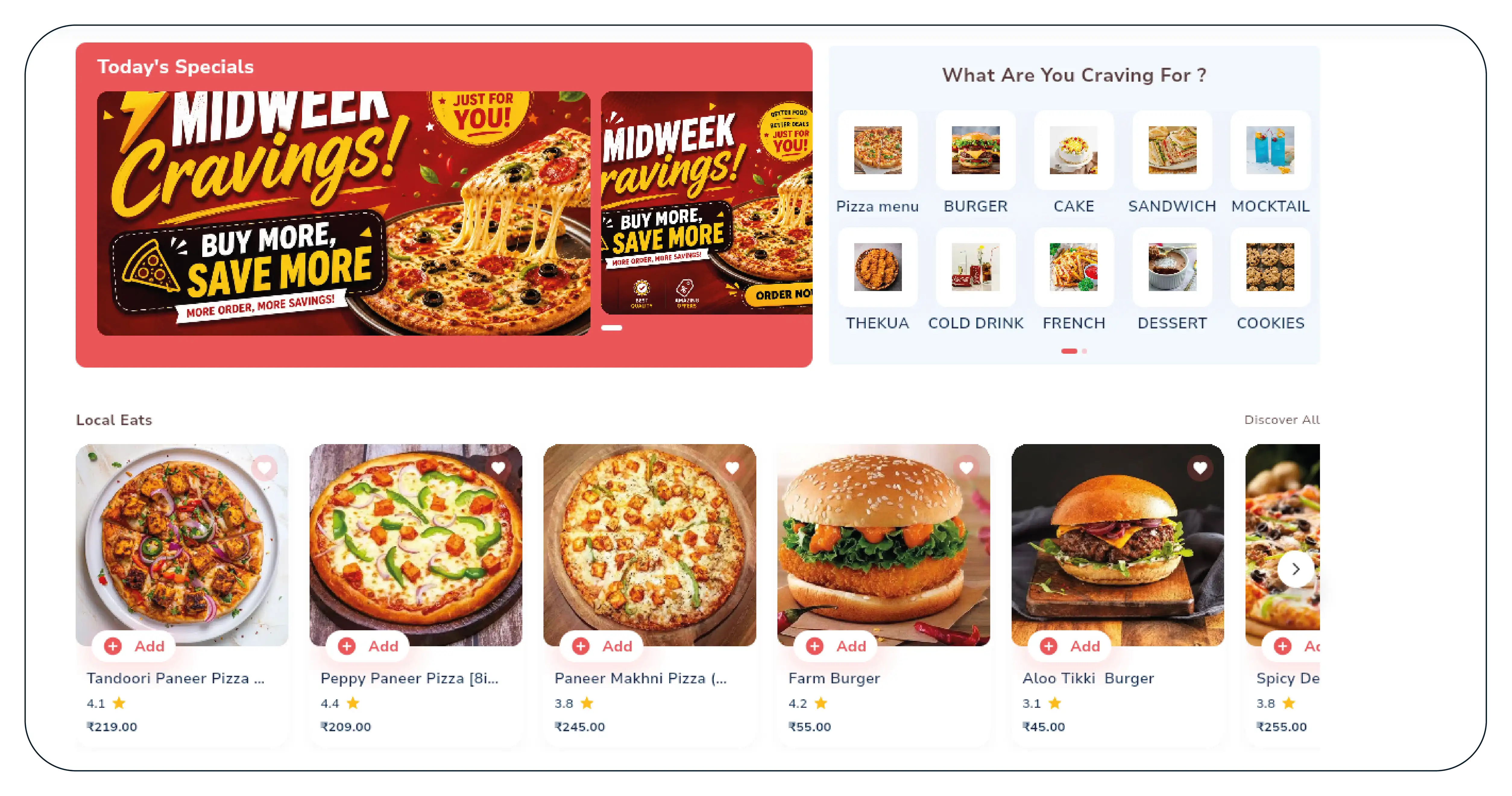
FreshBite wanted to establish a scalable monitoring framework that could
support its expanding online product portfolio. The primary business goals included:
Track product visibility across multiple digital retail channels.
Improve the speed of marketplace performance reporting.
Increase accuracy and consistency in competitive data.
Identify products losing visibility or availability.
Monitor pricing and promotional movements affecting the brand.
Create a repeatable process for future FMCG categories and markets.
The framework was designed around Digital Share-of-Shelf for FMCG Brands,
giving FreshBite a structured way to assess how frequently its products appeared compared with
competing products for relevant search terms.
The technical implementation focused on:
Automating recurring product and competitor data collection.
Standardizing product, brand, price, ranking, and availability fields.
Integrating location-specific observations into a unified dataset.
Supporting near-real-time visibility checks where source availability
permitted.
Reducing dependence on manual spreadsheet-based monitoring.
Creating structured datasets suitable for dashboards and analytics.
Success was measured through operational and data-quality indicators:
96% targeted data-field accuracy.
93% monitoring coverage across the defined product universe.
41% reduction in reporting turnaround time.
89% successful product-to-category mapping.
95% consistency in recurring product identification.
Improved detection of out-of-stock and ranking changes across monitored
locations.
The Core Challenge
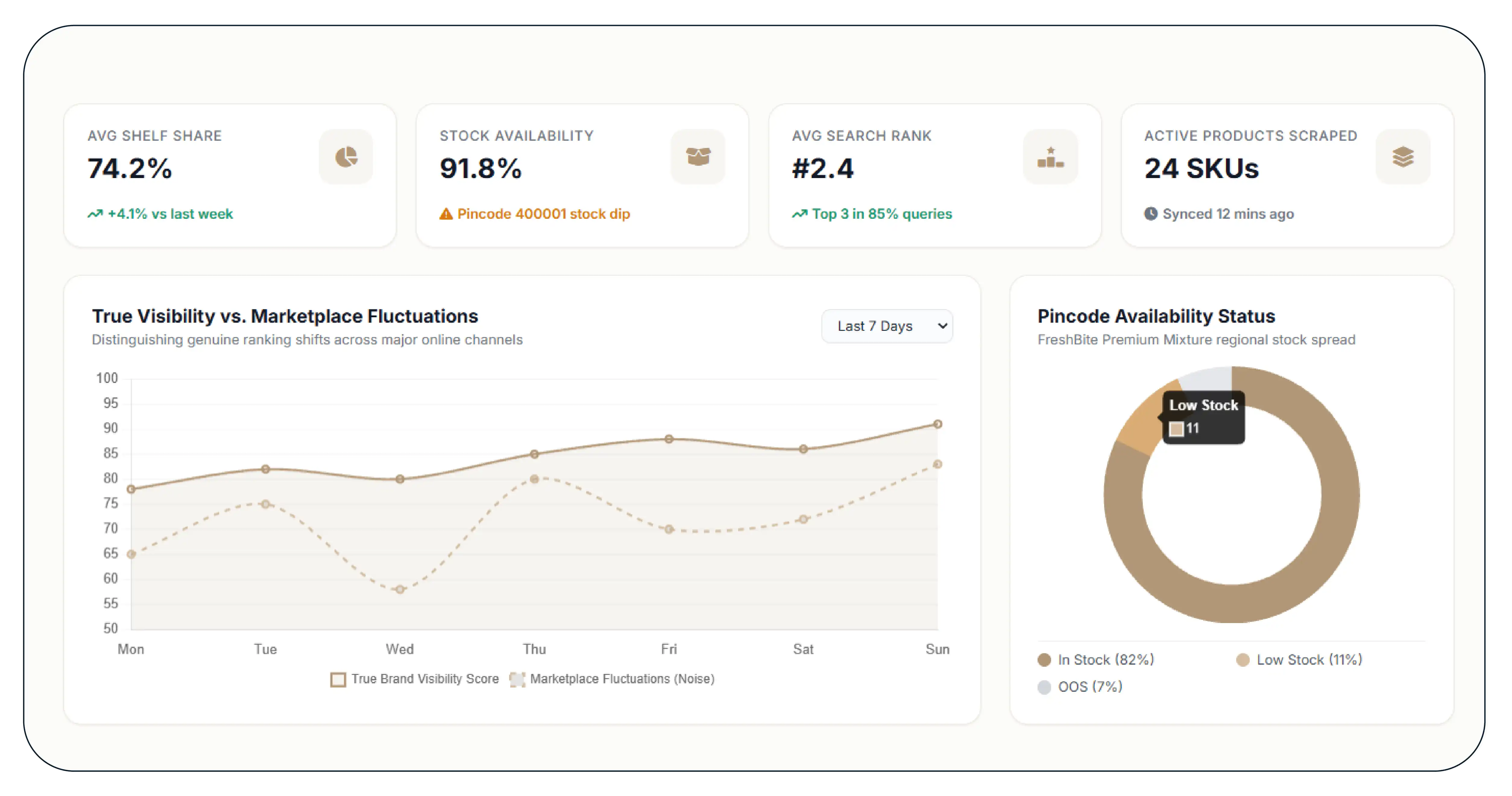
Before the engagement, FreshBite Foods had limited visibility into how its
products performed across different online retail environments. Teams could manually search for
FreshBite Classic Potato Chips or FreshBite Masala Crunch, but repeating the same process across
marketplaces and locations consumed significant time.
One of the biggest operational bottlenecks was data fragmentation. Product
names, pack sizes, promotional prices, rankings, availability indicators, and seller information
appeared differently across platforms. Manual collection increased the risk of inconsistent
records and made historical comparisons difficult.
The brand also faced challenges in distinguishing genuine visibility changes
from temporary marketplace fluctuations. A product could rank prominently in one location while
appearing much lower in another. Similarly, FreshBite Premium Mixture could be available in one
pincode but unavailable in another.
The absence of a standardized FMCG Digital Shelf Data Scraping process meant
teams had to spend considerable effort collecting and cleaning information before analysis could
begin. Reporting delays reduced the usefulness of the data because pricing, rankings,
promotions, and availability could change before stakeholders reviewed the findings.
Product Data Scrape therefore needed to create an automated framework that
could collect consistent digital shelf observations, organize them by product and location, and
make the resulting intelligence easier for FreshBite's commercial and e-commerce teams to use.
Our Solution
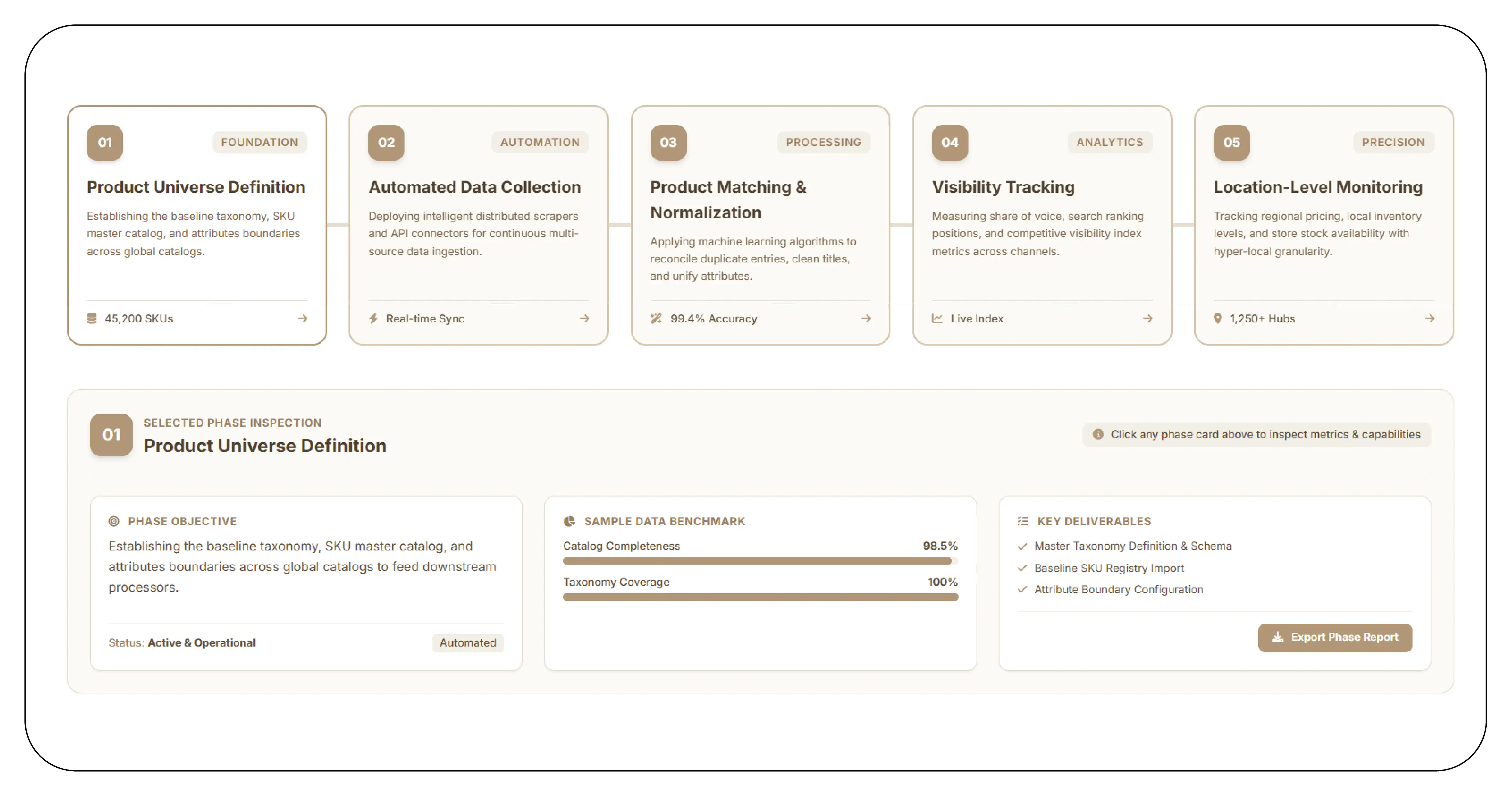
Product Data Scrape approached the project as a structured data-engineering and
digital commerce intelligence initiative. The implementation was divided into several phases to
improve coverage, consistency, automation, and reporting quality.
Phase 1: Product Universe Definition
The first stage established a master product universe for FreshBite Foods. Core
products such as FreshBite Classic Potato Chips 100g, FreshBite Masala Crunch 150g, FreshBite
Premium Mixture 200g, and FreshBite Salted Peanuts 200g were mapped with relevant product
identifiers, category information, pack sizes, and brand attributes. Competitor products from
brands such as CrunchKart Snacks and DailyMunch Foods were also included in the monitoring
universe to provide comparative visibility.
Phase 2: Automated Data Collection
The next stage introduced automated collection workflows for selected
marketplaces, grocery platforms, and quick-commerce environments. The framework captured
accessible fields such as product name, brand, category, price, discount, availability, ranking,
ratings, review counts, product URL, seller information, and location. The objective was to
reduce repetitive manual searches while creating a consistent structure for recurring
observations.
Phase 3: Product Matching and Normalization
Different platforms frequently used different product naming conventions. A
normalization layer was therefore introduced to connect variations such as "FreshBite Classic
Chips 100g," "FreshBite Potato Chips Classic – 100 G," and similar listings to the appropriate
master product. This improved consistency when comparing product visibility across platforms.
Phase 4: Visibility Tracking
The monitoring framework then evaluated how frequently FreshBite products
appeared for relevant searches and where they were positioned. FMCG Brand Product Visibility
Tracking helped organize observations around product rankings, search presence, availability,
and competitor placements. The resulting dataset allowed the team to identify products with
declining visibility, missing listings, weaker rankings, or inconsistent availability.
Phase 5: Location-Level Monitoring
Because digital retail performance can vary by location, observations were
structured by pincode and market. This allowed FreshBite to compare the visibility of products
such as FreshBite Masala Crunch 150g between different service areas. The final framework
supported Digital Shelf Monitoring for an FMCG Brand by bringing product, competitor, pricing,
ranking, availability, and location-level observations into a consistent monitoring workflow.
Results & Key Metrics
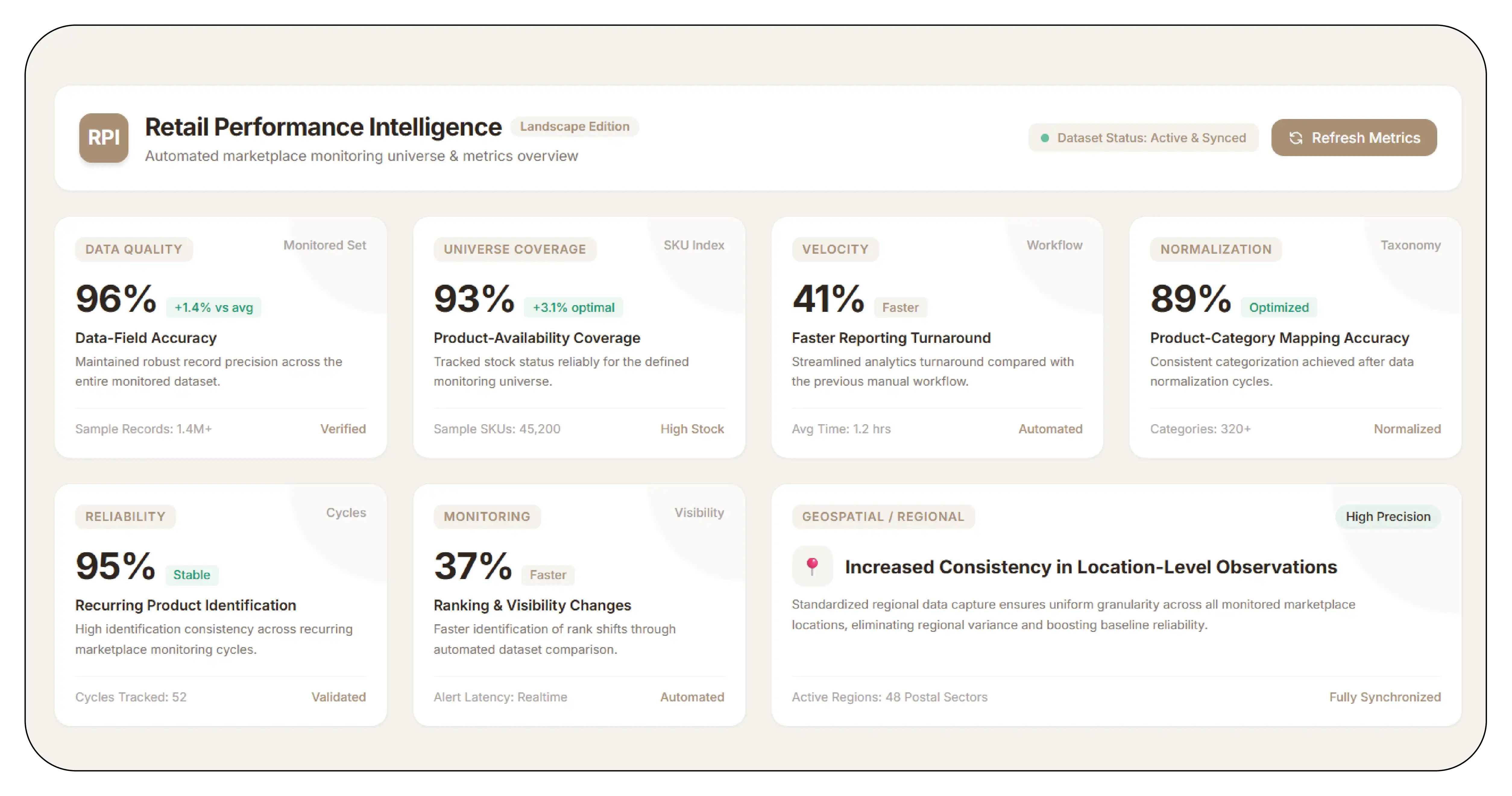
The implementation produced measurable improvements in monitoring efficiency
and data quality:
96% data-field accuracy across the monitored dataset.
93% product-availability coverage for the defined monitoring universe.
41% faster reporting turnaround compared with the previous manual workflow.
89% product-category mapping accuracy after normalization.
95% recurring product identification consistency across monitoring cycles.
37% faster identification of ranking and visibility changes through automated
comparison.
Increased consistency in location-level marketplace observations.
Results Narrative
The project gave FreshBite Foods a centralized view of how its products
appeared across monitored digital channels. Brand Product Visibility and Ranking Data could be
reviewed using consistent product identifiers, allowing commercial teams to distinguish
product-level changes from broader marketplace movements.
For example, FreshBite Classic Potato Chips could be evaluated against
competing snack listings based on ranking, availability, pricing, and search presence.
Location-level observations also highlighted areas where FreshBite Masala Crunch had weaker
availability or visibility.
The automated workflow reduced repetitive data collection and enabled teams to
spend more time interpreting results instead of preparing spreadsheets. The improved reporting
cycle also helped stakeholders react faster to changes in competitor pricing, product
availability, and marketplace placement.
What Made Product Data Scrape Different
Product Data Scrape differentiated its approach by combining automated
extraction, structured product normalization, location-level monitoring, and repeatable
validation workflows. Instead of treating digital shelf information as isolated snapshots, the
framework was designed to create comparable observations across products, platforms, and
locations.
The use of Pincode-Level Price Tracking for
FMCG Brands helped identify geographic variations in product pricing and availability,
supporting more granular marketplace intelligence. Automated validation rules also helped detect
missing values, inconsistent product identifiers, and unusual changes before reporting.
The approach enabled FreshBite to move from manually checking individual
product pages toward a more systematic intelligence framework. Digital Shelf Monitoring for an
FMCG Brand became an ongoing process rather than a one-time data collection exercise, allowing
the brand to continuously monitor product visibility, competitor activity, pricing movements,
rankings, and availability.
Client's Testimonial
"Before working with Product Data Scrape, our teams spent significant time
manually checking marketplace listings and compiling product information. The new monitoring
framework gave us a much clearer view of how FreshBite products such as Classic Potato Chips
and Masala Crunch were performing across different digital channels and locations. The
consistency of the data made it easier to identify visibility gaps and competitor movements,
while automated reporting reduced the operational effort involved in recurring checks. The
project also helped our e-commerce and category teams work from a common data foundation. We
now have a more structured approach to monitoring digital shelf performance and can use the
insights more effectively for marketplace planning and product-level decisions."
— Head of E-commerce & Digital Growth, FreshBite Foods
Conclusion
For FMCG brands, digital shelf visibility increasingly influences how products
are discovered, compared, and purchased. FreshBite Foods needed a scalable way to understand
these changes across products, platforms, competitors, and locations. Product Data Scrape delivered an automated
intelligence framework that improved data consistency, monitoring coverage, and reporting speed.
The solution also created a foundation for ongoing Ratings, reviews and sentiment analysis, allowing the brand
to move beyond basic price and availability monitoring toward a broader understanding of
customer perception.
With structured data and recurring monitoring, FMCG teams can identify
visibility gaps earlier, evaluate competitor movements, and make more informed digital commerce
decisions. FMCG Category Pricing
Analysis can further support pricing evaluation and competitive benchmarking across
marketplaces. The framework can also be expanded to additional marketplaces, categories,
products, pincodes, and performance indicators as the brand's online presence grows.
FAQs
1. What does digital shelf monitoring help FMCG brands track?
It helps brands monitor product visibility, rankings, pricing, promotions, availability,
ratings, reviews, competitor listings, and search presence across online marketplaces and retail
platforms.
2. Why is product availability important for FMCG brands?
Availability directly affects digital purchase opportunities. Monitoring stock status across
locations helps brands identify recurring out-of-stock patterns and understand where products
may be losing potential sales visibility.
3. Can digital shelf data be monitored by pincode?
Yes. Location-level monitoring can compare product pricing, availability, rankings, and
visibility across different pincodes, helping FMCG teams identify geographic differences in
digital retail performance.
4. How does automated monitoring improve marketplace intelligence?
Automation reduces repetitive manual searches, standardizes recurring data collection, improves
monitoring frequency, and enables teams to identify changes in product visibility, pricing,
rankings, and availability more efficiently.
5. Can the framework support multiple FMCG products and competitors?
Yes. A structured monitoring framework can scale across multiple brands, categories, SKUs, pack
sizes, marketplaces, competitors, and locations, creating a broader dataset for digital commerce
analysis.


 Singapore
 EMAIL
EMAIL
 PHONE
PHONE











.webp)