The Client
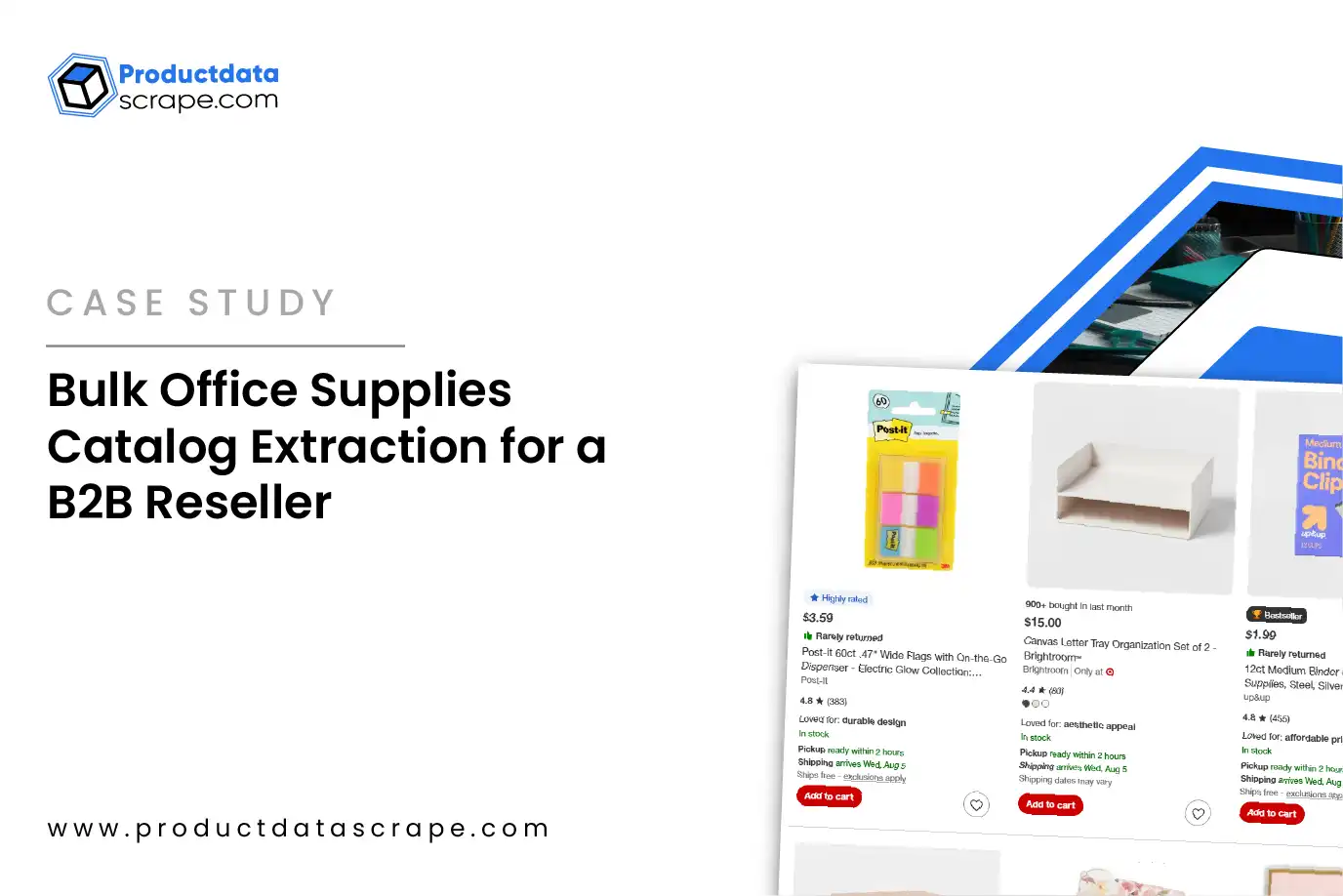
A B2B office-supplies reseller — stationery, printer consumables, furniture, and workplace essentials — supplying corporate and institutional buyers. Its competitiveness depended on offering a broad, well-structured catalogue, and building that catalogue was the bottleneck holding the business back.
Client details are anonymised. Figures are representative of the engagement.
The Problem: A Catalogue Too Big to Build by Hand
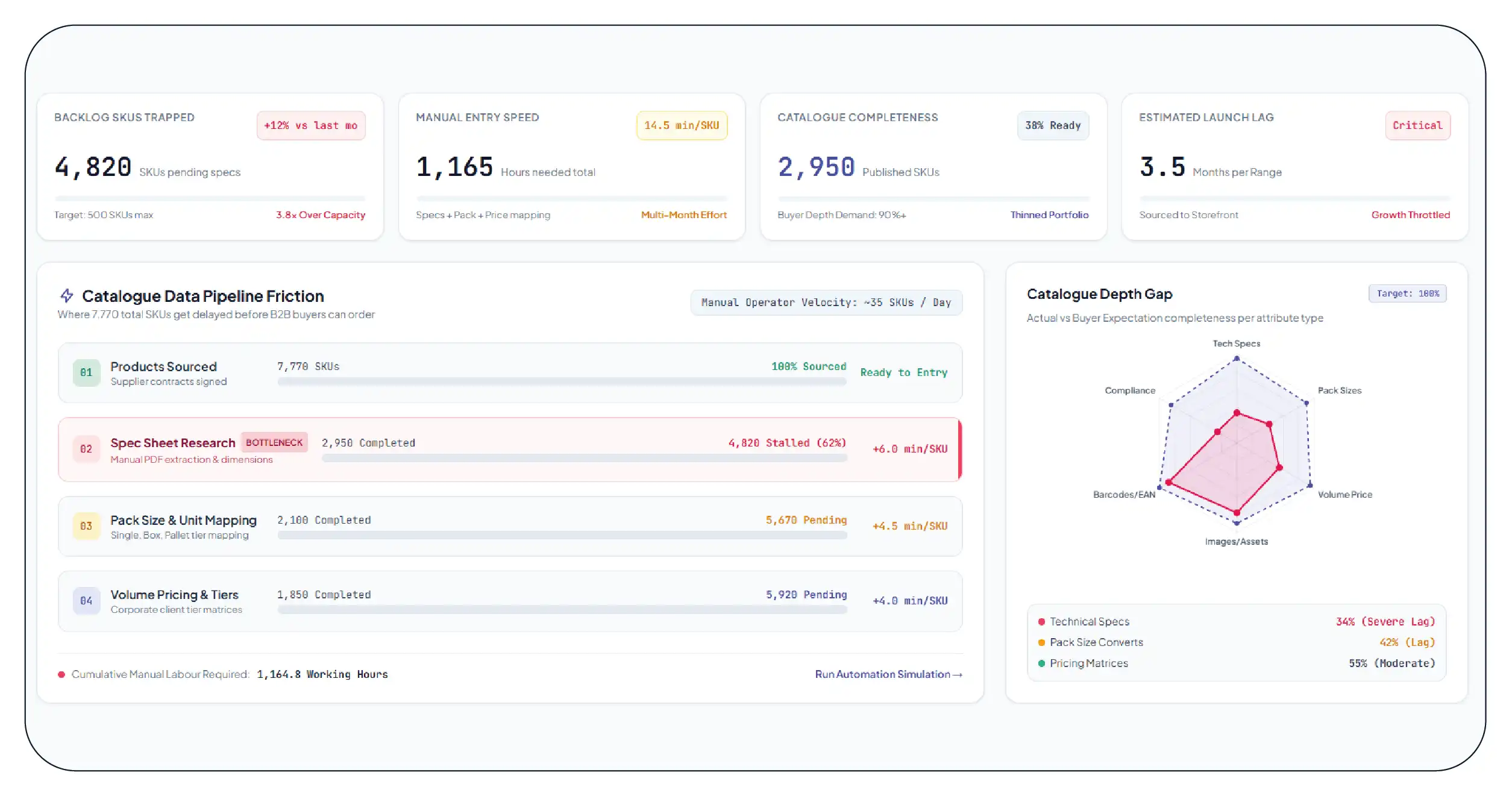
The reseller needed a large, structured product catalogue — thousands of SKUs across many categories, each with complete specifications, pack sizes, and pricing — and building it manually was a bottleneck that throttled growth.
B2B buyers expect breadth and detail. A corporate buyer sourcing office supplies wants the full range, with accurate specs, pack quantities, and unit economics, so they can compare and order at volume. The reseller's catalogue was narrower and thinner than buyers wanted, not because it couldn't source the products, but because it couldn't build the catalogue data fast enough. Each SKU meant researching specs, pack configurations, and pricing and entering them in a consistent structure — and at thousands of SKUs, that was a multi-person, multi-month effort the reseller kept falling behind on.
The operations lead's summary: we can get the products. We can't build the catalogue. Every new range takes weeks of data entry before we can sell a single unit.
Why Manual Catalogue Building Failed
Building a large B2B catalogue by hand hits the same walls every reseller does.
Scale. Thousands of SKUs, each needing multiple structured attributes, is a volume manual entry cannot keep pace with. The catalogue grew slower than the business needed it to.
Pack-size and unit complexity. Office supplies are sold in complex pack configurations — boxes of reams, cartons of cartridges, cases of units — and B2B buyers reason in unit economics. Capturing pack size, unit count, and unit price correctly for every SKU is fiddly and error-prone by hand.
Consistency. Manual entry across many people and categories produces inconsistent attributes and formats, which breaks the structured comparison B2B buyers rely on and the internal systems that depend on clean data.
Onboarding lead time. Every new supplier range meant weeks of data-building before those products could go live — a lead time that lost the reseller business to competitors who already listed them.
The Solution: Bulk Catalog Extraction
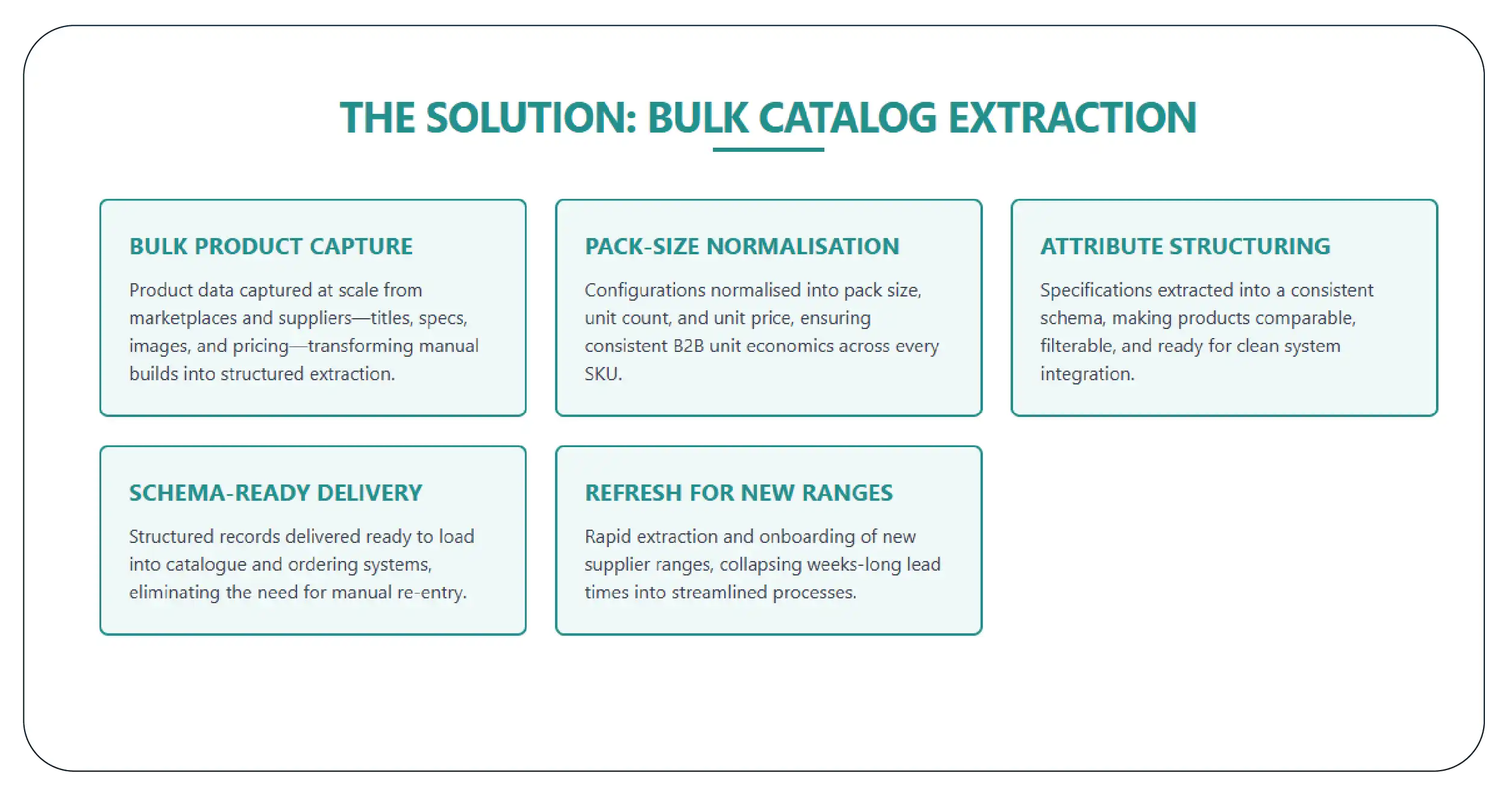
Product Data Scrape built office supplies catalog extraction at scale — structured product data across the reseller's categories, ready to load.
- Bulk product capture. Across the reseller's categories, product data was captured at scale from marketplaces and supplier sources — titles, specifications, images, pack configurations, and pricing — turning a multi-month manual build into a structured extraction.
- Pack-size and unit normalisation. Pack configurations were captured and normalised into pack size, unit count, and unit price, so the catalogue carried the unit economics B2B buyers reason in, consistently across every SKU.
- Attribute structuring. Specifications were extracted into a consistent, category-appropriate schema, so products were comparable and filterable and the data loaded cleanly into the reseller's systems.
- Delivery in the reseller's schema. Structured records were delivered ready to load into the reseller's catalogue and ordering systems, rather than as a raw dump requiring re-entry.
- Refresh for new ranges. New supplier ranges could be extracted and onboarded rapidly, collapsing the weeks-long lead time on adding products.
Sample Data: A Structured Catalogue Record
An illustrative extracted and normalised office-supplies record.
| Field |
Value |
| Product |
A4 Copier Paper, 75 GSM |
| Pack configuration |
Box of 5 reams |
| Units per pack |
5 reams (2,500 sheets) |
| Pack price |
1,299 |
| Unit price (per ream) |
259.80 |
| Category |
Paper & printing |
| Specs |
75 GSM, A4, white, 500 sheets/ream |
| Bulk tier available |
Yes (10+ boxes) |
Illustrative.
The structured record:
{
  "sku": "OFF-PAPER-A4-75GSM",
  "title": "A4 Copier Paper 75 GSM — White",
  "category": "paper_printing",
  "pack": {
    "configuration": "box_of_5_reams",
    "units_per_pack": 5,
    "unit_label": "ream",
    "sheets_per_unit": 500,
    "pack_price": 1299,
    "unit_price": 259.80
  },
  "specs": {
    "gsm": 75,
    "size": "A4",
    "colour": "white",
    "sheets_per_ream": 500
  },
  "bulk_pricing_available": true,
  "extraction_complete": true,
  "ready_to_load": true
}
The value was breadth and structure at once: thousands of SKUs captured with the pack-size and unit-price normalisation B2B buyers actually reason in — the copier paper carried both its pack price (1,299 per box) and its unit price (259.80 per ream), consistently, so a corporate buyer could compare and order at volume without the reseller hand-calculating it per SKU.
What the Reseller Did
Expanded the catalogue at scale. The reseller grew its listed catalogue from a manual trickle to thousands of structured SKUs, finally offering the breadth B2B buyers expected, without the multi-month data-entry effort.
Competed on unit economics. With pack size and unit price normalised on every SKU, the reseller could present the unit economics corporate buyers compare on, and quote volume orders accurately.
Onboarded new ranges fast. New supplier ranges were extracted and live in a fraction of the previous time, so the reseller stopped losing business to competitors who listed products first.
Loaded clean data. Consistent, structured records loaded cleanly into ordering and quoting systems, ending the errors and rework that manual entry had produced.
The Results (Two Quarters)
| Metric |
Before |
After Two Quarters |
| Catalogue build method |
Manual entry |
Bulk structured extraction |
| Listed SKUs |
Limited |
Thousands, structured |
| New-range onboarding time |
Weeks |
Days |
| Unit-economics data on SKUs |
Inconsistent |
Normalised across catalogue |
| Catalogue-related data errors |
Frequent |
Sharply reduced |
| Quote-to-order conversion (B2B), indexed |
100 |
129 |
| Revenue, indexed |
100 |
133 |
Figures are representative of the engagement outcome.
The operations lead's follow-up: the catalogue stopped being our bottleneck. We can add a range in days now, structured and ready to sell, instead of losing weeks to data entry.
The Lesson
For a B2B reseller, the catalogue is the product — buyers choose on breadth, structure, and accurate unit economics — and building that catalogue by hand is a bottleneck that caps the business regardless of how well it can source. The constraint isn't getting the products; it's getting the data, structured and consistent, at the scale B2B buyers expect, fast enough to compete.
Bulk catalogue extraction removed the bottleneck. It turned a multi-month manual build into a structured extraction, with the pack-size and unit-price normalisation B2B buyers reason in, delivered ready to load. The reseller didn't source better; it built its catalogue at a scale and speed manual entry never could — and the catalogue stopped being the ceiling on the business.
Work With Product Data Scrape
Product Data Scrape delivers office supplies catalog extraction at scale: bulk product capture, pack-size and unit-price normalisation, consistent attribute structuring, and delivery ready to load into your systems — as JSON, CSV, API, or your catalogue schema, with rapid onboarding for new ranges.
We capture publicly available product information only, structured and ready to sell.
Ask us to build or expand your catalogue — we will turn a category of products into structured, load-ready SKUs in days, not months.
Product Data Scrape — turning marketplace complexity into decision-ready data.


 Singapore
 EMAIL
EMAIL
 PHONE
PHONE


.webp "thumb")
.webp "thumb")










.webp)