Introduction
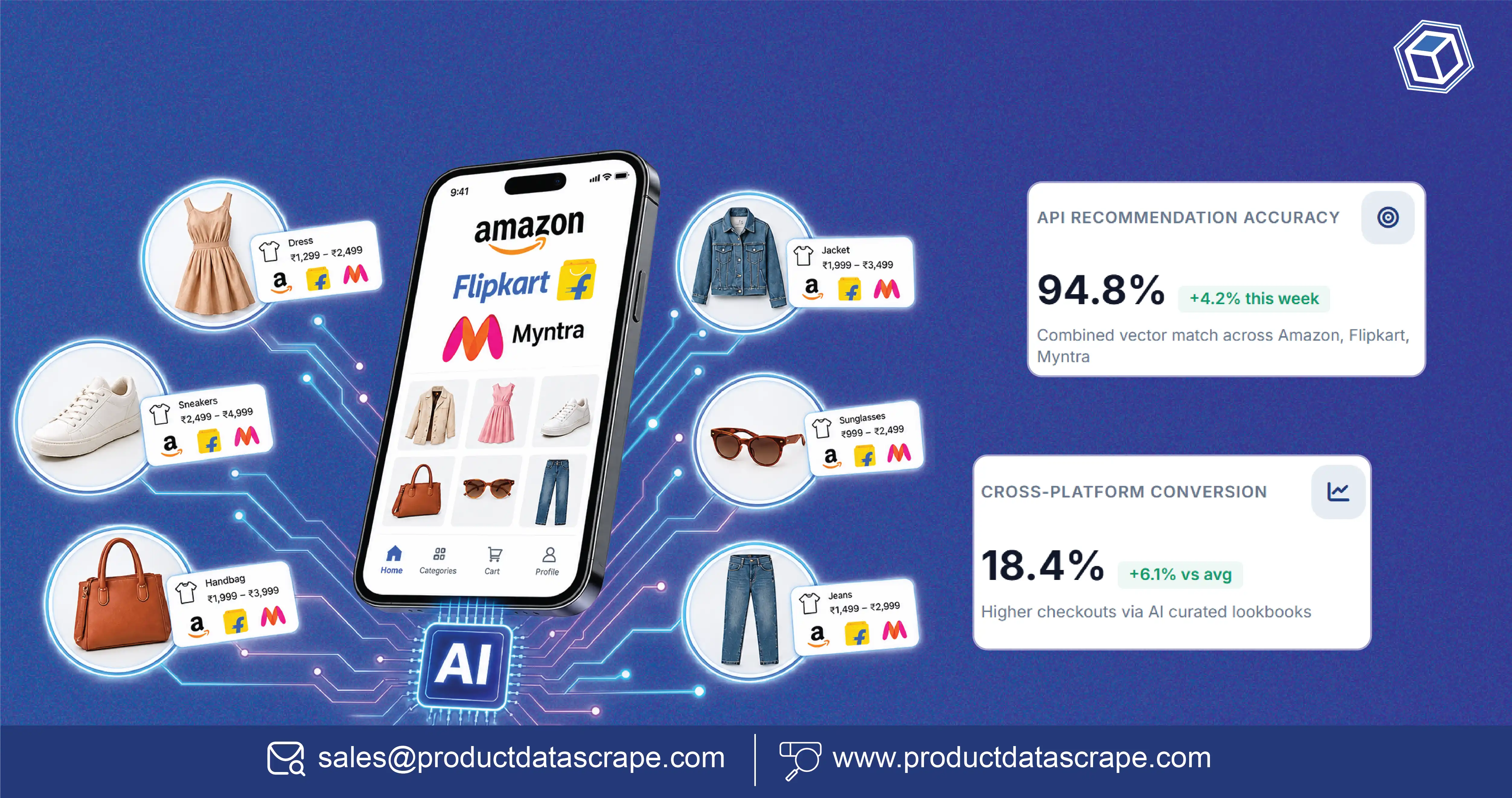
AI Fashion Shopping App with Amazon, Flipkart & Myntra API helps businesses create smarter fashion discovery experiences by connecting product catalogs, attributes, prices, availability, and other structured signals with AI recommendation systems.
Fashion shoppers rarely search using only a product name. They may look for a black oversized shirt under a specific price, running shoes for a particular use case, a wedding-ready ethnic outfit, or a sustainable fashion alternative. An AI shopping application needs structured product data to understand these requirements and return relevant options.
This is where E-commerce Data for AI Shopping Assistants becomes important. AI systems need consistent product attributes, categories, brands, prices, images, sizes, colors, descriptions, ratings, and availability to generate useful recommendations.
The core business challenge is therefore not simply building an AI interface. It is creating a reliable product-data foundation behind that interface.
A fashion-focused AI system can use structured marketplace information to:
- Improve product discovery
- Compare similar products
- Understand fashion attributes
- Personalize recommendations
- Identify price ranges
- Track availability
- Match shopper preferences
- Generate product comparisons
- Support conversational shopping
- Refresh recommendations as catalogs change
For fashion retailers, aggregators, marketplace businesses, and AI shopping startups, better recommendations depend on better product intelligence.
How Can Businesses Build a Better Fashion Data Foundation?
Track Fashion Product Listings for AI Shopping by collecting structured information across relevant fashion catalogs and transforming it into consistent fields that AI systems can interpret.
A fashion recommendation engine may need substantially more context than product name and price. Attributes such as fabric, fit, sleeve type, neckline, pattern, occasion, color, size, brand, gender, category, and material can influence recommendation relevance.
Fashion data scraping can support this requirement by creating recurring datasets from accessible online product sources, subject to applicable terms and technical constraints.
| Data Attribute |
AI Shopping Application |
| Product name |
Search and product matching |
| Brand |
Brand preference modeling |
| Category |
Product classification |
| Color |
Preference-based filtering |
| Size |
Availability-aware recommendations |
| Fabric |
Attribute-based discovery |
| Fit |
Style matching |
| Price |
Budget-based recommendations |
| Discount |
Deal discovery |
| Rating |
Quality-related filtering |
| Availability |
Purchase-ready recommendations |
| Product URL |
Product redirection |
What makes fashion data difficult for AI?
Fashion catalogs are highly varied. One marketplace may describe a product as "relaxed fit," while another may use "oversized." Similarly, color names can vary between "navy," "dark blue," and "midnight blue."
An effective data pipeline can normalize these variations into standardized attributes while preserving the original product information.
2020–2026: How fashion data became more AI-ready
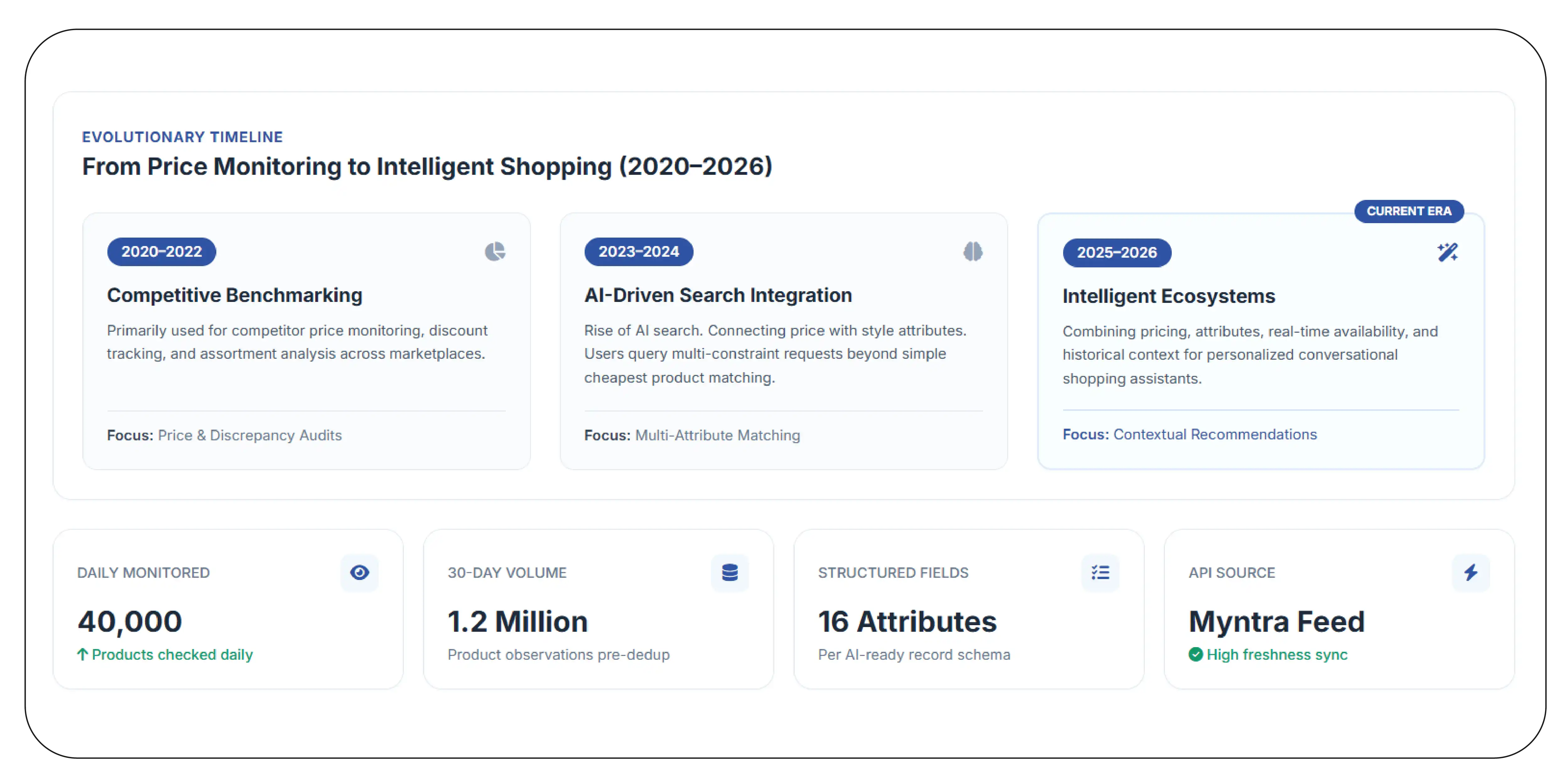
From 2020 to 2022, online fashion catalogs expanded rapidly as consumers increasingly used digital channels for product discovery. Product datasets initially focused heavily on basic attributes such as name, price, brand, category, and availability.
From 2023 onward, AI-driven search and recommendation applications created greater demand for richer metadata. Businesses increasingly needed structured information that could support semantic search, recommendation engines, product matching, and conversational interfaces.
Between 2024 and 2026, the emphasis shifted further toward machine-readable product information. Instead of simply storing product pages, businesses can organize attributes into normalized schemas that are easier for AI systems to process.
Benchmark: A dataset containing 50,000 fashion SKUs with 20 standardized attributes creates up to 1 million attribute-value points before accounting for variants. This illustrates why automated normalization and validation become important as catalogs grow.
What Product Information Improves AI Fashion Recommendations?
Scrape Fashion Product Data for AI Recommendations to provide recommendation systems with detailed and structured product information rather than relying only on basic catalog fields.
An AI shopping assistant needs to understand both what the shopper wants and what each product offers. The quality of the second component depends heavily on the product dataset.
For example, a shopper asking for "casual cotton shirts under ₹1,500 in neutral colors" requires an AI system to identify:
- Product category
- Material
- Style or occasion
- Price
- Color
- Availability
- Relevant variants
| Shopper Requirement |
Required Product Signal |
| Under a budget |
Current selling price |
| Cotton product |
Material/fabric |
| Neutral color |
Normalized color |
| Casual style |
Style/occasion |
| Available in M |
Size availability |
| Preferred brand |
Brand |
| Highly reviewed |
Rating/review information |
How does structured data improve recommendations?
Structured data makes it easier to match shopper intent with product characteristics. Instead of searching for exact phrases, an AI system can use semantic relationships.
For example:
"Black party dress under ₹3,000"
can be translated into multiple structured conditions:
- Category = dress
- Color = black
- Occasion = party
- Price <= ₹3,000
This creates a more useful foundation for recommendation logic.
2020–2026: From keyword search to semantic discovery
Between 2020 and 2022, fashion discovery largely relied on keyword-driven search, filters, categories, and marketplace navigation. These systems were useful but depended heavily on shoppers knowing how to describe what they wanted.
From 2023 to 2024, conversational AI and generative AI increased interest in natural-language shopping experiences. Consumers could increasingly describe requirements in complete sentences rather than using short search terms.
During 2025 and 2026, AI shopping workflows increasingly emphasize intent interpretation, product matching, recommendation generation, and conversational comparison. This makes structured product attributes more valuable.
Benchmark: If a recommendation dataset expands from 10 to 30 normalized product attributes, the system gains three times as many defined attribute fields per SKU, although recommendation quality still depends on data completeness, normalization, model design, and user behavior.
How Can Marketplace Data Improve AI Shelf Visibility?
Scrape Flipkart Fashion Catalog Data for AI Shopping to create structured marketplace intelligence that can help AI applications understand product assortment, attributes, prices, brands, and availability.
An AI shopping system needs visibility into the products it can recommend. Scrape Flipkart Fashion Catalog Data for AI Shopping to maintain updated product information, especially when a catalog changes frequently and stale data can produce poor recommendations.
For example, a recommendation engine may suggest a product that is no longer available, show an outdated price, or overlook a newly listed alternative. Recurring data collection can reduce these gaps.
Track AI shelf visibility by maintaining structured records that show which products, brands, categories, and variants are present within the monitored catalog.
| AI Shelf Signal |
Potential Application |
| Product presence |
Recommendation availability |
| Brand presence |
Brand discovery |
| Category depth |
Assortment intelligence |
| Price |
Budget matching |
| Discount |
Deal recommendations |
| Rating |
Review-aware ranking |
| Availability |
Purchase readiness |
| New listings |
Catalog freshness |
What is an AI-ready shelf?
An AI-ready digital shelf is more than a collection of URLs. It is a structured representation of products that can be searched, compared, classified, and interpreted by intelligent systems.
A useful record can contain a product identifier, product name, brand, category, normalized attributes, current price, discount, rating, availability, image references, and timestamp.
2020–2026: The digital shelf became increasingly data-driven
From 2020 through 2022, digital shelf analysis primarily focused on product visibility, pricing, assortment, and marketplace presence. As online fashion competition increased, brands needed more frequent visibility into how their products appeared to customers.
In 2023 and 2024, AI search and recommendation technologies increased the importance of product metadata. A product with incomplete attributes can be harder for automated systems to classify or recommend.
By 2025–2026, AI shelf intelligence increasingly connects catalog monitoring with recommendation and discovery workflows. Brands can examine whether products have complete attributes, whether competing products occupy similar categories, and whether prices or availability have changed.
Benchmark: Monitoring 25,000 products across 15 core attributes creates 375,000 primary attribute fields per collection cycle. Variants, historical records, and location-level observations can increase the dataset substantially.
Which Product Attributes Matter Most for AI Models?
Scrape Amazon Fashion Product Attributes for AI Models to create detailed product records that can support classification, semantic search, recommendation, comparison, and other AI applications.
Fashion AI requires richer information because consumer preferences are multidimensional. A shopper may care about brand, style, material, fit, color, occasion, price, and sustainability-related attributes simultaneously.
| Attribute Group |
Examples |
AI Use |
| Identity |
SKU, product name, brand |
Product matching |
| Style |
Casual, formal, streetwear |
Recommendation |
| Physical |
Color, material, pattern |
Preference matching |
| Fit |
Slim, regular, relaxed |
Personalization |
| Occasion |
Party, office, travel |
Intent matching |
| Commercial |
Price, discount |
Budget filtering |
| Social proof |
Rating, review count |
Ranking |
| Availability |
Size, stock status |
Purchase-ready results |
Why does attribute normalization matter?
AI systems perform better when equivalent concepts are represented consistently.
Consider these examples:
- "Olive" and "olive green"
- "Relaxed fit" and "relaxed"
- "Sneakers" and "casual shoes"
- "Crew neck" and "round neck"
A normalization layer can map equivalent values into standardized fields while preserving original descriptions for context.
2020–2026: The growth of attribute-rich commerce data
During 2020–2022, many fashion data projects concentrated on basic catalog extraction. Product names, categories, prices, and URLs were often sufficient for simple monitoring.
From 2023 onward, AI applications created stronger demand for detailed attributes. Recommendation engines need more context than traditional price-monitoring systems.
In 2024–2026, product attribute enrichment became increasingly important for AI search, product embeddings, recommendation systems, and conversational shopping applications. A structured schema can provide the foundation for these workflows.
Benchmark: Suppose an AI dataset contains 100,000 products and 25 normalized attributes. That represents 2.5 million core attribute fields before variants and historical snapshots. Missing-value rates therefore become an important data-quality KPI.
Useful quality metrics include:
- Attribute completeness
- Duplicate rate
- SKU matching accuracy
- Price freshness
- Availability freshness
- Category consistency
- Variant coverage
How Can Pricing Data Make AI Shopping More Useful?
Monitor Myntra API Fashion Product Prices for AI, AI-ready datasets Shopping by connecting pricing information with product attributes, availability, brands, categories, and historical observations.
Price is one of the most important constraints in fashion shopping. A shopper might ask for "formal shoes below ₹2,000" or "designer-style dresses under ₹5,000." An AI assistant needs current and structured pricing information to respond appropriately.
| Pricing Signal |
AI Shopping Application |
| Current price |
Budget filtering |
| MRP |
Discount context |
| Discount |
Deal identification |
| Historical price |
Price-change context |
| Price range |
Product comparison |
| Variant price |
Variant-level recommendations |
| Timestamp |
Freshness verification |
Why are AI-ready datasets important?
AI systems require datasets that can be queried and processed efficiently. A raw page dump is less useful than a structured record containing consistent fields.
An AI-ready fashion dataset can include:
- Product ID
- Product name
- Brand
- Category
- Subcategory
- Color
- Material
- Size
- Fit
- Price
- MRP
- Discount
- Rating
- Availability
- Product URL
- Timestamp
This structure can support recommendation models, retrieval systems, conversational shopping assistants, analytics dashboards, and product comparison tools.
2020–2026: From price monitoring to intelligent shopping
Between 2020 and 2022, online fashion price monitoring was primarily used for competitive benchmarking and promotional analysis. Businesses compared selling prices, discounts, and assortment across marketplaces.
From 2023 to 2024, the rise of AI-driven search increased the importance of connecting price information with product attributes. Instead of asking simply "what is the cheapest product?", users could ask for a product that satisfies multiple style and budget requirements.
By 2025–2026, AI shopping applications increasingly benefit from combining pricing, attributes, availability, and historical context. This enables richer recommendation scenarios while giving businesses more control over how product information is retrieved and presented.
Benchmark: If 40,000 products are monitored daily for price and availability, the system can generate up to 1.2 million product observations over 30 days before filtering or deduplication.
How Does Marketplace Data Support a Unified Fashion Experience?
Myntra product data scraping can help businesses build structured datasets for fashion catalogs, provided collection is conducted using permitted methods and in accordance with applicable platform requirements.
The biggest opportunity is integration. An AI fashion application becomes more useful when it can Monitor Myntra API Fashion Product Prices for AI Shopping and understand products across multiple sources using a common data model.
For example, a user could ask:
"Show me white sneakers under ₹3,000 with strong ratings and availability in my size."
The application can interpret this as a combination of:
- Category
- Color
- Price
- Rating
- Size
- Availability
It can then retrieve relevant products from the connected dataset and present a concise comparison.
| AI Capability |
Required Data |
| Conversational search |
Product descriptions + attributes |
| Recommendations |
Product and preference attributes |
| Price comparison |
Current prices |
| Similar-product discovery |
Category + attribute vectors |
| Deal discovery |
Price + discount |
| Availability-aware results |
Stock/variant status |
| Brand recommendations |
Brand + category |
| Fashion trend analysis |
Historical product records |
2020–2026: Toward connected fashion intelligence
From 2020 to 2022, businesses generally managed marketplace datasets independently. Each platform had its own product structures, categories, and attributes.
From 2023 onward, cross-platform product matching became increasingly useful. Businesses could compare similar products and identify differences in pricing, assortment, and availability.
During 2024–2026, AI introduced another requirement: data must be understandable across sources. A unified schema allows product records from different platforms to be compared using common attributes.
This creates opportunities for AI fashion assistants to become more than search interfaces. They can act as conversational product discovery systems capable of interpreting natural-language requests, filtering products, comparing alternatives, and explaining why products match a shopper's requirements.
Benchmark: Combining 30,000 products from three sources creates a potential 90,000 source-level product records before entity resolution. Product matching can reduce duplicates and create a unified view of equivalent products.
Why Choose Product Data Scrape?
An AI shopping application is only as useful as the product information supporting its recommendations. Flipkart scraper workflows can help businesses collect structured product information while maintaining consistent schemas, validation processes, and recurring updates.
The solution can be designed around the buyer's specific needs, including fashion attributes, pricing, availability, product variants, categories, and brand information.
Key capabilities include:
- Multi-source product data collection
- Fashion attribute extraction
- Product and SKU matching
- Price and discount monitoring
- Availability tracking
- Attribute normalization
- Data validation
- Historical snapshots
- AI-ready structured datasets
- Recurring data delivery
The focus should remain on creating decision-ready information rather than collecting raw data at maximum volume. This allows AI developers, retailers, and fashion businesses to build recommendation and discovery workflows on a cleaner product-data foundation.
What Business Benefits Can AI-Powered Fashion Data Deliver?
A structured fashion data pipeline can support multiple business functions simultaneously.
| Business Function |
Application |
| Product discovery |
Natural-language product search |
| Personalization |
Preference-based recommendations |
| Pricing |
Budget-aware product suggestions |
| Merchandising |
Assortment intelligence |
| Competitive intelligence |
Cross-marketplace comparison |
| Marketing |
Product and promotion insights |
| Analytics |
Historical catalog analysis |
| AI development |
Training and retrieval datasets |
For startups, the dataset can become the foundation of an AI shopping assistant. For established retailers, it can enhance existing search and recommendation systems. For market researchers, it can provide a structured view of fashion marketplace dynamics.
The most important consideration is freshness. Fashion catalogs change continuously through new arrivals, price updates, promotions, inventory movements, and discontinued products. A recurring pipeline helps keep downstream AI applications aligned with current catalog conditions.
Conclusion
An effective AI fashion shopping experience requires more than a conversational interface. It needs accurate, structured, and sufficiently fresh product information behind the interface. Amazon Product Data Scraper workflows can contribute to this foundation by organizing product attributes, prices, availability, categories, brands, and other relevant signals into machine-readable datasets.
AI Fashion Shopping App with Amazon, Flipkart & Myntra API can help businesses connect marketplace product intelligence with recommendation, search, comparison, and personalization workflows.
The opportunity is to transform fragmented fashion catalogs into an AI-ready product intelligence layer that supports faster discovery and more relevant recommendations.
Work with Product Data Scrape to build a scalable fashion product dataset tailored to your AI shopping, recommendation, pricing, and product discovery requirements!
FAQs
1. What data does an AI fashion shopping app need?
An AI fashion shopping app needs product names, brands, categories, attributes, prices, sizes, colors, availability, ratings, descriptions, and timestamps to generate relevant shopping recommendations.
2. How does structured fashion data improve AI recommendations?
Structured fashion data converts product characteristics into consistent fields, allowing AI systems to match shopper intent with attributes such as style, color, material, fit, occasion, and budget.
3. Can marketplace data support conversational fashion search?
Yes. Structured marketplace data can support conversational search by translating natural-language requests into product filters involving categories, attributes, prices, brands, ratings, and availability.
4. How can Product Data Scrape help build AI-ready datasets?
Product Data Scrape can support structured collection, normalization, validation, historical monitoring, and delivery of fashion product information designed for AI search, recommendations, comparisons, and analytics.
5. Why is fresh fashion product data important for AI?
Fashion catalogs change through new products, price updates, discounts, stock movements, and removals. Fresh data helps AI systems avoid presenting outdated products, prices, or availability information.


 Singapore
 EMAIL
EMAIL
 PHONE
PHONE










.webp)