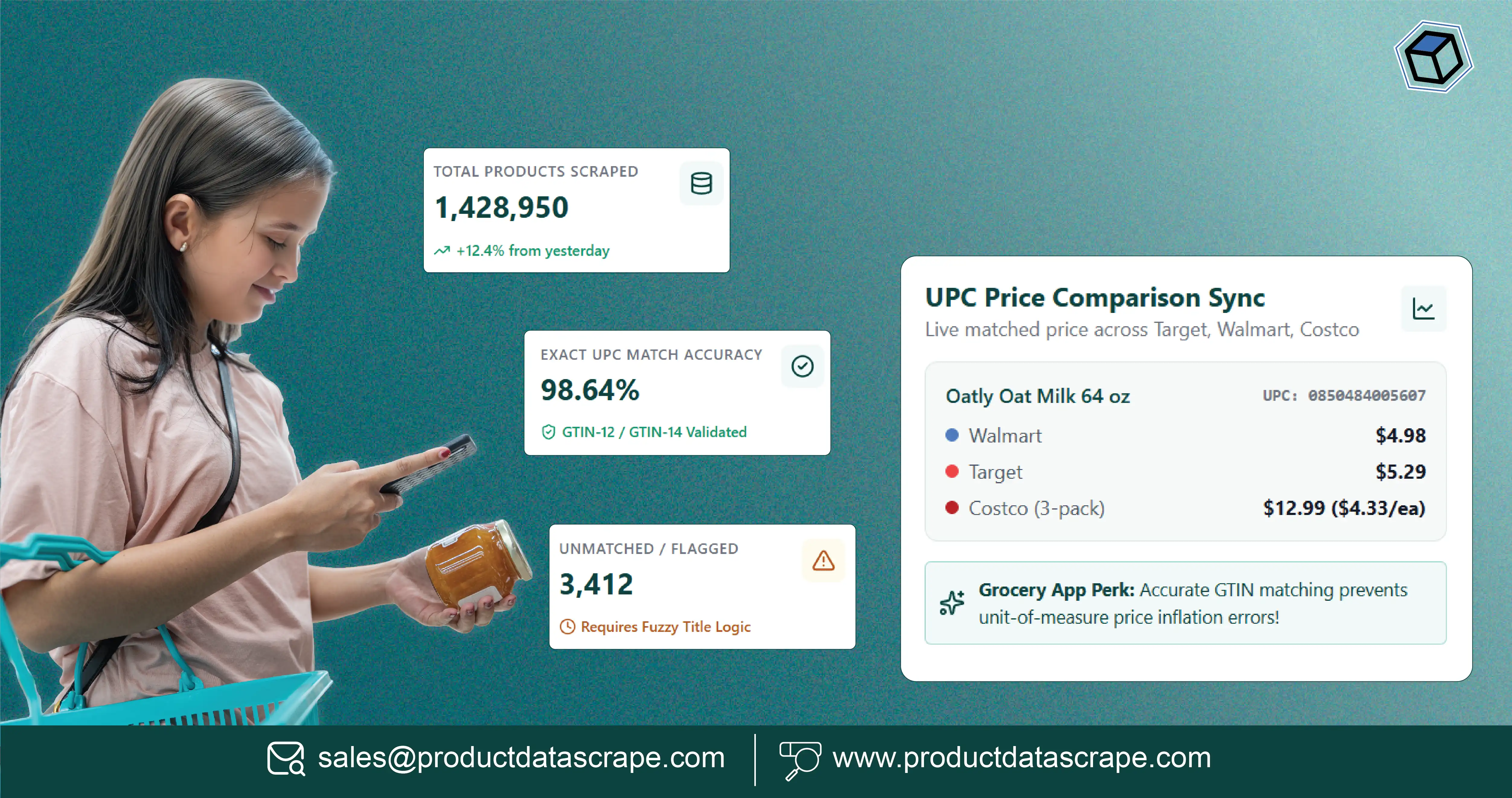
Introduction
Accurate UPC and GTIN matching helps grocery apps identify equivalent products across retailers, reduce duplicate listings, and support more reliable product and price comparisons. By combining standardized identifiers with product names, package sizes, and images, businesses can distinguish genuine matches from similar-looking items at Costco, Walmart, and Target. Scrape UPC/GTIN Matching for Grocery Apps describes a data workflow for collecting and aligning product identifiers from permitted retail sources. It helps grocery technology teams build more consistent catalogs, especially when retailers use different product titles, packaging descriptions, or internal stock-keeping units. Scrape Product Images & Barcodes adds visual evidence that can help analysts validate product records when identifiers are missing, inconsistent, or difficult to interpret.
The challenge is that matching products is not simply a matter of comparing names. A single brand may sell different package sizes, flavors, multipacks, and formulations. Costco's warehouse-oriented assortment can also include pack configurations that differ from products sold individually elsewhere. UPC or GTIN values are valuable matching signals, but they must be checked alongside product attributes and packaging details.
For grocery app developers, catalog managers, and retail data analysts, the goal is a traceable product-matching process. Each proposed match should preserve its source, identifier, package information, and confidence level so teams can investigate uncertain records before using them for price comparison or product recommendations.
Why are standardized product identifiers important for grocery comparisons?
Grocery catalogs often describe products differently even when the underlying item is the same. Standardized identifiers provide a stronger starting point than title similarity alone. UPC commonly refers to a barcode format used in retail, while GTIN is the broader Global Trade Item Number system managed through GS1 standards. The exact identifier type and packaging level matter when comparing products.
UPC and GTIN matching for grocery comparison apps combines these identifiers with descriptive fields such as brand, size, flavor, and unit count. The requested term UK Grocery Market Benchmarking Intelligence is relevant when comparing practices across markets, but UK market data should not be presented as evidence of US retailer-specific matching performance.
GS1 explains that GTINs identify trade items and can be represented in different barcode formats. Its standards help businesses identify products consistently across supply chains. See the GS1 GTIN overview and GS1 US barcode resources.
| Matching field |
Purpose |
Validation rule |
| UPC or GTIN |
Primary identifier signal |
Validate format and available check digit |
| Brand |
Confirms brand identity |
Normalize spelling without removing meaningful distinctions |
| Product name |
Describes the item |
Retain flavor, variety, and formulation |
| Net quantity |
Identifies size |
Compare weight, volume, and count |
| Pack configuration |
Distinguishes singles from multipacks |
Record the number of consumer units |
| Product image |
Provides visual evidence |
Check packaging and visible size information |
| Source URL |
Supports traceability |
Keep the original source reference |
What should analysts remember? Identical brand names do not guarantee identical products, and different GTINs can represent different package levels or trade-item configurations. A reliable system should treat identifier matching as a strong signal—not as permission to ignore product attributes. This reduces the risk of comparing a single item with a multipack or treating a different formulation as an equivalent product.
How can product records be collected and organized across retailers?
An effective product dataset starts with clearly defined fields and consistent collection rules. Where retailers provide public product pages or authorized feeds, teams can capture available identifiers, titles, package details, images, displayed prices, and source links. Not every retailer page exposes a UPC or GTIN, so missing identifiers should be recorded as missing rather than inferred from a similar listing.
A UPC GTIN Mapping Dataset can bring records from multiple sources into one schema. When teams Extract Walmart Grocery Data, they should use permitted access methods and retain the context of each observation. The dataset should distinguish retailer-specific item identifiers from standardized global identifiers, because an internal SKU is not necessarily interchangeable with a UPC or GTIN.
| Dataset field |
Example of what it stores |
Quality control |
| Retailer |
Walmart, Costco, or Target |
Use a controlled retailer name |
| Retailer item ID |
Retailer-specific listing reference |
Keep separate from GTIN |
| UPC/GTIN |
Identifier displayed or supplied by an authorized source |
Validate structure where possible |
| Product title |
Retailer's displayed title |
Preserve the original text |
| Brand |
Brand as listed |
Normalize cautiously |
| Package quantity |
Count, weight, or volume |
Store units explicitly |
| Image reference |
Authorized image URL or internal asset ID |
Track source and usage rights |
| Collection timestamp |
Date and time captured |
Use a consistent time standard |
| Source URL |
Product page or feed reference |
Retain for review |
A practical pipeline separates raw records from normalized records. Raw data preserves exactly what the source provided; normalized data standardizes units and naming for analysis. That distinction allows analysts to correct a mapping without losing the original evidence.
Walmart's public site is a source for its displayed grocery catalog, but field availability can vary by listing and market. Product teams should validate actual source coverage before promising that every listing will provide a barcode. See Walmart and GS1's GTIN standards.
How can grocery apps match equivalent products across retailers?
Grocery Product Matching Across Retailers requires more than comparing product titles. A retailer may shorten a brand name, rearrange product attributes, or describe a multipack differently from another store. A matching system should therefore combine standardized identifiers with product attributes and visual checks. When both listings have the same valid GTIN at the same trade-item level, that is strong evidence of a match. If identifiers are missing or differ, the system should investigate rather than automatically merge the records.
Scrape UPC/GTIN Matching for Grocery Apps can support this process by creating normalized records from permitted product sources. Image comparison can help analysts check packaging, brand marks, flavor, and pack configuration, but an image alone cannot prove that two products are identical. GS1's GTIN Management Standard also recognizes that changes such as declared net content or pack quantity can affect trade-item identification. GS1 GTIN Management Standard
| Matching signal |
Evidence strength |
Recommended action |
| Same validated GTIN and same package level |
Strong |
Confirm key product attributes |
| Same UPC but conflicting size or description |
Requires review |
Check packaging and source records |
| Similar name and brand only |
Weak |
Do not auto-merge |
| Similar product images |
Supporting evidence |
Check size, flavor, and pack count |
| Different GTINs for different pack sizes |
Usually distinct trade items |
Preserve separate records |
| Missing identifier |
Incomplete evidence |
Seek another authorized source |
The broader retail environment also matters. The US Census Bureau reported that total US retail e-commerce sales reached $1.2337 trillion in 2025, representing 16.4% of total retail sales. This is a measure of all retail e-commerce, not grocery-specific sales or product-matching adoption. It provides context for why structured product information is important to digital commerce, but it does not establish a measured benefit from barcode matching. US Census Bureau retail e-commerce data
A practical recommendation is to assign match statuses such as confirmed, probable, needs review, and unmatched. Record the evidence behind each status. That makes catalog corrections easier to audit and prevents uncertain matches from silently affecting comparisons.
What makes cross-retailer matching difficult at Costco, Walmart, and Target?
UPC matching across Costco Walmart and Target can be complicated by differences in package size, assortment, and listing detail. A product sold as a single unit at one retailer may appear as a multipack at another. Even when the brand and product family are the same, these listings should not automatically be treated as identical price-comparison units.
Costco's official website, Walmart's official website, and Target's official website provide retailer-specific product listings. The fields available on each listing can vary. A production workflow should test actual page coverage and avoid assuming that every product page exposes a UPC, GTIN, or identical package description.
The USDA's historical food-at-home inflation series helps illustrate the changing economic environment in which grocery comparison apps operate. These figures are contextual measures of national grocery-price change—not evidence of matching performance at any of the three retailers. USDA ERS Food Price Outlook
| Year |
US food-at-home price change |
Status |
| 2020 |
+3.5% |
Historical |
| 2021 |
+3.5% |
Historical |
| 2022 |
+11.4% |
Historical |
| 2023 |
+5.0% |
Historical |
| 2024 |
+1.2% |
Historical |
| 2025 |
+2.3% |
Historical |
| 2026 |
+2.4% |
USDA forecast, September 2026 |
For accurate comparison, teams should normalize package sizes and calculate unit prices only when the quantity and unit are known. A price per ounce, pound, or individual item can be useful, but the chosen unit must be consistent across records. Multipacks should retain both the total pack quantity and the number of consumer units.
Recommended workflow: match the identifier first, validate brand and product attributes second, and use images to investigate uncertain records. Keep retailer-specific IDs alongside standardized identifiers. If the evidence conflicts, preserve the listings separately until a reviewer can resolve the discrepancy.
How should teams build a dependable mapping guide?
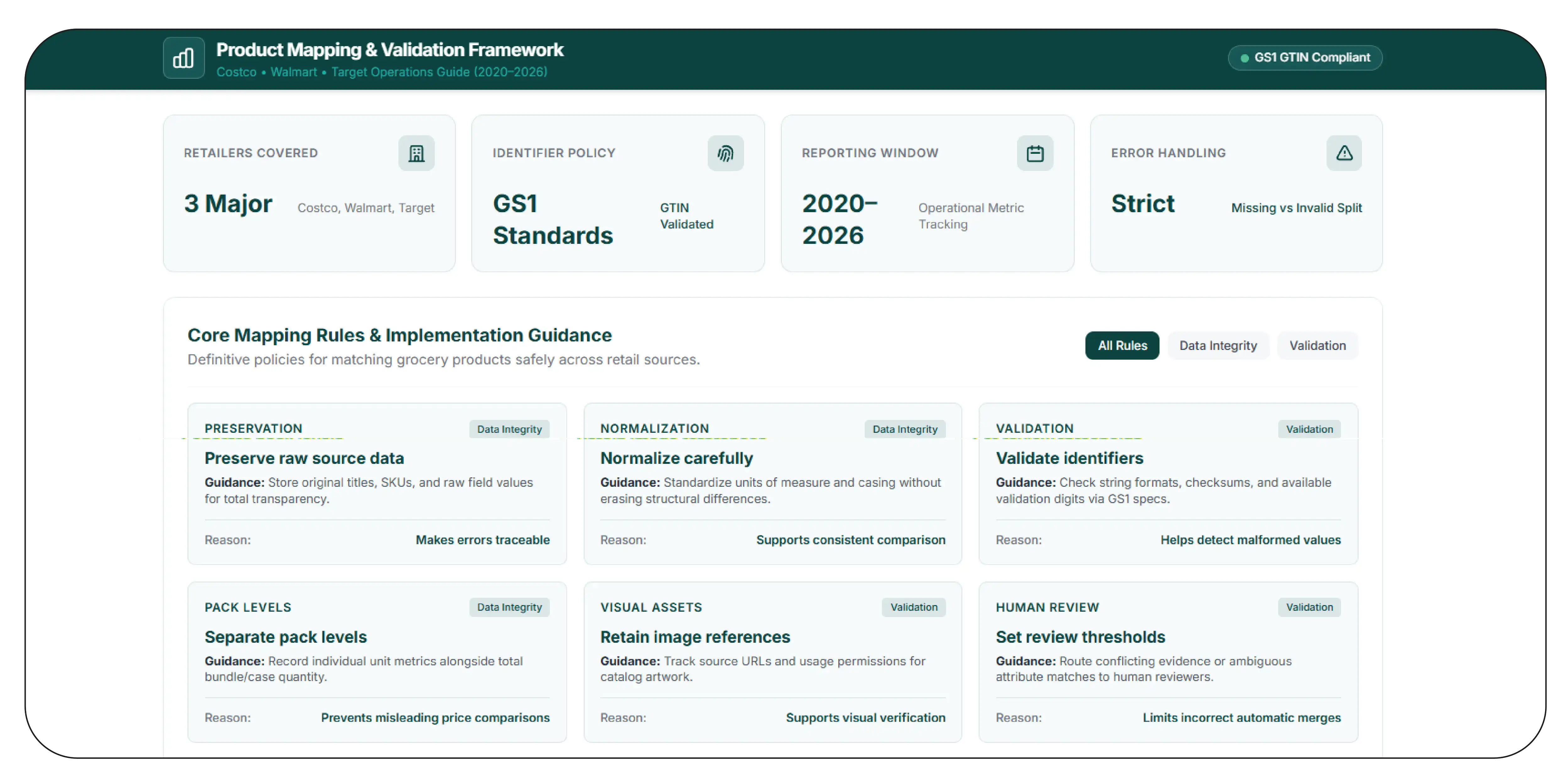
A Costco Walmart Target product mapping guide should document how the business defines an equivalent product, which fields are mandatory, and when a human review is required. Scrape UPC/GTIN Matching for Grocery Apps can help populate the mapping process, but reliable results depend on validation rules and source quality rather than collection volume alone.
A useful guide includes an identifier policy, normalization rules, package-size handling, image-review criteria, exception statuses, and a record of changes. It should also distinguish between a missing identifier and an invalid one. Missing data may require additional research; an invalid identifier may indicate a source error or a parsing problem.
| Mapping rule |
Implementation guidance |
Reason |
| Preserve raw source data |
Store the original title and values |
Makes errors traceable |
| Normalize carefully |
Standardize units and text without erasing differences |
Supports consistent comparison |
| Validate identifiers |
Check format and available validation digits |
Helps detect malformed values |
| Separate pack levels |
Record individual units and total quantity |
Prevents misleading price comparisons |
| Retain image references |
Track source and usage permissions |
Supports visual verification |
| Set review thresholds |
Send conflicting evidence to a reviewer |
Limits incorrect automatic merges |
| Version mappings |
Record corrections and timestamps |
Enables reproducible analysis |
For 2020–2026 reporting, a mapping project should distinguish real operational measurements from external market context. A year-by-year report could track the number of records processed, the proportion with valid identifiers, confirmed match rates, unresolved cases, and review time—but only if the project actually measures those values. There is no verified public annual dataset establishing Costco-, Walmart-, and Target-specific UPC matching rates for these years, so such rates should not be invented.
Teams can use the GS1 GTIN standards and GS1 barcode resources to define identifier rules. The resulting guide should be tested against real product records and reviewed whenever source formats or product packaging change.
How can teams maintain product mappings as catalogs change?
Grocery item mapping across retailer catalogs is an ongoing data-quality task. Product titles change, images are replaced, packaging is updated, and listings may disappear or return. A mapping that was correct at one point should not be assumed to remain correct forever. Teams need a way to detect changes, revalidate important fields, and preserve earlier records for comparison.
A sustainable workflow can monitor source pages or authorized feeds for changes in identifiers, titles, quantities, and image references. It should also flag when a product disappears from a source, without immediately concluding that the item has been discontinued. Temporary unavailability, page changes, and regional differences can produce similar signals.
The following monitoring framework can be applied throughout 2020–2026 or any other reporting period, provided the business maintains actual historical records:
| Monitoring measure |
What to record |
Why it matters |
| Identifier coverage |
Share of records with a usable UPC/GTIN |
Shows data completeness |
| Confirmed match rate |
Matches reviewed against defined rules |
Measures matching quality |
| Exception volume |
Conflicting or unresolved records |
Highlights review workload |
| Source freshness |
Time since last successful update |
Helps detect stale data |
| Attribute changes |
Changes to size, brand, title, or pack count |
Identifies possible product changes |
| Image changes |
New or missing image references |
Triggers visual revalidation |
| Mapping revisions |
Correction date and reason |
Supports auditing |
These are recommended metrics, not published results for the three retailers. Businesses should establish their own baseline from verified observations and avoid comparing match rates across periods unless definitions and source coverage remain consistent.
A robust process also respects source access restrictions, website terms, and image-use rights. Public visibility does not automatically grant unrestricted permission to reuse every data field or product image. Where available, authorized APIs and approved data feeds can provide a more dependable collection route.
The objective is a catalog that remains traceable and comparable over time. When uncertain records are flagged instead of silently merged, product teams can protect the quality of price comparisons, search results, and recommendations.
Why Choose Product Data Scrape?
Grocery apps need consistent product records to compare listings across retailers and deliver useful shopping experiences. A dependable data workflow combines identifier validation, product attributes, image references, source tracking, and exception handling. Store-Level UPC Data Guide practices can help teams document how products are matched, when records require review, and how mappings are updated as listings change.
Scrape UPC/GTIN Matching for Grocery Apps can support a structured approach to catalog organization when collection methods are authorized and the source fields are available. The key priorities are accuracy, traceability, and transparent limits—not simply collecting more records. By defining quality checks and monitoring data freshness, businesses can build a stronger foundation for product discovery and cross-retailer comparisons.
Conclusion
Accurate product matching helps grocery apps distinguish identical items from products that only look similar. Combining validated identifiers with brand, package quantity, product descriptions, and image evidence improves the reliability of comparisons across Costco, Walmart, and Target. Barcode and GTIN Matching for Grocery Data should follow documented rules, preserve source evidence, and flag uncertain records for review. Scrape UPC/GTIN Matching for Grocery Apps can support this workflow when sources and collection methods are permitted.
Contact Product Data Scrape to discuss a tailored grocery catalog-matching workflow, identifier coverage, and data-quality validation for your app!
Frequently Asked Questions
1. What is UPC and GTIN matching?
UPC and GTIN matching uses standardized product identifiers, supported by product attributes, to determine whether listings across different catalogs refer to the same trade item.
2. Can UPCs match grocery products across retailers?
Yes, when identifiers and package levels align. Analysts should still verify brand, size, quantity, and product details before treating listings as equivalent.
3. Why are product images useful for matching?
Images provide supporting evidence about packaging, brand, flavor, and pack configuration. They should complement identifiers and descriptive fields rather than serve as the only matching method.
4. Do Costco, Walmart, and Target expose UPCs on every product page?
Public listing fields vary by retailer and product. Teams should verify source coverage and avoid assuming that every listing provides a UPC or GTIN.
5. How can Product Data Scrape help with grocery catalog matching?
Product Data Scrape can discuss data collection scope, identifier coverage, and validation requirements. Specific retailer coverage and available fields should be confirmed before a project begins.


 Singapore
 EMAIL
 PHONE











.webp)