Introduction
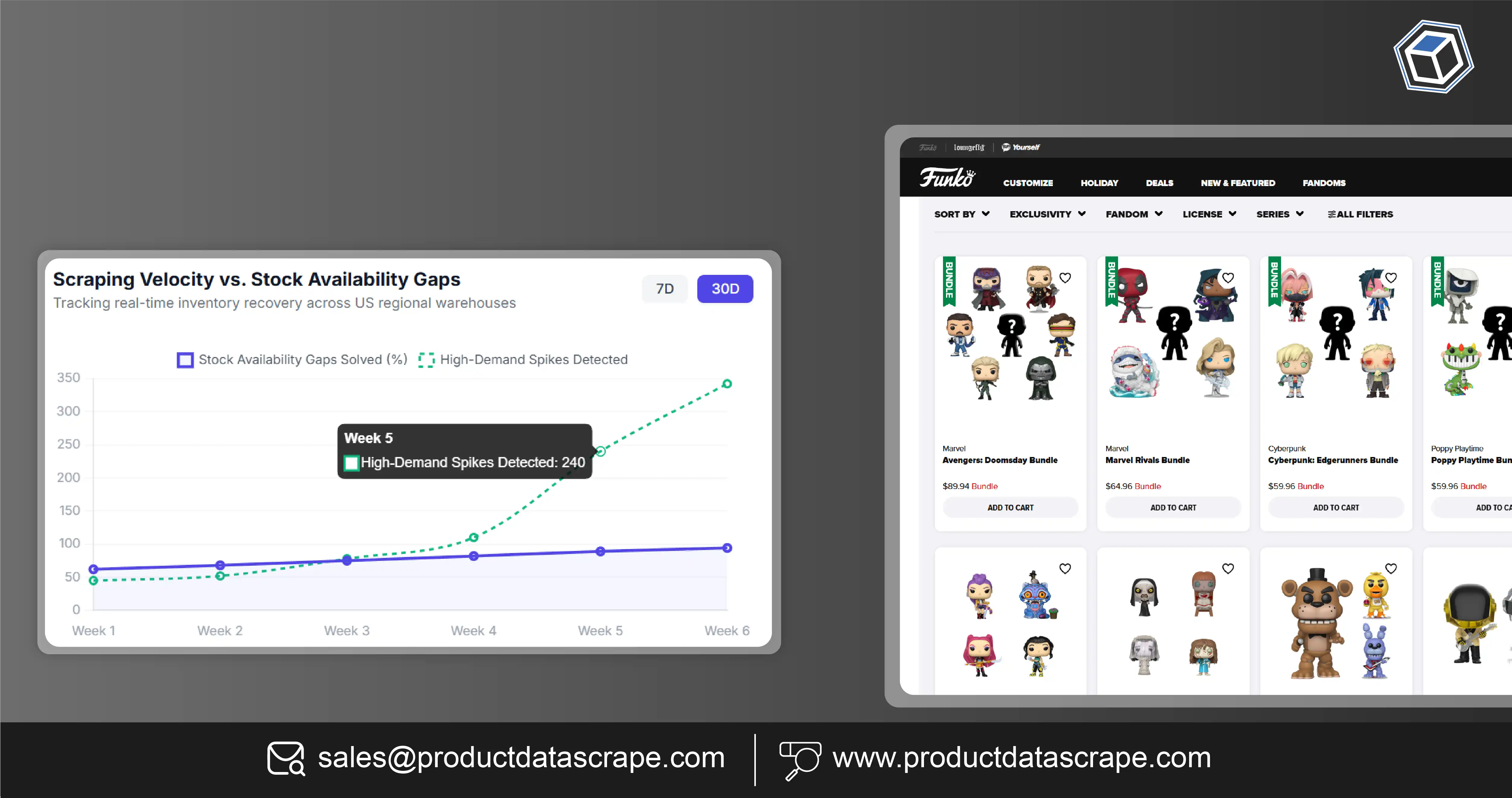
USA Funko Marketplace Scraping helps collectible retailers identify product availability gaps, monitor competitor listings, track limited-edition releases, and discover pricing opportunities across online marketplaces. By collecting structured information about product listings, sellers, prices, and stock status, businesses can make better-informed purchasing and merchandising decisions.
The Funko collectibles market includes products associated with movies, television shows, anime, gaming, sports, and popular culture. Retailers face challenges when products become unavailable, exclusive releases attract attention, or marketplace sellers change their prices. Manually tracking these developments across multiple platforms can consume considerable time and create inconsistent records.
An effective Marketplace & Seller Intelligence strategy allows retailers to examine competitor listings, seller activity, product availability, discounts, and customer feedback in one structured dataset. This information can help businesses distinguish active products from discontinued listings, recognize collectible categories receiving attention, and identify potential inventory gaps.
For retailers, distributors, resellers, and collectibles marketplace operators, accurate product intelligence is essential for reducing missed opportunities and improving inventory planning. Combining historical observations with current marketplace information creates a stronger foundation for product selection, competitor benchmarking, and pricing decisions.
How Can Release Information Help Retailers Prepare for New Collectibles?
New collectible releases can create inventory planning challenges for retailers. Products associated with popular entertainment franchises, special events, and exclusive collections may attract customer attention before retailers have sufficient information about their availability and competing listings.
Funko Release Calendar Extraction helps businesses organize publicly available release information into structured records. Relevant information can include product names, character names, franchise categories, announced release dates, retailer exclusivity, limited-edition labels, and product identifiers.
Funko provides an official limited-edition release calendar that distinguishes Funko.com exclusives from retailer exclusives. Its calendar also displays announced release dates, participating retailers, and stated edition quantities for selected products. For example, the official calendar identifies retailer-exclusive releases from businesses such as Target, Walmart, GameStop, and Hot Topic.
Source: Official Funko Limited Edition Calendar.
Retailers can use this information to organize upcoming releases, compare announced products with their existing catalogs, and prepare inventory research before launch dates. Historical release records can also help merchandising teams understand which franchises and product categories appear repeatedly in special collections.
Retail media and promotional activity are another important consideration. Retail media and ad intelligence helps businesses examine publicly visible promotional placements, sponsored product listings, campaign messaging, and advertised offers across relevant retail platforms.
A combined dataset can help retailers identify products receiving promotional attention and compare advertised availability with actual product listings. However, advertising visibility should not automatically be treated as proof of sales demand.
A useful release-monitoring dataset can contain:
- Product title and unique identifier.
- Franchise and character information.
- Announced release date.
- Retailer-exclusive designation.
- Published edition quantity, where available.
- Product listing and availability status.
- Publicly visible promotional information.
By organizing these fields, retailers can prepare product research earlier, identify potential assortment gaps, and improve release-related merchandising decisions.
Why Should Businesses Combine Release Information With Price Research?
Release information explains when collectibles are expected to appear, while pricing information reveals how sellers position those products in the marketplace. Combining these two data sources helps retailers understand the relationship between new releases, seller competition, and product availability.
Funko USA Product Release and Price Data Scraping enables businesses to collect product details alongside publicly displayed prices, discounts, seller information, and listing dates. This creates a structured dataset that supports comparisons across marketplaces and retail channels.
For example, a retailer can examine the listed prices of a newly announced Funko Pop! product across different sellers. The retailer can also record whether listings are marked as preorders, available for immediate purchase, or temporarily unavailable. These distinctions are important because preorder prices and prices for immediately available products do not necessarily represent equivalent purchasing conditions.
Price elasticity analysis can provide another layer of commercial insight. It examines how changes in price relate to changes in purchasing demand. However, calculating actual price elasticity requires reliable transaction or quantity-demand data. Public listing prices alone cannot establish how many units customers purchase at each price.
The historical financial performance of Funko provides useful company-level context.
| Year | Funko annual net sales |
|---|
| 2020 | $652.5 million |
| 2021 | $1,029.3 million |
| 2022 | $1,322.7 million |
| 2023 | $1,096.1 million |
| 2024 | $1,049.9 million |
| 2025 | $908.2 million |
| 2026 | $666.0 million through Q3 |
Sources: Funko SEC annual filings and Q3 2026 financial results.
Important: The 2020–2025 figures represent annual worldwide company net sales. The 2026 figure is the sum of reported first-, second-, and third-quarter sales, not a full-year result. These figures are not marketplace sales or individual Funko Pop! prices.
This financial history demonstrates why retailers should avoid making inventory decisions using outdated market assumptions. Businesses need current product-level observations to evaluate seller competition, changing availability, and pricing opportunities.
Combining release dates with historical prices also helps businesses distinguish temporary launch promotions from longer-term pricing movements. Retailers can then develop more informed product purchasing and promotional strategies.
How Does Product-Level Price Monitoring Improve Collectible Comparisons?
Collectibles are not interchangeable simply because they belong to the same franchise. Different characters, editions, product numbers, packaging variations, and retailer exclusives can have different marketplace listings and prices.
Funko SKU-Level Price Intelligence helps retailers compare individual products using consistent identifiers and product attributes. This is particularly important for businesses managing large collectible catalogs across multiple online marketplaces.
USA Funko Marketplace Scraping can collect product titles, SKU or product identifiers, franchise names, character details, edition labels, seller information, displayed prices, discounts, and availability information from accessible marketplace listings.
A reliable comparison process should begin with product identification. Matching products only by character name can create inaccurate comparisons because the same character may have multiple releases or variations.
Retailers should consider the following factors:
- Product identifiers: Use available SKU, UPC, or other identifiers to distinguish individual listings.
- Edition information: Record exclusive, special-edition, and limited-edition labels.
- Condition: Separate new, used, damaged-box, and collectible-condition listings.
- Seller details: Identify the marketplace seller and distinguish individual listings.
- Price information: Record listed prices, sale prices, and shipping charges separately.
- Availability: Distinguish available products from preorder and unavailable listings.
These fields make it easier to compare equivalent products rather than unrelated collectibles.
For example, comparing a standard retail release with a retailer-exclusive version without accounting for edition differences can produce misleading price benchmarks. Similarly, a damaged-box listing should not automatically be compared with a sealed collectible in new condition.
Historical price records are equally valuable. Repeated observations allow retailers to examine whether a product's listed price has changed, whether sellers have introduced discounts, and whether the number of available listings has increased or decreased.
Businesses should also preserve collection timestamps. A price without a collection date offers limited value for historical analysis.
By connecting product identifiers, seller records, prices, and availability information, retailers can create more accurate competitive benchmarks and identify product-level opportunities.
How Can Retailers Distinguish Active Products From Retired Collectibles?
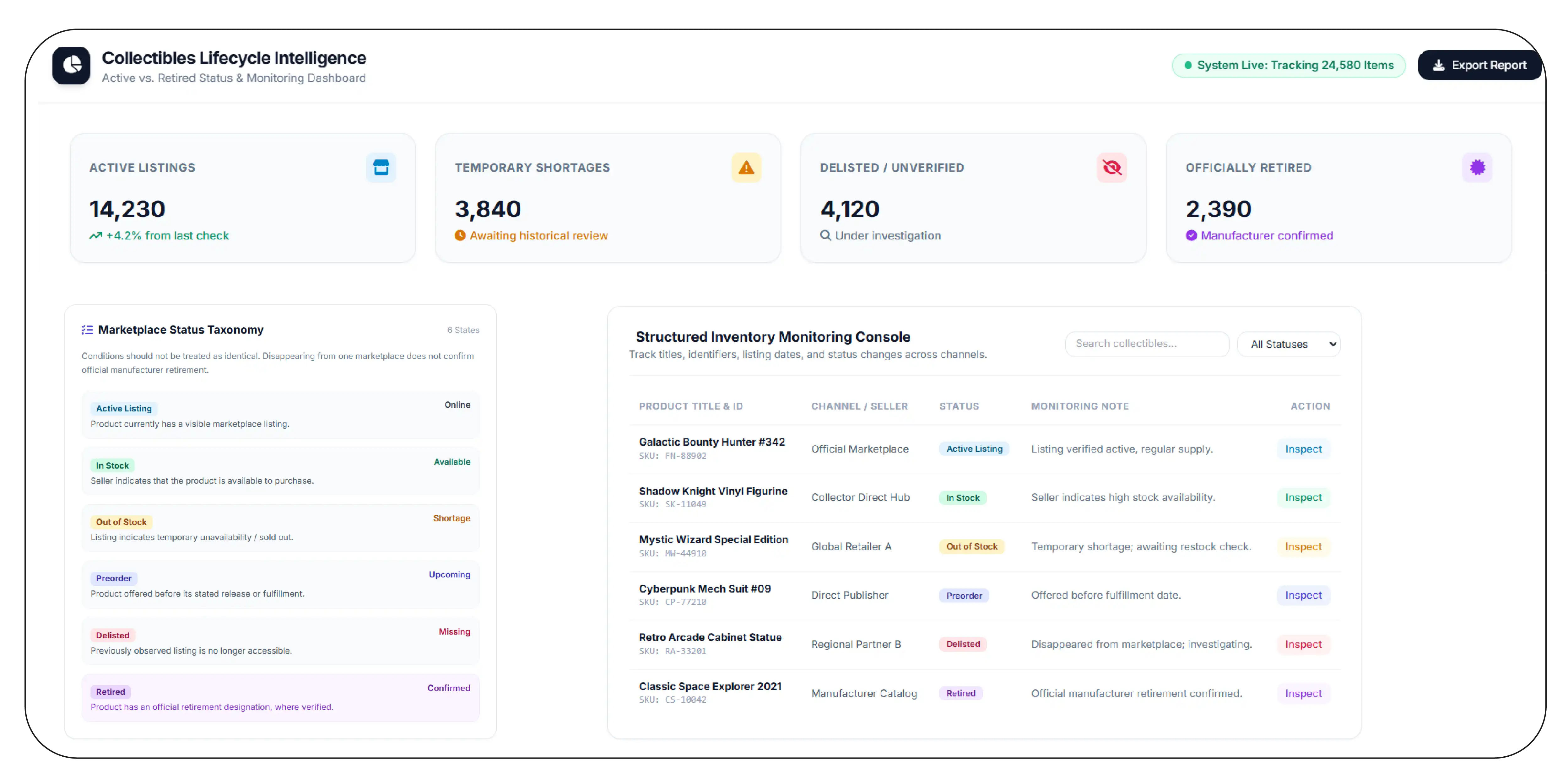
One major challenge in collectibles retail is understanding whether a product is still actively listed, temporarily unavailable, or no longer being offered through a particular retail channel.
These conditions should not be treated as identical. A product disappearing from one marketplace does not necessarily mean that the manufacturer has officially retired it. It may have sold out at one retailer, been temporarily delisted, or become unavailable in a particular region.
Funko Retired and Active Product Data Scraping helps businesses organize product listings according to their observed marketplace status and available product information.
A structured monitoring system can track product titles, identifiers, listing dates, seller details, availability messages, and changes in product-page status. Retailers can use these records to identify products that have disappeared from active listings and investigate whether they remain available elsewhere.
The following distinctions are useful:
| Product status | Meaning for retailers |
|---|
| Active listing | Product currently has a visible marketplace listing |
| In stock | Seller indicates that the product is available |
| Out of stock | Listing indicates that the product is unavailable |
| Preorder | Product is offered before its stated release or fulfillment |
| Delisted | Previously observed listing is no longer accessible |
| Retired | Product has an official retirement designation, where verified |
Businesses should avoid classifying every unavailable product as retired. Official product announcements, manufacturer information, and reliable catalog records should be used when confirming retirement status.
Historical observations can reveal whether an unavailable listing returns, whether another seller continues offering the same product, or whether the product remains absent over an extended monitoring period.
This approach is particularly useful for collectibles retailers managing large inventories. It can help purchasing teams avoid unnecessary restocking decisions, identify products requiring further investigation, and separate temporary stock shortages from longer-term catalog changes.
The most effective strategy combines marketplace observations with verified product information instead of relying on a single stock-status message.
Why Is Monitoring Limited Releases Important for Collectible Sellers?
Limited-edition collectibles require additional monitoring because their availability may depend on release schedules, participating retailers, and stated edition quantities. Retailers that rely only on general product searches may overlook important distinctions between standard releases and exclusive collections.
Funko Limited Edition Price Tracking helps businesses organize publicly available information about special releases, retailer exclusives, announced quantities, listed prices, and seller availability.
The official Funko release calendar provides a useful example of why this information matters. It separates Funko.com exclusives from retailer exclusives and identifies participating retailers and announced edition quantities for selected products.
For instance, Funko's official calendar has published releases with stated quantities of 7,500 and 9,500 pieces for certain retailer-exclusive products. These figures are product-specific announcements, not estimates of total market supply or actual sales.
Source: Funko Limited Edition Release Calendar.
USA Funko Marketplace Scraping allows retailers to organize this release information alongside marketplace observations. Businesses can examine how different sellers list the same exclusive collectible, whether the product remains available, and how displayed prices change over time.
Useful monitoring fields include:
- Limited-edition product designation.
- Announced edition quantity, if published.
- Release date and retailer.
- Marketplace listing price.
- Seller identity.
- Product condition.
- Shipping charges.
- Availability status.
- Historical price observations.
This information can support purchasing research and help retailers identify collectible categories that deserve closer attention.
However, a limited production quantity does not automatically guarantee strong resale demand or future appreciation. Retailers should consider actual listing activity, completed sales where lawfully accessible, product condition, and comparable market evidence before making purchasing decisions.
Historical monitoring is also important because marketplace prices can change without corresponding changes in the manufacturer's suggested retail price. Comparing dated observations helps businesses understand whether a price movement is temporary or part of a longer-term pattern.
By combining release information, seller data, and product-level pricing, retailers can improve their understanding of limited-edition collectibles and make more disciplined inventory decisions.
How Can Retailers Build Reliable Competitive Benchmarks?
A competitive benchmark is useful only when the underlying product information is accurate, comparable, and consistently collected. Retailers managing Funko collectibles across different marketplaces need a standardized dataset that combines product identification, seller information, pricing, and availability.
A USA Funko Retail Price Benchmark Dataset can help businesses organize these attributes into a consistent reporting structure.
The dataset should distinguish between manufacturer's suggested retail prices, marketplace asking prices, promotional prices, and completed transaction prices. These values represent different types of commercial information and should not be combined without clear definitions.
For example, an asking price represents what a seller requests, whereas a completed transaction price represents a reported purchase. A product listing marked as sold out also does not establish the price at which customers previously purchased that product.
Retailers can build useful benchmark reports by organizing products into comparable categories, including standard releases, retailer exclusives, limited editions, character collections, and franchise-based products.
The following data fields can support a consistent reporting structure:
| Data category | Recommended fields |
|---|
| Product identity | Product name, SKU, UPC |
| Collectible details | Character, franchise, edition |
| Seller information | Seller name, marketplace |
| Price information | Listed price, discount, shipping |
| Availability | In stock, preorder, unavailable |
| Release information | Release date, retailer |
| Historical records | Collection timestamp, previous price |
| Quality indicators | Condition, listing completeness |
A strong benchmark also requires data validation. Product matching should identify duplicate listings, incomplete identifiers, inconsistent product names, and variations in collectible condition.
Retailers can then use dashboards to compare seller prices, monitor product availability, and identify changes in competitor assortment.
Another important consideration is collection frequency. High-priority products may require more frequent monitoring than standard catalog items. Collection schedules should reflect business needs, marketplace rules, and the rate at which relevant listings change.
Finally, businesses should retain historical observations rather than replacing old records with new values. This creates a traceable dataset that supports price comparisons, stock monitoring, and longer-term merchandising analysis.
The result is a more dependable foundation for competitor research and inventory planning.
Why Choose Product Data Scrape?
Product Data Scrape helps businesses convert publicly accessible marketplace information into structured datasets for commercial research. Its solutions can support product identification, seller monitoring, competitor price comparisons, and collectible availability analysis.
E-Commerce Data Scraping United States can help retailers organize product titles, identifiers, prices, seller details, discounts, and stock information across relevant online platforms.
With USA Funko Marketplace Scraping, businesses can develop customized datasets for standard collectibles, exclusive releases, and selected product categories. Structured data delivery can also support reporting, dashboards, and business intelligence workflows.
Accurate product information helps retailers reduce manual research, identify catalog gaps, and make more informed purchasing and merchandising decisions.
Conclusion
Collectible retailers need reliable marketplace information to identify product availability issues, monitor competitor prices, and understand changing product assortments. Combining release information, seller activity, and historical observations provides a stronger foundation for inventory planning.
Pricing intelligence helps businesses compare equivalent products, examine marketplace price movements, and identify competitive opportunities.
USA Funko Marketplace Scraping supports these objectives through structured product, seller, price, and availability information.
Want to improve your collectible market research? Contact Product Data Scrape today to discuss a customized marketplace data extraction solution for your business!
FAQs
1. What is Funko marketplace data scraping?
It is the structured collection of publicly accessible Funko product listings, prices, seller information, edition details, and availability records from relevant online marketplaces.
2. How does product availability monitoring help retailers?
It helps retailers identify unavailable listings, compare seller availability, monitor product returns, and make better-informed purchasing and inventory planning decisions.
3. Can retailers track limited-edition Funko products?
Yes. Publicly announced release dates, retailer exclusivity, edition quantities, listing prices, and availability information can be organized for limited-edition product research.
4. What data can Product Data Scrape collect?
Product Data Scrape can help organize product identifiers, titles, prices, discounts, seller information, descriptions, edition details, and publicly visible availability information.
5. Why is historical pricing important for collectibles?
Historical pricing helps retailers compare previous and current asking prices, identify promotional changes, evaluate seller competition, and understand marketplace pricing patterns over time.


 Singapore
 EMAIL
 PHONE










.webp)