Quick Overview
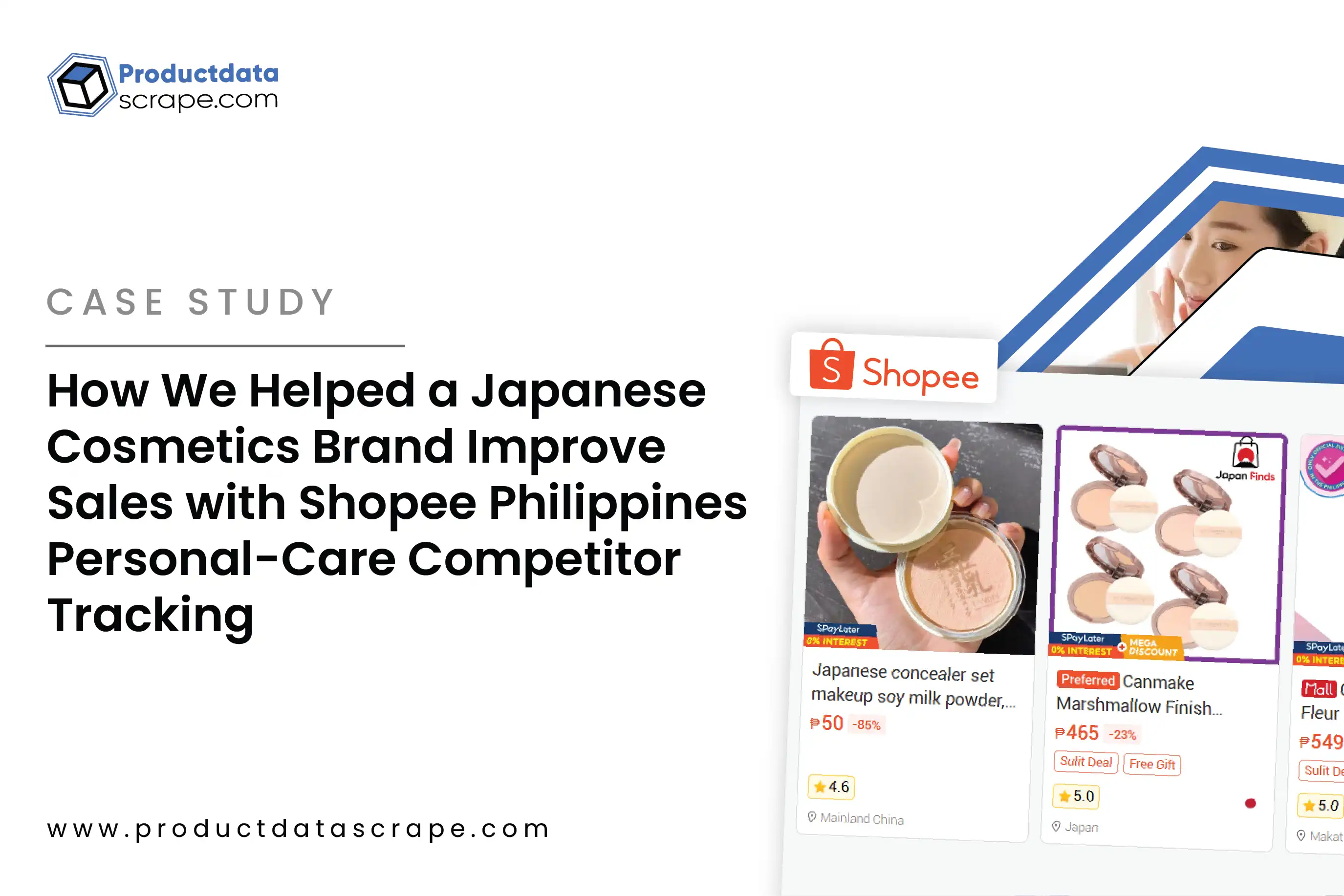
A Japanese cosmetics brand wanted to strengthen its presence in the Philippines by understanding competitor pricing, product assortment, promotional campaigns, and customer feedback on Shopee. Product Data Scrape implemented Shopee Philippines Personal-Care Competitor Tracking to automate marketplace research and deliver structured competitor intelligence. The solution included Scrape Japanese Skincare & Makeup Data workflows covering product listings, prices, discounts, reviews, ratings, and availability. This helped the Japanese Cosmetics Brand improve marketplace visibility, identify pricing opportunities, and make more informed product positioning decisions.
Client Name / Industry: Confidential Japanese Cosmetics Brand | Beauty, Skincare, and Personal Care.
Service / Duration: Shopee Marketplace Data Extraction, Competitor Monitoring, and Product Intelligence | Illustrative duration: 12 weeks.
Key Impact Metrics (Illustrative Targets):
65% reduction in manual competitor research.
90% product attribute completeness.
55% faster promotional price analysis.
The Client
The client was a Japanese cosmetics manufacturer selling skincare, makeup, and personal-care products through online retail channels. Its product portfolio included facial cleansers, moisturizers, sunscreens, serums, lip tints, and makeup essentials. The company wanted to expand its reach among Filipino consumers through Shopee Philippines.
The Philippines beauty market offered significant opportunities, but competition from local and international brands made marketplace positioning increasingly challenging. Consumers could compare prices, product benefits, ratings, reviews, and promotional offers across numerous sellers before making purchasing decisions.
The client needed Philippine Beauty Product Catalog Scraping to understand how competing brands positioned similar products, which categories attracted attention, and how promotional campaigns influenced marketplace performance.
Before partnering with Product Data Scrape, the brand relied on manual searches and spreadsheets to collect competitor information. Teams struggled to maintain updated product records, identify duplicate listings, and compare different product sizes and formulations.
Limited Beauty data also made it difficult to understand changing customer preferences and competitor strategies. Promotional prices, seller information, and customer reviews were scattered across individual listings.
The company recognized that manual research could not support its growing marketplace requirements. It needed a scalable data collection framework to improve competitor visibility, support pricing decisions, and identify opportunities for product expansion in the Philippines.
Goals & Objectives
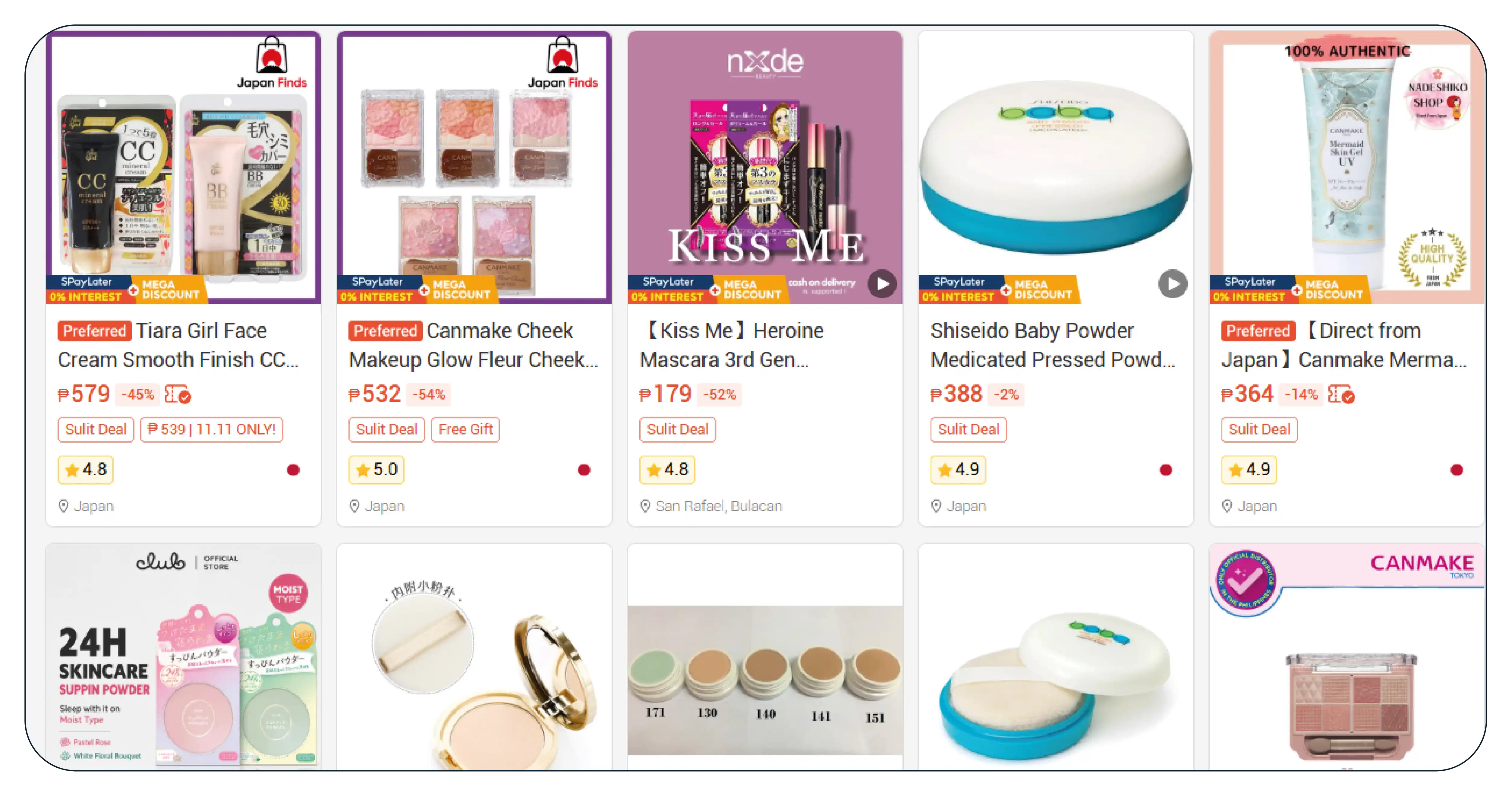
The primary objective was to help the cosmetics brand build a reliable competitor intelligence system for Shopee Philippines. The project focused on improving data collection speed, product identification, pricing accuracy, and marketplace performance analysis.
The business wanted to establish a scalable monitoring framework that could support its growing product catalog and competitive expansion.
Monitor competitor skincare, makeup, and personal-care listings.
Identify pricing gaps across competing cosmetics brands.
Understand discount strategies and promotional activities.
Improve product positioning and marketplace visibility.
Use Japanese Cosmetics Seller Listing Monitoring to identify competing sellers, product assortment changes, and emerging market opportunities.
The technical implementation focused on automating marketplace data collection and improving information consistency.
Extract product titles, brand names, prices, discounts, ratings, and reviews.
Capture product images, specifications, variants, and seller details.
Standardize product attributes across different Shopee listings.
Automate recurring collection and validation workflows.
Integrate structured datasets with internal reporting systems.
Support Shopee Philippines Personal-Care Competitor Tracking through scheduled monitoring and organized reporting.
The following illustrative targets were established to measure project performance:
Competitor listing coverage: 95% of the defined target catalog.
Product attribute completeness: 90% or higher.
Manual research reduction: 65%.
Promotional price analysis speed: 55% faster.
Scheduled extraction success: 98%.
Duplicate listing reduction: 80%.
These KPIs provided measurable benchmarks for evaluating data quality, operational efficiency, and marketplace intelligence improvements.
The Core Challenge
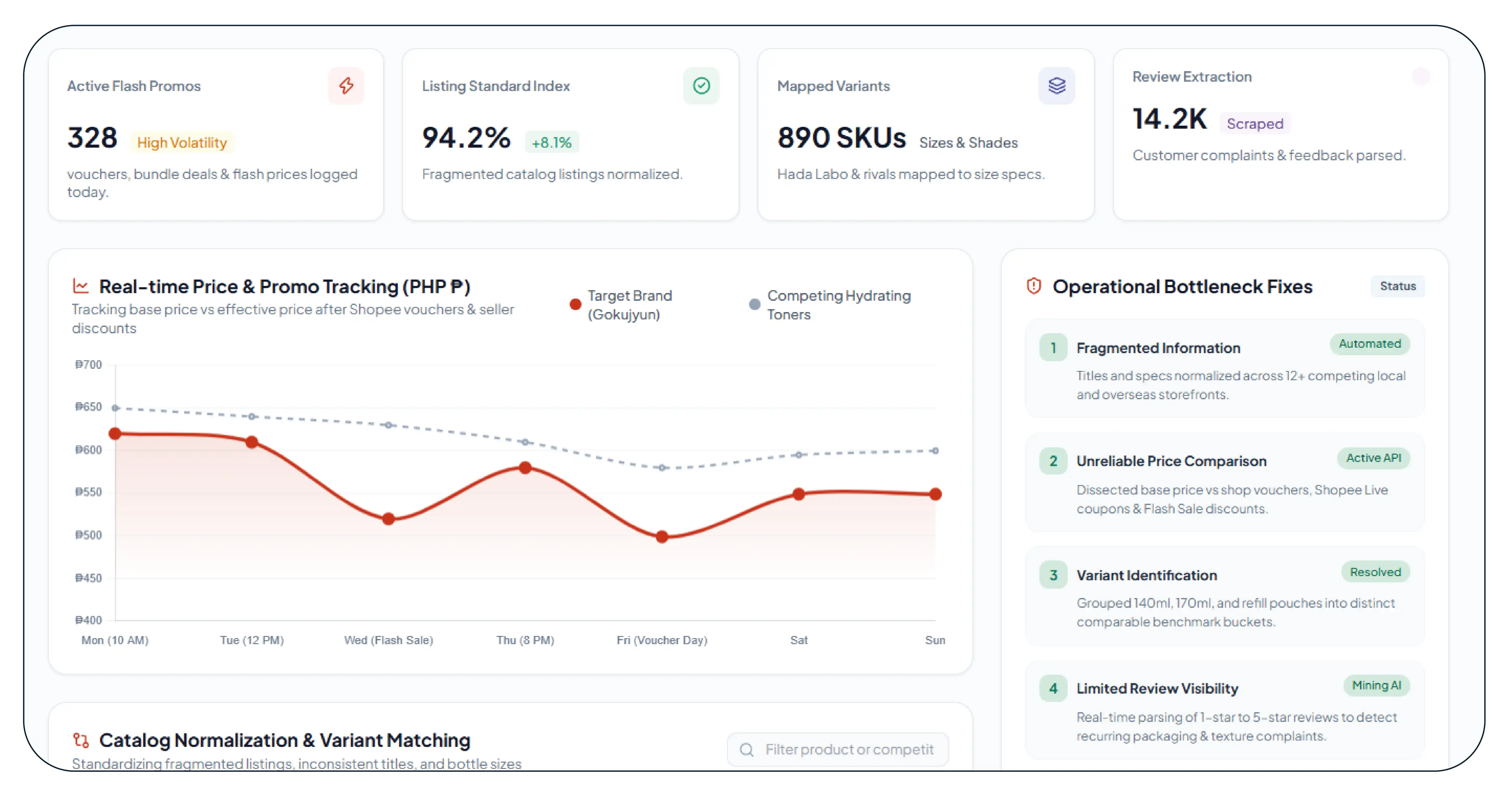
The Japanese cosmetics brand faced several operational challenges while monitoring personal-care competitors on Shopee Philippines. Its existing research process depended heavily on manual searches, making it difficult to track changing product information consistently.
One major issue involved promotional pricing. Sellers frequently introduced vouchers, discounts, flash sales, and limited-time offers. Without automated Beauty Brand Promotional Price Tracking, the client struggled to identify pricing changes and understand how competitors adjusted their promotional strategies.
Product catalog inconsistencies created another problem. Similar skincare products appeared under different titles, product sizes, and descriptions. For example, Hada Labo Gokujyun Hyaluronic Acid Lotion and competing hydrating toners could have overlapping descriptions but different formulations and packaging sizes.
The major operational bottlenecks included:
Fragmented product information: Competitor listings contained inconsistent titles, descriptions, and specifications.
Unreliable price comparisons: Discounts, vouchers, and promotional prices complicated comparisons.
Variant identification issues: Different sizes, shades, and formulations were sometimes grouped incorrectly.
Limited review visibility: Manual collection made it difficult to identify recurring customer complaints and product preferences.
Delayed competitor insights: Spreadsheet-based research could not consistently capture frequent listing changes.
Incomplete seller information: Changes in seller availability and listing activity were difficult to monitor.
The client needed Shopee Philippines Personal-Care Competitor Tracking to replace fragmented research with structured, repeatable data collection and validation.
Our Solution
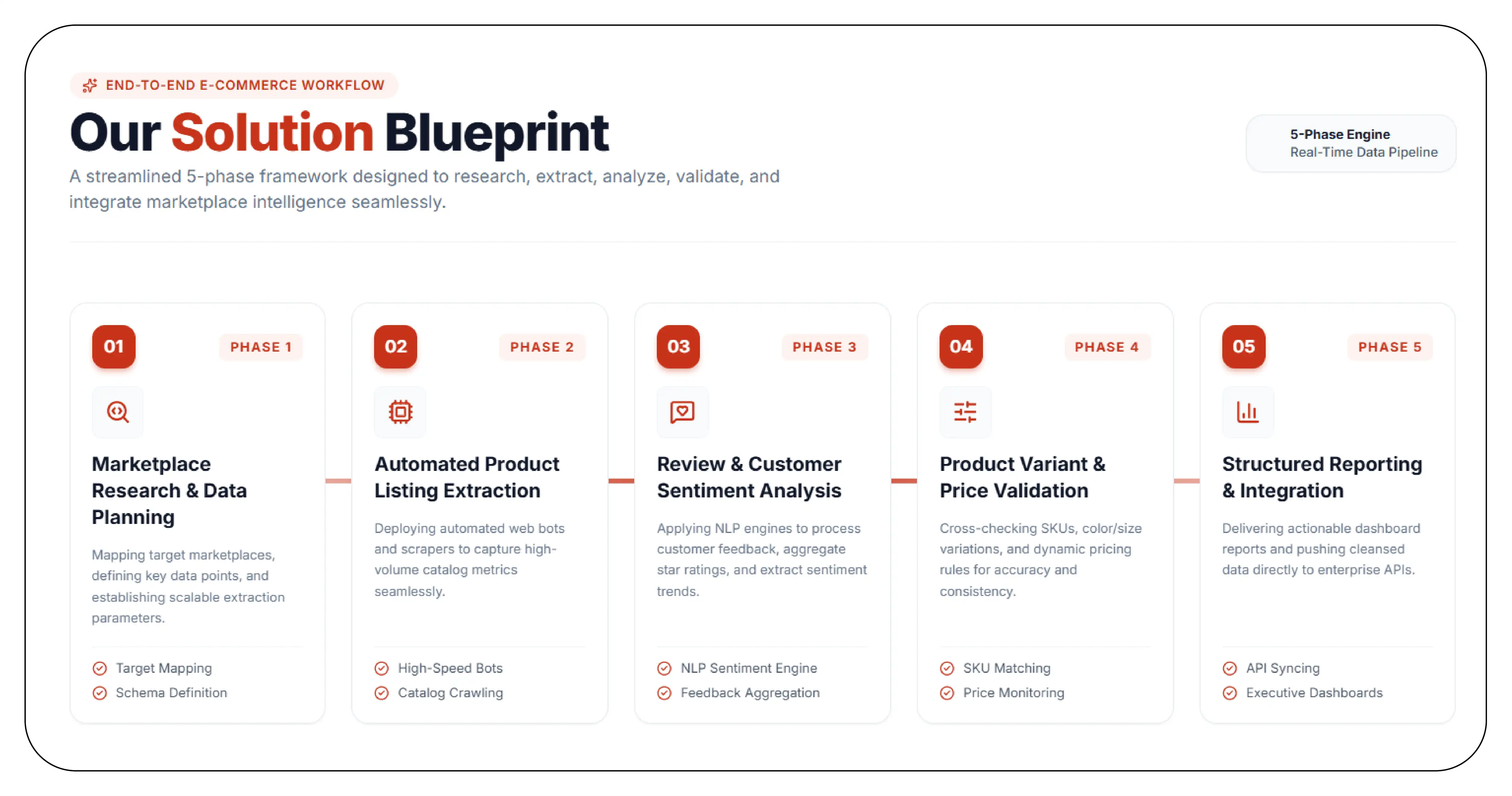
Product Data Scrape implemented a phased marketplace intelligence solution designed to improve competitor monitoring, pricing analysis, and product catalog visibility. The workflow focused on Shopee Philippines and relevant Japanese beauty and personal-care products.
Phase 1: Marketplace Research and Data Planning
The first phase involved identifying relevant product categories, competitor brands, and seller listings. The team defined the required data fields, including product titles, brand names, product URLs, prices, discounts, ratings, reviews, images, seller details, and availability. Target product categories included Japanese skincare, facial cleansers, sunscreens, moisturizers, serums, makeup, and personal-care essentials. Representative brands included Hada Labo (hydrating lotions and facial moisturizers), SK-II (facial treatment and skincare products), Shiseido (skincare, sunscreen, and cosmetics), Biore (UV protection and facial cleansers), Canmake (makeup and cosmetic products), and Senka (facial cleansing and skincare products).
Phase 2: Automated Product Listing Extraction
The second phase introduced automated data collection workflows for relevant Shopee Philippines listings. The extraction process captured product names, descriptions, prices, promotional offers, seller information, ratings, review counts, product images, and available variants. The collected information was organized into standardized records, allowing the brand to compare competing products without manually opening individual listings.
Phase 3: Review and Customer Sentiment Analysis
The next phase focused on collecting publicly accessible product reviews and ratings. Through Shopee Philippines Cosmetics Review Scraping, the team organized customer feedback into structured datasets. For example, reviews associated with Hada Labo moisturizers, Biore sunscreens, and Shiseido skincare products could be analyzed for recurring themes such as texture, fragrance, packaging, product effectiveness, and customer satisfaction. This helped the brand understand which product attributes influenced customer perceptions and purchasing decisions.
Phase 4: Product Variant and Price Validation
The collected records passed through validation and matching workflows. Products were compared using brand names, model identifiers, product sizes, shades, formulations, and packaging details. This reduced the risk of comparing different product variants as identical items. The system also standardized regular prices and displayed promotional prices where available. Missing or uncertain information was flagged for further verification.
Phase 5: Structured Reporting and Integration
The final phase converted validated records into structured datasets for reporting and analysis. Data could be delivered through CSV, JSON, API endpoints, or database integrations, depending on the client's requirements. The resulting framework supported competitor price comparisons, seller monitoring, product assortment analysis, and promotional performance reviews. This phased implementation gave the cosmetics brand a repeatable approach to marketplace intelligence while creating a foundation for expanding monitoring across additional beauty categories and Southeast Asian marketplaces.
Results & Key Metrics
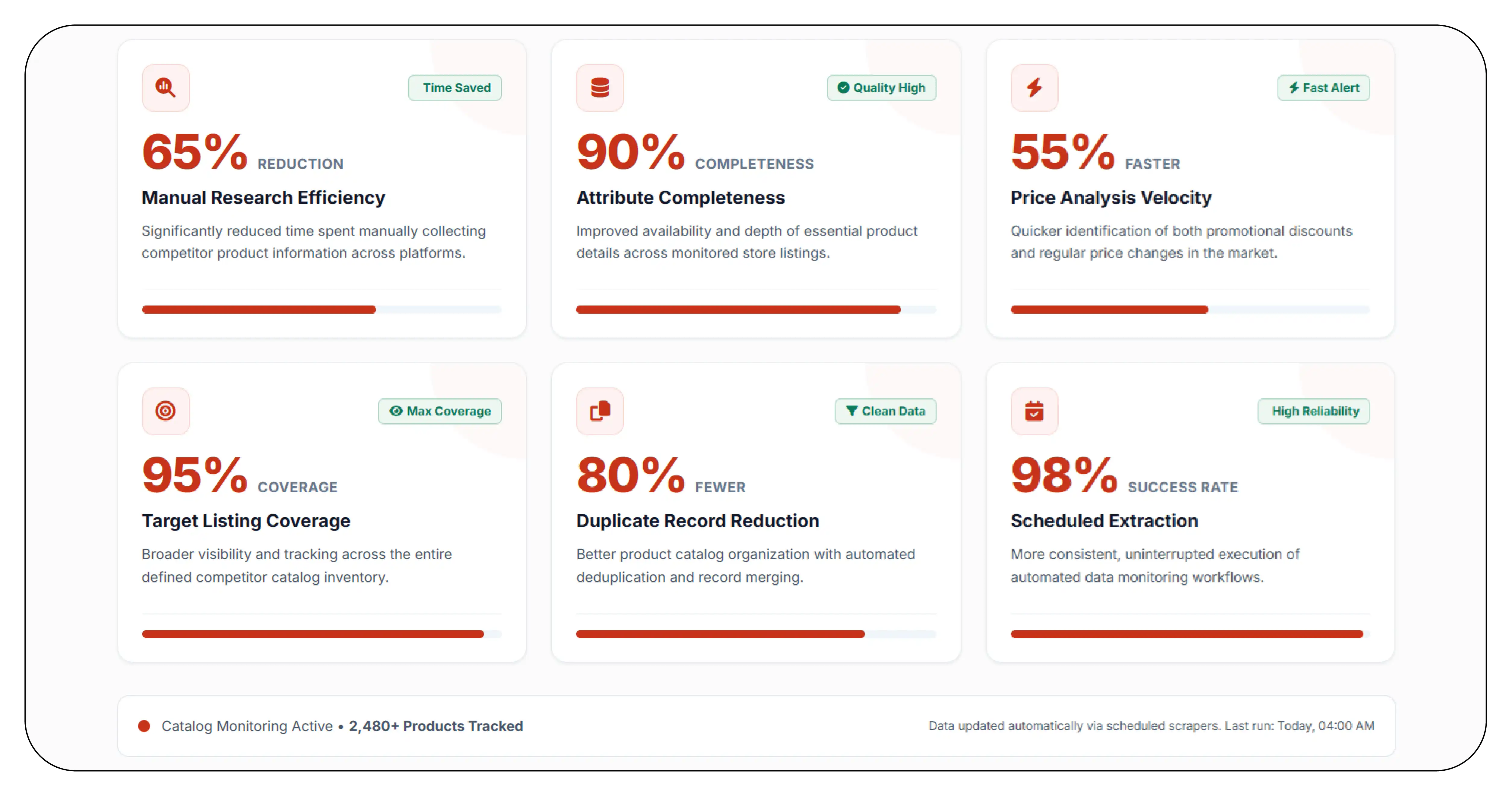
The automated monitoring framework established a more organized approach to competitor research and product intelligence. The following figures are illustrative performance targets rather than verified client results.
Illustrative project performance indicators:
65% reduction in manual research: Less time spent collecting competitor product information.
90% attribute completeness: Improved availability of essential product details.
55% faster price analysis: Quicker identification of promotional and regular price changes.
95% target listing coverage: Broader visibility across the defined competitor catalog.
80% fewer duplicate records: Better product catalog organization.
98% scheduled extraction success: More consistent execution of monitoring workflows.
Results Narrative
The implementation helped the Japanese cosmetics brand establish a structured approach to marketplace competitor analysis.
Through Beauty Brand Product Variant Monitoring, the company could organize comparable products based on sizes, shades, formulations, and packaging differences.
The collected datasets improved visibility into competitor pricing, promotional campaigns, product availability, and customer feedback. Teams could identify products requiring pricing reviews and categories with opportunities for stronger marketplace positioning.
The structured reporting process also reduced repetitive research and improved collaboration between product, marketing, and e-commerce teams.
By combining product listing information with customer reviews and seller activity, the brand gained a broader understanding of competitor strategies.
These improvements created a foundation for more informed assortment planning, promotional decisions, and marketplace expansion in the Philippines.
What Made Product Data Scrape Different?
Product Data Scrape focused on building a structured and scalable competitor intelligence framework rather than providing disconnected marketplace reports.
The solution combined automated extraction, product attribute standardization, duplicate detection, and product variant validation. Its monitoring workflows supported Daily Cosmetics Ecommerce Data Scraping, helping businesses organize frequently changing marketplace information.
The framework also enabled structured tracking of prices, promotional offers, product availability, seller details, and customer feedback.
A key differentiator was the ability to connect multiple data points into one reporting workflow. Through Shopee Philippines Personal-Care Competitor Tracking, the brand gained a consistent view of competing skincare and personal-care products.
The modular approach also supported additional categories, configurable refresh schedules, and integration with existing business intelligence systems.
Client's Testimonial
"Product Data Scrape helped us improve how we monitor competitor activities in the Philippines beauty market. Previously, collecting product prices, promotional information, and customer reviews required considerable manual effort. The automated data collection framework gave our team better visibility into competing skincare and personal-care products. We could identify product variations, understand promotional strategies, and organize competitor information more efficiently. The structured reporting also supported our Cosmetics Pricing Intelligence initiatives by making competitor comparisons easier and more consistent. This project provided a stronger foundation for our marketplace research and helped our teams make more informed decisions about product positioning and promotional planning."
— E-commerce Marketing Manager, Japanese Cosmetics Brand
Conclusion
Competing in the Philippines beauty market requires accurate product information, consistent competitor monitoring, and timely pricing insights. Product Data Scrape helped the Japanese cosmetics brand establish a structured marketplace intelligence framework through automated data extraction, product validation, and review analysis.
With a scalable Shopee Product Data Scraper, businesses can monitor competing skincare, makeup, and personal-care listings while improving catalog visibility and pricing decisions.
Implementing Shopee Philippines Personal-Care Competitor Tracking creates opportunities to identify market trends, understand customer preferences, and strengthen competitive positioning.
Want to improve your beauty marketplace intelligence? Partner with Product Data Scrape to transform e-commerce data into actionable business insights!
Frequently Asked Questions
1. What is Shopee Philippines personal-care competitor tracking?
It is the process of monitoring competing skincare, makeup, and personal-care listings on Shopee Philippines. Businesses analyze prices, discounts, ratings, reviews, sellers, and product availability to improve competitive positioning.
2. What product information can be collected?
Data collection can include product names, brands, descriptions, prices, discounts, images, ratings, reviews, seller details, and available variants.
3. Which Japanese cosmetics brands can be monitored?
Depending on listing availability, businesses can monitor brands such as Hada Labo, Shiseido, SK-II, Biore, Senka, and Canmake.
4. How does competitor price monitoring help cosmetics brands?
It helps identify competitor pricing changes, promotional strategies, discount patterns, and product positioning opportunities. Brands can use these insights to improve pricing and promotional decisions.
5. Can collected Shopee data support business intelligence dashboards?
Yes. Structured marketplace datasets can be delivered through CSV, JSON, APIs, or database integrations. Businesses can use them to build dashboards for competitor analysis, product performance, review monitoring, and pricing intelligence.


 Singapore
 EMAIL
 PHONE











.webp)