Quick Overview
Product Data Scrape developed a structured grocery pricing intelligence solution to help a retail analytics business compare supermarket basket costs across leading UK grocery chains. Using Scrape UK Cheapest-Basket Calculator Data, the project collected product-level prices, basket information, and retailer comparisons from Tesco, Asda, Sainsbury's, and Aldi. The solution strengthened UK Supermarket Pricing Intelligence through automated collection, product matching, and standardized datasets. The project covered Tesco, Asda, Sainsbury's & Aldi Data, helping the client build a consistent foundation for grocery price analysis, competitive benchmarking, and retail market research.
Client Name / Industry: Confidential Retail Analytics Company | Grocery Retail Intelligence
Service / Duration: Supermarket Data Scraping, Product Matching, Price Monitoring | Illustrative 12-week implementation
Key Impact Metrics (Illustrative Targets): 95%+ product-matching accuracy, 60% reduction in manual data handling, and 3x faster pricing analysis.
The Client
The UK grocery market faces continuous pressure from changing household budgets, supermarket competition, promotional campaigns, and fluctuating product prices. Consumers increasingly compare grocery baskets across retailers to identify where everyday shopping offers better value. For retail analytics businesses, maintaining accurate and comparable supermarket information has therefore become essential.
Our client was a retail intelligence company supporting grocery brands, market researchers, and pricing analysts. It wanted to improve its supermarket comparison capabilities by collecting structured information from major UK grocery retailers, including Tesco, Asda, Sainsbury's, and Aldi.
Before partnering with Product Data Scrape, the client relied heavily on manual research and fragmented product information. Different product names, pack sizes, promotional prices, and category structures made direct comparisons difficult. Analysts also struggled to maintain consistent records when products changed or became unavailable.
The business needed a scalable solution to Scrape UK Grocery Price Comparison Calculator information and transform scattered retail records into reliable datasets. Its existing workflow limited the speed of market research and made frequent updates difficult.
The client also wanted professional Grocery data scraping capabilities that could support product matching, price benchmarking, and long-term grocery market intelligence without increasing manual workloads.
Goals & Objectives
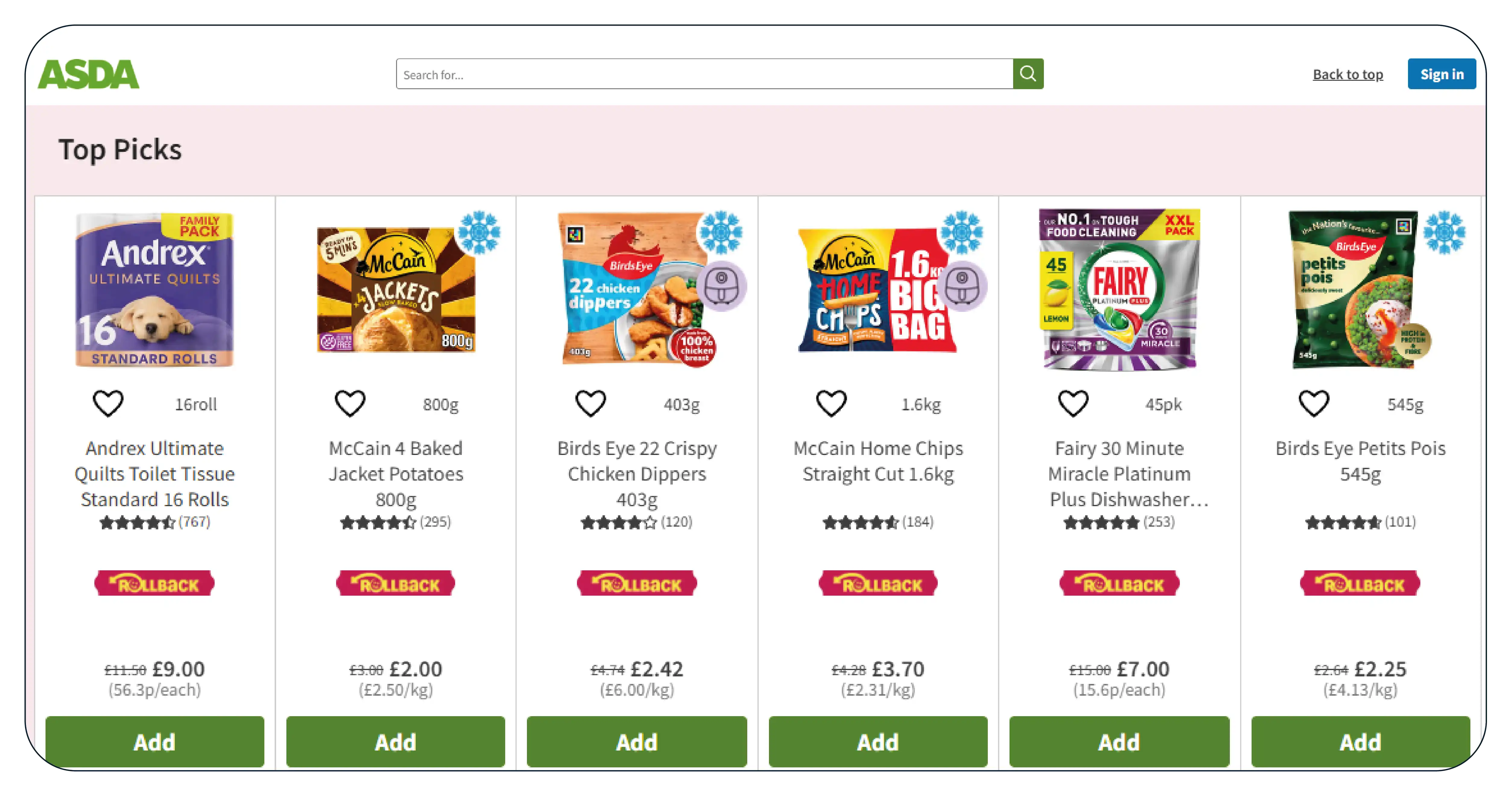
The primary business goal was to create a scalable supermarket pricing intelligence system covering major UK grocery retailers. The client wanted to compare equivalent products, understand basket-level price differences, and identify competitive pricing opportunities.
The project also aimed to improve reporting speed, reduce repetitive research, and support future expansion into additional grocery categories and retailers.
The technical objectives focused on building an automated and reliable data collection pipeline.
Automate product and price collection from selected supermarket sources.
Standardize product names, brands, pack sizes, and categories.
Develop product-matching rules for equivalent grocery items.
Capture regular prices and available promotional information.
Organize records into a structured Cheapest Grocery Basket Dataset for UK Supermarkets.
Build an update-ready workflow for recurring price analysis.
Support integration with business intelligence and reporting platforms.
The implementation also incorporated an Asda Product Data Scraper workflow to collect and normalize relevant product information from Asda alongside the other selected retailers.
The following illustrative performance indicators were established for evaluation:
Product-matching accuracy: Target of 95% or higher.
Manual data-processing reduction: Target of 60%.
Data collection efficiency: Target of 3x faster processing.
Retailer coverage: Four supermarket chains.
Data completeness: Target of 98% for required product fields.
Update reliability: Consistent completion of scheduled collection cycles.
The Core Challenge
Comparing grocery baskets across UK supermarkets involved several operational and technical challenges. Although retailers offered similar everyday products, their product descriptions, package sizes, promotional structures, and online catalog formats were not standardized.
The client struggled with fragmented information and inconsistent product records. A product listed as a 500g package on one website might appear with a different description or brand variation elsewhere. Without proper matching rules, analysts risked comparing products that were not genuinely equivalent.
Another major challenge was the frequency of price changes. Grocery prices and promotions could change between collection cycles, making manually maintained spreadsheets unreliable for ongoing comparisons. This affected the freshness of the client's Daily Grocery Price Intelligence for UK Retailers.
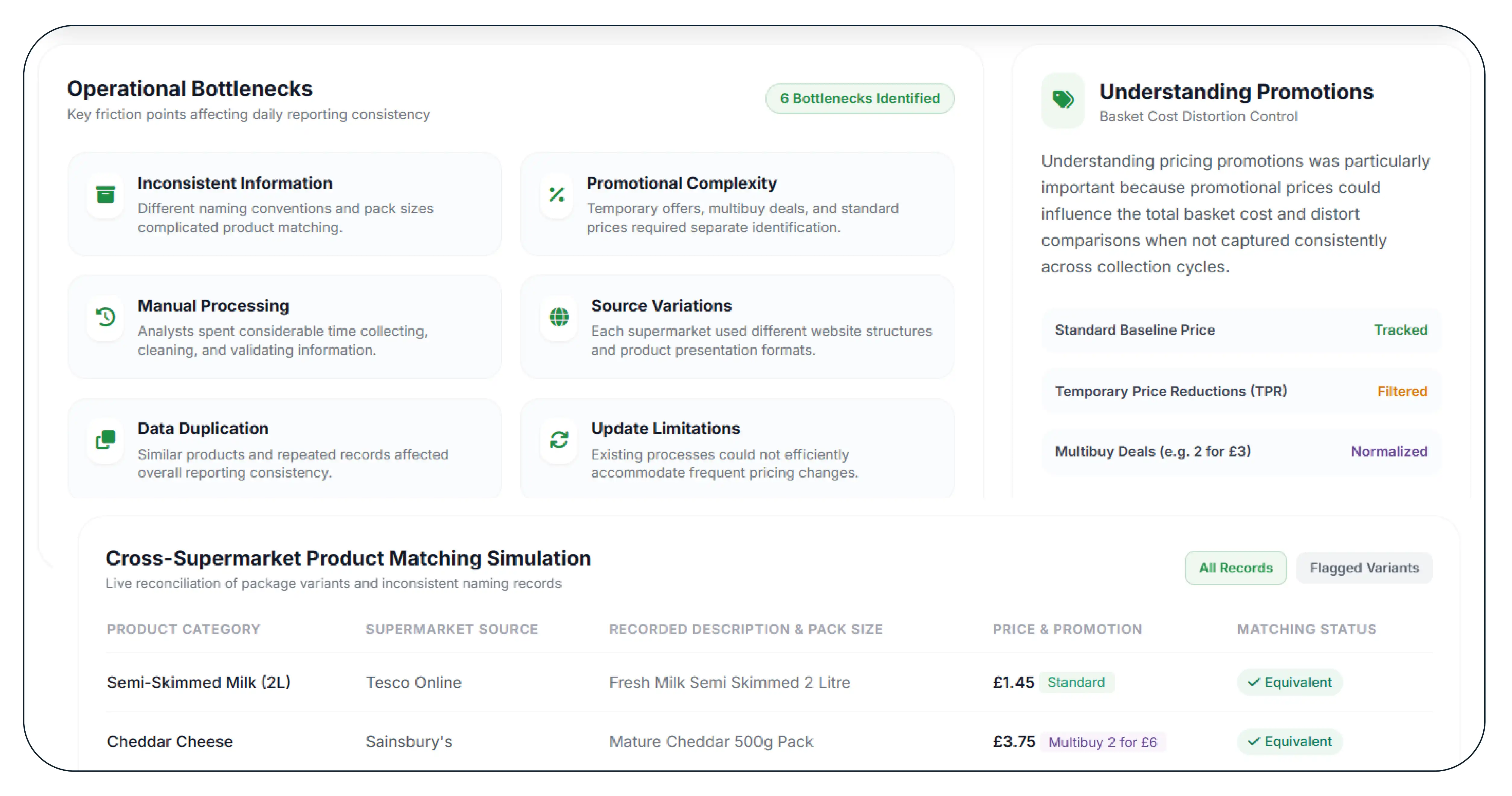
The project also faced several operational bottlenecks:
Inconsistent product information: Different naming conventions and pack sizes complicated product matching.
Promotional complexity: Temporary offers, multibuy deals, and standard prices required separate identification.
Manual processing: Analysts spent considerable time collecting, cleaning, and validating information.
Source variations: Each supermarket used different website structures and product presentation formats.
Data duplication: Similar products and repeated records affected reporting consistency.
Update limitations: Existing processes could not efficiently accommodate frequent pricing changes.
Understanding Pricing Promotions was particularly important because promotional prices could influence the total basket cost and distort comparisons when not captured consistently.
Our Solution
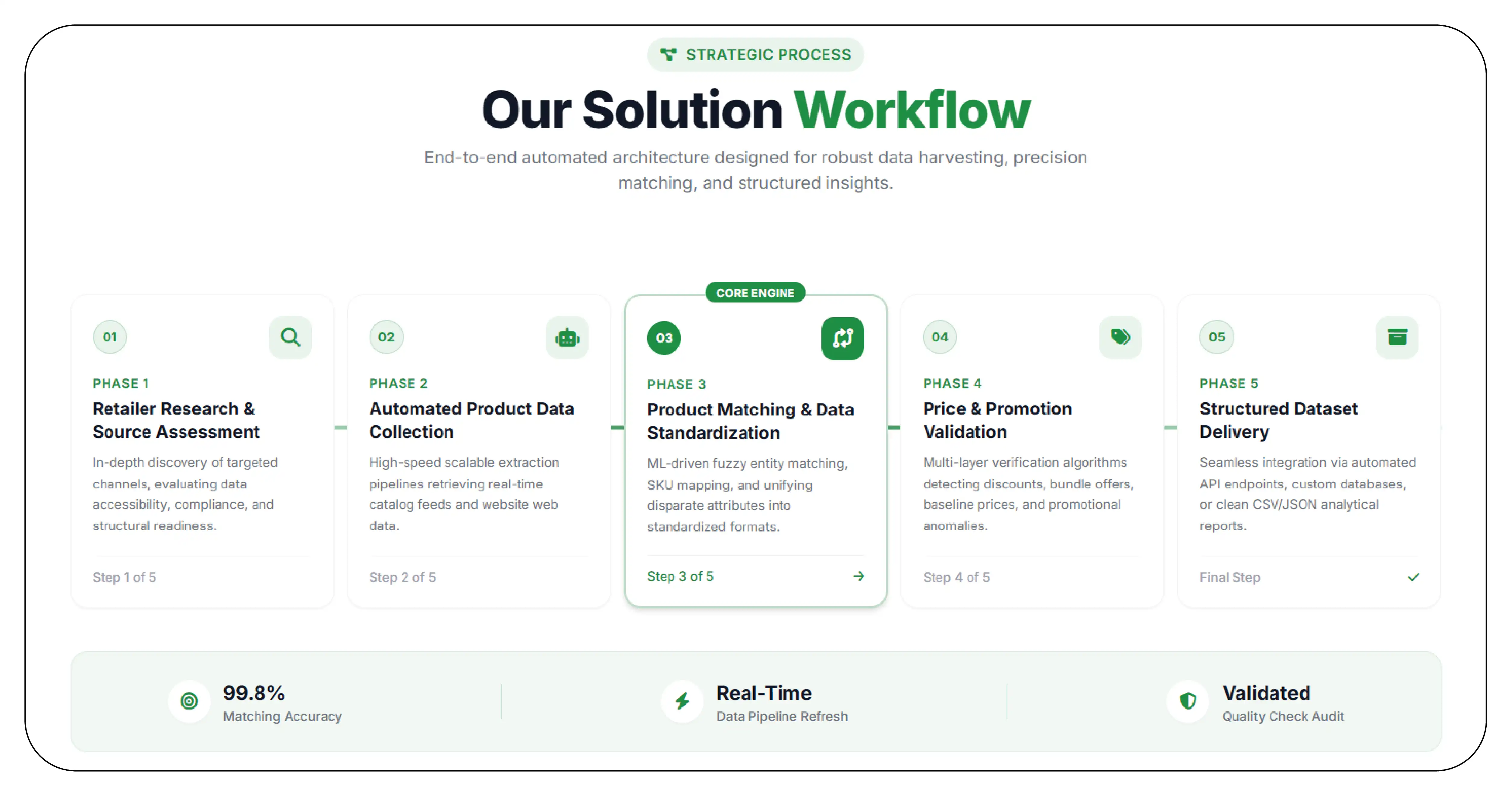
Product Data Scrape implemented a phased data extraction and processing solution to improve grocery product comparisons across Tesco, Asda, Sainsbury's, and Aldi.
Phase 1: Retailer Research and Source Assessment
We first evaluated the selected supermarket websites, product catalog structures, available pricing information, and category organization.
The assessment identified the relevant product fields, including product name, brand, category, package size, unit price, displayed price, promotional information, and product URL.
Collection methods were designed around publicly accessible information and applicable website permissions.
Phase 2: Automated Product Data Collection
Our team developed a structured collection workflow for Tesco, Asda, Sainsbury's & Aldi Price Data Scraping.
The extraction process focused on gathering consistent product information from the selected supermarket sources. Separate retailer-specific collection configurations helped accommodate differences in website layouts and catalog structures.
Relevant product examples included:
Tesco: Tesco Everyday Value alternatives, own-brand groceries, and branded products.
Asda: ASDA own-label groceries, pantry products, and household essentials.
Sainsbury's: Stamford Street and other Sainsbury's own-brand grocery products.
Aldi: Everyday Essentials, Specially Selected, and other Aldi grocery ranges.
Phase 3: Product Matching and Data Standardization
Collected records were processed through a common data structure. Product names, brands, package quantities, categories, and unit measurements were standardized.
Matching rules helped identify equivalent or comparable products across retailers. For example, two products with different descriptions could be matched when their brand, product type, quantity, and other relevant attributes indicated a valid comparison.
This stage reduced duplicate records and improved the consistency of basket-level calculations.
Phase 4: Price and Promotion Validation
The processing workflow separated regular prices from promotional information wherever the source displayed those details.
Validation checks identified missing values, unusual price changes, duplicate products, and inconsistent unit measurements. Records that failed validation could be flagged for additional review instead of being included automatically in comparisons.
Phase 5: Structured Dataset Delivery
Finally, the processed information was organized into structured datasets suitable for spreadsheets, databases, dashboards, and business intelligence applications.
The resulting Scrape UK Cheapest-Basket Calculator Data workflow provided the client with a repeatable foundation for analyzing supermarket product prices, comparing grocery baskets, and identifying retail pricing trends.
The solution was designed for scheduled updates, configurable retailer coverage, and future expansion into additional grocery categories.
Results & Key Metrics
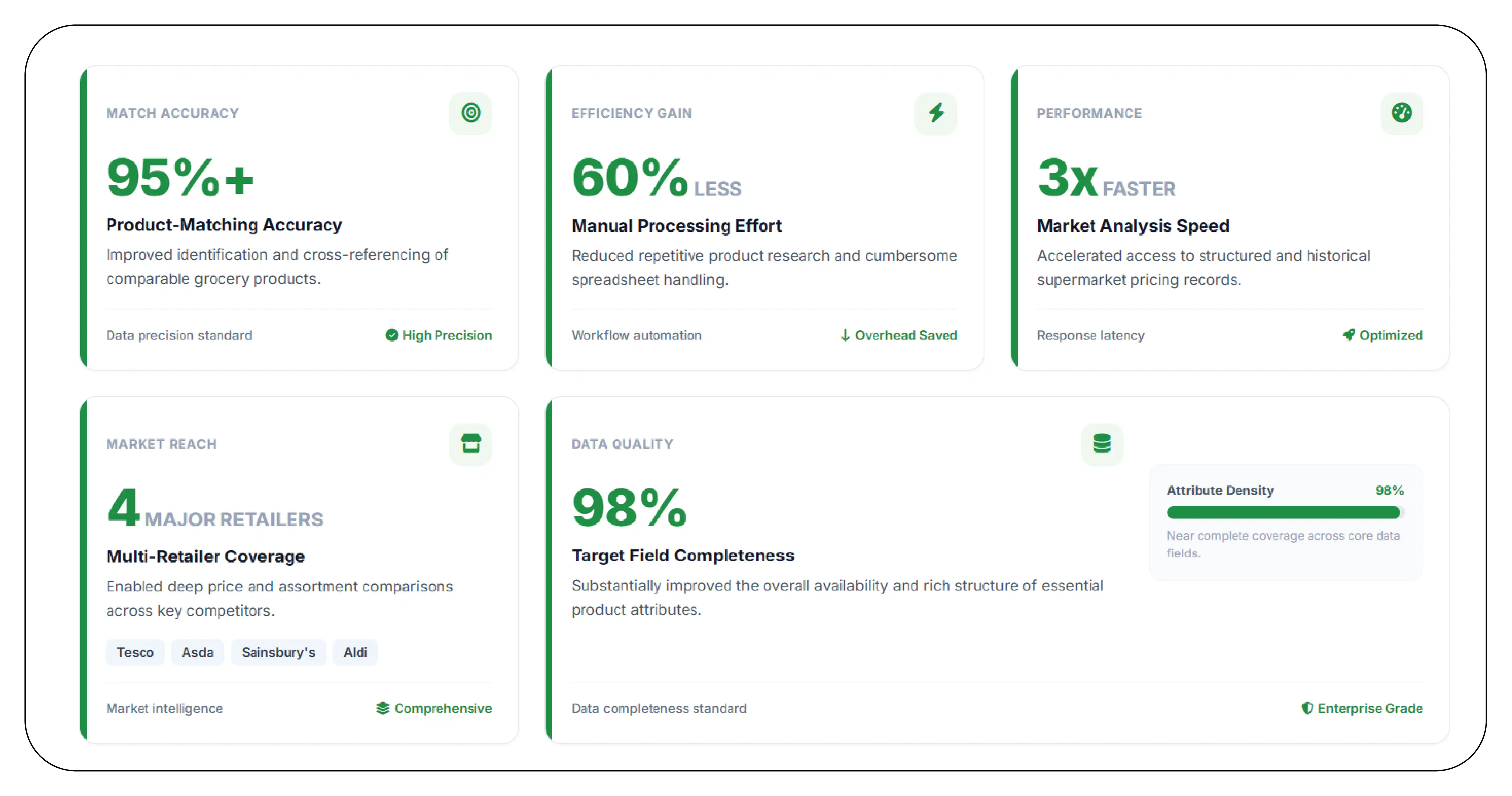
The implementation established a more consistent foundation for supermarket pricing comparisons. The following figures represent illustrative project targets, not independently verified client results.
The solution was evaluated against the following performance indicators:
95%+ product-matching accuracy: Improved identification of comparable grocery products.
60% less manual processing: Reduced repetitive product research and spreadsheet handling.
3x faster analysis: Accelerated access to structured supermarket pricing records.
Four retailer coverage: Enabled comparisons across Tesco, Asda, Sainsbury's, and Aldi.
98% target field completeness: Improved the availability of essential product attributes.
The structured UK Retailer Product Price Comparison Dataset provided a consistent foundation for reporting and competitive benchmarking.
The automated workflow helped establish a repeatable approach to grocery price intelligence. Instead of depending entirely on manual research, analysts could work with standardized product records and comparable pricing attributes.
The solution improved visibility into differences between supermarket product ranges, package sizes, and promotional prices. It also made it easier to identify missing information and review unusual price variations.
With Scrape UK Cheapest-Basket Calculator Data, the client gained a scalable framework for expanding supermarket coverage, improving reporting workflows, and supporting future grocery market analysis.
What Made Product Data Scrape Different?
Product Data Scrape combined retailer-specific extraction with standardized processing to solve the complexities of supermarket price comparisons.
Our approach focused on more than simply collecting product prices. It incorporated product identification, package-size normalization, duplicate detection, promotional price validation, and structured dataset delivery.
The solution also used configurable automation to accommodate differences between supermarket websites. This made the workflow adaptable to changing catalog structures and additional retail sources.
A key differentiator was our UK Grocery Cheapest-Basket Comparison Data Scraping methodology, which emphasized comparable products and consistent unit measurements rather than treating every listed price as directly equivalent.
This combination of automation, data quality controls, and flexible integration helped create a reliable foundation for grocery pricing intelligence.
Client's Testimonial
"Product Data Scrape helped us establish a more organized approach to collecting and comparing supermarket product pricing information. Previously, our analysts spent considerable time handling inconsistent product records and manually checking prices across different grocery retailers. The structured collection process made product comparisons easier and improved our ability to organize pricing information for market research. We particularly appreciated the focus on product matching, data validation, and retailer-specific requirements. The solution provided a scalable foundation for expanding our grocery pricing intelligence capabilities and improving our internal reporting workflows."
— Head of Retail Analytics
Conclusion
Grocery price transparency is becoming increasingly important for retailers, consumer research companies, and pricing intelligence providers. Accurate supermarket information, supported by a Sainsbury's Scraping API, helps businesses understand competitive positioning, monitor product-level changes, and evaluate grocery basket affordability.
Through Scrape FMCG & Grocery Shelf Data capabilities and structured supermarket data extraction, Product Data Scrape helps businesses turn fragmented retail information into actionable intelligence.
Our approach to Scrape UK Cheapest-Basket Calculator Data demonstrates how automation, product matching, and data validation can support scalable grocery price comparisons.
Looking ahead, businesses can extend these capabilities across more retailers, product categories, and market intelligence applications.
Want to build a reliable UK supermarket pricing dataset? Contact Product Data Scrape to discuss your grocery data extraction requirements!
FAQs
1. What is UK cheapest-basket calculator data scraping?
It is the automated collection of supermarket product prices, package sizes, and basket information to compare grocery costs across retailers such as Tesco, Asda, Sainsbury's, and Aldi.
2. Which supermarket data can be collected?
Relevant publicly accessible information may include product names, brands, categories, regular prices, promotional prices, pack sizes, unit prices, and product URLs, subject to source availability and permissions.
3. How does product matching improve grocery price comparisons?
Product matching identifies equivalent or comparable products across supermarkets. It considers product names, brands, quantities, packaging, and unit measurements to reduce inaccurate comparisons.
4. Can grocery pricing data support competitive analysis?
Yes. Structured pricing information helps retailers and market researchers monitor competitor prices, understand promotional activity, evaluate product positioning, and identify pricing trends.
5. How often can supermarket pricing datasets be updated?
Update frequency depends on source accessibility, business requirements, and permitted collection methods. Daily, weekly, or customized schedules may be configured where supported. Regular validation helps maintain dataset consistency and identify changes in product availability and pricing.


 Singapore
 EMAIL
 PHONE










.webp)