Introduction
Businesses gain faster pricing insights, monitor menu availability, and
identify food delivery trends when they Scrape Cloud-Kitchen & Delivery Menus in Singapore.
Real-time menu intelligence helps restaurant chains, food delivery platforms, cloud kitchens,
and market researchers optimize pricing, improve competitive positioning, and respond quickly to
changing consumer demand.
Industry Insight (2026): Analysts estimate that Singapore's online food
delivery market will continue strong double-digit growth through 2026, while more than 70% of
restaurant operators are expected to use digital analytics to improve pricing, menu
optimization, and customer engagement.
Singapore's cloud kitchen ecosystem continues to expand as consumers
increasingly prefer convenient online food ordering. Menu prices, promotional offers, product
availability, and delivery options change frequently throughout the day. Businesses require
accurate and timely market intelligence to remain competitive in this dynamic environment.
Beyond food delivery analytics, many organizations also combine restaurant
intelligence with home & kitchen products market
data to better understand household purchasing trends, seasonal demand, and cross-category
consumer behavior. Together, these datasets provide a broader view of evolving customer
preferences and purchasing habits.
How Can Businesses Monitor Dynamic Menu Pricing?
Menu prices on food delivery platforms change frequently due to promotions,
seasonal campaigns, operational costs, and competitive pricing. Businesses that monitor these
changes continuously can react faster and optimize their own pricing strategies.
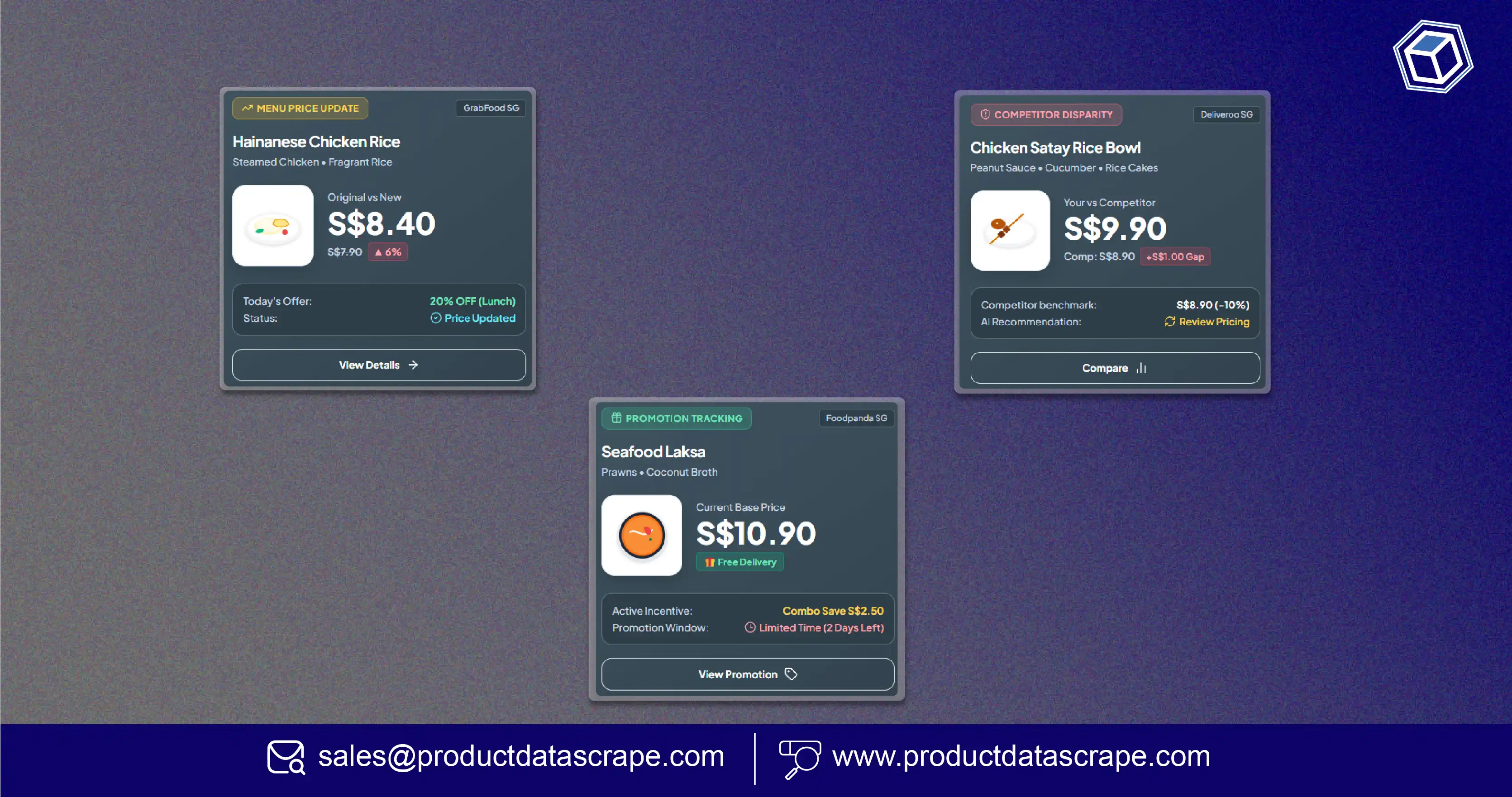
Organizations increasingly scrape cloud kitchen menus in Singapore to monitor
menu updates, promotional offers, combo meals, discounts, and Price monitoring activities across multiple cloud kitchens
and restaurant brands. This structured information supports competitive benchmarking, revenue
optimization, and better pricing decisions.
Key Benefits
- Monitor menu price changes.
- Compare competitor pricing.
- Detect promotional offers.
- Track combo meal pricing.
- Improve pricing strategy.
- Strengthen competitive analysis.
Cloud Kitchen Pricing Trends (2020–2026)
.webp)
Key Insights
- Menu prices continue to change more frequently.
- Promotional campaigns increase pricing volatility.
- Automated monitoring improves competitive responsiveness.
- Pricing intelligence supports revenue optimization.
- Real-time updates reduce decision delays.
- Continuous monitoring strengthens market positioning.
Businesses that monitor pricing trends consistently can identify opportunities
faster, improve promotional planning, and respond effectively to competitive market changes.
How Can Businesses Keep Track of Expanding Digital Menus?
Cloud kitchens regularly introduce new menu items, seasonal specials,
limited-time offers, and category updates. Tracking these changes manually across hundreds of
restaurants is time-consuming and prone to errors. Automated monitoring provides continuous
visibility into evolving digital menus.
Organizations increasingly rely on Singapore Cloud Kitchen Catalog Monitoring
to capture product names, categories, ingredients, cuisine types, combo meals, beverages,
desserts, dietary options, and newly launched menu items. This structured information supports
category management, assortment optimization, consumer trend analysis, and competitive
intelligence.
Business Applications
- Monitor new menu launches.
- Track category expansion.
- Compare menu assortments.
- Analyze cuisine popularity.
- Support demand forecasting.
- Improve merchandising strategies.
Cloud Kitchen Catalog Growth (2020–2026)
.webp)
Key Insights
- Cloud kitchen catalogs continue expanding rapidly.
- New menu launches increase every year.
- Structured catalog data improves competitive analysis.
- Automated monitoring enhances category management.
- Menu intelligence supports product innovation.
- Accurate catalog tracking improves business planning.
Businesses that monitor digital menu catalogs gain a clearer understanding of
evolving consumer preferences, emerging cuisine trends, and competitive product strategies,
enabling faster and more informed business decisions.
How Can Businesses Collect Reliable Food Delivery Menu Data?
Food delivery platforms update menus throughout the day with new products,
promotional bundles, pricing changes, and availability updates. Manual tracking across hundreds
of restaurants is inefficient and often results in incomplete datasets. Automated extraction
delivers structured and timely menu intelligence for business analysis.
Organizations use Singapore Food Delivery Menu Data Extraction together with E-commerce data scraping to collect
menu names, categories, prices, descriptions, images, restaurant information, delivery
availability, discounts, and promotional campaigns. This data enables restaurants, cloud
kitchens, aggregators, and market research firms to evaluate market trends, optimize offerings,
and benchmark competitors.
Business Benefits
- Collect menu data automatically.
- Monitor promotional campaigns.
- Compare restaurant assortments.
- Track product availability.
- Analyze pricing trends.
- Support business intelligence initiatives.
Food Delivery Menu Data Growth (2020–2026)
.webp)
Key Insights
- Food delivery menus continue to expand across platforms.
- Automated extraction improves data completeness.
- Structured datasets strengthen analytics.
- Real-time updates improve competitive intelligence.
- Delivery menu monitoring supports pricing optimization.
- Reliable menu intelligence enables better forecasting.
Organizations using automated menu extraction gain consistent access to
structured information that supports pricing, merchandising, and strategic planning.
How Can Menu Analytics Improve Business Decisions?
Restaurant menus reveal changing customer preferences, pricing strategies,
product innovation, and promotional activity. Businesses that analyze these patterns can
identify growth opportunities, improve assortment planning, and optimize customer engagement
strategies.
Leveraging Singapore Restaurant Menu Analytics, organizations evaluate cuisine
popularity, category performance, seasonal menu changes, promotional effectiveness, average
selling prices, and customer purchasing patterns. These insights help businesses make informed
operational and marketing decisions.
Major Applications
- Measure category performance.
- Identify trending cuisines.
- Compare pricing strategies.
- Evaluate promotional success.
- Forecast customer demand.
- Improve menu optimization.
Restaurant Analytics Adoption (2020–2026)
| Year |
Restaurants Analyzed |
Businesses Using Menu Analytics |
Forecast Accuracy |
| 2020 |
5,300 |
32% |
83% |
| 2021 |
6,900 |
40% |
86% |
| 2022 |
8,800 |
49% |
89% |
| 2023 |
11,200 |
59% |
92% |
| 2024 |
14,100 |
69% |
95% |
| 2025 |
17,600 |
78% |
97% |
| 2026* |
21,500 |
87% |
98% |
Key Insights
- Analytics improves menu planning.
- Category intelligence supports merchandising.
- Historical trends improve forecasting accuracy.
- Promotional analysis strengthens pricing strategies.
- Consumer behavior insights improve customer retention.
- Data-driven decisions increase operational efficiency.
Businesses using menu analytics can better understand changing market dynamics
while improving profitability and customer satisfaction.
How Can Catalog Intelligence Support Competitive Growth?
Cloud kitchen operators compete in an environment where new menu items,
promotional bundles, and product variations appear frequently. Continuous catalog intelligence
helps organizations understand competitor strategies while improving assortment planning and
product innovation.
Using Cloud Kitchen Catalog Intelligence, businesses collect structured
information on menu assortments, cuisine categories, product availability, meal combinations,
seasonal launches, and promotional bundles. This enables decision-makers to benchmark
competitors, optimize menus, identify market gaps, and respond quickly to changing customer
demand.
Business Applications
- Benchmark competitor assortments.
- Track seasonal menu launches.
- Monitor product availability.
- Analyze cuisine diversity.
- Support innovation planning.
- Improve assortment optimization.
Cloud Kitchen Intelligence Trends (2020–2026)
| Year |
Catalogs Analyzed |
Product Variants Tracked |
Intelligence Accuracy |
| 2020 |
3,800 |
420,000 |
89% |
| 2021 |
5,000 |
560,000 |
91% |
| 2022 |
6,600 |
740,000 |
93% |
| 2023 |
8,500 |
980,000 |
95% |
| 2024 |
10,900 |
1,270,000 |
97% |
| 2025 |
13,600 |
1,610,000 |
98% |
| 2026* |
16,800 |
2,010,000 |
99% |
Key Insights
- Cloud kitchen assortments continue expanding.
- Product innovation drives competitive differentiation.
- Catalog intelligence improves strategic planning.
- Automated monitoring reduces research effort.
- Competitive benchmarking supports faster decision-making.
- Structured data strengthens long-term market analysis.
Organizations leveraging catalog intelligence gain deeper visibility into
market trends, enabling them to optimize product portfolios, enhance customer experiences, and
maintain a strong competitive position in Singapore's rapidly evolving food delivery ecosystem.
How Can Continuous Menu Tracking Improve Business Performance?
Cloud kitchens and food delivery platforms update menus frequently throughout
the day. New dishes, promotional bundles, seasonal offers, and availability changes can
significantly influence customer purchasing behavior. Businesses that monitor these updates
continuously gain timely insights that support pricing, assortment, and marketing decisions.
Organizations leverage Singapore Food Delivery Menu Tracking to monitor menu
availability, delivery status, product launches, discounts, cuisine categories, and restaurant
performance across multiple delivery platforms. Continuous tracking enables restaurants, FMCG
brands, aggregators, and market researchers to identify emerging food trends and respond quickly
to changing consumer demand.
Key Benefits
- Monitor menu updates in real time.
- Detect new product launches.
- Track promotional campaigns.
- Compare restaurant performance.
- Improve demand forecasting.
- Support competitive benchmarking.
Food Delivery Tracking Trends (2020–2026)
| Year |
Menus Tracked |
Daily Menu Updates |
Monitoring Accuracy |
| 2020 |
540,000 |
14,500 |
89% |
| 2021 |
710,000 |
19,800 |
91% |
| 2022 |
930,000 |
26,400 |
93% |
| 2023 |
1,210,000 |
35,900 |
95% |
| 2024 |
1,560,000 |
47,600 |
97% |
| 2025 |
1,950,000 |
60,500 |
98% |
| 2026* |
2,420,000 |
75,800 |
99% |
Key Insights
- Menu updates are becoming more frequent.
- Real-time monitoring improves competitive responsiveness.
- Automated tracking reduces manual effort.
- Historical menu data supports forecasting.
- Delivery intelligence enhances strategic planning.
- Continuous monitoring improves operational efficiency.
Businesses that continuously monitor food delivery menus can quickly adapt to
market changes, optimize pricing strategies, and improve customer satisfaction through
data-driven decisions.
Why Choose Product Data Scrape?
Product Data Scrape provides enterprise-grade restaurant and food delivery
intelligence solutions that help businesses transform publicly available menu information into
actionable insights. Our scalable platform supports retailers, restaurant chains, cloud
kitchens, FMCG brands, food delivery platforms, and market research firms with accurate,
structured, and real-time datasets.
With expertise in Cloud-Kitchen data scraping
in Singapore, we help organizations monitor menu pricing, availability, promotions,
restaurant catalogs, cuisine trends, and competitor activity. Businesses looking to Scrape
Cloud-Kitchen & Delivery Menus in Singapore can leverage our automated data pipelines, scalable
APIs, and customized delivery formats to accelerate analytics, pricing optimization, and market
intelligence initiatives.
Why Businesses Choose Product Data Scrape
- Enterprise-scale menu data extraction.
- Real-time restaurant monitoring.
- High-quality structured datasets.
- API-ready data delivery.
- AI and BI platform integration.
- Scalable and secure infrastructure.
- Customized solutions for food delivery intelligence.
Business Benefits
- Optimize menu pricing strategies.
- Improve competitor benchmarking.
- Monitor product availability.
- Enhance demand forecasting.
- Strengthen category management.
- Support data-driven expansion decisions.
Product Data Scrape empowers organizations with reliable food delivery
intelligence that enables faster decisions, improved operational efficiency, and sustainable
competitive growth.
Conclusion
Singapore's cloud kitchen and food delivery ecosystem continues to evolve
rapidly as consumer expectations, menu offerings, and pricing strategies change in real time.
Businesses that rely on accurate market intelligence can better understand customer preferences,
monitor competitors, optimize assortments, and respond quickly to emerging opportunities.
Combining Real-time price tracking
with the ability to Scrape Cloud-Kitchen & Delivery Menus in Singapore provides organizations
with comprehensive visibility into menu changes, promotional campaigns, product availability,
and category performance. These insights enable restaurant operators, delivery platforms, FMCG
brands, and market researchers to improve pricing decisions, strengthen competitive positioning,
and forecast market demand with greater confidence.
Organizations investing in automated menu intelligence gain a scalable
foundation for long-term growth, helping them stay ahead in Singapore's increasingly competitive
digital food delivery landscape.
Ready to gain real-time visibility into Singapore's food delivery market?
Partner with Product Data Scrape to leverage
advanced menu intelligence, real-time price tracking, and scalable data solutions that help you
Scrape Cloud-Kitchen & Delivery Menus in Singapore for smarter pricing, stronger competitive
insights, and sustainable business growth!
FAQs
1. Why should businesses scrape cloud-kitchen and delivery menu data in
Singapore?
Scraping menu data helps businesses monitor pricing, availability, promotions, and product
assortments. These insights support competitive benchmarking, demand forecasting, menu
optimization, and faster decision-making in Singapore's growing food delivery market.
2. What type of information can be collected from cloud-kitchen delivery
platforms?
Businesses can collect publicly available menu items, prices, categories, descriptions,
availability, promotional offers, restaurant details, cuisine types, delivery coverage, and
product images for comprehensive market and competitive analysis.
3. How often should restaurant menu data be updated?
Real-time or scheduled daily updates are recommended because menus, prices, promotions, and
product availability change frequently. Regular monitoring ensures businesses always work with
accurate and up-to-date market intelligence.
4. Which industries benefit the most from menu data intelligence?
Restaurant chains, cloud kitchens, FMCG brands, food delivery platforms, market research firms,
pricing analysts, and businesses using Product Data Scrape solutions benefit from accurate menu
intelligence and competitive insights.
5. How does automated menu tracking improve business performance?
Automated tracking reduces manual effort, improves data accuracy, identifies pricing
opportunities, monitors competitors, detects market trends, supports forecasting, and enables
businesses to make faster, data-driven strategic decisions.


 Singapore
 EMAIL
EMAIL
 PHONE
PHONE













.webp)