Introduction
Brands can protect revenue and customer trust by continuously identifying suspicious marketplace sellers, monitoring price deviations, and tracing unauthorized product listings before they become widespread. Grey Market & Unauthorized Seller Detection turns fragmented marketplace signals into actionable seller, product, and pricing intelligence, helping brands distinguish legitimate distribution from potentially risky activity.
The challenge has become more important as e-commerce expands across marketplaces, social-commerce channels, and cross-border sellers. The OECD and EUIPO estimated that counterfeit and pirated goods represented up to USD 467 billion, or 2.3% of global imports, in 2021. The same research notes that online platforms and modern logistics create additional opportunities for illicit distribution.
For brand managers, marketplace teams, channel partners, and revenue leaders, the practical question is not simply whether an unauthorized seller exists. It is where that seller operates, which SKUs are affected, how prices compare with authorized channels, how frequently listings change, and what evidence can support enforcement.
This approach combines seller discovery, product matching, price monitoring, listing history, and structured web data to create a repeatable detection workflow. It helps brands prioritize high-risk sellers instead of manually reviewing thousands of marketplace pages.
How Can Brands Identify Suspicious Sellers Before Revenue Is Affected?
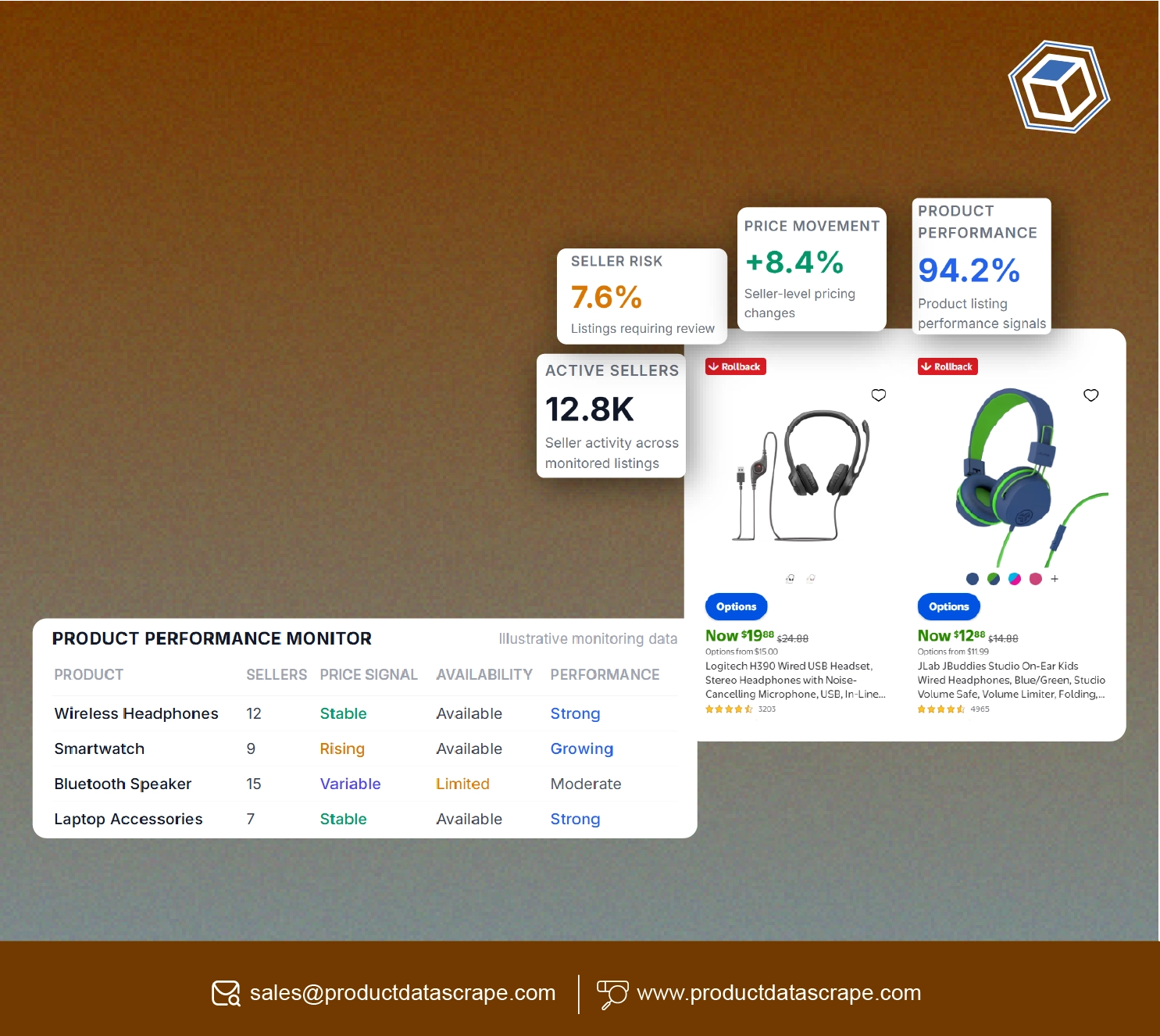
Brands need a systematic process that connects seller identity, product information, pricing, availability, and marketplace behavior. Detect Unauthorized Marketplace Sellers helps create that process by continuously comparing observed sellers against approved seller lists, known distributors, product catalogs, and channel policies.
A useful workflow begins with seller discovery. Marketplace pages can be collected for seller name, seller URL, SKU, brand, product title, price, discount, availability, rating, review count, location, and fulfillment information. These fields can then be matched against internal authorized-seller records. A seller appearing repeatedly across multiple SKUs but missing from the approved network can be assigned a higher risk score.
Pricing provides another signal. A seller offering the same product substantially below the expected channel price may indicate grey-market sourcing, liquidation inventory, unauthorized distribution, or another channel conflict. The signal should not automatically be treated as proof of wrongdoing. Instead, it should trigger verification.
Historical monitoring is equally important because unauthorized sellers can disappear and reappear under different names. The table below provides a monitoring benchmark, not reported industry statistics.
| Year |
Suggested Marketplace Coverage |
Suggested Monitoring Frequency |
Priority |
| 2020 |
30% |
Weekly |
Establish baseline |
| 2021 |
40% |
Weekly |
Expand seller mapping |
| 2022 |
50% |
2–3 times weekly |
Add price signals |
| 2023 |
60% |
Daily |
Build historical records |
| 2024 |
70% |
Daily |
Add cross-marketplace matching |
| 2025 |
80% |
Daily |
Introduce risk scoring |
| 2026 |
90%+ |
Near real time |
Automate high-risk alerts |
The objective is not merely to collect more pages. It is to reduce the time between a suspicious listing appearing and the brand identifying, validating, and responding to it.
What Data Should Be Collected to Investigate Unauthorized Distribution?
Scrape Web Data for Unauthorized Seller Detection to create a structured evidence layer across marketplaces, retailer websites, distributor pages, and other public sources. Seller detection becomes significantly stronger when individual listings are analyzed as connected records rather than isolated web pages.
A practical dataset can include seller name, seller ID, seller profile URL, product URL, SKU, product title, brand, model number, GTIN or other product identifier where available, listed price, original price, discount, stock status, delivery information, seller rating, review count, marketplace, collection timestamp, and geographic indicators.
Product matching is particularly important. Unauthorized sellers may use slightly different titles, abbreviations, bundles, spelling variations, or marketplace-specific descriptions. Matching should therefore combine multiple identifiers instead of relying only on product titles. SKU, model number, brand, pack size, images, specifications, and other available attributes can strengthen matching accuracy.
A historical dataset also makes investigations more useful. Instead of seeing that a seller currently offers a product, teams can determine when the listing first appeared, how its price changed, whether availability fluctuated, and whether the seller expanded into additional SKUs.
The following data-quality benchmark shows how monitoring programs can mature.
| Year |
Target Fields Captured |
Historical Depth |
Recommended Use |
| 2020 |
8 |
30 days |
Basic discovery |
| 2021 |
12 |
60 days |
Seller comparison |
| 2022 |
16 |
90 days |
SKU matching |
| 2023 |
20 |
180 days |
Trend analysis |
| 2024 |
24 |
12 months |
Enforcement support |
| 2025 |
28 |
18 months |
Risk scoring |
| 2026 |
30+ |
24 months |
Predictive monitoring |
The key is consistency. A structured dataset enables brands to compare sellers, identify recurring patterns, prioritize investigations, and maintain an auditable record of marketplace activity.
How Can Brands Track Grey-Market Activity Across Multiple Channels?
Grey Market Seller Tracking becomes more effective when brands monitor sellers across multiple marketplaces rather than examining one channel at a time. A seller that looks insignificant on one platform may represent a much larger distribution issue when its listings are connected across several websites.
The first step is seller normalization. Marketplace names can vary because of abbreviations, punctuation, spelling differences, or local-language variations. A seller intelligence system should therefore create a normalized seller identity wherever reliable matching signals are available.
The second step is product-level mapping. If the same seller repeatedly lists the same brand across different marketplaces, the brand can identify the seller's apparent assortment footprint. This helps reveal whether the activity is limited to a few products or extends across a strategic category.
Grey Market & Unauthorized Seller Detection can then combine seller identity, SKU activity, price movement, availability, and marketplace presence into a risk profile. High-risk records can be reviewed manually before any enforcement action is taken.
The following table provides an operational benchmark for building cross-channel visibility.
| Year |
Channels Monitored |
Seller Matching Goal |
Review Approach |
| 2020 |
2 |
Basic name matching |
Manual |
| 2021 |
3 |
Name + URL |
Manual |
| 2022 |
4 |
Seller + SKU |
Semi-automated |
| 2023 |
5 |
Multi-field matching |
Automated alerts |
| 2024 |
6 |
Cross-channel profiles |
Risk-based review |
| 2025 |
8 |
Historical seller graphs |
Prioritized cases |
| 2026 |
10+ |
Continuous identity matching |
Automated triage |
This model helps channel managers move from reactive investigations to continuous monitoring. It also supports conversations with authorized distributors because teams can compare observed marketplace activity against contractual expectations and approved channel coverage.
How Does Continuous Listing Monitoring Reveal Channel Violations?
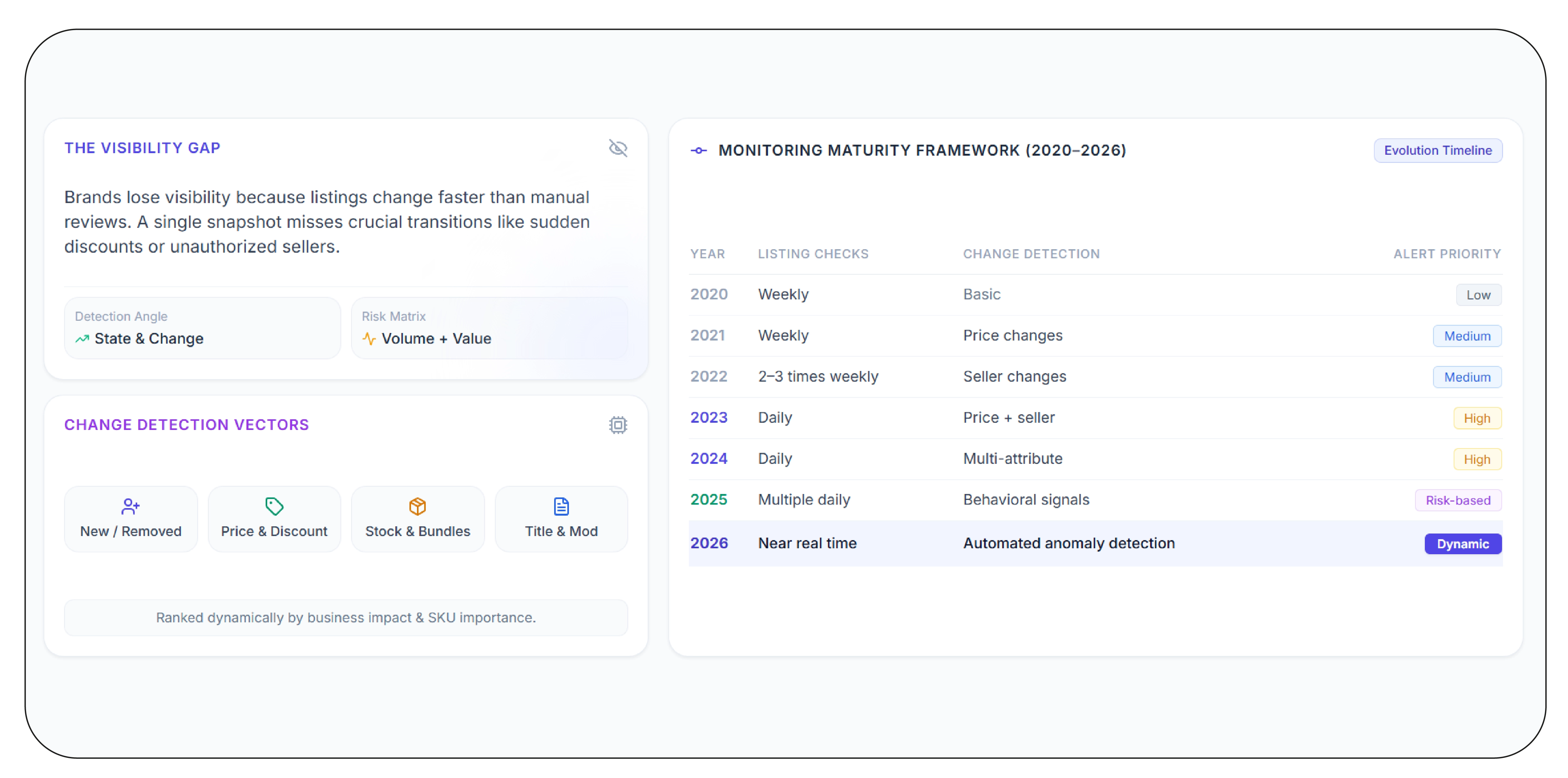
Brands often lose visibility because marketplace listings change faster than internal teams can manually review them. Grey Market Listing Monitoring provides a continuous way to detect changes in product price, seller identity, availability, descriptions, and other listing attributes.
Monitoring should capture both the current state and the change over time. A product may be listed by an authorized seller today and by an unknown seller tomorrow. Similarly, a seller may maintain a normal price for weeks and suddenly introduce a substantial discount. A single snapshot would miss the transition.
Change detection can flag new sellers, removed sellers, price changes, unusual discounts, sudden stock availability, new product bundles, title changes, and other listing modifications. These events can then be ranked according to business impact.
For example, a new seller offering one low-volume SKU may require limited attention. A newly discovered seller offering dozens of high-value products at unusually low prices deserves faster review. Combining seller activity with product importance creates a more practical alerting system.
The table below is a monitoring maturity framework.
| Year |
Listing Checks |
Change Detection |
Alert Priority |
| 2020 |
Weekly |
Basic |
Low |
| 2021 |
Weekly |
Price changes |
Medium |
| 2022 |
2–3 times weekly |
Seller changes |
Medium |
| 2023 |
Daily |
Price + seller |
High |
| 2024 |
Daily |
Multi-attribute |
High |
| 2025 |
Multiple daily |
Behavioral signals |
Risk-based |
| 2026 |
Near real time |
Automated anomaly detection |
Dynamic |
The business benefit is visibility. Instead of waiting for customers or authorized partners to report suspicious listings, brands can establish their own monitoring layer and investigate potential violations using historical evidence.
How Can Product Listing Data Support Seller Investigations?
Scrape Unauthorized Product Listings to identify products being offered outside approved channels and connect those listings to seller, pricing, and availability information. Listing-level data provides the foundation for determining the scale and persistence of suspicious activity.
A strong extraction process should preserve the exact marketplace URL and collection timestamp. This allows teams to establish when a listing was observed and compare subsequent versions. Product attributes should also be normalized so that identical products can be recognized even when sellers use different titles.
Price data is another critical field. A listing priced significantly below the brand's expected market range can be flagged for review, particularly when the seller is not recognized as an approved channel partner. However, price alone should not determine whether a seller is unauthorized. Promotions, regional pricing, clearance inventory, bundles, and marketplace-specific campaigns can create legitimate differences.
Availability data adds another layer. A seller repeatedly showing inventory for products that are officially unavailable through normal channels may deserve additional investigation. Geographic information can also help identify cross-border distribution patterns where such information is publicly available.
The following extraction benchmark shows a possible progression.
| Year |
Listing Records Monitored |
Key Data Focus |
Investigation Value |
| 2020 |
10K |
Product + seller |
Discovery |
| 2021 |
25K |
Price + availability |
Comparison |
| 2022 |
50K |
SKU matching |
Pattern detection |
| 2023 |
100K |
Historical changes |
Evidence building |
| 2024 |
250K |
Cross-marketplace data |
Seller profiling |
| 2025 |
500K |
Risk indicators |
Prioritized investigations |
| 2026 |
1M+ |
Continuous signals |
Scaled monitoring |
These figures are planning examples rather than claims about industry-wide volumes. The appropriate scale depends on the number of brands, SKUs, marketplaces, regions, and monitoring frequency involved.
How Can an Alerting System Prioritize the Highest-Risk Sellers?
Unauthorized seller detection should not end with identifying a seller. The real value comes from ranking cases so teams know which incidents deserve immediate attention.
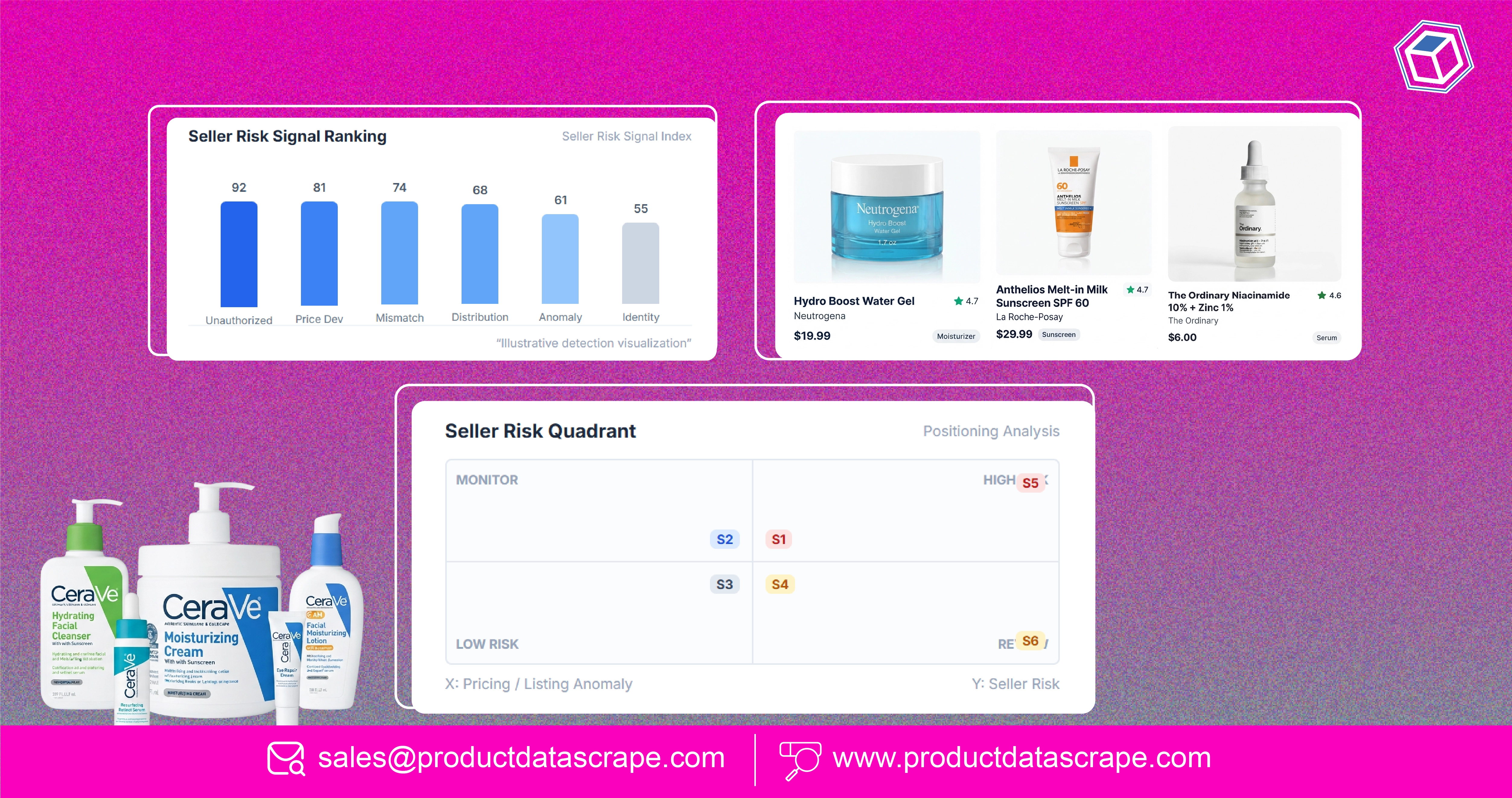
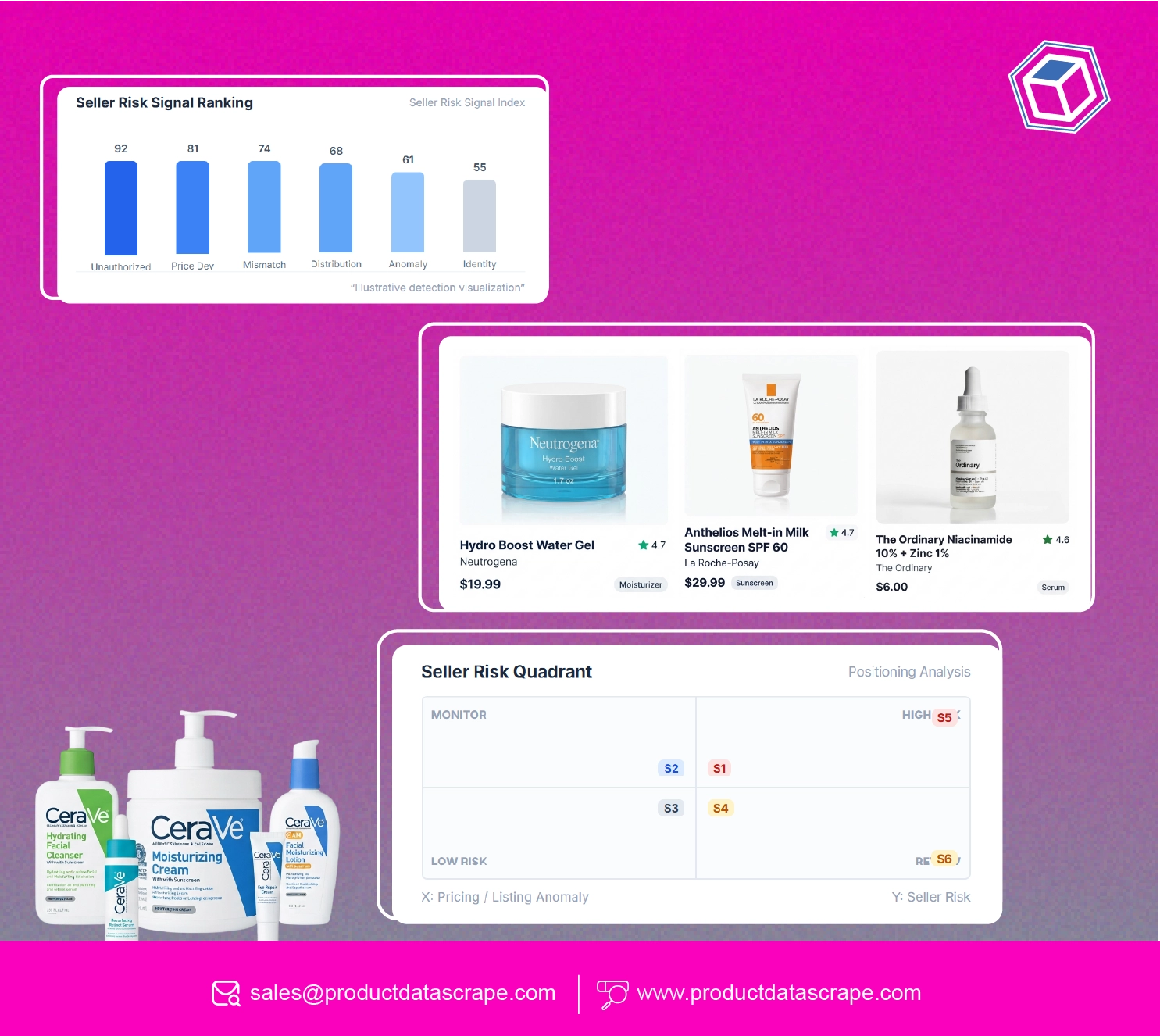
A practical risk model can combine multiple signals. Seller authorization status can provide the initial classification. Product importance can determine commercial exposure. Price deviation can indicate possible channel conflict. The number of affected SKUs can indicate scale. Frequency of appearance can show persistence. Cross-marketplace activity can reveal broader distribution. Sudden changes can identify emerging threats.
A simple scoring model can assign weighted points to these signals. For example, an unknown seller could receive a baseline score, while repeated listings across multiple marketplaces, significant price deviations, and expansion into strategic SKUs increase the score. The final score should be treated as a prioritization mechanism rather than definitive evidence of misconduct.
The following risk-scoring framework demonstrates how monitoring can evolve.
| Year |
Risk Signals |
Suggested Risk Levels |
Response |
| 2020 |
2 |
2 |
Manual review |
| 2021 |
3 |
2 |
Seller verification |
| 2022 |
5 |
3 |
Channel comparison |
| 2023 |
7 |
3 |
Automated alerts |
| 2024 |
9 |
4 |
Priority investigation |
| 2025 |
12 |
4 |
Case management |
| 2026 |
15+ |
5 |
Continuous risk triage |
A risk engine can also help prevent alert fatigue. Without prioritization, a large monitoring program can generate thousands of potential matches, many of which may be legitimate. Scoring focuses analyst attention on cases with the strongest combination of commercial and behavioral signals.
This approach supports revenue protection, channel governance, partner management, and brand protection without assuming that every unusual seller or price represents infringement.
Why Choose Product Data Scrape?
Brands need reliable marketplace data to turn seller monitoring from a manual task into a repeatable intelligence process. Protect your brand by building structured visibility across seller names, product listings, prices, availability, and marketplace changes. The solution can support scalable collection, product matching, historical tracking, and data normalization for teams managing large assortments. It also helps businesses organize evidence for internal investigations and prioritize high-risk marketplace activity. The goal is not simply to collect web pages. It is to transform fragmented public marketplace information into usable datasets that support faster decisions, stronger channel control, and more consistent monitoring across markets and product categories.
Conclusion
Web Data Scraping gives brands the visibility needed to discover suspicious sellers, compare marketplace prices, monitor listing changes, and build historical evidence. Grey Market & Unauthorized Seller Detection transforms that visibility into a structured process for prioritizing channel risks and protecting customer trust. The OECD estimates that counterfeit goods represented USD 467 billion in global trade in 2021, demonstrating why digital-channel oversight remains important. With Product Data Scrape, brands can create scalable monitoring workflows that connect sellers, products, prices, and marketplace activity.
Contact Product Data Scrape today to build a data-driven marketplace monitoring strategy and strengthen control over unauthorized online distribution!
FAQs
1. What is grey-market seller monitoring?
Grey-market seller monitoring tracks sellers and product listings outside approved distribution channels. It compares seller identity, product, pricing, availability, and marketplace activity to identify potential channel risks.
2. Why is unauthorized seller detection important for brands?
It helps brands identify potentially unauthorized distribution, investigate unusual pricing, protect authorized partners, reduce channel conflicts, and maintain greater visibility into how products are sold online.
3. What marketplace data should brands monitor?
Brands should monitor seller identity, product titles, SKUs, prices, discounts, availability, seller ratings, product URLs, marketplace presence, timestamps, and other publicly available attributes relevant to channel verification.
4. Can seller monitoring identify pricing violations?
Yes. Historical marketplace data can reveal unusual price deviations, repeated discounting, and sudden changes. Pricing signals should be combined with seller and product information before an investigation is initiated.
5. How can Product Data Scrape support marketplace monitoring?
Product Data Scrape can help businesses structure marketplace information into datasets for seller discovery, product matching, price monitoring, historical analysis, and risk-based investigation workflows.


 Singapore
 EMAIL
EMAIL
 PHONE
PHONE












.webp)