Quick Overview
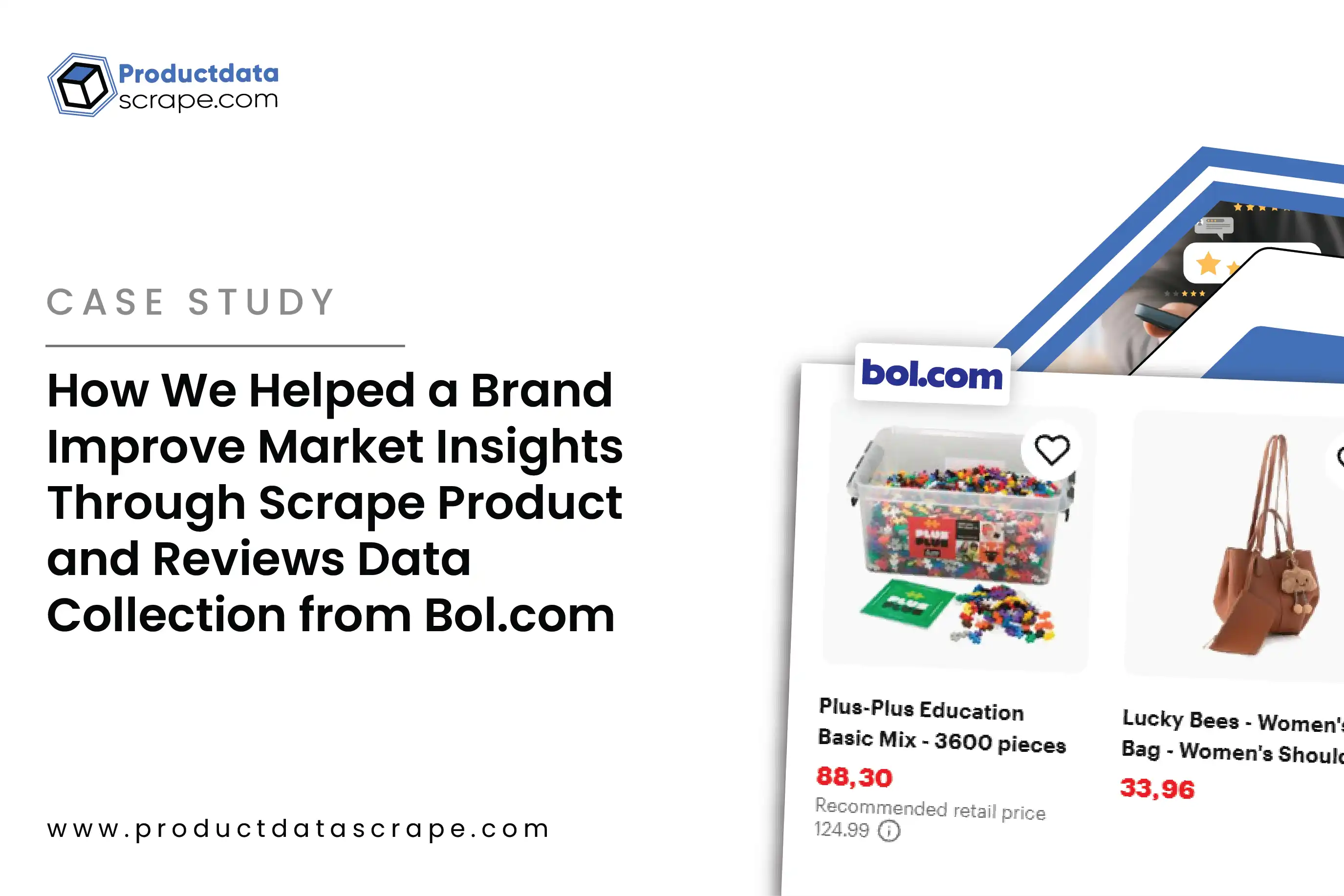
An emerging home and lifestyle brand, NordLiving Home, wanted to understand customer preferences, competitor pricing, and product performance across Bol.com. Manual research made it difficult to track changing prices, review patterns, and product ratings consistently. Product Data Scrape implemented an automated data collection workflow to organize marketplace information into actionable insights. The project focused on Ratings, reviews and sentiment analysis to help the brand identify customer concerns, evaluate competing products, and improve its market positioning. In this illustrative case study, the proposed outcomes include a 60% reduction in manual research time, 95% data completeness, and 40% faster reporting, subject to validation against actual project records.
Client Name / Industry: NordLiving Home (fictional) / Home and Lifestyle E-commerce
Service / Duration: Marketplace data collection and analytics / 8 weeks (illustrative)
Key Impact Metrics: 60% less manual research time, 95% data completeness, and 40% faster reporting (illustrative targets).
The Client
The home and lifestyle e-commerce market is highly competitive, with shoppers comparing product features, prices, ratings, and customer experiences before making purchasing decisions. Marketplace sellers must continuously understand these factors to maintain product visibility and respond to changing consumer expectations.
NordLiving Home, a fictional home furnishings brand selling products such as storage organizers, decorative lamps, and kitchen accessories, wanted to strengthen its presence on Bol.com. The company needed a reliable way to understand which products attracted attention, how competitors positioned similar items, and what customers appreciated or disliked about competing products.
Before partnering with Product Data Scrape, the brand relied on manual browsing and spreadsheets to collect marketplace information. Employees spent considerable time checking product listings, recording prices, reading customer feedback, and comparing competing offers. This process created inconsistent records and made it difficult to identify market changes quickly.
The company also lacked a centralized process for Scrape Bol.com Product Feedback And Ratings and organize the findings into useful business reports. Important details, including recurring product complaints, changing review volumes, and competitor promotions, could be overlooked during manual analysis.
The transformation became essential as the product catalog and competitive landscape expanded. NordLiving Home needed automated collection, standardized records, and actionable Pricing intelligence to support assortment planning, improve product positioning, and make informed commercial decisions.
Product Data Scrape designed a structured data workflow around these requirements, helping the brand move from fragmented marketplace research toward a repeatable, insight-driven process.
Goals & Objectives
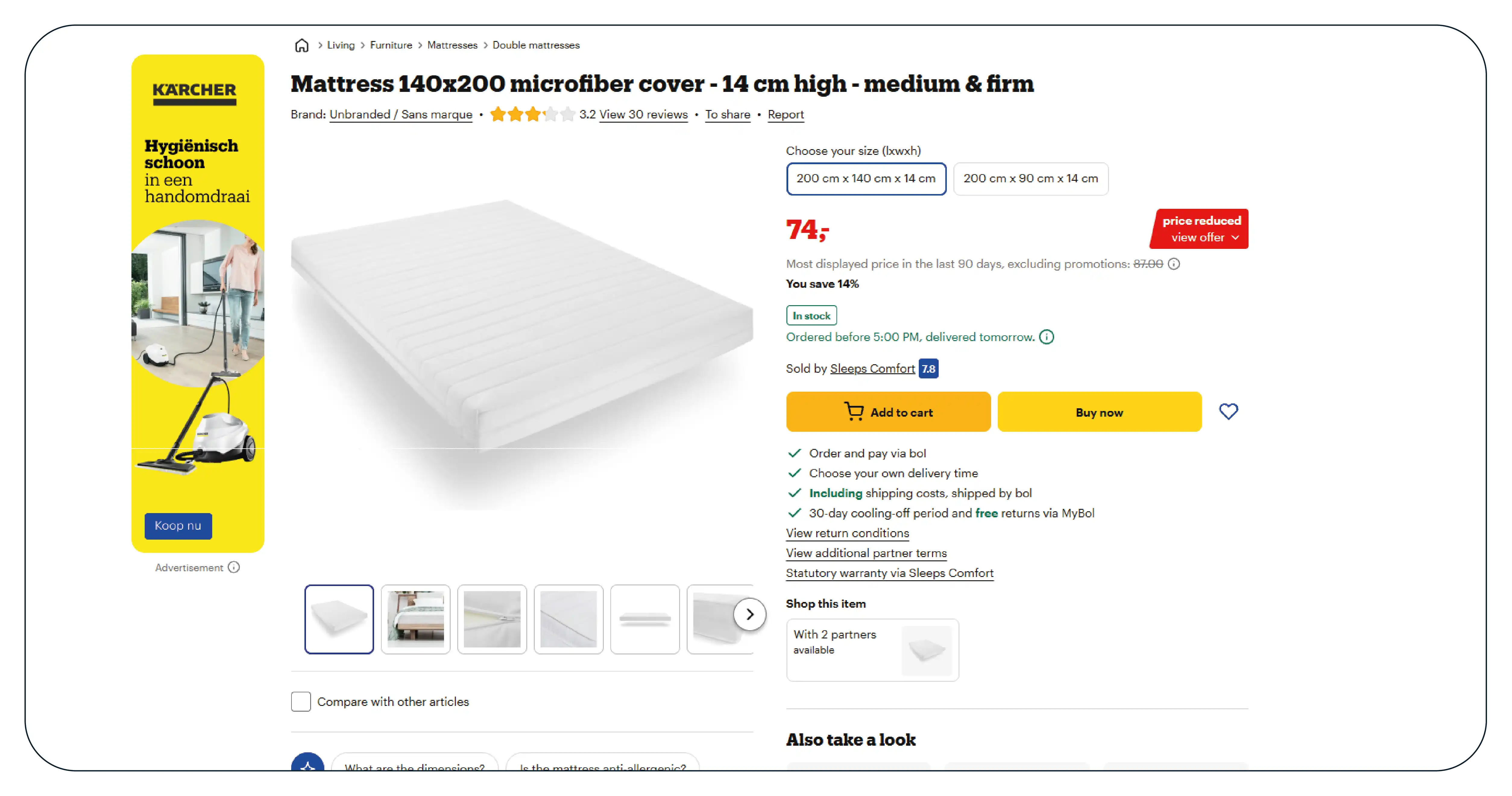
The primary business goal was to help NordLiving Home understand marketplace performance without depending on repetitive manual research. The brand wanted to compare competing products, recognize customer expectations, and identify opportunities to improve its product listings.
Another goal was to establish a scalable foundation for Bol.com Product Review Data Scraping, enabling the business to analyze a growing set of product listings and reviews through a consistent workflow.
The company also aimed to improve reporting speed, strengthen data reliability, and support decisions related to product assortment, positioning, and customer experience.
The technical implementation focused on Scrape Bol.com Product and Review Data through an automated, configurable collection pipeline.
Key objectives included:
Automate the collection of publicly accessible product titles, URLs, prices, ratings, and review information.
Standardize product attributes and review records to improve consistency.
Identify duplicate entries, missing fields, and malformed records through validation checks.
Organize collected data into structured datasets suitable for dashboards and business intelligence tools.
Analyze recurring customer feedback and rating patterns to identify potential product improvements.
Establish scheduled collection and monitoring processes, subject to source accessibility and applicable platform requirements.
The project used the following illustrative performance targets:
Manual research time: Reduce repetitive research effort by 60%.
Data completeness: Achieve 95% completeness across required fields.
Reporting speed: Reduce report preparation time by 40%.
Data freshness: Measure the time between collection runs and dashboard updates.
Data quality: Monitor duplicate records, validation failures, and missing values.
Operational reliability: Track successful collection runs and recoverable processing errors.
These KPIs provide measurable criteria for evaluating the workflow and should be confirmed using actual baseline and post-implementation data.
The Core Challenge
NordLiving Home faced several operational bottlenecks that limited its ability to extract useful information from Bol.com. Its existing research process required employees to visit product pages individually, copy information into spreadsheets, and compare records manually. As the number of relevant products increased, maintaining consistent and current information became increasingly difficult.
A major issue was the fragmented nature of marketplace information. Product titles, specifications, prices, ratings, and customer comments appeared in different formats. Without standardized records, comparing similar products across competing brands required additional cleanup and manual verification.
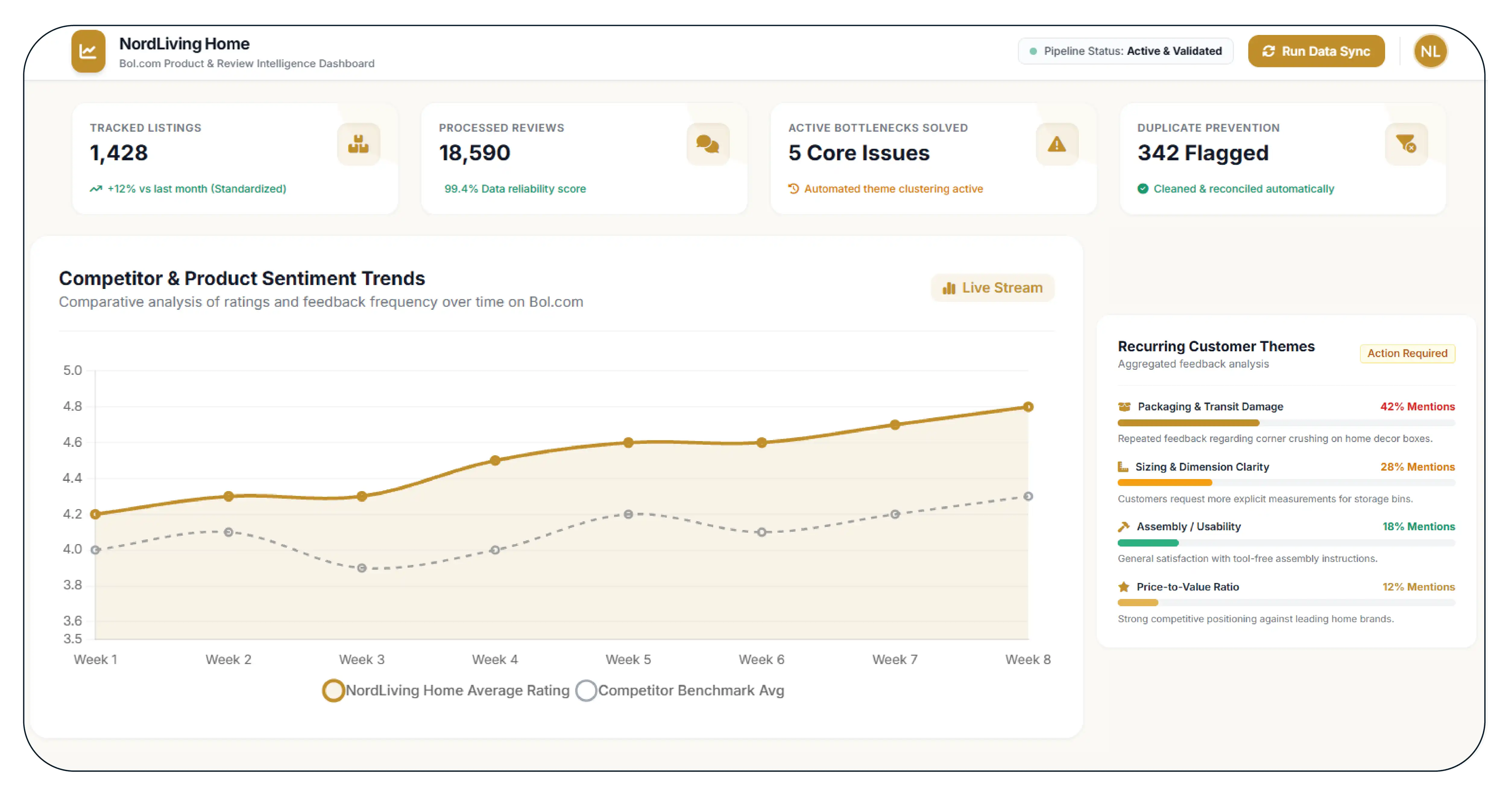
The team also struggled to identify meaningful patterns in large volumes of feedback. A single negative review might describe an isolated experience, while repeated complaints about durability, sizing, packaging, or usability could indicate a broader product issue. Manual review made these recurring themes harder to identify consistently.
The lack of centralized Bol.com Review Data For Product Analysis also affected reporting speed. Employees could not easily determine which products had changing ratings, which competitors were receiving stronger feedback, or which customer concerns appeared repeatedly across comparable listings.
Data reliability presented another challenge. Product pages could change, some fields might be unavailable, and collection processes could encounter temporary errors. Duplicate records and incomplete entries risked distorting comparisons if they were not detected.
NordLiving Home therefore needed more than a basic extraction script. It required a maintainable collection and validation process that could accommodate changing listings, organize information consistently, and turn marketplace data into practical business insights.
Our Solution
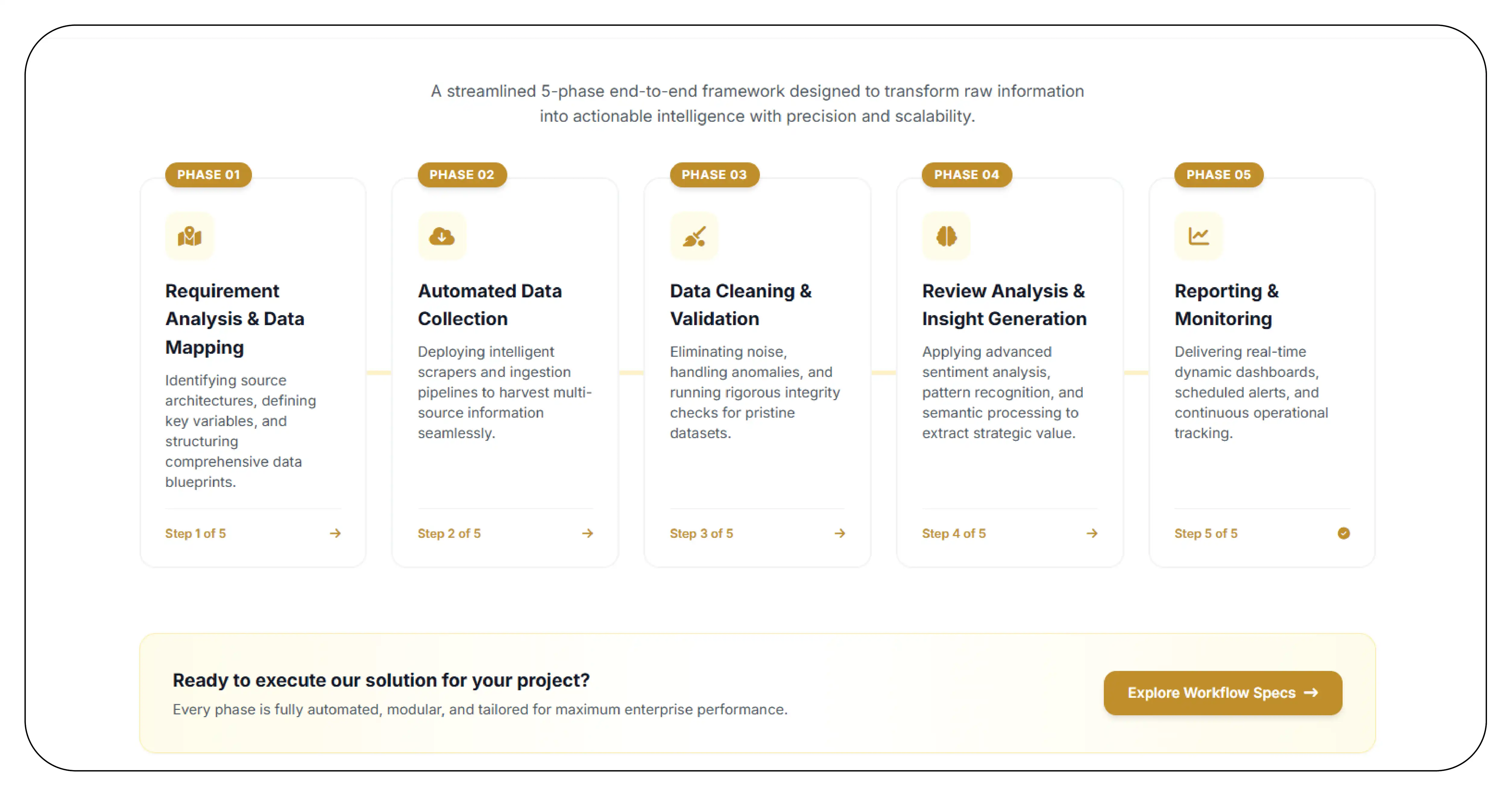
Product Data Scrape developed a phased workflow designed to address the brand's collection, quality, and analysis requirements.
Phase 1: Requirement Analysis and Data Mapping
The project began with identifying the product categories, competitor listings, and information fields most relevant to the brand. These included product names, brand names, product URLs, prices, available specifications, ratings, review counts, and accessible review text. The team defined a standardized schema to ensure that comparable information could be analyzed consistently. For example, a fictional Philips-style table lamp listing was not treated as a real client product; instead, the workflow used fictional examples such as the NordLiving Arc Table Lamp and NordLiving Modular Storage Box to demonstrate how product records would be organized. The scope also established collection frequency, data retention requirements, and validation rules.
Phase 2: Automated Data Collection
The next phase implemented an automated collection pipeline for eligible, publicly accessible marketplace information. Configurable extraction routines gathered relevant product details and available customer feedback while respecting applicable access restrictions, platform terms, and privacy requirements. The Extract Bol.com Product Ratings And Review Data process was designed to capture consistent fields across selected listings. Scheduling and controlled request rates helped organize collection runs and reduce unnecessary repetition. The system also accounted for unavailable information. Rather than inventing missing values, it marked fields appropriately for subsequent validation.
Phase 3: Data Cleaning and Validation
Raw records passed through a cleaning process before entering the analytical dataset. The workflow standardized text fields, normalized supported price formats, checked required attributes, and identified duplicate products or reviews. Product URLs and available identifiers helped distinguish records and track listing changes. Validation rules flagged unusual values and incomplete entries for review. These checks helped prevent inaccurate or inconsistent records from influencing competitor comparisons and customer feedback summaries.
Phase 4: Review Analysis and Insight Generation
The team organized customer feedback by product and relevant themes, such as quality, durability, ease of use, packaging, and value for money. Sentiment classification was used as an analytical aid rather than a definitive judgment of every review. Where necessary, ambiguous comments could be flagged for manual assessment. Ratings and review volumes provided additional context for interpreting the findings. This process helped the brand investigate recurring customer concerns and compare feedback patterns across competing product categories.
Phase 5: Reporting and Monitoring
Finally, structured datasets were prepared for dashboards and reporting tools. The reporting layer supported comparisons of product prices, ratings, review volumes, and emerging feedback themes. Automated checks monitored collection success, missing fields, and processing errors. Scheduled runs could refresh the dataset at an agreed frequency, subject to marketplace availability and technical constraints. The result was a repeatable workflow that connected marketplace information with practical commercial analysis, rather than leaving employees to manage disconnected spreadsheets.
Results & Key Metrics
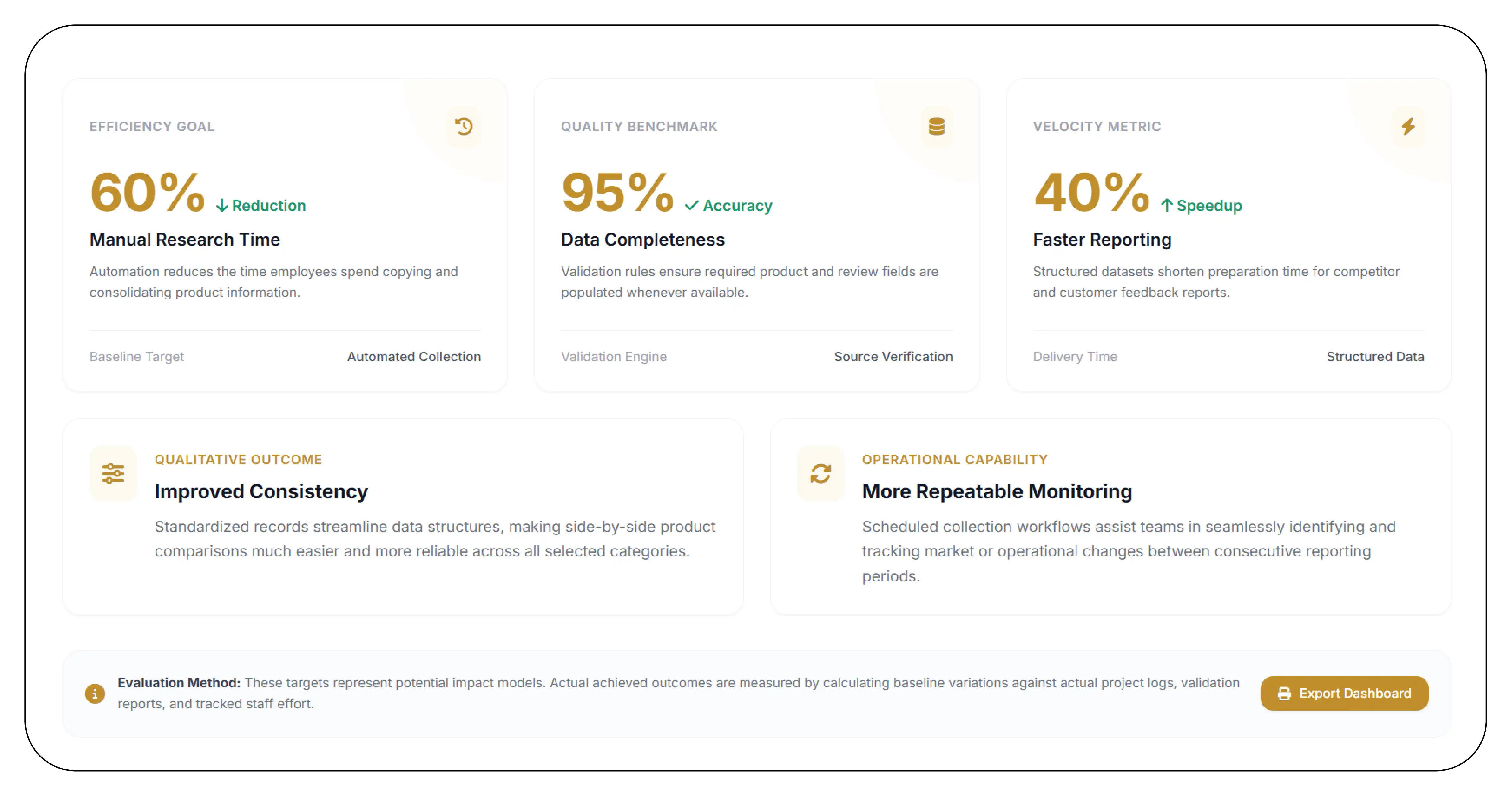
The following figures are illustrative targets for demonstrating how the project could be evaluated. They are not verified client results.
60% reduction in manual research time: Automation could reduce the time employees spend copying and consolidating product information.
95% data completeness: Validation rules could help ensure that required product and review fields are populated whenever the source provides them.
40% faster reporting: Structured datasets could shorten the time needed to prepare competitor and customer feedback reports.
Improved consistency: Standardized records could make product comparisons easier across selected categories.
More repeatable monitoring: Scheduled collection could help teams identify changes between reporting periods.
The workflow would track these indicators against the original baseline. Actual results should be calculated from project logs, validation reports, and measured staff effort before being presented as achieved outcomes.
Results Narrative
The proposed workflow gave NordLiving Home a structured foundation for Collect Bol.com Product Reviews For Analysis and connect customer feedback with product-level information.
Instead of relying exclusively on manual browsing, the brand could review standardized records and compare competing listings through consistent fields. Product teams could investigate recurring concerns, while commercial teams could assess pricing differences and rating patterns across selected categories.
Centralized reporting also made it easier to revisit earlier observations and compare them with subsequent collection runs. Validation checks helped users distinguish missing information from genuine changes in marketplace listings.
The approach supported more consistent decision-making across product research, listing optimization, and customer experience analysis. Rather than assuming that every rating or review represented the entire market, teams could consider review volume, product context, and recurring themes together.
Final business impact would depend on actual collection coverage, source availability, the quality of the underlying data, and how effectively the brand applied the findings.
What Made Product Data Scrape Different
Product Data Scrape focused on building a practical data workflow instead of delivering an unstructured collection of marketplace records. Its approach combined configurable extraction, standardized schemas, validation checks, and analysis-ready outputs.
The process for Bol.com Product Reviews For Ecommerce Intelligence connected product attributes with ratings and review themes, helping teams explore both competitive positioning and customer experience.
Automation reduced repetitive handling, while quality checks helped identify missing fields, duplicate entries, and unexpected values. The modular workflow could also be adapted to additional product categories when requirements changed.
Another differentiator was the emphasis on transparent reporting. Teams could review collection status, understand data limitations, and separate measured findings from assumptions. This supported more responsible interpretation of marketplace information and reduced the risk of treating incomplete records as definitive evidence.
Client's Testimonial
"Product Data Scrape helped us establish a more organized approach to marketplace research. Having product information, ratings, and customer feedback available in a structured format made comparisons easier and reduced our dependence on manual spreadsheets. The workflow also gave our team a clearer starting point for investigating customer concerns and reviewing competitor positioning. We particularly valued the emphasis on data validation and consistent reporting, which helped us understand the strengths and limitations of the information available. This approach created a useful foundation for improving our product research process and making more informed decisions as our catalog grows."
— Marketing and E-commerce Manager, NordLiving Home
Conclusion
Marketplace intelligence can help e-commerce brands understand competitive positioning, customer expectations, and product performance more systematically. For NordLiving Home, the proposed Product Data Scrape workflow demonstrates how automated collection, data validation, and structured analysis can turn fragmented marketplace information into useful business inputs.
Through Scraping Bol.com Product Data, businesses can establish repeatable processes for monitoring product attributes, comparing ratings, and reviewing available customer feedback. These insights can inform listing improvements, product research, and commercial planning when interpreted alongside other business evidence.
The next step is to validate the workflow against real collection records, confirm performance improvements, and expand coverage where permitted and technically feasible. With a strong data foundation, brands can work toward their goal to Win the digital shelf through better-informed decisions, more responsive product strategies, and a clearer understanding of customer needs.
FAQs
1. What is involved in marketplace product and review data collection?
The process gathers eligible product information, prices, ratings, review counts, and accessible review text. The exact fields depend on source availability, project requirements, and applicable access restrictions.
2. How can brands use ratings and customer feedback?
Scrape Bol.com Product Feedback And Ratings workflows can help businesses compare product performance and investigate recurring customer concerns. Ratings should be interpreted alongside review volume, product characteristics, and other relevant evidence.
3. Why is structured product review data important?
Bol.com Product Review Data Scraping helps organize product-level feedback into consistent records, making it easier to compare listings, identify recurring themes, and prepare reports.
4. Can review data support product improvements?
Yes. Bol.com Review Data For Product Analysis can help teams investigate recurring comments about product quality, usability, packaging, or value. Findings should be validated before they drive major product decisions.
5. How frequently should marketplace data be collected?
Collection frequency depends on the rate of marketplace changes, business objectives, technical feasibility, and permitted access conditions. A scheduled workflow can balance freshness with data quality, operational stability, and responsible collection practices.


 Singapore
 EMAIL
EMAIL
 PHONE
PHONE












.webp)