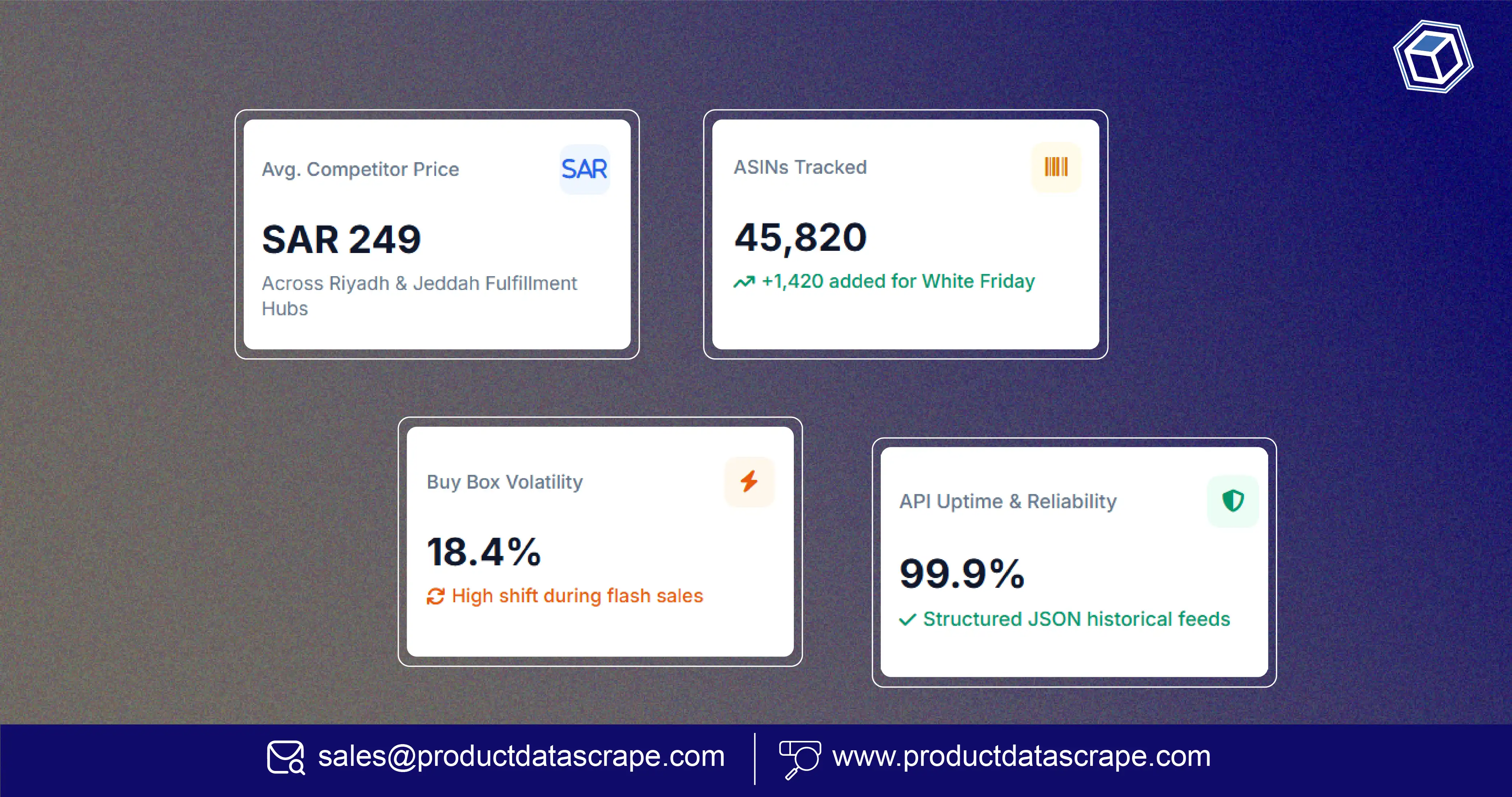
Introduction
Businesses can make better pricing decisions by connecting ASIN-level product identification with recurring historical price observations. Scrape Amazon Saudi Arabia Historical Price API workflows can turn changing Amazon.sa prices into structured time-series datasets, while Scrape Amazon Review & Rating Data can add customer-feedback context to product and pricing analysis.
The need for historical marketplace intelligence is growing alongside Saudi Arabia's digital commerce ecosystem. Saudi Arabia's Communications, Space and Technology Commission reported that 76.9% of internet users shopped online in 2025, while 95.3% of online shopping was conducted through local websites. Saudi Arabia's e-commerce sales through Mada cards exceeded SAR 69.3 billion in Q1 2025, up 56% year over year, according to Saudi Press Agency reporting based on Saudi Central Bank data.
For Amazon sellers, brands, retailers, pricing teams, and market researchers, today's price alone is rarely enough. A product may move from a regular price to a promotion, return to its previous price, or change repeatedly as sellers compete for the featured offer. Amazon itself provides automated pricing tools that can react to changes in the featured offer or lowest price, demonstrating the operational importance of price movement.
Historical data helps answer practical questions: What was the price last month? How often did it change? Was a discount temporary? Which products experienced repeated price movements? Did a competitor's pricing change coincide with movement in another listing?
The core value is therefore not simply collecting prices. It is building a reliable historical record that lets commercial teams compare, benchmark, investigate, and act.
How Can an ASIN-Level Dataset Create a Reliable Pricing Baseline?
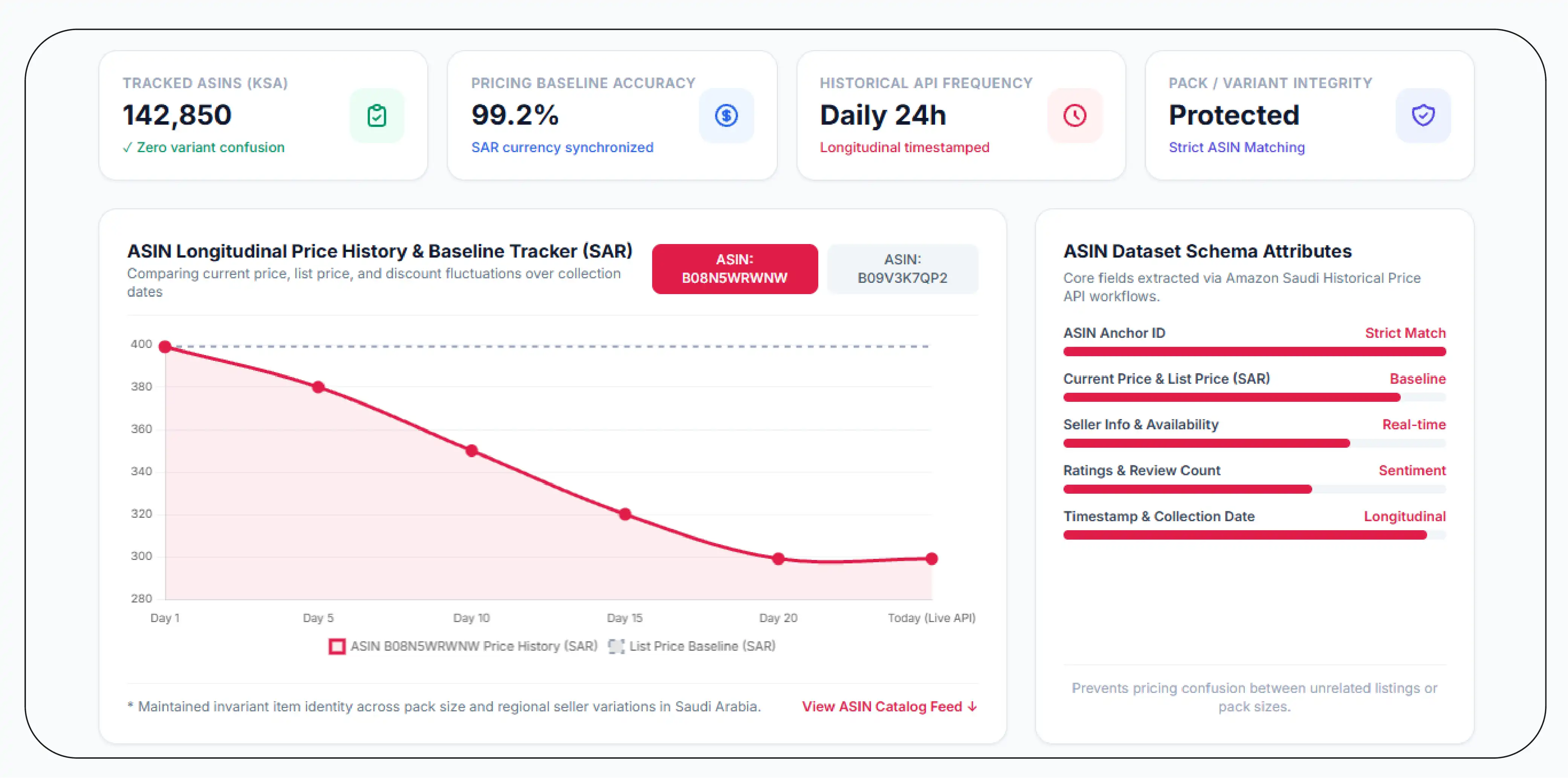
An Amazon Saudi ASIN Price Dataset gives businesses a consistent structure for tracking individual products across collection dates. Adding Scrape Amazon Saudi Arabia Historical Price API workflows to that structure can turn repeated observations into a searchable price history.
An ASIN identifies a specific Amazon catalog item, making it a useful anchor for longitudinal monitoring. A practical dataset can include ASIN, product title, brand, category, seller information where available, current price, list price where displayed, discount information, availability, product URL, rating, review count, currency, timestamp, and other permitted product attributes.
The key is maintaining the same ASIN identity across every observation. This prevents a pricing dataset from confusing different products, pack sizes, variants, or unrelated listings.
Recommended Dataset Structure
| Field |
Purpose |
| ASIN |
Stable product identifier |
| Product title |
Product identification |
| Brand |
Brand-level analysis |
| Category |
Category segmentation |
| Price |
Current observed price |
| List price |
Reference-price comparison when displayed |
| Discount |
Promotional analysis |
| Availability |
Stock-status context |
| Seller |
Offer-level analysis where available |
| Rating |
Customer perception context |
| Review count |
Review-scale context |
| Timestamp |
Historical comparison |
| Product URL |
Source traceability |
Amazon's Saudi seller documentation confirms that sellers can add products to the catalog and use API-based bulk listing and reporting tools through Amazon's seller infrastructure. It also notes that product listings use identifiers such as GTIN, UPC, ISBN, or EAN to specify products.
What Changed From 2020 to 2026?
Saudi Arabia's e-commerce environment changed substantially between 2020 and 2026. The pandemic accelerated digital purchasing, while subsequent investment in digital infrastructure, payments, logistics, and online retail continued to increase the amount of commercial activity occurring through digital channels. A Monsha'at report estimated that Saudi e-commerce users would reach 34.5 million by 2025 and reported 42% growth in e-commerce users between 2019 and 2024.
Payment data illustrates the scale of this transition. A Saudi-focused analysis using Mada data reported e-commerce sales rising from SAR 39 billion in 2020 to SAR 197 billion in 2024, with transactions increasing from 170 million to 1.135 billion during the same period. In 2025, Saudi Central Bank reported that electronic payments represented 85% of total retail payments, compared with 79% in 2024.
For Amazon-focused businesses, this expansion means that price monitoring needs to move beyond occasional manual checks. A historical dataset creates a baseline for every monitored ASIN and allows analysts to compare price observations across weeks, months, promotional periods, and seasons.
The practical insight is simple: a current price tells a business where a product is now; a timestamped ASIN dataset helps explain how it arrived there.
How Can Product Price Collection Improve Competitive Benchmarking?
Scrape Amazon Saudi Product Price Data workflows help retailers and brands create repeatable product-level benchmarks. Instead of manually checking individual Amazon.sa pages, businesses can establish a predefined ASIN universe and collect the same fields at scheduled intervals.
This is particularly useful for companies selling products that compete on price, promotions, assortment, and availability. A structured collection process can identify changes that may otherwise remain hidden between manual checks.
For example, a pricing team could monitor 1,000 selected ASINs every day. Each observation could be timestamped and compared with the previous record. The result is a dataset capable of calculating absolute price changes, percentage changes, minimum observed price, maximum observed price, average observed price, and the number of price-change events.
Useful Price Metrics
| Metric |
Calculation/use |
| Current price |
Latest observed price |
| Previous price |
Immediately preceding observation |
| Price change |
Current minus previous price |
| Percentage change |
Price movement relative to previous observation |
| Minimum price |
Lowest observed price |
| Maximum price |
Highest observed price |
| Average price |
Mean observed price |
| Change frequency |
Number of detected movements |
| Discount frequency |
Number of observed promotional events |
| Days at low price |
Duration below a defined threshold |
Amazon Saudi Arabia's seller platform specifically provides pricing-management capabilities and automated pricing rules that can respond to changes in the featured offer or lowest price. This makes historical external benchmarking relevant for sellers that need to understand the pricing environment surrounding their own products.
What Changed From 2020 to 2026?
From 2020 through 2026, pricing intelligence increasingly shifted from periodic competitor checks toward automated, continuous monitoring. The underlying reason is data volume. As online shopping became more established, the number of products, sellers, promotions, and price events that commercial teams needed to evaluate increased.
Saudi Arabia's digital adoption provides measurable context. The CST's 2023 Saudi Internet Report recorded 99% internet penetration and found that 93% of online shopping occurred through local websites. In 2024, internet penetration remained 99%, mobile phones represented 99.4% of internet usage, and 93.1% of online shopping occurred through local websites. By 2025, the CST reported that 76.9% of internet users purchased products or services online.
The implication for pricing teams is that marketplace monitoring can become a recurring operational process rather than a one-time research exercise.
Historical price collection also supports fairer comparisons. A competitor observed at SAR 99 today may have been SAR 129 yesterday. Without the historical context, an analyst could incorrectly interpret the current price as its normal level.
A recurring dataset solves this problem by preserving the observation date. Analysts can then distinguish a permanent price change from a temporary promotion or short-lived seller adjustment.
For retailers and brands, this enables more informed price benchmarking, promotional planning, and category research. For marketplace analysts, it creates a consistent evidence base for understanding pricing volatility.
How Does Product-Level Monitoring Reveal Meaningful Price Changes?
Amazon Saudi Product-Level Price Monitoring gives businesses a way to track individual ASINs over time instead of relying on isolated snapshots.
Product-level monitoring becomes especially valuable when businesses have large catalogs. A retailer may have hundreds or thousands of relevant products, while a brand may want to monitor its own ASINs alongside competing products. Manual checks quickly become difficult to scale.
A monitoring workflow can establish a baseline for each product and flag meaningful deviations. For example, an organization could define alerts for a 5% price movement, a new minimum price, a product becoming unavailable, or a significant change in the displayed discount.
Example Monitoring Logic
| Event |
Possible business interpretation |
| Price decreases 10% |
Promotional or competitive event |
| Price increases 8% |
Pricing adjustment |
| New lowest price |
Potential campaign opportunity |
| Product becomes unavailable |
Stock or listing event |
| Discount disappears |
Promotion ended |
| Repeated price changes |
High pricing volatility |
| Competitor changes first |
Possible competitive response |
Amazon's seller platform says automated pricing rules can change prices in response to events such as changes in the featured offer or lowest price. This demonstrates why a historical monitoring layer can be useful alongside seller-side pricing tools.
What Changed From 2020 to 2026?
Between 2020 and 2026, digital commerce monitoring became increasingly granular. Earlier approaches often focused on category averages or occasional competitor screenshots. Modern marketplace analytics can operate at SKU, ASIN, seller, category, and timestamp levels.
Saudi Arabia's e-commerce expansion provides the broader context. Monsha'at reported 40,953 commercial records related to e-commerce by Q4 2024 and 10% growth in active e-commerce registrations during that quarter. The Ministry of Commerce later reported 43,854 e-commerce commercial registrations in 2025, up from 40,041 in 2024.
As more businesses participate in digital commerce, product-level competition can become more dynamic. For pricing teams, this increases the value of monitoring defined product sets rather than trying to understand the entire marketplace simultaneously.
A useful monitoring system should also distinguish price changes from product changes. If a product variation changes, the ASIN being monitored may no longer represent the exact same commercial proposition. Dataset validation is therefore essential.
Historical monitoring also creates opportunities for anomaly detection. A product that normally sells within a narrow range but suddenly moves far outside that range deserves review. The system does not need to automatically declare the reason; it should surface the event for analyst validation.
This distinction is important for high-quality intelligence. Automated collection identifies what changed. Human or rule-based analysis determines what the change may mean.
How Can Historical Price Trends Explain Marketplace Behavior?
Historical datasets become substantially more valuable when they are analyzed as time series. Amazon Saudi Price Trend Analysis can reveal recurring price ranges, promotional periods, volatility, and differences between current and historical prices. Scrape Amazon Saudi Arabia Historical Price API processes can provide the recurring observations needed to build that analysis.
The analysis can be performed at several levels. Product managers can review individual ASINs. Pricing teams can compare brands. Category managers can study price distributions. Executives can examine broader market movements.
Historical Trend Metrics
| Analysis |
What it reveals |
| 7-day movement |
Short-term volatility |
| 30-day movement |
Promotional patterns |
| 90-day movement |
Medium-term pricing direction |
| 12-month minimum |
Lowest observed level |
| 12-month maximum |
Highest observed level |
| Median price |
Typical observed level |
| Price volatility |
Frequency/magnitude of movement |
| Promotion duration |
Length of observed discount |
Saudi Arabia's e-commerce activity makes such analysis increasingly relevant. Saudi Central Bank-linked reporting showed Mada e-commerce sales of SAR 69.3 billion during Q1 2025, compared with SAR 44.4 billion in Q1 2024.
What Changed From 2020 to 2026?
The 2020-2026 period shows why historical analysis has become more important. In 2020, Saudi e-commerce experienced a major acceleration as consumers shifted toward digital purchasing. Mada-based figures reported by Qoyod show e-commerce sales rising from SAR 10.2 billion in 2019 to SAR 39 billion in 2020, then to SAR 74 billion in 2021, SAR 123 billion in 2022, SAR 157 billion in 2023, and SAR 197 billion in 2024.
By 2025, Saudi Arabia's e-commerce activity continued expanding. Saudi Press Agency reported SAR 69.3 billion in Mada e-commerce sales during Q1 2025, representing 56% annual growth. The national e-commerce environment was therefore operating at a scale where historical product observations can provide useful context for commercial analysis.
The analytical advantage is that historical data can separate normal price ranges from exceptional events. A 15% discount may look significant without context, but historical records may show that the product regularly reaches the same price during major promotional periods.
Time-series analysis can also help businesses measure pricing consistency. A product with frequent changes may require a different monitoring cadence from a product with a stable price.
The strongest model combines product-level observations with timestamps, seller information where available, discount indicators, availability, and review signals. This produces a more complete marketplace record without assuming that every price movement has the same cause.
How Can Businesses Monitor Historical Pricing Without Losing Context?
Monitor Amazon Saudi Historical Pricing Data effectively by combining recurring collection with validation, timestamps, ASIN mapping, and historical storage. The objective is to preserve enough context around every price observation to make future comparisons meaningful.
A historical record should ideally answer five questions: which product was observed, what was the price, when was it captured, what other relevant product attributes were visible, and how did the observation compare with earlier records?
Historical Data Quality Framework
| Quality control |
Why it matters |
| ASIN validation |
Keeps product identity consistent |
| Timestamping |
Establishes observation date/time |
| Currency validation |
Prevents monetary-format errors |
| Duplicate removal |
Avoids repeated observations |
| Variant checks |
Prevents cross-variant comparisons |
| Availability capture |
Adds stock context |
| Seller capture |
Helps interpret offer changes |
| URL storage |
Enables source verification |
| Historical snapshots |
Preserves past observations |
Amazon's KSA seller documentation confirms that sellers can manage inventory and pricing through Seller Central and can use API-based bulk listing and reporting tools. For external marketplace intelligence, businesses should separately ensure that collection methods comply with applicable laws, platform terms, access restrictions, and privacy requirements.
What Changed From 2020 to 2026?
Between 2020 and 2026, the quality requirements for commercial marketplace datasets increased alongside data volume. A spreadsheet containing product name and price may be sufficient for a small manual comparison, but it becomes difficult to maintain when thousands of products are collected repeatedly.
Saudi Arabia's digital ecosystem continued to mature during this period. The CST reported 99% internet penetration in both its 2023 and 2024 reports, while mobile phones accounted for 98.9% and 99.4% of internet usage respectively. The 2025 CST report reported 76.9% of internet users shopping online.
The growth of electronic payments also strengthens the case for data-driven commerce operations. SAMA reported that electronic payments accounted for 85% of retail payments in 2025, up from 79% in 2024.
For marketplace analysts, these developments reinforce the importance of data freshness and historical continuity. If a price dataset is collected irregularly, it may miss short promotional periods and create gaps in the time series. If products are not mapped consistently, historical comparisons may become unreliable.
A better approach is to define collection frequency according to the business problem. High-volatility categories may require frequent observations, while stable categories can use longer intervals. The dataset should retain collection timestamps so analysts know exactly when each price was observed.
Historical monitoring should also preserve the raw observation alongside normalized fields. This allows teams to audit transformations and investigate unexpected changes.
How Can Product and Marketplace Data Work Together?
Combining Amazon Saudi Product-Level Price Monitoring with Web Scraping Amazon E-Commerce Product Data creates a broader product intelligence layer. Price history becomes more useful when connected to product titles, brands, categories, ratings, reviews, availability, seller information, and other permitted attributes.
For example, a price decrease can be analyzed alongside review growth, rating changes, or availability status. A product that becomes cheaper while remaining highly rated may require different analysis from a product that becomes cheaper after a prolonged period of low availability.
Product Intelligence Dataset
| Data category |
Example fields |
| Identity |
ASIN, SKU where available |
| Product |
Title, brand, category |
| Pricing |
Current, previous, list/reference price |
| Promotion |
Discount, promotional indicators |
| Availability |
In stock/out of stock |
| Seller |
Seller name or offer information where available |
| Reviews |
Rating, review count |
| Content |
Product attributes and specifications |
| Geography |
Amazon.sa marketplace |
| History |
Timestamped observations |
Amazon's Saudi seller platform states that sellers can use its Seller app to track sales, fulfill orders, find products, and manage listings. Amazon also promotes FBA and automated pricing tools for Saudi sellers.
What Changed From 2020 to 2026?
The evolution from 2020 to 2026 reflects a wider shift from isolated product data toward integrated commerce intelligence. During the early pandemic period, businesses primarily needed digital visibility. As online retail matured, they increasingly needed structured information that connected products, prices, sellers, availability, customer feedback, and historical changes.
Saudi Arabia's 2025 digital commerce indicators demonstrate the scale of this environment. The CST reported 76.9% of internet users shopping online and 95.3% of online shopping occurring through local websites. Saudi Arabia's Ministry of Commerce reported 43,854 e-commerce commercial registrations in 2025, compared with 40,041 in 2024.
For brands and retailers, this creates a need for datasets that can connect different product attributes without losing the historical dimension. Web Scraping Amazon E-Commerce Product Data makes it possible to collect structured product information alongside pricing, availability, reviews, and other relevant attributes. A price change becomes more informative when analysts can see whether the product was in stock, whether its review count changed, whether competing products moved simultaneously, and whether the event was temporary.
The analytical model can therefore progress from simple price tracking to product intelligence. Businesses can establish monitored ASIN groups, enrich them with relevant attributes, create historical snapshots, and calculate product-level metrics.
The most useful output is not necessarily a large raw dataset. It is a clean, timestamped, validated dataset that answers specific commercial questions. Pricing teams can use it for benchmarking, category teams for assortment research, brands for competitive monitoring, and analysts for market reports.
This approach also supports AI-ready analytics. Structured fields and historical timestamps make it easier for downstream systems to identify patterns, summarize changes, and surface anomalies while keeping the underlying observations available for verification.
Why Choose Product Data Scrape?
For businesses that need marketplace intelligence at scale, Saudi Arabia data collection requires consistent schemas, recurring monitoring, validation, and historical storage. A specialized workflow can help transform product-level observations into analytics-ready datasets.
Scrape Amazon ASIN Data projects can be designed around defined ASIN lists, product categories, competitor sets, or broader marketplace requirements. The dataset can include pricing, availability, product information, seller attributes, ratings, reviews, and timestamps according to the required scope.
The focus should remain on data quality. Product identity must remain consistent, duplicate observations should be controlled, and historical snapshots should be retained for meaningful comparison. This helps businesses move from one-off research to repeatable intelligence operations.
A suitable workflow can support pricing teams, e-commerce brands, retailers, market researchers, agencies, and analysts that need structured Amazon.sa information for commercial analysis.
Conclusion
Historical ASIN-level information gives businesses a clearer view of how Amazon.sa prices change over time. Scrape Amazon Product Data Using ASINs provides a structured foundation for connecting product identity with pricing, availability, seller, and review information, while Price monitoring turns repeated observations into actionable time-series intelligence.
Saudi Arabia's e-commerce ecosystem continues to expand, with 76.9% of internet users shopping online in 2025 and e-commerce sales through Mada cards reaching SAR 69.3 billion in Q1 2025.
For brands, retailers, and pricing teams, the opportunity is to replace isolated price checks with validated historical datasets.
Product Data Scrape can help businesses build scalable Amazon.sa product intelligence workflows tailored to specific ASINs, categories, competitors, and reporting requirements.
You can also reach us for all your mobile app scraping, data collection, web scraping, and instant data scraper service requirements!


 Singapore
 EMAIL
EMAIL
 PHONE
PHONE




.webp)
.webp "thumb")










.webp)