Introduction
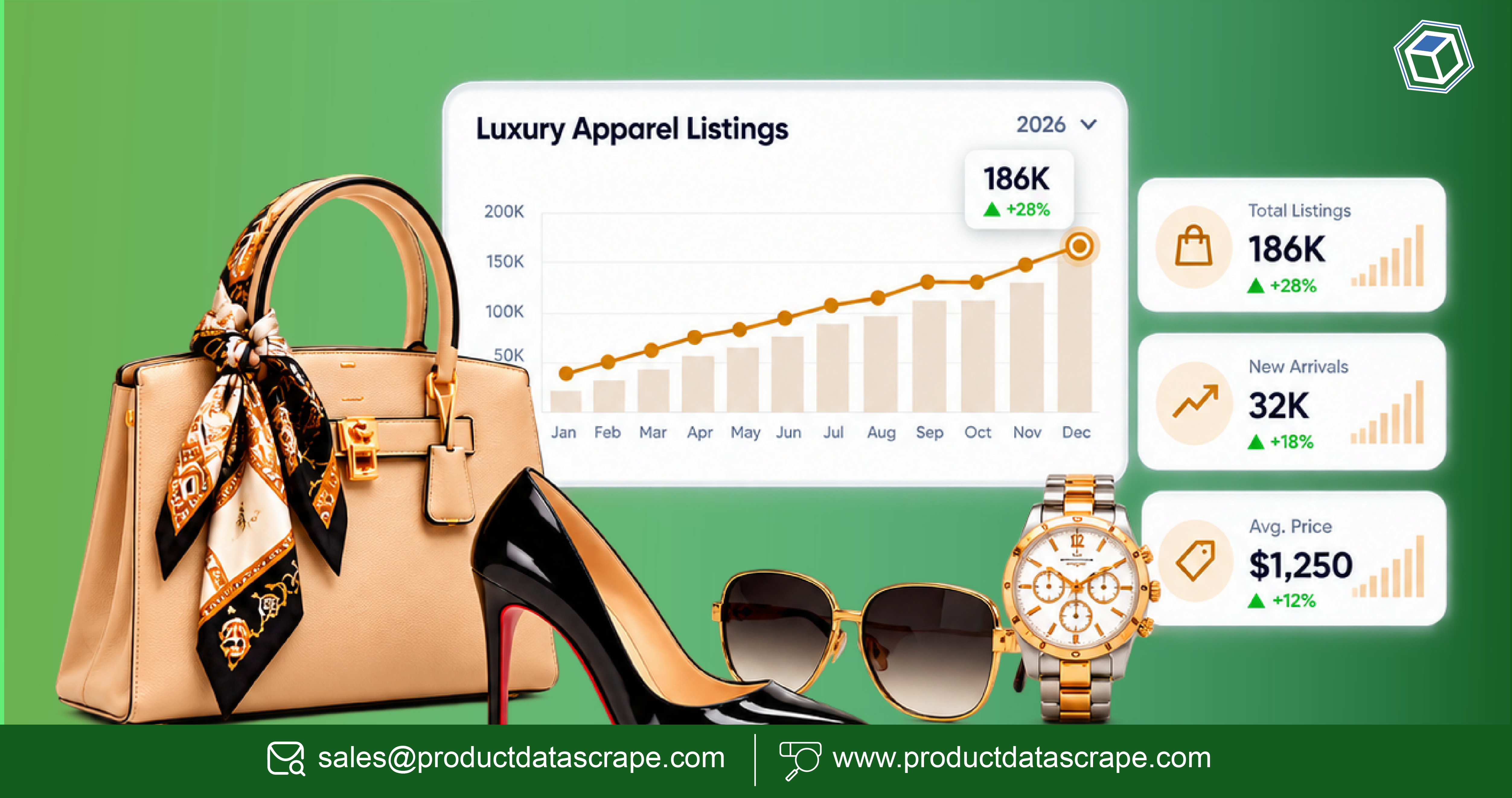
Businesses can improve luxury fashion intelligence by monitoring daily product listings, prices, availability, brands, categories, and assortment changes across Indian online marketplaces. Scrape India Luxury Apparel Daily Listing Data 2026 converts fragmented fashion listings into structured information that supports competitive analysis, assortment planning, pricing research, and market intelligence.
For UK luxury brands, fashion retailers, marketplaces, and market researchers entering or expanding in India, daily visibility matters. E-commerce data scraping for the UK market helps businesses monitor luxury fashion catalogs, which can change quickly as brands launch seasonal collections, introduce new products, adjust prices, update inventory, and remove discontinued items.
A one-time dataset provides a snapshot. Daily monitoring provides a timeline.
For example, a luxury fashion intelligence workflow can track products from brands such as Burberry, Alexander McQueen, Stella McCartney, Gucci, Prada, Versace, Balenciaga, Louis Vuitton, and Ralph Lauren where their products are publicly listed online. The resulting information can be organized by brand, category, product, price, size, color, availability, seller, and listing date.
This approach helps answer practical questions:
- Which luxury products are newly listed?
- Which brands have expanded their Indian assortment?
- Which products are discounted?
- Which categories are gaining marketplace visibility?
- How frequently do prices change?
- Which sellers carry competing products?
- Which products disappear from listings?
- How does Indian assortment differ from another market?
The objective is not simply to collect more data. It is to create decision-ready fashion intelligence that helps commercial teams understand marketplace movement with greater consistency.
How Can UK Brands Understand Changes in Indian Fashion Demand?
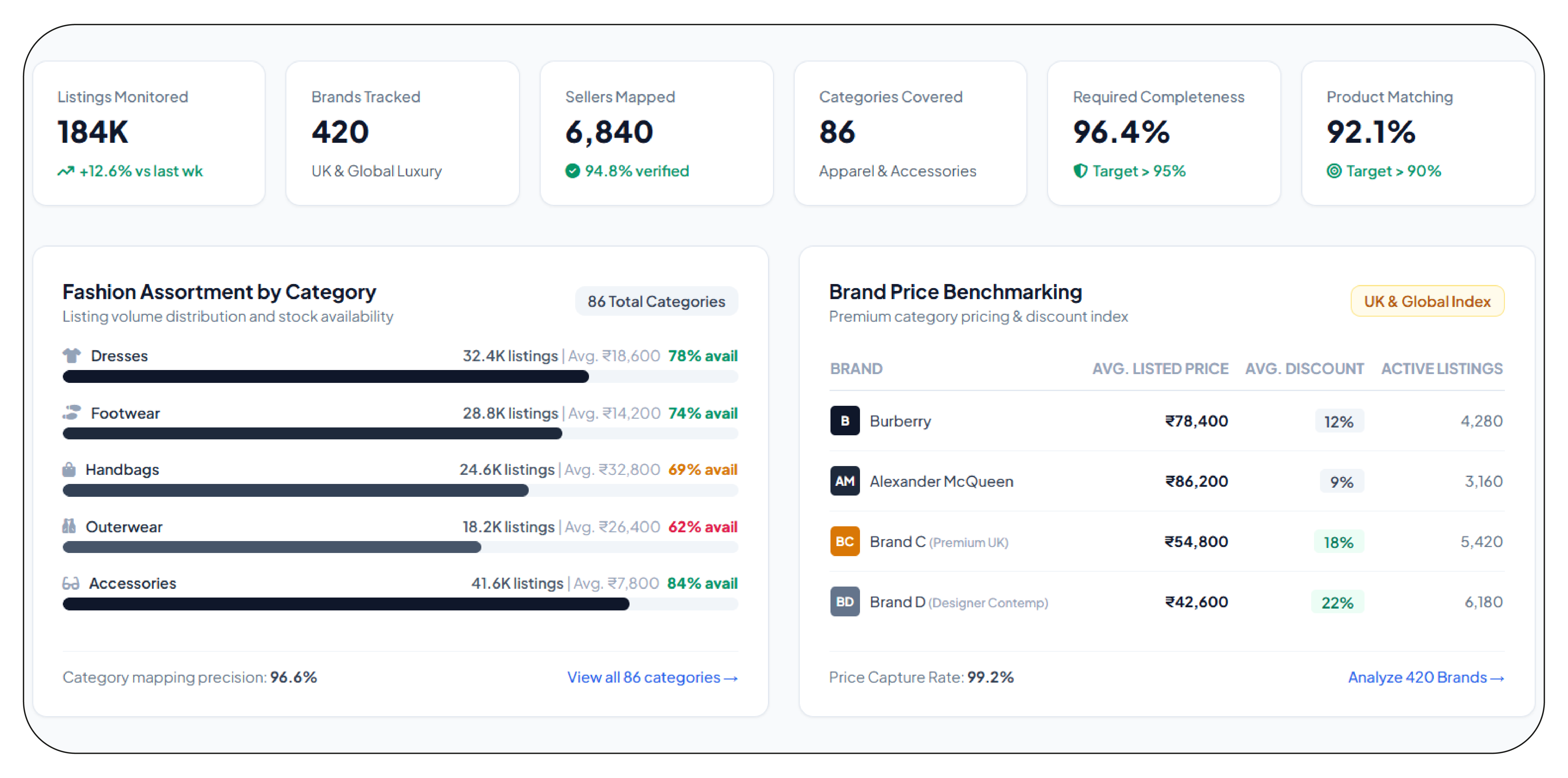
UK Brands Track Indian Marketplaces when they need structured visibility into products, sellers, prices, availability, and category movements across India's digital fashion ecosystem. A Fashion & Apparel Trend Data Scraper can support this process by organizing recurring listing information into comparable records.
Consider a UK brand such as Burberry or Alexander McQueen evaluating its marketplace presence in India. Its team may want to understand which product categories appear most frequently, what price points are visible, which sellers offer similar products, and how assortment changes throughout the year.
A daily collection process can capture listing-level attributes such as:
| Attribute |
Intelligence Application |
| Brand |
Brand visibility |
| Product name |
SKU/product tracking |
| Category |
Assortment analysis |
| Price |
Price benchmarking |
| Discount |
Promotion monitoring |
| Size |
Availability analysis |
| Color |
Variant monitoring |
| Seller |
Seller mapping |
| Product URL |
Listing verification |
| Timestamp |
Historical comparison |
2020–2026 Development
From 2020 onward, fashion commerce became increasingly digital, making online product visibility more important for international brands. During 2020–2021, businesses faced disruptions in physical retail and greater dependence on digital channels. In 2022–2023, marketplaces became increasingly relevant for product discovery and competitive research.
By 2024–2025, the need shifted from occasional catalog research toward recurring monitoring. Brands increasingly needed to know not only what products were available but how their assortment changed over time.
In 2026, daily listing intelligence can help commercial teams build a more granular view of marketplace activity. A brand can compare newly appearing products with existing assortment, monitor price movements, and identify changes in category representation.
Illustrative operational benchmarks: A well-designed daily monitoring workflow could target 95%+ required-field completeness, 90%+ automated product matching, and 60%+ reduction in repetitive manual listing checks. These are implementation targets, not independently verified India-market statistics.
How Can International Luxury Brands Monitor Their Indian Marketplace Presence?
UK Luxury Brands India Marketplace Tracking provides a structured way to observe how international luxury brands appear across Indian digital retail channels. The objective is to understand marketplace representation without relying exclusively on manual searches.
For brands such as Burberry, Mulberry, Jimmy Choo, and Alexander McQueen, teams may need to identify product listings, seller information, pricing, stock status, and assortment differences. A recurring dataset allows those observations to be compared by date.
What should brands monitor?
| Monitoring Area |
Example Question |
| Product assortment |
Which products are listed? |
| Pricing |
What price points are visible? |
| Availability |
Which sizes are available? |
| Sellers |
Who is offering the products? |
| Categories |
Which fashion categories are represented? |
| Discounts |
Which listings show promotions? |
| New listings |
Which products appeared recently? |
| Removed listings |
Which products are no longer visible? |
Daily tracking is particularly useful for seasonal fashion. A product may be available today and unavailable later because of inventory movement, assortment changes, or listing updates.
2020–2026 Development
The 2020–2022 period increased the importance of digital product discovery as consumers and businesses adapted to changing retail conditions. During 2023–2024, luxury and premium fashion companies increasingly needed better visibility into digital assortment and competitor positioning.
In 2025–2026, marketplace monitoring became more useful when combined with historical records. Instead of asking only, "What is listed now?", businesses can ask, "What changed since last week or last month?"
For international brands, this distinction matters because marketplace visibility can vary by category, seller, season, and product availability.
A structured dataset can also support regional teams that need to compare Indian marketplace activity with their existing global assortment information.
What Intelligence Can Be Built From Indian Luxury Fashion Listings?
India Luxury Fashion Marketplace Intelligence 2026 combines product, brand, seller, price, availability, and category observations to create a structured view of marketplace activity. When combined with Marketplace & Seller Intelligence, it can help businesses understand both product assortment and the commercial environment surrounding those products.
For example, a retailer could monitor handbags, dresses, footwear, jackets, shirts, watches, accessories, and other luxury categories. Products from brands such as Prada, Gucci, Versace, Balenciaga, Coach, and Michael Kors can be classified by category, product type, price band, and seller where publicly available.
Which intelligence layers matter?
| Intelligence Layer |
Business Application |
| Product |
Assortment monitoring |
| Brand |
Brand benchmarking |
| Seller |
Marketplace mapping |
| Price |
Competitive benchmarking |
| Discount |
Promotion monitoring |
| Availability |
Inventory signals |
| Category |
Trend analysis |
| Historical record |
Change detection |
The value increases when businesses maintain historical snapshots. If a Prada handbag appears at one price in January and another price later, the historical dataset provides context for understanding the change.
2020–2026 Development
Between 2020 and 2022, digital fashion research often focused on current product availability. From 2023 onward, historical comparison became more important because businesses wanted to understand how products and prices changed.
During 2024–2025, data pipelines increasingly incorporated product matching, category classification, and automated validation. By 2026, structured marketplace intelligence can be connected to dashboards and analytical systems, allowing teams to examine changes across thousands of records.
A critical principle is to distinguish marketplace visibility from actual market demand. A product appearing frequently online does not automatically mean it has higher sales. Strong analysis should combine marketplace observations with sales, search, customer, and other relevant datasets when available.
How Can UK Fashion Businesses Evaluate Their Position in India?
UK Fashion Brands India Market Intelligence helps international fashion companies examine product positioning, pricing patterns, assortment differences, and marketplace activity in the Indian market.
A UK fashion business may already have extensive product intelligence for its domestic market. However, Indian marketplace listings may differ in product selection, pricing, availability, seller representation, and seasonal assortment.
For example, a brand could compare the presence of outerwear, footwear, handbags, accessories, and ready-to-wear collections across markets.
Useful comparison dimensions
| Dimension |
UK Market |
Indian Market |
| Product assortment |
Existing catalog |
Listed catalog |
| Price |
Domestic benchmark |
Indian listing |
| Availability |
Stock visibility |
Indian stock visibility |
| Category |
UK category structure |
Indian category structure |
| Sellers |
Retail channels |
Indian marketplace sellers |
| Discounts |
Promotional activity |
Local promotional activity |
2020–2026 Development
From 2020 onward, cross-border fashion commerce created greater demand for market-specific digital intelligence. International brands increasingly needed to understand how their products were represented beyond their home markets.
By 2022–2023, businesses were looking beyond basic product availability and examining pricing and assortment. During 2024–2025, structured cross-market comparison became more practical as data pipelines could normalize product names, categories, currencies, and attributes.
In 2026, market intelligence can support expansion planning by helping teams identify category gaps, monitor competitor products, and compare price positioning.
For example, if a UK brand discovers that premium handbags are widely represented while a specific apparel category has limited marketplace visibility, that observation can become an input for further commercial research.
The data should support decisions, not replace them. Local consumer preferences, taxes, logistics, brand strategy, distribution agreements, and regulatory requirements should also be considered.
How Can Brands Compare Luxury Apparel Prices and Assortments?
India Luxury Apparel Competitive Intelligence enables brands and retailers to compare competing products, sellers, categories, and marketplace positioning. When supported by Competitive pricing data, businesses can examine price differences across comparable products and track changes over time.
Price comparison requires careful normalization. A luxury jacket from one brand cannot automatically be compared with a discounted accessory from another brand. Analysts should compare like-for-like products wherever possible, taking category, material, size, collection, product type, and promotional status into account.
What should pricing intelligence include?
| Field |
Purpose |
| Product price |
Current benchmark |
| Original price |
Discount comparison |
| Discount |
Promotion analysis |
| Currency |
Market normalization |
| Product category |
Like-for-like analysis |
| Product variant |
Accurate matching |
| Seller |
Channel comparison |
| Timestamp |
Historical tracking |
2020–2026 Development
In 2020–2021, fashion pricing research was frequently affected by promotional activity and rapidly changing retail conditions. From 2022 onward, businesses increasingly required historical price information to distinguish temporary promotions from longer-term positioning.
During 2023–2024, automated normalization made it easier to compare products across large catalogs. By 2025–2026, recurring price monitoring could support more detailed competitive analysis.
For example, if a Gucci handbag is listed by multiple sellers at different prices, analysts can record the seller, product variant, listed price, discount, and timestamp before making a comparison.
Illustrative analytical targets: Organizations may target 90%+ product matching accuracy and 95%+ timestamp completeness for recurring pricing datasets. These figures are operational benchmarks rather than market-wide performance claims.
The key is to preserve historical records rather than overwrite previous observations. Historical pricing creates context for understanding marketplace movement.
How Can Businesses Build Daily Luxury Apparel Listing Visibility?
Scrape India Luxury Apparel Listings to create recurring records covering luxury clothing, footwear, handbags, accessories, and other publicly listed fashion products.
A daily listing workflow can begin with source discovery and category mapping. The next stage identifies product attributes that matter to the buyer persona. For a luxury brand, this could include product title, brand, category, color, size, material, price, discount, seller, availability, and product URL.
How does the workflow operate?
- Source mapping: Identify relevant public marketplace and retail pages.
- Category discovery: Map luxury apparel and related categories.
- Automated collection: Capture listing information at scheduled intervals.
- Normalization: Standardize names, categories, sizes, currencies, and attributes.
- Product matching: Identify duplicate or recurring products.
- Validation: Check missing, inconsistent, or anomalous records.
- Historical storage: Preserve daily observations.
- Analytics delivery: Prepare structured data for dashboards and analysis.
2020–2026 Development
The progression from manual research to automated daily monitoring reflects the growing volume and complexity of online fashion catalogs. In 2020, teams could often manage smaller competitor sets manually. As marketplace catalogs expanded, manual checking became increasingly difficult.
By 2023–2024, automation could support recurring collection and product matching. In 2025–2026, businesses can build more sophisticated monitoring systems that preserve historical listing changes and connect them with internal analytics.
The most useful daily dataset is not necessarily the largest one. It is the dataset with consistent fields, reliable timestamps, appropriate product matching, and a structure aligned with business questions.
Why Choose Product Data Scrape?
Luxury Fashion E-commerce analysis requires data that reflects products, prices, sellers, availability, and assortment changes in a consistent format.
A specialized data partner can build workflows around the exact needs of luxury brands, retailers, marketplaces, and market researchers. This can include source mapping, automated collection, product matching, category classification, normalization, duplicate detection, validation, historical storage, and structured delivery.
The focus should remain on business usability. Fashion teams need datasets they can filter, compare, visualize, and integrate into existing analytical workflows.
A strong implementation can also scale from a limited group of brands to broader categories and marketplaces as monitoring requirements expand.
Conclusion
Managed India retail data scraping gives fashion businesses a structured way to monitor changing digital assortments, prices, sellers, and availability. Instead of relying on isolated manual searches, teams can maintain historical marketplace observations and use them for competitive research, assortment planning, pricing analysis, and market expansion.
Scrape India Luxury Apparel Daily Listing Data 2026 provides a framework for turning recurring marketplace observations into usable intelligence. For brands entering India, retailers monitoring competitors, and analysts studying luxury fashion, consistent product-level data can reveal changes that occasional research may miss.
Product Data Scrape can design customized workflows around specific brands, categories, marketplaces, attributes, and monitoring frequencies.
Contact Product Data Scrape to build a scalable daily luxury apparel intelligence dataset tailored to your India market, pricing, assortment, and competitive monitoring requirements!
FAQs
1. What is daily luxury apparel listing data?
Daily luxury apparel listing data captures recurring information such as brands, products, prices, sizes, colors, discounts, sellers, availability, and URLs from selected online sources.
2. Why should luxury brands monitor Indian marketplaces?
Monitoring helps brands understand digital assortment, pricing movements, seller presence, product availability, and competitor activity within the Indian online fashion environment.
3. Can historical listing changes be tracked?
Yes. Daily snapshots can preserve previous records, making it possible to identify newly added, removed, repriced, or updated products over time.
4. Which luxury fashion categories can be monitored?
Depending on source availability, monitoring can cover apparel, handbags, footwear, accessories, outerwear, dresses, shirts, jackets, and other luxury fashion categories.
5. Can Product Data Scrape customize collection requirements?
Yes. Product Data Scrape can structure workflows around selected marketplaces, brands, categories, product attributes, collection frequency, validation requirements, and preferred delivery formats.


 Singapore
 EMAIL
EMAIL
 PHONE
PHONE


.webp)
.webp "thumb")









.webp)