Quick Overview
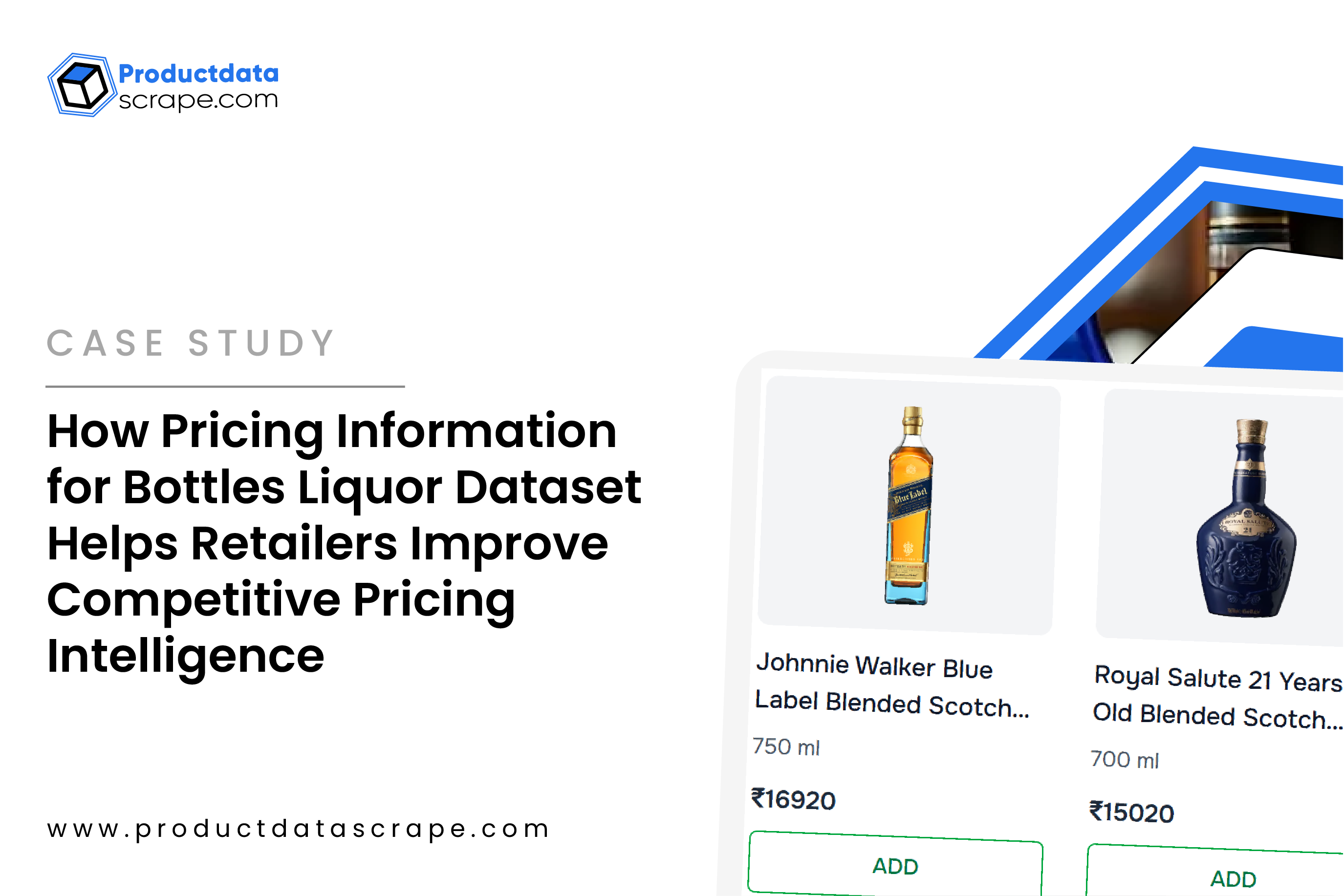
For retailers managing thousands of beverage SKUs, reliable pricing visibility is essential for understanding market movements, benchmarking competitors, and improving assortment decisions. Product Data Scrape developed a structured Pricing information for Bottles Liquor Dataset to help a retail intelligence client capture, normalize, and analyze liquor pricing information across online retail sources. The engagement focused on scalable alcohol Price Data Scraping, covering product names, brands, bottle sizes, prices, discounts, availability, categories, and URLs. The client was able to transform fragmented online pricing information into an analytics-ready resource for competitive monitoring and market analysis.
Client Name / Industry: Confidential Multi-Brand Beverage Retailer / Retail & Market Intelligence
Service / Duration: Liquor Product Data Scraping, Data Structuring & Competitive Monitoring / 12 Weeks
Key Impact Metrics: 96%+ data-field completeness, 93%+ automated validation accuracy, and 70% faster recurring data processing.
The Client
The client was a multi-brand beverage retailer and market intelligence organization operating in a highly competitive online retail environment. Its product portfolio included spirits and liquor products across categories such as whisky, vodka, rum, gin, tequila, and liqueurs. Representative products considered in the monitoring framework included brands such as Johnnie Walker, Absolut, Smirnoff, Bacardi, Grey Goose, Jack Daniel's, and Bombay Sapphire.
The market was experiencing increasing pressure from online retailers, marketplaces, specialty liquor stores, and digitally enabled competitors. Price changes could occur frequently because of promotions, seasonal campaigns, bottle-size variations, inventory conditions, and competitive positioning.
Before partnering with Product Data Scrape, the client relied on fragmented online research and manually maintained spreadsheets. Different sources used inconsistent naming conventions, bottle sizes, category structures, and promotional formats. This made it difficult to compare a 750 ml bottle with a 1 L variant or distinguish between standard and premium product offerings.
The existing process also lacked a consistent Bottles Liquor Dataset Pricing Information structure. Teams spent considerable time collecting information, cleaning duplicate records, and checking whether observed price changes represented genuine market movements.
Transformation was therefore essential. The client needed a repeatable data pipeline capable of collecting product-level information at scale, standardizing attributes, validating records, and preparing the output for analytics and Retail media and ad intelligence applications.
Goals & Objectives
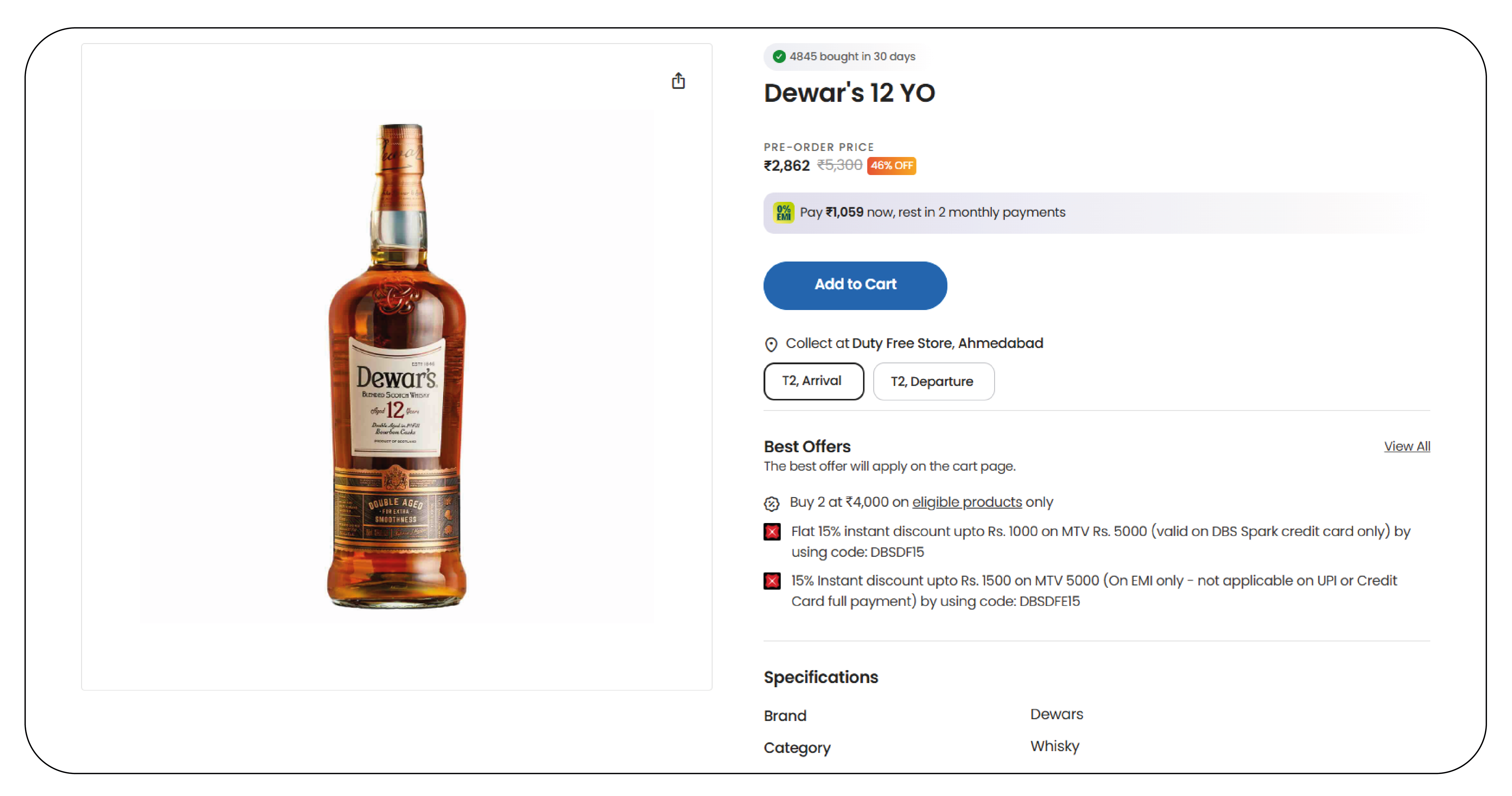
The project was designed around three connected priorities: creating a scalable data foundation, improving collection speed and accuracy, and making the information usable for automated analytics. Product Data Scrape aligned the technical framework with measurable business requirements so the client could move from manual observation toward systematic competitive intelligence.
Build a scalable Liquor Price and Competitor Intelligence Dataset covering multiple brands, products, bottle sizes, and retailers.
Improve collection speed for recurring price-monitoring cycles.
Increase accuracy by applying structured validation and normalization.
Capture comparable attributes for products such as Johnnie Walker Black Label, Absolut Vodka, Bacardi Carta Blanca, Grey Goose Vodka, and Jack Daniel's Old No. 7.
Support category-level and SKU-level competitive analysis.
Reduce manual spreadsheet maintenance.
Automate recurring Scrape Alcohol Menus workflows across selected online sources.
Normalize product names, brands, categories, bottle sizes, prices, discounts, and availability.
Integrate structured outputs with the client's analytics environment.
Establish automated duplicate detection and quality checks.
Enable historical price comparisons and trend analysis.
Prepare standardized datasets for dashboards and downstream reporting.
95%+ target data completeness.
90%+ automated validation accuracy.
60%+ reduction in manual processing time.
70% faster recurring data preparation.
Consistent SKU-level records across monitoring cycles.
The Core Challenge
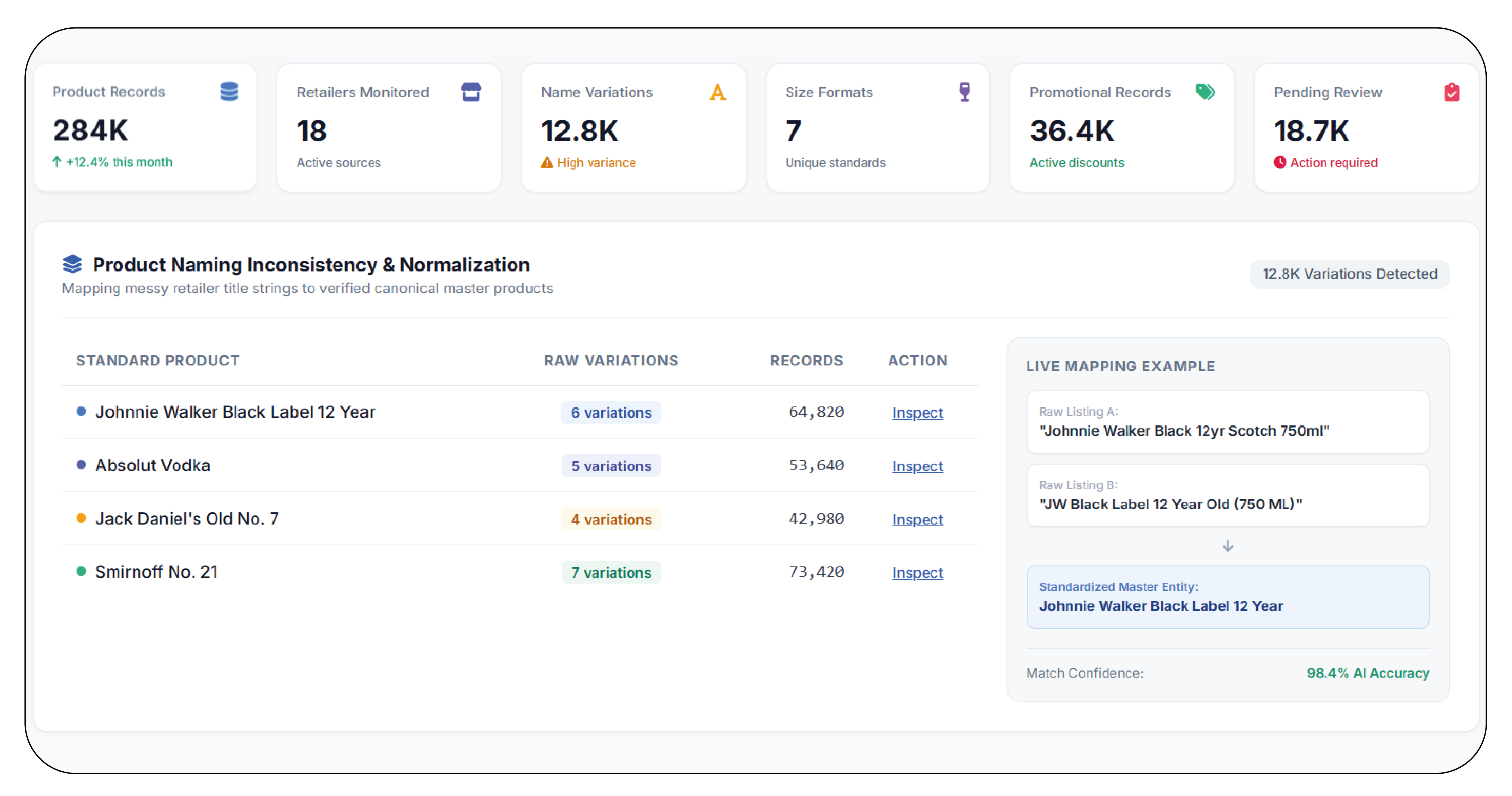
The client's biggest issue was not the availability of online liquor information but the difficulty of converting scattered product pages into consistent, comparable records. Different retailers frequently displayed product information in different formats. One listing might identify a product as "Johnnie Walker Black Label 12 Year," while another could use abbreviated naming. Bottle sizes could appear as 750ml, 750 ml, or 0.75 L.
Promotional pricing created another operational bottleneck. A product such as Absolut Vodka could have a standard price, discounted price, member promotion, or multi-buy offer depending on the retailer and collection time. Without structured fields, teams could mistakenly interpret promotional prices as regular market prices. Price scraping helped capture these pricing variations systematically, allowing analysts to distinguish base prices from promotional offers and improve the accuracy of competitive pricing analysis.
Liquor Bottle Size Price Analysis was particularly challenging because bottle size directly affects meaningful price comparisons. Comparing a 375 ml bottle with a 750 ml or 1 L bottle without normalization could distort competitive insights.
The previous process also involved significant manual verification. Analysts had to review URLs, remove duplicate records, standardize brand names, and identify missing attributes before the information could be used.
Another issue was collection speed. When multiple competitors changed prices simultaneously, manual workflows could not provide timely updates. Delayed information reduced the usefulness of the dataset for pricing and assortment decisions.
The client therefore required an automated framework that could collect product information consistently, validate records, normalize bottle sizes, and deliver analytics-ready data on a recurring basis.
Our Solution
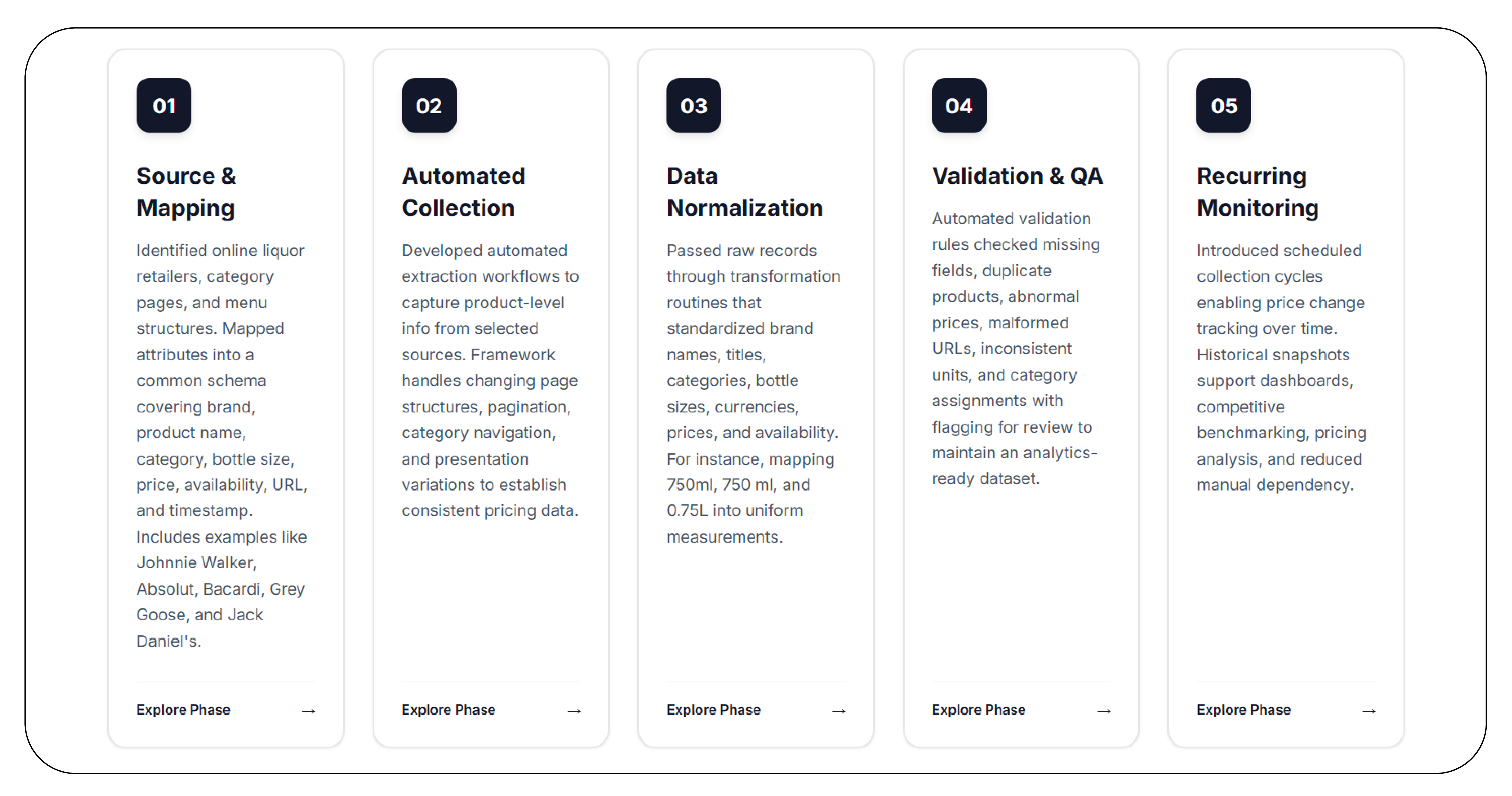
Product Data Scrape implemented a phased data engineering approach designed around collection scalability, standardization, validation, and recurring monitoring.
Phase 1: Source and Product Mapping
The first phase identified relevant online liquor retailers, category pages, product pages, and menu structures. Product attributes were mapped into a common schema covering brand, product name, category, bottle size, listed price, promotional price, availability, product URL, and collection timestamp. Representative products such as Johnnie Walker Red Label, Johnnie Walker Black Label, Absolut Vodka, Smirnoff No. 21, Bacardi Superior, Grey Goose Vodka, Jack Daniel's Tennessee Whiskey, and Bombay Sapphire were used as examples when designing category and attribute structures.
Phase 2: Automated Data Collection
Automated extraction workflows were developed to capture product-level information from selected sources. The framework was designed to handle changing page structures, pagination, category navigation, and variations in product presentation. The collection layer captured both core product information and relevant pricing attributes. This helped establish a consistent Bottles Liquor Price Data for Pricing Strategy foundation.
Phase 3: Data Normalization
Raw records were passed through transformation routines that standardized brand names, product titles, categories, bottle sizes, currencies, prices, and availability values. For example, bottle-size expressions such as 750ml, 750 ml, and 0.75L could be mapped into a standardized measurement format. This enabled more reliable comparisons between products and retailers.
Phase 4: Validation and Quality Control
Automated validation rules checked missing fields, duplicate products, abnormal price values, malformed URLs, inconsistent units, and unexpected category assignments. Records failing defined quality checks were flagged for additional review. The process maintained the Pricing information for Bottles Liquor Dataset as a structured, analytics-ready resource rather than simply a collection of scraped pages.
Phase 5: Recurring Monitoring
The final stage introduced scheduled collection cycles so the client could monitor price changes over time. Historical snapshots enabled analysts to compare previous and current prices, identify promotional movements, and examine brand-level patterns. The resulting pipeline supported dashboards, competitive benchmarking, pricing analysis, and internal reporting while reducing dependency on manual data collection.
Results & Key Metrics
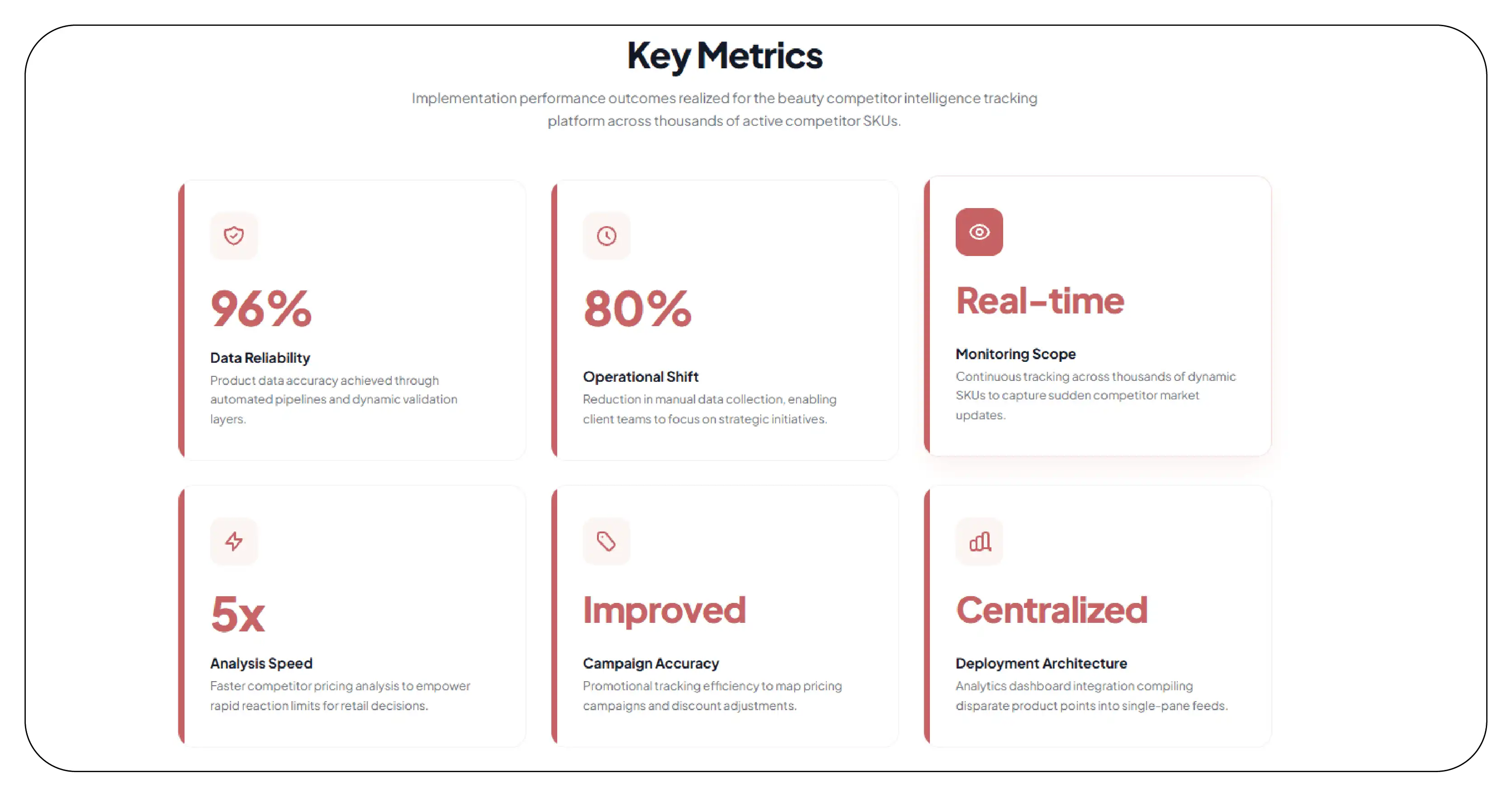
96%+ data-field completeness: Core product and pricing fields were consistently populated across the monitored dataset.
93%+ automated validation accuracy: Automated checks improved consistency before data entered downstream analytics.
70% faster recurring processing: Automation shortened the time required to prepare repeated monitoring datasets.
60%+ reduction in manual review: Standardization and validation reduced repetitive spreadsheet-based checks.
90%+ duplicate-control effectiveness: Product and URL matching helped reduce repeated records.
Results Narrative
The implementation created a more reliable foundation for Bottles Liquor Pricing Intelligence for Retailers by converting fragmented product listings into structured, comparable records. Analysts could examine brand-level, product-level, and bottle-size pricing patterns without repeatedly rebuilding spreadsheets.
The Pricing information for Bottles Liquor Dataset also supported recurring monitoring, allowing the client to observe changes involving products such as Absolut Vodka, Bacardi Superior, Grey Goose Vodka, and Jack Daniel's Tennessee Whiskey.
The combination of automation, normalization, and validation improved operational speed while giving business teams more consistent data for competitive benchmarking, assortment reviews, promotional analysis, and pricing discussions.
What Made Product Data Scrape Different
Product Data Scrape approached the project as a data engineering and intelligence workflow rather than a simple extraction exercise. The framework combined automated collection, schema-based normalization, validation rules, duplicate detection, historical snapshots, and structured delivery.
Its Alcohol & Liquor Data Scraping approach was designed to accommodate differences between retailer websites, product categories, naming conventions, and bottle-size formats. Automated checks helped identify missing or inconsistent values before delivery, while recurring workflows reduced manual intervention.
The solution could also be expanded as the client's monitoring requirements evolved. New brands, categories, retailers, product attributes, and monitoring frequencies could be incorporated without redesigning the entire data model.
The Pricing information for Bottles Liquor Dataset therefore became a reusable intelligence asset that could support pricing analysis, competitor monitoring, assortment planning, and broader retail analytics initiatives.
Client's Testimonial
"Product Data Scrape helped us move from fragmented online price checks to a structured monitoring workflow. The biggest improvement was the consistency of the information. Product names, brands, bottle sizes, prices, and availability were organized into a format our analysts could work with immediately. The automated validation process also reduced the amount of manual checking required by our team. We can now review recurring pricing movements across products and competitors more efficiently and use the information as part of our broader market intelligence process."
— Director of Retail Intelligence, Confidential Beverage Retail Organization
Conclusion
For retailers competing in dynamic online beverage markets, structured product and pricing information can provide a stronger foundation for market analysis. Product Data Scrape transformed fragmented online listings into a standardized dataset designed for recurring monitoring, comparison, and analytics.
The ability to extract liquor product details such as brand, product name, bottle size, price, discount, availability, and URL helped create a consistent information layer for business teams. With automation and validation built into the workflow, the client reduced manual processing and improved data consistency.
The project demonstrates how structured data collection can support competitive pricing intelligence while creating a scalable foundation for future retail analytics initiatives.
FAQs
1. What information can be included in a liquor pricing dataset?
A structured dataset can include product name, brand, category, bottle size, regular price, promotional price, discount, availability, retailer, product URL, and collection timestamp. Examples may include products from brands such as Johnnie Walker, Absolut, Bacardi, Smirnoff, Grey Goose, and Jack Daniel's.
2. How can retailers use liquor pricing data?
Retailers can use the information for competitor benchmarking, price monitoring, assortment analysis, promotional tracking, historical comparisons, and category-level market intelligence.
3. Why is bottle-size normalization important?
A 375 ml, 750 ml, and 1 L product should not be compared as though they represent identical quantities. Standardizing bottle sizes enables more meaningful product and price comparisons.
4. Can the dataset support recurring monitoring?
Yes. Automated collection workflows can be configured for recurring monitoring cycles, allowing businesses to maintain historical snapshots and identify changes across selected products and retailers.
5. Can Product Data Scrape customize the dataset?
Yes. The schema can be customized around specific brands, products, retailers, categories, bottle sizes, pricing attributes, availability fields, and delivery requirements. This allows the resulting dataset to align with the client's analytics and competitive intelligence objectives.


 Singapore
 EMAIL
EMAIL
 PHONE
PHONE










.webp)