Quick Overview
A leading FMCG and consumer-products company partnered with Product Data Scrape to strengthen its quick-commerce inventory visibility and understand product availability across Flipkart Minutes. The project focused on Flipkart Minutes Product Availability Tracking to monitor SKU-level stock status across multiple pincodes and product categories. Using an automated Flipkart scraper, Product Data Scrape collected product names, brands, SKUs, prices, pack sizes, availability, and location-level signals. The resulting dataset helped the client identify stock gaps, improve monitoring speed, and support more responsive inventory decisions. The solution achieved 95%+ data accuracy, reduced manual monitoring effort by 80%, and improved availability reporting turnaround by 70%.
Client Name / Industry: Leading FMCG & Consumer Products Brand
Service / Duration: Quick-Commerce Product Availability Data Collection / 6 Months
Key Impact Metrics: 95%+ data accuracy | 80% lower manual effort | 70% faster availability reporting
The Client
The client was a large FMCG and consumer-products organization managing an extensive portfolio of grocery, beverages, snacks, personal-care, and household products. Its competitive assortment included products such as Coca-Cola, Pepsi, Amul, Nestlé, Maggi, Britannia, Lay's, Dove, Surf Excel, and Tata Salt, alongside private-label and regional alternatives.
The rapid growth of quick-commerce platforms was increasing pressure on brands to maintain strong digital shelf visibility. Consumers increasingly expected products to be available within minutes, making stock availability an important factor in purchase decisions. Even when demand existed, an unavailable SKU could result in lost sales and reduced brand visibility.
Before partnering with Product Data Scrape, the client depended heavily on manual checks to understand whether products were available across different service locations. This made it difficult to identify location-specific stock gaps or determine whether an unavailable product represented a temporary stockout or a broader distribution issue.
The organization needed Flipkart Minutes Pincode-Level Availability intelligence to understand product availability across different delivery locations. Manual monitoring was time-consuming, inconsistent, and difficult to scale across hundreds of SKUs.
Transformation was therefore essential. The client required a structured and automated approach capable of collecting availability signals frequently, standardizing product information, and creating a historical view of stock movements. This would allow inventory, sales, and category teams to make faster decisions based on reliable marketplace intelligence.
Goals & Objectives
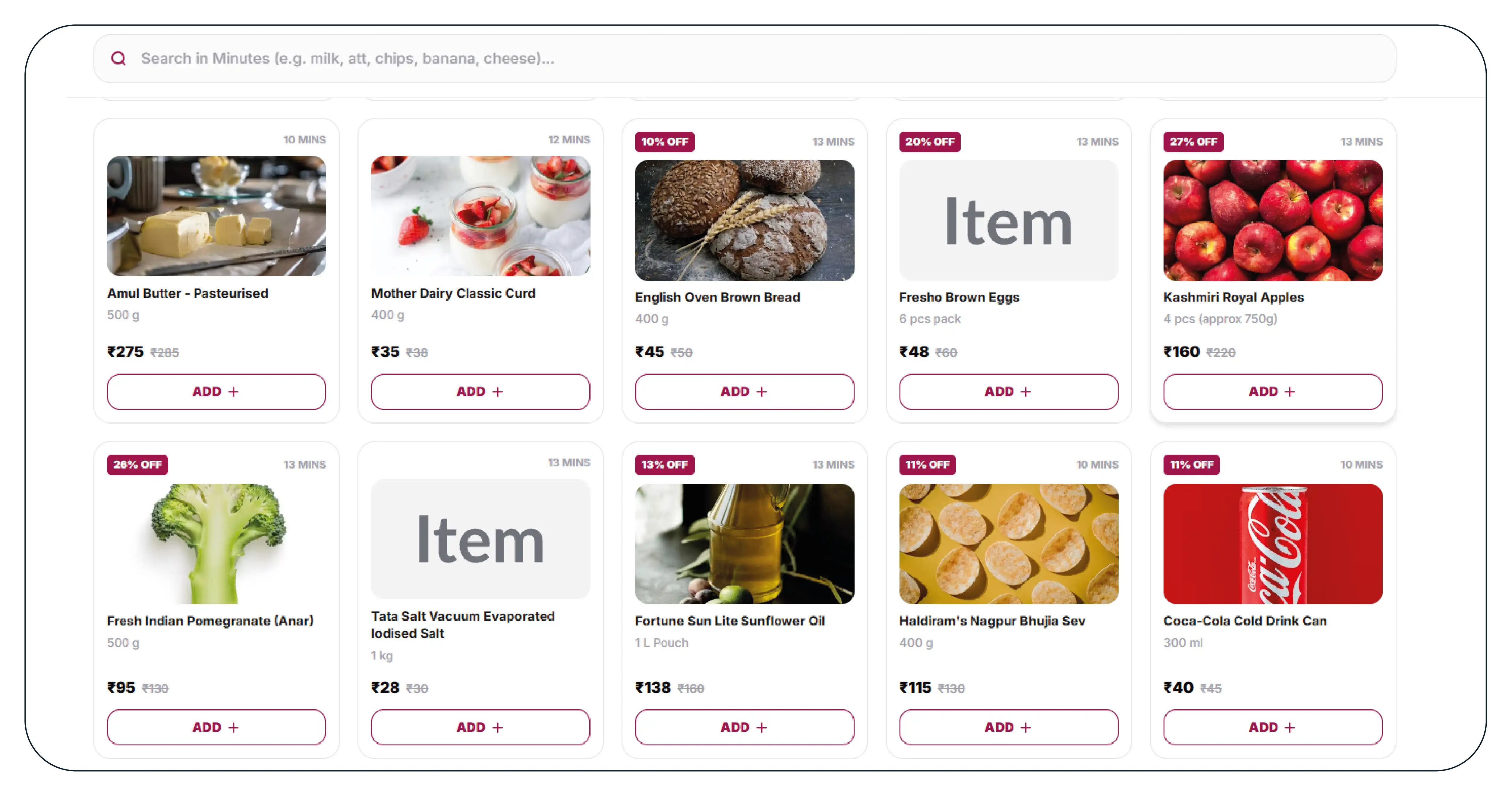
The project was designed to establish an automated product availability monitoring framework for Flipkart Minutes. The client wanted to move away from manual availability checks and create a scalable system that could monitor a large SKU universe across multiple pincodes.
The primary business goal was to Scrape Flipkart Minutes SKU Availability at scale and create actionable visibility into digital inventory conditions.
Improve visibility into product availability.
Monitor inventory conditions across multiple pincodes.
Increase monitoring scalability across hundreds of SKUs.
Improve data collection speed and accuracy.
Detect recurring stockout patterns.
Support faster replenishment and distribution decisions.
Strengthen digital shelf performance.
The technical implementation focused on automation, integration, and analytics. The solution needed to collect standardized product information while supporting recurring data refreshes.
Automate SKU discovery and availability extraction.
Capture product name, brand, SKU, category, pack size, and price.
Record availability status by pincode.
Normalize product and location information.
Validate collected records automatically.
Integrate datasets with analytics workflows.
Enable historical availability tracking.
Support scheduled data collection.
Achieve 95%+ availability-data accuracy.
Reduce manual monitoring effort by 80%.
Improve reporting turnaround time by 70%.
Achieve 90%+ successful SKU matching.
Increase monitoring coverage across priority categories.
Improve detection of recurring stockout patterns.
Maintain consistent scheduled data refreshes.
The Core Challenge
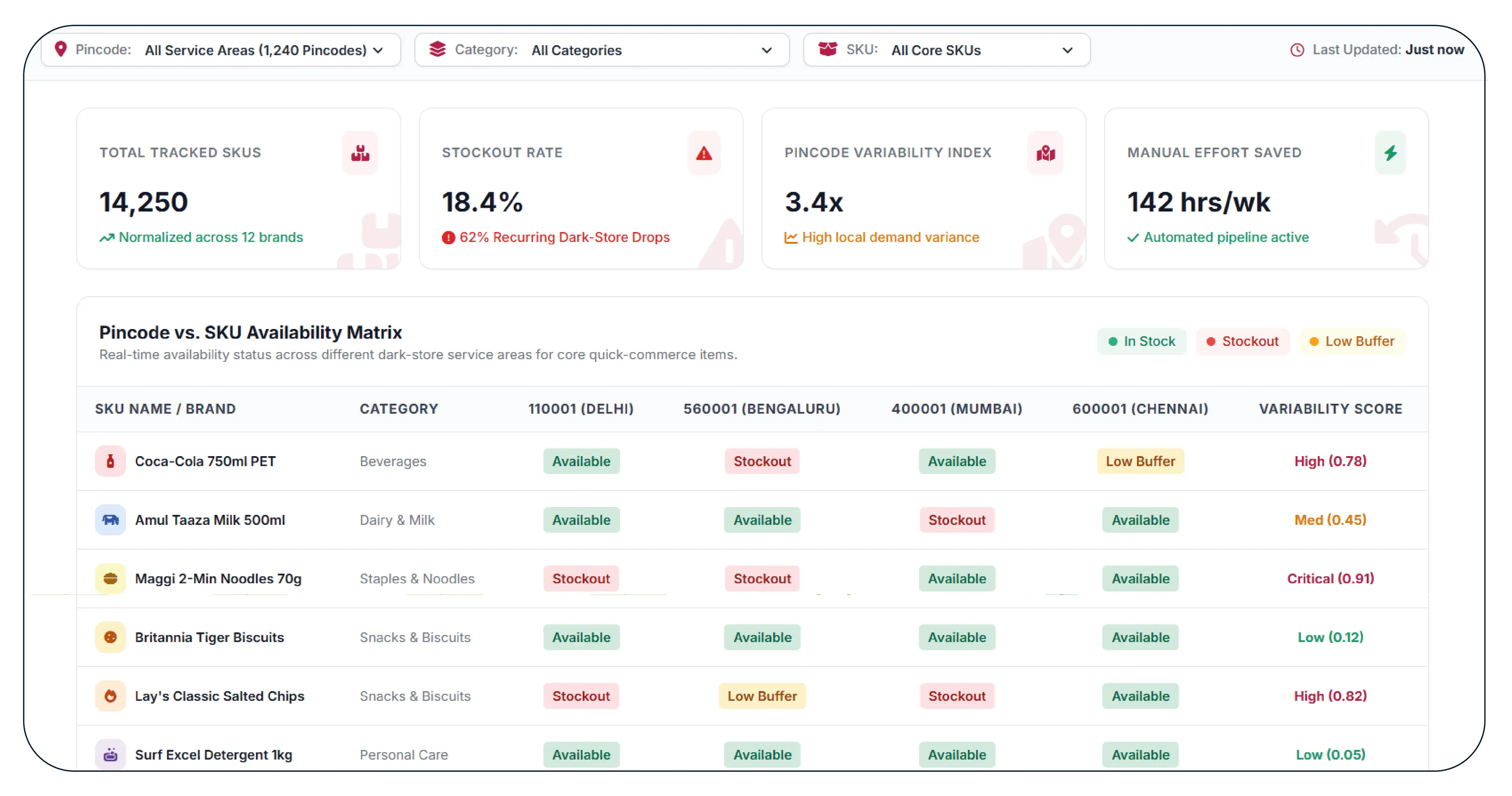
The client's major challenge was the dynamic nature of quick-commerce inventory. Product availability could vary significantly from one pincode to another because of local demand, dark-store inventory, replenishment schedules, and fulfillment capacity.
For example, products such as Coca-Cola beverages, Amul milk, Maggi noodles, Britannia biscuits, Lay's chips, Surf Excel detergent, or Dove personal-care products could be available in one service area while appearing unavailable in another. A single marketplace-level availability check therefore did not provide sufficient visibility.
The client also needed Flipkart Minutes Stockout Tracking to understand how frequently individual SKUs became unavailable and whether stockouts were isolated or recurring. Existing manual processes could not reliably capture these changes at sufficient frequency.
Operational bottlenecks created additional issues. Analysts had to repeatedly search for products, record availability manually, compare pincodes, and consolidate information into spreadsheets. This process consumed considerable time and introduced inconsistencies.
Data quality was another concern. Product names, pack sizes, SKU identifiers, and category structures could differ between listings. Without normalization, teams could mistakenly treat similar products as separate SKUs or compare different pack configurations.
The absence of historical data also limited trend analysis. Teams could see the current status but had difficulty answering questions such as which products experienced repeated stockouts, which pincodes had weaker availability, and which categories were most affected.
The client therefore needed a scalable automated framework that could capture location-specific inventory signals, validate records, and transform marketplace observations into actionable inventory intelligence.
Our Solution
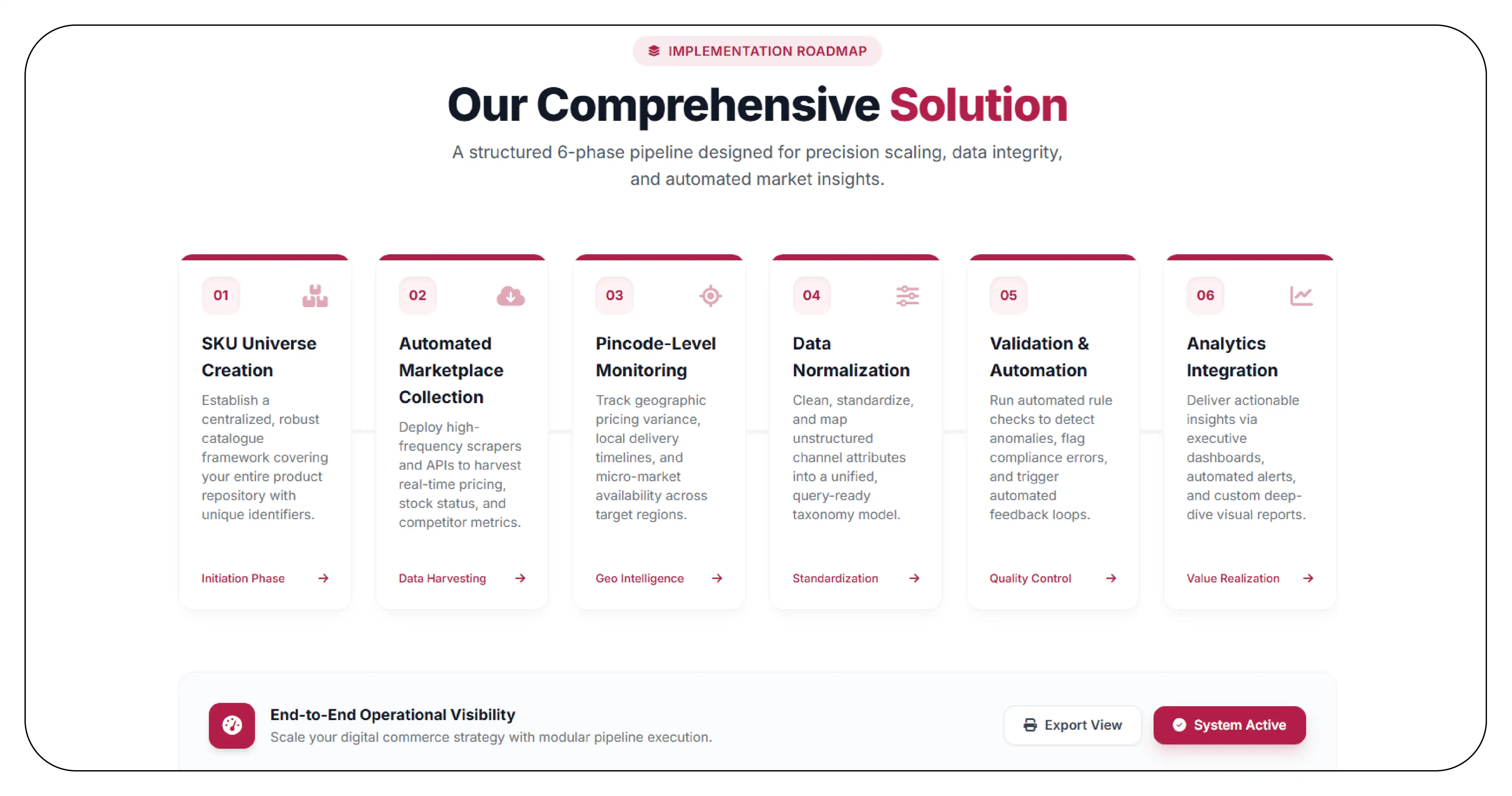
Product Data Scrape developed a phased solution to automate product availability collection and create a structured quick-commerce inventory intelligence framework.
Phase 1: SKU Universe Creation
The first phase focused on creating a comprehensive SKU universe. Priority categories included beverages, dairy, packaged foods, snacks, personal care, cleaning products, and household essentials. Products such as Coca-Cola, Pepsi, Amul, Nestlé, Maggi, Britannia, Lay's, Dove, Surf Excel, and Tata Salt were mapped using available product identifiers, names, brands, pack sizes, and categories. This ensured that monitoring was performed against a defined and repeatable product universe.
Phase 2: Automated Marketplace Collection
A scalable extraction framework was implemented to collect product information from Flipkart Minutes at scheduled intervals. The system captured product name, brand, SKU/product identifier, category, pack size, listed price, discount where available, availability status, pincode/service location, product URL, and collection timestamp. This created a structured dataset suitable for recurring monitoring.
Phase 3: Pincode-Level Monitoring
The next phase introduced location-specific monitoring. Selected pincodes were incorporated into recurring collection schedules to identify differences in availability. The system could distinguish between products that were consistently available, temporarily unavailable, or repeatedly out of stock in particular service areas.
Phase 4: Data Normalization
Collected information was standardized to make cross-location analysis reliable. Product names, brands, categories, units, pack sizes, and SKU identifiers were normalized. For example, different representations of a Maggi noodle pack or Coca-Cola multipack could be standardized to prevent duplicate records and improve product matching.
Phase 5: Validation and Automation
Automated validation rules checked for missing fields, duplicate SKUs, unexpected changes, incomplete responses, and inconsistent availability signals. Invalid or suspicious records were flagged for review. Recurring schedules minimized manual intervention and ensured that new observations were continuously added to the historical dataset.
Phase 6: Analytics Integration
The final datasets were integrated into analytics workflows to support availability dashboards, SKU-level monitoring, pincode comparisons, and historical trend analysis. This Quick-Commerce Inventory Data Scraping framework enabled the client to move from occasional manual checks to structured recurring monitoring. The implementation ultimately provided a scalable system for understanding where products were available, where gaps existed, and how inventory conditions changed over time.
Results & Key Metrics
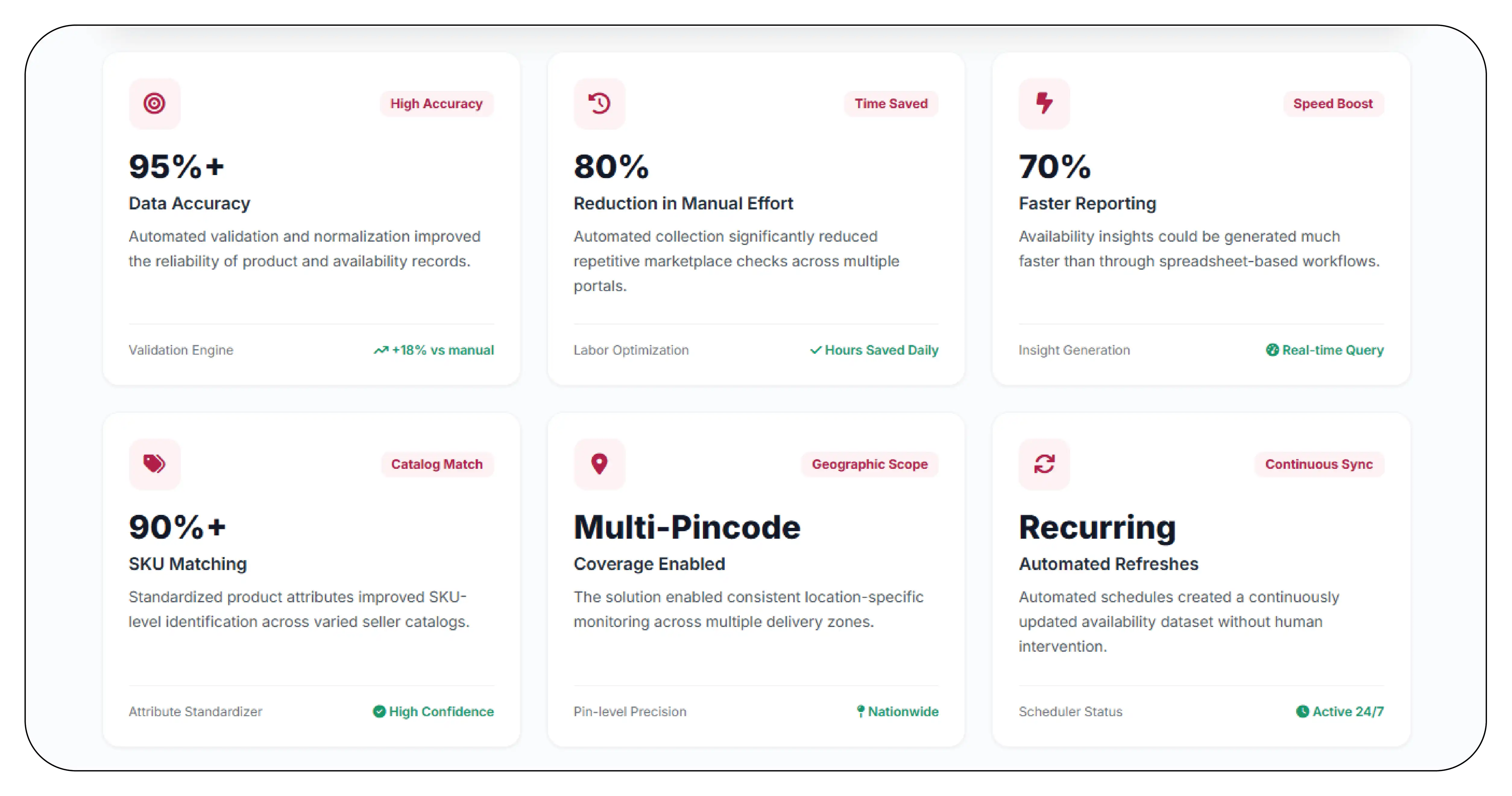
95%+ data accuracy: Automated validation and normalization improved the reliability of product and availability records.
80% reduction in manual effort: Automated collection significantly reduced repetitive marketplace checks.
70% faster reporting: Availability insights could be generated much faster than through spreadsheet-based workflows.
90%+ SKU matching: Standardized product attributes improved SKU-level identification.
Multi-pincode coverage: The solution enabled consistent location-specific monitoring.
Recurring refreshes: Automated schedules created a continuously updated availability dataset.
Results Narrative
The client gained actionable Flipkart Minutes Availability Intelligence across its priority products and service locations. Instead of relying on isolated manual checks, teams could identify recurring availability gaps and compare SKU performance across monitored pincodes.
The solution made it easier to understand whether products such as Amul, Coca-Cola, Maggi, Britannia, Lay's, Dove, and Surf Excel were consistently available or experiencing localized stockouts. Faster reporting also helped inventory and category teams investigate availability issues earlier.
By combining automated collection, validation, SKU matching, and location-level analysis, the organization established a more reliable foundation for digital inventory decisions. The new framework improved operational efficiency while making availability monitoring more scalable.
What Made Product Data Scrape Different
Product Data Scrape differentiated its approach by combining automated marketplace collection, SKU-level normalization, pincode-based monitoring, validation, and historical analytics within one workflow.
Its Flipkart Minutes Pincode-wise Price Tracking capabilities could be integrated with broader availability monitoring to help brands evaluate both inventory and pricing conditions at a local level. This created a richer understanding of digital shelf performance across service areas.
Smart scheduling reduced repetitive manual work while automated validation helped identify missing, duplicated, or inconsistent records. The architecture could also be expanded as the client added new SKUs, categories, or locations.
Most importantly, Flipkart Minutes Product Availability Tracking was treated as an ongoing intelligence process rather than a one-time data extraction exercise. This enabled the client to build historical visibility and respond more effectively to changing quick-commerce conditions.
Client's Testimonial
"Product Data Scrape transformed how our teams monitor marketplace inventory. Previously, understanding product availability across different service locations required repetitive manual checks and spreadsheet consolidation. The automated solution gave us structured visibility into SKU-level availability and helped us identify localized stock gaps much faster. The ability to support Assortment and availability monitoring across a large product portfolio has made our inventory discussions more data-driven. We can now investigate recurring availability issues, compare locations, and prioritize products that require attention. The solution has also created a scalable foundation for expanding our monitoring coverage as our quick-commerce strategy continues to grow."
— Head of Digital Commerce & Marketplace Intelligence, Leading FMCG Brand
Conclusion
Quick-commerce competition increasingly depends on whether products are visible and available when consumers are ready to purchase. Out-of-stock monitoring gives brands the ability to identify inventory gaps, understand recurring availability problems, and improve digital shelf performance.
For the client, the project created a scalable framework for monitoring product availability across Flipkart Minutes pincodes. Automated collection, SKU matching, validation, and recurring refreshes significantly improved data accuracy and reporting speed.
The implementation demonstrated how Flipkart Minutes Product Availability Tracking can transform fragmented marketplace signals into actionable inventory intelligence. With the framework in place, the organization can expand monitoring across more products, categories, pincodes, and quick-commerce channels while supporting faster and more informed inventory decisions.
FAQs
1. What is Flipkart Minutes product availability tracking?
It is the process of monitoring whether specific products or SKUs are available, unavailable, or experiencing stock-related changes across Flipkart Minutes service locations. Brands can use the data to understand digital shelf availability and identify inventory gaps.
2. Why is pincode-level availability important?
Quick-commerce inventory is often location-dependent. A product may be available in one pincode but unavailable in another because of local demand, dark-store inventory, or replenishment conditions. Pincode-level monitoring helps brands identify these localized differences.
3. Which product attributes can be collected?
Depending on marketplace accessibility, datasets can include product name, brand, SKU, category, pack size, price, discount, availability status, pincode, product URL, and timestamp. Products such as Coca-Cola, Amul, Maggi, Britannia, Lay's, Dove, and Surf Excel can be incorporated into the monitored product universe.
4. How can brands use availability data?
Brands can use availability data for inventory monitoring, replenishment planning, assortment management, stockout analysis, distribution optimization, marketplace performance measurement, and competitive intelligence.
5. Can availability monitoring be automated?
Yes. An automated workflow can collect data on a predefined schedule, normalize product information, validate records, maintain historical datasets, and feed results into dashboards or analytics systems. This reduces manual monitoring and enables teams to identify availability changes more quickly.


 Singapore
 EMAIL
EMAIL
 PHONE
PHONE












.webp)