Introduction
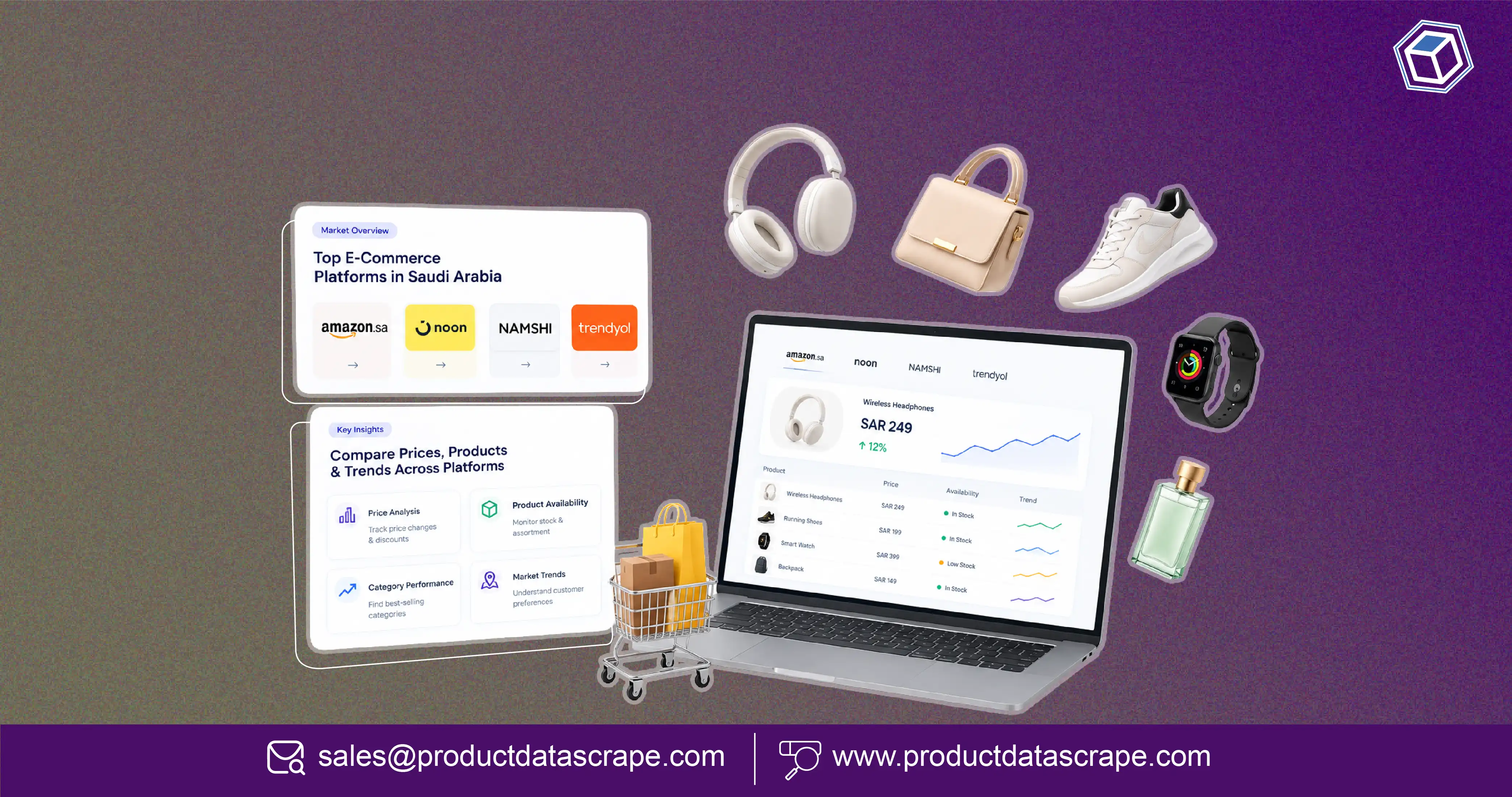
Saudi E-Commerce Market Intelligence 2026 helps brands, retailers, sellers, and market researchers compare products, prices, categories, availability, and competitive movements across Amazon.sa, Noon, Namshi, and Trendyol. E-commerce data scraping turns fragmented marketplace information into structured datasets that can be monitored and analyzed over time.
Saudi Arabia has a highly digital consumer environment. The Communications, Space and Technology Commission reported that 76.9% of internet users purchased products or services online in 2025, while 95.3% of online shoppers used local websites. Apparel and footwear were the most widely purchased category at 87.7% among online shoppers.
The market is also expanding on the business side. Saudi Arabia's Ministry of Commerce reported 43,854 e-commerce commercial registrations in 2025, compared with 40,041 in 2024.
For brands competing across several marketplaces, checking each platform manually creates fragmented information. One platform may show a different assortment, seller structure, price, discount, or availability position from another. A unified dataset makes these differences measurable.
The business objective is not simply to collect more marketplace records. It is to answer practical questions: Which platform carries the widest assortment? Where are price gaps appearing? Which products are discounted? Which categories are expanding? How does fashion pricing differ across marketplaces? Which products are consistently available?
How Can Cross-Marketplace Price Comparisons Improve Pricing Decisions?
Saudi E-Commerce Product Price Analysis helps brands and retailers compare the same or similar products across major online marketplaces. A structured price dataset can capture product name, brand, SKU or identifier, price, discount, availability, seller information where available, product URL, rating, review count, and timestamp.
The important distinction is between a current price and a historical pricing record. A single observation shows today's position. Recurring observations reveal whether a price is stable, promotional, volatile, or repeatedly adjusted.
Key Pricing Metrics
| Metric |
Business Use |
| Current price |
Current marketplace benchmark |
| Previous price |
Detect recent changes |
| Discount percentage |
Promotional comparison |
| Lowest observed price |
Identify price floors |
| Highest observed price |
Establish price range |
| Average price |
Benchmark typical pricing |
| Price gap |
Compare marketplaces |
| Availability |
Add supply context |
| Seller count |
Understand marketplace competition |
Amazon Saudi Arabia provides sellers with automated pricing capabilities, including tools that can respond to changes in the Featured Offer or lowest price. This demonstrates the importance of continuously understanding marketplace pricing conditions. Amazon Flipkart & Noon Third-Party Seller Data Scraping can help businesses monitor seller-level pricing, product availability, and competitive changes across major marketplaces, creating structured data for ongoing pricing analysis.
How Can Noon Data Reveal Product and Pricing Opportunities?
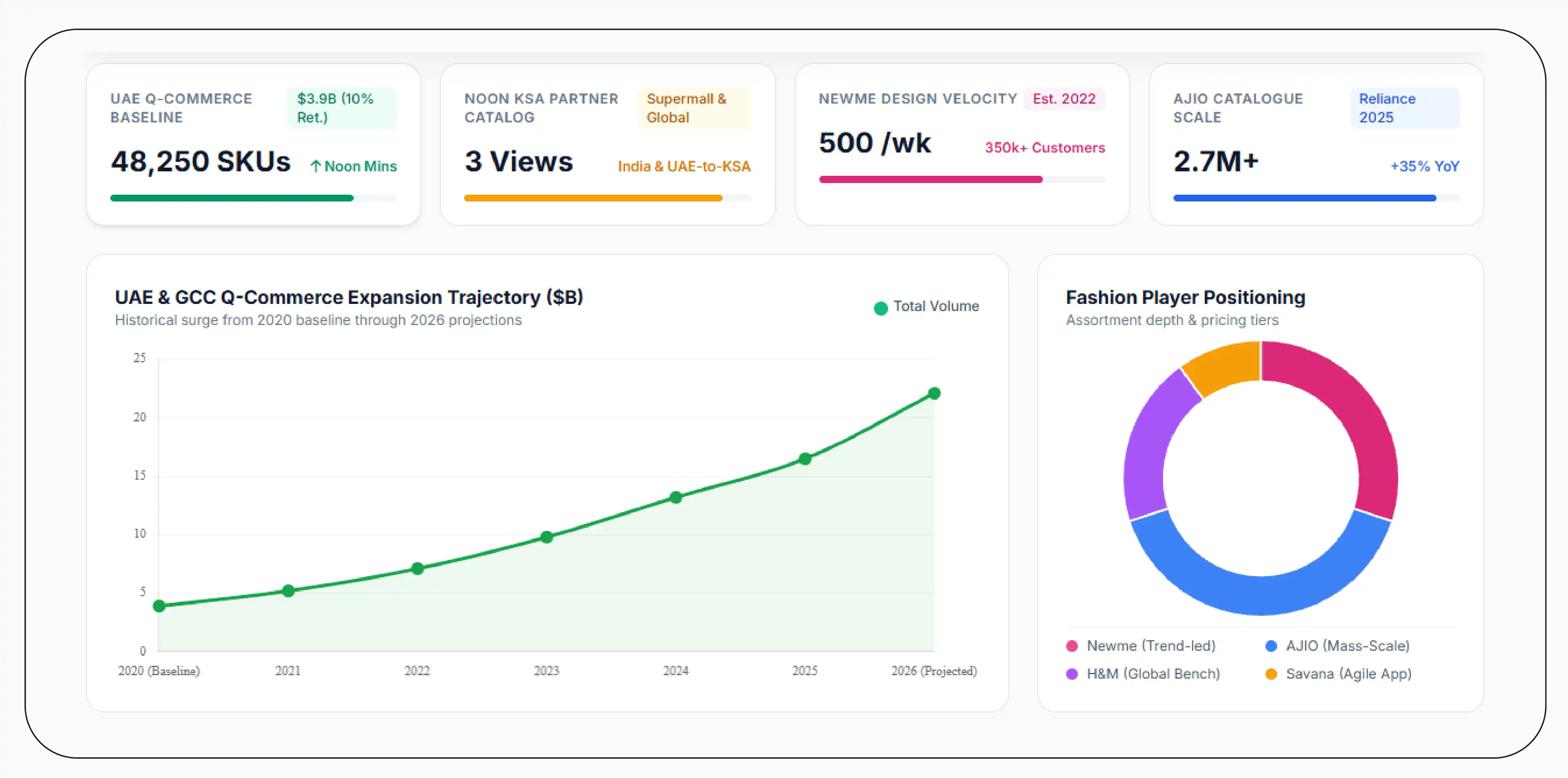
Noon Product Data Extraction Saudi Arabia can help businesses analyze product assortment, pricing, seller information, availability, ratings, reviews, and category structures on one of the region's major marketplaces.
Noon's official seller documentation shows that its Partner Catalog organizes seller SKUs into different catalog views, including noon, Supermall, and Global. Sellers can also search and filter their catalog inventory.
The platform also supports cross-border selling into KSA. Its Global Selling documentation identifies India-to-KSA and UAE-to-KSA selling programs, showing how sellers from other markets can participate in the Saudi marketplace.
Product Dataset Structure
| Data Point |
Example Purpose |
| Product name |
Product matching |
| Product ID/SKU |
Record identification |
| Brand |
Brand analysis |
| Category |
Category segmentation |
| Price |
Competitive benchmarking |
| Discount |
Promotion tracking |
| Availability |
Stock visibility |
| Seller |
Seller analysis |
| Rating |
Customer perception |
| Reviews |
Engagement context |
| Product URL |
Source traceability |
Noon also publishes category-specific seller fees. Its KSA FBN documentation, for example, lists different referral-fee structures across fashion, electronics, home, automotive, books, and other categories. These differences reinforce the value of category-level marketplace analysis because pricing decisions can occur within very different commercial structures.
How Can Fashion Marketplace Listings Be Compared More Effectively?
Scrape Trendyol Product Listings Saudi Arabia workflows can support fashion and lifestyle businesses that need to understand product assortment, prices, brands, discounts, ratings, reviews, and availability within the Saudi market.
Trendyol is particularly relevant to fashion analysis because apparel and footwear represent a major online shopping category in Saudi Arabia. CST's 2025 Internet Report found that 87.7% of online shoppers purchased apparel and footwear, making it the most commonly purchased product category in the report.
Fashion Intelligence Metrics
| Metric |
Why It Matters |
| Brand |
Brand-level benchmarking |
| Product category |
Assortment analysis |
| Product title |
Product matching |
| Price |
Pricing comparison |
| Discount |
Promotion monitoring |
| Color/size |
Variant availability |
| Rating |
Customer response |
| Review count |
Product engagement |
| Availability |
Stock monitoring |
| Product URL |
Record validation |
Fashion requires deeper product normalization than many other categories. A single item can have multiple sizes, colors, materials, styles, and promotional prices. Comparing only product titles may therefore create inaccurate marketplace comparisons. Scrape Real-Time Fashion Pricing Data from Namsh can help businesses capture current product variants, prices, discounts, and availability, enabling more consistent fashion marketplace comparisons and pricing analysis.
How Can Businesses Build a Unified View of Saudi Online Catalogs?
Scrape Saudi E-Commerce Catalog Data enables businesses to collect structured product information across categories and marketplaces. For teams that need faster access to standardized information, Buy Ready-to-Use Datasets can provide a prestructured alternative to building every collection workflow from scratch.
A catalog dataset can include product identifiers, titles, brands, categories, prices, discounts, availability, ratings, reviews, seller information, URLs, and timestamps.
Catalog Intelligence Framework
| Layer |
Data Examples |
| Product |
Name, identifier, attributes |
| Brand |
Brand name and category |
| Pricing |
Current/reference price |
| Promotion |
Discount indicators |
| Availability |
Stock status |
| Seller |
Seller information |
| Reviews |
Rating and count |
| Category |
Taxonomy and subcategory |
| Geography |
Saudi marketplace |
| History |
Timestamped observations |
Saudi Arabia's Ministry of Commerce reported 43,854 e-commerce commercial registrations in 2025, up from 40,041 in 2024. This expanding business base increases the importance of organized market visibility.
How Can Fashion and Marketplace Data Support Competitive Research?
Namshi Product Intelligence Saudi Arabia can help fashion brands and retailers analyze product assortment, pricing, discounts, availability, brands, ratings, and other marketplace signals. Combined with Saudi E-Commerce Market Intelligence 2026, this information can contribute to a broader view of competitive positioning.
Namshi is particularly relevant to fashion and lifestyle research. This category deserves attention because apparel and footwear represented 87.7% of online shopping purchases reported by Saudi Arabia's CST in 2025.
Competitive Fashion Dataset
| Intelligence Area |
Example Analysis |
| Brand coverage |
Compare brand presence |
| Product assortment |
Identify category depth |
| Price |
Benchmark comparable items |
| Discounts |
Monitor promotional activity |
| Availability |
Detect stock changes |
| Ratings |
Compare customer feedback |
| Reviews |
Measure engagement |
| Categories |
Identify assortment gaps |
| Variants |
Compare size/color availability |
How Can a Unified Intelligence Layer Support Saudi Retail Strategy?
Saudi Online Retail Market Intelligence brings product, pricing, assortment, seller, category, and availability information into a common analytical framework. A Scraper as a Service model can support businesses that need recurring collection without managing the entire technical infrastructure internally.
The value of a unified intelligence layer is consistency. A retailer can define a product universe once and monitor the same products across multiple marketplaces. Analysts can then compare observations using common fields.
Multi-Marketplace Intelligence Model
| Platform |
Primary intelligence |
| Amazon.sa |
Product, price, seller, review and availability analysis |
| Noon |
Catalog, seller, pricing and assortment analysis |
| Namshi |
Fashion assortment and pricing |
| Trendyol |
Fashion listings, pricing and assortment |
| Combined dataset |
Cross-marketplace benchmarking |
The CST's 2025 data shows that local websites accounted for 95.3% of online shopping, while apparel and footwear were purchased by 87.7% of online shoppers. This provides a strong reason for Saudi-focused brands to treat local marketplace data as a core market-intelligence input.
Why Choose Product Data Scrape?
Product Data Scrape supports marketplace data projects that require structured, repeatable, and analytics-ready information. The focus is on transforming product-level marketplace observations into datasets that can support pricing analysis, assortment research, competitive benchmarking, and market intelligence.
A scalable workflow can cover product discovery, field mapping, extraction, normalization, validation, duplicate management, timestamping, and historical storage. This approach helps businesses avoid fragmented spreadsheets and inconsistent manual research.
The dataset structure can be tailored to the target marketplaces, categories, brands, products, geographies, and business questions. Recurring collection can also support historical analysis instead of one-time snapshots.
For Saudi-focused research, the workflow can incorporate marketplace-specific requirements while maintaining common fields that make cross-platform comparison easier.
Conclusion
Amazon.ae Product Data Scraper workflows can provide useful regional product intelligence when businesses need to compare Gulf-market assortment and pricing alongside Saudi-focused marketplace data. For Saudi Arabia data projects, combining product, pricing, availability, seller, rating, review, and category information creates a stronger foundation for marketplace research.
The market is highly digital: 76.9% of Saudi internet users shopped online in 2025, while local websites accounted for 95.3% of online shopping.
Saudi E-Commerce Market Intelligence 2026 therefore requires recurring, structured, and comparable marketplace observations rather than isolated manual checks.
Product Data Scrape can build tailored datasets for brands, retailers, agencies, and researchers seeking cross-marketplace visibility.
You can also reach us for all your mobile app scraping, data collection, web scraping, and instant data scraper service requirements!
FAQs
1. What is Saudi e-commerce market intelligence?
It is structured information about Saudi online products, prices, sellers, availability, categories, and competitors used for market research, pricing, assortment, and strategic analysis.
2. Which marketplaces can businesses compare?
Businesses can compare Amazon.sa, Noon, Namshi, and Trendyol across products, prices, discounts, availability, ratings, reviews, and categories using standardized datasets.
3. How frequently should marketplace data be collected?
Collection frequency depends on the business objective. Fast-changing pricing may require daily monitoring, while assortment research can use weekly or monthly collection cycles.
4. Can Product Data Scrape provide Saudi marketplace datasets?
Yes. Product Data Scrape can structure marketplace datasets around selected products, categories, fields, marketplaces, locations, timestamps, and recurring collection requirements.
5. Why is historical marketplace data important?
Historical observations reveal price movements, assortment changes, promotional periods, and availability shifts that cannot be understood reliably from a single marketplace snapshot.


 Singapore
 EMAIL
EMAIL
 PHONE
PHONE


.webp)
.webp "thumb")
.webp "thumb")
.webp "thumb")









.webp)