Quick Overview
For an e-commerce brand expanding its product intelligence operations across Kazakhstan, Product Data Scrape developed a structured marketplace data workflow to collect, organize, validate, and analyze Taobao product information. The project focused on Taobao Product Catalog Data Scraping, helping the client monitor product names, categories, prices, SKUs, images, seller information, availability, and other relevant attributes. The service was designed for recurring data collection and analytics-ready delivery. Key impact areas included improved product-data coverage, faster refresh cycles, and better consistency across marketplace records, giving the client a more reliable foundation for pricing analysis, assortment decisions, and competitor monitoring.
Client Name / Industry: Confidential E-Commerce Retail Brand
Service / Duration: Taobao Product Data Collection & API Integration / Ongoing
Key Impact Metrics: Product-data coverage, data freshness, and record-level data accuracy
The Client
The client was an e-commerce retail brand operating in a competitive digital marketplace environment where product assortment, pricing, seller activity, and availability could change frequently. Its team was interested in using Taobao as an additional source of marketplace intelligence for product research, sourcing analysis, pricing comparisons, and assortment planning.
The pressure came from the speed at which online catalogs evolve. Product prices can change, sellers can modify listings, SKUs can vary, and product availability can shift. For a business evaluating hundreds or thousands of marketplace records, manually checking these changes creates unnecessary operational effort and makes historical comparison difficult.
The client therefore needed Taobao Product Trend Analysis Kazakhstan to understand how product categories, pricing patterns, seller activity, and assortment characteristics changed over time. Assortment and availability monitoring was also important because product presence alone does not provide enough information for commercial decision-making.
Before partnering with Product Data Scrape, the client relied heavily on manual product research and fragmented marketplace checks. Data was collected from different sources and formats, making normalization and comparison difficult. The absence of a recurring structured pipeline also meant that newly changed product attributes could be missed between manual checks.
The transformation required a scalable data process that could turn Taobao marketplace information into standardized records suitable for dashboards, spreadsheets, databases, and downstream analytics.
Goals & Objectives
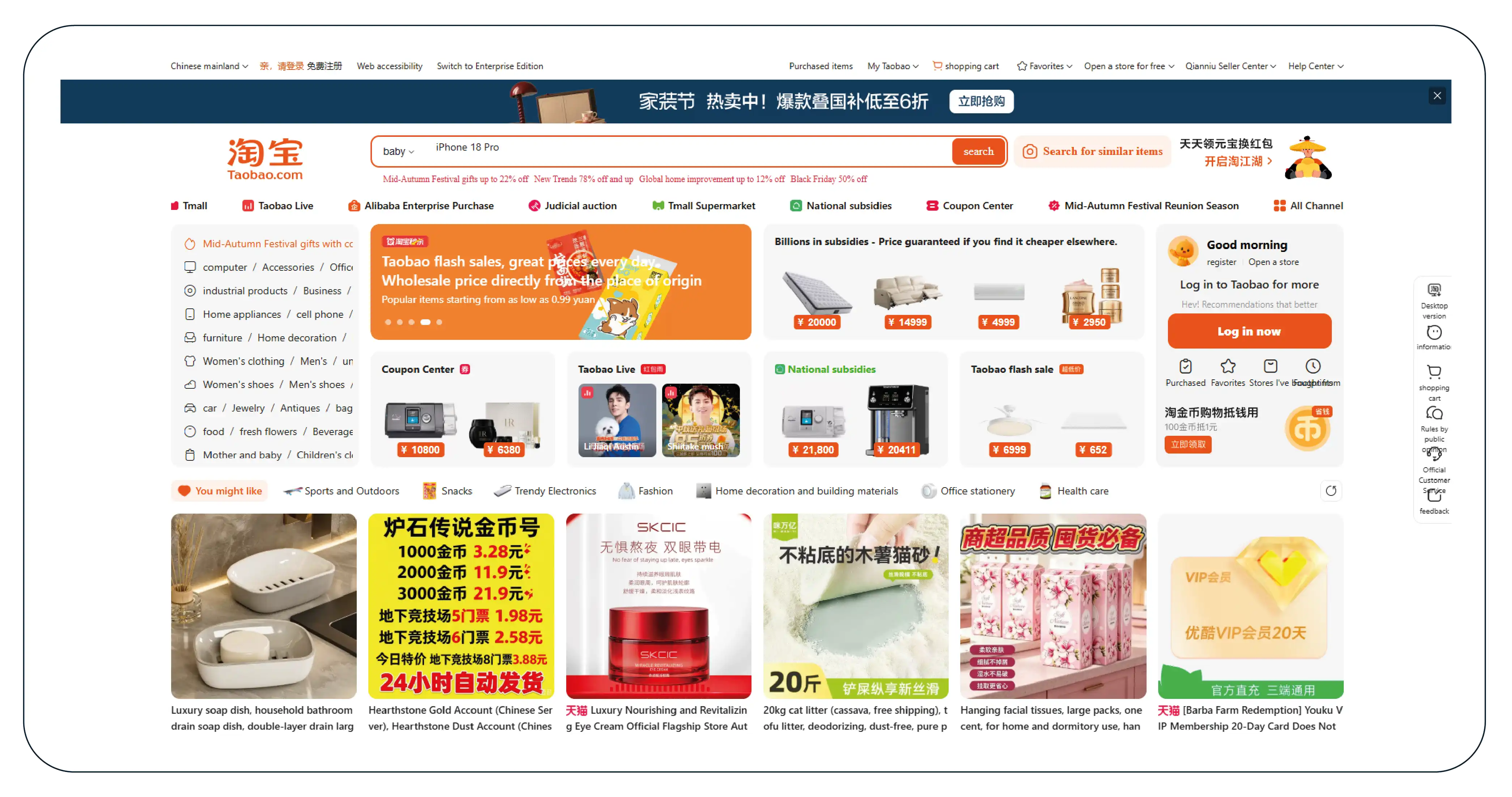
The project was designed around three priorities: scalability, speed, and accuracy. From a technical perspective, the client wanted an automated collection architecture capable of handling recurring requests while maintaining consistent product-level structures.
Build a scalable product-data collection workflow.
Improve the speed of marketplace data retrieval.
Increase consistency across product and seller records.
Support pricing, assortment, and availability analysis.
Create a reusable data foundation for future Kazakhstan-focused research.
Implement a structured Taobao Product Sourcing API Kazakhstan workflow for relevant product information.
Automate recurring product-data collection instead of depending on manual checks.
Normalize product attributes, categories, prices, SKUs, seller information, and URLs.
Create a data structure compatible with analytics and reporting systems.
Support Marketplace & Seller Intelligence through organized seller and listing attributes.
Enable data validation and duplicate detection before delivery.
Product-record completeness.
API response and collection success rate.
Data-refresh frequency.
Duplicate-record rate.
Attribute-level validation accuracy.
Processing time per collection cycle.
Availability of analytics-ready datasets.
The Core Challenge
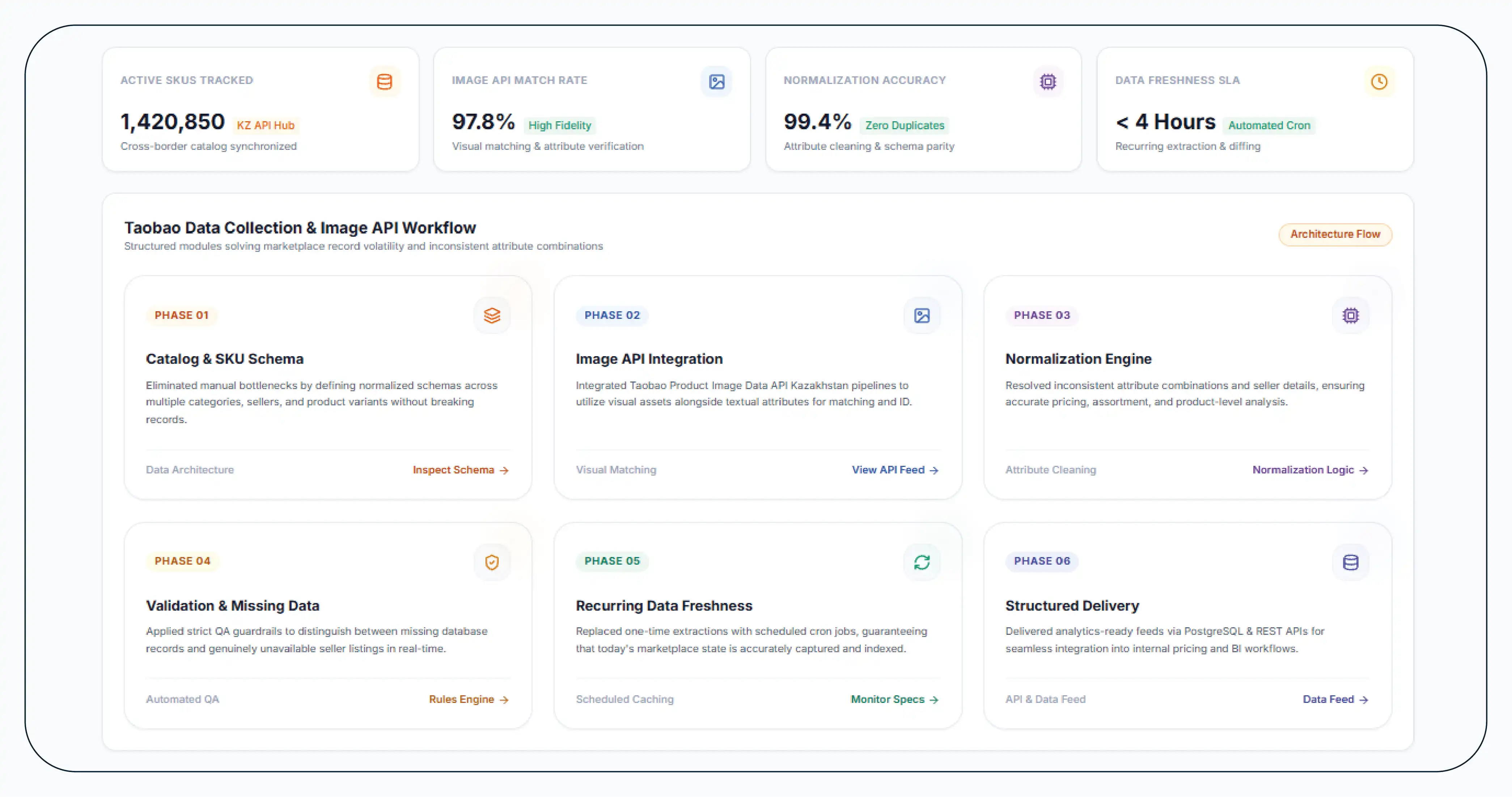
The client's biggest problem was not simply collecting Taobao product information; it was maintaining a dependable process as marketplace records changed. Manual collection created operational bottlenecks, particularly when teams needed to compare multiple categories, sellers, SKUs, and product variants.
The project also required careful handling of product images and related attributes. Taobao Product Image Data API Kazakhstan became relevant because product images could be used alongside textual product attributes for catalog research, visual matching, and product-level identification.
Another challenge was maintaining consistent product structures. Different listings could contain different attribute combinations, seller details, SKU structures, category information, or availability indicators. Without normalization, comparing one record against another could produce misleading results and weaken Commerce Intelligence across pricing, assortment, seller, and product-level analysis.
Data freshness was equally important. A dataset that accurately represents yesterday's product state may not accurately represent today's marketplace. The client therefore required recurring collection rather than a one-time extraction.
There was also a need to distinguish between missing data and genuinely unavailable information. The workflow had to preserve source-level fields where possible while applying validation rules to identify incomplete records, malformed values, duplicate products, and inconsistent formats.
These issues made automation, validation, scheduling, and structured delivery central to the project.
Our Solution
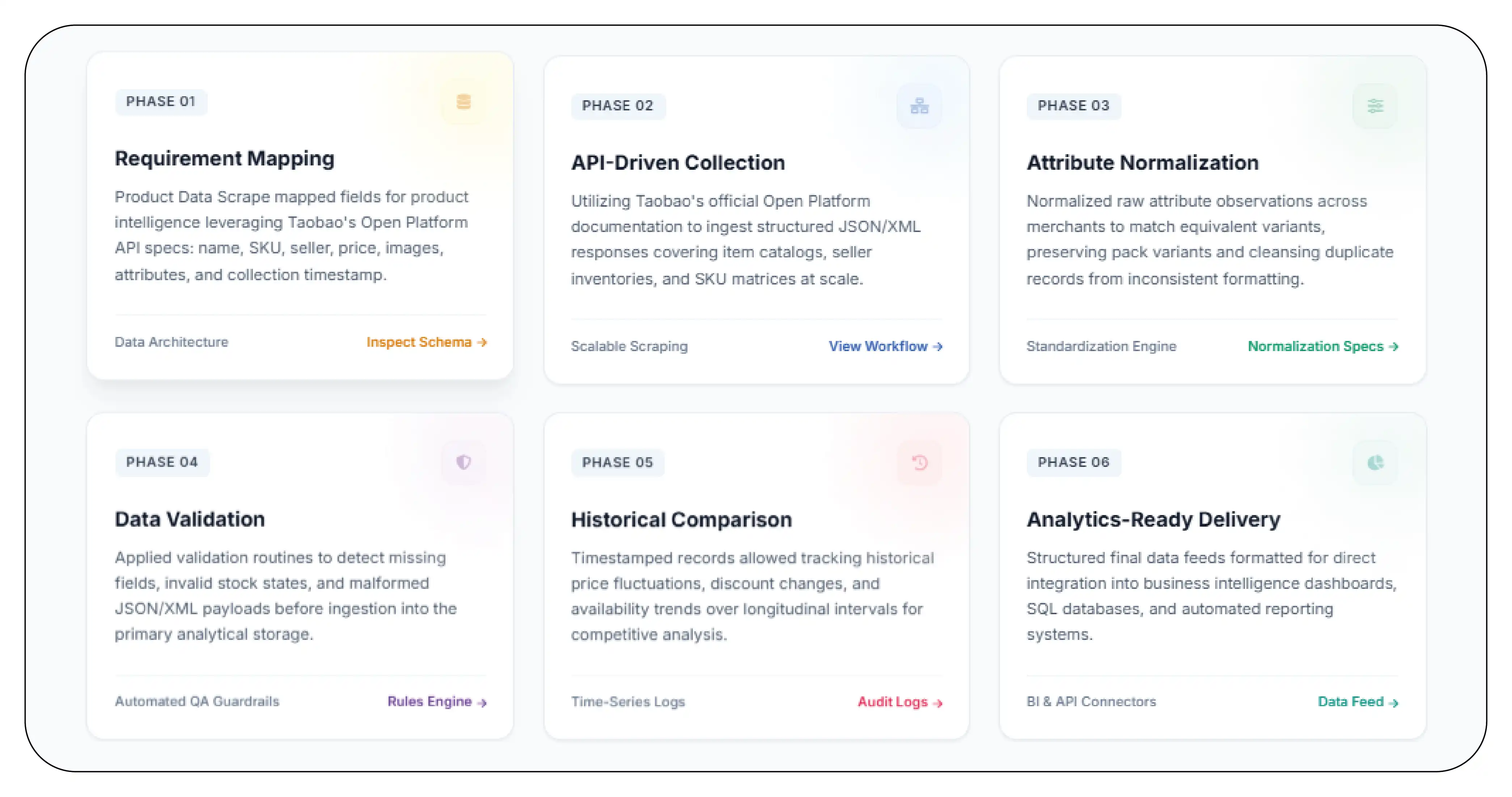
Product Data Scrape designed a phased data pipeline around the client's product intelligence requirements. Taobao's official Open Platform documentation describes API-based access to product-related information and supports structured responses such as JSON and XML. Its documentation also lists product, SKU, image, category, and item-related API capabilities.
Phase 1: Requirement Mapping
The first phase focused on defining the data schema. Product Data Scrape mapped the fields required for product intelligence, including product name, product ID/SKU, category, brand, seller/store, price, discount information where available, product images, product URL, availability/status, product attributes, and collection timestamp. This created a consistent structure before collection began.
Phase 2: API-Based Data Collection
The next stage established the automated collection workflow. Instead of depending on repeated manual searches, the pipeline was structured around API requests and defined product/category inputs. Taobao Product Availability Tracking Kazakhstan was incorporated into the workflow so the client could distinguish available products from records requiring further review. Taobao's API documentation indicates that API calls use defined parameters and can return JSON or XML responses, while the platform provides product and SKU-related interfaces.
Phase 3: Data Normalization
Raw marketplace responses were converted into a standardized schema. Prices were placed into consistent fields, product identifiers were normalized, category values were structured, and seller attributes were organized into comparable records. This step helped prevent problems such as duplicate columns, inconsistent naming, mixed data types, and fragmented SKU information.
Phase 4: Validation and Quality Control
Validation rules were applied to identify incomplete records, duplicate products, missing identifiers, malformed URLs, and inconsistent attributes. The system also separated valid records from exceptions so that data-quality issues could be reviewed without interrupting the broader collection workflow.
Phase 5: Recurring Automation
The final phase introduced scheduled collection cycles. Scrape Taobao Product Data API Kazakhstan became part of a repeatable workflow rather than a one-time data project. Each cycle could capture the latest available product information and append or update records according to the client's database logic. This provided a stronger foundation for price comparison, product trend analysis, seller research, and assortment monitoring. The resulting architecture could also support future integrations with dashboards, databases, business intelligence tools, and internal analytics systems.
Results & Key Metrics
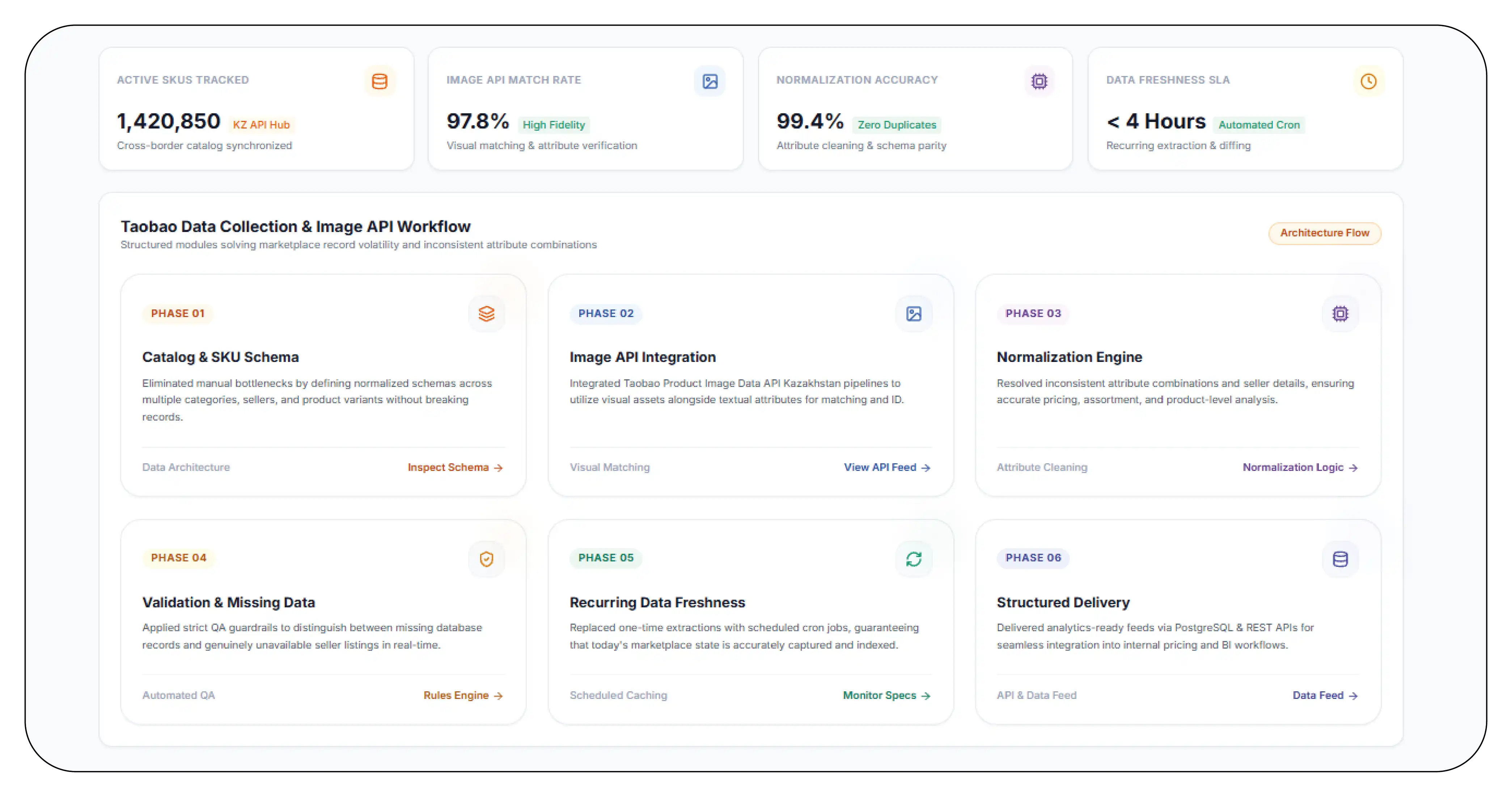
Data Coverage: Broader structured coverage across targeted Taobao product records and categories.
Data Freshness: Recurring collection improved the ability to work with recently retrieved marketplace information.
Data Accuracy: Validation and normalization reduced inconsistent formats and duplicate records.
Processing Efficiency: Automated collection reduced dependence on repetitive manual marketplace checks.
Analytics Readiness: Standardized fields made the dataset easier to connect with reporting and analytical workflows.
Results Narrative
The project gave the client a repeatable framework for Extract Taobao API for Kazakhstan E-Commerce requirements instead of relying on disconnected manual research. Product records could be collected, normalized, validated, and prepared for downstream analysis through a consistent workflow.
The primary improvement was operational: product intelligence became easier to refresh and compare. The client could use structured records for price monitoring, assortment research, seller analysis, product discovery, and availability reviews.
Scrape Taobao Product Data API Kazakhstan also created a scalable foundation for expanding the number of categories, products, sellers, or collection cycles without redesigning the entire data workflow.
What Made Product Data Scrape Different
Product Data Scrape combined API-oriented collection with data engineering, normalization, validation, and recurring automation rather than treating the project as a basic product extraction exercise. The workflow was designed around the client's analytical requirements, allowing raw marketplace information to become structured business data.
Global Market Analysis was supported through standardized product and seller records that could be filtered by category, brand, price, availability, and other attributes.
The solution also emphasized flexibility. New categories and fields could be incorporated into the schema as the client's intelligence requirements expanded. This made the pipeline suitable for ongoing marketplace research rather than a single static dataset.
Scrape Taobao Product Data API Kazakhstan ultimately provided a reusable foundation for product intelligence, pricing analysis, assortment monitoring, and marketplace research.
Client's Testimonial
"The structured marketplace data gave our team a much clearer way to work with Taobao product information. Instead of spending significant time checking listings manually, we could work with organized product, seller, pricing, and availability records. The recurring workflow also helped us maintain a more consistent view of marketplace changes and made our internal product research easier to scale."
— E-Commerce Intelligence Manager, Confidential Retail Brand
Conclusion
The project demonstrated how structured marketplace data can improve product research when collection, validation, and automation are designed together. By implementing E-commerce data scraping capabilities around the client's requirements, Product Data Scrape helped create a repeatable workflow for product, price, seller, assortment, and availability intelligence.
The resulting architecture can be expanded as the client's marketplace coverage grows, supporting additional categories, product attributes, sellers, and analytical use cases.
For brands seeking scalable marketplace intelligence, Scrape Taobao Product Data API Kazakhstan can provide a structured foundation for turning frequently changing product information into usable business datasets.
FAQs
1. What type of data can be collected from Taobao?
Depending on API access, permissions, and the specific endpoint, product-related information can include product IDs, titles, categories, SKU information, prices, images, seller information, product URLs, and other available attributes. Taobao's official documentation lists APIs for product, item, SKU, image, and category-related operations.
2. Can Taobao data be collected for Kazakhstan-focused analysis?
Yes. A collection workflow can be structured around the client's target products, categories, sellers, and business requirements for Kazakhstan market research. The final fields depend on the available source data, API permissions, and project scope.
3. How does API-based collection help e-commerce businesses?
API-based collection can reduce repetitive manual retrieval and provide a structured mechanism for requesting and processing data. Official Taobao documentation describes API requests, authorization requirements, structured responses, and multiple product-related interfaces.
4. Can the dataset support price and competitor monitoring?
Yes. A structured dataset containing product identifiers, prices, sellers, categories, and timestamps can support price comparisons, assortment analysis, seller monitoring, and historical marketplace research.
5. Can Product Data Scrape create recurring Taobao datasets?
Yes. Product Data Scrape can design recurring collection workflows based on the required categories, products, attributes, frequency, validation rules, and delivery format. The resulting dataset can be prepared for databases, dashboards, spreadsheets, or other analytics environments.


 Singapore
 EMAIL
EMAIL
 PHONE
PHONE


.webp "thumb")









.webp)