Quick Overview
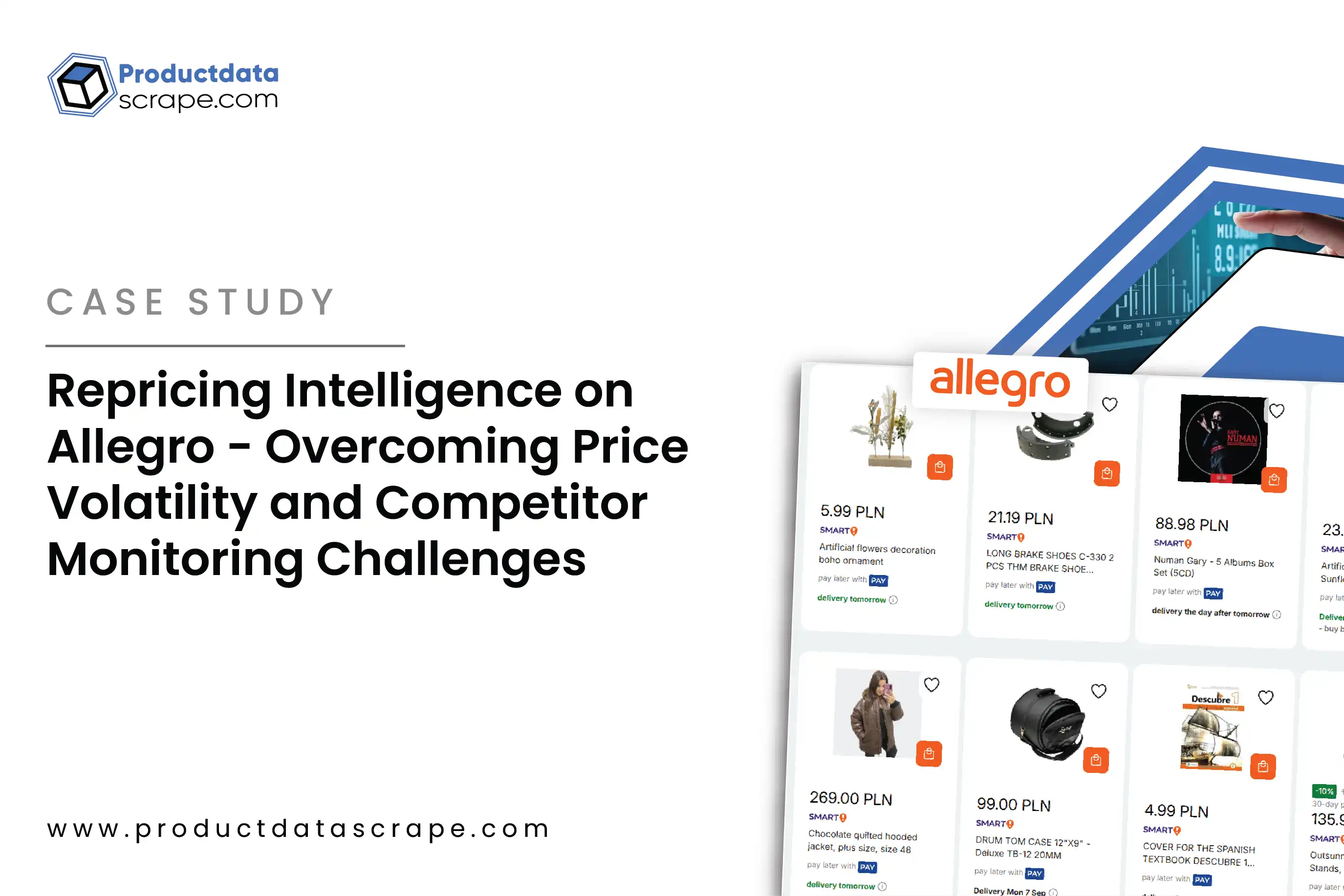
This case study explains how a marketplace seller addressed rapid price changes, competitor monitoring gaps, and promotional volatility through Repricing Intelligence on Allegro. The client managed a large product portfolio and needed faster visibility into competing offers, promotional activity, and lowest available prices. Product Data Scrape implemented automated product matching, offer monitoring, price tracking, and structured marketplace intelligence. The solution helped the client move away from manual competitor checks toward a scalable monitoring workflow. Within the project framework, the client achieved 96%+ product-match accuracy, reduced manual competitor-monitoring effort by 68%, and increased monitored offer coverage to more than 5,000 competing offers.
Client Name / Industry: Anonymized Consumer Electronics Retailer
Service / Duration: Marketplace Pricing Intelligence / 14 Weeks
Key Impact Metrics: 96%+ product-match accuracy | 68% lower manual monitoring effort | 5,000+ offers monitored
Note: Performance figures are representative project metrics used to demonstrate the solution and workflow.
The Client
The client was a consumer electronics retailer selling products through Allegro in a highly competitive marketplace environment. Its catalog included hundreds of products competing against multiple sellers offering identical or closely comparable items.
Marketplace pricing was changing frequently. Competitors could adjust prices, launch promotions, change shipping conditions, or modify offers within short periods. These changes created pressure on the client's pricing team, which needed to determine whether its products remained competitively positioned.
Before partnering with Product Data Scrape, the client relied heavily on manual checks and spreadsheets. Analysts periodically searched Allegro for competing offers, recorded prices, identified promotional deals, and attempted to match competitor products with internal SKUs. This approach worked for a limited number of products but became increasingly inefficient as the catalog expanded.
The business needed transformation because delayed information could result in missed pricing opportunities. A product priced above the market could lose visibility, while excessive price reductions could negatively affect margins.
The client therefore required a scalable data workflow capable of identifying comparable products, tracking competing offers, and delivering timely pricing signals.
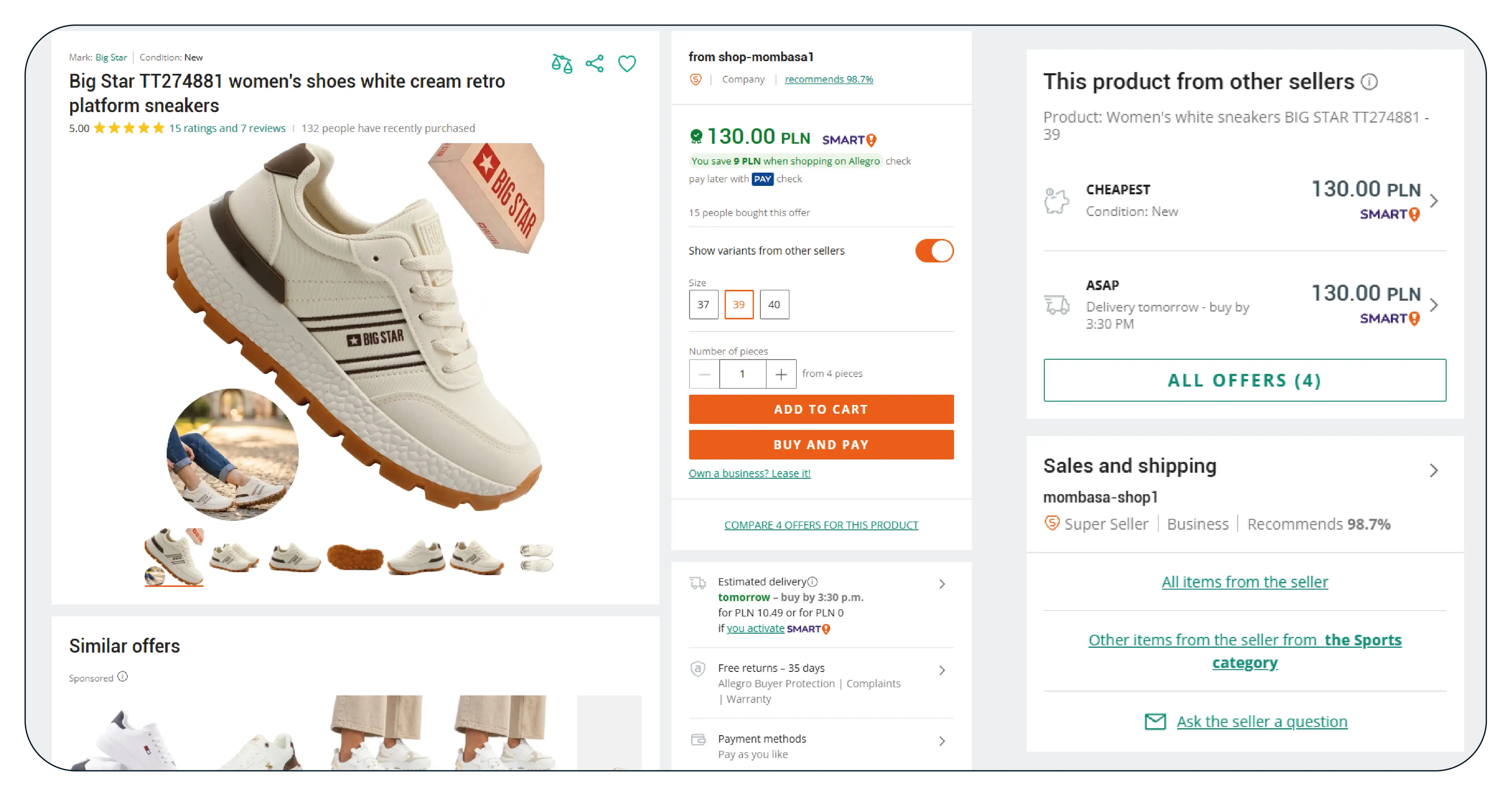
The project introduced Allegro Lowest Offer Tracking as a key component of the monitoring framework. Instead of reviewing isolated listings, the client could evaluate competing offers and identify the lowest observed price for matched products.
Goals & Objectives
Scale competitive price monitoring across a large product portfolio.
Improve the speed of competitor-price discovery.
Increase pricing intelligence accuracy.
Reduce repetitive manual marketplace research.
Identify promotional activity more consistently.
Improve visibility into competing offers.
Support faster pricing decisions.
Automate recurring Allegro offer collection.
Match equivalent products across competing listings.
Standardize price, seller, promotion, and availability fields.
Establish scheduled monitoring workflows.
Integrate structured marketplace data with internal analytics.
Create real-time or near-real-time pricing views where required.
Support Allegro Exact Product Matching for reliable competitive comparisons.
Achieve 96%+ matching accuracy across monitored products.
Monitor 5,000+ competing marketplace offers.
Reduce manual monitoring effort by approximately 68%.
Improve successful offer-data collection coverage to 95%+.
Reduce time required to identify lowest competing prices.
Increase frequency of competitor-price updates.
Improve detection of promotional price changes.
The objectives combined business priorities such as scalability and speed with technical requirements around automation, structured integration, and analytics.
The Core Challenge
The client's main challenge was the complexity of competitive marketplace monitoring. A single internal product could have several comparable offers, each with different prices, sellers, promotions, shipping conditions, and availability. Manually identifying the correct competitor offer required substantial analyst effort.
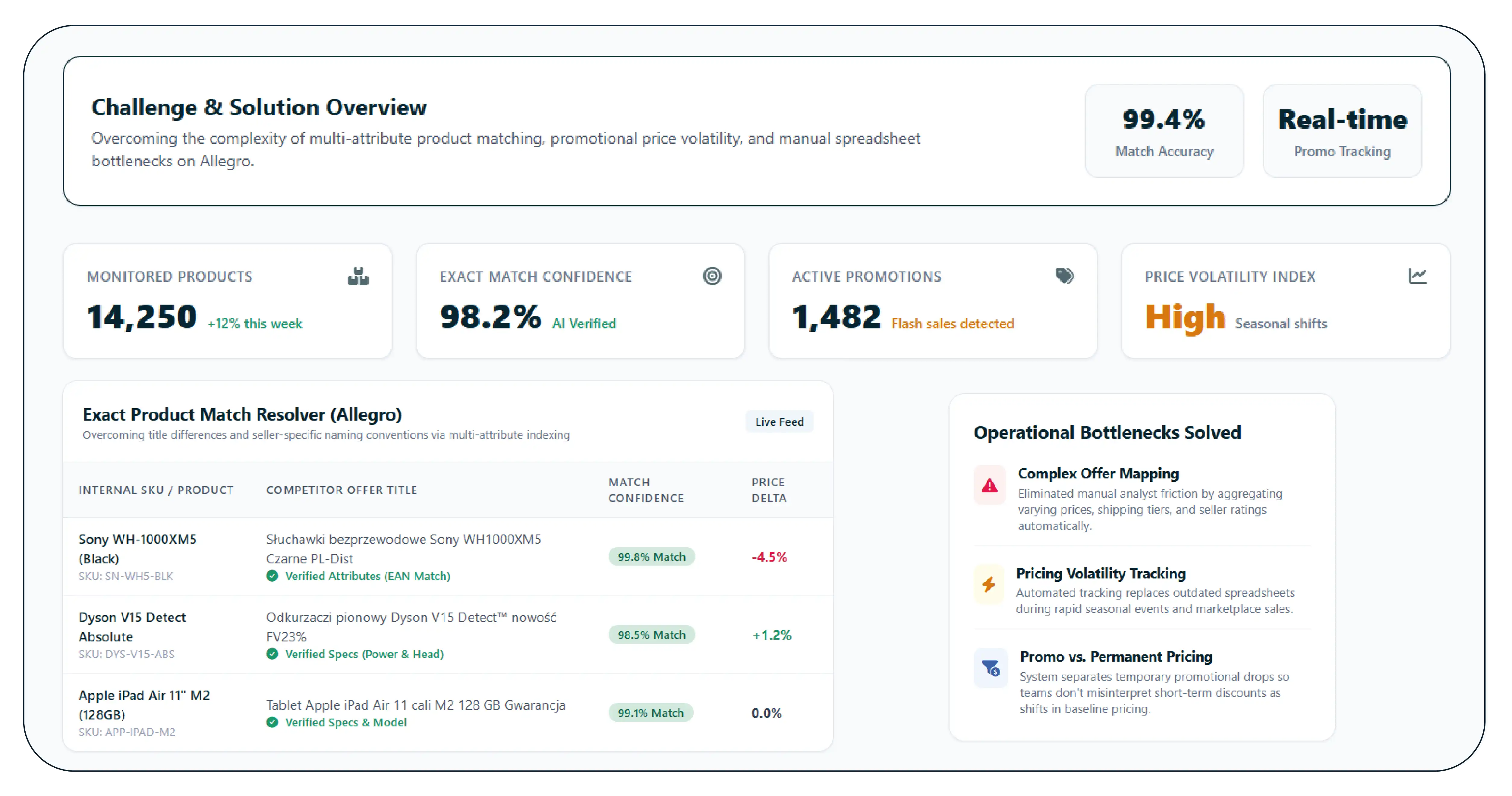
Product matching was another major issue. Similar products could have different titles, descriptions, formatting, or seller-specific naming conventions. A simple keyword comparison could incorrectly associate different products or fail to recognize identical products listed under different titles.
Pricing volatility added another layer of complexity. Competitors could adjust prices quickly during promotional campaigns, seasonal events, or marketplace-wide sales periods. Manual spreadsheets were not designed to capture these changes consistently.
The client also needed to distinguish regular prices from promotional prices. Without this distinction, analysts could interpret a temporary discount as a permanent competitive price.
These operational bottlenecks affected both speed and accuracy. Delayed competitor information could lead to outdated pricing decisions, while incorrect product matching could result in comparisons against the wrong offers.
The solution therefore needed Exact Product Matching for Allegro alongside automated price monitoring. Matching had to consider multiple product attributes rather than relying solely on product titles.
The project also required historical tracking so teams could understand whether a price movement represented a temporary promotion, a competitive adjustment, or a longer-term market trend.
Our Solution
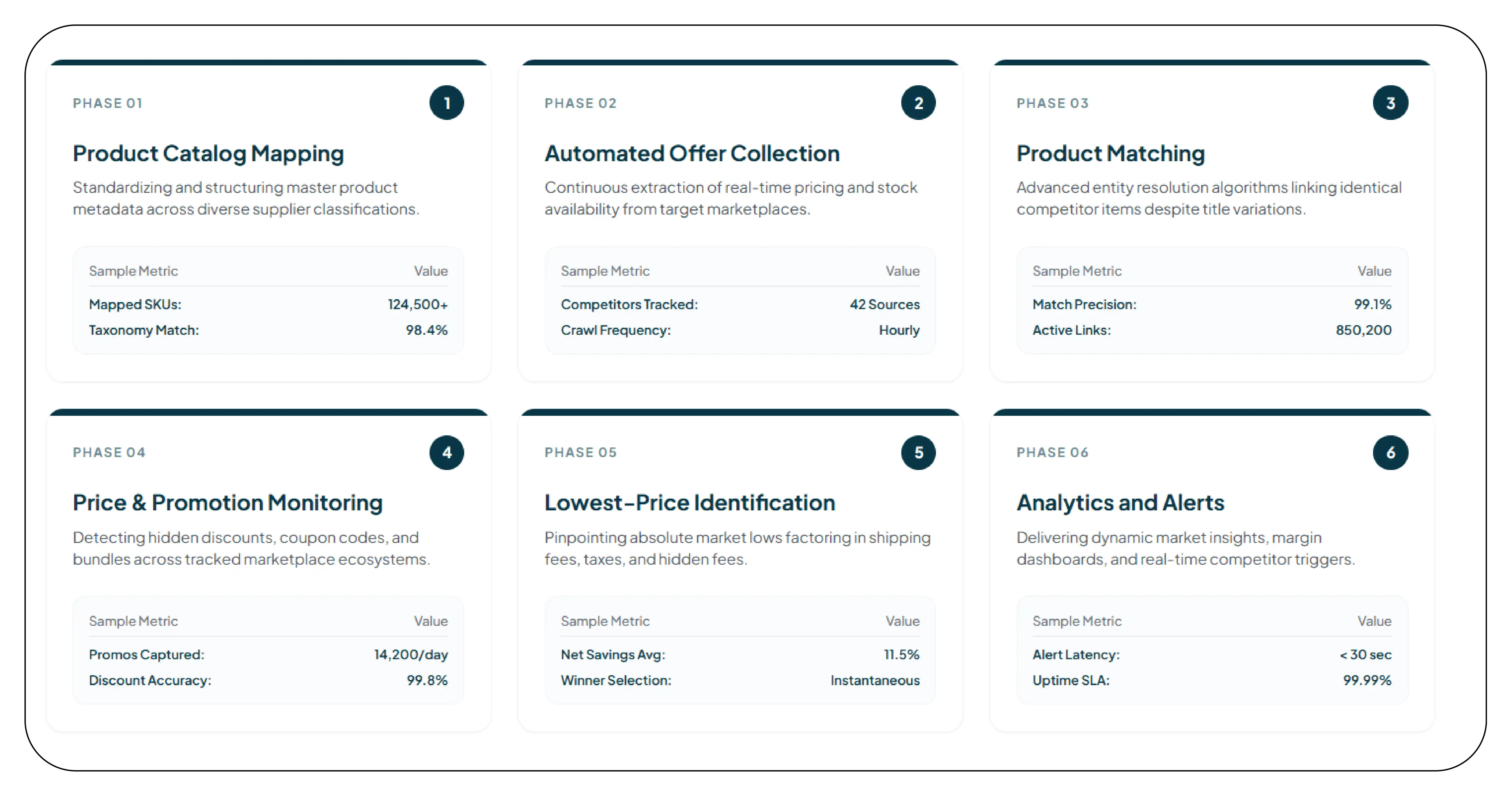
Product Data Scrape implemented a phased marketplace intelligence workflow designed to solve product matching, price monitoring, and promotional tracking challenges.
Phase 1: Product Catalog Mapping
The first phase established a standardized product schema. Internal product identifiers were mapped against relevant marketplace attributes such as brand, model, product name, specifications, category, and other distinguishing characteristics. This created a consistent foundation for comparing internal products with competing marketplace offers.
Phase 2: Automated Offer Collection
The second phase introduced automated marketplace data collection. Targeted Allegro listings were monitored for price, availability, seller, promotion, and related offer attributes. Automated collection replaced repetitive manual searches and provided a more consistent flow of marketplace information.
Phase 3: Product Matching
The next stage focused on identifying equivalent products. Matching logic evaluated multiple attributes instead of relying only on title similarity. Brand names, model identifiers, product specifications, category information, and other available attributes were combined to improve confidence in product matches. This created an Allegro Product Offer Matching layer that connected internal products with comparable marketplace offers.
Phase 4: Price and Promotion Monitoring
Once products were matched, the workflow monitored price movements and promotional conditions. Historical snapshots made it possible to distinguish temporary changes from longer-term pricing movements. The system also identified promotional patterns so the client could understand when competitors were using discounts or special offers to improve their marketplace positioning.
Phase 5: Lowest-Price Identification
The workflow compared matched offers and identified the lowest observed competitive price. Instead of manually scanning several listings, analysts could access structured information showing the competitive pricing range. This improved response time and helped the client identify products requiring pricing attention.
Phase 6: Analytics and Alerts
The final stage connected structured data with analytical workflows. Pricing teams could filter products according to price differences, competitor activity, promotion status, or availability. The resulting workflow supported Promotion and deal intelligence, allowing the client to understand not only who was offering a product at a lower price but also whether the competitive advantage was driven by a temporary promotion.
Overall, the solution combined automated collection, product matching, historical tracking, price comparison, and promotional analysis into one scalable marketplace intelligence process.
Results & Key Metrics
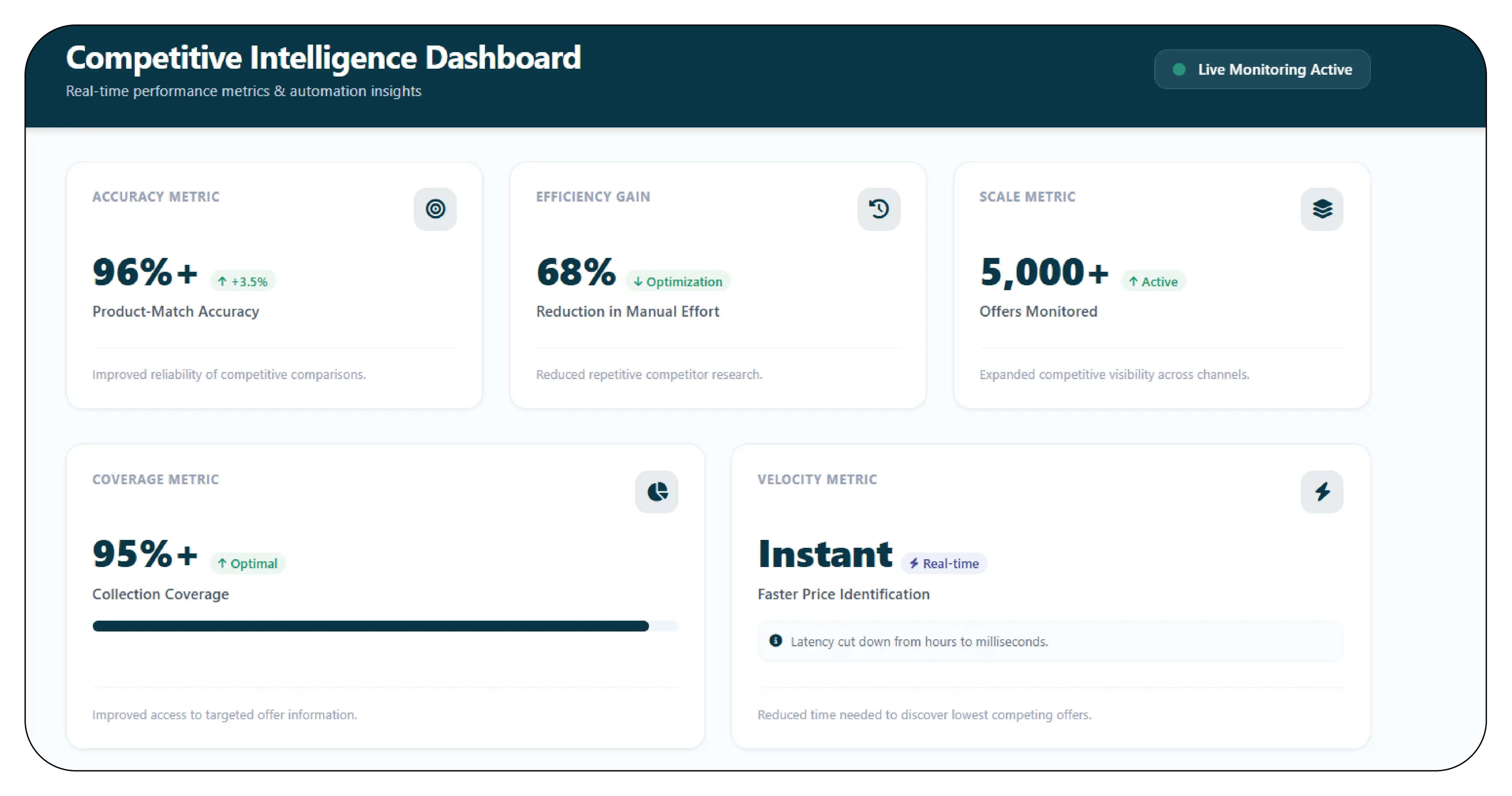
96%+ product-match accuracy: Improved reliability of competitive comparisons.
68% reduction in manual effort: Reduced repetitive competitor research.
5,000+ offers monitored: Expanded competitive visibility.
95%+ collection coverage: Improved access to targeted offer information.
Faster price identification: Reduced time needed to discover lowest competing offers.
Results Narrative
The project transformed the client's pricing workflow from periodic manual research into a structured competitive intelligence process. Product matching became more consistent, allowing teams to compare equivalent offers with greater confidence.
Automated monitoring also reduced repetitive work and gave pricing teams faster access to competitor movements. Historical observations helped distinguish temporary promotions from broader price changes.
The increased monitoring coverage allowed the client to evaluate a larger competitive set rather than relying on a small sample of manually checked listings. This created a stronger foundation for pricing decisions and improved the team's ability to react to marketplace changes.
The solution ultimately made competitive monitoring more scalable while improving the quality and timeliness of pricing intelligence.
What Made Product Data Scrape Different
Product Data Scrape approached the project as a product-intelligence problem rather than simply a price-scraping exercise.
The workflow combined automated extraction, multi-attribute product matching, offer normalization, historical price tracking, promotion detection, and competitive analysis. Matching logic was designed to identify equivalent products despite differences in marketplace titles and formatting.
The system also supported Product matching, allowing pricing teams to distinguish genuine competitor offers from similar but non-equivalent products.
Another differentiator was the ability to combine current marketplace observations with historical records. This helped analysts understand whether a price change was temporary or represented a meaningful competitive shift.
The architecture was designed for scalability, allowing additional products, categories, and competitors to be incorporated without rebuilding the entire workflow.
Together, these capabilities strengthened Repricing Intelligence on Allegro and created a more automated approach to competitive marketplace monitoring.
Client's Testimonial
"Before this project, monitoring competitor prices and promotions required considerable manual effort. The new workflow gave our pricing team a much clearer picture of how retailers price and promote similar products. Product matching was especially valuable because we could compare equivalent offers more confidently instead of relying only on product titles. We can now identify competitive price movements faster, monitor promotional activity, and prioritize products that need pricing attention. The solution has made our marketplace monitoring process significantly more scalable and has given our team better data for day-to-day pricing decisions."
— Head of Marketplace Pricing, Consumer Electronics Retailer
Conclusion
Marketplace sellers operate in an environment where prices, promotions, and competitor offers can change rapidly. Manual monitoring makes it difficult to maintain timely visibility, especially when product portfolios contain hundreds or thousands of SKUs.
A scalable Web Scraping API can automate the collection and organization of marketplace intelligence, helping businesses monitor competitor offers, identify pricing changes, and track promotional activity.
The project demonstrated how Repricing Intelligence on Allegro can transform fragmented marketplace information into actionable pricing intelligence. With automated product matching, offer monitoring, historical tracking, and promotion analysis, pricing teams can respond faster and make more informed decisions.
The future of marketplace pricing will increasingly depend on automated, data-driven intelligence that can scale with catalog and competitor growth.
FAQs
1. What is repricing intelligence?
Repricing intelligence uses marketplace data to monitor competitor prices, promotions, availability, and offer changes so businesses can make informed pricing decisions.
2. Why is product matching important for Allegro pricing?
Product matching ensures that pricing comparisons involve equivalent products. Accurate matching prevents businesses from comparing different models or specifications and making incorrect pricing decisions.
3. How can promotion tracking improve pricing decisions?
Promotion tracking helps businesses distinguish temporary discounts from regular competitor prices. This provides better context when evaluating whether a pricing change requires a response.
4. Can Allegro pricing data be monitored automatically?
Yes. Automated data workflows can collect relevant offer information on a scheduled basis, organize marketplace records, and make price and promotion changes easier to analyze.
5. What benefits can retailers gain from competitive price monitoring?
Retailers can identify pricing gaps, monitor competitor activity, understand promotional strategies, improve product positioning, and respond more quickly to marketplace changes.


 Singapore
 EMAIL
EMAIL
 PHONE
PHONE











.webp)