Introduction
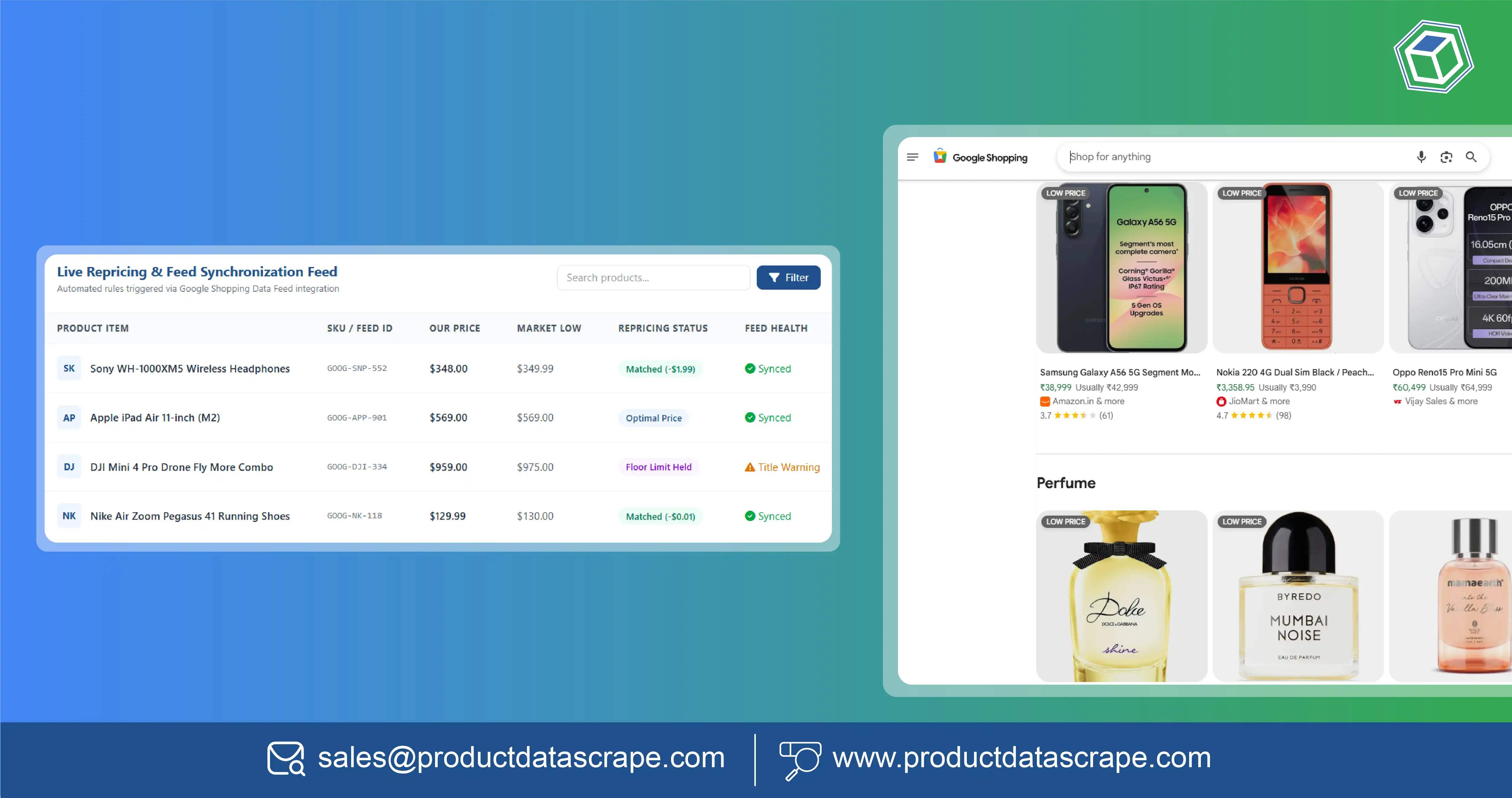
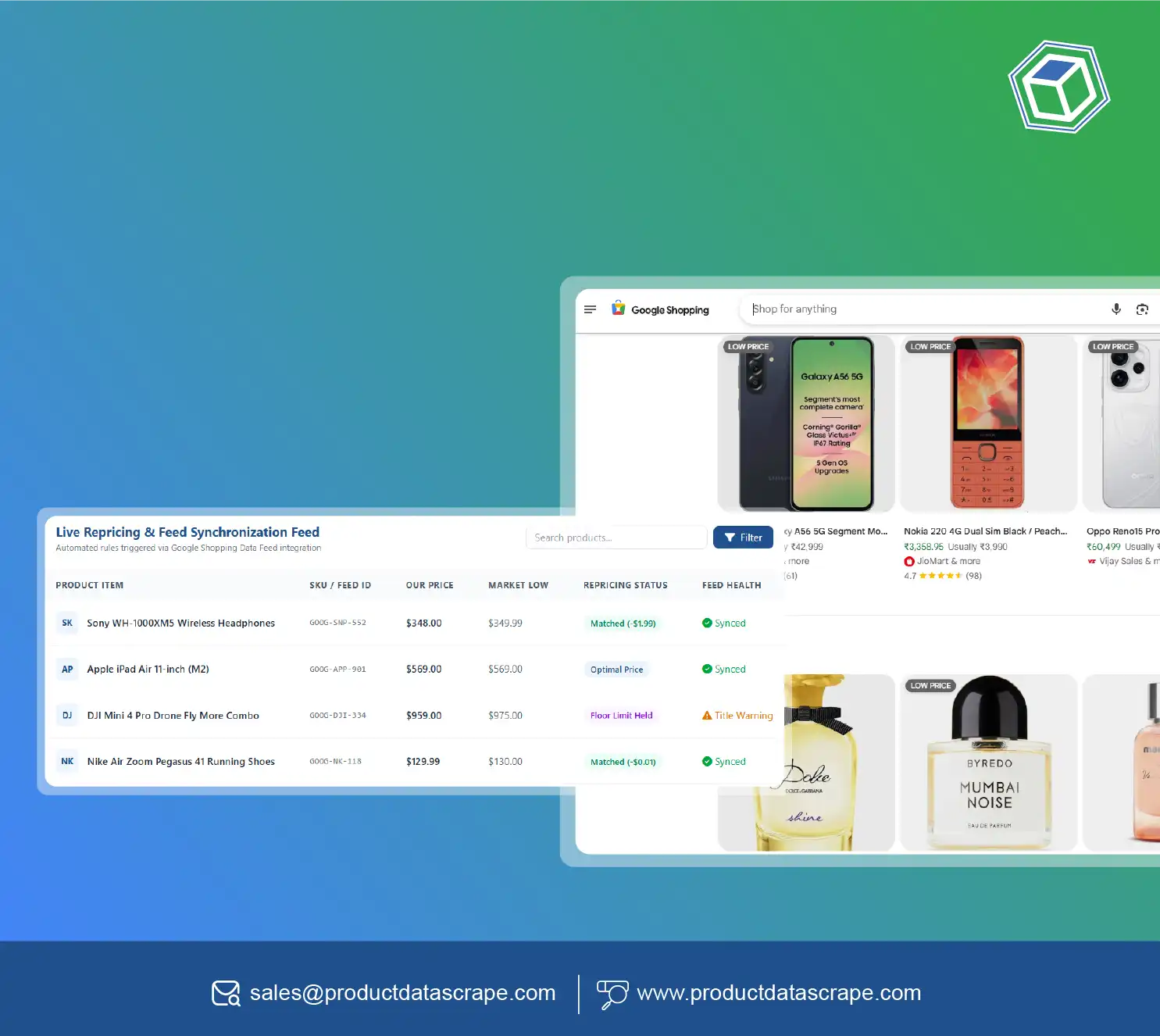
Price Matching Repricing and Google Shopping Data Feed helps e-commerce brands connect competitor price monitoring, automated repricing, product matching, and shopping-feed optimization into one data-driven workflow. Businesses can compare competitor prices, identify pricing gaps, adjust product prices, and maintain accurate product information for better marketplace visibility.
Online shoppers increasingly compare prices before purchasing. A small price difference can influence which retailer receives the sale. At the same time, Google Shopping results depend on accurate product information, competitive pricing, availability, and feed quality.
This makes Product matching an important part of competitive pricing. Businesses must ensure that the product they compare against a competitor is genuinely equivalent. Brand, model, size, color, pack count, specifications, and variant attributes can all affect the comparison.
A structured pricing workflow can monitor:
- Competitor product prices.
- Current selling prices.
- MRP and discount levels.
- Product availability.
- Product identifiers.
- Google Shopping feed attributes.
- Competitor price gaps.
- Repricing thresholds.
- Historical price movements.
- Product visibility signals.
Illustrative Monitoring Scale (2020–2026)
| Year |
Illustrative Products Monitored |
Competitors Compared |
Price Observations/Month |
| 2020 |
1,000 |
3 |
5,000 |
| 2021 |
2,000 |
4 |
12,000 |
| 2022 |
5,000 |
5 |
30,000 |
| 2023 |
10,000 |
7 |
75,000 |
| 2024 |
25,000 |
10 |
200,000 |
| 2025 |
50,000 |
15 |
500,000 |
| 2026 |
100,000+ |
20+ |
1,000,000+ |
The figures are illustrative benchmarks designed to show how a pricing-monitoring program can scale.
The objective is not simply to become the cheapest seller. Businesses can use pricing data to maintain a competitive position while protecting margins. Automated data collection also reduces repetitive manual checks and gives pricing teams more time to focus on strategy.
How Can Businesses Match Competitor Prices in Real Time?
Price matching becomes difficult when retailers sell thousands of products across multiple competitors. Product catalogs may use different titles, descriptions, SKUs, images, and specifications.
Real-Time Price Matching Solutions can automate the process of identifying comparable products and monitoring their prices. The system can collect competitor pricing at defined intervals and compare it with a retailer's own catalog.
E-commerce data scraping can provide structured product and pricing information from relevant online sources. The resulting dataset can contain product names, prices, discounts, availability, product URLs, brand information, and timestamps.
A typical workflow looks like this:
Retailer Product → Product Match → Competitor Product → Price Comparison → Pricing Rule → Action
Illustrative Monitoring Scale (2020–2026)
| Year |
Illustrative SKUs |
Price Checks/Month |
Matching Focus |
| 2020 |
1,000 |
5,000 |
Basic product matching |
| 2021 |
2,000 |
12,000 |
SKU comparison |
| 2022 |
5,000 |
30,000 |
Competitor pricing |
| 2023 |
10,000 |
75,000 |
Automated matching |
| 2024 |
20,000 |
150,000 |
Multi-store monitoring |
| 2025 |
40,000 |
350,000 |
Dynamic price analysis |
| 2026 |
75,000+ |
750,000+ |
Near-real-time monitoring |
These figures are illustrative.
Accurate product matching is critical. Consider two laptops with similar names but different RAM, storage, or processor configurations. A simple name-based match could create an incorrect pricing comparison.
A stronger matching system can consider multiple attributes.
Businesses can also define price rules. For example, a retailer may want to remain 2% below a selected competitor but never reduce the price below a minimum margin threshold.
Another retailer may choose to match competitor prices only when the competitor has the same product in stock.
This creates a smarter approach to price matching.
Historical data also helps businesses understand competitor behavior. Teams can identify which competitors change prices frequently and which maintain stable pricing.
The resulting intelligence supports faster and more controlled pricing decisions.
How Can AI Improve Automated Repricing Decisions?
Repricing involves more than changing a product price whenever a competitor changes theirs. Businesses need to consider margins, inventory, demand, competitor behavior, product popularity, and pricing rules.
AI-Powered Repricing Intelligence can help businesses evaluate multiple pricing signals before recommending or applying a price adjustment.
An intelligent repricing workflow can consider:
- Competitor price.
- Current selling price.
- Minimum margin.
- Inventory level.
- Product demand.
- Competitor availability.
- Historical pricing.
- Promotional periods.
- Sales velocity.
- Business pricing rules.
Illustrative Repricing Scale (2020–2026)
| Year |
Illustrative Products |
Repricing Decisions/Month |
Intelligence Level |
| 2020 |
500 |
1,000 |
Rule-based |
| 2021 |
1,000 |
3,000 |
Automated rules |
| 2022 |
2,500 |
10,000 |
Multi-factor pricing |
| 2023 |
5,000 |
25,000 |
Predictive analysis |
| 2024 |
12,000 |
75,000 |
AI-assisted |
| 2025 |
25,000 |
200,000 |
Automated intelligence |
| 2026 |
50,000+ |
500,000+ |
Advanced repricing |
These are illustrative figures.
AI can help identify pricing patterns. For example, a competitor may frequently lower prices during specific periods. A system can recognize this pattern and help the retailer prepare an appropriate response.
Inventory is another important variable.
A retailer with limited stock may not want to match a competitor's aggressive discount. A retailer with excess inventory may have more flexibility to reduce price.
The objective should therefore be optimized pricing rather than simply minimum pricing.
Businesses can establish guardrails. A repricing system can prevent prices from falling below a defined margin or moving beyond an approved range.
AI can also prioritize products. High-revenue or highly competitive SKUs may receive more frequent monitoring than low-priority products.
This creates an efficient pricing workflow.
The result is a balance between competitive positioning and profitability.
How Can Google Shopping Data Help Brands Optimize Product Visibility?
Google Shopping gives consumers a direct way to compare products, prices, retailers, and offers. Accurate product information and competitive pricing can therefore influence how products appear in shopping experiences.
Google Shopping Pricing Analytics can help businesses evaluate their product pricing alongside competitor information.
A useful dataset can include product title, brand, category, price, sale price, availability, product identifiers, seller information, and timestamps.
Businesses can compare their own prices with competing offers and identify pricing gaps.
Illustrative Shopping Data Scale (2020–2026)
| Year |
Illustrative Products |
Shopping Records/Month |
Main Objective |
| 2020 |
1,000 |
3,000 |
Product comparison |
| 2021 |
2,000 |
7,000 |
Price benchmarking |
| 2022 |
5,000 |
20,000 |
Competitive analysis |
| 2023 |
10,000 |
50,000 |
Shopping intelligence |
| 2024 |
20,000 |
125,000 |
Feed optimization |
| 2025 |
40,000 |
300,000 |
Automated analysis |
| 2026 |
75,000+ |
750,000+ |
Continuous monitoring |
These figures are illustrative.
Price is only one component of shopping visibility. Product information must also remain accurate and consistent.
Incorrect product titles, outdated prices, unavailable products, or mismatched variants can reduce the quality of the shopping experience.
Pricing analytics can identify discrepancies between a retailer's internal catalog and its external shopping information.
For example, a retailer may update a website price but fail to reflect the same value in its product feed. A monitoring system can identify the difference.
Historical analysis can also show whether price changes correlate with improved competitive positioning.
Businesses can monitor the percentage of products priced above, below, or near selected competitors.
This creates a practical pricing benchmark.
Google Shopping data can also support category analysis. Teams can identify categories with intense price competition and categories where pricing remains relatively stable.
The information can then guide repricing priorities.
When combined with accurate product data, pricing analytics becomes part of a broader digital commerce strategy.
How Can Retailers Compare Prices Across Multiple Stores?
Customers rarely compare products within only one store. They may check several retailers before making a purchase.
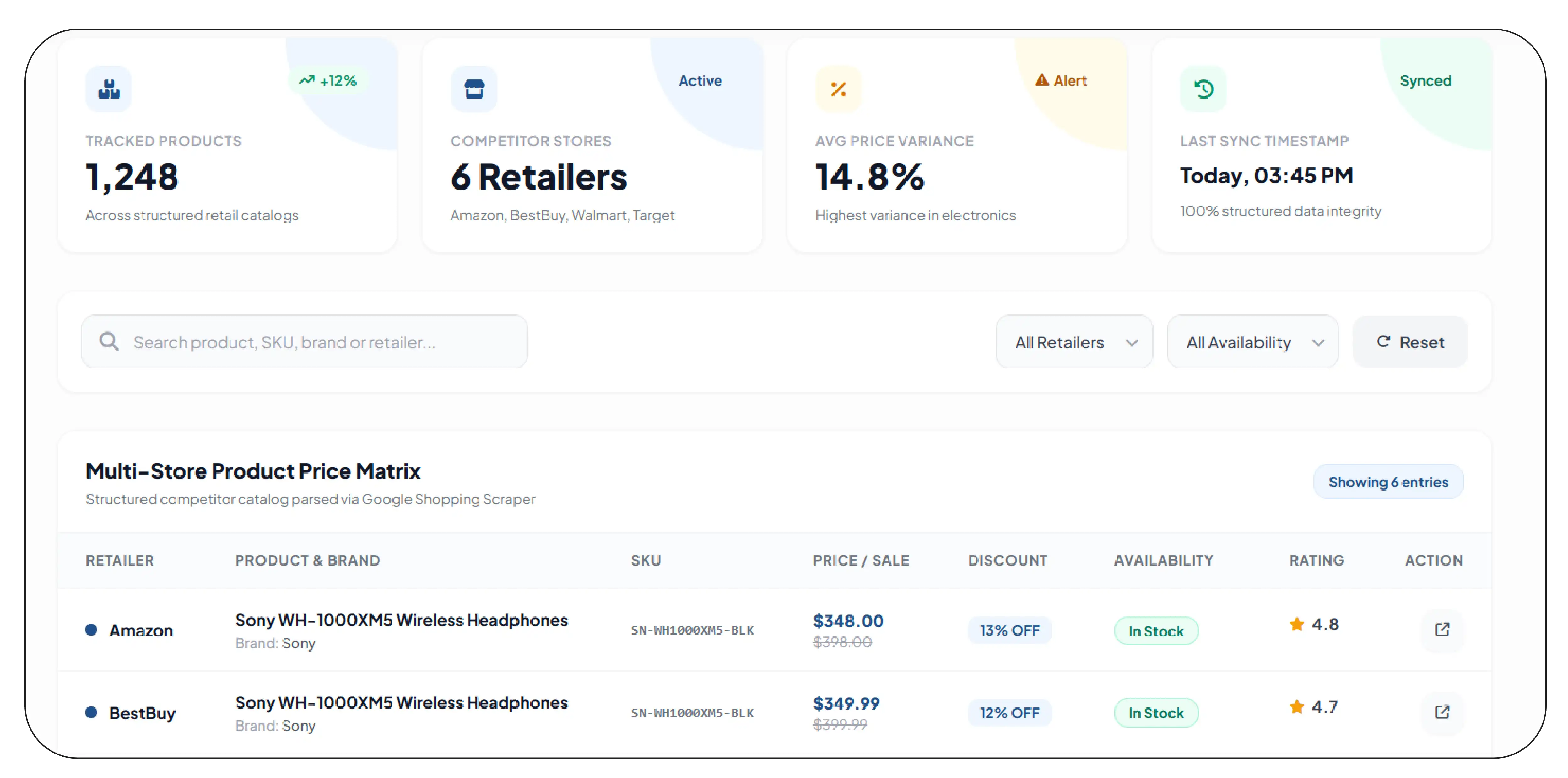
Multi-Store Price Matching helps retailers compare their products against several competitors rather than relying on one reference price.
A Google Shopping Product Data Scraper can help collect structured product information for comparison and analysis where applicable.
A multi-store dataset can include:
- Retailer.
- Product.
- Brand.
- SKU.
- Price.
- Sale price.
- Discount.
- Availability.
- Rating.
- Product URL.
- Timestamp.
Illustrative Multi-Store Monitoring Scale (2020–2026)
| Year |
Illustrative Stores |
Products Compared |
Monthly Observations |
| 2020 |
3 |
1,000 |
5,000 |
| 2021 |
4 |
2,000 |
12,000 |
| 2022 |
5 |
5,000 |
30,000 |
| 2023 |
7 |
10,000 |
80,000 |
| 2024 |
10 |
20,000 |
200,000 |
| 2025 |
15 |
40,000 |
500,000 |
| 2026 |
20+ |
75,000+ |
1,000,000+ |
These are illustrative monitoring figures.
Multi-store comparison helps businesses identify the lowest visible competitor price, average market price, and price range.
However, the lowest price is not always the right benchmark.
A competitor may offer a lower price because of a limited promotion. Another retailer may have a different shipping policy or product configuration.
Businesses should therefore define matching rules carefully.
Product identifiers can help improve matching accuracy. For products without common identifiers, multiple attributes can be used to determine equivalence.
Price comparison can also be segmented by category.
Electronics may require model-level matching. Fashion may require size and color matching. Grocery may require pack-size normalization.
This flexibility is essential for accurate price intelligence.
Historical multi-store records also help businesses identify recurring competitive patterns.
A retailer may discover that one competitor consistently prices certain categories lower while another competitor uses short-term promotions.
These patterns can inform repricing strategies.
How Can Product Repricing Intelligence Improve Margin Control?
Competitive pricing should not happen without financial guardrails. A retailer that continuously matches competitors without considering margins can create unnecessary profit pressure.
Product Repricing Intelligence helps businesses evaluate pricing changes using competitive and internal signals.
The system can categorize products based on pricing conditions.
For example:
- Competitor lower by more than 10%.
- Competitor lower by 5–10%.
- Price approximately equal.
- Retailer already cheaper.
- Competitor product unavailable.
- Product requires manual review.
Illustrative Repricing Intelligence Scale (2020–2026)
| Year |
Illustrative SKUs |
Pricing Rules |
Monthly Decisions |
| 2020 |
500 |
5 |
1,000 |
| 2021 |
1,000 |
8 |
3,000 |
| 2022 |
2,500 |
12 |
10,000 |
| 2023 |
5,000 |
20 |
25,000 |
| 2024 |
12,000 |
30 |
75,000 |
| 2025 |
25,000 |
50 |
200,000 |
| 2026 |
50,000+ |
75+ |
500,000+ |
These figures are illustrative.
Margin protection should be part of every repricing workflow.
For example, a retailer can set a minimum gross-margin threshold. If a competitor price falls below the retailer's acceptable threshold, the system can flag the product rather than automatically matching it.
Inventory can also influence decisions.
Products with high inventory may receive more aggressive pricing. Products with limited stock may maintain higher prices.
Demand is another signal.
Fast-selling products may not need aggressive discounts. Slow-moving products may require stronger promotional pricing.
This creates a more strategic repricing model.
Historical price records help measure outcomes. Businesses can compare price changes with sales performance, inventory movement, and competitor activity.
The result is a data-driven approach rather than reactive price changes.
Repricing intelligence can therefore support both competitiveness and margin management.
How Can E-commerce Analytics Connect Pricing With Business Performance?
Pricing generates large amounts of data. Without analytics, businesses may struggle to understand which price changes actually improve performance.
eCommerce Repricing Analytics connects pricing movements with competitive and operational data.
The Price Matching Repricing and Google Shopping Data Feed framework can bring competitor prices, internal pricing, product information, and shopping-feed data into a centralized workflow.
A business can track:
- Competitor price.
- Own price.
- Price difference.
- Discount percentage.
- Product availability.
- Inventory position.
- Ranking or visibility signals.
- Historical price movement.
- Repricing actions.
- Resulting business metrics.
Illustrative Analytics Scale (2020–2026)
| Year |
Illustrative Products |
Pricing Events/Month |
Analytics Focus |
| 2020 |
1,000 |
5,000 |
Price tracking |
| 2021 |
2,000 |
12,000 |
Competitor comparison |
| 2022 |
5,000 |
30,000 |
Repricing analysis |
| 2023 |
10,000 |
75,000 |
Margin monitoring |
| 2024 |
25,000 |
200,000 |
Shopping analytics |
| 2025 |
50,000 |
500,000 |
Automated intelligence |
| 2026 |
100,000+ |
1,000,000+ |
Continuous optimization |
These figures are illustrative.
Analytics can reveal whether repricing actions deliver meaningful results.
For example, a retailer may discover that reducing a product price by 5% increases competitiveness but produces little additional demand. Another product may respond strongly to a small price adjustment.
This helps businesses avoid applying the same rule to every product.
Category-level analysis can also reveal different pricing behavior.
Premium products may need margin protection. Highly commoditized products may require tighter price matching.
The data can also identify competitor pricing patterns.
A retailer can measure how often competitors change prices and how large those changes typically are.
Shopping-feed analytics adds another layer.
If product prices change internally but the shopping feed remains outdated, the retailer may create a mismatch between its actual price and displayed price.
Continuous monitoring can help identify such inconsistencies.
The result is a connected pricing intelligence framework.
Businesses can move from isolated price checks to continuous measurement, analysis, and controlled repricing.
Why Should Businesses Choose a Specialized Data Partner?
Modern pricing teams need reliable data, scalable collection, product matching, historical storage, and flexible integrations. repricing teams can use structured competitive data to monitor price gaps and prioritize products requiring action.
A centralized Price Matching Repricing and Google Shopping Data Feed workflow can connect competitor monitoring with product-feed and repricing processes.
Key benefits include:
- Scalable monitoring: Track thousands of products and competitors.
- Product matching: Compare equivalent products using multiple attributes.
- Historical pricing: Analyze price movements over time.
- Automated workflows: Reduce repetitive manual research.
- Flexible delivery: Support APIs, datasets, dashboards, and internal systems.
- Pricing intelligence: Identify competitive gaps and repricing opportunities.
- Feed support: Maintain more consistent product and pricing information.
Businesses can begin with a focused category and expand as pricing requirements grow.
The approach can support electronics, fashion, grocery, beauty, home products, appliances, and other e-commerce categories.
A specialized data solution also allows companies to define their own matching rules, monitoring frequency, pricing thresholds, and required data fields.
This creates a pricing system aligned with actual commercial goals.
Conclusion
Competitive pricing requires continuous visibility. Retailers need to know how their prices compare, which competitors are changing prices, where product information differs, and when repricing actions could improve competitiveness.
Track AI shelf strategies can add another layer of intelligence by connecting pricing, product visibility, competitor movements, and digital shelf signals.
The Price Matching Repricing and Google Shopping Data Feed approach provides a unified framework for collecting and analyzing these signals. Businesses can use historical data to identify pricing patterns, protect margins, improve product-feed accuracy, and make faster decisions.
The goal is not simply to offer the lowest price. It is to offer the right price based on competition, demand, inventory, margins, and marketplace conditions.
Partner with Product Data Scrape to build a customized price matching, repricing, and Google Shopping data solution designed around your products, competitors, pricing rules, and e-commerce goals!
FAQs
1. What is automated price matching?
Automated price matching compares a retailer's product prices with equivalent competitor products and applies predefined rules or recommendations when meaningful price differences are detected.
2. How does product matching support repricing?
Product matching identifies equivalent products across retailers using attributes such as brand, model, SKU, size, variant, specifications, and identifiers before comparing their prices.
3. Can Google Shopping data support pricing decisions?
Yes. Google Shopping product and pricing information can help businesses benchmark competitors, identify price gaps, monitor product visibility, and improve pricing and feed strategies.
4. Why should retailers track historical competitor prices?
Historical competitor prices reveal pricing patterns, promotion frequency, price volatility, and recurring competitive behavior, helping businesses create more informed repricing strategies and protect margins.
5. Can Product Data Scrape provide customized repricing datasets?
Yes. Product Data Scrape can provide customized datasets covering products, competitors, prices, discounts, availability, matching attributes, timestamps, and other fields required for pricing intelligence.


 Singapore
 EMAIL
EMAIL
 PHONE
PHONE










.webp)