Quick Overview
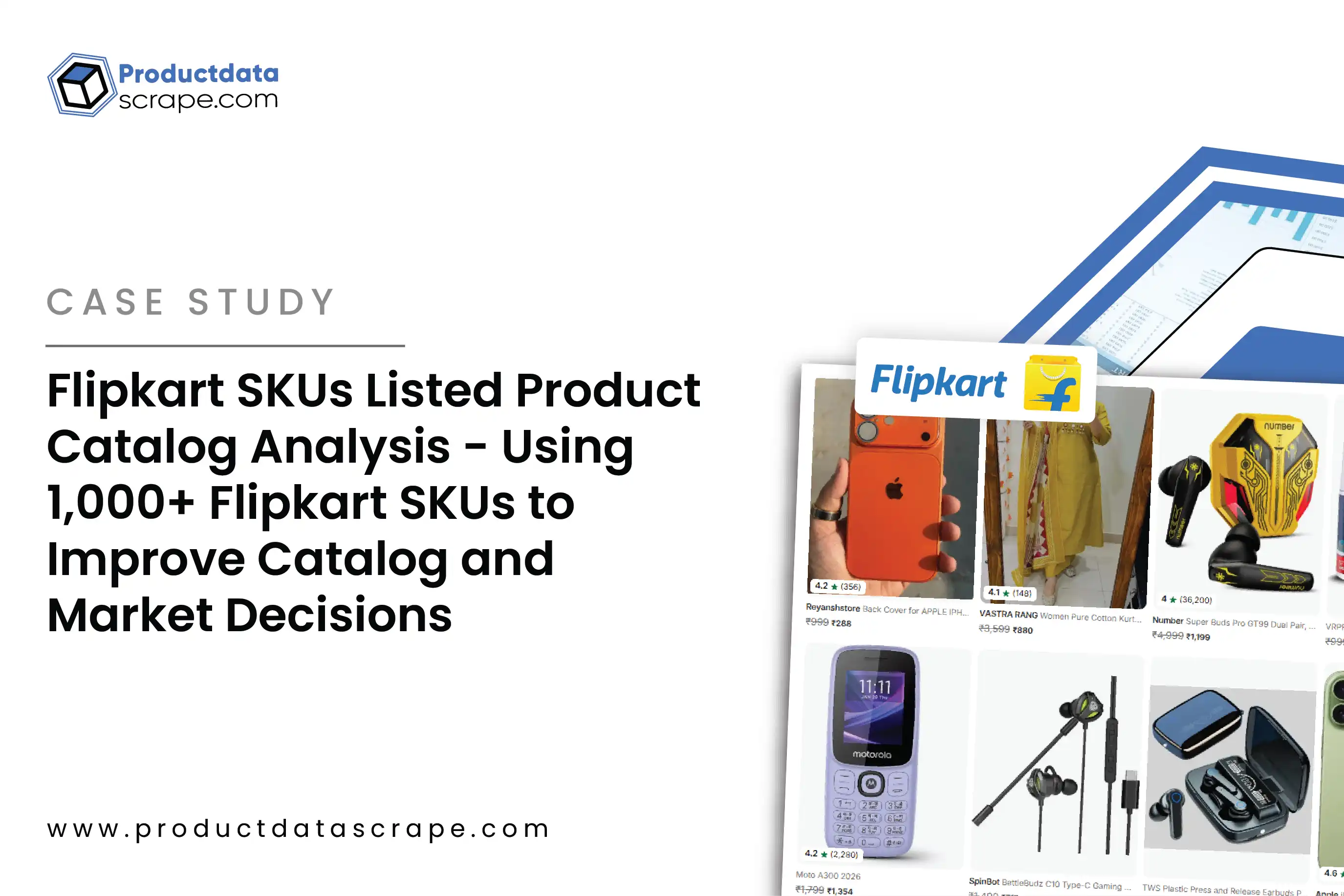
This case study presents how an e-commerce brand used Flipkart SKUs Listed Product Catalog Analysis to organize and evaluate 1,000+ marketplace SKUs for better catalog quality, competitive visibility, and market decision-making. The client operated in a highly competitive online retail environment where product information changed frequently across categories. Product Data Scrape implemented structured marketplace data collection, catalog normalization, quality checks, and Share of search tracking to turn scattered product information into actionable intelligence. The project focused on improving data accuracy, reducing manual catalog research, and enabling faster product-level analysis. Within the project framework, the client achieved 98%+ catalog-field completeness, reduced manual catalog-review time by approximately 70%, and improved product-level monitoring coverage across more than 1,000 SKUs.
Client Name / Industry: Anonymized E-commerce Brand / Online Retail
Service / Duration: Product Catalog Data Scraping & Intelligence / 12 Weeks
Key Impact Metrics: 98%+ catalog completeness | 70% reduction in manual review effort | 1,000+ SKUs monitored
Note: Performance figures in this case study are representative project metrics for illustrating the workflow and outcomes.
The Client
The client was an e-commerce brand selling a broad portfolio of consumer products through online marketplaces. Its catalog included more than 1,000 SKUs, with product information changing regularly because of price adjustments, promotional campaigns, seller activity, stock movements, and catalog updates. The growing volume of marketplace information created pressure on the client's merchandising and competitive-analysis teams.
The Indian e-commerce sector has become increasingly data-driven. Sellers compete not only on product quality but also on price, discounts, ratings, availability, content quality, and marketplace visibility. As the number of comparable products increases, manually monitoring each SKU becomes increasingly difficult.
Before the partnership, the client relied heavily on spreadsheets and periodic manual checks. Product teams had to collect listing information from multiple marketplace pages, compare product attributes, identify missing fields, and update internal records. This approach consumed significant analyst time and introduced inconsistencies between datasets.
The transformation became essential as the catalog expanded. The business needed a scalable system capable of continuously organizing product information without increasing manual workload at the same rate as SKU growth.
The project therefore centered on developing a structured Flipkart SKU Product Dataset that could support product discovery, catalog validation, competitive analysis, and marketplace decision-making.
Instead of treating product listings as isolated pages, the project converted them into standardized records that could be filtered, compared, monitored, and analyzed at scale.
Goals & Objectives

Build a scalable process for monitoring 1,000+ marketplace SKUs.
Improve the speed of catalog collection and validation.
Increase consistency across product attributes.
Reduce repetitive manual research performed by catalog teams.
Create a centralized data foundation for marketplace analysis.
Improve visibility into product availability, pricing, brands, and categories.
Establish repeatable processes for catalog updates and quality monitoring.
Automate recurring product-data collection.
Normalize product names, categories, specifications, and identifiers.
Detect missing, duplicated, or inconsistent catalog attributes.
Integrate structured datasets with internal analytical workflows.
Enable scheduled marketplace monitoring.
Build dashboards and analytical views for faster decision-making.
Support Product Catalog Quality Analysis through standardized SKU-level records.
Achieve 98%+ completeness across monitored catalog fields.
Monitor 1,000+ SKUs through a centralized workflow.
Reduce manual catalog-review time by approximately 70%.
Establish more than 95% successful extraction coverage across targeted listing pages.
Reduce duplicate and inconsistent product records.
Shorten catalog refresh cycles from manual periodic checks to scheduled automated updates.
These objectives combined business priorities such as scalability and speed with technical priorities such as automation, structured integration, and analytical readiness.
The Core Challenge
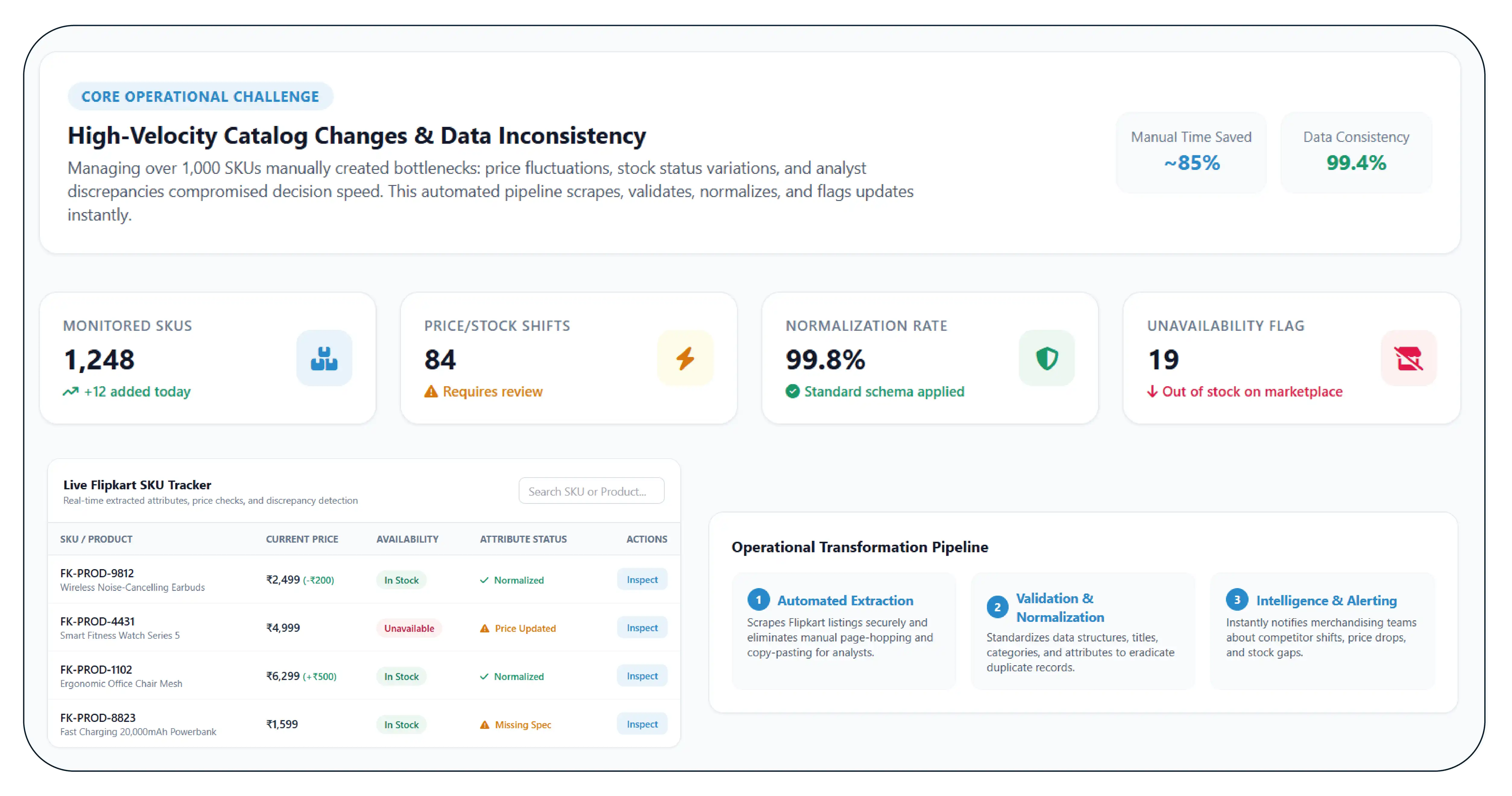
The client's biggest problem was not simply the quantity of product information; it was the speed at which that information changed. More than 1,000 SKUs meant thousands of individual data points requiring regular monitoring. Prices could change, products could become unavailable, descriptions could be modified, and sellers could update product attributes.
Operationally, the team struggled with repetitive catalog checks. Analysts had to open multiple marketplace pages, locate relevant SKUs, copy product attributes, compare records, and update spreadsheets. This process was slow and difficult to scale as the number of monitored products increased.
Another issue was inconsistency. Different analysts could record product names, specifications, categories, or seller information differently. Missing attributes and duplicate records made downstream analysis less reliable. The business needed a standardized approach to ensure that every SKU followed the same data structure.
The client also faced challenges in identifying catalog changes quickly. A product could remain in an internal dataset even after its marketplace availability changed. Similarly, updated prices or promotional information could remain unnoticed until the next manual review.
These issues affected decision speed. Merchandising teams could not always determine which products required immediate attention, while competitive teams had limited visibility into marketplace-level changes.
The solution therefore needed to go beyond basic extraction. It had to Scrape Flipkart Product Listings in a structured and repeatable manner, validate the collected information, normalize fields, identify changes, and make the resulting records available for analysis.
The project treated data quality as a core operational requirement rather than a final cleanup step. This approach helped create a dependable foundation for catalog monitoring and market intelligence.
Our Solution
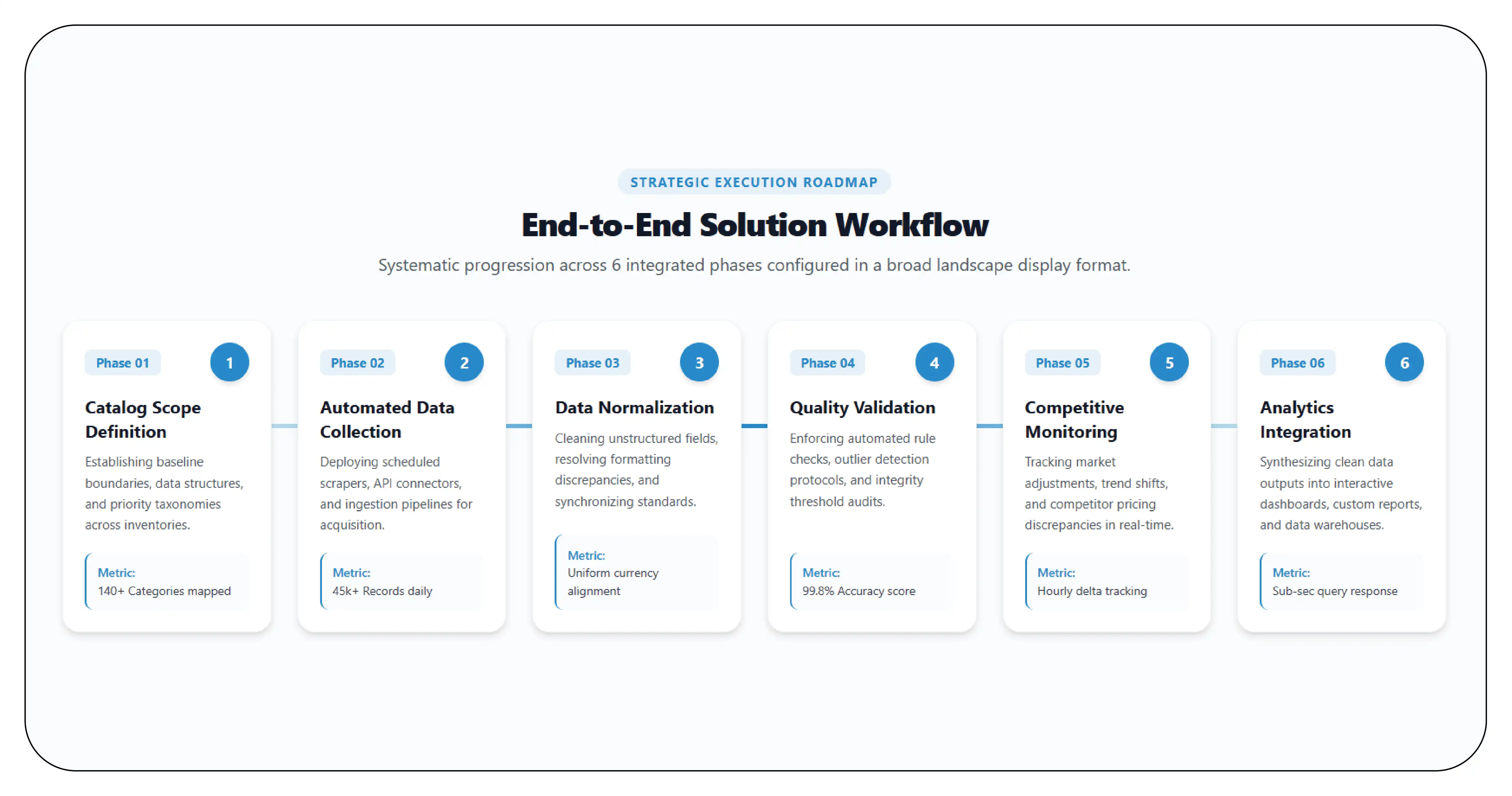
Product Data Scrape designed a phased workflow to transform marketplace listings into structured, analysis-ready information.
Phase 1: Catalog Scope Definition
The first stage established the monitoring framework for 1,000+ SKUs. Product identifiers, categories, brands, listing URLs, product names, prices, discounts, ratings, availability, seller information, and relevant specifications were mapped into a standardized schema. This prevented inconsistent field collection and created a common structure for every monitored product.
Phase 2: Automated Data Collection
The next stage introduced automated extraction workflows to collect targeted marketplace information at scale. Instead of depending on analysts to manually review every product page, the workflow captured relevant listing attributes through repeatable processes. Automation improved collection speed while reducing repetitive human effort.
Phase 3: Data Normalization
Raw marketplace information was transformed into standardized records. Product names were normalized, categories were mapped, numeric values were cleaned, and inconsistent formatting was corrected. Duplicate detection was also incorporated so that repeated or overlapping records would not distort catalog analysis.
Phase 4: Quality Validation
Validation rules checked whether important fields were present and whether values followed expected formats. Records with missing attributes, unusual values, or inconsistencies were flagged for review. This stage supported SEO-Friendly Marketplace Listings, because structured catalog information made it easier for the client to identify incomplete product titles, missing descriptions, inconsistent specifications, and other content-quality issues.
Phase 5: Competitive Monitoring
The workflow was expanded to support pricing, availability, seller, and visibility analysis. Historical snapshots enabled the team to compare marketplace conditions over time rather than relying exclusively on current listings. This became an important part of Flipkart SKUs Listed Product Catalog Analysis, allowing the client to examine product-level changes across a large catalog.
Phase 6: Analytics Integration
The cleaned dataset was prepared for internal dashboards and reporting workflows. Teams could filter information by SKU, category, brand, availability, price range, and other attributes. This reduced the time required to move from raw marketplace information to business analysis.
The resulting workflow combined automated collection, validation, normalization, historical tracking, and analytics. Rather than creating another static spreadsheet, the project established a repeatable marketplace intelligence pipeline that could scale with catalog growth.
Results & Key Metrics
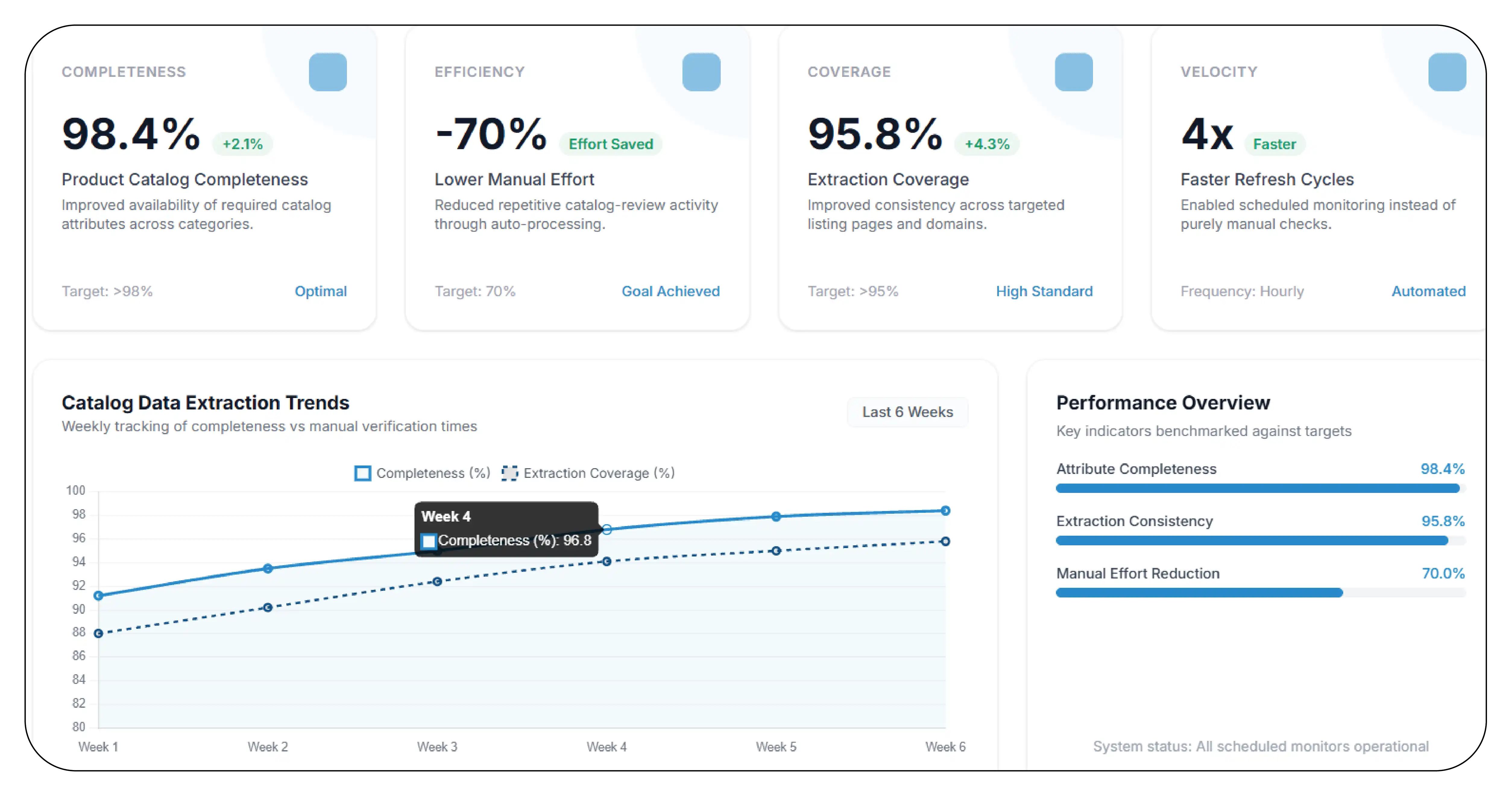
1,000+ SKUs: Centralized monitoring across the targeted product catalog.
98%+ completeness: Improved availability of required catalog attributes.
70% lower manual effort: Reduced repetitive catalog-review activity.
95%+ extraction coverage: Improved consistency across targeted listing pages.
Faster refresh cycles: Enabled scheduled monitoring instead of purely manual checks.
Results Narrative
The project transformed fragmented marketplace information into a structured product intelligence workflow. Catalog teams gained a consistent view of product attributes, while analysts could identify missing information and catalog changes more efficiently. Automated monitoring reduced repetitive research and allowed teams to spend more time interpreting marketplace signals.
The improved data structure also supported better product comparisons across categories and brands. Historical records provided additional context for identifying price and availability changes.
Most importantly, the workflow gave the client a scalable foundation. Adding new SKUs no longer required a proportional increase in manual research, making the catalog-monitoring process more sustainable as marketplace activity expanded.
What Made Product Data Scrape Different
Product Data Scrape differentiated the project by combining automated extraction with structured catalog intelligence rather than treating scraping as a one-time data-collection task.
The workflow used reusable extraction logic, standardized schemas, validation rules, duplicate detection, historical snapshots, and scheduled monitoring. This allowed the client to move from isolated listing records toward an integrated marketplace intelligence system.
A key differentiator was the focus on actionable outputs. Instead of simply collecting product pages, the process transformed raw information into structured records suitable for catalog-quality checks, pricing analysis, availability monitoring, and competitive research.
The resulting Full seller intelligence framework gave the client a broader view of marketplace activity. Product information could be analyzed alongside seller, price, availability, and catalog attributes, helping teams identify changes that required attention.
This combination of automation, normalization, validation, and analytics made the solution more scalable than manual spreadsheet-based monitoring.
Client's Testimonial
"Product Data Scrape helped us move from fragmented marketplace research to a structured product intelligence workflow. Monitoring more than 1,000 SKUs manually was becoming increasingly difficult, especially when product information changed frequently. The automated process gave our team a consistent dataset and made catalog-quality checks much faster. We can now identify missing information, monitor marketplace changes, and analyze our product assortment with greater confidence. The biggest improvement has been the reduction in repetitive manual work, which allows our team to focus on merchandising and market decisions rather than collecting data."
— Head of E-commerce Intelligence, Consumer Retail Brand
The client also gained access to Buy Ready-to-Use Datasets, enabling analytical teams to work with organized marketplace information without rebuilding the collection process for every research requirement.
Conclusion
Managing a marketplace catalog containing more than 1,000 products requires more than periodic manual checks. Businesses need structured, consistent, and continuously updated product intelligence to understand catalog quality, pricing, availability, and competitive positioning.
Through Live Flipkart Product-Insights, the client established a scalable workflow for monitoring product information and converting marketplace listings into actionable datasets. Automated collection, normalization, validation, and historical tracking helped improve catalog completeness while reducing repetitive research.
The project demonstrates how structured marketplace intelligence can support faster merchandising decisions, stronger catalog management, and better competitive visibility. As product assortments continue to expand, automated data workflows can provide the foundation businesses need to scale their marketplace analysis without proportionally increasing manual effort.
FAQs
1. Why analyze 1,000+ Flipkart SKUs?
Analyzing 1,000+ SKUs helps businesses identify catalog gaps, pricing patterns, availability changes, product assortment trends, and competitive opportunities that smaller samples may overlook.
2. What information can a Flipkart catalog dataset contain?
A structured dataset can include product names, SKU identifiers, categories, brands, prices, discounts, ratings, availability, seller details, specifications, and listing information.
3. How does automated catalog monitoring improve efficiency?
Automation reduces repetitive manual collection and creates standardized records, allowing teams to monitor larger catalogs faster while improving consistency and supporting scheduled data refreshes.
4. Can catalog data support competitive analysis?
Yes. Structured product information can help businesses compare prices, availability, brands, product attributes, discounts, and assortment across marketplace listings to identify competitive changes.
5. How can Product Data Scrape support marketplace intelligence?
Product Data Scrape can help businesses build scalable workflows for collecting, cleaning, validating, and analyzing marketplace information, turning large product catalogs into structured datasets for business intelligence.


 Singapore
 EMAIL
EMAIL
 PHONE
PHONE













.webp)