Quick Overview
A leading online gifting retailer offering personalized merchandise, celebration products, corporate gifts, and customized accessories needed better visibility into changing market conditions. Personalized Gifting Market Intelligence helped the business monitor competitor products, pricing movements, seasonal demand, promotions, and emerging gifting trends across major marketplaces.
Product Data Scrape developed automated data collection and analysis workflows covering thousands of listings and seller records. The monitoring framework tracked products such as personalized mugs, photo frames, engraved wallets, customized cushions, nameplates, keychains, LED photo lamps, greeting cards, gift hampers, and personalized jewelry.
Marketplace & Seller Intelligence provided deeper visibility into seller activity, assortment changes, pricing positions, and product performance across platforms including Amazon, Flipkart, Myntra, Etsy, Meesho, and IndiaMART.
Within 14 weeks, the retailer achieved a 37% improvement in product discovery, 29% faster pricing decisions, and 24% better assortment optimization, strengthening its competitive position.
The Client
The retailer operates in the rapidly expanding online gifting industry, selling personalized merchandise, customized accessories, celebration products, corporate gifts, and occasion-based collections.
Its catalog included popular categories such as customized birthday gifts, wedding gifts, anniversary gifts, corporate gift sets, personalized photo gifts, engraved accessories, couple gifts, baby gifts, and festival hampers.
Increasing consumer demand for unique gifts encouraged retailers and marketplace sellers to introduce new designs, personalization options, seasonal collections, and competitive price points. This growing competition made timely market visibility increasingly important.
The business previously depended on manual competitor research, spreadsheets, supplier feeds, and periodic catalog reviews. Teams had difficulty identifying fast-moving gift categories, emerging themes, pricing shifts, and changes in competitor assortments.
Marketplace activity also changed frequently. On Amazon, for example, competing sellers could introduce new customized mugs, engraved pens, photo frames, and personalized keychains while changing discounts and delivery promises. Similar assortment movements could occur across Flipkart and Meesho, making manual tracking difficult.
A structured Personalized Gift Assortment Analysis approach was needed to identify popular categories, emerging personalization trends, assortment gaps, and opportunities for catalog expansion.
Pricing presented another challenge because competitor discounts and promotional offers changed frequently around Valentine's Day, Mother's Day, Father's Day, Raksha Bandhan, Diwali, Christmas, birthdays, weddings, and anniversaries.
Without reliable Pricing intelligence, teams could react slowly to market movements or miss opportunities to improve product positioning.
Product Data Scrape introduced automated data collection and structured analysis to replace fragmented research processes. The resulting information gave merchandising and pricing teams clearer visibility into competitor activity, customer-facing product trends, assortment changes, and market opportunities.
Goals & Objectives
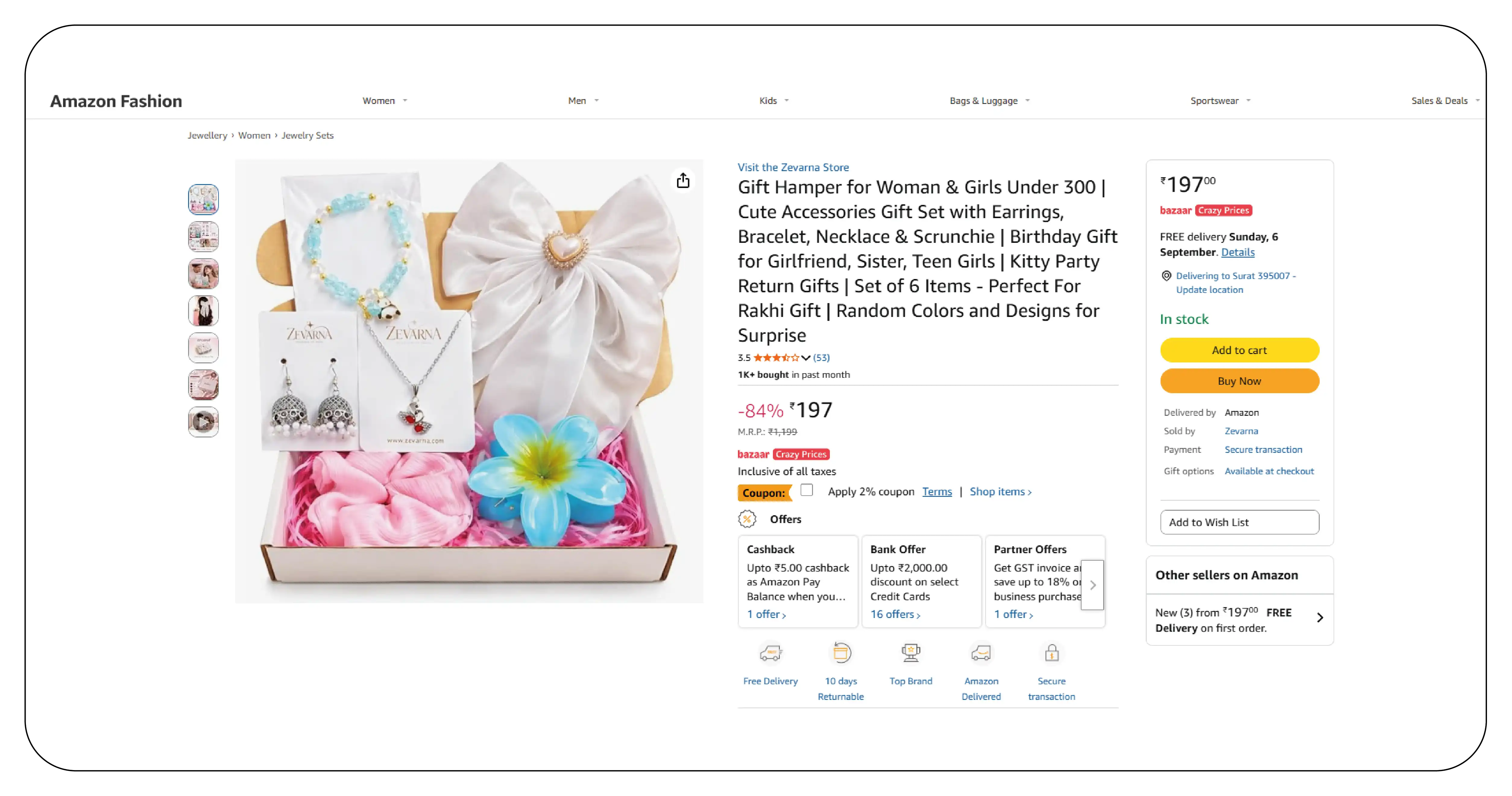
The primary goal was to build a scalable market intelligence framework that would give the gifting retailer timely visibility into competitor products, pricing, seller activity, promotions, and changing customer demand.
Key goals included:
Improve visibility into personalized gifting products across major marketplaces.
Track competitor pricing, discounts, and promotional movements.
Identify emerging gifting categories and seasonal product trends.
Improve product discovery and assortment planning.
Reduce dependency on manual competitor research.
Create a centralized and continuously refreshed view of marketplace activity.
Support faster, data-driven merchandising and pricing decisions.
The project focused on converting fragmented marketplace information into structured, actionable datasets.
The key objectives were to:
Automate product data collection across relevant marketplaces and seller pages.
Track products including personalized mugs, photo frames, engraved wallets, LED lamps, keychains, gift hampers, jewelry, and corporate gifts.
Monitor product prices, MRP, discounts, ratings, reviews, availability, and seller information.
Compare competitor assortment and identify new product launches.
Detect pricing changes around Valentine's Day, Diwali, Christmas, Raksha Bandhan, weddings, and birthdays.
Normalize product and category information for accurate cross-marketplace comparison.
Create dashboards and alerts for significant product, pricing, and assortment changes.
Provide merchandising teams with reliable intelligence for catalog expansion and optimization.
The success of the initiative was measured through operational efficiency, data quality, market visibility, and decision-making improvements.
Product discovery improvement: 37%
Faster pricing decisions: 29%
Assortment optimization improvement: 24%
Product data accuracy: 97%+
Competitor monitoring automation: 90%+
Manual pricing research reduction: 60%
Repetitive research reduction: 70%
Faster trend identification: 35%
Promotional opportunity identification: 28%
Marketplace listings monitored: Thousands
These KPIs established a measurable framework for evaluating the impact of automated market intelligence. By connecting product discovery, competitive pricing, assortment monitoring, and data accuracy, the retailer could measure improvements not only in research efficiency but also in the speed and quality of merchandising decisions.
The Core Challenge
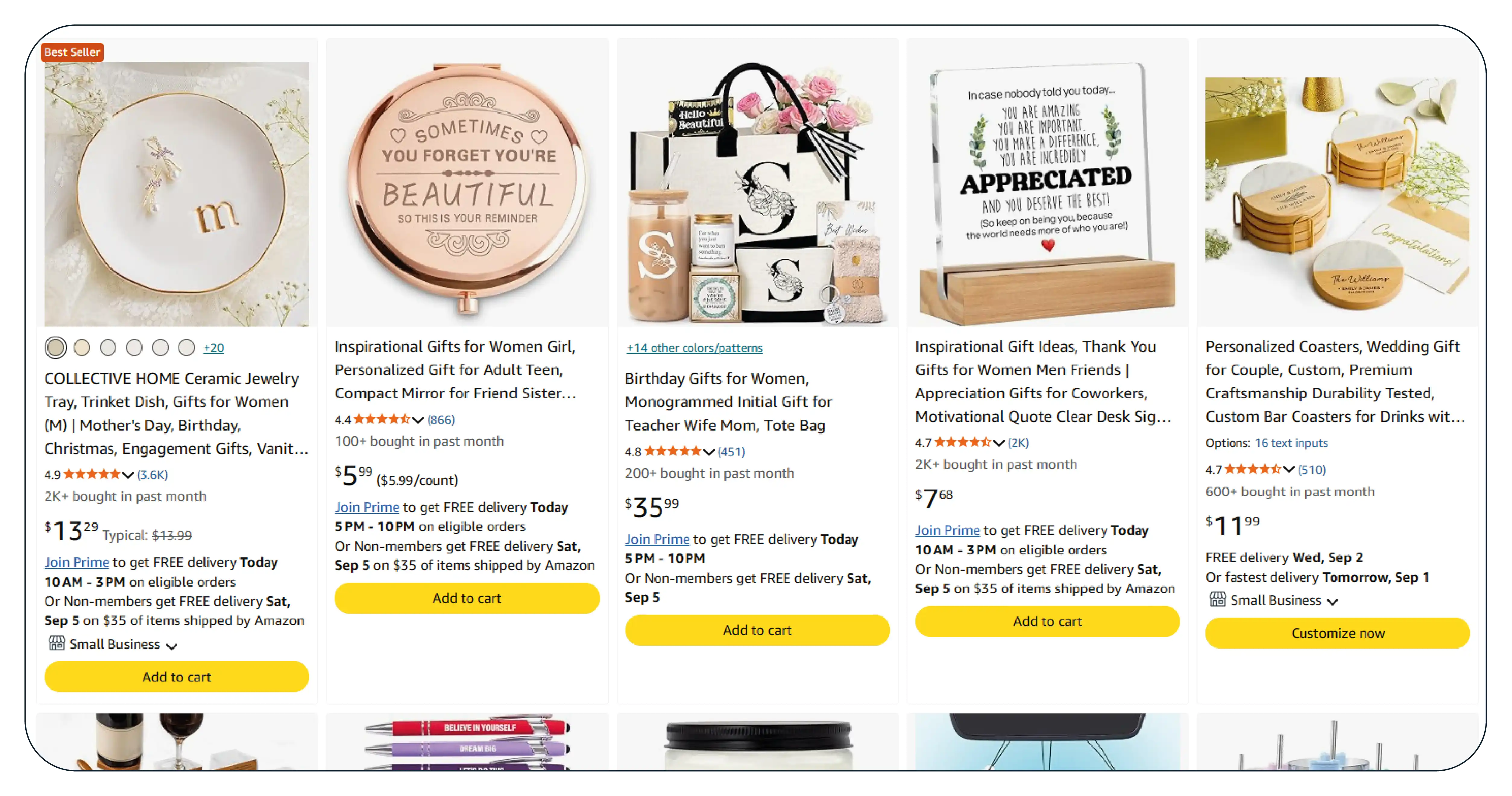
The gifting retailer faced growing difficulty managing a rapidly changing marketplace filled with personalized products, seasonal collections, promotional offers, and competing sellers.
Product information was spread across multiple marketplaces, seller pages, supplier feeds, and internal spreadsheets, making it difficult to maintain a consistent view of market activity.
One major issue was the lack of centralized Personalized Gift Retail Analytics. Teams often relied on manual searches to identify popular products, emerging designs, pricing changes, and competitor assortment movements.
For example, identifying whether personalized photo frames, engraved watches, customized mugs, couple lamps, or name-printed wallets were gaining popularity required repeated searches across multiple platforms.
Pricing presented another operational bottleneck. Competitor prices and discounts could change frequently during festivals, holidays, wedding seasons, birthdays, and promotional campaigns.
A ₹499 personalized mug could be discounted to ₹349 on one marketplace while a comparable product remained at ₹399 on another. Similarly, a customized LED photo lamp could move between promotional price points depending on the seller, occasion, or campaign.
The retailer also struggled to identify assortment gaps. New products could appear rapidly across marketplaces, while existing listings could change descriptions, prices, availability, ratings, or promotional positioning.
For instance, competitors could quickly introduce Spotify-code plaques, Instagram-photo frames, custom caricature portraits, engraved bracelets, and personalized hamper boxes around major gifting occasions.
Without automated monitoring, maintaining accurate information across thousands of listings became increasingly challenging.
These limitations affected product discovery, pricing responsiveness, merchandising decisions, and overall data accuracy. Teams spent too much time collecting and cleaning information instead of using it for strategic planning.
A scalable data collection and monitoring framework was needed to provide timely, structured, and reliable market information.
Our Solution
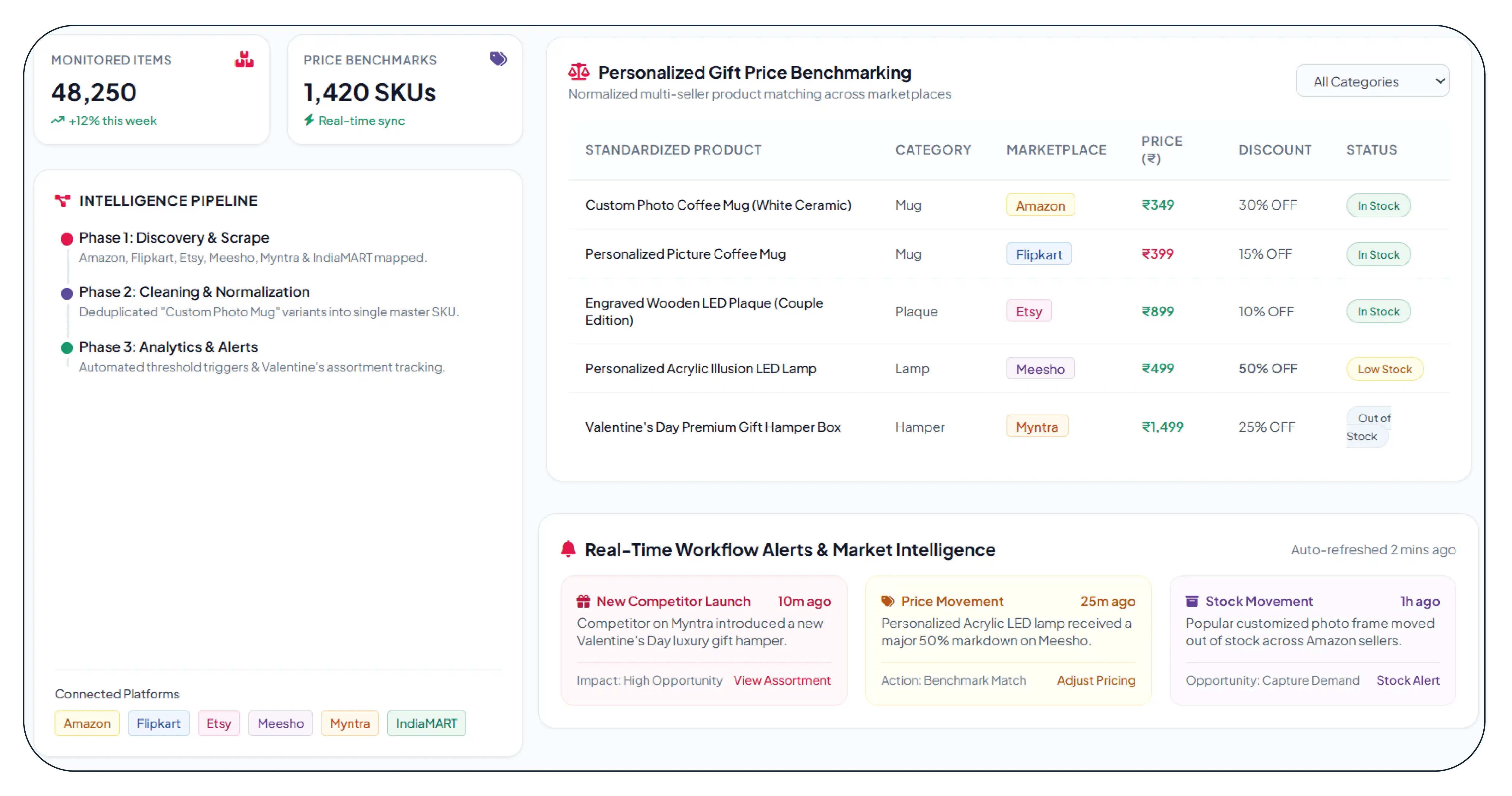
Product Data Scrape developed a structured data intelligence framework focused on automated collection, normalization, competitive analysis, and continuous monitoring of the gifting marketplace.
Phase 1: Data Discovery and Mapping
The first phase identified relevant marketplaces, competitor stores, seller pages, product categories, and gifting segments. The monitoring framework covered product fields such as product name, category, personalization type, material, dimensions, price, MRP, discount, ratings, reviews, availability, seller, delivery information, and promotional indicators. Relevant platforms included Amazon, Flipkart, Meesho, Etsy, Myntra, and IndiaMART, depending on product category and marketplace relevance.
Phase 2: Automated Data Collection
The second phase introduced automated product listing collection. Scheduled extraction workflows captured new products, price changes, discounts, availability updates, seller activity, and assortment movements. Personalized Gift Price Benchmarking enabled the retailer to compare similar products across sellers and identify competitive pricing positions. For example, the system could compare pricing for customized mugs, engraved wooden plaques, personalized photo frames, and corporate gift boxes across different sellers and marketplaces.
Phase 3: Data Cleaning and Standardization
Next, raw information was cleaned and standardized. Duplicate listings were removed, inconsistent product names were normalized, and category structures were aligned. A product listed as "Custom Photo Mug," "Personalized Photo Coffee Mug," and "Customized Picture Mug" could be grouped into a standardized product category for more accurate comparison. Validation rules helped identify incomplete or unusual records before they reached reporting systems.
Phase 4: Analytics and Market Intelligence
The analytics layer transformed the collected information into actionable insights. Personalized Gifting Market Intelligence helped identify emerging product categories, seasonal trends, assortment gaps, competitor launches, pricing movements, and promotional opportunities. Teams could compare products such as personalized couple gifts, wedding hampers, engraved accessories, customized stationery, photo gifts, and corporate merchandise across marketplaces.
Phase 5: Dashboard Integration and Monitoring
The final phase connected structured datasets with dashboards and monitoring workflows. Automated alerts highlighted major price changes, newly listed products, availability movements, and significant assortment updates. For example, teams could receive an alert when a competitor introduced a new Valentine's Day gift hamper, when a personalized LED lamp received a major discount, or when a popular customized photo frame moved out of stock. Regular refreshes kept market information current without requiring continuous manual research.
This approach gave the retailer a scalable framework for monitoring thousands of gifting products while improving data consistency, pricing visibility, product discovery, and merchandising decisions.
Results & Key Metrics
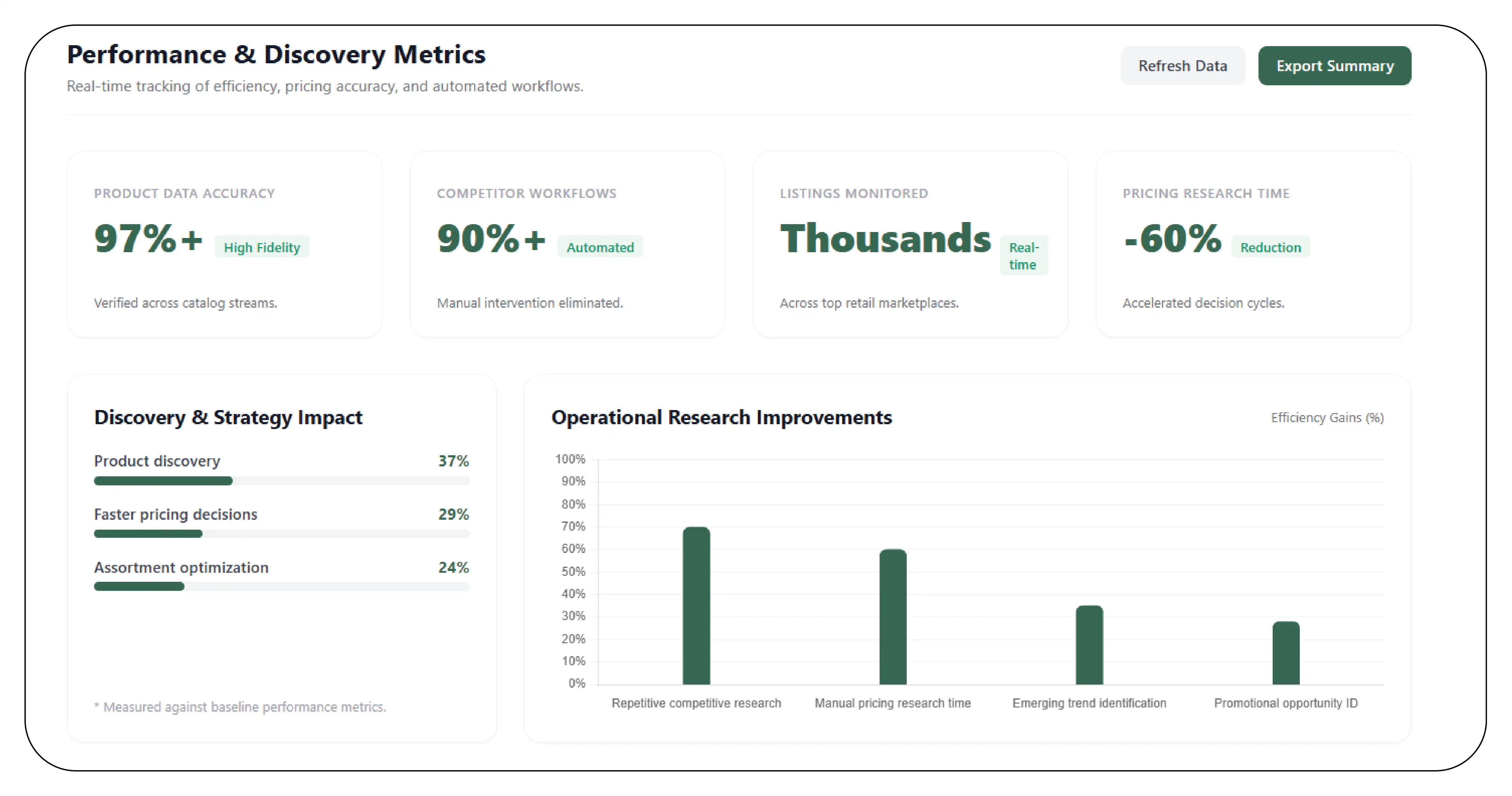
Product discovery improvement: 37%
Faster pricing decisions: 29%
Assortment optimization improvement: 24%
Product data accuracy: 97%+
Competitor workflows automated: 90%+
Manual pricing research time: 60% reduction
Repetitive competitive research: 70% reduction
Emerging trend identification: 35% faster
Promotional opportunity identification: 28% improvement
Listings monitored: Thousands
Results Narrative
Automated market monitoring gave the retailer faster access to current product, pricing, seller, and assortment information.
Teams could identify emerging gifting trends earlier, compare competitor prices more efficiently, and recognize assortment gaps before making catalog decisions.
For example, monitoring could identify growing competitor activity around personalized wedding hampers, engraved couple gifts, customized nameplates, photo lamps, and corporate gift kits before these categories became major assortment priorities.
Standardized information improved consistency across different marketplace sources, while automated monitoring reduced repetitive research activities.
Faster access to competitive signals also supported more responsive merchandising and promotional planning.
The retailer gained a clearer understanding of marketplace movements and could adjust product positioning with greater confidence.
The improved workflow created a scalable foundation for monitoring expanding product ranges and responding quickly to seasonal gifting opportunities such as Valentine's Day, Raksha Bandhan, Diwali, Christmas, Mother's Day, and wedding season.
What Made Product Data Scrape Different
Product Data Scrape combines automated data collection, normalization, validation, competitive monitoring, and analytics-ready datasets within one scalable framework.
Instead of collecting isolated product information, the system connects product attributes with pricing, seller activity, promotions, availability, ratings, and assortment changes.
Automated validation helps identify duplicate, incomplete, or inconsistent records before analysis.
Scheduled collection keeps market information refreshed while reducing repetitive manual research.
The framework can monitor diverse gifting products, including personalized mugs, engraved pens, customized T-shirts, photo frames, LED lamps, nameplates, jewelry, keychains, gift hampers, and corporate merchandise.
Dashboards make complex marketplace information easier to interpret and support faster decision-making across merchandising and pricing teams.
The system can also compare seller activity across platforms such as Amazon, Flipkart, Meesho, Etsy, and Myntra, providing a broader competitive view.
This approach strengthens Pricing strategy services by providing timely competitive signals and structured market information that can support more responsive pricing and assortment decisions.
Client's Testimonial
"Product Data Scrape changed the way our team monitors the gifting marketplace. Previously, collecting competitor prices, products, and assortment information required significant manual effort. The automated data framework gave us faster access to structured information and helped us identify pricing opportunities and emerging product trends much earlier.
We also gained better visibility into seller activity and marketplace changes. The accuracy and consistency of the collected data have made our merchandising decisions more confident and efficient.
We can now spend less time researching individual listings and more time developing strategies around customer demand, seasonal opportunities, and competitive positioning."
— Head of Marketplace Strategy, Online Gifting Retailer
Conclusion
The personalized gifting market continues to evolve as shoppers look for customized products that match specific occasions, interests, and preferences.
Retailers need timely visibility into pricing, product trends, seller activity, assortment changes, and promotional movements to remain competitive.
Product Data Scrape helped establish a more efficient data-driven approach that improved market visibility and supported faster merchandising decisions.
Automated monitoring reduced manual research while structured datasets made competitor and product comparisons easier.
The retailer could monitor categories such as personalized birthday gifts, wedding gifts, anniversary presents, customized home décor, corporate gift sets, and festival hampers across leading digital marketplaces.
By combining accurate intelligence with E-commerce data scraping, the retailer can continue tracking market changes, refining its assortment, responding to seasonal demand, and identifying new opportunities for sustainable growth.
FAQs
1. What is personalized gifting market intelligence?
It involves collecting and analyzing product, pricing, seller, promotional, and trend information to understand changes in the gifting marketplace and support better business decisions.
2. How can competitor pricing be monitored?
Automated data collection can track product prices, discounts, promotions, and availability at scheduled intervals, helping businesses identify important pricing changes quickly.
3. How does product data help improve assortment planning?
Product information can reveal popular categories, emerging designs, personalization options, seasonal trends, and competitor assortment gaps. These insights help retailers decide which products to introduce, promote, or expand.
4. Can marketplace seller activity be tracked?
Yes. Automated monitoring can capture seller information, product availability, pricing, ratings, reviews, promotions, and listing changes to provide a broader view of competitive activity.
5. Why automate gifting market research?
Automation reduces repetitive manual research, improves data consistency, supports larger product volumes, and provides fresher information for pricing, merchandising, product discovery, and competitive analysis.


 Singapore
 EMAIL
EMAIL
 PHONE
PHONE











.webp)