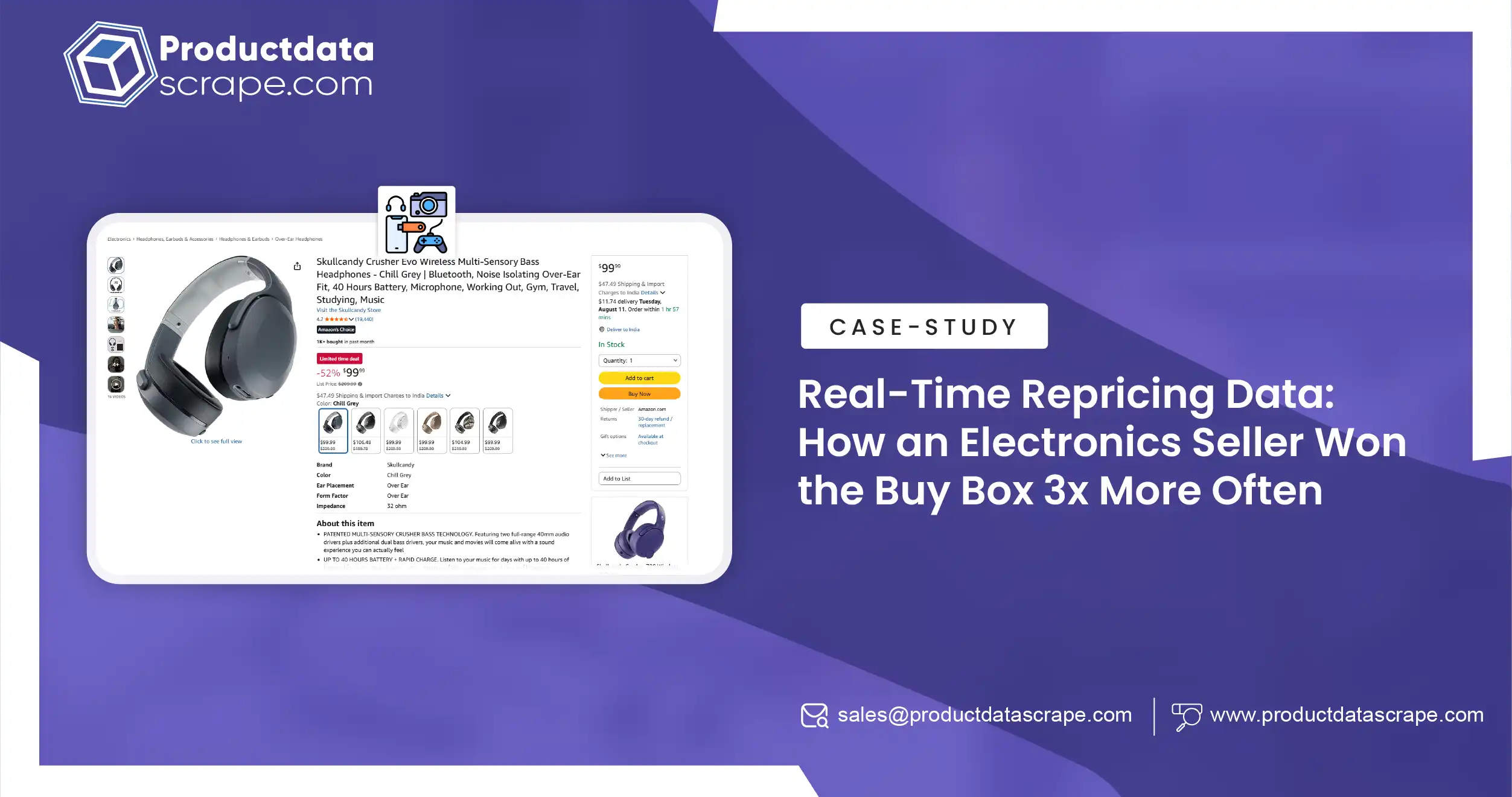
Real-Time Repricing Data: How an Electronics Seller Won the Buy Box 3x More Often

The Client

An electronics seller operating across major marketplaces — audio, accessories, and small devices — competing on listings shared with many other sellers, where winning the Buy Box (the default "Add to Cart" seller) is the difference between getting the sale and getting nothing.

Client details are anonymised. Figures are representative of the engagement.

The Problem: Losing the Buy Box on Products It Should Have Won
The Problem Losing the Buy Box on Products It Should Have Won

The seller stocked competitive products at competitive prices and still lost the Buy Box far more often than it should have. On shared listings, a rival seller consistently held the default position, and the seller's stock sat in the "other sellers" list where most shoppers never look.

The cause was speed. The seller updated prices once a day, in a morning batch. Competitors on the same listings adjusted continuously. So for most of every day, the seller's price was set against yesterday's competitive landscape — frequently a few rupees above a rival who had moved since, which on a marketplace Buy Box algorithm is enough to lose the default position entirely.

The seller was not uncompetitive. It was slow, and on a shared listing, slow and uncompetitive look identical from the shopper's side — because both end with a competitor holding the Buy Box.

The operations lead's summary: we're priced to win and we keep losing, because by lunchtime our "competitive" price is competing with this morning's ghosts.

Why Once-a-Day Pricing Could Not Hold the Buy Box

The Buy Box is decided continuously; a price set once a day is stale within hours.

Competitors move all day; the seller moved once. A daily price is correct at 9 a.m. and progressively wrong as rivals adjust through the day. For most of the trading day, the seller was priced against a landscape that no longer existed.

The Buy Box is won on small margins. A marketplace default-seller algorithm can flip on a few rupees combined with fulfilment and rating signals. Being "about right" is not right enough; being a little above a rival who moved an hour ago loses the box.

No signal when the box was lost. The seller had no alert when it lost the Buy Box on a SKU. It found out from a sales dip days later, by which point it had already lost the volume.

Manual repricing could not scale. Even where the team wanted to react, updating prices by hand across a large catalogue in response to continuous competitor moves was impossible at any useful speed.

The Solution: Real-Time Repricing Data
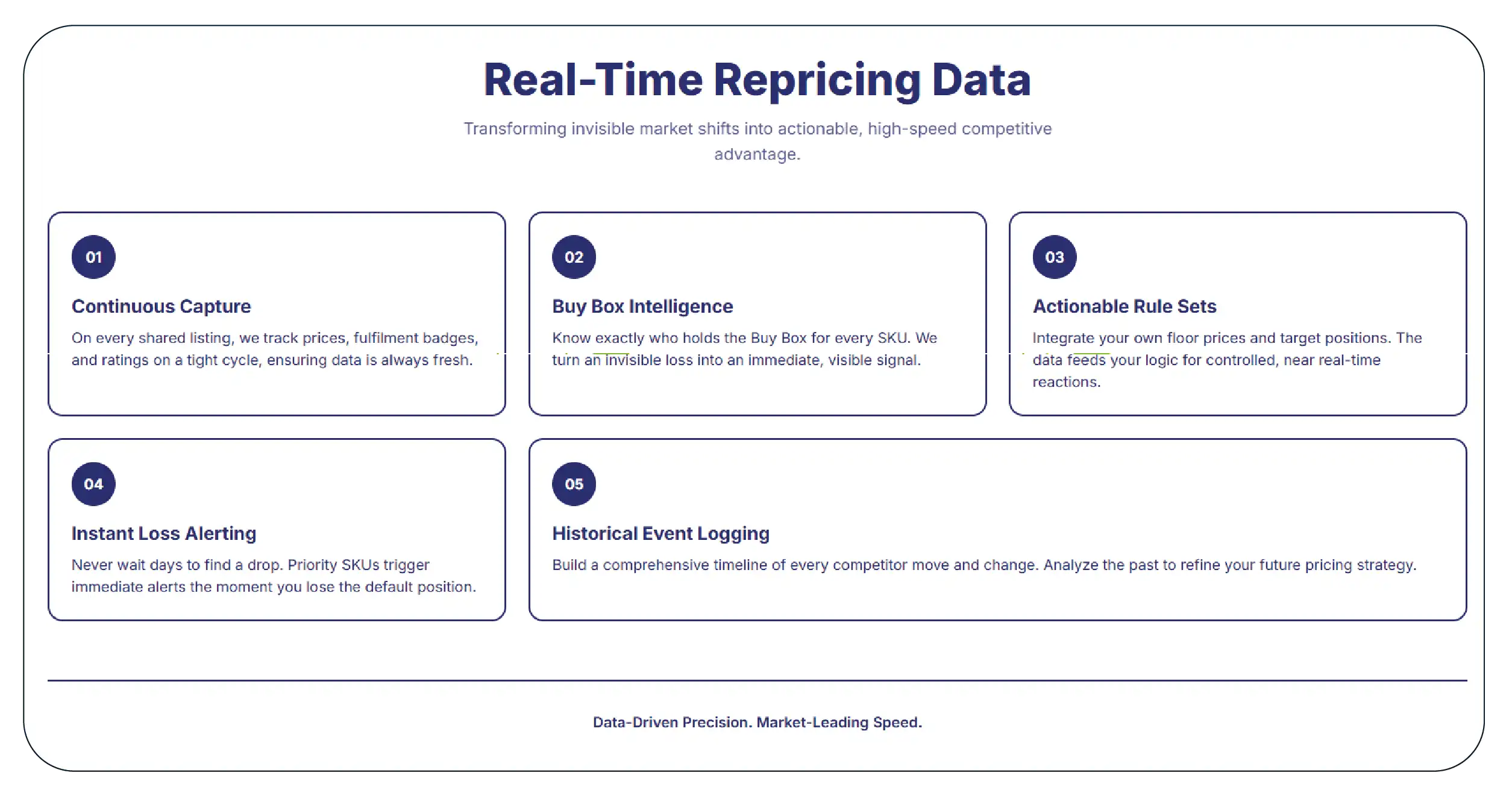
The Solution Real-Time Repricing Data

Product Data Scrape built a real-time repricing data feed that tracked competitor prices and Buy Box status continuously across the seller's shared listings.

  • Continuous competitor capture. On every shared listing, all sellers' prices, fulfilment badges, ratings, and the current Buy Box holder were captured on a tight cycle — not once a day, continuously.
  • Buy Box status per SKU. For every SKU, the feed reported whether the seller currently held the Buy Box and, if not, who did and at what price — turning an invisible loss into a visible, immediate signal.
  • Repricing signals within a rule set. The feed fed the seller's own repricing rules — a floor below which it would not go, a target position, a step size — so the seller could react within a controlled band rather than blindly matching. The rules were the seller's; the data made them actionable in near real time.
  • Loss alerting. Any Buy Box loss on a priority SKU fired an alert immediately, so the seller knew the moment it dropped out of the default position rather than days later.
  • Full event logging. Every competitor move and Buy Box change was logged, building a history the seller could analyse to refine its rules.

Sample Data: The Repricing Event Log

An illustrative event log for a single SKU across part of a day.

Time Our Price Competitor Best Buy Box Holder Action
09:00 1,299 1,299 Us Held
10:12 1,299 1,289 Competitor Lost — alert fired
10:19 1,285 1,289 Us Regained (within floor)
12:40 1,285 1,279 Competitor Lost — alert fired
12:46 1,279 1,279 Us Regained (tie, won on rating)
15:30 1,279 1,269 Competitor Below floor — held, did not chase

Illustrative series.

The structured record at 12:46:

{
  "sku": "AUDIO-TWS-3391",
  "captured_at": "2026-07-14T12:46:03+05:30",
  "our_price": 1279,
  "buy_box_holder": "us",
  "all_sellers": [
    {"seller": "Us",          "price": 1279, "fulfilment": "marketplace", "rating": 4.6, "has_buy_box": true},
    {"seller": "Competitor X", "price": 1279, "fulfilment": "seller",      "rating": 4.1, "has_buy_box": false}
  ],
  "repricing_rule_applied": "match_to_floor",
  "price_floor": 1265,
  "won_on": "rating_tiebreak"
}

Two lines carry the whole lesson. At 12:46, the seller tied the competitor on price and won the Buy Box on its higher rating — the data captured why, so the seller learned that rating was buying it tiebreak wins and worth protecting. At 15:30, the competitor dropped below the seller's floor, and the rules correctly held rather than chasing into a loss — the feed made a disciplined non-response as easy as a response.

What the Seller Did

Reacted in minutes, within its own rules. Repricing moved from a daily batch to a continuous, rule-bounded response — regaining the Buy Box within minutes of losing it, always inside a floor it set, never chasing blindly.

Knew immediately when it lost the box. Loss alerts replaced the days-late sales-dip discovery, so no SKU sat out of the Buy Box unnoticed.

Held the line when chasing didn't pay. The rules meant that when a competitor priced below the seller's floor, the seller declined the sale rather than destroying its margin to win it — a decision it previously had no framework to make.

Refined rules from the log. The event history showed where the seller was winning on rating, where fulfilment cost it the box, and where its floor was set wrong — so the rules got sharper over time.

The Results (One Quarter)

Metric Before After One Quarter
Buy Box win rate, priority SKUs ~22% ~68%
Median time to regain a lost Buy Box Hours to days Minutes
Buy Box losses detected in real time None All priority SKUs
Margin-destroying chases avoided Held below floor consistently
Revenue on shared listings, indexed 100 152
Gross margin, priority SKUs, indexed 100 109 (protected by floors)

Figures are representative of the engagement outcome.

The operations lead's follow-up: we didn't get cheaper. We got faster, and we got disciplined — winning the box when it paid and walking away when it didn't.

The Lesson

On a shared listing, the Buy Box is everything, and it is decided in near real time. A seller pricing once a day is not making a pricing mistake; it is making a speed mistake, and on a shared listing the two are indistinguishable in their result — a competitor holds the default position and gets the sale.

Winning the Buy Box three times more often did not require the lowest price. It required reacting at the speed the box is actually contested, inside rules that said when to fight and when to hold. The seller's prices were already competitive; what it lacked was the data to act on them before they went stale. Real-time repricing data closed that gap — and the discipline to not chase below the floor protected the margin that speed alone would have burned.

Work With Product Data Scrape

Product Data Scrape delivers real-time repricing data across shared marketplace listings: continuous competitor and Buy Box capture, per-SKU Buy Box status, rule-ready repricing signals, immediate loss alerting, and full event logging — as JSON, CSV, API, or straight into your repricing engine.

Ask us for a Buy Box diagnostic on your shared listings — we will show you how often you lose the box to speed rather than to price.

Product Data Scrape — turning marketplace complexity into decision-ready data.

LATEST BLOG

Flipkart Bank Offers Data: Scraping EMI, Exchange, and Discount Terms to Calculate Effective Consumer Price

Flipkart bank offers data, no-cost EMI and exchange discounts decide what a customer really pays. Learn which fields to capture and how to compute effective price.

How Food Delivery Business Data Before Launch Helps Optimize Pricing, Delivery Zones, and Customer Demand

Food Delivery Business Data Before Launch helps analyze demand, competitors, pricing, and delivery zones for a successful market entry.

Analyze Zomato Delivery Pricing Before Opening a Restaurant - A Complete Guide to Smarter Restaurant Launch Planning

Analyze Zomato Delivery Pricing Before Opening a Restaurant to optimize menu pricing, delivery costs, profits, and market positioning.

Case Studies

Discover our scraping success through detailed case studies across various industries and applications.

WHY CHOOSE US?
Product Data Scrape for Retail Web Scraping

Choose Product Data Scrape to access accurate data, enhance decision-making, and boost your online sales strategy effectively.

Reliable Insights

Reliable Insights

With our Retail Data scraping services, you gain reliable insights that empower you to make informed decisions based on accurate product data and market trends.

Data Efficiency

Data Efficiency

We help you extract Retail Data product data efficiently, streamlining your processes to ensure timely access to crucial market information and operational speed.

Market Adaptation

Market Adaptation

By leveraging our Retail Data scraping, you can quickly adapt to market changes, giving you a competitive edge with real-time analysis and responsive strategies.

Price Optimization

Price Optimization

Our Retail Data price monitoring tools enable you to stay competitive by adjusting prices dynamically, attracting customers while maximizing your profits effectively.

Competitive Edge

Competitive Edge

THIS IS YOUR KEY BENEFIT.
With our competitive price tracking, you can analyze market positioning and adjust your strategies, responding effectively to competitor actions and pricing in real-time.

Feedback Analysis

Feedback Analysis

Utilizing our Retail Data review scraping, you gain valuable customer insights that help you improve product offerings and enhance overall customer satisfaction.

5-Step Proven Methodology

How We Scrape E-Commerce Data?

01
Identify Target Websites

Identify Target Websites

Begin by selecting the e-commerce websites you want to scrape, focusing on those that provide the most valuable data for your needs.

02
Select Data Points

Select Data Points

Determine the specific data points to extract, such as product names, prices, descriptions, and reviews, to ensure comprehensive insights.

03
Use Scraping Tools

Use Scraping Tools

Utilize web scraping tools or libraries to automate the data extraction process, ensuring efficiency and accuracy in gathering the desired information.

04
Data Cleaning

Data Cleaning

After extraction, clean the data to remove duplicates and irrelevant information, ensuring that the dataset is organized and useful for analysis.

05
Analyze Extracted Data

Analyze Extracted Data

Once cleaned, analyze the extracted e-commerce data to gain insights, identify trends, and make informed decisions that enhance your strategy.

Start Your Data Journey
99.9% Uptime
GDPR Compliant
Real-time API

See the results that matter

Read inspiring client journeys

Discover how our clients achieved success with us.

6X

Conversion Rate Growth

“I used Product Data Scrape to extract Walmart fashion product data, and the results were outstanding. Real-time insights into pricing, trends, and inventory helped me refine my strategy and achieve a 6X increase in conversions. It gave me the competitive edge I needed in the fashion category.”

7X

Sales Velocity Boost

“Through Kroger sales data extraction with Product Data Scrape, we unlocked actionable pricing and promotion insights, achieving a 7X Sales Velocity Boost while maximizing conversions and driving sustainable growth.”

"By using Product Data Scrape to scrape GoPuff prices data, we accelerated our pricing decisions by 4X, improving margins and customer satisfaction."

"Implementing liquor data scraping allowed us to track competitor offerings and optimize assortments. Within three quarters, we achieved a 3X improvement in sales!"

Resource Hub: Explore the Latest Insights and Trends

The Resource Center offers up-to-date case studies, insightful blogs, detailed research reports, and engaging infographics to help you explore valuable insights and data-driven trends effectively.

Get In Touch

Flipkart Bank Offers Data: Scraping EMI, Exchange, and Discount Terms to Calculate Effective Consumer Price

Flipkart bank offers data, no-cost EMI and exchange discounts decide what a customer really pays. Learn which fields to capture and how to compute effective price.

How Food Delivery Business Data Before Launch Helps Optimize Pricing, Delivery Zones, and Customer Demand

Food Delivery Business Data Before Launch helps analyze demand, competitors, pricing, and delivery zones for a successful market entry.

Analyze Zomato Delivery Pricing Before Opening a Restaurant - A Complete Guide to Smarter Restaurant Launch Planning

Analyze Zomato Delivery Pricing Before Opening a Restaurant to optimize menu pricing, delivery costs, profits, and market positioning.

Real-Time Repricing Data: How an Electronics Seller Won the Buy Box 3x More Often

Real-Time Repricing Data helped an electronics seller win the Buy Box three times more often — by reacting to competitor moves in minutes instead of once a day.

Fragrance Pricing Intelligence: Benchmarking Perfume Pricing Across Beauty Marketplaces

Fragrance Pricing Intelligence across beauty marketplaces revealed a brand was priced right per bottle and wrong per millilitre — where the real comparison happens.

How an FMCG Brand Used Hyperlocal Flipkart Pricing Data Across 2,000+ Indian Pincodes

How an FMCG brand used hyperlocal Flipkart pricing data across 2,000+ Indian pincodes to expose price drift, find distribution gaps and lift tier-2 revenue.

Albertsons Grocery Delivery Scraper API - Market Intelligence, Inventory Monitoring, and Grocery Retail Benchmarking

ASDA Grocery Data Scraping helps track grocery prices, promotions, inventory, and competitor trends across the UK retail market.

Costco Alcohol & Liquor Price Data scraping to Track Consumer Buying Trends and Inventory Intelligence

Costco Alcohol & Liquor Price Data scraping helps brands track pricing, promotions, inventory trends, and competitor insights.

B&M Stores Pet Supplies Data Scraping for Market Research and Pet Product Trend Analysis in Retail Chains

B&M Stores Pet Supplies Data Scraping helps businesses collect pricing, stock, and product insights to optimize pet retail strategies.

Reducing Returns with Myntra AND AJIO Customer Review Datasets

Analyzed Myntra and AJIO customer review datasets to identify sizing issues, helping brands reduce garment return rates by 8% through data-driven insights.

Before vs After Web Scraping - How E-Commerce Brands Unlock Real Growth

Before vs After Web Scraping: See how e-commerce brands boost growth with real-time data, pricing insights, product tracking, and smarter digital decisions.

Scrape Data From Any Ecommerce Websites

Easily scrape data from any eCommerce website to track prices, monitor competitors, and analyze product trends in real time with Real Data API.

Fresh Citrus Price Wars - Coles vs Aldi — What Does the Data Say?

Fresh Citrus Price Wars — Coles vs Aldi: data-driven comparison of prices, trends, and savings to see which retailer wins on value for shoppers.

Retail Inflation 2025 – Comparing Grocery Baskets in Dubai vs. Abu Dhabi (Noon)

Retail Inflation 2025 – Comparing Grocery Baskets in Dubai vs. Abu Dhabi (Noon) highlights price differences and real-world grocery costs across UAE cities.

Unlock Winning Products on Pinduoduo - How Scraping Bestseller Data Reveals Top Titles, Prices & Sales Trends

Scrape Pinduoduo bestseller data to analyze top-selling products, pricing trends, sales performance, for smarter eCommerce and intelligence decisions.

FAQs

E-Commerce Data Scraping FAQs

Our E-commerce data scraping FAQs provide clear answers to common questions, helping you understand the process and its benefits effectively.

E-commerce scraping services are automated solutions that gather product data from online retailers, providing businesses with valuable insights for decision-making and competitive analysis.

We use advanced web scraping tools to extract e-commerce product data, capturing essential information like prices, descriptions, and availability from multiple sources.

E-commerce data scraping involves collecting data from online platforms to analyze trends and gain insights, helping businesses improve strategies and optimize operations effectively.

E-commerce price monitoring tracks product prices across various platforms in real time, enabling businesses to adjust pricing strategies based on market conditions and competitor actions.

Get a free sample dataset

See the exact fields, accuracy and format — for your products, on your target sites — before you spend a rupee or a dollar.

  • Sample delivered within 24 hours
  • Scoped to your real use case, not a generic demo
  • No obligation, no long contract

Tell us what you need

A specialist replies within one business day.